


1 Corinthians 7:14
Bible text: King James Version (1769 Blayney text) · Public domain
Bible text: King James Version with Strong's numbers · Public domain
Bible text: Berean Standard Bible · Public domain
Bible text: American Standard Version (1901) · Public domain
Bible text: World English Bible, Messianic edition · Public domain
Bible text: Geneva Bible (1599) · Public domain
Bible text: Young's Literal Translation · Public domain
- ἡγίασταιhēgiastaiHas been sanctifiedG37V-RPI-3SVerb Perfect Passive Indicative 3rd Singular
- γὰρgarforG1063CONJConjunction
- ὁhotheG3588T-NSMDefinite article Nominative Singular Masculine
- ἀνὴρanērhusbandG435N-NSMNoun Nominative Singular Masculine
- ὁho<the>G3588T-NSMDefinite article Nominative Singular Masculine
- ἄπιστοςapistosunbelievingG571A-NSMAdjective Nominative Singular Masculine
- ἐνeninG1722PREPPreposition
- τῇtēatheG3588T-DSFDefinite article Dative Singular Feminine
- γυναικίgunaikiwifeG1135N-DSFNoun Dative Singular Feminine
- καὶkaiandG2532CONJConjunction
- ἡγίασταιhēgiastaihas been sanctifiedG37V-RPI-3SVerb Perfect Passive Indicative 3rd Singular
- ἡhētheG3588T-NSFDefinite article Nominative Singular Feminine
- γυνὴgunēwifeG1135N-NSFNoun Nominative Singular Feminine
- ἡhē<the>G3588T-NSFDefinite article Nominative Singular Feminine
- ἄπιστοςapistosunbelievingG571A-NSFAdjective Nominative Singular Feminine
- ἐνeninG1722PREPPreposition
- τῷtōtheG3588T-DSMDefinite article Dative Singular Masculine
- ἀδελφῷ·adelphōbrotherG80N-DSMNoun Dative Singular Masculine
- ἐπεὶepeielseG1893CONJConjunction
- ἄραarathenG686CONJConjunction
- τὰtatheG3588T-NPNDefinite article Nominative Plural Neuter
- τέκναteknachildrenG5043N-NPNNoun Nominative Plural Neuter
- ὑμῶνhumōnof youG4771P-2GPPersonal pronoun Genitive 2nd Plural
- ἀκάθαρτάakathartauncleanG169A-NPNAdjective Nominative Plural Neuter
- ἐστινestinareG1510V-PAI-3SVerb Present Active Indicative 3rd Singular
- νῦνnunnowG3568ADVAdverb
- δὲdehoweverG1161CONJConjunction
- ἅγιάhagiaholyG40A-NPNAdjective Nominative Plural Neuter
- ἐστινestinthey areG1510V-PAI-3SVerb Present Active Indicative 3rd Singular
English is a literal word-by-word gloss of the Greek, not the KJV's wording. Why?
This is the original text the KJV's translators worked from — each Greek word with its own literal English meaning in this verse, prepared by scholars at Tyndale House, Cambridge. The KJV translates whole sentences, not word by word, so its wording differs: one Greek word can become several English words, and the KJV may choose “charity” where the gloss reads “love”. Both are faithful — they answer different questions. For the KJV's own rendering, switch to the KJV text.
Details
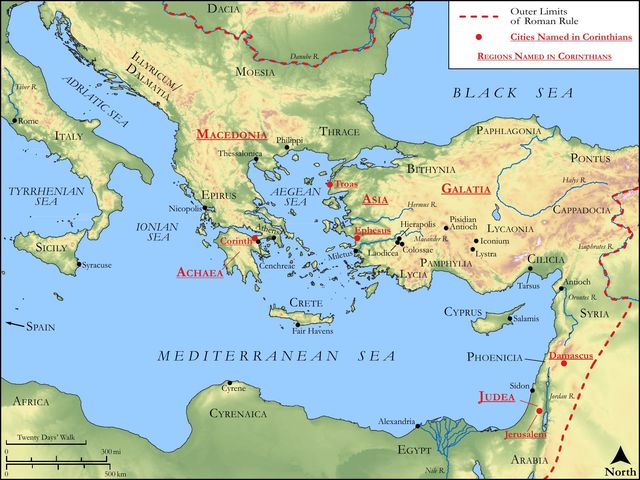
See on the biblical-era maps

Study this verse
Public-domain commentary
Matthew Henry
From his Commentary on the Whole Bible. Henry comments on passages, not single verses — this entry covers 1 Corinthians 7:10–16. His three-level outline is real structure in the source text, so it is rendered as structure.
In this paragraph the apostle gives them direction in a case which must be very frequent in that age of the world, especially among the Jewish converts; I mean whether they were to live with heathen relatives in a married state. Moses's law permitted divorce; and there was a famous instance in the Jewish state, when the people were obliged to put away their idolatrous wives, Ezr 10:3. This might move a scruple in many minds, whether converts to Christianity were not bound to put away or desert their mates, continuing infidels. Concerning this matter the apostle here gives direction. And,
I.In general, he tells them that marriage, by Christ's command, is for life; and therefore those who are married must not think of separation.
The wife must not depart from the husband (Co1 7:10), nor the husband put away his wife, Co1 7:11. This I command, says the apostle; yet not I, but the Lord. Not that he commanded any thing of his own head, or upon his own authority. Whatever he commanded was the Lord's command, dictated by his Spirit and enjoined by his authority. But his meaning is that the Lord himself, with his own mouth, had forbidden such separations, Mat 5:32; Mat 19:9; Mar 10:11; Luk 16:18. Note, Man and wife cannot separate at pleasure, nor dissolve, when they will, their matrimonial bonds and relation. They must not separate for any other cause than what Christ allows. And therefore the apostle advises that if any woman had been separated, either by a voluntary act of her own or by an act of her husband, she should continue unmarried, and seek reconciliation with her husband, that they might cohabit again. Note, Husbands and wives should not quarrel at all, or should be quickly reconciled. They are bound to each other for life. The divine law allows of no separation. They cannot throw off the burden, and therefore should set their shoulders to it, and endeavour to make it as light to each other as they can.
II.He brings the general advice home to the case of such as had an unbelieving mate (Co1 7:12):
But to the rest speak I, not the Lord; that is, the Lord had not so expressly spoken to this case as to the former divorce. It does not mean that the apostle spoke without authority from the Lord, or decided this case by his own wisdom, without the inspiration of the Holy Ghost. He closes this subject with a declaration to the contrary (Co1 7:40), I think also that I have the Spirit of God. But, having thus prefaced his advice, we may attend,
1.To the advice itself, which is that if an unbelieving husband or wife were pleased to dwell with a Christian relative, the other should not separate. The husband should not put away an unbelieving wife, nor the wife leave an unbelieving husband, Co1 7:12, Co1 7:13. The Christian calling did not dissolve the marriage covenant, but bind it the faster, by bringing it back to the original institution, limiting it to two persons, and binding them together for life. The believer is not by faith in Christ loosed from matrimonial bonds to an unbeliever, but is at once bound and made apt to be a better relative. But, though a believing wife or husband should not separate from an unbelieving mate, yet if the unbelieving relative desert the believer, and no means can reconcile to a cohabitation, in such a case a brother or sister is not in bondage (Co1 7:15), not tied up to the unreasonable humour, and bound servilely to follow or cleave to the malicious deserter, or not bound to live unmarried after all proper means for reconciliation have been tried, at least of the deserter contract another marriage or be guilty of adultery, which was a very easy supposition, because a very common instance among the heathen inhabitants of Corinth. In such a case the deserted person must be free to marry again, and it is granted on all hands. And some think that such a malicious desertion is as much a dissolution of the marriage-covenant as death itself. For how is it possible that the two shall be one flesh when the one is maliciously bent to part from or put away the other? Indeed, the deserter seems still bound by the matrimonial contract; and therefore the apostle says (Co1 7:11), If the woman depart from her husband upon the account of his infidelity, let her remain unmarried. But the deserted party seems to be left more at liberty (I mean supposing all the proper means have been used to reclaim the deserter, and other circumstances make it necessary) to marry another person. It does not seem reasonable that they should be still bound, when it is rendered impossible to perform conjugal duties or enjoy conjugal comforts, through the mere fault of their mate: in such a case marriage would be a state of servitude indeed. But, whatever liberty be indulged Christians in such a case as this, they are not allowed, for the mere infidelity of a husband or wife, to separate; but, if the unbeliever be willing, they should continue in the relation, and cohabit as those who are thus related. This is the apostle's general direction.
2.We have here the reasons of this advice.
(1.)Because the relation or state is sanctified by the holiness of either party: For the unbelieving husband is sanctified by the wife, and the unbelieving wife by the husband (Co1 7:14), or hath been sanctified. The relation itself, and the conjugal use of each other, are sanctified to the believer. To the pure all things are pure, Tit 1:15. Marriage is a divine institution; it is a compact for life, by God's appointment. Had converse and congress with unbelievers in that relation defiled the believer, or rendered him or her offensive to God, the ends of marriage would have been defeated, and the comforts of it in a manner destroyed, in the circumstances in which Christians then were. But the apostle tells them that, though they were yoked with unbelievers, yet, if they themselves were holy, marriage was to them a holy state, and marriage comforts, even with an unbelieving relative, were sanctified enjoyments. It was no more displeasing to God for them to continue to live as they did before, with their unbelieving or heathen relation, than if they had become converts together. If one of the relatives had become holy, nothing of the duties or lawful comforts of the married state could defile them, and render them displeasing to God, though the other were a heathen. He is sanctified for the wife's sake. She is sanctified for the husband's sake. Both are one flesh. He is to be reputed clean who is one flesh with her that is holy, and vice vers: Else were your children unclean, but now are they holy (Co1 7:14), that is, they would be heathen, out of the pale of the church and covenant of God. They would not be of the holy seed (as the Jews are called, Isa 6:13), but common and unclean, in the same sense as heathens in general were styled in the apostle's vision, Act 10:28. This way of speaking is according to the dialect of the Jews, among whom a child begotten by parents yet heathens, was said to be begotten out of holiness; and a child begotten by parents made proselytes was said to be begotten intra sanctitatem - within the holy enclosure. Thus Christians are called commonly saints; such they are by profession, separated to be a peculiar people of God, and as such distinguished from the world; and therefore the children born to Christians, though married to unbelievers, are not to be reckoned as part of the world, but of the church, a holy, not a common and unclean seed. "Continue therefore to live even with unbelieving relatives; for, if you are holy, the relation is so, the state is so, you may make a holy use even of an unbelieving relative, in conjugal duties, and your seed will be holy too." What a comfort is this, where both relatives are believers!
(2.)Another reason is that God hath called Christians to peace, Co1 7:15. The Christian religion obliges us to act peaceably in all relations, natural and civil. We are bound, as much as in us lies, to live peaceably with all men (Rom 12:18), and therefore surely to promote the peace and comfort of our nearest relatives, those with whom we are one flesh, nay, though they should be infidels. Note, It should be the labour and study of those who are married to make each other as easy and happy as possible.
(3.)A third reason is that it is possible for the believing relative to be an instrument of the other's salvation (Co1 7:16): What knowest thou, O wife, whether thou shalt save thy husband? Note, It is the plain duty of those in so near a relation to seek the salvation of those to whom they are related. "Do not separate. There is other duty now called for. The conjugal relation calls for the most close and endeared affection; it is a contract for life. And should a Christian desert a mate, when an opportunity offers to give the most glorious proof of love? Stay, and labour heartily for the conversion of thy relative. Endeavour to save a soul. Who knows but this may be the event? It is not impossible. And, though there be no great probability, saving a soul is so good and glorious a service that the bare possibility should put one on exerting one's self." Note, Mere possibility of success should be a sufficient motive with us to use our diligent endeavours for saving the souls of our relations. "What know I but I may save his soul? should move me to attempt it."
Historical interpretation
Two Centuries of Reception
9 surviving comments on this verse. Each one is dated, so this reads as a timeline rather than a list.
Select a marker to jump to its quote. Markers stagger vertically where authors wrote within a few decades of each other.
And for this reason, Paul declares that the "unbelieving wife is sanctified by the believing husband."
The children of believers were in some sense destined for holiness and salvation, and in the pledge of this hope Paul supported those marriages which he wished to continue.
Secondly, if, according to the Scripture, they who shall be "apprehended" by the faith in (the state of) Gentile marriage are not defiled (thereby) for this reason, that, together with themselves, others also are sanctified: without doubt, they who have been sanctified before marriage, if they commingle themselves with "strange flesh," cannot sanctify that (flesh) in (union with) which they were not "apprehended.
It was from this circumstance that the apostle said, that when either of the parents was sanctified, the children were holy; and this as much by the prerogative of the (Christian) seed as by the discipline of the institution (by baptism, and Christian education). "Else," says he, "were the children unclean" by birth: as if he meant us to understand that the children of believers were designed for holiness, and thereby for salvation; in order that he might by the pledge of such a hope give his support to matrimony, which he had determined to maintain in its integrity.
Husband and wife are one in the same way that wine and water are one when they are mixed together. Just as the believing partner sanctifies the unbelieving one, so the unbelieving partner corrupts the believing one. This is why a man who is not yet married should consider very carefully and either not marry at all or marry only in the Lord.
But if continency follows Christ, and virginity is destined for the kingdom of God, what have they to do with earthly dress, and with ornaments, wherewith while they are striving to please men they offend God? Not considering that it is declared, "They who please men are put to confusion, because God hath despised them; " and that Paul also has gloriously and sublimely uttered, "If I yet pleased men, I should not be the servant of Christ." But continence and modesty consist not alone in purity of the flesh, but also in seemliness, as well as in modesty of dress and adornment; so that, according to the apostle, she who is unmarried may be holy both in body and in spirit. Paul instructs and teaches us, saying, "He that is unmarried careth for the things of the Lord, how he may please God: but he who has contracted marriage careth for the things which are of this world, how he may please his wife. So both the virgin and the unmarried woman consider those things which are the Lord's, that they may be holy both in body and spirit." A virgin ought not only to be so, but also to be perceived and believed to be so: no one on seeing a virgin should be in any doubt as to whether she is one. Perfectness should show itself equal in all things; nor should the dress of the body discredit the good of the mind. Why should she walk out adorned? Why with dressed hair, as if she either had or sought for a husband? Rather let her dread to please if she is a virgin; and let her not invite her own risk, if she is keeping herself for better and divine things. They who have not a husband whom they profess that they please, should persevere, sound and pure not only in body, but also in spirit. For it is not right that a virgin should have her hair braided for the appearance of her beauty, or boast of her flesh and of its beauty, when she has no struggle greater than that against her flesh, and no contest more obstinate than that of conquering and subduing the body.
These unbelievers have the benefit of good will, which protects them from detesting the name of Christ.
Then lest the woman might fear, as though she became unclean because of intercourse with her husband, he says, "For the unbelieving husband is sanctified in the wife, and the unbelieving wife is sanctified in the husband." And yet, if "he that is joined to an harlot is one body," it is quite clear that the woman also who is joined to an idolater is one body. Well: it is one body; nevertheless she becomes not unclean, but the cleanness of the wife overcomes the uncleanness of the husband; and again, the cleanness of the believing husband overcomes the uncleanness of the unbelieving wife.
How then in this case is the uncleanness overcome, and therefore the intercourse allowed; while in the woman who prostitutes herself, the husband is not condemned in casting her out? Because here there is hope that the lost member may be saved through the marriage; but in the other case the marriage has already been dissolved; and there again both are corrupted; but here the fault is in one only of the two. I mean something like this: she that has been guilty of fornication is utterly abominable: if then "he that is joined to an harlot is one body," he also becomes abominable by having connection with an harlot; wherefore all the purity flits away. But in the case before us it is not so. But how? The idolater is unclean but the woman is not unclean. For if indeed she were a partner with him in that wherein he is unclean, I mean his impiety, she herself would also become unclean. But now the idolater is unclean in one way, and the wife holds communion with him in another wherein he is not unclean. For marriage and mixture of bodies is that wherein the communion consists.
Again, there is a hope that this man may be reclaimed by his wife for she is made completely his own: but for the other it is not very easy. For how will she who dishonored him in former times and became another's and destroyed the rights of marriage, have power to reclaim him whom she had wronged; him, moreover, who still remains to her as an alien?
Again in that case, after the fornication the husband is not a husband: but here, although the wife be an idolatress, the husband's rights are not destroyed.
However, he doth not simply recommend cohabitation with the unbeliever, but with the qualification that he wills it. Wherefore he said, "And he himself be content to dwell with her." For, tell me, what harm is there when the duties of piety remain unimpaired and there are good hopes about the unbeliever, that those already joined should so abide and not bring in occasions of unnecessary warfare? For the question now is not about those who have never yet come together, but about those who are already joined. He did not say, If any one wish to take an unbelieving wife, but, "If any one hath an unbelieving wife." Which means, If any after marrying or being married have received the word of godliness, and then the other party which had continued in unbelief still yearn for them to dwell together, let not the marriage be broken off. "For," saith he, "the unbelieving husband is sanctified in the wife." So great is the superabundance of thy purity.
What then, is the Greek holy? Certainly not: for he said not, He is holy; but, "He is sanctified in his wife." And this he said, not to signify that he is holy, but to deliver the woman as completely as possible from her fear and lead the man to desire the truth. For the uncleanness is not in the bodies wherein there is communion, but in the mind and the thoughts. And here follows the proof; namely, that if thou continuing unclean have offspring, the child, not being of thee alone, is of course unclean or half clean. But now it is not unclean. To which effect he adds, "else were your children unclean; but now are they holy;" that is, not unclean. But the Apostle calls them, "holy," by the intensity of the expression again casting out the dread arising from that sort of suspicion.
When the children are clean and holy, uncorrupted by unbelief, the faith of the parent has won.
Continue studying 1 Corinthians 7:14 across the web’s major study libraries — every link below opens this exact verse, chapter, or book on the destination site.
Read & Compare
 BibleGatewayThis verse in more than 200 translations and 70 languages.
 Bible.comThe YouVersion reader — hundreds of translations, reading plans, and highlights.
 ESV.orgCrossway's official English Standard Version reader.
 NET BibleThe NET translation with 60,000+ translators' notes on every rendering decision.
 STEP BibleTyndale House's free study tool — original text, vocabulary, and scholarly resources.
 BibliaLogos Bible Software's free web reader.
 USCCBThe New American Bible (Revised Edition) with the U.S. bishops' study notes.
Commentaries
 BibleHub CommentariesDozens of classic commentaries on this verse, gathered on one page.
 StudyLightMore than 100 commentary sets — the largest collection on the web.
 BibleRefPlain-English commentary on what this verse means, verse by verse.
 Enduring WordDavid Guzik's free commentary on this chapter, widely used by Bible teachers.
 Bible Study ToolsVerse commentary alongside Greek and Hebrew study aids.
Original Language & Research
- BibleHub InterlinearThe verse word by word — original language, transliteration, and English.
- BibleHub LexiconEvery word's original-language definition and Strong's entry.
 Blue Letter BibleDeep-study tools — Strong's numbers, concordance, and word studies.
 CNTR CollationThe earliest Greek manuscripts of this verse, collated letter by letter.
Sermons, Hymns & Audio


TrulyRandomVerse is not affiliated with these sites and doesn’t control their content. They’re linked because they’re genuinely useful.
Summary
In 1 Corinthians 7:14, the apostle Paul addresses a pressing concern within the early Corinthian congregation: whether a believer married to an unbeliever should dissolve the marriage for the sake of spiritual purity. Paul's answer is striking in its reassurance. Rather than commanding separation, he declares that the unbelieving spouse is "sanctified" through the believing partner, and that their children are "holy" rather than "unclean." This verse does not teach that an unbeliever is automatically saved through marriage to a Christian, but rather that the marriage itself is consecrated — set apart under God's covenant blessing — by the presence of faith in one partner. The logic moves from the lesser to the greater: if the marriage were spiritually defiling, then the children produced by it would be ritually unclean; but since the community already regards these children as holy (belonging to the covenant community), the marriage itself must carry a sanctified status. Paul thus provides pastoral comfort to anxious believers, affirming that a mixed-faith marriage is not a source of contamination but a sphere where God's grace operates, setting the stage for his broader principle that each person should remain in the situation in which God called them.
Context
ShowHideLiterary Context
This verse falls within Paul's extended discussion of marriage, singleness, and calling in 1 Corinthians 7, which itself is part of his response to specific questions the Corinthian church sent him (referenced in 1 Corinthians 7:1). Verses 12–16 form a distinct unit addressing mixed marriages — unions where one partner has come to faith after the marriage was already established. Verse 14 provides the theological rationale for why the believing spouse should not initiate divorce (the instruction given in verses 12–13), while verse 15 addresses the exception when the unbeliever chooses to leave.
Historical & Cultural Context
In first-century Corinth, a cosmopolitan Roman colony, intermarriage between people of different religious backgrounds was common. When one spouse converted to Christianity, serious questions arose about ritual purity — a concept deeply rooted in both Jewish law (see Ezra 9:1-2) and the religious practice of the Greeks and Romans. Some Corinthian believers apparently feared that continued union with a pagan spouse would defile them or their children, much as the Old Testament warned against intermarriage with idolatrous nations. Paul reframes the dynamic: rather than impurity spreading from the unbelieving spouse to the believing one, the sanctifying influence flows in the opposite direction — from faith toward the household.
Key Themes
ShowHideThe verse engages several interwoven themes: the nature of holiness as a relational and covenantal category rather than merely a moral one; the sanctifying influence of faith within the household; the status of children in the believing community; and the broader Pauline principle of remaining in one's calling. It also touches on the tension between separation from the world and engagement with it — a tension Paul addresses throughout the letter, including in his discussion of food offered to idols and being in the world but not of it.
Exposition and Analysis
ShowHidePaul's argument in this verse is both pastorally sensitive and theologically precise. He addresses the fear that a spiritually "mixed" household is inherently defiled by inverting the expected direction of influence. In Old Testament purity law, contact with the unclean typically rendered the clean unclean. But Paul, writing in the new covenant era, argues that the sanctifying power of the believing spouse's faith consecrates the household — a remarkable assertion of grace's superiority over impurity. His reasoning takes the form of a reductio ad absurdum: if the unbelieving spouse's presence truly contaminated the home, then the children of such unions would be "unclean" — a conclusion the Corinthians themselves would reject, since they evidently treated these children as members of the holy community.
Key Word Analysis
ShowHideFrom Strong's G37, derived from hágios (G40, meaning sacred, holy, consecrated). The verb means to make holy, to set apart, to consecrate. Here it does not indicate saving faith or personal regeneration in the unbeliever, but rather a positional or relational sanctification — the unbelieving spouse is set apart within a sphere of divine grace through the marriage bond. This is a covenantal-relational use of the term, akin to how Israel was holy as a nation even when individual members were unfaithful.
From Strong's G169, composed of the negative particle a- and a derivative of kathaírō (to cleanse). It means impure — whether ceremonially, morally, or in a special demonic sense (foul, unclean). Paul uses it here in a covenantal-ceremonial sense: if the marriage did not carry sanctified status, the children would be akáthartos — outside the pale of God's covenant community, belonging to the profane realm rather than the holy one.
From Strong's G571, formed from the negative particle a- and pistós (faithful, believing). It means actively disbelieving, without Christian faith — translated as faithless, infidel, or unbeliever. Paul uses this term specifically to denote a spouse who has not embraced the Christian faith, distinguishing between the spiritual status of the two partners while affirming that the marriage union itself remains valid and consecrated.
Verse Breakdown
ShowHide"For the unbelieving husband is sanctified by the wife"
Paul begins with the conjunction "for" (gar), signaling that this verse provides the theological ground for his instruction in the preceding verses not to divorce an unbelieving spouse. The unbelieving husband (anḗr ápistos, G435 + G571) is sanctified — set within a sphere of holiness — through his union with the believing wife (gynḗ, G1135). The preposition "by" (en) indicates the instrumental means: the wife's faith is the channel through which sanctification reaches the marriage.
"and the unbelieving wife is sanctified by the husband"
Paul states the reciprocal case to show that the principle operates regardless of which spouse is the believer. Whether it is the husband or the wife who has faith, the sanctifying dynamic is the same. This symmetry is notable in Paul's writing, reflecting the mutual dignity of both spouses — a point he develops further in the chapter.
"else were your children unclean"
The word "else" (epei) introduces the logical consequence of denying the premise: if the unbelieving spouse's presence rendered the marriage unholy, then the children (téknon, G5043) produced by it would necessarily be akáthartos (G169) — ceremonially and covenantally impure, outside the community of faith. Paul appeals to what the Corinthians already accept in practice as evidence for his theological claim.
"but now are they holy"
The contrasting "but now" (nyn de) pivots to the actual reality the Corinthians recognize: their children are hágios (G40) — holy, set apart, belonging to God's people. This is the proof that clinches Paul's argument. Since the community already treats these children as holy members rather than pagan outsiders, the marriage that produced them must itself be sanctified. The holiness of the children confirms the sanctified status of the mixed marriage.
Literary Devices
ShowHidePaul employs a reductio ad absurdum as his primary argumentative strategy: he presents the hypothetical consequence of the opposing view (the children would be unclean) and shows that the Corinthians themselves reject this conclusion, thereby undermining the premise. The verse also features chiastic parallelism — the unbelieving husband sanctified by the wife mirrors the unbelieving wife sanctified by the husband, creating an A-B / B-A structure that emphasizes mutual sanctification regardless of gender. Additionally, Paul uses a sharp antithesis between "unclean" (akáthartos) and "holy" (hágios), drawing on the deeply rooted Old Testament binary of clean versus unclean to redefine the categories in light of the new covenant. The rhetorical force of the argument is strengthened by appeal to common ground — Paul does not introduce a new doctrine but draws out the implications of what the Corinthians already believe and practice regarding their children.
Theological and Thematic Connections
ShowHideThis verse stands at a critical intersection of several major biblical themes. The concept of a believing individual consecrating an entire household echoes the Old Testament principle that God's covenant blessings flow through chosen individuals to their families and communities. Just as Abraham's faith brought his household into covenant relationship with God, and just as the Passover lamb's blood consecrated an entire household in Egypt, so here the believing spouse's faith extends a canopy of sanctification over the marriage and its children. This is not automatic salvation but covenantal privilege — being placed within the sphere where God's grace actively operates. The verse also connects to the broader Pauline theology of holiness as something that spreads outward rather than retreating inward, a principle that undergirds Paul's insistence that Christians should not withdraw from the world but engage it redemptively. The tension between holiness and worldly contact, which the Corinthians struggled with throughout this letter, finds its resolution in the confidence that Christ's sanctifying power is greater than the world's contaminating power.
Reflection and Application
ShowHidePaul's words to the Corinthians carry profound relevance for believers today who find themselves in spiritually mixed households — whether through a spouse's deconversion, a marriage entered before one partner came to faith, or the complex realities of family life in a pluralistic society. The verse offers neither triumphalism nor despair but a grounded, grace-saturated realism. The believing spouse is not called to force conversion, nor to flee in fear of contamination, but to remain as a faithful, sanctifying presence — trusting that God's holiness is more powerful than the world's unholiness. This principle extends beyond marriage to every sphere where Christians find themselves as minorities: the workplace, the neighborhood, the extended family. Rather than retreating into spiritual enclaves, believers are called to be agents of consecration, confident that their faith creates a sphere where God's grace can work in the lives of those around them. At the same time, this verse reminds parents of the profound spiritual significance of their role: children raised in a household where even one parent walks with God are set within a holy context, surrounded by prayer, instruction, and the living witness of faith.
Questions for Reflection
ShowHideFAQ
ShowHideDoes this verse mean that an unbelieving spouse is saved through the believing partner's faith?
ShowHideNo. The "sanctification" Paul describes here is not personal salvation or regeneration but a covenantal and relational setting apart. The unbelieving spouse is placed within the sphere of God's grace through the marriage bond, benefiting from the believing partner's prayers, witness, and the household's orientation toward God. Paul himself acknowledges in verse 16 that the salvation of the unbelieving spouse remains uncertain, which would be contradictory if verse 14 already guaranteed it. Salvation remains a matter of personal faith in Christ.
What does it mean that the children are "holy" — does this support infant baptism?
ShowHideThis verse has historically been cited in debates about infant baptism, with some traditions arguing that the children's "holy" status reflects their inclusion in the covenant community and thus their fitness for baptism. Others interpret the holiness as a general statement about the children being set apart by God's providence rather than a specific sacramental claim. What is clear from the text is that Paul regards the children of even one believing parent as belonging — in some meaningful, covenantal sense — to the community of faith rather than to the pagan world. The precise ecclesiological and sacramental implications remain a matter of interpretive tradition.
Does this verse apply to a Christian who knowingly marries an unbeliever?
ShowHidePaul's specific context addresses marriages where one partner converted after the union was already established — he is not giving permission for believers to enter into mixed marriages. Elsewhere, the principle of marrying "in the Lord" is upheld (see 1 Corinthians 7:39 and 2 Corinthians 6:14). However, if a believer does find themselves in a mixed marriage for whatever reason, the principle of verse 14 still applies: God's sanctifying grace operates through the believing spouse, and the marriage is not to be abandoned on grounds of spiritual incompatibility.
Christ-Centered Fulfillment
ShowHideThe principle at the heart of this verse — that holiness spreads outward from the consecrated to the unconsecrated rather than the reverse — finds its ultimate ground in the person and work of Jesus Christ. Throughout His earthly ministry, Jesus demonstrated that His holiness was not threatened by contact with the unclean but rather that His touch cleansed lepers (Mark 1:41), His presence sanctified sinners' homes (Luke 19:5-9), and His fellowship transformed tax collectors and prostitutes into disciples. Where the old covenant's purity system operated on the principle that impurity was contagious, Christ inaugurated a new reality in which holiness is the greater contagion. Paul's teaching in this verse flows directly from this Christological revolution: because believers are united to Christ, they carry His sanctifying presence into every relationship and sphere of life. The believing spouse in a mixed marriage is, in a real sense, an embassy of Christ's kingdom within the household — not by force or coercion, but by the quiet, persistent radiation of grace. This is why Paul can speak with such confidence about the holiness of the children and the sanctification of the unbelieving spouse: the Christ who makes all things new is at work wherever His people dwell, extending the reach of His redemptive kingdom through the ordinary means of faithful presence, love, and covenant commitment.