


1 Corinthians 7:39
- ΓυνὴGunēA wifeG1135N-NSFNoun Nominative Singular Feminine
- δέδεταιdedetaihas been boundG1210V-RPI-3SVerb Perfect Passive Indicative 3rd Singular
- νόμῳnomōto [the] lawG3551N-DSMNoun Dative Singular Masculine
- ἐφ᾽eph᾽forG1909PREPPreposition
- ὅσονhosonas long asG3745K-ASMCorrelative pronoun Accusative Singular Masculine
- χρόνονchronontimeG5550N-ASMNoun Accusative Singular Masculine
- ζῇzēamay liveG2198V-PAI-3SVerb Present Active Indicative 3rd Singular
- ὁhotheG3588T-NSMDefinite article Nominative Singular Masculine
- ἀνὴρanērhusbandG435N-NSMNoun Nominative Singular Masculine
- αὐτῆς·autēsof herG846P-GSFPersonal pronoun Genitive Singular Feminine
- ἐὰνeanifG1437CONDConjunction
- δὲdehoweverG1161CONJConjunction
- κοιμηθῇkoimēthēashall have diedG2837V-APS-3SVerb Aorist Passive Subjunctive 3rd Singular
- ὁhotheG3588T-NSMDefinite article Nominative Singular Masculine
- ἀνήρanērhusbandG435N-NSMNoun Nominative Singular Masculine
- αὐτῆςautēsof herG846P-GSFPersonal pronoun Genitive Singular Feminine
- ἐλευθέραeleutherafreeG1658A-NSFAdjective Nominative Singular Feminine
- ἐστὶνestinshe isG1510V-PAI-3SVerb Present Active Indicative 3rd Singular
- ᾧhōto whomG3739R-DSMRelative pronoun Dative Singular Masculine
- θέλειtheleishe willsG2309V-PAI-3SVerb Present Active Indicative 3rd Singular
- γαμηθῆναιgamēthēnaito be marriedG1060V-APNVerb Aorist Passive Infinitive
- μόνονmonononlyG3441A-ASNAdjective Accusative Singular Neuter
- ἐνeninG1722PREPPreposition
- κυρίῳkuriō[the] LordG2962N-DSM-TNoun Dative Singular Masculine Title
English is a literal word-by-word gloss of the Greek, not the KJV's wording. Why?
This is the original text the KJV's translators worked from — each Greek word with its own literal English meaning in this verse, prepared by scholars at Tyndale House, Cambridge. The KJV translates whole sentences, not word by word, so its wording differs: one Greek word can become several English words, and the KJV may choose “charity” where the gloss reads “love”. Both are faithful — they answer different questions. For the KJV's own rendering, switch to the KJV text.
Details
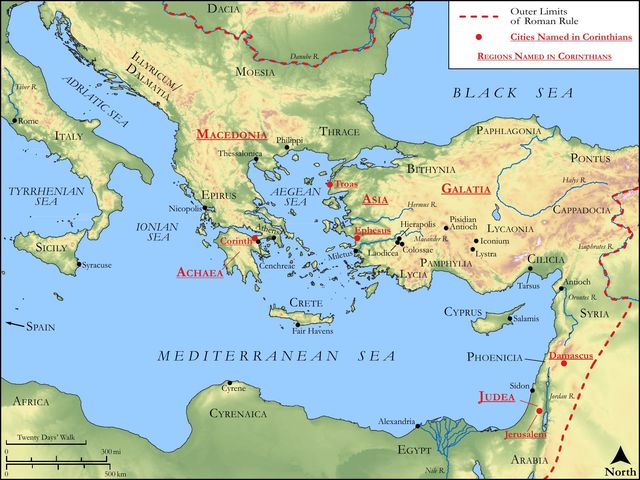
See on the biblical-era map

Study this verse
Public-domain commentary
Matthew Henry
From his Commentary on the Whole Bible. Henry comments on passages, not single verses — this entry covers 1 Corinthians 7:39–40.
The whole is here closed up with advice to widows: As long as the husband liveth the wife is bound by the law, confined to one husband, and bound to continue and cohabit with him. Note, The marriage - contract is for life; death only can annul the bond. But, the husband being dead, she is at liberty to marry whom she will. There is no limitation by God's law to be married only for such a number of times. It is certain, from this passage, that second marriages are not unlawful; for then the widow could not be at liberty to marry whom she pleased, nor to marry a second time at all. But the apostle asserts she has such a liberty, when her husband is dead, only with a limitation that she marry in the Lord. In our choice of relations, and change of conditions, we should always have an eye to God. Note, Marriages are likely to have God's blessing only when they are made in the Lord, when persons are guided by the fear of God, and the laws of God, and act in dependence on the providence of God, in the change and choice of a mate - when they can look up to God, and sincerely seek his direction, and humbly hope for his blessing upon their conduct. But she is happier, says the apostle, if she so abide (that is, continue a widow) in my judgment; and I think I have the Spirit of God, Co1 7:40. At this juncture, at least, if not ordinarily, it will be much more for the peace and quiet of such, and give them less hindrance in the service of God, to continue unmarried. And this, he tells them, was by inspiration of the Spirit. "Whatever your false apostles may think of me, I think, and have reason to know, that I have the Spirit of God." Note, Change of condition in marriage is so important a matter that it ought not to be made but upon due deliberation, after careful consideration of circumstances, and upon very probable grounds, at least, that it will be a change to advantage in our spiritual concerns.
Historical interpretation
Three Centuries of Reception
12 surviving comments on this verse. Each one is dated, so this reads as a timeline rather than a list.
Select a marker to jump to its quote. Markers stagger vertically where authors wrote within a few decades of each other.
And I said, "If a wife or husband die, and the widower or widow marry, does he or she commit sin?" "There is no sin in marrying again," said he; "but if they remain unmarried, they gain greater honour and glory with the Lord; but if they marry, they do not sin."
Further, if we set down in order the higher and happier grades of bodily patience, (we find that)it is she who is entrusted by holiness with the care of continence of the flesh: she keeps the widow, and sets on the virgin the seal and raises the self-made eunuch to the realms of heaven.
You ought to take more pains to please him for whose sake you have not preferred to please God! Such (conduct) the Psychics will have it the apostle approved, or else totally failed to think about, when he wrote: "The woman is bound for such length of time as her husband liveth; but if he shall have died, she is free; whom she will let her marry, only in the Lord." For it is out of this passage that they draw their defence of the licence of second marriage; nay, even of (marriages) to any amount, if of second (marriage): for that which has ceased to be once for all, is open to any and every number.
You degrade your god, O Marcion, when you make him circumscribed at all by the Creator's time. Assuredly also, when (the apostle) rules that marriage should be "only in the Lord," that no Christian should intermarry with a heathen, he maintains a law of the Creator, who everywhere prohibits marriage with strangers.
Let us now turn our attention to the next best advice, in regard of human infirmity; admonished hereto by the examples of certain, who, when an opportunity for the practice of Continence has been offered them, by divorce, or by the decease of the husband, have not only thrown away the opportunity of attaining so great a good, but not even in their remarriage have chosen to be mindful of the rule that "above all they marry in the Lord.
You have the law from the patriarchs indeed; you have the apostle enjoining people to marry in the Lord. You have a crowning also on the making of a freeman; but you have been already ransomed by Christ, and that at a great price.
But in as far as marrying "in the Lord" is permissible, as being within our power, so far more culpable is it not to observe that which you can observe. Add to this the fact that the apostle, with regard to widows and the unmarried, advises them to remain permanently in that state, when he says, "But I desire all to persevere in (imitation of) my example: " but touching marrying "in the Lord," he no longer advises, but plainly bids. Therefore in this case especially, if we do not obey, we run a risk, because one may with more impunity neglect an "advice" than an "order; "in that the former springs from counsel, and is proposed to the will (for acceptance or rejection): the other descends from authority, and is bound to necessity. In the former case, to disregard appears liberty, in the latter, contumacy.
But it is Gentiles who "are called," I take it, not believers. But if he had been pronouncing absolutely, (in the words under discussion,) touching the marriage of believers merely, (then) had he (virtually) given to saints a permission to marry promiscuously. If, however, he had given such a permission, he would never have subjoined a declaration so diverse from and contrary to his own permission, saying: "The woman, when her husband is dead, is free: let her marry whom. she wishes, only in the Lord." Here, at all events, there is no need for reconsidering; for what there might have been reconsideration about, the Spirit has oracularly declared.
Again, the woman, if intending to marry, has to marry "in the Lord; " that is, not to an heathen, but to a brother, inasmuch as even the ancient law forbids marriage with members of another tribe.
That marriage is not to be contracted with Gentiles. In Tobias: "Take a wife from the seed of thy parents, and take not a strange woman who is not of the tribe of thy parents." Also in Genesis, Abraham sends his servant to take from his seed Rebecca, for his son Isaac. Also in Esdras, it was not sufficient for God when the Jews were laid waste, unless they forsook their foreign wives, with the children also whom they had begotten of them. Also in the first Epistle of Paul to the Corinthians: "The woman is bound so long as her husband liveth; but if he die, she is freed to marry whom she will, only in the Lord. But she will be happier if she abide thus." And again: "Know ye not that your bodies are the members of Christ? Shall I take the members of Christ, and make them the members of an harlot? Far be it from me. Or know ye not that he who is joined together with an harlot is one body? for two shall be in one flesh. But he who is joined to the Lord is one spirit." Also in the second to the Corinthians: "Be not joined together with unbelievers. For what participation is there between righteousness and unrighteousness? or what communication hath light with darkness? " Also concerning Solomon in the third book of Kings: "And foreign wives turned away his heart after their gods."
Paul writes this in order to make it clear that a woman who has been rejected by her husband is not free to marry again. If he should die, then she may remarry, but only in the Lord, which means without any suspicion of wrongdoing and within the bounds of the church.
The death referred to here is clearly the death of the body, not of the soul. Forgiveness and attempts at reconciliation of the offending person are offered as better solutions than divorce.
Continue studying 1 Corinthians 7:39 across the web’s major study libraries — every link below opens this exact verse, chapter, or book on the destination site.
Read & Compare
 BibleGatewayThis verse in more than 200 translations and 70 languages.
 Bible.comThe YouVersion reader — hundreds of translations, reading plans, and highlights.
 ESV.orgCrossway's official English Standard Version reader.
 NET BibleThe NET translation with 60,000+ translators' notes on every rendering decision.
 STEP BibleTyndale House's free study tool — original text, vocabulary, and scholarly resources.
 BibliaLogos Bible Software's free web reader.
 USCCBThe New American Bible (Revised Edition) with the U.S. bishops' study notes.
Commentaries
 BibleHub CommentariesDozens of classic commentaries on this verse, gathered on one page.
 StudyLightMore than 100 commentary sets — the largest collection on the web.
 BibleRefPlain-English commentary on what this verse means, verse by verse.
 Enduring WordDavid Guzik's free commentary on this chapter, widely used by Bible teachers.
 Bible Study ToolsVerse commentary alongside Greek and Hebrew study aids.
Original Language & Research
- BibleHub InterlinearThe verse word by word — original language, transliteration, and English.
- BibleHub LexiconEvery word's original-language definition and Strong's entry.
 Blue Letter BibleDeep-study tools — Strong's numbers, concordance, and word studies.
 CNTR CollationThe earliest Greek manuscripts of this verse, collated letter by letter.
Sermons, Hymns & Audio


TrulyRandomVerse is not affiliated with these sites and doesn’t control their content. They’re linked because they’re genuinely useful.
Summary
1 Corinthians 7:39 provides specific guidance from the Apostle Paul regarding the remarriage of a widow. It affirms that a wife is bound to her husband by the law as long as he lives, but upon his death, she is at liberty to remarry. Crucially, Paul stipulates that any subsequent marriage for a believer must be "in the Lord," emphasizing the necessity of spiritual compatibility and shared faith as the foundation for a God-honoring union.
Context
ShowHideLiterary Context
This verse serves as the concluding statement in a significant section of Paul's first letter to the Corinthian church, specifically 1 Corinthians 7. Throughout this chapter, Paul addresses various questions concerning marriage, singleness, divorce, and sexual ethics, often in light of the "present distress" (likely persecution or the urgency of the gospel mission). He provides nuanced advice for different relational statuses, aiming to guide believers toward choices that honor God and facilitate their devotion to Christ. Verse 39 builds directly on the principles of marital fidelity and the permanence of the marriage covenant established earlier in the chapter, offering a clear directive for widows, distinguishing their situation from those contemplating divorce.
Historical & Cultural Context
In the Greco-Roman world of Corinth, societal norms regarding marriage and divorce varied. While Roman law allowed for relatively easy divorce, Jewish tradition, and by extension, early Christian teaching, held a higher view of marital permanence. Widows in ancient societies often faced significant social and economic vulnerability, making remarriage a practical necessity for some. Paul's counsel here is both compassionate and counter-cultural. He grants freedom for remarriage, which was culturally accepted, but places a distinct Christian qualification on it, distinguishing believers' choices from those of the surrounding pagan society. This "only in the Lord" principle would have been a radical departure from common practice, where social status, wealth, or family alliances often dictated marital choices.
Key Themes
ShowHide1 Corinthians 7:39 contributes significantly to several overarching themes within the chapter and Paul's broader theology. First, it underscores the sanctity and permanence of the marriage covenant, affirming it as a lifelong bond dissolved only by death, a principle echoed by Jesus in Matthew 19:6. Second, it highlights the freedom of believers in Christ, demonstrating that while the initial marital bond is binding, death releases one from that specific legal and spiritual obligation, granting liberty to remarry. Third, and most profoundly, it emphasizes the paramount importance of spiritual compatibility in Christian marriage. The phrase "only in the Lord" establishes a non-negotiable standard for believers, ensuring that their most intimate human relationship is aligned with their ultimate devotion to God. This principle is foundational to avoiding the spiritual pitfalls of being unequally yoked with unbelievers, a concept Paul elaborates on elsewhere.
Exposition and Analysis
ShowHideKey Word Analysis
ShowHideThis word signifies being tied, fastened, or obligated. In the context of marriage, it denotes a legal and moral obligation, emphasizing the unbreakable nature of the marital covenant as long as both parties are alive. It implies a divinely ordained bond that carries specific duties and responsibilities.
Meaning "unrestrained (to go at pleasure)," this term conveys freedom from obligation or liability. When applied to a widow, it signifies that the death of her husband dissolves the previous bond, freeing her from its constraints and allowing her to choose remarriage without legal or moral impediment from the former union.
This term refers to one who is supreme in authority, a controller, or Master. In the New Testament, it is consistently used to refer to Jesus Christ. Thus, to marry "in the Lord" means to marry someone who acknowledges Jesus as their supreme authority and Master, living under His Lordship and according to His will.
Verse Breakdown
ShowHide"The wife is bound by the law as long as her husband liveth"
This clause establishes the foundational principle of marital permanence. The marriage covenant, understood as a legal and divine bond, remains in effect for the duration of both spouses' lives. It underscores the serious, lifelong commitment inherent in Christian marriage, reflecting God's original design for a permanent union.
"but if her husband be dead, she is at liberty to be married to whom she will"
This segment articulates the specific condition under which the marital bond is dissolved: the death of one spouse. Upon the husband's death, the wife is released from her previous obligation and gains the freedom to remarry. Paul grants this liberty without specifying any particular person, allowing for personal choice in selecting a new spouse.
"only in the Lord"
This is the crucial qualification and the theological heart of the verse. While a widow is free to remarry, her choice is not unfettered. For a Christian, remarriage must occur within the sphere of Christian faith and community. This implies marrying another genuine believer who shares a common commitment to Jesus Christ as Lord, ensuring spiritual unity and alignment in the new partnership.
Literary Devices
ShowHidePaul employs several literary devices to convey his message with clarity and authority. The primary device is Legal Language, evident in phrases like "bound by the law" and "at liberty," which frame marriage as a legally recognized and divinely sanctioned institution with specific parameters for its beginning and end. This legalistic phrasing lends weight and authority to Paul's instruction. Furthermore, there is a clear use of Contrast between the "bound" state during the husband's life and the "at liberty" state after his death, highlighting the transformative power of death in dissolving the marital covenant. Finally, the verse concludes with a strong Stipulation or Admonition in the phrase "only in the Lord." This short, emphatic phrase acts as a non-negotiable condition, underscoring its critical importance and serving as a concise summary of Christian marital ethics.
Theological and Thematic Connections
ShowHide1 Corinthians 7:39 encapsulates profound theological truths about marriage, liberty, and the nature of Christian fellowship. It affirms that marriage, while a human institution, operates under divine law, reflecting God's design for covenantal faithfulness. The dissolution of this bond by death is not a failure but a natural end, after which God grants freedom. However, this freedom is not absolute license but is circumscribed by one's identity "in the Lord." This principle elevates marriage beyond mere social arrangement to a spiritual partnership, where shared faith in Christ is paramount. It suggests that the deepest unity in marriage is spiritual, enabling spouses to pursue God's purposes together, reflecting the ultimate union between Christ and His Church.
Reflection and Application
ShowHideFor believers today, 1 Corinthians 7:39 offers timeless and practical wisdom concerning marriage and remarriage. It provides compassionate affirmation for widows and widowers, assuring them of their biblical freedom to remarry after the death of a spouse, alleviating any potential guilt or confusion. More broadly, the directive "only in the Lord" serves as a foundational principle for all Christians contemplating marriage. It calls for intentionality in seeking a spouse who not only professes faith but genuinely lives "in the Lord"—someone who shares a deep commitment to Christ, aligns with biblical values, and is pursuing spiritual growth. This ensures that the marriage will be a partnership in faith, capable of glorifying God, fostering spiritual maturity in both individuals, and providing a unified foundation for raising a family in the Christian tradition. It reminds us that our most intimate relationships should always reflect our ultimate allegiance to Christ.
Questions for Reflection
ShowHideFAQ
ShowHideQuestion? Is "in the Lord" just about being a Christian?
ShowHideWhile a foundational requirement, "in the Lord" implies more than just a nominal profession of faith or church attendance. It refers to a genuine, active, and transformative relationship with Jesus Christ as Lord. It suggests that the individual's life is characterized by submission to Christ's authority, a pursuit of holiness, and a commitment to God's will. Therefore, marrying "in the Lord" means choosing a spouse who shares not only the same theological beliefs but also the same spiritual direction, values, and ultimate purpose in life, which is to glorify God.
Question? Does this verse apply to divorce and remarriage after divorce?
ShowHideThis specific verse (1 Corinthians 7:39) directly addresses remarriage after the death of a spouse, explicitly stating that death dissolves the marital bond. Paul discusses divorce and remarriage for other circumstances earlier in 1 Corinthians 7, particularly in verses 10-16. While the "only in the Lord" principle is universally applicable to believers entering marriage, the conditions for divorce and subsequent remarriage in the church are complex and debated, and this verse itself does not directly address those situations.
Christ-Centered Fulfillment
ShowHide1 Corinthians 7:39, while addressing practical marital matters, implicitly points to the profound Christ-centered realities of the believer's life. The concept of being "bound by the law" until death foreshadows our spiritual state before Christ: we were "bound" to sin and the law, but through Christ's death and resurrection, we have died to that old covenant and are now "at liberty" to be married to another—namely, to Christ Himself, that we might bear fruit for God, as articulated in Romans 7:4. Our freedom in Christ, a central theme in Paul's theology (e.g., Galatians 5:1), is the ultimate liberation that enables all other righteous choices, including marriage. The crucial stipulation "only in the Lord" thus becomes a reflection of the ultimate spiritual union: the Church's exclusive devotion to Christ, her heavenly Bridegroom. Earthly marriage, particularly when lived "in the Lord," serves as a profound mystery, a living parable that points to the unparalleled, eternal covenant relationship between Christ and His Church, culminating in the joyous anticipation of the marriage supper of the Lamb.