


2 Corinthians 6:16
Bible text: King James Version (1769 Blayney text) · Public domain
Bible text: King James Version with Strong's numbers · Public domain
Bible text: Berean Standard Bible · Public domain
Bible text: American Standard Version (1901) · Public domain
Bible text: World English Bible, Messianic edition · Public domain
Bible text: Geneva Bible (1599) · Public domain
Bible text: Young's Literal Translation · Public domain
- τίςtisWhatG5101I-NSFInterrogative pronoun Nominative Singular Feminine
- δὲdenowG1161CONJConjunction
- συγκατάθεσιςsugkatathesisagreementG4783N-NSFNoun Nominative Singular Feminine
- ναῷnaō[the] templeG3485N-DSMNoun Dative Singular Masculine
- θεοῦtheouof GodG2316N-GSM-TNoun Genitive Singular Masculine Title
- μετὰmetawithG3326PREPPreposition
- εἰδώλων;eidōlōnidols?G1497N-GPNNoun Genitive Plural Neuter
- ἡμεῖςhēmeisWe ourselvesG3165P-1NPPersonal pronoun Nominative 1st Plural
- γὰρgarforG1063CONJConjunction
- ναὸςnaos[the] templeG3485N-NSMNoun Nominative Singular Masculine
- θεοῦtheouof GodG2316N-GSM-TNoun Genitive Singular Masculine Title
- ἐσμενesmenwe areG1510V-PAI-1PVerb Present Active Indicative 1st Plural
- ζῶντοςzōntos[the] livingG2198V-PAP-GSMVerb Present Active Participle Genitive Singular Masculine
- καθὼςkathōseven asG2531CONJConjunction
- εἶπενeipenhas saidG2036V-2AAI-3SVerb 2nd Aorist Active Indicative 3rd Singular
- ὁho<the>G3588T-NSMDefinite article Nominative Singular Masculine
- θεὸςtheosGodG2316N-NSM-TNoun Nominative Singular Masculine Title
- ὅτιhotithatG3754CONJConjunction
- ἐνοικήσωenoikēsōI will dwellG1774V-FAI-1SVerb Future Active Indicative 1st Singular
- ἐνeninG1722PREPPreposition
- αὐτοῖςautoisthemG846P-DPMPersonal pronoun Dative Plural Masculine
- καὶkaiandG2532CONJConjunction
- ἐμπεριπατήσωemperipatēsōwill walk among [them]G1704V-FAI-1SVerb Future Active Indicative 1st Singular
- καὶkaiandG2532CONJConjunction
- ἔσομαιesomaiI will beG1510V-FDI-1SVerb Future Middle Deponent Indicative 1st Singular
- αὐτῶνautōntheirG846P-GPMPersonal pronoun Genitive Plural Masculine
- θεὸςtheosGodG2316N-NSM-TNoun Nominative Singular Masculine Title
- καὶkaiandG2532CONJConjunction
- αὐτοὶautoithey themselvesG846P-NPMPersonal pronoun Nominative Plural Masculine
- ἔσονταίesontaiwill beG1510V-FDI-3PVerb Future Middle Deponent Indicative 3rd Plural
- μουmouto MeG3165P-1GSPersonal pronoun Genitive 1st Singular
- λαόςlaosa peopleG2992N-NSMNoun Nominative Singular Masculine
English is a literal word-by-word gloss of the Greek, not the KJV's wording. Why?
This is the original text the KJV's translators worked from — each Greek word with its own literal English meaning in this verse, prepared by scholars at Tyndale House, Cambridge. The KJV translates whole sentences, not word by word, so its wording differs: one Greek word can become several English words, and the KJV may choose “charity” where the gloss reads “love”. Both are faithful — they answer different questions. For the KJV's own rendering, switch to the KJV text.
Details
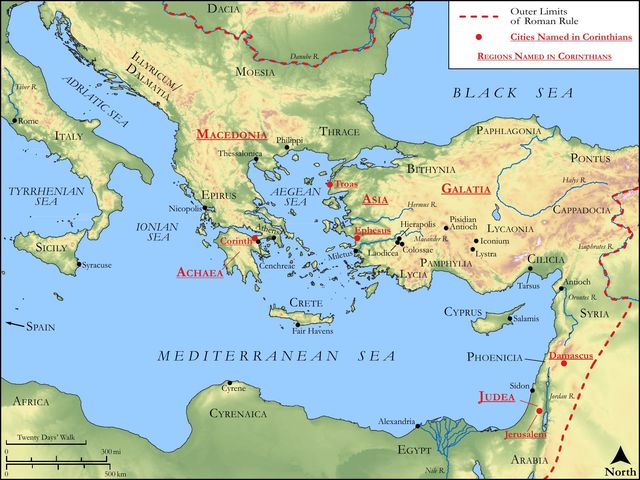
See on the biblical-era maps

Study this verse
Public-domain commentary
Matthew Henry
From his Commentary on the Whole Bible. Henry comments on passages, not single verses — this entry covers 2 Corinthians 6:11–18. His three-level outline is real structure in the source text, so it is rendered as structure.
The apostle proceeds to address himself more particularly to the Corinthians, and cautions them against mingling with unbelievers. Here observe,
I.How the caution is introduced with a profession, in a very pathetic manner, of the most tender affection to them, even like that of a father to his children, Co2 6:11-13. Though the apostle was happy in a great fluency of expressions, yet he seemed to want words to express the warm affections he had for these Corinthians. As if he had said, "O ye Corinthians, to whom I am now writing, I would fain convince you how well I love you: we are desirous to promote the spiritual and eternal welfare of all to whom we preach, yet our mouth is open unto you, and our heart is enlarged unto you, in a special manner." And, because his heart was thus enlarged with love to them, therefore he opened his mouth so freely to them in kind admonitions and exhortations: "You are not," says he, "straitened in us; we would gladly do you all the service we can, and promote your comfort, as helpers of your faith and your joy; and, if it be otherwise, the fault is in yourselves; it is because you are straitened in yourselves, and fail in suitable returns to us, through some misapprehensions concerning us; and all we desire as a recompense is only that you would be proportionably affected towards us, as children should love their father." Note, It is desirable that there should be a mutual good affection between ministers and their people, and this would greatly tend to their mutual comfort and advantage.
II.The caution or exhortation itself, not to mingle with unbelievers, not to be unequally yoked with them, Co2 6:14. Either,
1.In stated relations. It is wrong for good people to join in affinity with the wicked and profane; these will draw different ways, and that will be galling and grievous. Those relations that are our choice must be chosen by rule; and it is good for those who are themselves the children of God to join with those who are so likewise; for there is more danger that the bad will damage the good than hope that the good will benefit the bad.
2.In common conversation. We should not yoke ourselves in friendship and acquaintance with wicked men and unbelievers. Though we cannot wholly avoid seeing, and hearing, and being with such, yet we should never choose them for our bosom-friends.
3.Much less should we join in religious communion with them; we must not join with them in their idolatrous services, nor concur with them in their false worship, nor any abominations; we must not confound together the table of the Lord and the table of devils, the house of God and the house of Rimmon. The apostle gives several good reasons against this corrupt mixture.
(1.)It is a very great absurdity, Co2 6:14, Co2 6:15. It is an unequal yoking of things together that will not agree together; as bad as for the Jews to have ploughed with an ox and an ass or to have sown divers sorts of grain intermixed. What an absurdity is it to think of joining righteousness and unrighteousness, or mingling light and darkness, fire and water, together! Believers are, and should be, righteous; but unbelievers are unrighteous. Believers are made light in the Lord, but unbelievers are in darkness; and what comfortable communion can these have together? Christ and Belial are contrary one to the other; they have opposite interests and designs, so that it is impossible there should be any concord or agreement between them. It is absurd, therefore, to think of enlisting under both; and, if the believer has part with an infidel, he does what in him lies to bring Christ and Belial together.
(2.)It is a dishonour to the Christian's profession (Co2 6:16); for Christians are by profession, and should be in reality, the temples of the living God - dedicated to, and employed for, the service of God, who has promised to reside in them, to dwell and walk in them, to stand in a special relation to them, and take a special care of them, that he will be their God and they shall be his people. Now there can be no agreement between the temple of God and idols. Idols are rivals with God for his honour, and God is a jealous God, and will not give his glory to another.
(3.)There is a great deal of danger in communicating with unbelievers and idolators, danger of being defiled and of being rejected; therefore the exhortation is (Co2 6:17) to come out from among them, and keep at a due distance, to be separate, as one would avoid the society of those who have the leprosy or the plague, for fear of taking infection, and not to touch the unclean thing, lest we be defiled. Who can touch pitch, and not be defiled by it? We must take care not to defile ourselves by converse with those who defile themselves with sin; so is the will of God, as we ever hope to be received, and not rejected, by him.
(4.)It is base ingratitude to God for all the favours he has bestowed upon believers and promised to them, Co2 6:18. God has promised to be a Father to them, and that they shall be his sons and his daughters; and is there a greater honour or happiness than this? How ungrateful a thing then must it be if those who have this dignity and felicity should degrade and debase themselves by mingling with unbelievers! Do we thus requite the Lord, O foolish and unwise?
Historical interpretation
Two Centuries of Reception
7 surviving comments on this verse. Each one is dated, so this reads as a timeline rather than a list.
Select a marker to jump to its quote. Markers stagger vertically where authors wrote within a few decades of each other.
"We are God's temples; as the prophet said, I will dwell among them and walk among them, and I will be their God, and they shall be my people," if our behaviour conforms to the commandments both as individuals and also as a society, as the Church. "Wherefore come out from among them and be separate, saith the Lord, and touch not the unclean thing, and I will receive you and be to you a Father, and you shall be my sons and daughters, saith the Lord Almighty." He prophetically commands us to be separate not from those who are married, as they assert, but from the heathen who are still living in immorality, and also from the heretics we have mentioned, as unclean and godless persons.
In Platonic phrase, indeed, the body is a prison, but in the apostle's it is "the temple of God," because it is in Christ.
For He saith, That I will dwell in you, and will walk in (you), and will be their God, and they shall be to Me a people. Wherefore depart from the midst of them, be separate, and touch not the unclean.' This (thread of discourse) also you spin out, O apostle, when at the very moment you yourself are offering your hand to so huge a whirlpool of impurities; nay, you superadd yet further, 'Having therefore this promise, beloved, cleanse we ourselves out from every defilement of flesh and spirit, perfecting chastity in God's fear.
Es in His law day and night; strengthen them in piety, unite them to and number them with His holy flock; vouchsafe them the layer of regeneration, and the garment of in corruption, which is the true life; and deliver them from all ungodliness, and give no place to the adversary against them; "and cleanse them from all filthiness of flesh and spirit, and dwell in them, and walk in them, by His Christ; bless their goings out and their comings in, and order their affairs for their good."
It is obvious that the things Paul lists are opposites and that we are to flee from the ones and cling to the others. No one can serve two masters. Christ has proclaimed that we should go away from the devil, who wants to represent himself falsely as God. He has promised us eternal life, so we should be strangers to the treachery and wrong-headedness of unbelievers. He has forbidden the worship of idols because they are incompatible with the temple of God. We are temples of the living God. There is nothing more damaging to us than idols, because they tempt us to depart from our faith in the one true God.
The Dignity For Which We Are Made
“Know to what extent the Creator has honoured you [the human being] above all the rest of creation. The sky is not an image of God, nor is the moon, nor the sun, nor the beauty of the stars, nor anything of what can be seen in creation. You alone have been made the image of the Reality that transcends all understanding, the likeness of imperishable beauty, the imprint of true Divinity, the recipient of beatitude, the seal of the true light. When you turn to Him you become that which He is Himself… There is nothing so great among beings that it can be compared with your greatness. God is able to measure the whole Heaven with His span. The earth and sea are enclosed in the hollow of His hand. And although He is so great and holds all creation in the palm of His hand, you are able to hold Him, He dwells in you and moves within you without constraint, for He has said, ‘I will live and move among them’ (2 Corinthians 6:16).” - "Second Homily on the Song of Songs (PG 44,765)"
"What agreement hath a temple of God with idols? For ye are a temple of the living God."
Now what he says is this. Neither hath your King aught in common with him, "for what concord hath Christ with Beliar?" nor have the things [aught in common'], "for what communion hath light with darkness?" Therefore neither should ye. And first he mentions their king and then themselves; by this separating them most effectually. Then having said, "a temple of God with idols," and having declared, "For ye are a temple of the living God," he is necessitated to subjoin also the testimony of this to show that the thing is no flattery. For he that praises except he also exhibit proof, even appears to flatter. What then is his testimony? For,
"I will dwell in them, saith he, "and walk in them. I will dwell in," as in temples, "and walk in them," signifying the more abundant attachment to them.
"And they shall be my people and I will be their God." 'What?' saith he, 'Dost thou bear God within thee, and runnest unto them? God That hath nothing in common with them? And in what can this deserve forgiveness? Bear in mind Who walketh, Who dwelleth in thee.'
Continue studying 2 Corinthians 6:16 across the web’s major study libraries — every link below opens this exact verse, chapter, or book on the destination site.
Read & Compare
 BibleGatewayThis verse in more than 200 translations and 70 languages.
 Bible.comThe YouVersion reader — hundreds of translations, reading plans, and highlights.
 ESV.orgCrossway's official English Standard Version reader.
 NET BibleThe NET translation with 60,000+ translators' notes on every rendering decision.
 STEP BibleTyndale House's free study tool — original text, vocabulary, and scholarly resources.
 BibliaLogos Bible Software's free web reader.
 USCCBThe New American Bible (Revised Edition) with the U.S. bishops' study notes.
Commentaries
 BibleHub CommentariesDozens of classic commentaries on this verse, gathered on one page.
 StudyLightMore than 100 commentary sets — the largest collection on the web.
 BibleRefPlain-English commentary on what this verse means, verse by verse.
 Enduring WordDavid Guzik's free commentary on this chapter, widely used by Bible teachers.
 Bible Study ToolsVerse commentary alongside Greek and Hebrew study aids.
Original Language & Research
- BibleHub InterlinearThe verse word by word — original language, transliteration, and English.
- BibleHub LexiconEvery word's original-language definition and Strong's entry.
 Blue Letter BibleDeep-study tools — Strong's numbers, concordance, and word studies.
 CNTR CollationThe earliest Greek manuscripts of this verse, collated letter by letter.
Sermons, Hymns & Audio


TrulyRandomVerse is not affiliated with these sites and doesn’t control their content. They’re linked because they’re genuinely useful.
Summary
Second Corinthians 6:16 profoundly declares the sacred identity of believers as the very dwelling place of the living God, drawing a stark contrast between this divine indwelling and any association with idols. Paul's rhetorical question underscores the absolute incompatibility of God's holy presence with anything that defiles, urging the Corinthian church to live in a manner consistent with their unique status as His spiritual temple, where He desires to dwell and walk among His people, fulfilling His ancient covenant promise.
Context
ShowHideLiterary Context
This verse serves as the powerful culmination of Paul's impassioned plea for separation and holiness, beginning in 2 Corinthians 6:14. The preceding verses (6:14-15) present a series of rhetorical questions, each highlighting the irreconcilable differences between opposing spiritual realities: righteousness and lawlessness, light and darkness, Christ and Belial, a believer and an unbeliever. These questions build a logical and theological case for why believers cannot be "yoked together" with unbelievers in ways that compromise their faith or purity. Verse 16 directly answers the implicit question raised by these contrasts, revealing the foundational reason for such separation: believers are the temple of God, and therefore, God's dwelling place cannot coexist with idols or unholy practices. This entire section (6:14-7:1) functions as a cohesive unit, transitioning from a call for spiritual separation to a renewed emphasis on sanctification, culminating in the exhortation to "cleanse ourselves from every defilement of body and spirit, bringing holiness to completion in the fear of God" (2 Corinthians 7:1).
Historical & Cultural Context
The Corinthian church existed within a vibrant and often morally lax Roman port city, renowned for its diverse religious cults, philosophical schools, and prevalent idolatry, including the worship of gods like Aphrodite, Apollo, and Poseidon. Participation in civic life often involved attendance at pagan festivals, which frequently included idol sacrifices and associated immoral behaviors. Believers faced immense pressure to conform to these cultural norms, making Paul's strong admonition against "agreement with idols" critically relevant. The concept of a "temple" was deeply ingrained in their society, representing a sacred space dedicated to a deity. By declaring the believers themselves as the "temple of the living God," Paul was reorienting their understanding of sacred space and divine presence from physical structures to the community of faith, challenging them to embody holiness in a pagan environment. This context explains the urgency and directness of Paul's appeal for spiritual purity and distinctiveness.
Key Themes
ShowHideThe central theme in 2 Corinthians 6:16 is the Believer as God's Temple, a profound theological truth that shifts the locus of God's dwelling from a physical building (like the Jerusalem Temple or pagan shrines) to His people. This theme is foundational to Paul's theology, also articulated in 1 Corinthians 3:16 (the corporate church as God's temple) and 1 Corinthians 6:19 (the individual body as the Holy Spirit's temple). This identity demands Incompatibility of God and Idols, emphasizing that the worship of the one true "living God" cannot coexist with the worship of false gods or any form of spiritual compromise. The rhetorical question "what agreement hath the temple of God with idols?" powerfully conveys this absolute antithesis. Furthermore, the verse highlights God's Indwelling Presence, as it explicitly quotes Old Testament promises from Leviticus 26:12 and Ezekiel 37:27, where God declares His intention to "dwell in them, and walk in [them]." This signifies God's desire for intimate fellowship and active presence among His people. Finally, the concluding phrase, "and I will be their God, and they shall be my people," reaffirms the Covenant Relationship between God and His chosen ones, a promise of ownership, protection, and reciprocal loyalty that defines the identity of believers throughout salvation history.
Exposition and Analysis
ShowHideKey Word Analysis
ShowHideThis term refers specifically to the inner sanctuary of a temple, the holiest part where the deity was believed to reside, as opposed to the broader temple complex (hieron). Paul's use of naós here underscores the profound sacredness and intimacy of believers' relationship with God, implying that God's very presence dwells within them, making them a consecrated space.
Derived from a word meaning "image" or "phantom," eídōlon denotes an object of worship that is not the true God. It encompasses not only physical statues but also anything that usurps God's rightful place in one's life or devotion. Paul uses this term to represent the antithesis of the living God, emphasizing the complete spiritual opposition between divine truth and false worship.
This compound verb, meaning "to inhabit" or "to live in," emphasizes a permanent, indwelling presence. It signifies God's active and continuous residence within believers, transforming them into His spiritual habitation. This is not a temporary visit but a settled, intimate presence, reflecting a covenant relationship.
Verse Breakdown
ShowHide"And what agreement hath the temple of God with idols?"
This is a powerful rhetorical question that serves as the climax of Paul's preceding series of contrasts. It implies an absolute impossibility: there can be no common ground, harmony, or shared purpose between the sacred dwelling place of the one true God and the empty, defiling presence of false gods or anything that competes for ultimate allegiance. The question highlights the inherent spiritual and moral incompatibility.
"for ye are the temple of the living God;"
This clause provides the foundational reason for the incompatibility stated in the preceding question. It shifts from the abstract concept of "the temple of God" to the concrete reality of the Corinthian believers themselves. The term "living God" contrasts sharply with the lifelessness of idols, emphasizing God's active, dynamic, and life-giving presence among His people. This declaration establishes the believers' new identity and sacred status.
"as God hath said, I will dwell in them, and walk in [them];"
Paul grounds this profound truth in the Old Testament, quoting from passages like Leviticus 26:12 and Ezekiel 37:27. This demonstrates that God's desire to indwell His people is not a new concept but a fulfillment of ancient covenant promises. "Dwell in them" (enoikeō) signifies a permanent residence, while "walk in them" (emperipateō) suggests an active, dynamic, and intimate presence, indicating God's ongoing relationship and communion with His people.
"and I will be their God, and they shall be my people."
This concluding phrase is a classic covenant formula, echoing numerous Old Testament declarations (e.g., Exodus 6:7, Jeremiah 31:33). It reaffirms the reciprocal relationship established by God's grace: He is their sovereign Lord and protector, and they are His chosen, beloved possession, bound to Him in loyalty and obedience. This statement encapsulates the essence of the covenant, defining the identity and destiny of those who are the temple of the living God.
Literary Devices
ShowHidePaul masterfully employs several literary devices in 2 Corinthians 6:16 to convey his urgent message. The most prominent is Rhetorical Question, "And what agreement hath the temple of God with idols?" This question is not meant to be answered literally, but rather to emphasize the absolute impossibility and absurdity of any such "agreement." It forces the audience to confront the stark contrast and draw the obvious conclusion about the incompatibility of God and idolatry. Paul also uses Metaphor extensively by referring to believers as "the temple of the living God." This powerful image transforms the physical temple, a sacred structure in Israel, into a spiritual reality, highlighting the sacredness, holiness, and divine indwelling presence within individual believers and the collective church. Furthermore, the verse contains Allusion and Quotation to Old Testament covenant promises (Leviticus 26:12, Ezekiel 37:27), grounding the New Covenant reality in the historical faithfulness of God. This intertextual connection lends authority and depth to Paul's argument, demonstrating that the indwelling of God in His people is a consistent theme throughout salvation history.
Theological and Thematic Connections
ShowHideThe declaration that believers are the "temple of the living God" is a profound theological statement, signifying a radical shift in God's dwelling place from a physical structure to His redeemed people. This concept elevates the status of every believer and the corporate church, imbuing them with immense sacredness and responsibility. It underscores God's desire for intimate, indwelling communion with humanity, fulfilling ancient covenant promises. The absolute incompatibility between God's holy presence and idols (representing anything that competes for ultimate devotion) demands a life of separation and purity, reflecting the character of the God who indwells. This theological truth calls believers to a lifestyle of holiness, recognizing that their bodies and the community of faith are consecrated spaces where God's glory is to be manifested.
Reflection and Application
ShowHideThe truth of 2 Corinthians 6:16 is both a profound privilege and a weighty responsibility. To be the "temple of the living God" means that the Creator of the universe, the Holy One, has chosen to make His home within us, both individually and corporately as the Church. This reality should profoundly shape our understanding of ourselves, our relationships, and our choices. If God truly dwells within us, then our lives must reflect His holiness and character. This calls for a conscious and continuous effort to "cleanse ourselves from every defilement of body and spirit" (2 Corinthians 7:1), recognizing that anything that compromises our purity or draws our ultimate devotion away from God is an "idol" that defiles His dwelling place. This applies not only to overt acts of sin but also to subtle compromises in our values, relationships, and priorities. Living as God's temple means cultivating a deep reverence for His presence within us, leading to a life of worship, obedience, and discerning separation from the world's unholy influences. It is an invitation to walk in intimate fellowship with the God who desires to "dwell in" and "walk in" His people.
Questions for Reflection
ShowHideFAQ
ShowHideWhat does Paul mean by "agreement" between the temple of God and idols?
ShowHideIn 2 Corinthians 6:16, Paul uses the Greek word synkatathesis (G4783), which implies a shared sentiment, concord, or a harmonious agreement. By asking "what agreement hath the temple of God with idols?", Paul is posing a rhetorical question that expects a resounding "none!" He means that there can be no common ground, no partnership, no harmonious coexistence, and no shared purpose between the holy presence of the living God (who indwells believers) and the lifeless, defiling nature of idols or anything that represents false worship and unrighteousness. It underscores the absolute spiritual and moral incompatibility between light and darkness, Christ and Belial, and God's people and the world's systems of idolatry and sin.
Christ-Centered Fulfillment
ShowHideThe concept of believers as the "temple of the living God" finds its ultimate Christ-centered fulfillment in the person and work of Jesus Christ. He is the true and ultimate Temple, the very dwelling place of God on earth, as John 1:14 declares that the Word "dwelt among us" (literally, "tabernacled among us"). Jesus Himself spoke of His body as the temple that would be destroyed and raised in three days (John 2:19-21). Through His atoning sacrifice and resurrection, Christ broke down the barrier between God and humanity, making it possible for God's Spirit to indwell believers. The Holy Spirit, who is the Spirit of Christ (Romans 8:9), now takes up residence in the hearts of those who believe, transforming them into living stones built into a spiritual house (1 Peter 2:5). Thus, the promise of God to "dwell in them, and walk in [them]" is fulfilled through Christ, who, by His Spirit, makes believers a new temple where God's presence is not confined to a physical structure but is intimately experienced within His redeemed people, forming them into a holy habitation for the Lord (Ephesians 2:21-22).