


1 Corinthians 6:19
Bible text: King James Version (1769 Blayney text) · Public domain
Bible text: King James Version with Strong's numbers · Public domain
Bible text: Berean Standard Bible · Public domain
Bible text: American Standard Version (1901) · Public domain
Bible text: World English Bible, Messianic edition · Public domain
Bible text: Geneva Bible (1599) · Public domain
Bible text: Young's Literal Translation · Public domain
- ἢēOrG2228CONJConjunction
- οὐκouksurelyG3756PRT-NNegative Particle Negative
- οἴδατεoidateyou knowG1492V-RAI-2PVerb Perfect Active Indicative 2nd Plural
- ὅτιhotithatG3754CONJConjunction
- τὸtotheG3588T-NSNDefinite article Nominative Singular Neuter
- σῶμαsōmabodyG4983N-NSNNoun Nominative Singular Neuter
- ὑμῶνhumōnof youG4771P-2GPPersonal pronoun Genitive 2nd Plural
- ναὸςnaosa templeG3485N-NSMNoun Nominative Singular Masculine
- τοῦtouof theG3588T-GSNDefinite article Genitive Singular Neuter
- ἐνeninG1722PREPPreposition
- ὑμῖνhuminyouG4771P-2DPPersonal pronoun Dative 2nd Plural
- ἁγίουhagiouHolyG40A-GSNAdjective Genitive Singular Neuter
- πνεύματόςpneumatosSpiritG4151N-GSNNoun Genitive Singular Neuter
- ἐστινestinisG1510V-PAI-3SVerb Present Active Indicative 3rd Singular
- οὗhouwhomG3739R-GSNRelative pronoun Genitive Singular Neuter
- ἔχετεecheteyou haveG2192V-PAI-2PVerb Present Active Indicative 2nd Plural
- ἀπὸapofromG575PREPPreposition
- θεοῦtheouGod?G2316N-GSM-TNoun Genitive Singular Masculine Title
- καὶkaiAndG2532CONJConjunction
- οὐκouknotG3756PRT-NNegative Particle Negative
- ἐστὲesteyou areG1510V-PAI-2PVerb Present Active Indicative 2nd Plural
- ἑαυτῶν;he'autōnyour own?G1438F-2GPMReflexive pronoun Genitive 2nd Plural Masculine
English is a literal word-by-word gloss of the Greek, not the KJV's wording. Why?
This is the original text the KJV's translators worked from — each Greek word with its own literal English meaning in this verse, prepared by scholars at Tyndale House, Cambridge. The KJV translates whole sentences, not word by word, so its wording differs: one Greek word can become several English words, and the KJV may choose “charity” where the gloss reads “love”. Both are faithful — they answer different questions. For the KJV's own rendering, switch to the KJV text.
Details
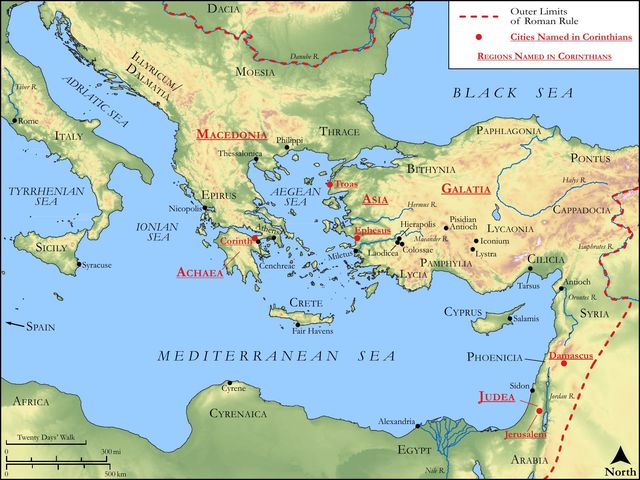
See on the biblical-era maps

Study this verse
Public-domain commentary
Matthew Henry
From his Commentary on the Whole Bible. Henry comments on passages, not single verses — this entry covers 1 Corinthians 6:12–20.
The twelfth verse and former part of the thirteenth seem to relate to that early dispute among Christians about the distinction of meats, and yet to be prefatory to the caution that follows against fornication. The connection seems plain enough if we attend to the famous determination of the apostles, Acts 15, where the prohibition of certain foods was joined with that of fornication. Now some among the Corinthians seem to have imagined that they were as much at liberty in the point of fornication as of meats, especially because it was not a sin condemned by the laws of their country. They were ready to say, even in the case of fornication, All things are lawful for me. This pernicious conceit Paul here sets himself to oppose: he tells them that many things lawful in themselves were not expedient at certain times, and under particular circumstances; and Christians should not barely consider what is in itself lawful to be done, but what is fit for them to do, considering their profession, character, relations, and hopes: they should be very careful that by carrying this maxim too far they be not brought into bondage, either to a crafty deceiver or a carnal inclination. All things are lawful for me, says he, but I will not be brought under the power of any, Co1 6:12. Even in lawful things, he would not be subject to the impositions of a usurped authority: so far was he from apprehending that in the things of God it was lawful for any power on earth to impose its own sentiments. Note, There is a liberty wherewith Christ has made us free, in which we must stand fast. But surely he would never carry this liberty so far as to put himself into the power of any bodily appetite. Though all meats were supposed lawful, he would not become a glutton nor a drunkard. And much less would he abuse the maxim of lawful liberty to countenance the sin of fornication, which, though it might be allowed by the Corinthian laws, was a trespass upon the law of nature, and utterly unbecoming a Christian. He would not abuse this maxim about eating and drinking to encourage any intemperance, nor indulge a carnal appetite: "Though meats are for the belly and the belly for meats (Co1 6:13), though the belly was made to receive food, and food was originally ordained to fill the belly, yet if it be not convenient for me, and much more if it be inconvenient, and likely to enslave me, if I am in danger of being subjected to my belly and appetite, I will abstain. But God shall destroy both it and them, at least as to their mutual relation. There is a time coming when the human body will need no further recruits of food." Some of the ancients suppose that this is to be understood of abolishing the belly as well as the food; and that though the same body will be raised at the great day, yet not with all the same members, some being utterly unnecessary in a future state, as the belly for instance, when the man is never to hunger, nor thirst, nor eat, nor drink more. But, whether this be true or no, there is a time coming when the need and use of food shall be abolished. Note, The expectation we have of being without bodily appetites in a future life is a very good argument against being under their power in the present life. This seems to me the sense of the apostle's argument; and that this passage is plainly to be connected with his caution against fornication, though some make it a part of the former argument against litigious law-suits, especially before heathen magistrates and the enemies of true religion. These suppose that the apostle argues that though it may be lawful to claim our rights yet it is not always expedient, and it is utterly unfit for Christians to put themselves into the power of infidel judges, lawyers, and solicitors, on these accounts. But this connection seems not so natural. The transition to his arguments against fornication, as I have laid it, seems very natural: But the body is not for fornication, but for the Lord, and the Lord for the body, Co1 6:13. Meats and the belly are for one another; not so fornication and the body.
I.The body is not for fornication, but for the Lord.
This is the first argument he uses against this sin, for which the heathen inhabitants of Corinth were infamous, and the converts to Christianity retained too favourable an opinion of it. It is making things to cross their intention and use. The body is not for fornication; it was never formed for any such purpose, but for the Lord, for the service and honour of God. It is to be an instrument of righteousness to holiness (Rom 6:19), and therefore is never to be made an instrument of uncleanness. It is to be a member of Christ, and therefore must not be made the member of a harlot, Co1 6:15. And the Lord is for the body, that is, as some think, Christ is to be Lord of the body, to have property in it and dominion over it, having assumed a body and been made to partake of our nature, that he might be head of his church, and head over all things, Heb 2:5, Heb 2:18. Note, We must take care that we do not use what belongs to Christ as if it were our own, and much less to his dishonour.
II.Some understand this last passage, The Lord is for the body, thus:
He is for its resurrection and glorification, according to what follows, Co1 6:14, which is a second argument against this sin, the honour intended to be put on our bodies: God hath both raised up our Lord, and will raise us up by his power (Co1 6:14), by the power of him who shall change our vile body, and make it like to his glorious body by that power whereby he is able to subdue all things to himself, Phi 3:21. It is an honour done to the body that Jesus Christ was raised from the dead: and it will be an honour to our bodies that they will be raised. Let us not abuse those bodies by sin, and make them vile, which, if they be kept pure, shall, notwithstanding their present vileness, be made like to Christ's glorious body. Note, The hopes of a resurrection to glory should restrain Christians from dishonouring their bodies by fleshly lusts.
III.A third argument is the honour already put on them:
Know you not that your bodies are the members of Christ? Co1 6:15. If the soul be united to Christ by faith, the whole man is become a member of his mystical body. The body is in union with Christ as well as the soul. How honourable is this to the Christian! His very flesh is a part of the mystical body of Christ. Note, It is good to know in what honourable relations we stand, that we may endeavour to become them. But now, says the apostle, shall I take the members of Christ, and make them the members of a harlot? God forbid. Or, take away the members of Christ? Would not this be a gross abuse, and the most notorious injury? Would it not be dishonouring Christ, and dishonouring ourselves to the very last degree? What, make a Christ's members the members of a harlot, prostitute them to so vile a purpose! The thought is to be abhorred. God forbid. Know you not that he who is joined to a harlot is one body with hers? For two, says he, shall be one flesh. But he who is joined to the Lord is one spirit, Co1 6:16, Co1 6:17. Nothing can stand in greater opposition to the honourable relations and alliances of a Christian man than this sin. He is joined to the Lord in union with Christ, and made partaker by faith of his Spirit. One spirit lives and breathes and moves in the head and members. Christ and his faithful disciples are one, Joh 17:21, Joh 17:22. But he that is joined to a harlot is one body, for two shall be one flesh, by carnal conjunction, which was ordained of God only to be in a married state. Now shall one in so close a union with Christ as to be one spirit with him yet be so united to a harlot as to become one flesh with her? Were not this a vile attempt to make a union between Christ and harlots? And can a greater indignity he offered to him or ourselves? Can any thing be more inconsistent with our profession or relation? Note, The sin of fornication is a great injury in a Christian to his head and lord, and a great reproach and blot on his profession. It is no wonder therefore that the apostle should say, "Flee fornication (Co1 6:18), avoid it, keep out of the reach of temptations to it, of provoking objects. Direct the eyes and mind to other things and thoughts." Alia vitia pugnando, sola libido fugiendo vincitur - Other vices may be conquered in fight, this only by flight; so speak many of the fathers.
IV.A fourth argument is that it is a sin against our own bodies.
Every sin that a man does is without the body; he that committeth fornication sinneth against his own body (Co1 6:18); every sin, that is, every other sin, every external act of sin besides, is without the body. It is not so much an abuse of the body as of somewhat else, as of wine by the drunkard, food by the glutton, etc. Nor does it give the power of the body to another person. Nor does it so much tend to the reproach of the body and render it vile. This sin is in a peculiar manner styled uncleanness, pollution, because no sin has so much external turpitude in it, especially in a Christian. He sins against his own body; he defiles it, he degrades it, making it one with the body of that vile creature with whom he sins. He casts vile reproach on what he Redeemer has dignifies to the last degree by taking it into union with himself. Note, We should not make our present vile bodies more vile by sinning against them.
V.The fifth argument against this sin is that the bodies of Christians are the temples of the Holy Ghost which is in them, and which they have of God, Co1 6:19. He that is joined to Christ is one spirit. He is yielded up to him, is consecrated thereby, and set apart for his use, and is hereupon possessed, and occupied, and inhabited, by his Holy Spirit. This is the proper notion of a temple - a place where God dwells, and sacred to his use, by his own claim and his creature's surrender. Such temples real Christians are of the Holy Ghost. Must he not therefore be God? But the inference is plain that hence we are not our own. We are yielded up to God, and possessed by and for God; nay, and this is virtue of a purchase made of us: You are bought with a price. In short, our bodies were made for God, they were purchased for him. If we are Christians indeed they are yielded to him, and he inhabits and occupies them by his Spirit: so that our bodies are not our own, but his. And shall we desecrate his temple, defile it, prostitute it, and offer it up to the use and service of a harlot? Horrid sacrilege! This is robbing God in the worst sense. Note, The temple of the Holy Ghost must be kept holy. Our bodies must be kept as his whose they are, and fit for his use and residence.
VI.The apostle argues from the obligation we are under to glorify God both with our body and spirit, which are his, Co1 6:20.
He made both, he bought both, and therefore both belong to him and should be used and employed for him, and therefore should not be defiled, alienated from him, and prostituted by us. No, they must be kept as vessels fitted for our Master's use. We must look upon our whole selves as holy to the Lord, and must use our bodies as property which belongs to him and is sacred to his use and service. We are to honour him with our bodies and spirits, which are his; and therefore, surely, must abstain from fornication; and not only from the outward act, but from the adultery of the heart, as our Lord calls it, Mat 5:28. Body and spirit are to be kept clean, that God may be honoured by both. But God is dishonoured when either is defiled by so beastly a sin. Therefore flee fornication, nay, and every sin. Use your bodies for the glory and service of their Lord and Maker. Note, We are not proprietors of ourselves, nor have power over ourselves, and therefore should not use ourselves according to our own pleasure, but according to his will, and for his glory, whose we are, and whom we should serve, Act 27:23.
Historical interpretation
Five Centuries of Reception
14 surviving comments on this verse. Each one is dated, so this reads as a timeline rather than a list.
Select a marker to jump to its quote. Markers stagger vertically where authors wrote within a few decades of each other.
There is nothing which is hid from God, but our very secrets are near to Him. Let us therefore do all things as those who have Him dwelling in us, that we may be His temples.
And, for fear you should fly to that statement for a licence to fornication, on the ground that you will be sinning against a thing which is yours, not the Lord's, he takes you away from yourself, and awards you, according to his previous disposition, to Christ: "And ye are not your own; "immediately opposing (thereto), "for bought ye are with a price"-the blood, to wit, of the Lord: "glorify and extol the Lord in your body." See whether he who gives this injunction be likely to have pardoned one who has disgraced the Lord, and who has cast Him down from (the empire of) his body, and this indeed through incest.
And, accordingly, why excuse it on the ground of pristine precedent? It did not bear the names of "body of Christ," of "members of Christ," of "temple of God," at the time When it used to obtain pardon for adultery.
In the Platonic view, the body is a prison; in that of Paul, it is the temple of God because it is in Christ.
So far as I know, "we are not our own, but bought with a price; " and what kind of price? The blood of God.
For since, by the introduction into an appropriation (in) us of the Holy Spirit, we are all" the temple of God," Modesty is the sacristan and priestess of that temple, who is to suffer nothing unclean or profane to be introduced (into it), for fear that the God who inhabits it should be offended, and quite forsake the polluted abode.
That he who has attained to trust, having put off the former man, ought to regard only celestial and spiritual things, and to give no heed to the world which he has already renounced... Of this same thing in Matthew: "The foxes have holes, and the birds of the heaven have nests; but the Son of man hath not where He may lay His head." Also in the same place: "Whoso forsaketh not all that he hath, cannot be my disciple." Of this same thing in the first to the Corinthians: "Ye are not your own, for ye are bought with a great price. Glorify and bear God in your body."
For you are translated from your former vain and tedious mode of life and have contemned the lifeless idols, and despised the demons, which are in darkness, and have run to the "true light," [John 1:9] and by it have "known the one and only true God and Father," [John 17:3] and so are owned to be heirs of His kingdom. For since you have "been baptized into the Lord's death," [Romans 6:3] and into His resurrection, as "new-born babes," [1 Peter 2:2] you ought to be wholly free from all sinful actions; "for you are not your own, but His that bought you" [1 Corinthians 6:19-20] with His own blood.
Paul said this with the intention that we should keep our bodies uncontaminated, so that the Holy Spirit may dwell in them.
Let them, therefore, with fasting and with prayer make their adjurations, and not with the elegant and well-arranged and fitly-ordered words of learning, but as men who have received the gift of healing from God, confidently, to the glory of God. By your fastings and prayers and perpetual watching, together with your other good works, mortify the works of the flesh by the power of the Holy Spirit. He who acts thus "is a temple of the Holy Spirit of God." [1 Corinthians 6:19]
"Know ye not that your body is a temple of the Holy Ghost which is in you?" He did not merely say, "of the Spirit," but, "which is in you;" which was the part of one who also was soothing. And again, explaining himself still further, he added, "which ye have from God." He mentioned Him that gave also, both exalting the hearer and putting him in fear, both by the magnitude of the deposit, and by the munificence of Him that made it.
"And ye are not you own." This is not only to abash, but even to force men towards virtue. "For why," says he; "doest thou what thou wilt? thou art not thine own master." But these things he said, not to take away free-will. For so in saying, "All things are lawful for me, but not all things are expedient," he does not take away our liberty. And here again, writing, "Ye are not your own;" he makes no infringement upon freedom of choice, but he leads away from vice and indicates the guardian care of the Lord. And therefore he added, "For ye were bought with a price."
"But if I am not my own, upon what ground do you demand of me duties to be done? And why do you go on to say again, 'Glorify God therefore in your body and in your spirit, which are God's?'" What then is the meaning of, "ye are not your own?" And what does he wish to prove thereby? To settle them in a state of security against sin, and against following the improper desires of the mind. For indeed we have many improper wishes: but we must repress them, for we can. And if we could not, exhortation would be in vain.
The fornicator is also guilty of impiety, for by doing harm to his body he has corrupted the temple of the Holy Spirit.
Gregory said, ‘God asks three things of anyone who is baptized: to keep the true faith with all his soul and all his might; to control his tongue; to be chaste in his body.’
And again: "What! know ye not that your bodies are the temple of the Holy Spirit which is in you, which ye have of God? "
Continue studying 1 Corinthians 6:19 across the web’s major study libraries — every link below opens this exact verse, chapter, or book on the destination site.
Read & Compare
 BibleGatewayThis verse in more than 200 translations and 70 languages.
 Bible.comThe YouVersion reader — hundreds of translations, reading plans, and highlights.
 ESV.orgCrossway's official English Standard Version reader.
 NET BibleThe NET translation with 60,000+ translators' notes on every rendering decision.
 STEP BibleTyndale House's free study tool — original text, vocabulary, and scholarly resources.
 BibliaLogos Bible Software's free web reader.
 USCCBThe New American Bible (Revised Edition) with the U.S. bishops' study notes.
Commentaries
 BibleHub CommentariesDozens of classic commentaries on this verse, gathered on one page.
 StudyLightMore than 100 commentary sets — the largest collection on the web.
 BibleRefPlain-English commentary on what this verse means, verse by verse.
 Enduring WordDavid Guzik's free commentary on this chapter, widely used by Bible teachers.
 Bible Study ToolsVerse commentary alongside Greek and Hebrew study aids.
Original Language & Research
- BibleHub InterlinearThe verse word by word — original language, transliteration, and English.
- BibleHub LexiconEvery word's original-language definition and Strong's entry.
 Blue Letter BibleDeep-study tools — Strong's numbers, concordance, and word studies.
 CNTR CollationThe earliest Greek manuscripts of this verse, collated letter by letter.
Sermons, Hymns & Audio


TrulyRandomVerse is not affiliated with these sites and doesn’t control their content. They’re linked because they’re genuinely useful.
Summary
1 Corinthians 6:19 serves as a profound theological declaration, asserting that the physical body of a believer is not merely a personal possession but a sacred dwelling place for the Holy Spirit, received directly from God. This divine indwelling establishes an unbreakable bond of ownership, fundamentally transforming the believer's identity and calling them to live in a manner consistent with their consecrated status, recognizing they no longer belong to themselves but to God.
Context
ShowHideLiterary Context
This powerful verse is situated within a broader section of Paul's letter to the Corinthian church (1 Corinthians 5-7) where he addresses various issues of sexual immorality and Christian conduct. Specifically, 1 Corinthians 6:12-20 deals with the misuse of Christian freedom, particularly concerning sexual sin. Paul has just argued vehemently against visiting prostitutes, stating that such acts unite a believer's body with a harlot, which is antithetical to being united with Christ (1 Corinthians 6:15-17). Verse 19, therefore, provides the theological bedrock for his ethical commands, establishing the sacred nature of the body as the Spirit's temple, leading directly into the call to glorify God with one's body in 1 Corinthians 6:20.
Historical & Cultural Context
Corinth was a bustling, cosmopolitan port city renowned for its wealth, trade, and unfortunately, its pervasive immorality. The city was home to numerous pagan temples, including the infamous temple of Aphrodite, which reportedly employed sacred prostitutes. In this environment, the human body was often viewed as a vessel for pleasure or a disposable entity, disconnected from spiritual realities. Paul's declaration that the body is a "temple of the Holy Ghost" would have been revolutionary and counter-cultural, directly challenging the prevailing pagan worldview and the casual approach to sexuality. The Corinthians, familiar with the concept of temples as sacred spaces where deities resided, would have grasped the profound implications of their own bodies being such a sanctuary.
Key Themes
ShowHideThis verse powerfully contributes to several overarching themes in 1 Corinthians and Pauline theology. It reinforces the theme of the indwelling Holy Spirit, a hallmark of the new covenant, emphasizing the Spirit's personal and intimate presence within individual believers. It elevates the sacredness of the human body, transforming it from a mere physical entity into a consecrated space, directly combating the dualistic tendencies (common in Greek thought) that often devalued the physical. Furthermore, it underscores the theme of divine ownership and belonging, asserting that believers are not their own masters but belong entirely to God, a concept foundational to Christian ethics and discipleship, as seen in Paul's call for believers to live for Christ in Romans 14:7-8.
Exposition and Analysis
ShowHideKey Word Analysis
ShowHideA primary verb meaning "to see (literally or figuratively); by implication, (in the perfect tense only) to know." Paul's rhetorical question, "What? know ye not?", is not an inquiry into their ignorance but a forceful reminder of a truth they should already know. It implies a failure to live in accordance with a fundamental theological reality, highlighting the cognitive dissonance between their understanding and their behavior.
A term referring to "a fane, shrine, temple." Unlike hieron (ἱερόν), which denotes the entire temple complex, naós specifically refers to the inner sanctuary, the holy of holies, where the deity was believed to reside. By using naós, Paul emphasizes the intimate and consecrated presence of the Holy Spirit within the believer, making the body the most sacred of spaces, a direct parallel to the dwelling place of God in the Old Testament Tabernacle and Temple.
A reflexive pronoun meaning "him- (her-, it-, them-, also (in conjunction with the personal pronoun of the other persons) my-, thy-, our-, your-) self (selves), etc." This phrase emphatically declares a radical shift in ownership. Prior to salvation, individuals might consider themselves autonomous, but through redemption, they are purchased by God. This means their bodies, wills, and lives are no longer under their own jurisdiction but belong to their divine Creator and Redeemer, forming the basis for a life of submission and glorification.
Verse Breakdown
ShowHide"What? know ye not"
This is a powerful rhetorical question, designed not to elicit information but to challenge the Corinthians' inconsistent behavior by appealing to a truth they ought to have known and internalized. It implies a severe lapse in their understanding or application of fundamental Christian doctrine.
"that your body is the temple of the Holy Ghost"
This is the central theological assertion. Paul declares that the physical body of each individual believer (singular "body," not plural "bodies") is a sacred dwelling place, the inner sanctuary (naós), for the Holy Spirit. This elevates the body to a status of profound holiness, making it a consecrated space for God's presence.
"[which is] in you"
This phrase emphasizes the immanence and personal indwelling of the Holy Spirit. The Spirit is not merely an external influence but resides within the believer, making their very being a locus of divine presence. This personal indwelling is the source of the body's sacredness.
"which ye have of God"
This clause clarifies the origin and nature of the Holy Spirit's indwelling. The Spirit's presence is not earned or self-generated but is a gracious gift, freely bestowed by God. This highlights God's initiative and sovereign act in establishing this intimate relationship with believers.
"and ye are not your own?"
This concluding declaration is the logical consequence of the preceding truths. Because the body is the temple of the Holy Spirit, and the Spirit is a gift from God, believers are no longer self-owned. Their lives, including their physical bodies, belong entirely to God, implying a profound responsibility to live in a way that honors this divine ownership.
Literary Devices
ShowHidePaul masterfully employs several literary devices to convey his urgent message. The verse opens with a Rhetorical Question ("What? know ye not?"), designed to jolt the Corinthian believers into recognizing a fundamental truth they had seemingly forgotten or neglected. This immediate challenge sets an authoritative tone. The most prominent device is the Metaphor of the "temple of the Holy Ghost." By comparing the human body to a sacred temple, Paul elevates its status from a mere physical vessel to a consecrated dwelling place for the divine. This metaphor directly counters the prevailing pagan views of the body and provides a powerful theological basis for ethical conduct. Finally, the concluding declaration, "and ye are not your own," serves as a stark Statement of Consequence and Emphasis, highlighting the radical shift in ownership from self to God. This emphatic statement underscores the profound implications of the indwelling Spirit for every aspect of a believer's life.
Theological and Thematic Connections
ShowHideThe profound truth that the believer's body is the temple of the Holy Spirit fundamentally reshapes Christian anthropology and ethics. It signifies a radical consecration of the human person, where the very physical being becomes a locus of divine presence. This indwelling of the Spirit is not merely a passive presence but an active, sanctifying power that empowers believers to live lives of holiness and to glorify God in every aspect, including their physical actions. The concept of divine ownership, "ye are not your own," flows directly from this indwelling, establishing the basis for Christian stewardship of the body and a rejection of self-indulgence or sin that would defile God's sacred dwelling. This theological reality calls for a reorientation of desires and actions, aligning them with God's purposes rather than personal gratification.
Reflection and Application
ShowHideUnderstanding that your body is the temple of the Holy Spirit is not merely an abstract theological concept; it carries profound implications for daily living. It transforms our perception of self-worth and purpose, elevating the physical body from a mundane vessel to a sacred sanctuary. This truth calls us to a radical re-evaluation of our choices, especially concerning our physical health, sexual purity, and the activities we engage in. If God's Spirit truly dwells within us, then our bodies are no longer our own to do with as we please, but are on loan, consecrated for His glory. This should inspire a deep reverence for our bodies and a commitment to honor God in every aspect of our physical existence, avoiding anything that would defile or dishonor this divine dwelling. It also fosters a sense of accountability, knowing that our actions reflect upon the indwelling Spirit.
Questions for Reflection
ShowHideFAQ
ShowHideWhat does "temple of the Holy Ghost" mean for individual believers?
ShowHideThe phrase "temple of the Holy Ghost" (or Holy Spirit) means that the Holy Spirit, who is God, personally indwells every believer in Jesus Christ. Just as ancient temples were considered sacred dwelling places for deities, the body of a Christian is consecrated as a holy space where God's Spirit resides. This signifies a profound, intimate, and permanent presence of God within the believer, elevating the human body to a sacred status and implying that it is set apart for God's purposes. It underscores that believers are not merely individuals but living sanctuaries of the divine.
Why does Paul say "ye are not your own" immediately after stating the body is the temple?
ShowHidePaul's declaration, "ye are not your own," is a direct and logical consequence of the body being the temple of the Holy Spirit, which believers "have of God." Since the Holy Spirit is a gift from God and resides within the believer's body, it signifies that God has taken possession and ownership. This concept is further elaborated in 1 Corinthians 6:20, where Paul states believers "are bought with a price." This divine ownership means that believers' lives, including their bodies, are no longer subject to their own desires or the world's influences, but are to be used for God's glory and according to His will. It's a call to abandon self-sovereignty in favor of God's Lordship.
Christ-Centered Fulfillment
ShowHideThe profound truth of 1 Corinthians 6:19 finds its ultimate fulfillment and enablement in the person and work of Jesus Christ. It is through Christ's atoning sacrifice on the cross and His glorious resurrection that humanity, once alienated from God by sin, can be reconciled and indwelt by the Holy Spirit. Christ's death purchased believers, making them "not your own" but God's possession, as emphasized in 1 Corinthians 6:20. His resurrection demonstrates His victory over sin and death, paving the way for the new life in the Spirit, where believers are united with Him (Romans 6:3-11). The Holy Spirit, the "Holy Ghost" mentioned in the verse, is the Spirit of Christ (Romans 8:9) whom the Father sent in Jesus' name (John 14:26). Thus, the body becoming the temple of the Holy Spirit is a direct result of Christ's finished work, establishing an intimate union between the believer and the triune God, enabling a life of holiness and glorification of God through the power of the indwelling Christ.