


1 Timothy 6:15
Bible text: King James Version (1769 Blayney text) · Public domain
Bible text: Berean Standard Bible · Public domain
Bible text: American Standard Version (1901) · Public domain
Bible text: World English Bible, Messianic edition · Public domain
Bible text: Geneva Bible (1599) · Public domain
Bible text: Young's Literal Translation · Public domain
- ἣνhēnwhichG3739R-ASFRelative pronoun Accusative Singular Feminine
- καιροῖςkairoisin seasonsG2540N-DPMNoun Dative Plural Masculine
- ἰδίοιςidiois[their] ownG2398A-DPMAdjective Dative Plural Masculine
- δείξειdeixeiHe will displayG1166V-FAI-3SVerb Future Active Indicative 3rd Singular
- ὁhotheG3588T-NSMDefinite article Nominative Singular Masculine
- μακάριοςmakariosblessedG3107A-NSMAdjective Nominative Singular Masculine
- καὶkaiandG2532CONJConjunction
- μόνοςmonosaloneG3441A-NSMAdjective Nominative Singular Masculine
- δυνάστηςdunastēsSovereignG1413N-NSMNoun Nominative Singular Masculine
- ὁhotheG3588T-NSMDefinite article Nominative Singular Masculine
- βασιλεὺςbasileusKingG935N-NSM-TNoun Nominative Singular Masculine Title
- τῶνtōnof thoseG3588T-GPMDefinite article Genitive Plural Masculine
- βασιλευόντωνbasileuontōnbeing kingsG936V-PAP-GPMVerb Present Active Participle Genitive Plural Masculine
- καὶkaiandG2532CONJConjunction
- κύριοςkurios[the] LordG2962N-NSM-TNoun Nominative Singular Masculine Title
- τῶνtōnof thoseG3588T-GPMDefinite article Genitive Plural Masculine
- κυριευόντωνkurieuontōnbeing lordsG2961V-PAP-GPMVerb Present Active Participle Genitive Plural Masculine
English is a literal word-by-word gloss of the Greek, not the KJV's wording. Why?
This is the original text the KJV's translators worked from — each Greek word with its own literal English meaning in this verse, prepared by scholars at Tyndale House, Cambridge. The KJV translates whole sentences, not word by word, so its wording differs: one Greek word can become several English words, and the KJV may choose “charity” where the gloss reads “love”. Both are faithful — they answer different questions. For the KJV's own rendering, switch to the KJV text.
Details
See on the biblical-era maps

Study this verse
Public-domain commentary
Matthew Henry
From his Commentary on the Whole Bible. Henry comments on passages, not single verses — this entry covers 1 Timothy 6:13–21. His three-level outline is real structure in the source text, so it is rendered as structure.
The apostle here charges Timothy to keep this commandment (that is, the whole work of his ministry, all the trust reposed in him, all the service expected from him) without spot, unrebukable; he must conduct himself so in his ministry that he might not lay himself open to any blame nor incur any blemish. What are the motives to move him to this?
I.He gives him a solemn charge:
I give thee charge in the sight of God that thou do this. He charges him as he will answer it at the great day to that God whose eyes are upon us all, who sees what we are and what we do: - God, who quickens all things, who has life in himself and is the fountain of life. This should quicken us to the service of God that we serve a God who quickens all things. He charges him before Christ Jesus, to whom in a peculiar manner he stood related as a minister of his gospel: Who before Pontius Pilate witnessed a good confession. Observe, Christ died not only as a sacrifice, but as a martyr; and he witnessed a good confession when he was arraigned before Pilate, saying (Joh 18:36, Joh 18:37), My kingdom is not of this world: I am come to bear witness unto the truth. That good confession of his before Pilate, My kingdom is not of this world, should be effectual to draw off all his followers, both ministers and people, from the love of this world.
II.He reminds him of the confession that he himself had made:
Thou hast professed a good profession before many witnesses (Ti1 6:12), namely, when he was ordained by the laying on of the hands of the presbytery. The obligation of that was still upon him, and he must live up to that, and be quickened by that, to do the work of his ministry.
III.He reminds him of Christ's second coming:
"Keep this commandment - until the appearing of our Lord Jesus Christ; keep it as long as thou live, till Christ come at death to give thee a discharge. Keep it with an eye to his second coming, when we must all give an account of the talents we have been entrusted with," Luk 16:2. Observe, The Lord Jesus Christ will appear, and it will be a glorious appearing, not like his first appearing in the days of his humiliation. Ministers should have an eye to this appearing of the Lord Jesus Christ in all their ministrations, and, till his appearing, they are to keep this commandment without spot, unrebukable. Mentioning the appearing of Christ, as one that loved it, Paul loves to speak of it, and loves to speak of him who shall then appear. The appearing of Christ is certain (he shall show it), but it is not for us to know the time and season of it, which the Father has kept in his own power: let this suffice us, that in time he will show it, in the time that he thinks fit for it. Observe,
1.Concerning Christ and God the Father the apostle here speaks great things.
(1.)That God is the only Potentate; the powers of earthly princes are all derived from him, and depend upon him. The powers that exist are ordained of God, Rom 13:1. He is the only Potentate that is absolute and sovereign, and perfectly independent.
(2.)He is the blessed and the only Potentate, infinitely happy, and nothing can in the least impair his happiness.
(3.)He is King of kings, and Lord of lords. All the kings of the earth derive their power from him; he gave them their crowns, they hold them under him, and he has a sovereign dominion over them. This is Christ's title (Rev 19:16), upon his vesture and his thigh; for he has a name higher than the kings of the earth.
(4.)He only has immortality. He only is immortal in himself, and has immortality as he is the fountain of it, for the immortality of angels and spirits derived from him.
(5.)He dwells in inaccessible light, light which no man can approach unto: no man can get to heaven but those whom he is pleased to bring thither, and admit into his kingdom.
(6.)He is invisible: Whom no man hath seen, nor can see. It is impossible that mortal eyes should bear the brightness of the divine glory. No man can see God and live.
2.Having mentioned these glorious attributes, he concludes with a doxology: To him be honour and power everlasting. Amen. God having all power and honour to himself, it is our duty to ascribe all power and honour to him.
(1.)What an evil is sin, when committed against such a God, the blessed and only Potentate! The evil of it rises in proportion to the dignity of him against whom it is committed.
(2.)Great is his condescension, to take notice of such mean and vile creatures as we are. What are we then, that the blessed God, the King of kings and Lord of lords, should seek after us?
(3.)Blessed are those who are admitted to dwell with this great and blessed Potentate. Happy are thy men (says the queen of Sheba to king Solomon), happy are these thy servants, who stand continually before thee, Kg1 10:8. Much more happy are those who are allowed to stand before the King of kings.
(4.)Let us love, adore, and praise, the great God; for who shall not fear thee, O Lord, and glorify thy name? For thou only art holy, Rev 15:4.
IV.The apostle adds, by way of postscript, a lesson for rich people, Ti1 6:17-19.
1.Timothy must charge those that are rich to beware of the temptations, and improve the opportunities, of their prosperous estate.
(1.)He must caution them to take heed of pride. This is a sin that easily besets rich people, upon whom the world smiles. Charge them that they be not high-minded, or think of themselves above what is meet, or be puffed up with their wealth.
(2.)He must caution them against vain confidence in their wealth. Charge them that they trust not in uncertain riches. Nothing is more uncertain than the wealth of this world; many have had much of it one day and been stripped of all the next. Riches make themselves wings, and fly away as an eagle, etc., Pro 23:5.
(3.)He must charge them to trust in God, the living God, to make him their hope, who giveth us richly all things to enjoy. Those who are rich must see God giving them their riches, and giving them to enjoy them richly; for many have riches, but enjoy them poorly, not having a heart to use them.
(4.)He must charge them to do good with what they have (for what is the best estate worth, any more than as it gives a man an opportunity of doing so much the more good?): That they be rich in good works. Those are truly rich who are rich in good works. That they be ready to distribute, willing to communicate: not only to do it, but to do it willingly, for God loves a cheerful giver.
(5.)He must charge them to think of another world, and prepare for that which is to come by works of charity: Laying up in store a good foundation against the time to come, that they may take hold on eternal life.
2.Hence we may observe,
(1.)Ministers must not be afraid of the rich; be they ever so rich, they must speak to them, and charge them.
(2.)They must caution them against pride, and vain confidence in their riches: That they be not high-minded, nor trust in uncertain riches. Stir them up to works of piety and charity: That they do good, etc.
(3.)This is the way for the rich to lay up in store for themselves for the time to come, that they may lay hold on eternal life; in the way of well-doing we are to seek for glory, honour, and immortality, and eternal life will be the end of all, Rom 2:7.
(4.)Here is a lesson for ministers in the charge given to Timothy: Keep that which is committed to thy trust. Every minister is a trustee, and it is a treasure committed to his trust, which he has to keep. The truths of God, the ordinances of God, keep these, avoiding profane and vain babblings; not affecting human eloquence, which the apostle calls vain babbling, or human learning, which often opposes the truths of God, but keep close to the written word, for that is committed to our trust. Some who have been very proud of their learning, their science, which is falsely so called, have by that been debauched in their principles and been drawn away from the faith of Christ, which is a good reason why we should keep to the plain word of the gospel, and resolve to live and die by that. Observe, [1.] Ministers cannot be too earnestly exhorted to keep what is committed to their trust, because it is a great trust lodged with them: O Timothy, keep that which is committed to thy trust! as if he had said, "I cannot conclude without charging thee again; whatever thou doest, be sure to keep this trust, for it is too great a trust to be betrayed." [2.] Ministers are to avoid babblings, if they would keep what is committed to them, because they are vain and profane. [3.] That science that opposes the truth of the gospel is falsely so called; it is not true science, for if it were it would approve of the gospel and consent to it. [4.] Those who are so fond of such science are in great danger of erring concerning the faith; those who are for advancing reason above faith are in danger of leaving faith.
V.Our apostle concludes with a solemn prayer and benediction:
Grace be with thee. Amen. Observe, this is a short, yet comprehensive prayer for our friends, for grace comprehends in it all that is good, and grace is an earnest, yea, a beginning, of glory; for, wherever God gives grace, he will give glory, and will not withhold any good thing from him who walketh uprightly. Grace be with you all. Amen.
Historical interpretation
Six Centuries of Reception
7 surviving comments on this verse. Each one is dated, so this reads as a timeline rather than a list.
Select a marker to jump to its quote. Markers stagger vertically where authors wrote within a few decades of each other.
God’s other titles fall into two distinct groups. The first group belongs to his power, the second to his providential ordering of the world, a twofold providential ordering—involving, and not involving, incarnation. Clear cases of titles which belong to his power are … “King” of “rulers” and “Lord of the masters.” … For since we are controlled by three conditions—fear of punishment, hope for salvation and glory too, and the practice of the virtues which result in these last—the name which mentions retribution deals with fear. The one which mentions salvation with hope, and that which refers to virtues, disciplines us to practice them. The intention is that by, as it were, carrying God inside him, one may have some success here and press on all the harder to perfection, toward that affinity with God which comes from the virtues.
What is owed to the lonely Lord, which is to the Word, that is, to that spiritual, true sword of Solomon. What is the lonely? Is it the Father without the Son, or the Son without the Father? By no means. When I say only the Father, I do not separate the Son; because in the bosom and secret of the Father is the Son. When I say only the Son, I join the Father, just as the Son also joined, saying: Behold, the hour is coming when you will leave me alone: but not alone, because the Father is with me. So both the Father alone is blessed, and alone is called powerful; so that the Son may not be separated from Him, who is always in the Father.
When someone sees resplendent lords of rank, kings, leaders and all those who appear prominent in wealth, to them he speaks in fearful words. Their dynasties are advantaged by his fear. Yet “now, kings, understand; be instructed, all you who judge the earth; serve the Lord with fear and rejoice in him with trembling,” because “he is the King of kings and the Lord of lords.” Wherever the mighty rules, God threatens with the fear of his kingdom. Yet wherever the worthless are humbled, God offers the medicine of his clemency. For this God is a great King to those who reign and a Lord to those who exercise lordship. Again, the very same one lowers his rank and is found, according to holy Scripture, to be a Father to orphans and a Judge to widows, a King to kings, a Leader to leaders, a Lord to lords.
"Which in His times He shall show, Who is the blessed and only Potentate, King of kings, and Lord of lords, Who only hath immortality, dwelling in the light which no man can approach unto."
Of whom are these things said? Of the Father, or of the Son? Of the Son, undoubtedly: and it is said for the consolation of Timothy, that he may not fear nor stand in awe of the kings of the earth.
"In His times," that is, the due and fitting times, that he may not be impatient, because it has not yet come. And whence is it manifest, that He will show it? Because He is the Potentate, the "only Potentate." He then will show it, Who is "blessed," nay blessedness itself; and this is said, to show that in that appearing there is nothing painful or uneasy.
But he says, "only," either in contradistinction to men, or because He was unoriginated, or as we sometimes speak of a man whom we wish to extol.
"Who only hath immortality." What then? hath not the Son immortality? Is He not immortality itself? How should not He, who is of the same substance with the Father, have immortality?
Prayer itself must come from a humble, meek, pure heart. It must confess its sins without making excuses. In the course of bitter tears it will show trust in the most sweet pity of the Lord. It must not seek earthly aims but desire heavenly ones. It must be sequestered from desires of the body and attach itself solely to the divine. In short, it must be wholly spiritual, bestowing nothing but tears on the flesh. Insofar as it is lawful, seek to behold in mental contemplation him whom you entreat and then you realize what sort of person you should be in offering yourself prostrate before him. He is, as Paul says, “the blessed and only Mighty, the King of kings and Lord of lords.”
He, the framer of all creation and maker of our race, became man for our sake, and coming from a holy Virgin’s womb, on earth conversed with men. For us ungrateful servants the master endured death, even the death of the cross, that the tyranny of sin might be destroyed, that the former condemnation might be abolished, that the gates of heaven might be open to us again. In this way he has exalted our nature, and set it on the throne of glory, and granted to them that love him an everlasting kingdom and joys beyond all that tongue can tell or ear can hear. He is the mighty and the only potentate, King of kings and Lord of lords, whose might is invincible and whose lordship is beyond comparison. He alone is holy and dwells in holiness, who with the Father and the Holy Spirit is glorified. Into this faith I have been baptized.
which in its own times he will show, the blessed and only Sovereign, the King of kings and Lord of lords, who alone has immortality, dwelling in unapproachable light, whom no man has seen nor can see; to whom be honor and eternal power. Amen.
which in its own times. That is, to the appropriate, the appointed times. Therefore, do not be upset that it has not already happened.
the blessed and only Sovereign. These things have been said about the Son. For the one who is coming shows the presence. But the Father will not come, but the Son, for judgment; these things have been said concerning the one who is coming.
the blessed, the self-blessedness. For all sorrow and pain have fled from him. Jesus is both a ruler and a good king. Therefore, the earthly ones should not be feared by us.
and only Sovereign. Where you might hear about one of the three holy Persons, this or that one alone, do not accept what is said of the other two by way of contrast, but rather about those who do not exist, yet are called gods. For behold, now speaking about the Son these things, which elsewhere have also been said about the Father and about the Spirit, He said, The Only one.
— [OECUMENIUS] who alone has immortality. How does he say about God that He alone has immortality, when both angels and souls and demons have immortality? Therefore, when he says about God: "Who alone has immortality," he either takes away immortality from those we mentioned, or he lies. And we say that those about whom the address is do not have immortality, but they partake in it, by the grace of Him who alone by nature is immortal. For this has been given to them by God. For God is the one from whom we all partake, just as we do with other things, so immortality is compared to that which is more excellent. [end of the excerpt by Oecumenius A f. 15ν; B f. 211ν; G f. 300r] —
dwelling in unapproachable light. Which itself is immortality and inaccessible light, do you think it is limited to a place? Is light one thing and the light itself another? Yet it is the light itself. Do you see that when we want to say something great, the tongue becomes powerless? It is truly called unapproachable because no one can approach the shining mind, "whom no man has seen." For no one has seen the divinity of the Son, just as neither the Father nor the Spirit; for he was seen according to the flesh.
to whom be honor and eternal power. If his honor and power will be eternal, certainly his appearance will be as well. For he promised: "And behold, I am with you all the days." (Matt. 28:20)
A guide for the wealthy towards true life.
Continue studying 1 Timothy 6:15 across the web’s major study libraries — every link below opens this exact verse, chapter, or book on the destination site.
Read & Compare
 BibleGatewayThis verse in more than 200 translations and 70 languages.
 Bible.comThe YouVersion reader — hundreds of translations, reading plans, and highlights.
 ESV.orgCrossway's official English Standard Version reader.
 NET BibleThe NET translation with 60,000+ translators' notes on every rendering decision.
 STEP BibleTyndale House's free study tool — original text, vocabulary, and scholarly resources.
 BibliaLogos Bible Software's free web reader.
 USCCBThe New American Bible (Revised Edition) with the U.S. bishops' study notes.
Commentaries
 BibleHub CommentariesDozens of classic commentaries on this verse, gathered on one page.
 StudyLightMore than 100 commentary sets — the largest collection on the web.
 BibleRefPlain-English commentary on what this verse means, verse by verse.
 Enduring WordDavid Guzik's free commentary on this chapter, widely used by Bible teachers.
 Bible Study ToolsVerse commentary alongside Greek and Hebrew study aids.
Original Language & Research
- BibleHub InterlinearThe verse word by word — original language, transliteration, and English.
- BibleHub LexiconEvery word's original-language definition and Strong's entry.
 Blue Letter BibleDeep-study tools — Strong's numbers, concordance, and word studies.
 CNTR CollationThe earliest Greek manuscripts of this verse, collated letter by letter.
Sermons, Hymns & Audio


TrulyRandomVerse is not affiliated with these sites and doesn’t control their content. They’re linked because they’re genuinely useful.
Summary
1 Timothy 6:15 culminates a profound doxology, shifting focus from Paul's charge to Timothy to the majestic character and sovereign timing of God. It declares God as the ultimate authority—the supremely blessed, uniquely powerful Potentate, and the unrivaled King of kings and Lord of lords—who will, in His perfect appointed time, reveal the glorious appearing of Jesus Christ. This verse serves as a theological anchor, grounding Timothy's challenging ministry in the unshakeable reality of God's absolute dominion and perfect plan.
Context
ShowHideLiterary Context
This verse concludes a powerful and solemn charge given by Paul to Timothy, beginning in 1 Timothy 6:11. Paul exhorts Timothy to "flee these things" (referring to the love of money and false teachings discussed in 1 Timothy 6:3-10) and to "follow after righteousness, godliness, faith, love, patience, meekness." The immediate preceding verse, 1 Timothy 6:14, instructs Timothy to "keep this commandment without spot, unrebukeable, until the appearing of our Lord Jesus Christ." Verse 15 then functions as a magnificent doxology, a burst of praise that undergirds the preceding command, reminding Timothy of the glorious and sovereign God who guarantees the future appearing of Christ and empowers Timothy for faithful endurance. It elevates the discussion from Timothy's personal conduct to God's ultimate authority over all things.
Historical & Cultural Context
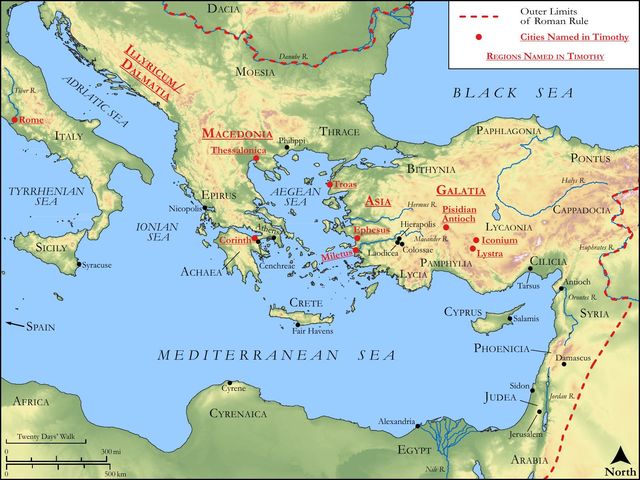
First Timothy was written to Timothy, Paul's protégé, while Timothy was serving as a pastor in Ephesus, a prominent city in Asia Minor known for its diverse religious practices, including the worship of Artemis, and its bustling commercial activity. The early church in Ephesus faced internal challenges from false teachers who promoted asceticism, myths, and a love for money, as well as external pressures from the pagan society. In a world where emperors (like Nero, who ruled during Paul's ministry) and various deities claimed ultimate authority, Paul's declaration of God as the "only Potentate, the King of kings, and Lord of lords" was a radical assertion of monotheistic supremacy. It provided a theological counter-narrative to the prevailing polytheistic and imperial claims, reminding believers that their ultimate allegiance belonged to the one true God, who holds absolute power and determines all events, including the timing of Christ's return.
Key Themes
ShowHide1 Timothy 6:15 powerfully contributes to several overarching themes within the book of 1 Timothy and broader Pauline theology. Firstly, it emphasizes Divine Sovereignty and Eschatological Hope. The phrase "in his times he shall shew" underscores God's absolute control over all history and His perfect timing for the revelation of Christ, reinforcing the hope of Christ's certain return (as also seen in Titus 2:13). Secondly, it highlights God's Supreme Authority and Unrivaled Majesty. The accumulation of majestic titles—"the blessed and only Potentate, the King of kings, and Lord of lords"—serves as a robust theological statement about God's unique and ultimate dominion over all creation and all earthly powers. This theme is foundational to understanding God's character and our proper response of worship and obedience, aligning with the doxological nature of the passage that began in 1 Timothy 1:17.
Exposition and Analysis
ShowHideKey Word Analysis
ShowHideThis term signifies a ruler, sovereign, or one of great authority. In this context, it emphasizes God's inherent, active, and supreme power. He is not merely powerful, but the very embodiment of power, holding all dominion and authority in Himself, distinct from any earthly ruler whose power is delegated or temporal.
This word means supremely blest, fortunate, or well off. When applied to God, it speaks to His intrinsic state of perfect happiness, self-sufficiency, and ultimate blessedness. God is the source of all blessing, perfectly content and complete within Himself, not dependent on anything outside of Himself. This contrasts sharply with human blessedness, which is often contingent on external circumstances.
This refers to an appointed, set, or proper time, an opportune season, as opposed to mere chronological duration (chronos). The use of the plural "times" (G2540) suggests that God has a series of specific, divinely appointed moments in His redemptive plan, and the revelation of Christ is one such crucial, predetermined event in His perfect schedule.
Verse Breakdown
ShowHide"Which in his times he shall shew,"
This phrase refers back to the "appearing of our Lord Jesus Christ" from 1 Timothy 6:14. It asserts God's absolute sovereignty over the timing of Christ's return. The verb "shew" (G1166, deiknýō) implies a powerful, public revelation or display. God, in His perfect wisdom and according to His pre-ordained schedule ("his times," referring to His opportune seasons), will unilaterally bring about this glorious event. It is not dependent on human effort or timing, but solely on divine prerogative.
"[who is] the blessed and only Potentate,"
This clause introduces a series of majestic titles for God, emphasizing His unique nature and supreme authority. "Blessed" (G3107, makários) describes God's inherent state of perfect happiness and self-sufficiency. He is the ultimate source of all blessing. "Only" (G3441, mónos) underscores His singularity and exclusivity in power; there is no other true "Potentate" (G1413, dynástēs) who holds inherent, ultimate dominion. All other rulers derive their authority from Him.
"the King of kings, and Lord of lords;"
These superlative titles further amplify God's absolute supremacy. "King of kings" (G935, basileús) and "Lord of lords" (G2962, kýrios) denote that He reigns over all earthly monarchs and holds dominion over all human and spiritual authorities. No power, whether political, military, or spiritual, can rival His. He is the ultimate sovereign, the one to whom all lesser kings and lords must ultimately bow, highlighting His universal and unchallenged reign.
Literary Devices
ShowHideThe verse is rich in doxological language, serving as a hymn of praise and adoration to God. It employs superlative expressions ("only Potentate," "King of kings," "Lord of lords") to emphasize God's absolute and unrivaled supremacy, a common feature in biblical descriptions of divine majesty. The accumulation of these titles creates a powerful crescendo, building a profound sense of awe and reverence for God's character and authority. There is also a strong element of parallelism in "King of kings, and Lord of lords," which uses a common Hebrew idiom to express the highest possible degree of something, reinforcing the idea of ultimate dominion. The verse also functions as a theological anchor, providing a firm foundation for the preceding exhortations by reminding Timothy of the omnipotent God who stands behind His commands and promises.
Theological and Thematic Connections
ShowHideThis verse offers a profound theological statement about God's nature and His relationship to creation and history. It asserts His absolute sovereignty, not only over the timing of future events like Christ's return but also over all earthly and heavenly powers. God is not merely a powerful being; He is the source and sustainer of all power, unique in His dominion and blessedness. This understanding of God as the ultimate "Potentate" and "King of kings" provides a bedrock of assurance for believers, reminding them that no earthly circumstance or opposing force can thwart His divine purposes. It calls for a response of worship, trust, and unwavering obedience, knowing that our ultimate allegiance is to the one true, supreme Ruler of the universe.
Reflection and Application
ShowHide1 Timothy 6:15 provides immense encouragement and a vital perspective for living the Christian life. In a world often characterized by chaos, uncertainty, and the rise and fall of human powers, this verse reminds us that an infinitely wise, perfectly blessed, and supremely powerful God is ultimately in control. His plans unfold according to "his times," which means we can trust His perfect timing, even when our own patience wears thin or our circumstances seem bleak. This truth should cultivate a deep sense of peace, knowing that the ultimate victory belongs to the King of kings. It also calls us to humble submission and unwavering allegiance. If God is the "only Potentate," then our lives, resources, and ambitions must be surrendered to His sovereign will. Our worship, obedience, and hope are rightly placed in Him alone, the one who guarantees the glorious appearing of His Son and the consummation of His kingdom.
Questions for Reflection
ShowHideFAQ
ShowHideDoes this verse refer to God the Father or Jesus Christ?
ShowHideWhile the titles "King of kings, and Lord of lords" are explicitly applied to Jesus Christ in the book of Revelation (e.g., Revelation 19:16), in the immediate context of 1 Timothy 6:15, the verse primarily refers to God the Father. The phrase "Which in his times he shall shew" indicates that it is God the Father who will reveal or bring about the "appearing of our Lord Jesus Christ" mentioned in the preceding verse (1 Timothy 6:14). However, the shared titles underscore the profound unity and shared divine nature between the Father and the Son, as the Son perfectly embodies and reveals the Father's supreme authority and glory.
What is the significance of "in his times"?
ShowHideThe phrase "in his times" (Greek: kairois idiois) is highly significant because it emphasizes God's absolute sovereignty over all chronological events and appointed seasons. The Greek word kairós (G2540) refers to a specific, opportune, or divinely appointed time, as opposed to chronos, which denotes mere linear time. This means that the appearing of Jesus Christ is not a random event, nor is its timing subject to human prediction or manipulation. Instead, it will occur precisely when God the Father, in His perfect wisdom and according to His eternal plan, determines it. This truth provides immense comfort and stability, assuring believers that God's redemptive purposes will unfold exactly as He intends, regardless of present circumstances or perceived delays (Habakkuk 2:3).
Christ-Centered Fulfillment
ShowHideWhile 1 Timothy 6:15 primarily describes God the Father as the ultimate "Potentate, the King of kings, and Lord of lords" who will reveal Christ, it simultaneously points to the glorious fulfillment of these very titles in Jesus Christ. The "appearing of our Lord Jesus Christ" (1 Timothy 6:14) is the focal point of this divine revelation. Jesus, as the Son, perfectly embodies the Father's supreme authority and power. He is the one through whom the Father's dominion is exercised and made manifest. The New Testament consistently portrays Jesus as the ultimate sovereign, who has been given "all authority in heaven and on earth" (Matthew 28:18). He is the "faithful witness, the firstborn from the dead, and the ruler over the kings of the earth" (Revelation 1:5). Ultimately, at His second coming, Christ Himself will return as the "King of kings and Lord of lords" (Revelation 19:16), demonstrating the Father's absolute power and establishing His eternal kingdom. Thus, this doxology, while directed to the Father, finds its ultimate and visible fulfillment in the person and work of Jesus Christ, the one through whom God's blessedness, unique authority, and universal dominion are perfectly revealed and eternally established.