


Revelation 15:4
Bible text: King James Version (1769 Blayney text) · Public domain
Bible text: King James Version with Strong's numbers · Public domain
Bible text: Berean Standard Bible · Public domain
Bible text: American Standard Version (1901) · Public domain
Bible text: World English Bible, Messianic edition · Public domain
Bible text: Geneva Bible (1599) · Public domain
Bible text: Young's Literal Translation · Public domain
- τίςtisWhoG5101I-NSMInterrogative pronoun Nominative Singular Masculine
- οὐoucertainlyG3756PRT-NNegative Particle Negative
- μὴmēsurelyG3361PRT-NNegative Particle Negative
- φοβηθῇphobēthēamay fearG5399V-AOS-3SVerb Aorist Passive Deponent Subjunctive 3rd Singular
- σεseyouG4771P-2ASPersonal pronoun Accusative 2nd Singular
- κύριεkurieO LordG2962N-VSM-TNoun Vocative Singular Masculine Person Gentilic
- καὶkaiandG2532CONJConjunction
- δοξάσειdoxaseiwill glorifyG1392V-FAI-3SVerb Future Active Indicative 3rd Singular
- τὸtotheG3588T-ASNDefinite article Accusative Singular Neuter
- ὄνομάonomanameG3686N-ASNNoun Accusative Singular Neuter
- σου;souof You?G4771P-2GSPersonal pronoun Genitive 2nd Singular
- ὅτιhotiFor [You]G3754CONJConjunction
- μόνοςmonosalone [are]G3441A-NSMAdjective Nominative Singular Masculine
- ὅσιοςhosiossacredG3741A-NSMAdjective Nominative Singular Masculine
- ὅτιhotiForG3754CONJConjunction
- πάνταpantaallG3956A-NPNAdjective Nominative Plural Neuter
- τὰtatheG3588T-NPNDefinite article Nominative Plural Neuter
- ἔθνηethnēnationsG1484N-NPNNoun Nominative Plural Neuter
- ἥξουσινhēxousinwill comeG2240V-FAI-3PVerb Future Active Indicative 3rd Plural
- καὶkaiandG2532CONJConjunction
- προσκυνήσουσινproskunēsousinwill worshipG4352V-FAI-3PVerb Future Active Indicative 3rd Plural
- ἐνώπιόνenōpionbeforeG1799PREPPreposition
- σουsouYouG4771P-2GSPersonal pronoun Genitive 2nd Singular
- ὅτιhotibecauseG3754CONJConjunction
- τὰtatheG3588T-NPNDefinite article Nominative Plural Neuter
- δικαιώματάdikaiōmatarighteous actsG1345N-NPNNoun Nominative Plural Neuter
- σουsouof YouG4771P-2GSPersonal pronoun Genitive 2nd Singular
- ἐφανερώθησανephanerōthēsanwere revealedG5319V-API-3PVerb Aorist Passive Indicative 3rd Plural
English is a literal word-by-word gloss of the Greek, not the KJV's wording. Why?
This is the original text the KJV's translators worked from — each Greek word with its own literal English meaning in this verse, prepared by scholars at Tyndale House, Cambridge. The KJV translates whole sentences, not word by word, so its wording differs: one Greek word can become several English words, and the KJV may choose “charity” where the gloss reads “love”. Both are faithful — they answer different questions. For the KJV's own rendering, switch to the KJV text.
Details
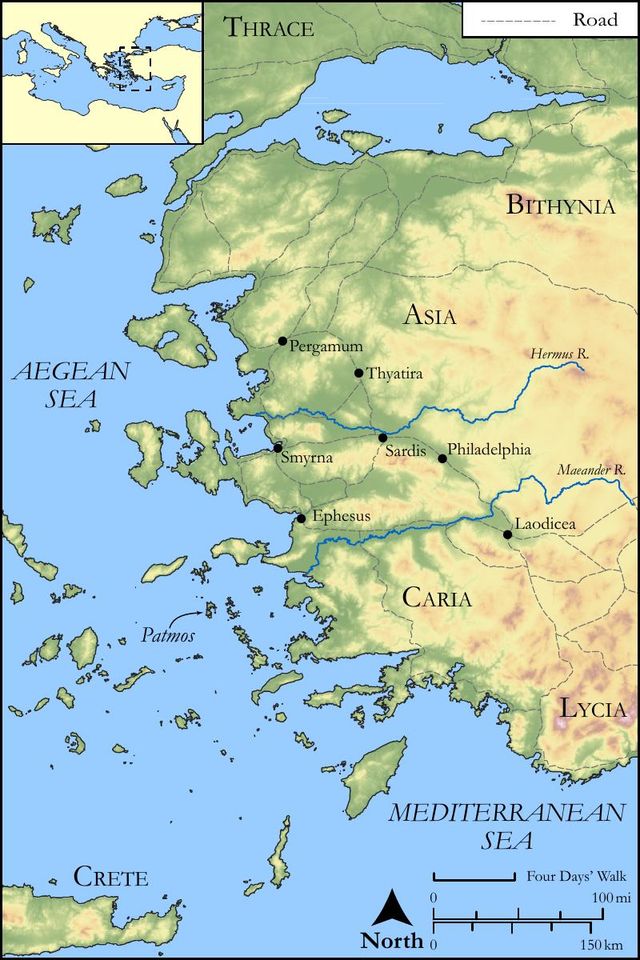
See on the biblical-era maps

Study this verse
Public-domain commentary
Matthew Henry
From his Commentary on the Whole Bible. Henry comments on passages, not single verses — this entry covers Revelation 15:1–4.
Here we have the preparation of matters for the pouring out of the seven vials, which was committed to seven angels; and observe how these angels appeared to the apostle - in heaven; it was in a wonderful manner, and that upon account, 1. Of the work they had to do, which was to finish the destruction of antichrist. God was now about to pour out his seven last plagues upon that interest; and, as the measure of Babylon's sins was filled up, they should now find the full measure of his vindictive wrath. 2. The spectators and witnesses of this their commission: all that had gotten the victory over the beast, etc. These stood on a sea of glass, representing this world, as some think, a brittle thing, that shall be broken to pieces; or, as others, the gospel covenant, alluding to the brazen sea in the temple, in which the priests were to wash (the faithful servants of God stand upon the foundation of the righteousness of Christ); or, as others, the Red Sea, that stood as it were congealed while the Israelites went through; and, the pillar of fire reflecting light upon the waters, they would seem to have fire mingled with them; and this to show that the fire of God's wrath against Pharaoh and his horses should dissolve the congealed waters, and destroy them thereby, to which there seems to be an allusion by their singing the song of Moses, in which, (1.) They extol the greatness of God's works, and the justice and truth of his ways, both in delivering his people and destroying their enemies. They rejoiced in hope, and the near prospect they had of this, though it was not yet accomplished. (2.) They call upon all nations to render unto God the fear, glory, and worship, due to such a discovery of his truth and justice: Who shall not fear thee? Rev 15:4.
Historical interpretation
Four Centuries of Reception
3 surviving comments on this verse. Each one is dated, so this reads as a timeline rather than a list.
Select a marker to jump to its quote. Markers stagger vertically where authors wrote within a few decades of each other.
He expresses here more fully the purpose and goal of the elect, who say from the heart, “Put the way of iniquity far from me, O Lord, and graciously teach me your law,” or, “For the sake of your law I have endured for you, O Lord,” and things similar to these. [By this scene] he wishes to make clear that these are in the number of the faithful in that they are participants in the victory mentioned. In Moses the Old Testament is signified as the New Testament is signified in the Lamb, and by this it teaches us that the elect were all equipped from both and perfected in both.… By a harmonious truth the pages of both Testaments testify to us concerning [their song], for “all the paths of the Lord are mercy and truth.” He is more aptly called the king of the nations, because he was a God not only known among the Jews, nor did the dew from heaven moisten only one fleece. But as Malachi said, “From the rising of the sun to its setting my name is great among the nations, and in every place a pure offering is sacrificed and offered to my name.”
From the song of Moses we learn the hymn sent up to God by those who were justified by the law before [the coming of] grace. From the song of the Lamb we learn the thanksgiving of those who lived in holiness after the coming of the Christ. This thanksgiving is for those benefactions and gifts from him that have come to our race, since through the holy apostles he has called all nations to the knowledge of him.
He says that Christ is indeed King of all nations, but since it is said to Isaiah: "and the root of Jesse and the one who rises to rule the nations, upon him the nations shall hope," (Isa. 11:10) therefore for this reason the vision also calls him King of the nations and that all the peoples shall come and worship him, appropriately announcing beforehand the calling of the nations and their faith toward the Lord.
Continue studying Revelation 15:4 across the web’s major study libraries — every link below opens this exact verse, chapter, or book on the destination site.
Read & Compare
 BibleGatewayThis verse in more than 200 translations and 70 languages.
 Bible.comThe YouVersion reader — hundreds of translations, reading plans, and highlights.
 ESV.orgCrossway's official English Standard Version reader.
 NET BibleThe NET translation with 60,000+ translators' notes on every rendering decision.
 STEP BibleTyndale House's free study tool — original text, vocabulary, and scholarly resources.
 BibliaLogos Bible Software's free web reader.
 USCCBThe New American Bible (Revised Edition) with the U.S. bishops' study notes.
Commentaries
 BibleHub CommentariesDozens of classic commentaries on this verse, gathered on one page.
 StudyLightMore than 100 commentary sets — the largest collection on the web.
 BibleRefPlain-English commentary on what this verse means, verse by verse.
 Enduring WordDavid Guzik's free commentary on this chapter, widely used by Bible teachers.
 Bible Study ToolsVerse commentary alongside Greek and Hebrew study aids.
Original Language & Research
- BibleHub InterlinearThe verse word by word — original language, transliteration, and English.
- BibleHub LexiconEvery word's original-language definition and Strong's entry.
 Blue Letter BibleDeep-study tools — Strong's numbers, concordance, and word studies.
 CNTR CollationThe earliest Greek manuscripts of this verse, collated letter by letter.
Sermons, Hymns & Audio


TrulyRandomVerse is not affiliated with these sites and doesn’t control their content. They’re linked because they’re genuinely useful.
Summary
Revelation 15:4 is a profound declaration from the "Song of Moses and the Lamb," sung by those victorious over the Beast, standing on the sea of glass. It is a rhetorical question that functions as a powerful affirmation of God's unique holiness, His supreme worthiness of fear and glorification, and the ultimate universal acknowledgment of His righteous judgments by all nations. This verse serves as a climactic hymn of praise and anticipation, setting the stage for the outpouring of God's final bowls of wrath, demonstrating that His justice and sovereignty will be fully revealed and recognized across the earth.
Context
ShowHideLiterary Context
Revelation 15:4 is an integral part of the "Song of Moses and the Lamb," sung by the victorious saints who have overcome the Beast, his image, and his mark, standing on the sea of glass mingled with fire (Revelation 15:2). This song, which begins in Revelation 15:3, serves as a prelude to the pouring out of the seven bowls of God's wrath, detailed in Revelation 16. The hymn celebrates God's righteous character and His just acts, providing a theological framework for the severe judgments that are about to be unleashed. It emphasizes that these judgments are not arbitrary but are a manifestation of God's holy and righteous nature, eliciting worship and fear from His redeemed people and ultimately from all creation.
Historical & Cultural Context
The Book of Revelation was written during a period of intense persecution of Christians under the Roman Empire, likely during the reign of Emperor Domitian. In this context, emperor worship was enforced, and refusing to participate could lead to severe consequences. The declaration "Who shall not fear thee, O Lord, and glorify thy name? for thou only art holy" directly challenges the idolatrous claims of earthly rulers and pagan deities. The concept of "nations" (Greek: ethne) coming to worship God has deep roots in Old Testament prophecy, envisioning a future time when the Gentiles would turn from their idols to worship the one true God, as seen in passages like Isaiah 2:2-4 and Zechariah 14:16. This vision would have offered immense hope and vindication to a persecuted community, assuring them that God's ultimate triumph over oppressive earthly powers was certain.
Key Themes
ShowHideThis verse powerfully encapsulates several key themes prevalent throughout the Book of Revelation and broader biblical theology. It underscores God's Absolute Holiness, asserting that He alone possesses this intrinsic perfection, setting Him apart from all creation and false gods. This holiness is the foundation for the Reverential Fear and Glorification that is due to Him, a fear that is not terror but profound awe and worship. The prophecy that "all nations shall come and worship before thee" speaks to the Universal Scope of God's Sovereignty and Worship, a theme that culminates in the New Jerusalem where people from every tribe, tongue, people, and nation will worship God and the Lamb (Revelation 7:9-10). Finally, the verse highlights the Manifestation of God's Judgments, affirming that His righteous decrees and acts of justice are not hidden but openly displayed, vindicating His character and bringing about His perfect will on earth, as seen in the unfolding of the bowl judgments in Revelation 16.
Exposition and Analysis
ShowHideKey Word Analysis
ShowHideThis word means to frighten, or passively, to be alarmed. By analogy, it means to be in awe of, i.e., revere. In this context, it signifies a profound, reverential awe and respect for God's power, authority, and majesty, rather than a servile terror. It is the proper, worshipful response of finite creation to the infinite Creator.
This term describes what is properly right by intrinsic or divine character. It distinguishes God's inherent moral perfection and purity from human statutes, formal consecration, or purity from defilement. When applied to God, it speaks of His unique, transcendent moral perfection and His distinctness from all that is created or sinful, forming the bedrock of His being and the basis for all true worship.
This word refers to an equitable deed, a statute, or a decision. In Revelation 15:4, it signifies God's righteous acts, just decrees, or ordinances. It specifically highlights God's righteous administration of justice, His vindication of His people, and the execution of His divine will, which are openly displayed for all to see and acknowledge.
Verse Breakdown
ShowHide"Who shall not fear thee, O Lord, and glorify thy name?"
This is a powerful rhetorical question, implying that no one should fail to fear and glorify God. It underscores the absolute necessity and inevitability of acknowledging God's supremacy. The "fear" here is not terror but a profound, reverential awe and respect for His divine majesty and power. To "glorify His name" means to acknowledge His inherent glory, to give Him honor, praise, and adoration, recognizing and declaring His divine attributes and mighty acts.
"for thou only art holy:"
This clause provides the foundational reason for the universal fear and glorification of God. His unique and absolute holiness – His moral perfection, purity, and distinctness from all creation – is the singular attribute that makes Him worthy of such ultimate reverence and worship. There is no other being who possesses this inherent, unblemished holiness.
"for all nations shall come and worship before thee;"
This is a prophetic declaration of the ultimate triumph of God's kingdom and the universal recognition of His sovereignty. Despite global rebellion and idolatry, a future time is foretold when every people, tribe, and tongue will bow before Him. This speaks to the eschatological reality where God's reign will be universally acknowledged, and His rightful place as the sole object of worship will be realized.
"for thy judgments are made manifest."
This final clause provides the immediate cause for the nations' coming to worship. God's righteous decrees and acts of justice are not hidden but are openly displayed and revealed to the world. These judgments serve to prove His righteousness, vindicate His character, and bring about His perfect will, compelling even those who previously resisted Him to acknowledge His just and sovereign rule.
Literary Devices
ShowHideRevelation 15:4 employs several potent literary devices that amplify its theological message. The opening phrase, Rhetorical Question ("Who shall not fear thee, O Lord, and glorify thy name?"), is not meant to elicit an answer but to make a strong affirmative statement, emphasizing the undeniable and universal obligation to revere and praise God. This is followed by a clear Cause and Effect structure, indicated by the repeated use of "for." The nations will come and worship "for" God alone is holy, and "for" His judgments are made manifest. This structure logically links God's inherent character (holiness) and His active demonstration of justice (manifest judgments) as the compelling reasons for universal worship. The phrase "thou only art holy" also exemplifies Exclusivity and Divine Uniqueness, highlighting God's singular nature and unparalleled attributes, setting Him apart from all other beings or deities. Furthermore, the mention of "all nations" coming to worship utilizes Hyperbole or Universalism, signifying a comprehensive and global acknowledgment of God's sovereignty, transcending all ethnic and geographical boundaries.
Theological and Thematic Connections
ShowHideRevelation 15:4 stands as a majestic affirmation of God's absolute sovereignty, His intrinsic holiness, and the ultimate triumph of His righteous will. It encapsulates the core biblical truth that God's character is the foundation for all worship and that His justice will inevitably be revealed to all creation. This verse connects to the broader biblical narrative of God's redemptive plan, which culminates in the universal recognition of His authority and the establishment of His kingdom. It assures believers that despite present evil and rebellion, God remains on His throne, actively working out His purposes, and that every knee will ultimately bow before Him, acknowledging His supreme worthiness. The manifestation of His judgments, while terrifying to the unrighteous, is a testament to His perfect justice and faithfulness, bringing about the vindication of His name and His people.
Reflection and Application
ShowHideRevelation 15:4 calls believers to a profound and transformative understanding of God's character and His ultimate victory. In a world often marked by injustice, chaos, and a pervasive disregard for divine authority, this verse serves as a powerful anchor of hope and a clarion call to worship. It reminds us that our worship is not merely an emotional response but a deep, reverential acknowledgment of God's inherent holiness and His unshakeable justice. When we truly grasp that "thou only art holy," our perspective shifts from focusing on earthly powers or personal struggles to fixing our gaze on the One who is supremely worthy of all praise. This understanding should inspire us to live lives that reflect His holiness, trusting that even when His judgments seem slow, they are indeed "made manifest" in His perfect timing. Furthermore, the vision of "all nations" coming to worship should ignite within us a passion for global missions, knowing that our efforts contribute to the ultimate fulfillment of this prophetic declaration. It encourages us to cultivate a reverential fear of the Lord, which is the beginning of wisdom, leading to humble submission, unwavering trust, and joyful obedience to His divine will.
Questions for Reflection
ShowHideFAQ
ShowHideWhat does "fear thee, O Lord" mean in this context?
ShowHideIn Revelation 15:4, "fear" (Greek: phobéō) does not imply terror or fright in the presence of God, but rather a profound, reverential awe, respect, and submission to His supreme power, majesty, and holiness. It is the appropriate response of finite creation to the infinite Creator, acknowledging His unique authority and worthiness of worship. This kind of fear leads to glorification and obedience, as seen throughout biblical wisdom literature (e.g., Proverbs 9:10).
Why is God described as "only holy"?
ShowHideThe phrase "thou only art holy" emphasizes God's unique and intrinsic moral perfection and purity. It signifies that holiness is an inherent attribute of His very being, distinguishing Him from all created beings, human rulers, or false gods. Unlike anything else, God is utterly set apart, without blemish or imperfection. This absolute holiness is the foundation for His righteous character and the ultimate reason He alone is worthy of universal worship and fear. It underscores His incomparable nature, as highlighted in passages like 1 Samuel 2:2.
What is the significance of "all nations shall come and worship before thee"?
ShowHideThis statement is a powerful prophetic declaration of God's ultimate triumph and the universal recognition of His sovereignty. It foretells a future time when, despite global rebellion and idolatry, every people group, nation, and tribe will ultimately acknowledge God's supreme authority and render Him worship. This vision resonates with numerous Old Testament prophecies (e.g., Psalm 22:27) and finds its ultimate fulfillment in the New Testament vision of a multitude from every nation standing before the throne (Revelation 7:9). It signifies the complete victory of God's kingdom over all earthly opposition.
Christ-Centered Fulfillment
ShowHideRevelation 15:4, with its declaration of God's unique holiness, universal worship, and manifest judgments, finds its profound Christ-centered fulfillment in the person and work of Jesus Christ. Jesus is the perfect embodiment of God's holiness, being "the radiance of God's glory and the exact representation of his being" (Hebrews 1:3). He is the one through whom the Father's holiness is fully revealed to humanity, for "the Word became flesh and made his dwelling among us. We have seen his glory, the glory of the one and only Son, who came from the Father, full of grace and truth" (John 1:14). The universal worship prophesied in this verse is ultimately directed to both God the Father and God the Son, for it is through Christ that all nations are invited to come. The Great Commission in Matthew 28:18-20 commands believers to "make disciples of all nations," actively participating in the very fulfillment of this prophecy. Furthermore, the "judgments made manifest" are supremely revealed through Christ's redemptive work on the cross, where God's justice against sin was satisfied, and His mercy was poured out. While Christ is the Lamb who takes away the sin of the world (John 1:29), He is also the one to whom "the Father judges no one, but has entrusted all judgment to the Son" (John 5:22). Thus, Revelation 15:4 points forward to the ultimate reign of Christ, where His holiness will be universally acknowledged, and His righteous judgments will bring about the full and final establishment of God's kingdom.