


Isaiah 66:22
Bible text: King James Version (1769 Blayney text) · Public domain
Bible text: King James Version with Strong's numbers · Public domain
Bible text: Berean Standard Bible · Public domain
Bible text: American Standard Version (1901) · Public domain
Bible text: World English Bible, Messianic edition · Public domain
Bible text: Geneva Bible (1599) · Public domain
Bible text: Young's Literal Translation · Public domain
- כִּיkiforH3588PrtParticle Conditional
- כַאֲשֶׁרkha·'a·Sherjust asH834Prep-k ¦ RelParticle Relativeכַjustאֲשֶׁרas
- הַשָּׁמַיִםha·sha·Ma·yimthe heavensH8064Art ¦ N-mpNoun Plural Masculine Absoluteהַtheשָּׁמַיִםheavens
- הַחֳדָשִׁיםHa·cho·da·shim<the> newH2319Art ¦ Adj-mpAdjective Plural Masculine Absoluteהַ<the>חֳדָשִׁיםnew
- וְהָאָרֶץve·ha·'A·retzand the earthH776Conj-w ¦ Art ¦ N-fsNoun Singular Feminine Absoluteוְandהָtheאָרֶץearth
- הַחֲדָשָׁהha·cha·da·Shah<the> newH2319Art ¦ Adj-fsAdjective Singular Feminine Absoluteהַ<the>חֲדָשָׁהnew
- אֲשֶׁר'a·SherwhichH834RelParticle Relative
- אֲנִי'a·NiIH589Pro-1csPronoun Personal 1st Singular common gender
- עֹשֶׂה'o·Seh[am] about to makeH6213V-Qal-Prtcpl-msVerb Qal Participle Singular Masculine Absolute
- עֹמְדִים'o·me·Dim[will] endureH5975V-Qal-Prtcpl-mpVerb Qal Participle Plural Masculine Absolute
- לְפָנַיle·fa·Nai<to> before meH6440Prep-l ¦ N-mpc ¦ 1csNoun Plural Masculine Constructלְ<to>פָנַbeforeיme
- נְאֻםne·'um[the] utterance ofH5002N-mscNoun Singular Masculine Construct
- יְהוָהYah·wehYahwehH3068N-properNoun Proper Title
- כֵּןkensoH3651AdvAdverb
- יַעֲמֹדya·'a·Modit will endureH5975V-Qal-Imperf-3msVerb Qal Imperfect 3rd Singular Masculine
- זַרְעֲכֶםzar·'a·Khemyour offspringH2233N-msc ¦ 2mpNoun Singular Masculine Constructזַרְעֲoffspringכֶםyour
- וְשִׁמְכֶםve·shim·Khemand your nameH8034Conj-w ¦ N-msc ¦ 2mpNoun Singular Masculine Constructוְandשִׁמְnameכֶםyour
English is a literal word-by-word gloss of the Hebrew, not the KJV's wording. Why?
This is the original text the KJV's translators worked from — each Hebrew word with its own literal English meaning in this verse, prepared by scholars at Tyndale House, Cambridge. The KJV translates whole sentences, not word by word, so its wording differs: one Hebrew word can become several English words, and the KJV may choose “the LORD” where the gloss reads “Yahweh”. Both are faithful — they answer different questions. For the KJV's own rendering, switch to the KJV text.
Details
See on the biblical-era map
Study this verse
Public-domain commentary
Matthew Henry
From his Commentary on the Whole Bible. Henry comments on passages, not single verses — this entry covers Isaiah 66:15–24. His four-level outline is real structure in the source text, so it is rendered as structure.
These verses, like the pillar of cloud and fire, have a dark side towards the enemies of God's kingdom and all that are rebels against his crown, and a bright side towards his faithful loyal subjects. Probably they refer to the Jews in captivity in Babylon, of whom some are said to have been sent thither for their hurt, and with them God here threatens to proceed in his controversy; they hated to be reformed, and therefore should be ruined by the calamity (Jer 24:9); others were sent thither for their good, and they should have the trouble sanctified to them, should in due time get well through it and see many a good day after it. Many of the expressions here used are accommodated to that glorious dispensation; but doubtless the prophecy looks further, to the judgment for which Christ did come once, and will come again, into this world, and to the distinction which his word in both makes between the precious and the vile.
I.Christ will appear to the confusion and terror of all those that stand it out against him.
Sometimes he will appear in temporal judgments. The Jews that persisted in infidelity were cut off by fire and by his sword. The ruin was very extensive; the Lord then pleaded with all flesh; and, it being his sword with which they are cut off, they are called his slain, sacrificed to his justice, and they shall be many. In the great day the wrath of God will be his fire and sword, with which he will cut off and consume all the impenitent; and his word, when it takes hold of sinners' consciences, burns like fire, and is sharper than any two-edged sword. Idolaters will especially be contended with in the day of wrath, Isa 66:17. Perhaps some of those who returned out of Babylon retained such instances of idolatry and superstition as are here mentioned, had their idols in their gardens (not daring to set them up publicly in the high places) and there purified themselves (as the worshippers of the true God used to do) when they went about their idolatrous rites, one after another, or, as we read it, behind one tree in the midst, behind Ahad or Ehad, some idol that they worshipped by that name and in honour of which they ate swine's flesh (which was expressly forbidden by the law of God), and other abominations, as the mouse, or some other like animal. But the prophecy may refer to all those judgments which the wrath of God, according to the word of God, will bring upon provoking sinners, that live in contempt of God and are devoted to the world and the flesh: They shall be consumed together. From the happiness of heaven we find expressly excluded all idolaters, and whosoever worketh abomination, Rev 21:27; Rev 22:15. In the day of vengeance secret wickedness will be brought to light and brought to the account; for (Isa 66:18), I know their works and their thoughts. God knows both what men do and from what principle and with what design they do it; and therefore is fit to judge the world, because he can judge the secrets of men, Rom 2:16.
II.He will appear to the comfort and joy of all that are faithful to him in the setting up of his kingdom in this world, the kingdom of grace, the earnest and first-fruits of the kingdom of glory. The time shall come that he will gather all nations and tongues to himself, that they may come and see his glory as it shines in the face of Jesus Christ, Isa 66:18. This was fulfilled when all nations were to be discipled and the gift of tongues was bestowed in order thereunto. The church had hitherto been confined to one nation and in one tongue only God was worshipped; but in the days of the Messiah the partition-wall should be taken down, and those that had been strangers to God should be brought acquainted with him and should see his glory in the gospel, as the Jews had seen it in the sanctuary. As to this, it is here promised,
1.That some of the Jewish nation should, by the grace of God, be distinguished form the rest, and marked for salvation: I will not only set up a gathering ensign among them, to which the Gentiles shall seek (as is promised, Isa 11:12), but there shall be those among them on whom I will set a differencing sign; for so the word signifies. Though they are a corrupt degenerate nation, yet God will set apart a remnant of them, that shall be devoted to him and employed for him, and a mark shall be set upon them, with such certainty will God own them, Eze 9:4. The servants of God shall be sealed in their foreheads, Rev 7:3. The Lord knows those that are his. Christ's sheep are marked.
2.That those who are themselves distinguished thus by the grace of God shall be commissioned to invite others to come and take the benefit of that grace. Those that escape the power of those prejudices by which the generality of that nation is kept in unbelief shall be sent to the nations to carry the gospel among them, and preach it to every creature. Note, Those who themselves have escaped the wrath to come should do all they can to snatch others also as brands out of the burning. God chooses to send those on his errands that can deliver their message feelingly and experimentally, and warn people of their danger by sin as those who have themselves narrowly escaped the danger.
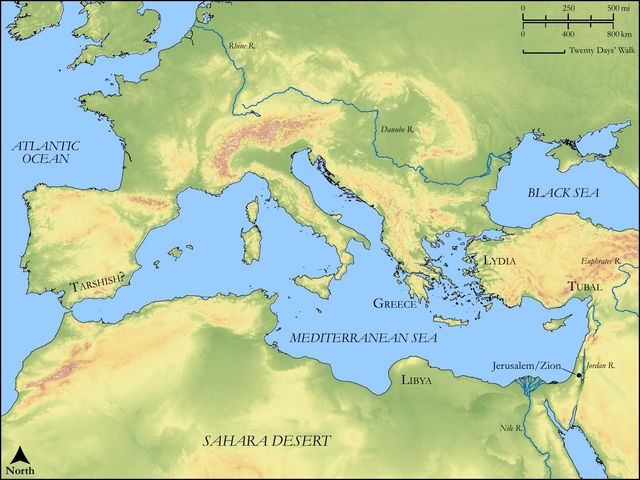
(1.)They shall be sent to the nations, several of which are here named, Tarshish, and Pul, and Lud, etc. It is uncertain, nor are interpreters agreed, what countries are here intended. Tarshish signifies in general the sea, yet some take it for Tarsus in Cilicia. Pul is mentioned sometimes as the name of one of the kings of Assyria; perhaps some part of that country might likewise bear that name. Lud is supposed to be Lydia, a warlike nation, famed for archers: the Lydians are said to handle and bend the bow, Jer 46:9. Tubal, some think, is Italy or Spain; and Javan most agree to be Greece, the Iones; and the isles of the Gentiles, that were peopled by the posterity of Japhet (Gen 10:5), probably are here meant by the isles afar off, that have not heard my name, neither have seen my glory. In Judah only was God known, and there only his name was great for many ages. Other countries sat in darkness, heard no the joyful sound, saw not the joyful light. This deplorable state of theirs seems to be spoken of here with compassion; for it is a pity that any of the children of men should be at such a distance from their Maker as not to hear his name and see his glory. In consideration of this,
(2.)Those that are sent to the nations shall go upon God's errand, to declare his glory among the Gentiles. The Jews that shall be dispersed among the nations shall declare the glory of God's providence concerning their nation all along, by which many shall be invited to join with them, as also by the appearances of God's glory among them in his ordinances. Some out of all languages of the nations shall take hold of the skirt of him that is a Jew, entreating him to take notice of them, to admit them into his company, and to stay a little while for them, till they are ready, "for we will go with you, having heard that God is with you," Zac 8:23. Thus the glory of God was in part declared among the Gentiles; but more clearly and fully by the apostles and early preachers of the gospel, who were sent into all the world, even to the isles afar off, to publish the glorious gospel of the blessed God. They went forth and preached every where, the Lord working with them, Mar 16:20.
3.That many converts shall hereby be made, Isa 66:20.
(1.)They shall bring all your brethren (for proselytes ought to be owned and embraced as brethren) for an offering unto the Lord. God's glory shall not be in vain declared to them, but they shall be both invited and directed to join themselves to the Lord. Those that are sent to them shall succeed so well in their negotiation that thereupon there shall be as great flocking to Jerusalem as used to be at the time of a solemn feast, when all the males from all parts of the country were to attend there, and not to appear empty. Observe,
[1.]The conveniences that they shall be furnished with for their coming. Some shall come upon horses, because they came from far and the journey was too long to travel on foot, as the Jews usually did to their feasts. Persons of quality shall come in chariots, and the aged, and sickly, and little children, shall be brought in litters or covered wagons, and the young men on mules and swift beasts. This intimates their zeal and forwardness to come. They shall spare no trouble nor charge to get to Jerusalem. Those that cannot ride on horseback shall come in litters; and in such haste shall they be, and so impatient of delay, that those that can shall ride upon mules and swift beasts. These expressions are figurative, and these various means of conveyance are heaped up to intimate (says the learned Mr. Gataker) the abundant provision of all those gracious helps requisite for the bringing of God's elect home to Christ. All shall be welcome, and nothing shall be wanting for their assistance and encouragement.
[2.]The character under which they shall be brought. They shall come, not as formerly they used to come to Jerusalem, to be offerers, but to be themselves an offering unto the Lord, which must be understood spiritually, of their being presented to God as living sacrifices, Rom 12:1. The apostle explains this, and perhaps refers to it, Rom 15:16, where he speaks of his ministering the gospel to the Gentiles, that the offering up, or sacrificing, of the Gentiles might be acceptable. They shall offer themselves, and those who are the instruments of their conversion shall offer them, as the spoils which they have taken for Christ and which are devoted to his service and honour. They shall be brought as the children of Israel bring an offering in a clean vessel, with great care that they be holy, purified from sin, and sanctified to God. It is said of the converted Gentiles (Act 15:9) that their hearts were purified by faith. Whatever was brought to God was brought in a clean vessel, a vessel appropriated to religious uses. God will be served and honoured in the way that he has appointed, in the ordinances of his own institution, which are the proper vehicles for these spiritual offerings. When the soul is offered up to God the body must be a clean vessel for it, possessed in sanctification and honour, and not in the lusts of uncleanness (Th1 4:4, Th1 4:5); and converts to Christ are not only purged from an evil conscience, but have their bodies also washed with pure water, Heb 10:22. Now,
(2.)This may refer,
[1.]To the Jews, devout men, and proselytes out of every nation under heaven, that flocked together to Jerusalem, expecting the kingdom of the Messiah to appear, Act 2:5, Act 2:6, Act 2:10. They came from all parts to the holy mountain of Jerusalem, as an offering to the Lord, and there many of them were brought to the faith of Christ by the gift of tongues poured out on the apostles. Methinks there is some correspondence between that history and this prophecy. The eunuch some time after came to worship at Jerusalem in his chariot and took home with him the knowledge of Christ and his holy religion.
[2.]To the Gentiles, some of all nations, that should be converted to Christ, and so added to his church, which, though a spiritual accession, is often in prophecy represented by a local motion. The apostle says of all true Christians that they have come to Mount Zion, and the heavenly Jerusalem (Heb 12:22), which explains this passage, and shows that the meaning of all this parade is only that they shall be brought into the church by the grace of God, and in the use of the means of that grace, as carefully, safely, and comfortably, as if they were carried in chariots and litters. Thus God shall persuade Japhet and he shall dwell in the tents of Shem, Gen 9:27.
4.That a gospel ministry shall be set up in the church, it being thus enlarged by the addition of such a multitude of members to it (Isa 66:21): I will take of them (of the proselytes, of the Gentile converts) for priests and for Levites, to minister in holy things and to preside in their religious assemblies, which is very necessary for doctrine, worship, and discipline. Hitherto the priests and Levites were all taken from among the Jews and were all of one tribe; but in gospel times God will take of the converted Gentiles to minister to him in holy things, to teach the people, to bless them in the name of the Lord, to be the stewards of the mysteries of God as the priests and Levites were under the law, to be pastors and teachers (or bishops), to give themselves to the word and prayer, and deacons to serve tables, and, as the Levites, to take care of the outward business of the house of God, Phi 1:1; Act 6:2-4. The apostles were all Jews, and so were the seventy disciples; the great apostle of the Gentiles was himself a Hebrew of the Hebrews; but, when churches were planted among the Gentiles, they had ministers settled who were of themselves, elders in every church (Act 14:23, Tit 1:5), which made the ministry to spread the more easily, and to be the more familiar, and, if not the more venerable, yet the more acceptable; gospel grace, it might be hoped, would cure people of those corruptions which kept a prophet from having honour in his own country. God says, I will take, not all of them, though they are all in a spiritual sense made to our God kings and priests, but of them, some of them. It is God's work originally to choose ministers by qualifying them for and inclining them to the service, as well as to make ministers by giving them their commission. I will take them, that is, I will admit them, though Gentiles, and will accept of them and their ministrations. This is a great honour and advantage to the Gentile church, as it was to the Jewish church that God raised up of their sons for prophets and their young men for Nazarites, Amo 2:11.
5.That the church and ministry, being thus settled, shall continue and be kept up in a succession from one generation to another, Isa 66:22. The change that will be made by the setting up of the kingdom of the Messiah is here described to be,
(1.)A very great and universal change; it shall be a new world, the new heavens and the new earth promised before, Isa 65:17. Old things have passed away, behold all things have become new (Co2 5:17), the old covenant of peculiarity is set aside, and a new covenant, a covenant of grace, established, Heb 8:13. We are now to serve in newness of the spirit, and not in the oldness of the letter, Rom 7:6. New commandments are given relating both to heaven and earth, and new promises relating to both, and both together make a New Testament; so that they are new heavens and a new earth that God will create, and these a preparative for the new heavens and new earth designed at the end of time, Pe2 3:13.
(2.)A change of God's own making; he will create the new heavens and the new earth. The change was made by him that had authority to make new ordinances, as well as power to make new worlds.
(3.)It will be an abiding lasting change, a change never to be changed, a new world that will be always new, and never wax old, as that does which is ready to vanish away: It shall remain before me unalterable; for the gospel dispensation is to continue to the end of time and not to be succeeded by any other. The kingdom of Christ is a kingdom that cannot be moved; the laws and privileges of it are things that cannot be shaken, but shall for ever remain, Heb 12:27, Heb 12:28. It shall therefore remain, because it is before God; it is under his eye, and care, and special protection.
(4.)It will be maintained in a seed that shall serve Christ: Your seed, and in them your name, shall remain - a seed of ministers, a seed of Christians; as one generation of both passes away, another generation shall come; and thus the name of Christ, with that of Christians, shall continue on earth while the earth remains, and his throne as the days of heaven. The gates of hell, though they fight against the church, shall not prevail, nor wear out the saints of the Most High.
6.That the public worship of God in religious assemblies shall be carefully and constantly attended upon by all that are thus brought as an offering to the Lord, Isa 66:23. This is described in expressions suited to the Old Testament dispensation, to show that though the ceremonial law should be abolished, and the temple service should come to an end, yet God should be still as regularly, constantly, and acceptably worshipped as ever. Heretofore only Jews went up to appear before God, and they were bound to attend only three times a year, and the males only; but now all flesh, Gentiles as well as Jews, women as well as men, shall come and worship before God, in his presence, though not in his temple at Jerusalem, but in religious assemblies dispersed all the world over, which shall be to them as the tabernacle of meeting was to the Jews. God will in them record his name, and, though but two or three come together, he will be among them, will meet them, and bless them. And they shall have the benefit of these holy convocations frequently, every new moon and every sabbath, not, as formerly, at the three annual feasts only. There is no necessity of one certain place, as the temple was of old. Christ is our temple, in whom by faith all believers meet, and now that the church is so far extended it is impossible that all should meet at one place; but it is fit that there should be a certain time appointed, that the service may be done certainly and frequently, and a token thereby given of the spiritual communion which all Christian assemblies have with each other by faith, hope, and holy love. The new moons and the sabbaths are mentioned because, under the law, though the yearly feasts were to be celebrated at Jerusalem, yet the new moons and the sabbaths were religiously observed all the country over, in the schools of the prophets first and afterwards in the synagogues (Kg2 4:23, Amo 8:5, Act 15:21), according to the model of which Christian assemblies seem to be formed. Where the Lord's day is weekly sanctified, and the Lord's supper monthly celebrated, and both are duly attended on, there this promise is fulfilled, there the Christian new moons and sabbaths are observed. See, here,
(1.)That God is to be worshipped in solemn assemblies, and that it is the duty of all, as they have opportunity, to wait upon God in those assemblies: All flesh must come; though flesh, weak, corrupt, and sinful, let them come that the flesh may be mortified.
(2.)In worshipping God we present ourselves before him, and are in a special manner in his presence.
(3.)For doing this there ought to be stated times, and are so; and we must see that it is our interest as well as our duty constantly and conscientiously to observe these times.
7.That their thankful sense of God's distinguishing favour to them should be very much increased by the consideration of the fearful doom and destruction of those that persist and perish in their infidelity and impiety, Isa 66:24. Those that have been worshipping the Lord of hosts, and rejoicing before him in the goodness of his house, shall, in order to affect themselves the more with their own happiness, take a view of the misery of the wicked. Observe,
(1.)Who they are whose misery is here described. They are men that have transgressed against God, not only broken his laws, but broken covenant with him, and thought themselves able to contend with him. It may be meant especially of the unbelieving Jews that rejected the gospel of Christ.
(2.)What their misery is. It is here represented by the frightful spectacle of a field of battle, covered with the carcases of the slain, that lie rotting above ground, full of worms crawling about them and feeding on them; and, if you go to burn them, they are so scattered, and it is such a noisome piece of work to get them together, that it would be endless, and the fire would never be quenched; so that they are an abhorring to all flesh, nobody cares to come near them. Now this is sometimes accomplished in temporal judgments, and perhaps never nearer the letter than in the destruction of Jerusalem and the Jewish nation by the Romans, in which destruction it is computed that above two millions, first and last, were cut off by the sword, besides what perished by famine and pestilence. It may refer likewise to the spiritual judgments that came upon the unbelieving Jews, which St. Paul looks upon, and shows us, Rom 11:8, etc. They became dead in sins, twice dead. The church of the Jews was a carcase of a church; all its members were putrid carcases; their worm died not, their own consciences made them continually uneasy, and the fire of their rage against the gospel was not quenched, which was their punishment as well as their sin; and they became, more than ever any nation under the sun, an abhorring to all flesh. But our Saviour applies it to the everlasting misery and torment of impenitent sinners in the future state, where their worm dies not, and their fire is not quenched (Mar 9:44); for the soul, whose conscience is its constant tormentor, is immortal, and God, whose wrath is its constant terror, is eternal.
(3.)What notice shall be taken of it. Those that worship God shall go forth and look upon them, to affect their own hearts with the love of their Redeemer, when they see what misery they are redeemed from. As it will aggravate the miseries of the damned to see others in the kingdom of heaven and themselves thrust out (Luk 13:28), so it will illustrate the joys and glories of the blessed to see what becomes of those that died in their transgression, and it will elevate their praises to think that they were themselves as brands plucked out of that burning. To the honour of that free grace which thus distinguished them let the redeemed of the Lord with all humility, and not without a holy trembling, sing their triumphant songs.
Historical interpretation
Historical reception
3 surviving comments on this verse. Each one is dated, so this reads as a timeline rather than a list.
Select a marker to jump to its quote. Markers stagger vertically where authors wrote within a few decades of each other.
(Vers. 22, 23.) For as the new heavens and the new earth, which I will make to stand before me, saith the Lord: so shall your seed stand, and your name. And there shall be month after month, and sabbath after sabbath: all flesh shall come to adore in my sight, saith the Lord. LXX: For as the new heavens and the new earth, which I will make to remain before me, saith the Lord: so shall your seed and your name remain. And there shall be month after month, and sabbath after sabbath: all flesh shall come to adore in my sight in Jerusalem the Lord. When he says: 'Assume from among them priests and Levites,' he indicates that the old priesthood was passed over, which was owed to the Levitical tribe, where there is not an election, but a natural order, and it is a succession of a family descending through offspring. For with the translation of the priesthood, it is necessary that both the translation of the Law be made, and the election pertain to those to whom priesthood is conferred, not according to blood, but according to merits and virtues, who will come from the islands of the Gentiles and announce the glory of the Lord. And they shall be brought in on horses, and in chariots, and in litters, and on mules, and in wagons. But as for the new heaven and the new earth, and the new Jerusalem, that it may not be said: The heaven and the earth shall pass away (Matt. XXIV, 35). And again: The heaven shall be folded up like a book: and the earth shall be dissolved by its corruption (Apoc. VI, 14): so in all things new, the people of God shall be made new, as scripture says: The old things have passed away: behold all things are made new (Isa. XLIII, 19). And in another place: If any man be in Christ a new creature (II Cor. V, 17) . And there shall be a new people; for Christ is the firstfruits, then they that are Christ's, at his coming: and there shall be a new heaven and a new earth, whereof it is said among the eight beatitudes: Blessed are the poor in spirit, for theirs is the kingdom of heaven. Blessed are the meek, for they shall possess the land (Matth. V, 3, 4) . For the creature was made subject to vanity, not willingly, but by reason of him that made it subject, in hope (Rom. VIII). But they will be set free from the slavery of corruption into the glory of the children of God, who will be made sons of him through men, and they will stand before him forever, and their name will always remain so that no other nation may succeed them, as happened among the Jews; but they shall remain forever. And, he says, month by month there will be a month, and Sabbath after Sabbath: so that from carnal Sabbaths and months, delicate spiritual Sabbaths may be made, which is the Sabbath of God reserved for the people. The spiritual month, when it is completed from one point to another by the moon, and follows its own order, in order to make a month, that is, the kalends, which in Greek are called 'neomeniai', that is, the beginning of the new month. Among them, the beginning of the kalends does not start and end according to the course of the sun and the different spans of the months, but according to the circuit of the moon. This is the moon about which in praise of the true Solomon it is said: 'It shall endure as long as the sun and before the moon throughout all generations' (Psalm 72:5). She who is called the chosen one in the Song of Songs: Who is this that comes forth like the dawn, beautiful as the moon, bright as the sun, awe-inspiring? (Song of Songs 6:9) Physicists, who are concerned with discussing celestial matters, say that the moon does not have its own light, but is illuminated by the rays of the sun. It is always filled and shines by a part of it, from which it is closer to the sun, and it is not hidden by the shadow of the earth, as the poet also demonstrated in a single verse (Virgil, Georgics Book I).
Nor does the moon rise under the rays of her brother.
If this is true, and we can also say in a metaphorical sense, that the Church which grows and diminishes in times of peace and persecution, and once again takes on its original light, shining with the radiance of the sun of justice, and this is what is meant by: 'The moon will shine like the sun' (Isai. XXX, 26); and its inhabitants will shine like the sun in the kingdom of their father. And during these months, the seed of the Lord, which is renewed forever, comes to its solemnities, which the holy one proclaimed with mystical words, saying: 'I have considered the eternal years, and I have meditated' (Psal. LXXVI, 6). But on the Sabbath, which signifies rest, we have treated extensively in the sermon (On Chapter LVI), about the prophecy of the eunuch strangers. And now it must be said briefly that they come on the new moons and on the Sabbaths, those who, having passed and left behind the six days in which the world was made, hasten to the seventh day, that is, the Sabbath, in which true rest is found. Concerning these solemnities, the believing Apostle Paul instructs, saying: For the law having a shadow of the good things to come (Hebrews X, 1). And again: Therefore let no one judge you in food, or in drink, or regarding a festival, or a new moon, or Sabbaths, which are a shadow of things to come (Colossians II, 16). But if these have preceded in the shadow of future goods, and in an image, then the whole law must be understood spiritually, of which the same Apostle said: We know that the law is spiritual (Romans VII, 14), the mysteries of which David desired to know: Open my eyes, and I will contemplate the wonders of your law (Psalm CXVIII, 18). For the things that are seen are temporal; but the things that are not seen are eternal. (II Corinthians IV). To quickly run through a discussion about these things is not of this time. For if the eye has not seen, nor the ear heard, neither has it entered into the heart of man, what things God has prepared for those who love him (I Corinthians II), how can we attempt to show the summary of the entire Law and the world in a short tablet? And what follows: All flesh shall come to adore in my sight in Jerusalem, it should be known that it is not written in Hebrew, Jerusalem, so that we may deride the pride of the Jews, but only 'in my sight', so that the word of the Lord may be fulfilled, saying in the Gospel: Amen, amen, I say to you, that the hour comes when you shall neither on this mountain, nor in Jerusalem adore the Father (John IV, 21). And again: The Spirit is God. And those who worship Him must worship in spirit and truth (John, 4:24). And the Apostle also said: Lifting up holy hands in every place (I Tim. II, 8). But all flesh does not signify the Jewish people, but every kind of people, according to what was said above: All flesh shall see your salvation (Isaiah, 40:5). And in Joel: I will pour out my Spirit upon all flesh, and your sons and daughters will prophesy (Joel, 2:28). And in Zechariah: Let all flesh fear before the Lord (Zech. II, 13). And in the Psalms: To you all flesh will come (Ps. LXIV, 2). Which in other words is said in another psalm: All the nations you have made shall come and worship before you, O Lord, and shall glorify your name (Ps. LXXXV, 9). They interpret from month to month, and from Sabbath to Sabbath, when all flesh will come to worship God, the "chiliasts," who we can call the Milestones: so that those who are nearby come to Jerusalem every Sabbath; those who are far away come through months, that is, completing the cycle of the calendar; those who are very far away come through individual years, that is, on the days of Passover or Tabernacles, according to what is said in Zechariah: And it shall come to pass that everyone who is left of all the nations which came against Jerusalem shall go up from year to year to worship the King, the Lord of hosts, and to keep the Feast of Tabernacles (Zech. XIV, 16). And to provide greater laughter to the hearers, which is written in the last volume of the same prophet: 'And there will no longer be a merchant in the house of the Lord of hosts on that day,' thus they interpret, that merchants will cease to exist for a thousand years, because everything will be produced in all places, so that neither will we need the leaf of amomum and pepper, nor will the Indians desire pennyroyal from us.
“ ‘And I will take from them priests and Levites,’ says the Lord,” so that those who will be saved can preach to the Gentiles.” Concerning this, one author said, “Thus a person should regard us as ministers of Christ and dispensers of the mysteries of God,” and the Evangelist Luke wrote, “just as they delivered to us, who saw from the beginning and were ministers of the word.” We, too, read above about this very matter: “But you will be for me priests of the Lord.” For just as he who is circumcised by the Spirit is a Jew in hiding, of whom it is written “we are the circumcision who serve the Spirit of God and offer spiritual sacrifices pleasing to God and sing psalms with the Spirit and with the mind,” so also they are priests and Levites in hiding who follow not a genealogy but the order of faith. It is certain, at least, that this does not speak of the apostles or of apostolic men, who were the princes of the church from the people of the Jews, but it speaks instead of those Gentiles enumerated above, from the sea, from Africa, from Lybia, from Cappadocia, from Italy, from Greece, and from all the islands, the inhabitants of which have not yet had an opportunity to hear the Lord for the first time or to see his glory and afterward to be made priests, such that those who were the tail may become the head and those who were the head may become the tail.“For, like the new heaven and the new earth that I will cause to stand before me,” says the Lord, “so shall your seed and your name stand. From month to month and from sabbath to sabbath, all flesh will come to adore the Lord in my presence in Jerusalem.”
When the Lord says, “I will take from them priests and Levites,” he shows the old priesthood to have passed away, which was bound to the tribe of Levi, where there was no choice but only a succession by the order of nature in family posterity. For “when there is a change in the priesthood, it is necessary that there be a change in the law as well” and that election to the priesthood be conferred by no means according to blood lineage but according to merits and virtues, choosing people who will come from the islands of the Gentiles and proclaim the glory of the Lord.
This is the immovable hope that Christ promises in all goodness to those who love him and who acknowledged his epiphany. As it says, “When I remake the heaven and the earth, I will allow them to remain, and no passing of time will destroy them.” So your seed and your name will stand before me. For we are the new heaven and the new earth and his promised things, just as they are written about. For the hope of the saints will stand forever and endures, as Paul confirms. …These misfortunes piled on the Jews are meant to be the things we say happened to them at the hands of the Romans, when the temple was destroyed and all were subjected to cruel slaughter. For suffering such things they became a spectacle for all, but their suffering was not prolonged indefinitely. Yet this is what perhaps is meant when it says, “Their worm will not die nor the fire go out.” Some, however, want to refer these words concerning them to the time of the end of the age.… In any case, Christ will deliver us from all such things, through whom and with whom may glory be to God the Father and the Holy Spirit forever.
Continue studying Isaiah 66:22 across the web’s major study libraries — every link below opens this exact verse, chapter, or book on the destination site.
Read & Compare
 BibleGatewayThis verse in more than 200 translations and 70 languages.
 Bible.comThe YouVersion reader — hundreds of translations, reading plans, and highlights.
 ESV.orgCrossway's official English Standard Version reader.
 NET BibleThe NET translation with 60,000+ translators' notes on every rendering decision.
 STEP BibleTyndale House's free study tool — original text, vocabulary, and scholarly resources.
 BibliaLogos Bible Software's free web reader.
 USCCBThe New American Bible (Revised Edition) with the U.S. bishops' study notes.
Commentaries
 BibleHub CommentariesDozens of classic commentaries on this verse, gathered on one page.
 StudyLightMore than 100 commentary sets — the largest collection on the web.
 BibleRefPlain-English commentary on what this verse means, verse by verse.
 Enduring WordDavid Guzik's free commentary on this chapter, widely used by Bible teachers.
 Bible Study ToolsVerse commentary alongside Greek and Hebrew study aids.
Original Language & Research
- BibleHub InterlinearThe verse word by word — original language, transliteration, and English.
- BibleHub LexiconEvery word's original-language definition and Strong's entry.
 Blue Letter BibleDeep-study tools — Strong's numbers, concordance, and word studies.
 SefariaThe Hebrew text with Rashi and centuries of Jewish commentary.
Sermons, Hymns & Audio


TrulyRandomVerse is not affiliated with these sites and doesn’t control their content. They’re linked because they’re genuinely useful.
Summary
Isaiah 66:22 delivers a profound promise of enduring hope and permanence, serving as a climactic affirmation of God's unwavering commitment to His covenant people and His renewed creation. This verse declares that just as the divinely fashioned new heavens and new earth will stand eternally before the Lord, so too will the lineage and identity of His faithful remnant endure, securing their place and legacy in the eschatological age.
Context
ShowHideLiterary Context
Isaiah 66:22 stands near the conclusion of the book of Isaiah, specifically within the final chapters (Isaiah 65-Isaiah 66) that present a grand vision of God's ultimate judgment and glorious restoration. This section contrasts the fate of the rebellious with the blessed destiny of the obedient, culminating in a powerful eschatological hope. The verse immediately follows prophecies concerning the gathering of all nations to Jerusalem (Isaiah 66:18-21) and precedes a final image of universal worship and the perpetual judgment of the wicked (Isaiah 66:23-24). It directly builds upon the promise of a new heavens and a new earth introduced in the preceding chapter, emphasizing the stability and permanence of this divine renewal.
Historical & Cultural Context
The prophecies in Isaiah, particularly in its latter half, address a people who have experienced exile or are on the cusp of it, grappling with questions of God's faithfulness, their national identity, and their future. The concept of "seed" (posterity) and "name" (reputation, legacy) was profoundly important in Israel, signifying continuity, honor, and the perpetuation of a family or nation. For a people facing potential annihilation or assimilation, the promise of an enduring seed and name was an extraordinary comfort, assuring them that their identity as God's chosen people would not be erased. The imagery of creation and new creation also resonates with the foundational narratives of Israel, reminding them of God's sovereign power as Creator and Sustainer, capable of bringing forth new life and order from chaos.
Key Themes
ShowHideThe verse powerfully articulates several core themes present throughout Isaiah. Firstly, Divine Faithfulness and Permanence is paramount; God's promises are as unshakeable as His new creation. This reinforces His reliability, a message crucial for a people who had experienced significant national upheaval and doubted His presence. Secondly, Everlasting Hope for God's People provides profound assurance; their identity, spiritual lineage, and place before God are eternally secure. This promise of an enduring future contrasts sharply with the fleeting nature of earthly kingdoms and human endeavors, offering an anchor for their souls. Finally, the theme of New Creation is central, pointing to a complete, divinely orchestrated renewal of the heavens and the earth, where righteousness and God's presence are fully manifested, a vision that finds its ultimate echo in the New Testament's descriptions of the new heaven and new earth.
Exposition and Analysis
ShowHideKey Word Analysis
ShowHideFrom the root חָדַשׁ, meaning "to renew, repair, make new." This word signifies not merely a superficial change but a profound, qualitative renewal. In the context of "new heavens and new earth," it speaks of a creation that is fresh, vibrant, and fundamentally different from the old, corrupted order, indicating a divine act of restoration that brings about a pristine state. It implies a complete transformation rather than a mere alteration.
A primitive root conveying the sense "to stand, in various relations (literal and figurative, intransitive and transitive)." It denotes stability, endurance, establishment, and continuance. Its repetition in the verse ("shall remain... so shall... remain") emphasizes the absolute, unwavering, and eternal nature of both God's new creation and His promise regarding His people's perpetual existence before Him. This word assures an unshakeable, permanent presence.
From זָרַע, meaning "seed," but figuratively extending to "fruit, plant, sowing-time, posterity." In this context, it refers primarily to descendants or offspring, encompassing both physical lineage and spiritual posterity. Coupled with "name," it speaks to the enduring identity, legacy, and continuous presence of God's faithful people throughout all generations and into eternity. It signifies the perpetuation of their existence as a distinct people of God.
Verse Breakdown
ShowHide"For as the new heavens and the new earth, which I will make,"
This opening clause establishes a foundational comparison, drawing on God's ultimate creative power. The "new heavens and new earth" represent a complete, divine re-creation, a perfect and uncorrupted creation that God Himself brings into being. The phrase "which I will make" highlights God's sole agency and sovereign authority in this grand eschatological renewal, emphasizing that this is not a human endeavor but a divine promise.
"shall remain before me, saith the LORD,"
This segment declares the absolute permanence and stability of God's new creation. "Shall remain before me" signifies not only their enduring existence but also their continuous presence in God's sight and under His direct oversight and favor. The divine oracle "saith the LORD" (Yᵉhôvâh, the covenant name of God) serves as an authoritative seal, guaranteeing the truth and certainty of this promise, underscoring the unchangeable nature of God's word and His covenant faithfulness.
"so shall your seed and your name remain."
This final clause presents the core promise to God's faithful people, directly paralleling the permanence of the new creation. "Your seed" refers to their descendants, their lineage, both physical and spiritual. "Your name" encompasses their identity, reputation, and legacy. Together, "seed and name" signify their enduring presence, recognition, and secure standing before God, ensuring that the faithful will never be cut off, forgotten, or cease to exist as His distinct people.
Literary Devices
ShowHideIsaiah 66:22 employs several powerful literary devices to convey its message of enduring hope and certainty. The most prominent is Simile, introduced by the "For as... so shall..." construction, which creates a direct and forceful comparison. The unshakeable permanence of God's new creation serves as the ultimate guarantee for the permanence of His people's "seed and name." This simile elevates the promise to an unshakeable certainty, grounded in the very nature of God's creative and sustaining power. Additionally, Parallelism is evident in the balanced structure of the comparison, where the stability of the new heavens and the new earth is directly mirrored by the stability of the covenant people's existence. The phrase "saith the LORD" functions as a Divine Oracle Formula, a common prophetic device that authenticates the message as a direct utterance from God, lending it ultimate authority, infallibility, and an emphatic seal of truth.
Theological and Thematic Connections
ShowHideIsaiah 66:22 stands as a cornerstone of biblical eschatology, connecting the promise of a renewed creation with the enduring security of God's covenant people. It underscores the profound truth that God's faithfulness is inextricably linked to His creative power and His redemptive plan. The permanence of the "new heavens and new earth" is not merely a backdrop but the very foundation upon which the eternal security of the "seed and name" of the faithful rests. This vision assures believers that their identity in God, their spiritual lineage, and their future inheritance are as immutable as God's own creative acts, promising a future where their relationship with Him is perpetually established and celebrated. It is a testament to God's unwavering commitment to His promises, providing ultimate hope beyond the transient nature of the present world.
Reflection and Application
ShowHideIsaiah 66:22 offers profound comfort and a steadfast anchor for the soul in a world characterized by relentless change, uncertainty, and the fleeting nature of all things temporal. This verse reminds us that our ultimate hope is not placed in human institutions, economic stability, or personal achievements, which are all subject to decay, but in the unchanging character and eternal purposes of the Almighty God. It calls us to cultivate an eternal perspective, recognizing that our true identity, our spiritual lineage as children of God, and our inheritance are secured not by our own efforts but by the unshakeable promises of a faithful Creator. This truth should inspire unwavering perseverance in the face of trials, deep trust in God's sovereign plan, and a life lived in worship, knowing that our future is as certain as the new creation God Himself will bring forth. It encourages us to live with courage and hope, knowing that our ultimate destiny is eternally secured in God's unfailing love and power.
Questions for Reflection
ShowHideFAQ
ShowHideWhat does "new heavens and new earth" signify in this context?
ShowHideThe phrase "new heavens and new earth" (Hebrew: châdâsh shâmayim vᵉʼerets) signifies a complete, qualitative renewal and transformation of the heavens and the earth, not merely a superficial renovation. It speaks of a creation that is fresh, pure, and restored to a state of perfection, free from the corruption of sin and its effects. This is a divine act, emphasizing God's sovereign power to make all things new, establishing a dwelling place where righteousness fully abides, as further revealed in Revelation 21:1 and 2 Peter 3:13. It represents the culmination of God's redemptive plan for all creation.
Who is meant by "your seed and your name"?
ShowHide"Your seed and your name" refers to God's faithful people, those who respond to His call and obey His voice. "Seed" (Hebrew: zeraʻ) denotes posterity, descendants, or offspring, encompassing both physical lineage and spiritual heirs. "Name" (Hebrew: shêm) signifies identity, reputation, legacy, and remembrance. Together, these phrases assure the enduring presence, recognition, and secure standing of God's covenant people before Him. This promise extends beyond a mere physical line to include all who are spiritually Abraham's seed through faith, as elaborated in the New Testament, particularly in Galatians 3:7-9. It is a promise of an eternal, distinct identity as God's beloved people.
Christ-Centered Fulfillment
ShowHideIsaiah 66:22 finds its ultimate and most glorious fulfillment in Jesus Christ, who is the very embodiment of the "new creation" and through whom God's people are eternally secured. Christ Himself is the one who inaugurates the new covenant and makes all things new (2 Corinthians 5:17 and Revelation 21:5). The permanence promised to "your seed and your name" is realized in those who are "in Christ," for they become the true spiritual seed of Abraham by faith (Galatians 3:29). Through His atoning work, Jesus provides the means for humanity to enter into this new creation, securing an imperishable inheritance and an eternal name that will never be blotted out (Philippians 2:9-11 and Hebrews 1:8). Thus, the enduring presence of God's people before Him is guaranteed not by their own merit, but by their union with Christ, the eternal Son, in whom all the promises of God are "Yes" and "Amen" (2 Corinthians 1:20), ensuring their eternal dwelling in the presence of the Lord in the new heavens and new earth.