


Zechariah 14:16
- וְהָיָהve·ha·Yahand it will beH1961Conj-w ¦ V-Qal-ConsecPerf-3msVerb Qal Consecutive Perfect 3rd Singular Masculineוְandהָיָהit will be
- כָּלkoleveryH3605N-mscNoun Singular Masculine Construct
- הַנּוֹתָרha·no·Tar<the> [one who] remainsH3498Art ¦ V-Niphal-Prtcpl-msVerb Niphal Participle Singular Masculine Absoluteהַ<the>נּוֹתָר[one who] remains
- מִכָּלmi·kolof allH3605Prep-m ¦ N-mscNoun Singular Masculine Constructמִofכָּלall
- הַגּוֹיִםha·go·Yimthe nationsH1471Art ¦ N-mpNoun Plural Masculine Absoluteהַtheגּוֹיִםnations
- הַבָּאִיםha·ba·'Imwhich cameH935Art ¦ V-Qal-Prtcpl-mpVerb Qal Participle Plural Masculine Absoluteהַwhichבָּאִיםcame
- עַל'alonH5921PrepPreposition
- יְרוּשָׁלִָםye·ru·sha·LimJerusalemH3389N-properNoun Proper Location
- וְעָלוּve·'a·Luand they will go upH5927Conj-w ¦ V-Qal-ConsecPerf-3cpVerb Qal Consecutive Perfect 3rd Plural common genderוְandעָלוּthey will go up
- מִדֵּיmi·Deias often asH1767Prep-m ¦ N-mscNoun Singular Masculine Constructמִasדֵּיoften as
- שָׁנָהsha·Naha yearH8141N-fsNoun Singular Feminine Absolute
- בְשָׁנָהve·sha·Nahin a yearH8141Prep-b ¦ N-fsNoun Singular Feminine Absoluteבְinשָׁנָהa year
- לְהִשְׁתַּחֲוֹתle·hish·ta·cha·Votto bow downH7812Prep-l ¦ V-Hishtaphel-InfVerb Hishtaphel Infinitive Constructלְtoהִשְׁתַּחֲוֹתbow down
- לְמֶלֶךְle·Me·lekhto [the] kingH4428Prep-l ¦ N-msNoun Singular Masculine Absoluteלְtoמֶלֶךְ[the] king
- יְהוָהYah·wehYahwehH3068N-properNoun Proper Title
- צְבָאוֹתtze·va·'otof hostsH6635N-fpNoun Plural Feminine Absolute
- וְלָחֹגve·la·Chogand to celebrate a festivalH2287Conj-w ¦ Prep-l ¦ V-Qal-InfVerb Qal Infinitive Constructוְandלָtoחֹגcelebrate a festival
- אֶת'et<obj.>H853DirObjMParticle Object Indicator
- חַגchag[the] festival ofH2282N-mscNoun Singular Masculine Construct
- הַסֻּכּוֹתha·su·Kot<the> TabernaclesH5521Art ¦ N-fpNoun Plural Feminine Absoluteהַ<the>סֻּכּוֹתTabernacles
English is a literal word-by-word gloss of the Hebrew, not the KJV's wording. Why?
This is the original text the KJV's translators worked from — each Hebrew word with its own literal English meaning in this verse, prepared by scholars at Tyndale House, Cambridge. The KJV translates whole sentences, not word by word, so its wording differs: one Hebrew word can become several English words, and the KJV may choose “the LORD” where the gloss reads “Yahweh”. Both are faithful — they answer different questions. For the KJV's own rendering, switch to the KJV text.
Details
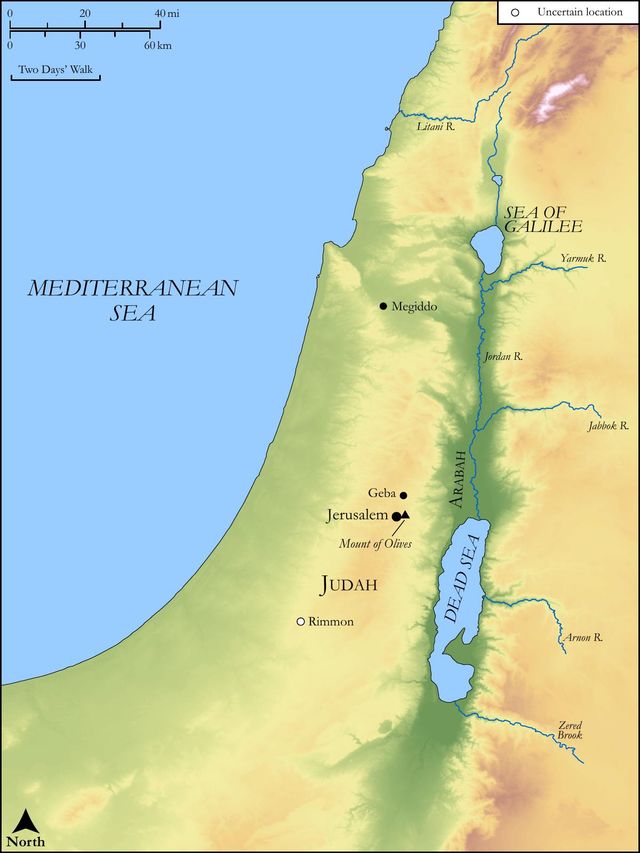
See on the biblical-era map
Study this verse
Public-domain commentary
Matthew Henry
From his Commentary on the Whole Bible. Henry comments on passages, not single verses — this entry covers Zechariah 14:16–21. His four-level outline is real structure in the source text, so it is rendered as structure.
Three things are here foretold: -
I.That a gospel-way of worship being set up in the church there shall be a great resort to it and a general attendance upon it.
Those that were left of the enemies of religion shall be so sensible of the mercy of God to them in their narrow escape that they shall apply themselves to the worship of the God of Israel, and pay their homage to him, Zac 14:16. Those that were not consumed shall be converted, and this makes their deliverance a mercy indeed, a double mercy. It is a great change that the grace of God makes upon them; those that had come against Jerusalem, finding their attempts vain and fruitless, shall become as much her admirers as ever they had been her adversaries, and shall come to Jerusalem to worship there, and go in concurrence with those whom they had gone contrary to. Note, As some of Christ's foes shall be made his footstool, so others of them shall be made his friends; and, when the principle of enmity is slain in them, their former acts of hostility are pardoned to them, and their services are admitted and accepted, as though they had never fought against Jerusalem. They shall go up to worship at Jerusalem, because that was the place which God had chosen, and there the temple was, which was a type of Christ and his mediation. Converting grace sets us right,
1.In the object of our worship. They shall no longer worship the Molochs and Baals, the kings and lords, that the Gentiles worship, the creatures of their own imagination, but the King, the Lord of hosts, the everlasting King, the King of kings, the sovereign Lord of all.
2.In the ordinances of worship, those which God himself has appointed. Gospel-worship is here represented by the keeping of the feast of tabernacles, for the sake of those two great graces which were in a special manner acted and signified in that feast - contempt of the world, and joy in God, Neh 8:17. The life of a good Christian is a constant feast of tabernacles, and, in all acts of devotion, we must retire from the world and rejoice in the Lord, must worship as in that feast.
3.In the Mediator of our worship; we must go to Christ our temple with all our offerings, for in him only our spiritual sacrifices are acceptable to God, Pe1 2:5. If we rest in ourselves, we come short of pleasing God; we must go up to him, and mention his righteousness only.
4.In the time of it; we must be constant. They shall go up from year to year, at the times appointed for this solemn feast. Every day of a Christian's life is a day of the feast of tabernacles, and every Lord's day especially (that is the great day of the feast); and therefore every day we must worship the Lord of hosts and every Lord's day with a peculiar solemnity.
II.That those who neglect the duties of gospel-worship shall be reckoned with for their neglect.
God will compel them to come and worship before him, by suspending his favours from those that keep not his ordinances: Upon them there shall be no rain, Zac 14:17. Some understand it figuratively; the rain of heavenly doctrine shall be withheld, and of the heavenly grace, which should accompany that doctrine. God will command the clouds that they rain no rain upon them. Note, It is a righteous thing with God to withhold the blessings of grace from those that do not attend the means of grace, to deny the green pastures to those that attend not the shepherd's tents. Or we may take it literally: On them there shall be no rain, to make their ground fruitful. Note, The gifts of common providence are justly denied to those that neglect and despise instituted ordinances. Those that neglected to build the temple were punished with the want of rain (Hag 2:17), and so were those that neglected to attend there when it was built. If we be barren and unfruitful towards God, justly is the earth made so to us. Many are crossed, and go backward, in their affairs, and this is at the bottom of it - they do not keep close to the worship of God as they should; they go off from God, and then he walks contrary to them. If we omit or postpone the duties he expects from us, it is just with him to deny the favours we expect from him. But what shall be done to the defaulters of the land of Egypt, to whom the threatening of the want of rain is no threatening, for they have no rain at any time; they need none; they desire none; the river Nilus is to them instead of the clouds of heaven, waters their land, and makes it fruitful, so that what is a punishment to others is none to them? Zac 14:18, Zac 14:19. It is threatened that if the family of Egypt go not up, that have no rain, yet God will find out a way to meet with them, for there shall be, in effect, the same plague wherewith other nations are smitten for their neglect. God can, and often did, restrain the overflowing of the river, which was equivalent to the shutting up of the clouds; or if the river did its part, and rose as high as it used to do, God had other ways of bringing famine upon them, and destroying the fruits of their ground, as he did by several of the ten plagues of Egypt, so that this (that is, the same) shall be the punishment of Egypt that is the punishment of other nations who come not up to keep the feast of tabernacles. Note, Those who think themselves least indebted to, and depending on, the mercy of heaven, cannot therefore think themselves guarded against the justice of Heaven. It does not follow that those who can live without rain can therefore live without God; for not the heavens only, but all other creatures, are that to us that God makes them to be, and no more; nor can any man's way of living enable him to set light by the judgments of God. This shall be the punishment - margin, This shall be the sin of Egypt, and the sin of all nations, that come not up to keep the feast of tabernacles. The same word signifies both sin and the punishment of sin, so close and inseparable is the connexion between them (as Gen 4:7), and sin is often its own punishment. Note, Omissions are sins, and we must come into judgment for them; those contract guilt that go not up to worship at the times appointed, as they have opportunity; and it is a sin that is its own punishment, for those who forsake the duty forfeit the privilege of communion with God.
III.That those who perform the duties of gospel-worship shall have grace to adorn their profession by the duties of a gospel-conversation too.
This is promised (Zac 14:20, Zac 14:21), and it is necessary to the completing of the beauty and happiness of the church. In general, all shall be holiness to the Lord.
1.The name and character of holiness shall not be so confined as formerly. Holiness to the Lord had been written only upon the high priest's forehead, but now it shall not be so appropriated. All Christians shall be living temples, and spiritual priests, dedicated to the honour of God and employed in his service.
2.Real holiness shall be more diffused than it had been, because there shall be more powerful means of sanctification, more excellent rules, more cogent arguments, and brighter patterns of holiness, and because there shall be a more plentiful effusion of the Spirit of holiness and sanctification, after Christ's ascension than ever before.
(1.)There shall be holiness introduced into common things; and those things shall be devoted to God that seemed very foreign.
[1.]The furniture of their horses shall be consecrated to God. "Upon the bells of the horses shall be engraven Holiness to the Lord, or upon the bridles of the horses (so the margin) or the trappings. The horses used in war shall no longer be used against God and his people, as they have been, but for him and them. Even their wars shall be holy wars, their troopers serving under God's banner. Their great men, who ride in state with a pompous retinue, shall reckon it their greatest ornament to honour God with their honours. Holiness to the Lord shall be written on the harness of their chariot-horses, as great men have sometimes their coat of arms with their motto painted on their coaches; every gentleman shall take the high priest's motto for his, and glory in it, and make it a memento to himself not to do any thing unworthy of it. Travellers shall have it upon their bridles, with which they guide their horses, as those who desire always to be put in mind of it, by having it continually before them, and to guide themselves in all their motions by this rule. The bells of the horses, which are designed to quicken them in their journey and to give notice of their approach, shall have Holiness to the Lord upon them," to signify that this is that which we ought to be influenced by ourselves, and make profession of to others, wherever we go.
[2.]The furniture of their houses too shall be consecrated to God, to be employed in his service. First, The furniture of the priests' houses, or apartments adjoining to the house of the Lord. The common drinking cups they used shall be like the bowls before the altar, that were used either to receive the blood of the sacrifices or to present the wine and oil in, which were for the drink-offerings. The vessels which they used for their own tables shall be used in such a religious manner, with such sobriety and temperance, such devotedness to the glory of God, and such a mixture of pious thoughts and expressions, that their meals shall look like sacrifices; they shall eat and drink, not to themselves, but to him that spreads their tables and fills their cups. And thus, in ministers' families especially, should common actions be done after a godly sort, however they are done in other families. Secondly, The furniture of other houses, those of the common people: "Every pot in Jerusalem and in Judah shall be holiness to the Lord. The pots in which they boil their meat, the cups out of which they drink their wine (Jer 35:5), in these God's good creatures shall never be abused to excess, nor that made the food and fuel of lust which should be oil to the wheels of obedience," as had formerly been, when all tables were full of vomit and filthiness, Isa 28:8. "What they eat and drink out of these shall nourish their bodies for the service of God; and out of these they shall give liberally for the relief of the poor;" then are they Holiness to the Lord, as the merchandise and the hire of the converted Tyrians are said to be (Isa 23:18); for both in our gettings and in our spendings we must have an eye to the will of God as our rule and the glory of God as our end. Thirdly, When there shall be such an abundance of real holiness people shall not be nice and curious about ceremonial holiness: "Those that sacrifice shall come and take of these common vessels, and seethe their sacrifices therein, making no distinction between them and the bowls before the altar." In gospel-times the true worshippers shall worship God in spirit and in truth, and neither in this mountain nor yet at Jerusalem, Joh 4:21. One place shall be as acceptable to God as another (I will that men pray every where); and one vessel shall be as acceptable as another. Little regard shall be had to the circumstance, provided there be nothing indecent or disorderly, while the substance is religiously preserved and adhered to. Some think it intimates that there should be greater numbers of sacrifices offered than the vessels of the sanctuary would serve for; but, rather than any should be turned back or deferred. they shall make no difficulty at all of using common vessels, as the Levites in a case of necessity helped the priests to kill the sacrifices, Ch2 29:34.
(2.)There shall be no unholiness introduced into their sacred things, to corrupt them: In that day there shall be no more the Canaanite in the house of the Lord of hosts. Some read it, There shall be no more the merchant, for so a Canaanite sometimes signifies; and they think it was fulfilled when Christ once and again drove the buyers and sellers out of the temple. Or though those that were Canaanites, strangers and foreigners, shall be brought into the house of the Lord, yet they shall cease to be Canaanites; they shall have nothing of the spirit or disposition of Canaanites in them. Or it intimates that though in gospel-times people should grow indifferent as to holy vessels, yet they should be very strict in church-discipline, and careful not to admit the profane to special ordinances, but to separate between the precious and the vile, between Israelites and Canaanites. Yet this will not have its full accomplishment short of the heavenly Jerusalem, that house of the Lord of hosts, into which no unclean thing shall enter; for at the end of time, and not before, Christ shall gather out of his kingdom every thing that offends, and the tares and wheat shall be perfectly and eternally separated.
Historical interpretation
Fourteen Centuries of Reception
3 surviving comments on this verse. Each one is dated, so this reads as a timeline rather than a list.
Select a marker to jump to its quote. Markers stagger vertically where authors wrote within a few decades of each other.
(Verse 16.) And all who remain of all the nations that came against Jerusalem shall go up year after year to worship the King, the Lord of hosts, and to keep the Feast of Tabernacles. LXX: And it shall come to pass that everyone who is left of all the nations which came against Jerusalem shall go up from year to year to worship the King, the Lord Almighty, and to keep the Feast of Tabernacles. All, he said, who remain from the nations that came against Jerusalem, shall go up year after year to worship the King, the Lord of hosts, and to celebrate the feast of Tabernacles. The Jews also promise that this will happen in the empty hope of a thousand-year kingdom, the beginning of which is this solemnity: The people of Israel went forth from Egypt through a vast and terrible and broad wilderness, in which there was no house, village, town, or cave, and they made for themselves tabernacles and tents (which are now called tents from the likeness of a small bird's wing) in which they dwelt with their spouses and children, and took food, and avoided the heat of the sun by day, the dampness and cold and harm of the dew by night. And it was commanded that the feast of Tabernacles should be held on the fifteenth day of the seventh month. And when your son asks you tomorrow, saying, What do these tabernacles mean? You shall respond to him: For a long time we have been traveling in Egypt, from which the Lord brought us out into the wilderness, and therefore we set up tabernacles, so that we may remember the blessings of God at all times, when we began to dwell in cities (Deut. VI, 20, 21, and Lev. XXIII, 43). He also commanded them to make tabernacles from very beautiful wood, which the Jews call citron, and from the branches and leaves of very dense wood, and from willow and poplar. We have laid the foundations of history, so that we may move from these to spiritual matters. As long as we are in progress and in the course and struggle, we dwell in tabernacles, striving in our whole mind, so that we may move from tabernacles to a firm and stable dwelling, that is, the house of God. Therefore, holy David says in the Psalm: Woe is me, that my dwelling is prolonged (Ps. 119:5)! And: I am a stranger and a sojourner as all my fathers were (Ps. 38:31). This is spoken by someone who is in Egypt, and still living in the world. But whoever leaves Egypt, which is called Moab in Hebrew, and interpreted as tribulation; and enters the desert of vices, takes his journey, and says in the psalm: I will go through to the place of the wonderful tent, even to the house of God (Ps. XLI, 5). For it is admirable not to dwell with the Egyptians; but with Pharaoh drowned, to desire to enter the land of promise (Exod. XIV). And elsewhere it is said: How lovely are your dwelling places, O Lord of hosts! My soul longs, indeed it even faints for the courts of the Lord (Ps. 84:1). And a little later: Blessed are those who dwell in your house, they will praise you forever and ever (ibid., 84:5). For we find written in Proverbs: The house of the righteous will stand firm, their dwelling places will endure for those who act rightly (Prov. 2:21). He promises about houses, that they remain; about tabernacles, that they have statures. And in another place the holy man says: One thing I have asked of the Lord, this I will seek, that I may dwell in the house of the Lord all the days of my life, and see the delight of the Lord, and visit His temple (Psalm 27:4). The one who dwells in such tabernacles, and from tabernacles goes to courtyards, and from courtyards goes to the house, and from the house goes to the temple of the Lord, ought to celebrate the feasts of tabernacles in the most beautiful wood of wisdom, about which it is said in Proverbs: It is a tree of life to all who approach it, and those who lean on it, as on a firm house (Proverbs 3:18). And in the branches of the palm trees, in which the sign of victory and the reward of virtue are contained, and in the leaves of the densest tree which the Jews understand to be myrtle, because of the mortification of the flesh and desires. Hence, it is offered to the Lord and Savior by the Magi in the form of myrrh (Matt. II). And he says, in the branches of the willow and the poplar, which some call one tree; and the name of the wood itself, which is called in Greek ἁγνὸς, indicates chastity. Doctors say, and those who have written about the nature of trees and plants, that if anyone drinks a mixture of willow flower or poplar with water, all heat will cool in him, and the vein of desire will become dry, and he will not be able to produce children. Whoever is protected by the branches of such trees should observe the feast of tabernacles, passing through the sixth month which refers to the world, and celebrating the spiritual Sabbath on the seventh day of the same month, when the moon of the night is fullest, and all its darkness is resolved by bright light. We have said these things briefly, contemplating in our mind the magnitude of the books, so that we may move on to the remaining ones.
They that shall be left: That is, many of them that persecuted the church shall be converted to its faith and communion.-- Ibid.
To keep the feast of tabernacles: This feast was kept by the Jews in memory of their sojourning forty years in the desert, in their way to the land of promise. And in the spiritual sense is duly kept by all such Christians as in their earthly pilgrimage are continually advancing toward their true home, the heavenly Jerusalem; by the help of the sacraments and sacrifice of the church. And they that neglect this must not look for the kind showers of divine grace, to give fruitfulness to their souls.
Continue studying Zechariah 14:16 across the web’s major study libraries — every link below opens this exact verse, chapter, or book on the destination site.
Read & Compare
 BibleGatewayThis verse in more than 200 translations and 70 languages.
 Bible.comThe YouVersion reader — hundreds of translations, reading plans, and highlights.
 ESV.orgCrossway's official English Standard Version reader.
 NET BibleThe NET translation with 60,000+ translators' notes on every rendering decision.
 STEP BibleTyndale House's free study tool — original text, vocabulary, and scholarly resources.
 BibliaLogos Bible Software's free web reader.
 USCCBThe New American Bible (Revised Edition) with the U.S. bishops' study notes.
Commentaries
 BibleHub CommentariesDozens of classic commentaries on this verse, gathered on one page.
 StudyLightMore than 100 commentary sets — the largest collection on the web.
 BibleRefPlain-English commentary on what this verse means, verse by verse.
 Enduring WordDavid Guzik's free commentary on this chapter, widely used by Bible teachers.
 Bible Study ToolsVerse commentary alongside Greek and Hebrew study aids.
Original Language & Research
- BibleHub InterlinearThe verse word by word — original language, transliteration, and English.
- BibleHub LexiconEvery word's original-language definition and Strong's entry.
 Blue Letter BibleDeep-study tools — Strong's numbers, concordance, and word studies.
 SefariaThe Hebrew text with Rashi and centuries of Jewish commentary.
Sermons, Hymns & Audio


TrulyRandomVerse is not affiliated with these sites and doesn’t control their content. They’re linked because they’re genuinely useful.
Summary
Zechariah 14:16 offers a profound prophetic vision of the post-conflict Messianic age, depicting a future where all surviving nations, even those who previously opposed Jerusalem, will annually journey to the holy city. Their purpose will be to worship the sovereign King, the LORD of hosts, and to observe the Feast of Tabernacles, signifying a universal acknowledgment of God's reign, a profound transformation from enmity to peace, and the joyous ingathering of all peoples into His kingdom.
Context
ShowHideLiterary Context
Zechariah 14:16 is situated within the climactic final chapter of the book of Zechariah, which vividly portrays the "Day of the Lord." The preceding verses (Zechariah 14:1-15) describe a dramatic eschatological battle where all nations gather against Jerusalem, followed by the LORD's miraculous intervention, a cataclysmic reshaping of the land, and the defeat of Jerusalem's enemies. This intervention establishes the LORD's universal kingship, as declared in Zechariah 14:9. Verse 16 then shifts from the judgment and conflict to the subsequent era of peace and universal worship, detailing the transformed relationship between God and the surviving nations. It serves as a direct consequence and fulfillment of the LORD's established reign, demonstrating the lasting impact of His victory and the establishment of His kingdom.
Historical & Cultural Context
The historical backdrop for Zechariah is the post-exilic period, as the Jewish people returned from Babylon and began rebuilding the temple and their national life. They faced discouragement and opposition, and Zechariah's prophecies provided hope and encouragement by looking forward to God's ultimate vindication of Jerusalem and the establishment of His kingdom. Culturally, the "Feast of Tabernacles" (Sukkot) was one of the three major annual pilgrimage festivals for Israel, commemorating God's provision during their wilderness wanderings and celebrating the ingathering of the harvest. Its mention here, in a universal context, elevates its significance beyond Israel to encompass all humanity, symbolizing God's dwelling with His people and the ingathering of all nations. The concept of "nations coming against Jerusalem" was a recurring historical reality and prophetic motif, reflecting the geopolitical struggles of Israel's past and future.
Key Themes
ShowHideThis verse powerfully contributes to several key themes within Zechariah and broader biblical prophecy. Firstly, it underscores the theme of God's Universal Sovereignty, explicitly stating that the LORD will be "King over all the earth" (Zechariah 14:9). Secondly, it highlights Universal Worship and Acknowledgment, envisioning a future where "every one that is left of all the nations" will come to worship, moving beyond Israel-centric worship to global adoration. This aligns with prophecies in Isaiah 2:2-4 and Micah 4:1-3. Thirdly, the observance of the Feast of Tabernacles emphasizes God's Dwelling Among Humanity and the Ingathering of Nations, symbolizing a time of divine presence, joy, and the inclusion of Gentiles into God's redemptive plan, a theme also seen in Isaiah 60:3. Finally, the transformation of former adversaries into worshippers speaks to Ultimate Peace and Reconciliation under God's righteous rule, a stark contrast to the conflict described earlier in the chapter.
Exposition and Analysis
ShowHideKey Word Analysis
ShowHideThis term, often translated as "Gentile" or "heathen," refers to foreign peoples or ethnic groups distinct from Israel. In this context, it specifically denotes the non-Israelite peoples who previously "came against Jerusalem," emphasizing the dramatic reversal where former adversaries will now come in worship, acknowledging the true King.
This primitive root means "to depress, i.e., prostrate," signifying an act of profound submission, homage, and reverence, typically by bowing down or falling flat. Its use here indicates not merely attendance, but a deep, humble acknowledgment of the King's supreme authority and worthiness of adoration, a stark contrast to their former hostility.
Chag refers to a festival or solemn feast, often involving a sacred procession. Çukkâh means "hut" or "booth." Together, this refers to Sukkot, a joyous harvest festival commemorating God's provision during Israel's wilderness wanderings and His dwelling among them. Its universal observance in this prophecy symbolizes God's ultimate presence with all humanity and the ingathering of the harvest of nations.
Verse Breakdown
ShowHide"And it shall come to pass, that every one that is left of all the nations which came against Jerusalem"
This opening clause sets the stage for a future event, specifically targeting the survivors from the Gentile nations that had previously waged war against Jerusalem. It highlights God's sovereignty even in judgment, preserving a remnant from these hostile groups who will now be transformed from adversaries into worshippers.
"shall even go up from year to year to worship the King, the LORD of hosts"
This specifies the annual pilgrimage of these surviving nations to Jerusalem. Their purpose is to "worship," indicating a profound act of obeisance and adoration. The object of their worship is explicitly identified as "the King, the LORD of hosts," emphasizing God's supreme, universal, and military authority over all creation. The annual nature suggests a perpetual, established practice in this future kingdom.
"and to keep the feast of tabernacles"
This final clause details the specific act of worship: the observance of Sukkot. Its inclusion signifies the universalization of a distinctly Israelite festival, symbolizing God's dwelling among all peoples, the joyous celebration of His provision, and the ingathering of all nations into His redemptive plan in the Messianic era.
Literary Devices
ShowHideZechariah 14:16 employs several potent literary devices to convey its prophetic message. The most prominent is Prophecy, as the verse describes a future event that has not yet occurred, detailing God's eschatological plan for the nations and Jerusalem. Symbolism is heavily at play with the "Feast of Tabernacles," which transcends its historical significance for Israel to become a universal symbol of God's dwelling with humanity, the ingathering of all peoples, and a time of profound joy and divine blessing in the Messianic kingdom. The phrase "every one that is left of all the nations" uses Synecdoche, where a part (the remnant) stands for the transformed whole of the Gentile world, emphasizing the comprehensive nature of God's future reign. Furthermore, the stark contrast between nations "which came against Jerusalem" and their subsequent act of "worship[ing] the King, the LORD of hosts" is a powerful use of Antithesis, highlighting the dramatic and miraculous transformation wrought by God's sovereign power.
Theological and Thematic Connections
ShowHideZechariah 14:16 presents a radical theological shift, envisioning a future where God's universal sovereignty is acknowledged not just by Israel, but by all surviving nations, even those who were once His adversaries. This demonstrates God's ultimate redemptive purpose extends beyond a single people group to encompass all humanity. The annual pilgrimage and observance of the Feast of Tabernacles signify a profound transformation from enmity to worship, illustrating God's power to reconcile and integrate diverse peoples into His kingdom. It underscores the theme of a worldwide, unified worship of the one true God, a future where peace reigns under His divine authority.
Reflection and Application
ShowHideZechariah 14:16 offers a beacon of hope and a powerful reminder of God's ultimate triumph over all opposition. In a world often characterized by conflict, division, and resistance to divine authority, this verse paints a vivid picture of a future where peace prevails and all peoples willingly submit to the King of kings. It challenges believers to live with an eternal perspective, understanding that current struggles are temporary and God's sovereign plan for universal worship will ultimately be fulfilled. This prophecy should fuel our passion for missions, knowing that God desires "every one that is left of all the nations" to come to Him. It encourages us to pray for global reconciliation and to embody the spirit of worship and submission in our daily lives, anticipating the glorious day when all knees will bow and every tongue confess that Jesus Christ is Lord.
Questions for Reflection
ShowHideFAQ
ShowHideWhat is the significance of the "Feast of Tabernacles" being observed by all nations in this prophecy?
ShowHideThe Feast of Tabernacles (Sukkot) was one of Israel's major pilgrimage festivals, commemorating God's provision during their wilderness wanderings and celebrating the ingathering of the harvest. Its universal observance in Zechariah 14:16 is highly significant. It symbolizes several key aspects of the Messianic age: God's dwelling among all humanity, not just Israel (foreshadowing Revelation 21:3); the ingathering of all nations into God's kingdom (a spiritual harvest); and a time of profound joy, peace, and divine blessing for the entire world under God's righteous rule. It suggests that the blessings and presence once uniquely experienced by Israel will be extended to all peoples.
Christ-Centered Fulfillment
ShowHideZechariah 14:16 finds its ultimate fulfillment in the person and work of Jesus Christ, who is the "King, the LORD of hosts" to whom all nations will eventually bow. While the Old Testament prophets foresaw a future Messianic kingdom, the New Testament reveals Jesus as the promised Messiah, the true King whose reign will indeed be universal. The prophecy of nations coming to Jerusalem to worship the LORD is realized in the global spread of the Gospel, where people from "every tribe and language and people and nation" are being redeemed and brought into God's kingdom through Christ (Revelation 5:9). The annual observance of the Feast of Tabernacles, symbolizing God's dwelling with humanity, is profoundly fulfilled in the Incarnation, where God "tabernacled among us" in the person of Jesus Christ (John 1:14). Furthermore, this prophecy looks forward to Christ's second coming, when His reign will be fully established, and every knee will truly bow and every tongue confess that He is Lord (Philippians 2:10-11). The transformation of hostile nations into worshippers points to the reconciling power of the cross, through which Christ breaks down walls of hostility and creates one new humanity in Himself (Ephesians 2:14-16). Thus, Zechariah 14:16 is a powerful testament to the universal scope of Christ's redemptive work and the ultimate triumph of His kingdom.