


Zechariah 14:21
Bible text: King James Version (1769 Blayney text) · Public domain
Bible text: King James Version with Strong's numbers · Public domain
Bible text: Berean Standard Bible · Public domain
Bible text: American Standard Version (1901) · Public domain
Bible text: World English Bible, Messianic edition · Public domain
Bible text: Geneva Bible (1599) · Public domain
Bible text: Young's Literal Translation · Public domain
- וְהָיָהVe·ha·yahand it will beH1961Conj-w ¦ V-Qal-ConsecPerf-3msVerb Qal Consecutive Perfect 3rd Singular Masculineוְandהָיָהit will be
- כָּלkoleveryH3605N-mscNoun Singular Masculine Construct
- סִירsirpotH5518N-fsNoun Singular Feminine Absolute
- בִּירוּשָׁלִַםbi·ru·sha·Limin JerusalemH3389Prep-b ¦ N-properNoun Proper LocationבִּinירוּשָׁלִַםJerusalem
- וּבִיהוּדָהu·vi·hu·Dahand in JudahH3063Conj-w ¦ Prep-b ¦ N-properNoun Proper LocationוּandבִinיהוּדָהJudah
- קֹדֶשׁKo·desha holy thingH6944N-msNoun Singular Masculine Absolute
- לַיהוָהla·Yah·wehto YahwehH3068Prep-l ¦ N-properNoun Proper TitleלַtoיהוָהYahweh
- צְבָאוֹתtze·va·'otof hostsH6635N-fpNoun Plural Feminine Absolute
- וּבָאוּu·Va·'uand they will comeH935Conj-w ¦ V-Qal-ConsecPerf-3cpVerb Qal Consecutive Perfect 3rd Plural common genderוּandבָאוּthey will come
- כָּלkolallH3605N-mscNoun Singular Masculine Construct
- הַזֹּבְחִיםha·Zoe·Chimthose [who] sacrificeH2076Art ¦ V-Qal-Prtcpl-mpVerb Qal Participle Plural Masculine Absoluteהַthoseזֹּבְחִים[who] sacrifice
- וְלָקְחוּve·la·ke·Chuand they will takeH3947Conj-w ¦ V-Qal-ConsecPerf-3cpVerb Qal Consecutive Perfect 3rd Plural common genderוְandלָקְחוּthey will take
- מֵהֶםme·Hemsome of themPrep-m ¦ 3mpSuffix Personal 3rd Plural Masculineמֵsome ofהֶםthem
- וּבִשְּׁלוּu·vi·she·Luand they will boilH1310Conj-w ¦ V-Piel-ConsecPerf-3cpVerb Piel Consecutive Perfect 3rd Plural common genderוּandבִשְּׁלוּthey will boil
- בָהֶםva·Hemin themPrep-b ¦ 3mpSuffix Personal 3rd Plural Masculineבָinהֶםthem
- וְלֹאve·lo'and notH3808Conj-w ¦ NegParticle Negativeוְandלֹאnot
- יִהְיֶהyih·Yeh[he] will beH1961V-Qal-Imperf-3msVerb Qal Imperfect 3rd Singular Masculine
- כְנַעֲנִיkhe·na·'a·Nia CanaaniteH3669N-msNoun Gentilic Singular Masculine Absolute
- עוֹדodagainH5750Adj-msAdjective Numerical Singular Masculine Absolute
- בְּבֵיתbe·veitin [the] house ofH1004Prep-b ¦ N-mscNoun Singular Masculine Constructבְּinבֵית[the] house of
- יְהוָהYah·wehYahwehH3068N-properNoun Proper Title
- צְבָאוֹתtze·va·'otof hostsH6635N-fpNoun Plural Feminine Absolute
- בַּיּוֹםbai·Yomon the dayH3117Prep-b ¦ N-msNoun Singular Masculine Absoluteבַּon theיּוֹםday
- הַהוּאha·Hu'<the> thatH1931Art ¦ Pro-3msPronoun Personal 3rd Singular Masculineהַ<the>הוּאthat
English is a literal word-by-word gloss of the Hebrew, not the KJV's wording. Why?
This is the original text the KJV's translators worked from — each Hebrew word with its own literal English meaning in this verse, prepared by scholars at Tyndale House, Cambridge. The KJV translates whole sentences, not word by word, so its wording differs: one Hebrew word can become several English words, and the KJV may choose “the LORD” where the gloss reads “Yahweh”. Both are faithful — they answer different questions. For the KJV's own rendering, switch to the KJV text.
Details
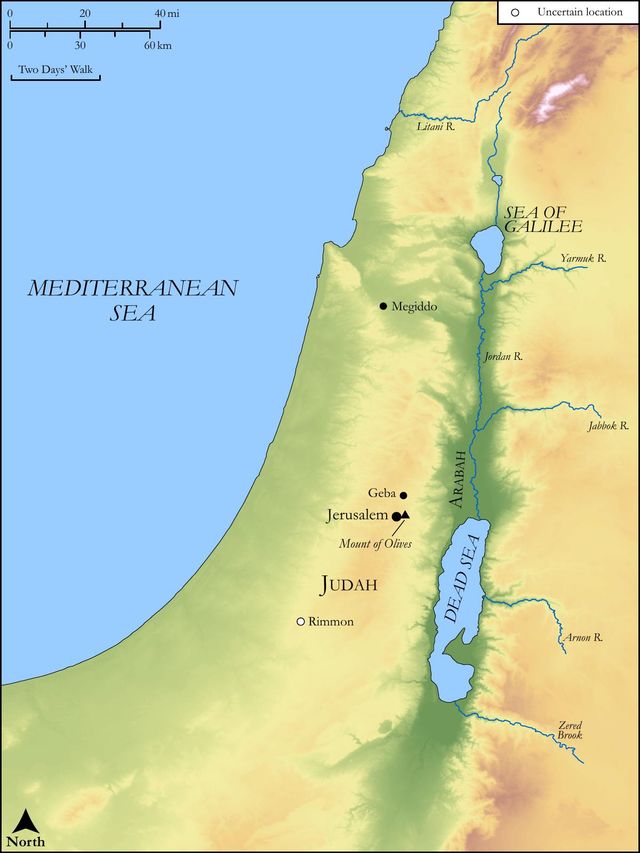
See on the biblical-era map
Study this verse
Public-domain commentary
Matthew Henry
From his Commentary on the Whole Bible. Henry comments on passages, not single verses — this entry covers Zechariah 14:16–21. His four-level outline is real structure in the source text, so it is rendered as structure.
Three things are here foretold: -
I.That a gospel-way of worship being set up in the church there shall be a great resort to it and a general attendance upon it.
Those that were left of the enemies of religion shall be so sensible of the mercy of God to them in their narrow escape that they shall apply themselves to the worship of the God of Israel, and pay their homage to him, Zac 14:16. Those that were not consumed shall be converted, and this makes their deliverance a mercy indeed, a double mercy. It is a great change that the grace of God makes upon them; those that had come against Jerusalem, finding their attempts vain and fruitless, shall become as much her admirers as ever they had been her adversaries, and shall come to Jerusalem to worship there, and go in concurrence with those whom they had gone contrary to. Note, As some of Christ's foes shall be made his footstool, so others of them shall be made his friends; and, when the principle of enmity is slain in them, their former acts of hostility are pardoned to them, and their services are admitted and accepted, as though they had never fought against Jerusalem. They shall go up to worship at Jerusalem, because that was the place which God had chosen, and there the temple was, which was a type of Christ and his mediation. Converting grace sets us right,
1.In the object of our worship. They shall no longer worship the Molochs and Baals, the kings and lords, that the Gentiles worship, the creatures of their own imagination, but the King, the Lord of hosts, the everlasting King, the King of kings, the sovereign Lord of all.
2.In the ordinances of worship, those which God himself has appointed. Gospel-worship is here represented by the keeping of the feast of tabernacles, for the sake of those two great graces which were in a special manner acted and signified in that feast - contempt of the world, and joy in God, Neh 8:17. The life of a good Christian is a constant feast of tabernacles, and, in all acts of devotion, we must retire from the world and rejoice in the Lord, must worship as in that feast.
3.In the Mediator of our worship; we must go to Christ our temple with all our offerings, for in him only our spiritual sacrifices are acceptable to God, Pe1 2:5. If we rest in ourselves, we come short of pleasing God; we must go up to him, and mention his righteousness only.
4.In the time of it; we must be constant. They shall go up from year to year, at the times appointed for this solemn feast. Every day of a Christian's life is a day of the feast of tabernacles, and every Lord's day especially (that is the great day of the feast); and therefore every day we must worship the Lord of hosts and every Lord's day with a peculiar solemnity.
II.That those who neglect the duties of gospel-worship shall be reckoned with for their neglect.
God will compel them to come and worship before him, by suspending his favours from those that keep not his ordinances: Upon them there shall be no rain, Zac 14:17. Some understand it figuratively; the rain of heavenly doctrine shall be withheld, and of the heavenly grace, which should accompany that doctrine. God will command the clouds that they rain no rain upon them. Note, It is a righteous thing with God to withhold the blessings of grace from those that do not attend the means of grace, to deny the green pastures to those that attend not the shepherd's tents. Or we may take it literally: On them there shall be no rain, to make their ground fruitful. Note, The gifts of common providence are justly denied to those that neglect and despise instituted ordinances. Those that neglected to build the temple were punished with the want of rain (Hag 2:17), and so were those that neglected to attend there when it was built. If we be barren and unfruitful towards God, justly is the earth made so to us. Many are crossed, and go backward, in their affairs, and this is at the bottom of it - they do not keep close to the worship of God as they should; they go off from God, and then he walks contrary to them. If we omit or postpone the duties he expects from us, it is just with him to deny the favours we expect from him. But what shall be done to the defaulters of the land of Egypt, to whom the threatening of the want of rain is no threatening, for they have no rain at any time; they need none; they desire none; the river Nilus is to them instead of the clouds of heaven, waters their land, and makes it fruitful, so that what is a punishment to others is none to them? Zac 14:18, Zac 14:19. It is threatened that if the family of Egypt go not up, that have no rain, yet God will find out a way to meet with them, for there shall be, in effect, the same plague wherewith other nations are smitten for their neglect. God can, and often did, restrain the overflowing of the river, which was equivalent to the shutting up of the clouds; or if the river did its part, and rose as high as it used to do, God had other ways of bringing famine upon them, and destroying the fruits of their ground, as he did by several of the ten plagues of Egypt, so that this (that is, the same) shall be the punishment of Egypt that is the punishment of other nations who come not up to keep the feast of tabernacles. Note, Those who think themselves least indebted to, and depending on, the mercy of heaven, cannot therefore think themselves guarded against the justice of Heaven. It does not follow that those who can live without rain can therefore live without God; for not the heavens only, but all other creatures, are that to us that God makes them to be, and no more; nor can any man's way of living enable him to set light by the judgments of God. This shall be the punishment - margin, This shall be the sin of Egypt, and the sin of all nations, that come not up to keep the feast of tabernacles. The same word signifies both sin and the punishment of sin, so close and inseparable is the connexion between them (as Gen 4:7), and sin is often its own punishment. Note, Omissions are sins, and we must come into judgment for them; those contract guilt that go not up to worship at the times appointed, as they have opportunity; and it is a sin that is its own punishment, for those who forsake the duty forfeit the privilege of communion with God.
III.That those who perform the duties of gospel-worship shall have grace to adorn their profession by the duties of a gospel-conversation too.
This is promised (Zac 14:20, Zac 14:21), and it is necessary to the completing of the beauty and happiness of the church. In general, all shall be holiness to the Lord.
1.The name and character of holiness shall not be so confined as formerly. Holiness to the Lord had been written only upon the high priest's forehead, but now it shall not be so appropriated. All Christians shall be living temples, and spiritual priests, dedicated to the honour of God and employed in his service.
2.Real holiness shall be more diffused than it had been, because there shall be more powerful means of sanctification, more excellent rules, more cogent arguments, and brighter patterns of holiness, and because there shall be a more plentiful effusion of the Spirit of holiness and sanctification, after Christ's ascension than ever before.
(1.)There shall be holiness introduced into common things; and those things shall be devoted to God that seemed very foreign.
[1.]The furniture of their horses shall be consecrated to God. "Upon the bells of the horses shall be engraven Holiness to the Lord, or upon the bridles of the horses (so the margin) or the trappings. The horses used in war shall no longer be used against God and his people, as they have been, but for him and them. Even their wars shall be holy wars, their troopers serving under God's banner. Their great men, who ride in state with a pompous retinue, shall reckon it their greatest ornament to honour God with their honours. Holiness to the Lord shall be written on the harness of their chariot-horses, as great men have sometimes their coat of arms with their motto painted on their coaches; every gentleman shall take the high priest's motto for his, and glory in it, and make it a memento to himself not to do any thing unworthy of it. Travellers shall have it upon their bridles, with which they guide their horses, as those who desire always to be put in mind of it, by having it continually before them, and to guide themselves in all their motions by this rule. The bells of the horses, which are designed to quicken them in their journey and to give notice of their approach, shall have Holiness to the Lord upon them," to signify that this is that which we ought to be influenced by ourselves, and make profession of to others, wherever we go.
[2.]The furniture of their houses too shall be consecrated to God, to be employed in his service. First, The furniture of the priests' houses, or apartments adjoining to the house of the Lord. The common drinking cups they used shall be like the bowls before the altar, that were used either to receive the blood of the sacrifices or to present the wine and oil in, which were for the drink-offerings. The vessels which they used for their own tables shall be used in such a religious manner, with such sobriety and temperance, such devotedness to the glory of God, and such a mixture of pious thoughts and expressions, that their meals shall look like sacrifices; they shall eat and drink, not to themselves, but to him that spreads their tables and fills their cups. And thus, in ministers' families especially, should common actions be done after a godly sort, however they are done in other families. Secondly, The furniture of other houses, those of the common people: "Every pot in Jerusalem and in Judah shall be holiness to the Lord. The pots in which they boil their meat, the cups out of which they drink their wine (Jer 35:5), in these God's good creatures shall never be abused to excess, nor that made the food and fuel of lust which should be oil to the wheels of obedience," as had formerly been, when all tables were full of vomit and filthiness, Isa 28:8. "What they eat and drink out of these shall nourish their bodies for the service of God; and out of these they shall give liberally for the relief of the poor;" then are they Holiness to the Lord, as the merchandise and the hire of the converted Tyrians are said to be (Isa 23:18); for both in our gettings and in our spendings we must have an eye to the will of God as our rule and the glory of God as our end. Thirdly, When there shall be such an abundance of real holiness people shall not be nice and curious about ceremonial holiness: "Those that sacrifice shall come and take of these common vessels, and seethe their sacrifices therein, making no distinction between them and the bowls before the altar." In gospel-times the true worshippers shall worship God in spirit and in truth, and neither in this mountain nor yet at Jerusalem, Joh 4:21. One place shall be as acceptable to God as another (I will that men pray every where); and one vessel shall be as acceptable as another. Little regard shall be had to the circumstance, provided there be nothing indecent or disorderly, while the substance is religiously preserved and adhered to. Some think it intimates that there should be greater numbers of sacrifices offered than the vessels of the sanctuary would serve for; but, rather than any should be turned back or deferred. they shall make no difficulty at all of using common vessels, as the Levites in a case of necessity helped the priests to kill the sacrifices, Ch2 29:34.
(2.)There shall be no unholiness introduced into their sacred things, to corrupt them: In that day there shall be no more the Canaanite in the house of the Lord of hosts. Some read it, There shall be no more the merchant, for so a Canaanite sometimes signifies; and they think it was fulfilled when Christ once and again drove the buyers and sellers out of the temple. Or though those that were Canaanites, strangers and foreigners, shall be brought into the house of the Lord, yet they shall cease to be Canaanites; they shall have nothing of the spirit or disposition of Canaanites in them. Or it intimates that though in gospel-times people should grow indifferent as to holy vessels, yet they should be very strict in church-discipline, and careful not to admit the profane to special ordinances, but to separate between the precious and the vile, between Israelites and Canaanites. Yet this will not have its full accomplishment short of the heavenly Jerusalem, that house of the Lord of hosts, into which no unclean thing shall enter; for at the end of time, and not before, Christ shall gather out of his kingdom every thing that offends, and the tares and wheat shall be perfectly and eternally separated.
Historical interpretation
Fourteen Centuries of Reception
3 surviving comments on this verse. Each one is dated, so this reads as a timeline rather than a list.
Select a marker to jump to its quote. Markers stagger vertically where authors wrote within a few decades of each other.
And the cooking pots in the house of the Lord shall be as holy as the bowls in front of the altar; and every cooking pot in Jerusalem and Judah shall be sacred to the Lord of hosts, so that all who sacrifice may come and use them to boil the flesh of the sacrifice. In that veneration the holy service of the house of the Lord will come, so that the common cooking pots may be revered by any foreigner, notwithstanding the fact that you Jews used to revere the bowls in front of the altar inside the closure of the house of the Lord. And not only will there be this honor for the cooking pots of the house of the Lord and of Jerusalem, but any cooking pot in the sanctuary as well as in the holy city and in the whole Jerusalem will be sanctified to the Lord, so that both the Jews and Gentiles will revere it as a thing consecrated to the Lord. The mystical meaning of this prophecy predicts two things: the honor to be given to the law of salvation proceeding from Judea and the conversion of the Jews and the Gentiles, whom the baptism of Christ received as cooking pots of flesh and turned into bowls full of perfumes.
(Verse 21.) And all the sacrificers shall come, and they shall take from them, and they shall cook in them: and there shall be no more a merchant in the house of the Lord of hosts in that day. LXX: And all who sacrifice shall come and take from them, and they shall cook in them, and there shall be no more a Canaanite in the house of the Lord Almighty in that day. For the Canaanite, Aquila interpreted it as a merchant, whom we also have followed in this place. When the pots have been turned into bowls, all the nations shall come around, whether those who have been left of all the nations sacrificing, and they shall take the bowls and cook in them the flesh of the victims, so that they do not eat the raw flesh of the lamb, but with all the moisture of the flesh cooked away by fire, what has been prepared by the fire remains to be consumed. Which are the vessels before the altar of the Lord, in which the Israelite dishes are converted, as we have said above, and now we will say in part. The bride praises her bridegroom in the Song of Songs: His cheeks are like containers of spices (Song of Songs 5). In the cheeks, the word is received, which, coming forth from the Lord, produces various ointments, and the fragrance of such a good odor will be so great that the Lord will make for himself a whip out of testimonies from the texts of the Scriptures, and he will drive out those who are buying and selling from the temple, and he will say to them: It is written, My Father's house shall be called a house of prayer for all nations, but you have made it a den of thieves (Matthew 21:13). Someone says that which is written in Daniel, although it is not read in Hebrew: 'The seed of Canaan, and not of Judah' (Dan. XIII, 56); and what is said by the prophet Hosea about Ephraim: 'Ephraim has become a partner with idols; he has set up stumbling blocks for himself, and has provoked the Canaanites to fornicate; they have committed fornication' (Hosea IV, 17-18). They apply this passage to the current situation and want every fornicator to be called a Canaanite and a foreigner, who they claim should be removed from the house of God.
The merchant shall be no more: Or, as some render it, The Chanaanite shall be no more, that is, the profane and unbelievers shall have no title to be in the house of the Lord. Or there shall be no occasion for buyers or sellers of oxen, or sheep, or doves, in the house of God, such as Jesus Christ cast out of the temple.
Continue studying Zechariah 14:21 across the web’s major study libraries — every link below opens this exact verse, chapter, or book on the destination site.
Read & Compare
 BibleGatewayThis verse in more than 200 translations and 70 languages.
 Bible.comThe YouVersion reader — hundreds of translations, reading plans, and highlights.
 ESV.orgCrossway's official English Standard Version reader.
 NET BibleThe NET translation with 60,000+ translators' notes on every rendering decision.
 STEP BibleTyndale House's free study tool — original text, vocabulary, and scholarly resources.
 BibliaLogos Bible Software's free web reader.
 USCCBThe New American Bible (Revised Edition) with the U.S. bishops' study notes.
Commentaries
 BibleHub CommentariesDozens of classic commentaries on this verse, gathered on one page.
 StudyLightMore than 100 commentary sets — the largest collection on the web.
 BibleRefPlain-English commentary on what this verse means, verse by verse.
 Enduring WordDavid Guzik's free commentary on this chapter, widely used by Bible teachers.
 Bible Study ToolsVerse commentary alongside Greek and Hebrew study aids.
Original Language & Research
- BibleHub InterlinearThe verse word by word — original language, transliteration, and English.
- BibleHub LexiconEvery word's original-language definition and Strong's entry.
 Blue Letter BibleDeep-study tools — Strong's numbers, concordance, and word studies.
 SefariaThe Hebrew text with Rashi and centuries of Jewish commentary.
Sermons, Hymns & Audio


TrulyRandomVerse is not affiliated with these sites and doesn’t control their content. They’re linked because they’re genuinely useful.
Summary
Zechariah 14:21 culminates a grand eschatological vision, portraying a future Messianic Age where the distinction between sacred and profane is abolished, and universal holiness permeates every aspect of life in Jerusalem and Judah. It prophesies a time of unhindered worship and complete purity, where all defiling influences, symbolized by the "Canaanite," are irrevocably removed from the presence of the Lord, ushering in an era of perfect communion and consecrated living under God's sovereign reign.
Context
ShowHideLiterary Context
This verse serves as the powerful conclusion to Zechariah chapter 14, which describes the climactic events of "the Day of the Lord" (Zechariah 14:1). The chapter opens with a depiction of Jerusalem under siege, followed by divine intervention, a dramatic transformation of the land, and the establishment of God's universal kingship (Zechariah 14:9). The preceding verses detail how even mundane items like horse bells will bear the inscription "HOLINESS UNTO THE LORD" (Zechariah 14:20), setting the stage for the ultimate sanctification of all things, culminating in the complete removal of impurity in verse 21.
Historical & Cultural Context
Zechariah prophesied to the Jewish exiles who had returned from Babylon, a community struggling to rebuild the temple and re-establish their identity. They lived in a world where holiness was strictly defined by Mosaic Law, with rigid distinctions between clean and unclean, sacred and common, and specific vessels and spaces designated for worship. The presence of "Canaanites" (or their symbolic equivalent, foreign, idolatrous, or profane influences) had historically plagued Israel, leading to apostasy and defilement of the land and worship. This prophecy offers a vision of a future radically different from their present struggles, where God's presence and holiness would not be confined to the Temple but would pervade all of society, and the defiling influences that had previously corrupted Israel would be entirely absent.
Key Themes
ShowHideThe overarching theme of Zechariah 14 is the eschatological triumph of God's kingdom. This verse specifically contributes to the themes of universal holiness and pervasive sanctification, indicating that in the Messianic era, the sacred will no longer be limited to specific rituals or objects, but will encompass all of life. It also emphasizes unhindered access to God for worship, as ceremonial barriers and defilement are removed. Most profoundly, it highlights the theme of complete purification and the eradication of evil, symbolized by the removal of the "Canaanite," signifying a future where nothing unclean or unholy can exist in God's presence, echoing the purity of the New Jerusalem described in Revelation 21:27.
Exposition and Analysis
ShowHideKey Word Analysis
ShowHideThis refers to a common cooking pot or caldron, an ordinary household item used for daily sustenance. Its transformation into "holiness unto the LORD" signifies that even the most mundane aspects of life will be consecrated and set apart for God's purposes in the future kingdom, blurring the traditional lines between sacred and secular.
Meaning "a sacred place or thing" or "sanctity," this term denotes something consecrated or set apart for God. Its application to common pots, a phrase previously reserved for the high priest's mitre (Exodus 28:36), underscores the radical and pervasive nature of sanctification in the eschatological age, extending divine purity to every sphere of existence.
Literally referring to an inhabitant of Canaan, this term often carried connotations of idolatry, moral corruption, and opposition to God's people in the Old Testament. By implication, it can also refer to a "merchant" or "trafficker," suggesting worldly gain or profane commerce. Its removal from "the house of the LORD of hosts" signifies the complete eradication of all defiling influences, whether spiritual, moral, or commercial, that would hinder true worship and devotion.
Verse Breakdown
ShowHide"Yea, every pot in Jerusalem and in Judah shall be holiness unto the LORD of hosts:"
This clause declares a radical transformation. Common cooking pots, used for everyday meals, will be consecrated to the Lord in the same manner as the most sacred Temple vessels. This signifies that in the future kingdom, the pervasive presence of God's holiness will extend beyond the Temple walls to permeate all aspects of daily life throughout the entire land of Judah, making every ordinary object and activity sacred.
"and all they that sacrifice shall come and take of them, and seethe therein:"
This indicates a future characterized by unhindered and accessible worship. The consecrated pots will be readily available for all who come to offer sacrifices, implying that the previous ceremonial restrictions and defilements that limited access to God's presence will be removed. Worship will be widespread, unburdened, and direct, allowing for intimate communion with the Lord.
"and in that day there shall be no more the Canaanite in the house of the LORD of hosts."
This powerful declaration signifies the ultimate purification of God's presence. The "Canaanite," representing all forms of impurity, idolatry, and unholy influence, will be completely expelled from the "house of the LORD," which here symbolizes not just the Temple but the entire sphere of God's dwelling and influence. This promises a final state of absolute spiritual perfection and purity, where nothing defiling can exist.
Literary Devices
ShowHideZechariah 14:21 employs several potent literary devices to convey its profound message. Symbolism is central, with "every pot" symbolizing the mundane and everyday aspects of life, which will be transformed and consecrated. The "Canaanite" serves as a powerful symbol of all that is impure, idolatrous, and antithetical to God's holiness, representing the complete removal of evil and defilement. The phrase "holiness unto the LORD of hosts" is an instance of transferred epithet or hyperbole, as it was previously inscribed only on the high priest's mitre, and its application to common pots dramatically emphasizes the extent of future sanctification. The entire verse uses eschatological imagery to paint a vivid picture of the future Messianic kingdom, characterized by pervasive holiness, universal worship, and ultimate purity, contrasting sharply with the historical struggles of Israel.
Theological and Thematic Connections
ShowHideZechariah 14:21 paints a vivid picture of a future characterized by pervasive holiness and the complete eradication of impurity, reflecting God's ultimate desire for a people and a world fully consecrated to Him. This vision extends the concept of holiness beyond ritualistic boundaries to encompass every aspect of life, signifying a profound transformation where the sacred permeates the mundane. It speaks to God's sovereign power to purify His creation and establish a kingdom where His presence is unblemished by sin or defilement, ensuring unhindered communion between Him and His people. This prophetic declaration anticipates a new covenant reality where the Spirit of God indwells believers, making them temples of the Holy Spirit and empowering them to live lives of holistic holiness.
Reflection and Application
ShowHideWhile Zechariah 14:21 describes a future, ultimate reality, its principles hold profound implications for believers today. We are called to live lives of present holiness, recognizing that through Christ, we are already set apart for God's purposes. This verse challenges us to consider how every "pot" in our lives—our work, our relationships, our finances, our leisure, our thoughts, and our actions—can be consecrated to the Lord. It encourages us to dismantle the artificial divide between the "sacred" and "secular," striving to live all of life as an act of worship, seeking to honor God in every detail. Furthermore, it reminds us of the ongoing need to purge "Canaanite" influences from our hearts and communities—any idolatry, impurity, or worldly compromise that defiles our devotion to Christ. This pursuit of personal and corporate holiness prepares us for the glorious day when Christ's reign will bring about perfect purity and unhindered communion with God.
Questions for Reflection
ShowHideFAQ
ShowHideWhat does "every pot... shall be holiness unto the LORD" mean?
ShowHideThis phrase signifies a radical transformation in the future Messianic Age. In ancient Israel, only specific vessels used in the Temple were considered "holy" or consecrated to the Lord. The high priest even wore an inscription "HOLINESS UNTO THE LORD" (Exodus 28:36). Zechariah 14:21 prophesies that in God's kingdom, even common cooking pots, used for mundane daily tasks, will be as sacred as Temple vessels. This means that the distinction between sacred and secular will largely vanish, and all aspects of life, from the most ordinary to the most extraordinary, will be permeated by God's holiness and dedicated to His glory. It speaks to a pervasive, all-encompassing sanctification of creation.
Who is "the Canaanite" and why will there be "no more" of them in the house of the LORD?
ShowHideLiterally, "Canaanite" refers to the inhabitants of the land of Canaan, who were known for their idolatrous and morally corrupt practices, often serving as a source of defilement and temptation for Israel (Deuteronomy 7:1-5). Symbolically, the term "Canaanite" could also refer to a "merchant" or "trafficker" (as seen in Proverbs 31:24 where the same Hebrew word is used), implying those who engage in profane commerce or bring worldly, defiling influences into sacred spaces. Therefore, "no more the Canaanite in the house of the LORD of hosts" signifies the complete and final removal of all impurity, idolatry, unholy practices, and worldly corruption from God's presence and His kingdom. It promises a state of absolute spiritual purity and perfection, where nothing that defiles or opposes God's holiness can exist, echoing the vision of the New Jerusalem (Revelation 21:27).
Christ-Centered Fulfillment
ShowHideZechariah 14:21 finds its ultimate fulfillment in the person and work of Jesus Christ and the establishment of His spiritual kingdom. The prophecy of "every pot... shall be holiness unto the LORD" points to the new covenant reality inaugurated by Christ, where the Holy Spirit indwells believers, making them living temples of God (1 Corinthians 6:19). Through Christ's atoning sacrifice, the barrier between God and humanity is removed, and all believers, both Jew and Gentile, are granted access to God's presence, becoming a "holy priesthood" (1 Peter 2:9). The promise that "there shall be no more the Canaanite in the house of the LORD" is fulfilled in Christ's victory over sin and evil. He purifies His people and His church, ultimately casting out all defiling influences, whether spiritual or moral, ensuring that in His eternal kingdom, only righteousness and perfect holiness will prevail (Ephesians 5:27 and Revelation 21:27). Thus, Zechariah's vision anticipates the comprehensive sanctification and purification brought about by Christ, culminating in a redeemed creation where all things are consecrated to God and His presence is unmarred by any impurity.