


Isaiah 66:18
- וְאָנֹכִיve·'a·no·Khiand IH595Conj-w ¦ Pro-1csPronoun Personal 1st Singular common genderוְandאָנֹכִיI
- מַעֲשֵׂיהֶםma·'a·sei·Hemtheir deedsH4639N-mpc ¦ 3mpNoun Plural Masculine Constructמַעֲשֵׂיdeedsהֶםtheir
- וּמַחְשְׁבֹתֵיהֶםu·mach·she·Vo·tei·Hemand their thoughtsH4284Conj-w ¦ N-fpc ¦ 3mpNoun Plural Feminine Constructוּandמַחְשְׁבֹתֵיthoughtsהֶםtheir
- בָּאָהba·'Ah[is] comingH935V-Qal-Prtcpl-fsVerb Qal Participle Singular Feminine Absolute
- לְקַבֵּץle·ka·Betzto gatherH6908Prep-l ¦ V-Piel-InfVerb Piel Infinitive Constructלְtoקַבֵּץgather
- אֶת'et<obj.>H853DirObjMParticle Object Indicator
- כָּלkolallH3605N-mscNoun Singular Masculine Construct
- הַגּוֹיִםha·go·Yimthe nationsH1471Art ¦ N-mpNoun Plural Masculine Absoluteהַtheגּוֹיִםnations
- וְהַלְּשֹׁנוֹתve·ha·le·sho·Notand the languagesH3956Conj-w ¦ Art ¦ N-fpNoun Plural Feminine Absoluteוְandהַtheלְּשֹׁנוֹתlanguages
- וּבָאוּu·Va·'uand they will comeH935Conj-w ¦ V-Qal-ConsecPerf-3cpVerb Qal Consecutive Perfect 3rd Plural common genderוּandבָאוּthey will come
- וְרָאוּve·ra·'Uand they will seeH7200Conj-w ¦ V-Qal-ConsecPerf-3cpVerb Qal Consecutive Perfect 3rd Plural common genderוְandרָאוּthey will see
- אֶת'et<obj.>H853DirObjMParticle Object Indicator
- כְּבוֹדִיke·vo·Dimy gloryH3519N-csc ¦ 1msNoun Singular common gender Constructכְּבוֹדִgloryיmy
English is a literal word-by-word gloss of the Hebrew, not the KJV's wording. Why?
This is the original text the KJV's translators worked from — each Hebrew word with its own literal English meaning in this verse, prepared by scholars at Tyndale House, Cambridge. The KJV translates whole sentences, not word by word, so its wording differs: one Hebrew word can become several English words, and the KJV may choose “the LORD” where the gloss reads “Yahweh”. Both are faithful — they answer different questions. For the KJV's own rendering, switch to the KJV text.
Details
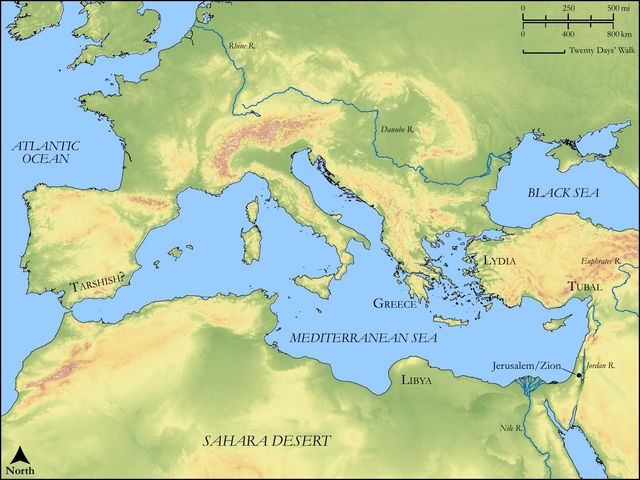
See on the biblical-era map
Study this verse
Public-domain commentary
Matthew Henry
From his Commentary on the Whole Bible. Henry comments on passages, not single verses — this entry covers Isaiah 66:15–24. His four-level outline is real structure in the source text, so it is rendered as structure.
These verses, like the pillar of cloud and fire, have a dark side towards the enemies of God's kingdom and all that are rebels against his crown, and a bright side towards his faithful loyal subjects. Probably they refer to the Jews in captivity in Babylon, of whom some are said to have been sent thither for their hurt, and with them God here threatens to proceed in his controversy; they hated to be reformed, and therefore should be ruined by the calamity (Jer 24:9); others were sent thither for their good, and they should have the trouble sanctified to them, should in due time get well through it and see many a good day after it. Many of the expressions here used are accommodated to that glorious dispensation; but doubtless the prophecy looks further, to the judgment for which Christ did come once, and will come again, into this world, and to the distinction which his word in both makes between the precious and the vile.
I.Christ will appear to the confusion and terror of all those that stand it out against him.
Sometimes he will appear in temporal judgments. The Jews that persisted in infidelity were cut off by fire and by his sword. The ruin was very extensive; the Lord then pleaded with all flesh; and, it being his sword with which they are cut off, they are called his slain, sacrificed to his justice, and they shall be many. In the great day the wrath of God will be his fire and sword, with which he will cut off and consume all the impenitent; and his word, when it takes hold of sinners' consciences, burns like fire, and is sharper than any two-edged sword. Idolaters will especially be contended with in the day of wrath, Isa 66:17. Perhaps some of those who returned out of Babylon retained such instances of idolatry and superstition as are here mentioned, had their idols in their gardens (not daring to set them up publicly in the high places) and there purified themselves (as the worshippers of the true God used to do) when they went about their idolatrous rites, one after another, or, as we read it, behind one tree in the midst, behind Ahad or Ehad, some idol that they worshipped by that name and in honour of which they ate swine's flesh (which was expressly forbidden by the law of God), and other abominations, as the mouse, or some other like animal. But the prophecy may refer to all those judgments which the wrath of God, according to the word of God, will bring upon provoking sinners, that live in contempt of God and are devoted to the world and the flesh: They shall be consumed together. From the happiness of heaven we find expressly excluded all idolaters, and whosoever worketh abomination, Rev 21:27; Rev 22:15. In the day of vengeance secret wickedness will be brought to light and brought to the account; for (Isa 66:18), I know their works and their thoughts. God knows both what men do and from what principle and with what design they do it; and therefore is fit to judge the world, because he can judge the secrets of men, Rom 2:16.
II.He will appear to the comfort and joy of all that are faithful to him in the setting up of his kingdom in this world, the kingdom of grace, the earnest and first-fruits of the kingdom of glory. The time shall come that he will gather all nations and tongues to himself, that they may come and see his glory as it shines in the face of Jesus Christ, Isa 66:18. This was fulfilled when all nations were to be discipled and the gift of tongues was bestowed in order thereunto. The church had hitherto been confined to one nation and in one tongue only God was worshipped; but in the days of the Messiah the partition-wall should be taken down, and those that had been strangers to God should be brought acquainted with him and should see his glory in the gospel, as the Jews had seen it in the sanctuary. As to this, it is here promised,
1.That some of the Jewish nation should, by the grace of God, be distinguished form the rest, and marked for salvation: I will not only set up a gathering ensign among them, to which the Gentiles shall seek (as is promised, Isa 11:12), but there shall be those among them on whom I will set a differencing sign; for so the word signifies. Though they are a corrupt degenerate nation, yet God will set apart a remnant of them, that shall be devoted to him and employed for him, and a mark shall be set upon them, with such certainty will God own them, Eze 9:4. The servants of God shall be sealed in their foreheads, Rev 7:3. The Lord knows those that are his. Christ's sheep are marked.
2.That those who are themselves distinguished thus by the grace of God shall be commissioned to invite others to come and take the benefit of that grace. Those that escape the power of those prejudices by which the generality of that nation is kept in unbelief shall be sent to the nations to carry the gospel among them, and preach it to every creature. Note, Those who themselves have escaped the wrath to come should do all they can to snatch others also as brands out of the burning. God chooses to send those on his errands that can deliver their message feelingly and experimentally, and warn people of their danger by sin as those who have themselves narrowly escaped the danger.
(1.)They shall be sent to the nations, several of which are here named, Tarshish, and Pul, and Lud, etc. It is uncertain, nor are interpreters agreed, what countries are here intended. Tarshish signifies in general the sea, yet some take it for Tarsus in Cilicia. Pul is mentioned sometimes as the name of one of the kings of Assyria; perhaps some part of that country might likewise bear that name. Lud is supposed to be Lydia, a warlike nation, famed for archers: the Lydians are said to handle and bend the bow, Jer 46:9. Tubal, some think, is Italy or Spain; and Javan most agree to be Greece, the Iones; and the isles of the Gentiles, that were peopled by the posterity of Japhet (Gen 10:5), probably are here meant by the isles afar off, that have not heard my name, neither have seen my glory. In Judah only was God known, and there only his name was great for many ages. Other countries sat in darkness, heard no the joyful sound, saw not the joyful light. This deplorable state of theirs seems to be spoken of here with compassion; for it is a pity that any of the children of men should be at such a distance from their Maker as not to hear his name and see his glory. In consideration of this,
(2.)Those that are sent to the nations shall go upon God's errand, to declare his glory among the Gentiles. The Jews that shall be dispersed among the nations shall declare the glory of God's providence concerning their nation all along, by which many shall be invited to join with them, as also by the appearances of God's glory among them in his ordinances. Some out of all languages of the nations shall take hold of the skirt of him that is a Jew, entreating him to take notice of them, to admit them into his company, and to stay a little while for them, till they are ready, "for we will go with you, having heard that God is with you," Zac 8:23. Thus the glory of God was in part declared among the Gentiles; but more clearly and fully by the apostles and early preachers of the gospel, who were sent into all the world, even to the isles afar off, to publish the glorious gospel of the blessed God. They went forth and preached every where, the Lord working with them, Mar 16:20.
3.That many converts shall hereby be made, Isa 66:20.
(1.)They shall bring all your brethren (for proselytes ought to be owned and embraced as brethren) for an offering unto the Lord. God's glory shall not be in vain declared to them, but they shall be both invited and directed to join themselves to the Lord. Those that are sent to them shall succeed so well in their negotiation that thereupon there shall be as great flocking to Jerusalem as used to be at the time of a solemn feast, when all the males from all parts of the country were to attend there, and not to appear empty. Observe,
[1.]The conveniences that they shall be furnished with for their coming. Some shall come upon horses, because they came from far and the journey was too long to travel on foot, as the Jews usually did to their feasts. Persons of quality shall come in chariots, and the aged, and sickly, and little children, shall be brought in litters or covered wagons, and the young men on mules and swift beasts. This intimates their zeal and forwardness to come. They shall spare no trouble nor charge to get to Jerusalem. Those that cannot ride on horseback shall come in litters; and in such haste shall they be, and so impatient of delay, that those that can shall ride upon mules and swift beasts. These expressions are figurative, and these various means of conveyance are heaped up to intimate (says the learned Mr. Gataker) the abundant provision of all those gracious helps requisite for the bringing of God's elect home to Christ. All shall be welcome, and nothing shall be wanting for their assistance and encouragement.
[2.]The character under which they shall be brought. They shall come, not as formerly they used to come to Jerusalem, to be offerers, but to be themselves an offering unto the Lord, which must be understood spiritually, of their being presented to God as living sacrifices, Rom 12:1. The apostle explains this, and perhaps refers to it, Rom 15:16, where he speaks of his ministering the gospel to the Gentiles, that the offering up, or sacrificing, of the Gentiles might be acceptable. They shall offer themselves, and those who are the instruments of their conversion shall offer them, as the spoils which they have taken for Christ and which are devoted to his service and honour. They shall be brought as the children of Israel bring an offering in a clean vessel, with great care that they be holy, purified from sin, and sanctified to God. It is said of the converted Gentiles (Act 15:9) that their hearts were purified by faith. Whatever was brought to God was brought in a clean vessel, a vessel appropriated to religious uses. God will be served and honoured in the way that he has appointed, in the ordinances of his own institution, which are the proper vehicles for these spiritual offerings. When the soul is offered up to God the body must be a clean vessel for it, possessed in sanctification and honour, and not in the lusts of uncleanness (Th1 4:4, Th1 4:5); and converts to Christ are not only purged from an evil conscience, but have their bodies also washed with pure water, Heb 10:22. Now,
(2.)This may refer,
[1.]To the Jews, devout men, and proselytes out of every nation under heaven, that flocked together to Jerusalem, expecting the kingdom of the Messiah to appear, Act 2:5, Act 2:6, Act 2:10. They came from all parts to the holy mountain of Jerusalem, as an offering to the Lord, and there many of them were brought to the faith of Christ by the gift of tongues poured out on the apostles. Methinks there is some correspondence between that history and this prophecy. The eunuch some time after came to worship at Jerusalem in his chariot and took home with him the knowledge of Christ and his holy religion.
[2.]To the Gentiles, some of all nations, that should be converted to Christ, and so added to his church, which, though a spiritual accession, is often in prophecy represented by a local motion. The apostle says of all true Christians that they have come to Mount Zion, and the heavenly Jerusalem (Heb 12:22), which explains this passage, and shows that the meaning of all this parade is only that they shall be brought into the church by the grace of God, and in the use of the means of that grace, as carefully, safely, and comfortably, as if they were carried in chariots and litters. Thus God shall persuade Japhet and he shall dwell in the tents of Shem, Gen 9:27.
4.That a gospel ministry shall be set up in the church, it being thus enlarged by the addition of such a multitude of members to it (Isa 66:21): I will take of them (of the proselytes, of the Gentile converts) for priests and for Levites, to minister in holy things and to preside in their religious assemblies, which is very necessary for doctrine, worship, and discipline. Hitherto the priests and Levites were all taken from among the Jews and were all of one tribe; but in gospel times God will take of the converted Gentiles to minister to him in holy things, to teach the people, to bless them in the name of the Lord, to be the stewards of the mysteries of God as the priests and Levites were under the law, to be pastors and teachers (or bishops), to give themselves to the word and prayer, and deacons to serve tables, and, as the Levites, to take care of the outward business of the house of God, Phi 1:1; Act 6:2-4. The apostles were all Jews, and so were the seventy disciples; the great apostle of the Gentiles was himself a Hebrew of the Hebrews; but, when churches were planted among the Gentiles, they had ministers settled who were of themselves, elders in every church (Act 14:23, Tit 1:5), which made the ministry to spread the more easily, and to be the more familiar, and, if not the more venerable, yet the more acceptable; gospel grace, it might be hoped, would cure people of those corruptions which kept a prophet from having honour in his own country. God says, I will take, not all of them, though they are all in a spiritual sense made to our God kings and priests, but of them, some of them. It is God's work originally to choose ministers by qualifying them for and inclining them to the service, as well as to make ministers by giving them their commission. I will take them, that is, I will admit them, though Gentiles, and will accept of them and their ministrations. This is a great honour and advantage to the Gentile church, as it was to the Jewish church that God raised up of their sons for prophets and their young men for Nazarites, Amo 2:11.
5.That the church and ministry, being thus settled, shall continue and be kept up in a succession from one generation to another, Isa 66:22. The change that will be made by the setting up of the kingdom of the Messiah is here described to be,
(1.)A very great and universal change; it shall be a new world, the new heavens and the new earth promised before, Isa 65:17. Old things have passed away, behold all things have become new (Co2 5:17), the old covenant of peculiarity is set aside, and a new covenant, a covenant of grace, established, Heb 8:13. We are now to serve in newness of the spirit, and not in the oldness of the letter, Rom 7:6. New commandments are given relating both to heaven and earth, and new promises relating to both, and both together make a New Testament; so that they are new heavens and a new earth that God will create, and these a preparative for the new heavens and new earth designed at the end of time, Pe2 3:13.
(2.)A change of God's own making; he will create the new heavens and the new earth. The change was made by him that had authority to make new ordinances, as well as power to make new worlds.
(3.)It will be an abiding lasting change, a change never to be changed, a new world that will be always new, and never wax old, as that does which is ready to vanish away: It shall remain before me unalterable; for the gospel dispensation is to continue to the end of time and not to be succeeded by any other. The kingdom of Christ is a kingdom that cannot be moved; the laws and privileges of it are things that cannot be shaken, but shall for ever remain, Heb 12:27, Heb 12:28. It shall therefore remain, because it is before God; it is under his eye, and care, and special protection.
(4.)It will be maintained in a seed that shall serve Christ: Your seed, and in them your name, shall remain - a seed of ministers, a seed of Christians; as one generation of both passes away, another generation shall come; and thus the name of Christ, with that of Christians, shall continue on earth while the earth remains, and his throne as the days of heaven. The gates of hell, though they fight against the church, shall not prevail, nor wear out the saints of the Most High.
6.That the public worship of God in religious assemblies shall be carefully and constantly attended upon by all that are thus brought as an offering to the Lord, Isa 66:23. This is described in expressions suited to the Old Testament dispensation, to show that though the ceremonial law should be abolished, and the temple service should come to an end, yet God should be still as regularly, constantly, and acceptably worshipped as ever. Heretofore only Jews went up to appear before God, and they were bound to attend only three times a year, and the males only; but now all flesh, Gentiles as well as Jews, women as well as men, shall come and worship before God, in his presence, though not in his temple at Jerusalem, but in religious assemblies dispersed all the world over, which shall be to them as the tabernacle of meeting was to the Jews. God will in them record his name, and, though but two or three come together, he will be among them, will meet them, and bless them. And they shall have the benefit of these holy convocations frequently, every new moon and every sabbath, not, as formerly, at the three annual feasts only. There is no necessity of one certain place, as the temple was of old. Christ is our temple, in whom by faith all believers meet, and now that the church is so far extended it is impossible that all should meet at one place; but it is fit that there should be a certain time appointed, that the service may be done certainly and frequently, and a token thereby given of the spiritual communion which all Christian assemblies have with each other by faith, hope, and holy love. The new moons and the sabbaths are mentioned because, under the law, though the yearly feasts were to be celebrated at Jerusalem, yet the new moons and the sabbaths were religiously observed all the country over, in the schools of the prophets first and afterwards in the synagogues (Kg2 4:23, Amo 8:5, Act 15:21), according to the model of which Christian assemblies seem to be formed. Where the Lord's day is weekly sanctified, and the Lord's supper monthly celebrated, and both are duly attended on, there this promise is fulfilled, there the Christian new moons and sabbaths are observed. See, here,
(1.)That God is to be worshipped in solemn assemblies, and that it is the duty of all, as they have opportunity, to wait upon God in those assemblies: All flesh must come; though flesh, weak, corrupt, and sinful, let them come that the flesh may be mortified.
(2.)In worshipping God we present ourselves before him, and are in a special manner in his presence.
(3.)For doing this there ought to be stated times, and are so; and we must see that it is our interest as well as our duty constantly and conscientiously to observe these times.
7.That their thankful sense of God's distinguishing favour to them should be very much increased by the consideration of the fearful doom and destruction of those that persist and perish in their infidelity and impiety, Isa 66:24. Those that have been worshipping the Lord of hosts, and rejoicing before him in the goodness of his house, shall, in order to affect themselves the more with their own happiness, take a view of the misery of the wicked. Observe,
(1.)Who they are whose misery is here described. They are men that have transgressed against God, not only broken his laws, but broken covenant with him, and thought themselves able to contend with him. It may be meant especially of the unbelieving Jews that rejected the gospel of Christ.
(2.)What their misery is. It is here represented by the frightful spectacle of a field of battle, covered with the carcases of the slain, that lie rotting above ground, full of worms crawling about them and feeding on them; and, if you go to burn them, they are so scattered, and it is such a noisome piece of work to get them together, that it would be endless, and the fire would never be quenched; so that they are an abhorring to all flesh, nobody cares to come near them. Now this is sometimes accomplished in temporal judgments, and perhaps never nearer the letter than in the destruction of Jerusalem and the Jewish nation by the Romans, in which destruction it is computed that above two millions, first and last, were cut off by the sword, besides what perished by famine and pestilence. It may refer likewise to the spiritual judgments that came upon the unbelieving Jews, which St. Paul looks upon, and shows us, Rom 11:8, etc. They became dead in sins, twice dead. The church of the Jews was a carcase of a church; all its members were putrid carcases; their worm died not, their own consciences made them continually uneasy, and the fire of their rage against the gospel was not quenched, which was their punishment as well as their sin; and they became, more than ever any nation under the sun, an abhorring to all flesh. But our Saviour applies it to the everlasting misery and torment of impenitent sinners in the future state, where their worm dies not, and their fire is not quenched (Mar 9:44); for the soul, whose conscience is its constant tormentor, is immortal, and God, whose wrath is its constant terror, is eternal.
(3.)What notice shall be taken of it. Those that worship God shall go forth and look upon them, to affect their own hearts with the love of their Redeemer, when they see what misery they are redeemed from. As it will aggravate the miseries of the damned to see others in the kingdom of heaven and themselves thrust out (Luk 13:28), so it will illustrate the joys and glories of the blessed to see what becomes of those that died in their transgression, and it will elevate their praises to think that they were themselves as brands plucked out of that burning. To the honour of that free grace which thus distinguished them let the redeemed of the Lord with all humility, and not without a holy trembling, sing their triumphant songs.
Historical interpretation
Historical reception
3 surviving comments on this verse. Each one is dated, so this reads as a timeline rather than a list.
Select a marker to jump to its quote. Markers stagger vertically where authors wrote within a few decades of each other.
And Zechariah saw during the night, “behold, a man mounting a red horse, who was standing between two shady mountains, and behind him were red and white and chestnut and variously colored horses.” … John also in the Apocalypse testified that he saw this: “I saw heaven opened, and behold, a white horse, and he who sat on it was called faithful and true and a righteous judge and warrior. His eyes were like flames of fire, and on his head were many diadems, having a written name that no one knew except himself. And he was clothed in a garment sprinkled with blood and the name by which he was called was Word of God. And an army in heaven followed him on white horses, clothed in the purest white linen, and a sharp sword went forth from his mouth to strike the nations.” The Lord and Savior was sitting on a red horse as he assumed human nature, to whom it is asked: “Why are your garments red? And who is this who ascends from Edom with crimson garments from Bozrah?” Horses of various colors followed him, moreover, either red with martyrdom or chestnut in flight or variegated with virtues or white with virginity. But he was sitting on a white horse when he assumed an immortal and uncorrupted body after the resurrection. Whoever followed him also used a white horse, incorrupt and immortal in body. If we wished to explain both texts, it would take a long time, but let me say only this, that the various vehicles by which people are led to faith are angels, or saints who have advanced from being people to being angels. Many Scripture passages teach that each of us should have angels, one of which is: “Do not despise one of these little ones, for their angels daily behold the face of the Father who is in heaven.” Also, when the maid Rhoda announced that it was Peter at the door, others believed him to be Peter’s angel.
(Verse 18, 19.) But I come to gather together with all nations and tongues their works and thoughts: and they shall come and see my glory. And I will set a sign among them, and will send some of them, who have been saved, to the nations in the sea ((or sea)), to Africa, to Lydia spreading the bow, to Italy and Greece, to distant islands: to those who have not heard of me, and have not seen my glory. LXX: And I know their works and thoughts, and I come to gather all nations and all tongues: and they shall come and see my glory, and I will send a sign upon them: and I will send some of them, who have been saved, to the nations, to Tarshish and Put, and Lud and Mosoch and Tubal, and to Greece, and to distant islands, who have not heard my name, nor seen my glory. Before I explain what the enumeration of many nations signifies, it must be briefly said about the variety of interpretation. Tharsis, in the Hebrew language, is called sea; and (as they say) the region of India: although Josephus, changing the letter, thinks that Tarshish is now called Tarsum, a city of Cilicia, to which Jonah, fleeing from Joppa, wanted to go (Jonah 1). Phud, or Phul, however, refers to the Libyans, and the whole of Africa up to the sea of Mauritania, in which the river that is now called Phud, and the whole region around it, is named Phutensis. But the Lydians are called Lud, whose colonists, the Etruscans, who are now called the Tuscans, were once the most skilled in shooting arrows, and they are now said to be arrow shooters. For this reason, it is written in Hebrew as Mosche Ceseth, which all translated similarly without the Septuagint, interpreting it as 'those who shoot arrows.' And the Septuagint put μοσὸχ, interpreting the word as a name. If this is accepted, it means 'Cappadocians,' whose capital is Mazaca, which later received the name Caesarea from Caesar Augustus. Those who do not know what they want, even in Genesis (Chapter X) the last son of Aram, that is, the Syrians of Damascus, who are called Mes, are interpreted as μοσὸχ: for which we more correctly transfer to Moeonas. Thubal, however, is interpreted as either Italy or Iberia, that is, Spain, from the river Iberus, from which today the region of Spain is called Celtiberia. Concerning these, Lucanus (Lucan, Book IV) beautifully says:
The Celts of Gaul mixing with the Iberian people: whom we can call Gallo-Hispanics. The Greeks, however, who are called Javan in the Hebrew language, are signified by Jonas: hence Greeks are also called Jones, and the Ionian Sea. And it should be considered that the Eastern nations are mostly descended from Japheth, one of Noah's sons: although Tharsis and Phut, as well as Shem and Ham, that is, the names of India and Africa, were also mentioned, in order to show the whole world. Therefore, the Lord comes to gather the works and thoughts of each individual. From this, we learn that not only actions but also thoughts will be judged on the day of judgment. For whoever looks at a woman with lust has already committed adultery with her in his heart (Matthew 5). Regarding this, it is said: 'Now their own thoughts have surrounded them: when the Lord will judge the hidden things of men according to the Gospel of Jesus Christ' (Romans 2:15). So that what the Apostle writes may be proven true by the judgment, with thoughts accusing and satisfying one another, on the day when God will judge the hidden things of men. That all our thoughts, gathered together at once, may be proven by the just judge, whether our conscience accuses us or satisfies us for our wrongdoing, whether there are more sins or good deeds, whether they are old or new, whether they have been erased by repentance or rebuilt with new crimes, as the Lord says: 'I will give them their ways upon their heads, and I will repay their thoughts to them' (Hosea 9:7). He who formed every heart and understands all their works. (Psalm XXXII, 15) About whom we also read in another place: You alone know the hearts of men. (2 Chronicles VI, 30) For no one knows what is in a man, except the spirit of man that is in him. (1 Corinthians II) Therefore, God speaks through Jeremiah: Am I a God at hand, says the Lord, and not a God afar off? Can a man hide himself in secret places, and I will not see him? (Jeremiah XXIII, 23) Finally, it is said to the scribes and Pharisees: You are the ones who justify yourselves before men, but God knows your hearts (Luke XVI, 15). In this, it should be considered that he did not say 'Father,' according to the blasphemies of heretics, so as not to appear to exclude the Son, but 'God,' which is common to both the Father and the Son. For in the beginning was the Word, and the Word was with God, and the Word was God; this was in the beginning with God (John I, 1, 2). About which John also writes: But Jesus himself did not believe in them, because he knew all men, and he did not need anyone to bear witness of man: for he himself knew what was in man (John 2:24-25). This is also consistent with this: But Jesus knowing their thoughts (Luke 6:8). And in another place: But Jesus knowing their wickedness (Matthew 22:18). And to prevent any doubt, when heretics maliciously slander the Word of God, that it knows all things, it is stated more fully in the Epistle to the Hebrews: For the word of God is living and effectual, and more piercing than any two-edged sword; and reaching unto the division of the soul and the spirit, of the joints also and the marrow, and is a discerner of the thoughts and intents of the heart. And there is no creature invisible in his sight. But all things are naked and open to his eyes, to whom our speech is. (Hebrews IV, 12). But after all thoughts have been gathered into one, accusing or defending us: then all peoples and languages will be brought together with their thoughts. And according to the Apostle Paul, we not only read the languages of men but also of Angels (I Corinthians XIII). From this it is understood that all creatures are to be judged by the Lord, not only on earth, but in the air and in the heavens, as he himself said in the passages above: My sword is intoxicated in heaven, and it will come down to the earth (Isaiah 34:5). But everyone will come to see the glory of God, and he will put a sign on them, as shown in the beginning of the book of Ezekiel under the interpretation of the Hebrew letter Thau (Ezekiel 9). By this sign, the hand of the one who struck will flee. This was also marked on the doorposts of houses in Egypt when Egypt was perishing, and only Israel remained untouched (Exodus 12). Concerning this sign that King Ahaz of Judah did not want to receive, the prophet Isaiah testifies: Therefore the Lord himself shall give you a sign; Behold, a virgin shall conceive, and bear a son (Isaiah 7:14). And so the Prophet prays for what was promised: Show me a sign for good (Psalm 86:17). And in another place: You have given a sign to those who fear you, that they may flee from the face of the bow (Psalm 59:4). The Lord left this to us as he ascended to the Father, or placed it on our foreheads, so that we may freely say: The light of your face, Lord, has shone upon us (Psalm 4:7). But what follows: And I will send those who have been saved to the nations: and he enumerates them individually, seems to be contrary to our interpretation. For if it is said of the Day of Judgment: how does the coming of the Savior recur to the first, when the Apostles are sent to the Gentiles, and hear from the Lord: Go, teach all nations, baptizing them in the name of the Father and of the Son and of the Holy Spirit (Matt. XXVIII, 19.) This is how it is resolved: The Day of Judgment is preached, or rather threatened, so that out of fear of future punishment, they may receive the coming of the Savior and the Gospel of the Apostles, who are to be sent before. But beautifully he said, 'And I will send out of them that shall be saved' (Isai. LXVI, 18). For unless the Lord had left us seed, we had been made as Sodom and we should have been like unto Gomorrha. And the Apostle says: 'The remnants, he saith, have been saved' (Rom. IX, 27). These are sent to the Gentiles in Tharsis, and Phud, and Lud, and Mosoch, and Thobel, and Greece, and to many islands which are far off, and have not heard my name, nor seen my glory. Of which we have already spoken in the account above (Ch. XII). Now the anagoge must be sought. Tharsis signifies the exploration of joy: so that we may consider not those things which are in the present, but those which are in the future; and may deserve to hear: 'Well done, good and faithful servants, enter into the joy of your Lord' (Matt. XXV, 21). Concerning which the Apostle Peter also writes: 'Rejoice with joy unspeakable and full of glory' (I Pet. I, 8); so that we may praise God, saying: 'Our mouth is filled with joy, and our tongue with exultation' (Ps. CXXV, 2). And what follows, Phud is interpreted as the exclusion of the mouth: that we may exclude all blasphemy, and speak those things which are good, and say: My mouth shall declare thy righteousness, O Lord: all the day long thy salvation (Psalm 70:15). And again: I have not hid thy righteousness within my heart; I have declared thy salvation (Psalm 39:11). Lud also in our language signifies usefulness, and Mosoch signifies extension, and Thubal, or Thobel, signifies mourning, or turned, or universal: all of which are in accord with the calling of the nations, that they may follow usefulness through the confession of their soul, forgetting the past and extending to the future. And let the ancient sins be mourned, and let them be dragged to lamentation and sadness, which leads to life. Blessed are those who mourn, for they themselves will laugh (Matthew 5). And let everyone turn to the Lord, so that they may later pass to grace, and know the saying by the Apostle: Glory and honor, from peace to everyone who works good, to the Jew first and to the Greek (Romans 2:10): for God is not only the God of the Jews, but also of the Gentiles. Furthermore, that which is said: And to the distant islands, who have not heard my name, nor seen my glory, applies to them, of whom we read above: Those to whom it has not been announced about him, they will see; and those who have not heard, they will understand (Isaiah 55:5). And again: I manifested myself to those who did not question me: I was found by those who did not seek me (Isaiah LXV, 1). I said: Behold, I am here, to those who do not call upon my name. However, we often said that the islands signify either all the nations of the world, or the Churches dispersed throughout the whole world.
Christ makes here in these words something like a summary of the whole message and of the whole prophecy, and in short compass in summary form he announces the things from start to finish and the power of his economy in the flesh. He mentions the calling of the nations, the election of the holy apostles, and that he will be worshiped by the whole wide world. For the former law gathered one people only, that is, those from Israel, and called to those only speaking that language. But our Lord Jesus Christ did not grant the power of his economy in the flesh only to those from Israel by blood but to every nation and language.…For like something consecrated to God, the host of the nations are given over to God’s glory, released from all charges through faith and washed from all filth through holy baptism, like a guest’s gift, as if given out of the apostolic fervor for God. On that account they rejoice, naming him their joy and crown. For that the return of the nations to God happens in an extremely comfortable fashion and without sweat and struggle is clearly declared in parabolic fashion when he speaks for our instruction, saying that “they will be led with horses, chariots, now with illuminations, now with shade.… And I will take from them priests and Levites.” From whom? This is not yet so clear, meaning either those sent to call them out from the nations or from those who were thus called out. For the divine disciples served through Christ as priests. But many were called to the priesthood, and many are still called who are of Greek stock, once God has changed them into the newness of life and knowledge.
Continue studying Isaiah 66:18 across the web’s major study libraries — every link below opens this exact verse, chapter, or book on the destination site.
Read & Compare
 BibleGatewayThis verse in more than 200 translations and 70 languages.
 Bible.comThe YouVersion reader — hundreds of translations, reading plans, and highlights.
 ESV.orgCrossway's official English Standard Version reader.
 NET BibleThe NET translation with 60,000+ translators' notes on every rendering decision.
 STEP BibleTyndale House's free study tool — original text, vocabulary, and scholarly resources.
 BibliaLogos Bible Software's free web reader.
 USCCBThe New American Bible (Revised Edition) with the U.S. bishops' study notes.
Commentaries
 BibleHub CommentariesDozens of classic commentaries on this verse, gathered on one page.
 StudyLightMore than 100 commentary sets — the largest collection on the web.
 BibleRefPlain-English commentary on what this verse means, verse by verse.
 Enduring WordDavid Guzik's free commentary on this chapter, widely used by Bible teachers.
 Bible Study ToolsVerse commentary alongside Greek and Hebrew study aids.
Original Language & Research
- BibleHub InterlinearThe verse word by word — original language, transliteration, and English.
- BibleHub LexiconEvery word's original-language definition and Strong's entry.
 Blue Letter BibleDeep-study tools — Strong's numbers, concordance, and word studies.
 SefariaThe Hebrew text with Rashi and centuries of Jewish commentary.
Sermons, Hymns & Audio


TrulyRandomVerse is not affiliated with these sites and doesn’t control their content. They’re linked because they’re genuinely useful.
Summary
Isaiah 66:18 powerfully declares God's absolute omniscience and His sovereign intention to gather all humanity for a climactic encounter with His glory. This verse establishes the divine knowledge of every human action and intention, setting the stage for a universal assembly of "all nations and tongues." This gathering culminates in a breathtaking revelation of God's majesty, serving as both a display of righteous judgment and a manifestation of saving power, ultimately revealing His undeniable reign over all creation.
Context
ShowHideLiterary Context
Isaiah 66 serves as the climactic conclusion to the entire book of Isaiah, bringing to a grand crescendo the prophet's sweeping vision of judgment and salvation. Following a stark contrast between true worship and hypocritical ritualism in Isaiah 66:1-6, and a miraculous depiction of Jerusalem's rebirth and expansion in Isaiah 66:7-14, the chapter shifts to a powerful declaration of God's impending judgment upon His adversaries in Isaiah 66:15-17. Verse 18 directly follows this pronouncement of fiery judgment, initiating a new phase of divine action: the universal gathering of humanity. This transition underscores that God's judgment is not an end in itself, but a prelude to a global revelation of His character and purposes, leading to the establishment of a new heavens and new earth where His glory is fully manifest, as prophesied in Isaiah 65:17-19.
Historical & Cultural Context
Written in a period likely encompassing the Babylonian exile and the return, Isaiah's prophecies often address the immediate historical circumstances of Judah while simultaneously projecting far into the eschatological future. The concept of "nations" (Hebrew: goyim) in the Old Testament often referred to the Gentile nations, distinct from Israel. While sometimes portrayed as enemies or objects of judgment, there were also prophetic streams envisioning their inclusion in God's redemptive plan. The idea of God "gathering" nations would have resonated with the historical experience of exile and dispersion, but here it takes on a grander, universal, and eschatological dimension, pointing to a time beyond the immediate post-exilic period. The "glory" of God (Hebrew: kavod) was a central concept in Israelite theology, often associated with the Shekinah presence in the Tabernacle and Temple, symbolizing His weighty presence, power, and majesty. The promise that "all nations" would "see my glory" would have been a radical departure from the common understanding of God's localized presence, expanding His revelation to a global scale.
Key Themes
ShowHideThis verse encapsulates several major themes woven throughout Isaiah. Firstly, it highlights Divine Omniscience and Sovereignty, emphasizing God's complete knowledge of human hearts and deeds, which undergirds His righteous judgment and sovereign control over history. Secondly, it powerfully articulates the Universal Scope of God's Plan, moving beyond Israel to encompass "all nations and tongues," a theme echoed in other prophetic passages like Isaiah 2:2-4 where all peoples stream to Jerusalem to learn God's ways. Thirdly, the verse culminates in the Revelation of God's Glory, portraying a future where God's majesty is undeniably displayed to all humanity. This theme of divine self-manifestation is central to Isaiah's vision of God's ultimate triumph and the establishment of His kingdom, where the earth will be full of the knowledge of the Lord as the waters cover the sea, as described in Isaiah 11:9.
Exposition and Analysis
ShowHideKey Word Analysis
ShowHideFrom the root meaning "to do" or "to make," this term refers to an action, deed, or transaction, encompassing both good and bad acts. It can also imply a product or activity. In this context, it signifies the outward manifestations of human will and character. God's knowledge of "works" implies a comprehensive understanding of all human conduct, whether public or private, righteous or rebellious.
From a root meaning "to contrive" or "to plan," this word denotes intention, plan, or device, whether for good or ill. It penetrates beyond mere external actions to the internal machinations of the human mind and heart. God's knowledge of "thoughts" emphasizes His omniscience, His ability to discern the deepest motivations and hidden purposes of humanity, leaving nothing concealed from His gaze.
Primarily meaning "weight" or "heaviness," this word figuratively conveys splendor, honor, majesty, and copiousness. It describes the tangible manifestation of God's inherent greatness, power, and divine presence. When nations "see my glory," it signifies a profound, undeniable encounter with the visible and experiential manifestation of God's awe-inspiring majesty, which will elicit either worship or terror.
Verse Breakdown
ShowHide"For I know their works and their thoughts:"
This opening clause establishes God's absolute omniscience. The divine "I know" (Hebrew: yada') implies an intimate, experiential, and complete understanding, not merely intellectual awareness. God possesses full discernment of both humanity's external actions ("works") and their internal motivations and intentions ("thoughts"). This foundational statement underscores His perfect justice and the basis for all subsequent divine action, as nothing is hidden from Him.
"it shall come, that I will gather all nations and tongues;"
This is a prophetic declaration of a future, divinely initiated event. The phrase "it shall come" emphasizes the certainty and inevitability of this occurrence. God Himself, in His sovereign power, declares His intention to "gather" (Hebrew: qâbats, to collect or assemble) every single people group on earth. The dual phrase "nations" (Hebrew: gôwy, referring to ethnic groups or peoples) and "tongues" (Hebrew: lâshôwn, referring to language groups) highlights the comprehensive and universal scope of this gathering, encompassing the entirety of humanity without exception.
"and they shall come, and see my glory."
This clause reveals the ultimate purpose and climax of the universal gathering. The gathered peoples "shall come" (Hebrew: bôwʼ, to arrive or enter) to a specific place or moment. The culmination is that they will "see" (Hebrew: râʼâh, to perceive, behold, or experience) God's "glory" (Hebrew: kâbôwd, His manifest presence, splendor, and majesty). This "seeing" is not merely passive observation but a profound, undeniable encounter with the divine, which will either lead to worship and submission or to judgment and terror, depending on the heart's posture.
Literary Devices
ShowHideIsaiah 66:18 masterfully employs several literary devices to convey its powerful message. Omniscience is immediately established through God's declaration, "I know their works and their thoughts," setting a tone of divine authority and comprehensive understanding. This is followed by a dramatic shift to Universalism, as God proclaims His intent to "gather all nations and tongues," emphasizing the global scope of His redemptive and judicial plans, transcending the boundaries of Israel. The verse culminates in a powerful Theophany, where all humanity will "see my glory." This anticipated revelation of God's Glory (Hebrew: kâbôwd) is a central motif in Isaiah, often associated with overwhelming power and majesty. Furthermore, there is an implicit Contrast between humanity's hidden works and thoughts and God's openly revealed glory, highlighting the ultimate transparency before the divine. The entire verse functions as a Prophecy, foretelling a future, decisive event in salvation history.
Theological and Thematic Connections
ShowHideIsaiah 66:18 stands as a monumental declaration of God's ultimate sovereignty over all creation, His perfect knowledge of humanity, and His unwavering commitment to reveal His glory universally. It underscores that God's plan is not limited to one nation but encompasses all peoples, drawing them into a final, undeniable encounter with His majesty. This eschatological vision speaks to the culmination of history, where every knee will bow and every tongue confess His Lordship, whether in worship or in judgment. The verse bridges the themes of divine judgment and ultimate salvation, showing that even the gathering for judgment serves the larger purpose of displaying God's glory to a world that has largely rejected Him. It anticipates a time when the truth of God's character and power will be undeniably manifest to all, leaving no room for ignorance or denial.
Reflection and Application
ShowHideIsaiah 66:18 offers a profound mirror for self-examination and a powerful lens through which to view God's global purposes. The opening declaration, "For I know their works and their thoughts," serves as a sobering reminder of our absolute transparency before God. There is no hidden motive, no secret deed, no unspoken thought that escapes His all-seeing gaze. This truth should cultivate a deep sense of integrity and authenticity in our private and public lives, prompting us to align our inner intentions with our outward actions, striving to live in a manner pleasing to Him. Simultaneously, the promise that God "will gather all nations and tongues" to "see my glory" ignites a fervent hope and fuels our participation in His global mission. It reminds us that God's heart beats for every people group, every language, every culture. This vision compels us to pray for, support, and engage in the spread of the Gospel to the ends of the earth, knowing that His ultimate plan involves the salvation and worship of people from every tribe and nation. It encourages us to live with an eternal perspective, anticipating the glorious day when God's majesty will be undeniably revealed to all, bringing an end to all injustice and ushering in His perfect reign.
Questions for Reflection
ShowHideFAQ
ShowHideWhat does it mean that God "knows their works and their thoughts"?
ShowHideThis phrase emphasizes God's absolute omniscience, meaning He has complete, intimate, and experiential knowledge of every human being. "Works" refers to all outward actions, deeds, and behaviors, whether good or bad. "Thoughts" delves deeper, referring to inner intentions, plans, motivations, and the hidden machinations of the heart and mind. Nothing is concealed from God; He sees and understands not just what we do, but why we do it, and what we contemplate even before it becomes an action. This divine knowledge forms the basis for His righteous judgment and sovereign dealings with humanity, as highlighted in passages like Hebrews 4:13.
How will God "gather all nations and tongues"?
ShowHideThis refers to a future, eschatological event where God, in His sovereign power, will assemble all peoples from every ethnic and linguistic group. The exact manner of this gathering is debated among scholars, but it is universally understood as a pivotal moment in salvation history. It could refer to a gathering for final judgment, a drawing of all peoples to worship Him, or a combination of both. Prophetic texts often speak of a time when all nations will come to Jerusalem to worship the Lord, as seen in Zechariah 14:16. Ultimately, it signifies a global, undeniable manifestation of God's authority and presence.
What does it mean for "all nations" to "see my glory"?
ShowHideTo "see my glory" means to witness a profound, undeniable manifestation of God's majesty, power, and inherent splendor. In the Old Testament, God's glory (Hebrew: kâbôwd) was often associated with visible displays of His presence, like the cloud in the wilderness or the Shekinah in the Temple. In the context of Isaiah 66:18, it implies a universal revelation of God's character and reign that will leave no one untouched or unaware. For those who have rejected Him, it will be a terrifying display of His righteous judgment; for those who have trusted Him, it will be a glorious unveiling of His saving power and ultimate triumph, leading to worship and eternal joy, echoing the vision in Revelation 7:9-10.
Christ-Centered Fulfillment
ShowHideIsaiah 66:18 finds its ultimate and most profound fulfillment in the person and work of Jesus Christ. The declaration that God "knows their works and their thoughts" is perfectly embodied in Jesus, who demonstrated divine omniscience throughout His earthly ministry, knowing the thoughts of those around Him (e.g., Matthew 9:4). More significantly, the prophecy of God gathering "all nations and tongues" to "see my glory" is directly fulfilled through Christ's redemptive work and the subsequent global mission of the Church. Jesus Himself commissioned His disciples to "go and make disciples of all nations" (Matthew 28:19), breaking down the dividing wall between Jew and Gentile through His cross (Ephesians 2:14). The "glory" that all nations will see is preeminently the glory of God revealed in the face of Jesus Christ, the "radiance of God's glory and the exact representation of His being" (Hebrews 1:3). Ultimately, at His second coming, every eye will see Him, and He will gather His elect from every nation, fulfilling this universal vision (Revelation 1:7; Matthew 24:31). Thus, Isaiah 66:18 powerfully anticipates the global reach of the Gospel and the climactic revelation of God's glory in and through His Son, Jesus Christ, who will reign over all peoples.