


Isaiah 37:28
Bible text: King James Version (1769 Blayney text) · Public domain
Bible text: Berean Standard Bible · Public domain
Bible text: American Standard Version (1901) · Public domain
Bible text: World English Bible, Messianic edition · Public domain
Bible text: Geneva Bible (1599) · Public domain
Bible text: Young's Literal Translation · Public domain
- וְשִׁבְתְּךָve·shiv·te·Khaand sitting down yourH3427Conj-w ¦ V-Qal-Inf ¦ 2msVerb Qal Infinitive Constructוְandשִׁבְתְּsitting downךָyour
- וְצֵאתְךָve·tze·te·Khaand going out youH3318Conj-w ¦ V-Qal-Inf ¦ 2msVerb Qal Infinitive Constructוְandצֵאתְgoing outךָyou
- וּבוֹאֲךָu·vo·'a·Khaand coming in youH935Conj-w ¦ V-Qal-Inf ¦ 2msVerb Qal Infinitive Constructוּandבוֹאֲcoming inךָyou
- יָדָעְתִּיya·Da·'e·tiI knowH3045V-Qal-Perf-1csVerb Qal Perfect 1st Singular common gender
- וְאֵתve·'Etand <obj.>H853Conj-w ¦ DirObjMParticle Object Indicatorוְandאֵת<obj.>
- הִתְרַגֶּזְךָhit·ra·gez·Kharaging youH7264V-Hithpael-Inf ¦ 2msVerb Hithpael Infinitive Constructהִתְרַגֶּזְragingךָyou
- אֵלָי'e·Laiagainst meH413Prep ¦ 1csPrepositionאֵלָagainstיme
English is a literal word-by-word gloss of the Hebrew, not the KJV's wording. Why?
This is the original text the KJV's translators worked from — each Hebrew word with its own literal English meaning in this verse, prepared by scholars at Tyndale House, Cambridge. The KJV translates whole sentences, not word by word, so its wording differs: one Hebrew word can become several English words, and the KJV may choose “the LORD” where the gloss reads “Yahweh”. Both are faithful — they answer different questions. For the KJV's own rendering, switch to the KJV text.
Details
See on the biblical-era map
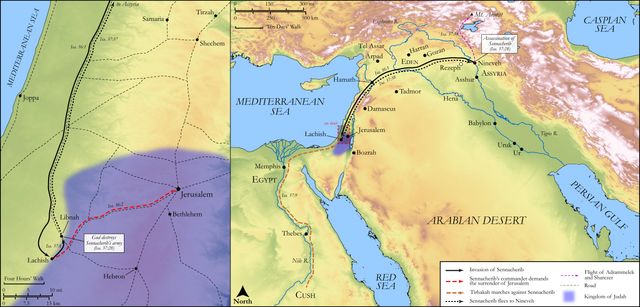
Study this verse
Public-domain commentary
Matthew Henry
From his Commentary on the Whole Bible. Henry comments on passages, not single verses — this entry covers Isaiah 37:21–38.
We may here observe, 1. That those who receive messages of terror from men with patience, and send messages of faith to God by prayer, may expect messages of grace and peace from God for their comfort, even when they are most cast down. Isaiah sent a long answer to Hezekiah's prayer in God's name, sent it in writing (for it was too long to be sent by word of mouth), and sent it by way of return to his prayer, relation being thereunto had: "Whereas thou hast prayed to me, know, for thy comfort, that thy prayer is heard." Isaiah might have referred him to the prophecies he had delivered (particularly that ch. 10) and bid him pick out an answer from thence; but, that he might have abundant consolation, a message is sent him on purpose. The correspondence between earth and heaven is never let fall on God's side. 2. Those who magnify themselves, especially who magnify themselves against God and his people, do really vilify themselves, and made themselves contemptible, in the eyes of all wise men: "The virgin, the daughter of Zion, has despised Sennacherib, and all his impotent malice and menaces; she knows that, while she preserves her integrity, she is sure of the divine protection, and that though the enemy may bark he cannot bite. All his threats are a jest; it is all but brutum fulmen - a mere flash," 3. Those who abuse the people of God affront God himself; and he takes what is said and done against them as said and done against himself: "Whom hast thou reproached? Even the Holy One of Israel, whom thou hast therefore reproached because he is a Holy One." And it aggravated the indignity Sennacherib did to God that he not only reproached him himself, but set his servants on to do the same: By thy servants, the abjects, thou hast reproached me. 4. Those who boast of themselves and their own achievements reflect upon God and his providence: "Thou hast said, I have digged, and drunk water; I have done mighty feats, and will do more; and wilt not own that I have done it," Isa 37:24-26. The most active men are no more than God makes them, and God makes them no more than of old he designed to make them: "What I have formed of ancient times, in an eternal counsel, now have I brought to pass" (for God does all according to the counsel of his will), "that thou shouldst be to lay waste defenced cities; it is therefore intolerable arrogance to make it thy own doing." 5. All the malice, and all the motions and projects, of the church's enemies, are under the cognizance and check of the church's God. Sennacherib was active and quick, here, and there, and every where, but God knew his going out and coming in, and had always an eye upon him, Isa 37:28. And that was not all; he had a hand upon him too, a strict hand, a strong hand, a hook in his nose and a bridle in his lips, with which, though he was very headstrong and unruly, he could and would turn him back by the way which he came, Isa 37:29. Hitherto he shall come and no further. God had signed Sennacherib's commission against Judah (Isa 10:6); here he supersedes it. He has frightened them, but he must not hurt them, and therefore is discharged from going any further; nay, his commitment is here signed, by which he is clapped up, to answer for what he had done beyond his commission. 6. God is his people's bountiful benefactor, as well as their powerful protector, both a sun and a shield to those that trust in him. Jerusalem shall be defended (Isa 37:35), the besiegers shall not come into it, no, nor come before it with any regular attack, but they shall be routed before they begin the siege, Isa 37:33. But this is not all; God will return in mercy to his people, and will do them good. Their land shall be more than ordinarily fruitful, so that their losses shall be abundantly repaired; they shall not feel any of the ill effects either of the enemies' wasting the country or of their own being taken off from husbandry. But the earth, as at first, shall bring forth of itself, and they shall live and live plentifully upon its spontaneous productions. The blessing of the Lord can, when he pleases, make rich without the hand of the diligent. And let them not think that the desolations of their country would excuse them from observing the sabbatical year, which happened (as it should seem) the year after, and when they were not to plough or sow; no, though they had not now their usual stock beforehand for that year, yet they must religiously observe it, and depend upon God to provide for them. God must be trusted in the way of duty. 7. There is no standing before the judgments of God when they come with commission. (1.) The greatest numbers cannot stand before them: one angel shall, in one night, lay a vast army of men dead upon the spot, when God commissions him so to do, Isa 37:36. Here are 185,000 brave soldiers in an instant turned into so many dead corpses. Many think the 76th Psalm was penned upon occasion of this defeat, where from the spoiling of the stout-hearted, and sending them to sleep their long sleep (Isa 37:5), it is inferred that God is more glorious and excellent than the mountains of prey (Isa 37:4), and that he, even he, is to be feared, Isa 37:7. Angels are employed, more than we are aware of, as ministers of God's justice, to punish the pride and break the power of wicked men. (2.) The greatest men cannot stand before them: The great king, the king of Assyria, looks very little when he is forced to return, not only with shame, because he cannot accomplish what he had projected with so much assurance, but with terror and fear, lest the angel that had destroyed his army should destroy him; yet he is made to look less when his own sons, who should have guarded him, sacrificed him to his idol, whose protection he sought, Isa 37:37, Isa 37:38. God can quickly stop their breath who breathe out threatenings and slaughter against his people, and will do it when they have filled up the measure of their iniquity; and the Lord is known by these judgments which he executes, known to be a God that resists the proud. Many prophecies were fulfilled in this providence, which should encourage us, as far as they look further, and are designed as common and general assurances of the safety of the church and of all that trust in God, to depend upon God for the accomplishment of them. He that has delivered does and will deliver. Lord, forgive our enemies; but, so let all thy enemies perish, O Lord!
Historical interpretation
Historical reception
2 surviving comments on this verse. Each one is dated, so this reads as a timeline rather than a list.
(Verse 26 and following) Have you not heard what I did to him in the past? From ancient times I formed it, and now I have brought it forth, and it has become a ruin of the hills that fight against me, and of fortified cities. The inhabitants of those cities were brought low, they trembled and were confused. They became like the grass of the field, and the green herb, and the roof grass that withered before it could mature. I have seen your dwelling place, your going out and your coming in, and your rage against me, when you raged against me. Your pride reaches my ears, so I will put a hoop in your nostrils and a bit in your lips, and I will bring you back on the path from which you came. These words are to be understood from the perspective of God in response to the blasphemy of the Assyrians: Do you not know that what you have done, you have done by my will, and that I have foretold these things, and commanded you to do them through you? Therefore, what I decreed long ago has been fulfilled in its time, that the hills, that is, the rulers who were previously fighting among themselves, and the heavily fortified cities, by my strengthening of my hand and without providing assistance as usual, would be uprooted and tremble and perish, and instead of olives and vineyards, and fruitful trees, there would be grass and weeds, and plants that are beaten down by hay and wither before reaching maturity. Therefore, I have known both your sitting down and your going out and your coming in beforehand, and the madness with which you were about to rage against me, as prophesied by the prophets. I spoke through them, knowing that you alone would declare, 'I will ascend into heaven, I will set my throne above the stars of heaven, and I will be like the Most High.' Therefore, your fury and your pride have reached my ears, and I will no longer bear you so that you may understand that you were able to act not by your own power, but by my will. For impious nations and unfruitful trees were deserving that they be cut down and fall by you, like my axe and saw. Therefore, I will place a circle or a bridle in your nostrils, so that I may restrain blasphemy from your mouth, and you may not dare to speak such things again; and I will apply a bridle to your lips, which will tame your ferocity and bring you back to the Assyrians. With this translation, the Scripture also uses it in the Psalms against the wicked: Put a bridle and a halter on their jaws, who do not come near you (Ps. 31:12).
This is directed from the person of God against the words of Assyria, to whose blasphemy the Lord responds thus: “Do you not know that you did this with my permission? Do you not know that I predict the future and command that certain things be done through you? Hence, what I decreed long ago is being fulfilled at this time: that the hills (that is, princes who fight among themselves) and the fortified cities will be shaken and eradicated, and will perish when I withdraw my hand and offer them none of the assistance to which they have grown accustomed. They were also compared not to olive groves and vineyards and fruitful trees but to straw and turf, to roof grass, all of which impede fruitfulness and wither before they reach maturity. In this way I have also foreknown your sitting down and your going out and your coming in, and I predicted through the prophets the insanity with which you would rage against me. Through these I knew long ago that you would say, ‘I will ascend to heaven; I will set my throne above the stars of heaven, and I will be like the Most High.’ Thus, your anger and your pride have reached my ears, and I will bear you no longer, that you may understand that you are not capable by your own strength but by my will. For the impious Gentiles and the unfruitful trees deserved to be cut down and felled through you, as though you were my axe and saw. Hence, I put a ring or a bit in your nostrils to restrain your verbal blasphemy, that you would dare to speak such things no more. I will also place a bridle on your lips to tame your ferocity and to lead you back to Egypt.” Scripture employs the same imagery in the Psalms against the impious: “Constrain their jaws with a bit and bridle, that they not approach you.”
Continue studying Isaiah 37:28 across the web’s major study libraries — every link below opens this exact verse, chapter, or book on the destination site.
Read & Compare
 BibleGatewayThis verse in more than 200 translations and 70 languages.
 Bible.comThe YouVersion reader — hundreds of translations, reading plans, and highlights.
 ESV.orgCrossway's official English Standard Version reader.
 NET BibleThe NET translation with 60,000+ translators' notes on every rendering decision.
 STEP BibleTyndale House's free study tool — original text, vocabulary, and scholarly resources.
 BibliaLogos Bible Software's free web reader.
 USCCBThe New American Bible (Revised Edition) with the U.S. bishops' study notes.
Commentaries
 BibleHub CommentariesDozens of classic commentaries on this verse, gathered on one page.
 StudyLightMore than 100 commentary sets — the largest collection on the web.
 BibleRefPlain-English commentary on what this verse means, verse by verse.
 Enduring WordDavid Guzik's free commentary on this chapter, widely used by Bible teachers.
 Bible Study ToolsVerse commentary alongside Greek and Hebrew study aids.
Original Language & Research
- BibleHub InterlinearThe verse word by word — original language, transliteration, and English.
- BibleHub LexiconEvery word's original-language definition and Strong's entry.
 Blue Letter BibleDeep-study tools — Strong's numbers, concordance, and word studies.
 SefariaThe Hebrew text with Rashi and centuries of Jewish commentary.
Sermons, Hymns & Audio


TrulyRandomVerse is not affiliated with these sites and doesn’t control their content. They’re linked because they’re genuinely useful.
Summary
Isaiah 37:28 delivers a profound and authoritative declaration from the Lord God to Sennacherib, the boastful King of Assyria, who had dared to blaspheme the Almighty and threaten Jerusalem. Through the prophet Isaiah, God assures King Hezekiah that He possesses absolute, intimate, and comprehensive knowledge of Sennacherib's every movement, his strategic planning, and, most damningly, his defiant rage directed against the divine. This verse stands as a powerful assertion of God's omniscient sovereignty, demonstrating His meticulous awareness and ultimate control over even the most formidable earthly powers, thereby setting the stage for His decisive and miraculous intervention.
Context
ShowHideLiterary Context
This verse is intricately woven into a dramatic and pivotal narrative found in Isaiah 36-39, with a parallel account in 2 Kings 18-19. Following a series of devastating Assyrian conquests throughout Judah, Sennacherib laid siege to Jerusalem. His strategy included sending highly provocative and blasphemous letters to King Hezekiah, boasting of Assyria's military supremacy and deriding Yahweh as no different from the vanquished gods of other nations. Overwhelmed by the threat but unwavering in his faith, Hezekiah took these letters directly into the temple, spreading them before the Lord in earnest prayer for divine deliverance. Isaiah 37:28 forms an integral part of God's immediate and powerful prophetic response, delivered through Isaiah, assuring Hezekiah that the Lord has not only heard his prayer but is intimately aware of Sennacherib's every move and malicious intent, promising a swift and sovereign counter-action.
Historical & Cultural Context
The late 8th century BCE was an era dominated by the Neo-Assyrian Empire, a formidable power notorious for its brutal military campaigns, psychological warfare, and forced deportations of conquered peoples. Sennacherib, who reigned from 705-681 BCE, was one of its most potent monarchs, and his siege of Jerusalem around 701 BCE is a well-documented historical event, corroborated by both biblical texts and Assyrian annals, including the Sennacherib Prism. Culturally, it was customary for conquering kings to attribute their victories to their patron deities and to publicly humiliate the gods of defeated nations. Sennacherib's "rage against me" (referring to God) was thus far more than a personal insult; it was a profound theological challenge, a direct assault on the honor, power, and unique supremacy of Yahweh, the God of Israel. This deep-seated cultural and historical backdrop elevates God's response from a mere military prediction to a declaration of His unparalleled authority over all earthly powers and false deities.
Key Themes
ShowHideIsaiah 37:28 powerfully contributes to several overarching themes central to the book of Isaiah and the broader biblical narrative. Firstly, it emphatically underscores Divine Omniscience, highlighting God's absolute, intimate, and comprehensive knowledge of all things, including the hidden motives, secret plans, and every movement of His adversaries. The phrase "thy abode, and thy going out, and thy coming in" functions as a merism, signifying God's exhaustive awareness, echoing the profound truth expressed in Psalm 139:2-4. Secondly, the verse asserts God's Sovereignty Over Nations, demonstrating that despite Sennacherib's immense power and military might, he remains utterly subject to God's ultimate control. This theme is foundational to Isaiah, which consistently portrays God as the one who raises up and casts down empires according to His sovereign will, even using them as instruments before judging their pride, as seen in Isaiah 10:5-19. Finally, the verse directly addresses Rebellion and Accountability, specifically Sennacherib's "rage against me," which is depicted as a direct and blasphemous challenge to the divine. This theme reinforces the principle that defiance against God will not go unnoticed or unpunished, emphasizing that God holds all rulers accountable for their actions, especially when they profane His name, a truth echoed in Proverbs 16:18.
Exposition and Analysis
ShowHideKey Word Analysis
ShowHideA primitive root meaning "to know," properly to ascertain by seeing. This verb encompasses a vast semantic range, including observation, care, recognition, and even intimate acquaintance. Here, it signifies God's comprehensive, direct, and personal understanding of Sennacherib's entire existence, intentions, and movements. It is not a passive intellectual knowledge but an active, sovereign awareness that undergirds and enables divine action.
A primitive root meaning "to sit down," and by implication, "to dwell" or "to remain." In this context, it refers to Sennacherib's dwelling place, his private quarters, or his base of operations. When paired with "going out" and "coming in," it forms a merism, signifying the totality of his existence—his inner life, his private thoughts, his secret plans, and his very being, all fully known to God.
A primitive root meaning "to quiver" with any violent emotion, especially anger or fear. It denotes a fierce, restless, agitated, and defiant spirit. Sennacherib's "rage" was not merely human anger but a violent, agitated hostility directed specifically "against me" (God), revealing a deep-seated rebellion and blasphemous defiance that provoked divine judgment.
Verse Breakdown
ShowHide"But I know thy abode,"
This opening clause emphatically establishes God's absolute omniscience and intimate awareness. The "I know" is a direct, personal divine declaration to Sennacherib, asserting God's comprehensive understanding. "Thy abode" refers to his dwelling place, signifying God's intimate awareness of his private life, his secret plans, and even his hidden thoughts. Nothing, not even the innermost sanctum of the king, is concealed from God's penetrating gaze.
"and thy going out, and thy coming in,"
This phrase, a classic merism, expands upon the comprehensiveness of God's knowledge. "Going out" refers to all of Sennacherib's public movements, military campaigns, and external actions, while "coming in" refers to his return, his entering into his dwelling, or his internal operations and strategies. Together, these two aspects encompass the entirety of his public and private activities, his every journey, every decision, and every military maneuver. God is fully aware of every step he takes, every strategy he devises.
"and thy rage against me."
This final clause reveals the core offense and the direct cause for God's impending judgment. Sennacherib's "rage" was not merely anger against Judah or King Hezekiah, but a direct, blasphemous, and defiant hostility aimed specifically at the Lord God Himself. This "rage" implies a restless, agitated spirit of rebellion, a direct challenge to God's sovereignty and honor, which God explicitly acknowledges and will therefore address with decisive action.
Literary Devices
ShowHideIsaiah 37:28 masterfully employs several potent literary devices to convey its divine message. The most prominent is Merism, powerfully demonstrated in the phrase "thy abode, and thy going out, and thy coming in." This device uses two contrasting or complementary parts to represent a complete whole, signifying God's exhaustive and comprehensive knowledge of Sennacherib's entire existence—from his private dwelling and inner thoughts to all his public movements and military campaigns. This conveys a sense of totality and divine omnipresence. The verse also utilizes Anthropomorphism, as God speaks in human terms of "knowing" and being the object of "rage," making the divine interaction with human affairs relatable and immediate, emphasizing God's personal engagement with Sennacherib's defiance. Furthermore, there is a profound implied Irony: Sennacherib, in his immense hubris and military might, believed himself to be the ultimate power, yet God reveals that He has full, intimate knowledge and ultimate control over every single aspect of Sennacherib's life and plans, demonstrating the utter futility of human pride and rebellion against divine sovereignty. The declaration itself functions as a Divine Oracle, a direct, authoritative, and unchallengeable pronouncement from God, carrying absolute certainty and promising an inevitable outcome.
Theological and Thematic Connections
ShowHideIsaiah 37:28 stands as a potent theological statement regarding God's absolute sovereignty and omniscience. It reveals that no human power, no matter how formidable, arrogant, or seemingly invincible, operates outside the meticulous purview of the Almighty. Sennacherib's "rage" against God was not an unforeseen outburst but a known quantity, fully comprehended by the divine mind, even before it was uttered. This intimate knowledge is not passive; rather, it forms the very basis for God's righteous judgment and His decisive intervention on behalf of His people. The verse underscores that God is not merely aware of events but is intimately involved in the affairs of nations, orchestrating them according to His divine purpose, even using wicked rulers as instruments before holding them fully accountable for their own pride and rebellion. It provides profound assurance to believers that their adversaries are never hidden from God's sight, and His comprehensive awareness guarantees His ultimate, perfectly timed response.
Reflection and Application
ShowHideFor believers today, Isaiah 37:28 offers both profound comfort and a sobering reminder. In a world often characterized by overwhelming threats, political turmoil, or personal adversaries, this verse assures us that God is never caught off guard. He knows the "abode," the "going out," and the "coming in" of every opposing force, every hostile intention, and every "rage" directed against His people or His divine purposes. This comprehensive knowledge translates into ultimate control and the certainty of divine intervention at the appointed time. We are called to trust implicitly in His comprehensive awareness, knowing that even when circumstances seem chaotic or overwhelming, God is intimately acquainted with every detail of our lives and the world around us. This truth should inspire us to live with unwavering confidence, knowing that our Protector is omniscient and omnipotent. Conversely, it calls us to walk in profound humility, recognizing that our own actions, thoughts, and attitudes are equally transparent before Him. It challenges us to align our hearts and lives with His will, understanding that true security and lasting peace lie not in human strength, strategic maneuvering, or worldly power, but in the all-knowing, sovereign God who faithfully defends His own.
Questions for Reflection
ShowHideFAQ
ShowHideWhat was the nature of Sennacherib's "rage against me"?
ShowHideSennacherib's "rage against me" (God) was not merely a general anger or frustration, but a specific, deliberate, and defiant blasphemy. As recounted in Isaiah 36:18-20, Sennacherib sent messengers who openly mocked the Lord, claiming He was no different from the gods of other nations that Assyria had conquered and whose people they had deported. This was a direct challenge to God's unique power, His covenant faithfulness, and His sovereignty, implying that Yahweh was just another impotent deity subject to human conquest. His "rage" was therefore a manifestation of extreme pride, contempt, and a direct affront to the one true God, which God personally took note of and promised to punish.
How does God's "knowing" apply to our lives today?
ShowHideGod's "knowing" in Isaiah 37:28, which encompasses every aspect of Sennacherib's being and actions, applies to us today as a profound assurance of His omnipresence and omniscience. Just as He knew Sennacherib's "abode, going out, and coming in"—his every private thought and public action—He knows every detail of our lives. This includes our deepest thoughts, our hidden struggles, our joys, our fears, and even the secret intentions of those who might oppose us. This comprehensive knowledge means we are never alone, never forgotten, and never beyond His watchful care. It provides immense comfort in times of trouble, knowing that our God is fully aware and actively engaged in our circumstances. It also calls us to live with integrity and authenticity, recognizing that all our actions, both public and private, are transparent before Him, as powerfully affirmed in Hebrews 4:13.
Christ-Centered Fulfillment
ShowHideIsaiah 37:28, with its powerful declaration of God's absolute knowledge and sovereign control over a defiant earthly king, finds its ultimate and most glorious fulfillment in the person and redemptive work of Jesus Christ. The Father's omniscience, so meticulously displayed in knowing Sennacherib's every move and malicious intent, is fully embodied in the Son. Jesus, as the eternal Word of God who became flesh, possesses inherent divine knowledge, perfectly discerning the hearts and intentions of all people (e.g., John 2:24-25). Just as God knew Sennacherib's "rage," Christ perfectly discerned the spiritual "rage" of the powers of darkness and the rebellious hearts of humanity that culminated in His crucifixion. His life, atoning death, and glorious resurrection represent the ultimate divine intervention against all forces that rage against God's kingdom. On the cross, Christ definitively disarmed the principalities and powers, triumphing over them (as declared in Colossians 2:15), demonstrating that no earthly or spiritual foe can ultimately withstand the sovereign will of God. Furthermore, Christ's enthronement as King of kings and Lord of lords signifies His complete and eternal authority over all nations and rulers, ensuring that every "rage against" God will ultimately be brought to nothing before His glorious and everlasting reign, just as Sennacherib's pride was decisively humbled by divine power.