


Isaiah 37:38
Bible text: King James Version (1769 Blayney text) · Public domain
Bible text: King James Version with Strong's numbers · Public domain
Bible text: Berean Standard Bible · Public domain
Bible text: American Standard Version (1901) · Public domain
Bible text: World English Bible, Messianic edition · Public domain
Bible text: Geneva Bible (1599) · Public domain
Bible text: Young's Literal Translation · Public domain
- וַיְהִיvay·Hiand it wasH1961Conj-w ¦ V-Qal-ConsecImperf-3msVerb Qal Consecutive Imperfect 3rd Singular Masculineוַandיְהִיit was
- הוּאhu'heH1931Pro-3msPronoun Personal 3rd Singular Masculine
- מִשְׁתַּחֲוֶהmish·ta·cha·Veh[was] bowing downH7812V-Hithpael-Prtcpl-msVerb Hithpael Participle Singular Masculine Absolute
- בֵּיתbeit[the] house ofH1004N-mscNoun Singular Masculine Construct
- נִסְרֹךְnis·RokhNisrochH5268N-properNoun Proper Title
- אֱלֹהָיו'e·lo·Havhis godH430N-mpc ¦ 3msNoun Plural Masculine Constructאֱלֹהָיgodוhis
- וְאַדְרַמֶּלֶךְve·'ad·ra·Me·lekhand AdrammelechH152Conj-w ¦ N-properNoun Proper TitleוְandאַדְרַמֶּלֶךְAdrammelech
- וְשַׂרְאֶצֶרve·sar·'E·tzerand SharezerH8272Conj-w ¦ N-proper-mNoun Proper MasculineוְandשַׂרְאֶצֶרSharezer
- בָּנָיוba·Navhis sonsH1121N-mpc ¦ 3msNoun Plural Masculine Constructבָּנָיsonsוhis
- הִכֻּהוּhi·Ku·huthey struck down himH5221V-Hiphil-Perf-3cp ¦ 3msVerb Hiphil Perfect 3rd Plural common genderהִכֻּthey struck downהוּhim
- בַחֶרֶבva·Che·revwith the swordH2719Prep-b ¦ N-fsNoun Singular Feminine Absoluteבַwith theחֶרֶבsword
- וְהֵמָּהve·He·mahand theyH1992Conj-w ¦ Pro-3mpPronoun Personal 3rd Plural Masculineוְandהֵמָּהthey
- נִמְלְטוּnim·le·Tuthey escapedH4422V-Niphal-Perf-3cpVerb Niphal Perfect 3rd Plural common gender
- אֶרֶץ'E·retz[the] land ofH776N-fscNoun Singular Feminine Construct
- אֲרָרָט'a·ra·RatAraratH780N-properNoun Proper Location
- וַיִּמְלֹךְvai·yim·Lokhand he reignedH4427Conj-w ¦ V-Qal-ConsecImperf-3msVerb Qal Consecutive Imperfect 3rd Singular Masculineוַandיִּמְלֹךְhe reigned
- אֵסַר'e·sarEsar-H634N-proper-mNoun Proper Masculine
- חַדֹּןcha·Don-haddonH634N-proper-mNoun Proper Masculine
- בְּנוֹbe·Nohis sonH1121N-msc ¦ 3msNoun Singular Masculine Constructבְּנsonוֹhis
- תַּחְתָּיוtach·Tavhis in placeH8478N-mpc ¦ 3msNoun Plural Masculine Constructתַּחְתָּיin placeוhis
English is a literal word-by-word gloss of the Hebrew, not the KJV's wording. Why?
This is the original text the KJV's translators worked from — each Hebrew word with its own literal English meaning in this verse, prepared by scholars at Tyndale House, Cambridge. The KJV translates whole sentences, not word by word, so its wording differs: one Hebrew word can become several English words, and the KJV may choose “the LORD” where the gloss reads “Yahweh”. Both are faithful — they answer different questions. For the KJV's own rendering, switch to the KJV text.
Details
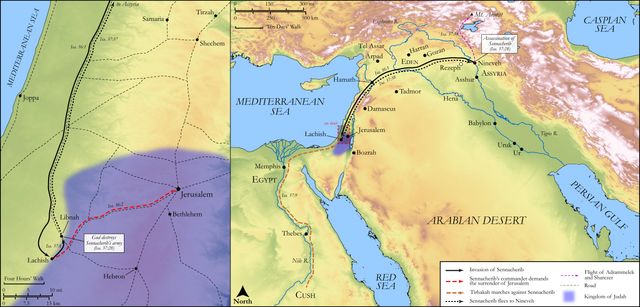
See on the biblical-era map
Study this verse
Public-domain commentary
Matthew Henry
From his Commentary on the Whole Bible. Henry comments on passages, not single verses — this entry covers Isaiah 37:21–38.
We may here observe, 1. That those who receive messages of terror from men with patience, and send messages of faith to God by prayer, may expect messages of grace and peace from God for their comfort, even when they are most cast down. Isaiah sent a long answer to Hezekiah's prayer in God's name, sent it in writing (for it was too long to be sent by word of mouth), and sent it by way of return to his prayer, relation being thereunto had: "Whereas thou hast prayed to me, know, for thy comfort, that thy prayer is heard." Isaiah might have referred him to the prophecies he had delivered (particularly that ch. 10) and bid him pick out an answer from thence; but, that he might have abundant consolation, a message is sent him on purpose. The correspondence between earth and heaven is never let fall on God's side. 2. Those who magnify themselves, especially who magnify themselves against God and his people, do really vilify themselves, and made themselves contemptible, in the eyes of all wise men: "The virgin, the daughter of Zion, has despised Sennacherib, and all his impotent malice and menaces; she knows that, while she preserves her integrity, she is sure of the divine protection, and that though the enemy may bark he cannot bite. All his threats are a jest; it is all but brutum fulmen - a mere flash," 3. Those who abuse the people of God affront God himself; and he takes what is said and done against them as said and done against himself: "Whom hast thou reproached? Even the Holy One of Israel, whom thou hast therefore reproached because he is a Holy One." And it aggravated the indignity Sennacherib did to God that he not only reproached him himself, but set his servants on to do the same: By thy servants, the abjects, thou hast reproached me. 4. Those who boast of themselves and their own achievements reflect upon God and his providence: "Thou hast said, I have digged, and drunk water; I have done mighty feats, and will do more; and wilt not own that I have done it," Isa 37:24-26. The most active men are no more than God makes them, and God makes them no more than of old he designed to make them: "What I have formed of ancient times, in an eternal counsel, now have I brought to pass" (for God does all according to the counsel of his will), "that thou shouldst be to lay waste defenced cities; it is therefore intolerable arrogance to make it thy own doing." 5. All the malice, and all the motions and projects, of the church's enemies, are under the cognizance and check of the church's God. Sennacherib was active and quick, here, and there, and every where, but God knew his going out and coming in, and had always an eye upon him, Isa 37:28. And that was not all; he had a hand upon him too, a strict hand, a strong hand, a hook in his nose and a bridle in his lips, with which, though he was very headstrong and unruly, he could and would turn him back by the way which he came, Isa 37:29. Hitherto he shall come and no further. God had signed Sennacherib's commission against Judah (Isa 10:6); here he supersedes it. He has frightened them, but he must not hurt them, and therefore is discharged from going any further; nay, his commitment is here signed, by which he is clapped up, to answer for what he had done beyond his commission. 6. God is his people's bountiful benefactor, as well as their powerful protector, both a sun and a shield to those that trust in him. Jerusalem shall be defended (Isa 37:35), the besiegers shall not come into it, no, nor come before it with any regular attack, but they shall be routed before they begin the siege, Isa 37:33. But this is not all; God will return in mercy to his people, and will do them good. Their land shall be more than ordinarily fruitful, so that their losses shall be abundantly repaired; they shall not feel any of the ill effects either of the enemies' wasting the country or of their own being taken off from husbandry. But the earth, as at first, shall bring forth of itself, and they shall live and live plentifully upon its spontaneous productions. The blessing of the Lord can, when he pleases, make rich without the hand of the diligent. And let them not think that the desolations of their country would excuse them from observing the sabbatical year, which happened (as it should seem) the year after, and when they were not to plough or sow; no, though they had not now their usual stock beforehand for that year, yet they must religiously observe it, and depend upon God to provide for them. God must be trusted in the way of duty. 7. There is no standing before the judgments of God when they come with commission. (1.) The greatest numbers cannot stand before them: one angel shall, in one night, lay a vast army of men dead upon the spot, when God commissions him so to do, Isa 37:36. Here are 185,000 brave soldiers in an instant turned into so many dead corpses. Many think the 76th Psalm was penned upon occasion of this defeat, where from the spoiling of the stout-hearted, and sending them to sleep their long sleep (Isa 37:5), it is inferred that God is more glorious and excellent than the mountains of prey (Isa 37:4), and that he, even he, is to be feared, Isa 37:7. Angels are employed, more than we are aware of, as ministers of God's justice, to punish the pride and break the power of wicked men. (2.) The greatest men cannot stand before them: The great king, the king of Assyria, looks very little when he is forced to return, not only with shame, because he cannot accomplish what he had projected with so much assurance, but with terror and fear, lest the angel that had destroyed his army should destroy him; yet he is made to look less when his own sons, who should have guarded him, sacrificed him to his idol, whose protection he sought, Isa 37:37, Isa 37:38. God can quickly stop their breath who breathe out threatenings and slaughter against his people, and will do it when they have filled up the measure of their iniquity; and the Lord is known by these judgments which he executes, known to be a God that resists the proud. Many prophecies were fulfilled in this providence, which should encourage us, as far as they look further, and are designed as common and general assurances of the safety of the church and of all that trust in God, to depend upon God for the accomplishment of them. He that has delivered does and will deliver. Lord, forgive our enemies; but, so let all thy enemies perish, O Lord!
Historical interpretation
Historical reception
1 surviving comment on this verse from the historical church.
(Vrs. 36 seqq.) However, the Angel of God went out and struck down in the Assyrian camp 185,000 men; and when they arose in the morning, behold, all the dead bodies. Then Sennacherib king of Assyria departed and returned to Nineveh, and he lived there. And it came about as he was worshiping in the temple of Nesrach his god, that Adrammelech and Sharezer, his sons, killed him with the sword; and they escaped into the land of Ararat. And Esarhaddon his son became king in his place. One hundred and eighty-five thousand brave men are killed by one Angel in one night, and the cruel death of the slain runs rampant without wounds, by the will of God, separating the souls from their bodies. On this, it is written in the Chronicles: And the Lord sent an Angel, who struck down every strong man, warrior, and prince of the army of the king of Assyria: and he returned with disgrace to his own land (2 Chronicles 32:24). He was saved for this reason, so that he would know the power of God and silence the blasphemous mouths: and he became a witness of that majesty, which he had recently condemned. And what he experienced: And they rose in the morning, whether Israelites or the rest of his armies, let us accept: although it is written in the Book of Kings, that when the king himself rose in the morning, he saw all the bodies of the dead (3 Kings 19). Pharaoh also suffered ten plagues in Egypt, so that he might perish in the end: which this person is also going to suffer. For when he returned to the city of Nineveh, the capital of his kingdom, and worshipped in the temple of his god Nesrach, as if he had achieved victory over his enemies, and walked triumphantly and joyfully in the shrine of his false deity, the despiser of the true God is killed in the temple of the false god. It was not the sword that was the weapon of the Angels, which was common to many, but the parricide of his sons. When they fled to the land of Ararat, which is known as Armenia, Asaraddon succeeded his father, whom the Scripture testifies sent inhabitants to Samaria so that the land would not remain uncultivated. But the region of Ararat in Armenia is a plain through which the Araxes River flows, of incredible fertility, near the foothills of the Taurus mountain, which extends all the way there. Therefore, the Ark in which Noah was saved with his children, when the Flood ceased, was not taken to the mountains of Armenia in general, which are called Ararat, but to the highest peaks of the Taurus mountain, which tower over the plains of Ararat.
Continue studying Isaiah 37:38 across the web’s major study libraries — every link below opens this exact verse, chapter, or book on the destination site.
Read & Compare
 BibleGatewayThis verse in more than 200 translations and 70 languages.
 Bible.comThe YouVersion reader — hundreds of translations, reading plans, and highlights.
 ESV.orgCrossway's official English Standard Version reader.
 NET BibleThe NET translation with 60,000+ translators' notes on every rendering decision.
 STEP BibleTyndale House's free study tool — original text, vocabulary, and scholarly resources.
 BibliaLogos Bible Software's free web reader.
 USCCBThe New American Bible (Revised Edition) with the U.S. bishops' study notes.
Commentaries
 BibleHub CommentariesDozens of classic commentaries on this verse, gathered on one page.
 StudyLightMore than 100 commentary sets — the largest collection on the web.
 BibleRefPlain-English commentary on what this verse means, verse by verse.
 Enduring WordDavid Guzik's free commentary on this chapter, widely used by Bible teachers.
 Bible Study ToolsVerse commentary alongside Greek and Hebrew study aids.
Original Language & Research
- BibleHub InterlinearThe verse word by word — original language, transliteration, and English.
- BibleHub LexiconEvery word's original-language definition and Strong's entry.
 Blue Letter BibleDeep-study tools — Strong's numbers, concordance, and word studies.
 SefariaThe Hebrew text with Rashi and centuries of Jewish commentary.
Sermons, Hymns & Audio


TrulyRandomVerse is not affiliated with these sites and doesn’t control their content. They’re linked because they’re genuinely useful.
Summary
Isaiah 37:38 brings to a climactic close the dramatic narrative of King Sennacherib of Assyria, recounting his assassination by his own sons, Adrammelech and Sharezer, as he worshipped his god Nisroch in Nineveh. This verse powerfully demonstrates the ultimate fulfillment of God's precise prophecy against the arrogant monarch who had blasphemed the Lord and threatened Jerusalem, firmly establishing his son Esarhaddon as his successor and underscoring the divine, sovereign hand in the rise and fall of earthly rulers.
Context
ShowHideLiterary Context
This verse serves as the definitive and satisfying climax to the extended narrative arc concerning King Sennacherib's audacious challenge to King Hezekiah and, more significantly, to the God of Israel. This narrative spans Isaiah 36 and Isaiah 37. Earlier in the chapter, the prophet Isaiah delivers a remarkably specific prophecy from the Lord concerning Sennacherib's fate: "Behold, I will send a blast upon him, and he shall hear a rumour, and return to his own land; and I will cause him to fall by the sword in his own land" (Isaiah 37:7). The preceding verse, Isaiah 37:36, describes the miraculous and devastating destruction of 185,000 Assyrian soldiers by the angel of the Lord, which immediately prompted Sennacherib's ignominious retreat to Nineveh. Verse 38, therefore, provides the final, personal, and long-awaited fulfillment of God's judgment against Sennacherib, occurring some years after his return to Assyria, thus bringing a profound sense of closure and divine vindication to this significant historical and theological narrative.
Historical & Cultural Context
Sennacherib was one of the most formidable and powerful kings of the Neo-Assyrian Empire, reigning from 705 to 681 BC. His extensive military campaigns, particularly his siege of Jerusalem in 701 BC, are thoroughly documented in both biblical accounts and extra-biblical Assyrian annals, such as the famous Taylor Prism, which corroborates the historical backdrop of this period. The "house of Nisroch his god" refers to a temple dedicated to an Assyrian deity. While the precise identity of Nisroch remains a subject of scholarly debate (some suggest a connection to the god Nusku or a specific eagle-headed deity), it was undoubtedly a prominent god within the Assyrian pantheon, likely associated with agriculture, war, or scribal arts. The act of regicide, particularly within the royal family, was a grim but not uncommon feature of the monarchies of that day, often driven by intense power struggles over succession. Adrammelech and Sharezer were indeed two of Sennacherib's sons, and their parricidal act, followed by their escape to "the land of Armenia" (ancient Urartu, a powerful kingdom north of Assyria), is further corroborated by non-biblical historical sources, which also consistently confirm Esarhaddon as Sennacherib's legitimate and successful successor. This remarkable historical accuracy lends significant credibility and weight to the biblical narrative.
Key Themes
ShowHideThis verse powerfully contributes to several overarching themes deeply embedded within the book of Isaiah and the broader Old Testament narrative. Firstly, it emphatically highlights Divine Retribution and the Certainty of Prophecy's Fulfillment. Sennacherib's death, though delayed by two decades, is presented as the direct, inevitable, and divinely orchestrated consequence of his profound hubris and blasphemy against the God of Israel. This demonstrates God's unwavering commitment to His declared word and His ultimate control over human destiny. Secondly, the passage underscores the profound Futility of Idolatry. Sennacherib is struck down while worshipping his pagan god, Nisroch, who proves utterly powerless to protect him, standing in stark contrast to the omnipotence of Yahweh, who had just miraculously delivered Jerusalem from the Assyrian onslaught (Isaiah 37:36). This powerfully emphasizes the biblical polemic against false gods, a recurring and vital theme throughout the prophetic books. Lastly, the verse vividly illustrates God's Absolute Sovereignty Over Human Affairs. Even the seemingly chaotic and violent internal dynamics of the Assyrian royal court—the assassination and subsequent succession—are portrayed as instruments in God's hand to bring about His perfect purposes, echoing the profound truth found in Proverbs 21:1 that "The king's heart is in the hand of the Lord, like the rivers of water; He turns it wherever He wishes."
Exposition and Analysis
ShowHideKey Word Analysis
ShowHideThis primitive root signifies "to depress, i.e., prostrate (especially reflexive, in homage to royalty or God)." It describes the physical act of bowing down or prostrating oneself, a posture signifying deep reverence, submission, or adoration. In this context, it highlights Sennacherib's devotion to his false god, Nisroch, making his violent death during this act particularly ironic and symbolic of the profound futility and impotence of his worship. The very act meant to secure divine favor becomes the moment of his demise.
A primitive root meaning "to strike (lightly or severely, literally or figuratively)." This versatile verb encompasses a wide range of actions from a simple hit to a fatal blow, as is unequivocally the case here. The use of this word emphasizes the direct, brutal, and decisive nature of the attack by his sons, confirming the precise fulfillment of Isaiah's prophecy that Sennacherib would "fall by the sword."
A primitive root meaning "to reign; inceptively, to ascend the throne; causatively, to induct into royalty." This word signifies the establishment of royal authority, the assumption of the throne, and the continuity of dynastic power. Its inclusion here emphasizes the immediate and orderly transfer of power following the assassination, ensuring the continuity of the Assyrian throne under divine oversight, even amidst such profound internal chaos and violence.
Verse Breakdown
ShowHide"And it came to pass, as he was worshipping in the house of Nisroch his god,"
This opening clause meticulously sets the scene for Sennacherib's dramatic and ignominious demise. It specifies both the location—the temple dedicated to his pagan deity—and the activity—an act of profound worship. This detail is laden with profound irony, underscoring the impotence of idols: the very god in whom Sennacherib placed his trust and to whom he offered devotion proved utterly incapable of protecting him at his most vulnerable moment. This powerfully highlights the stark contrast between the powerlessness of false gods and the active, sovereign power of the living God.
"that Adrammelech and Sharezer his sons smote him with the sword;"
This part precisely identifies the perpetrators of the assassination: two of Sennacherib's own sons. The method, "with the sword," directly and unequivocally fulfills Isaiah's earlier prophecy in Isaiah 37:7 that Sennacherib would "fall by the sword in his own land." This shocking act of parricide speaks volumes about the internal strife, ruthless ambition, and instability within the Assyrian royal court, which God sovereignly utilized as the instrument to execute His long-declared judgment.
"and they escaped into the land of Armenia:"
Immediately following the assassination, the two parricidal sons fled to a neighboring region, ancient Urartu, which the text refers to as Armenia. This detail provides crucial historical accuracy and explains their immediate fate, preventing them from seizing the throne themselves and allowing for the legitimate succession. Their escape confirms the violent and desperate nature of their act.
"and Esarhaddon his son reigned in his stead."
This final clause states the definitive outcome of the regicide: Esarhaddon, another son of Sennacherib, successfully ascended to the throne and established his reign. This confirms the new political reality in Assyria and powerfully demonstrates God's sovereign control over the succession of kings, even those who vehemently oppose Him, ensuring that His overarching plan for history unfolds precisely as He intends.
Literary Devices
ShowHideIsaiah 37:38 employs several potent literary devices that amplify its theological message and dramatic impact. Irony is profoundly prominent, as Sennacherib, the mighty Assyrian king who had arrogantly blasphemed the God of Israel and boasted of his invincible power, meets his ignominious end not in glorious battle, but in the most vulnerable and intimate of settings—while worshipping his own impotent idol. This dramatic contrast highlights the utter futility of false gods and the ultimate, undeniable sovereignty of Yahweh. The verse also serves as a powerful instance of Fulfillment of Prophecy, directly echoing Isaiah's earlier, precise declaration in Isaiah 37:7, thereby validating the divine origin of Isaiah's message and God's unwavering faithfulness to His declared word. Furthermore, the narrative uses Contrast to emphasize the stark difference between the seemingly invincible Assyrian king, whose vast army was miraculously decimated by a single angel (Isaiah 37:36), and the God of Israel, whose quiet, sovereign hand orchestrates the king's personal demise through the unexpected means of internal family strife. The specific details of the assassination and succession also provide a strong sense of Poetic Justice, as the one who sought to destroy God's people and mock their God is himself destroyed by those closest to him, in his own land, and at a moment of supposed security.
Theological and Thematic Connections
ShowHideIsaiah 37:38 stands as a powerful and enduring testament to the unwavering sovereignty of God and the absolute certainty of His prophetic word. It demonstrates unequivocally that no earthly power, however mighty, arrogant, or seemingly insurmountable, can ultimately thwart the divine will or escape the reach of divine justice. Sennacherib's dramatic and ignominious end, occurring two decades after his retreat from Jerusalem, underscores that divine judgment, though sometimes delayed according to God's perfect timing, is utterly inevitable for those who defiantly oppose the Lord and persecute His people. It serves as a profound reminder that human history, including the rise and fall of empires, the machinations of kings, and even the most chaotic internal political events, unfolds precisely according to God's overarching and meticulously executed plan. The futility of Sennacherib's worship of Nisroch further highlights the timeless biblical truth that idols are utterly powerless, vain, and offer no protection, salvation, or ultimate hope, standing in stark contrast to the living God who actively intervenes in human affairs with omnipotent power and perfect wisdom.
Reflection and Application
ShowHideIsaiah 37:38 offers profound and enduring lessons for believers across all generations, reinforcing the timeless truth that God is utterly sovereign over all creation, including the most powerful human leaders, complex geopolitical events, and even the darkest acts of human treachery. It serves as a powerful reminder that His promises, whether of judgment against His enemies or deliverance for His people, are always reliable, unwavering, and will come to pass in His perfect timing. For those facing seemingly insurmountable challenges, oppressive forces, or periods of profound uncertainty, this passage provides immense comfort and reassurance: the God who miraculously brought down the mighty Sennacherib and orchestrated his demise is still actively at work today, defending His people, fulfilling His purposes, and reigning supreme over all circumstances. It also serves as a sobering warning against the dangers of pride, self-reliance, and the idolatrous worship of anything other than the one true God, whether it be wealth, power, personal ambition, or human ideologies. Ultimately, our security, hope, and peace are found not in human strength, political systems, or false gods, but solely in the faithful, all-powerful, and sovereign Lord.
Questions for Reflection
ShowHideFAQ
ShowHideWho was Nisroch, and why is his mention significant?
ShowHideNisroch (H5268) was an Assyrian deity, though his precise identity and attributes are debated among scholars. Some theories link him to the god Nusku, associated with light and fire, or to a specific eagle-headed deity found in Assyrian iconography. His mention is profoundly significant because Sennacherib was "worshipping" (H7812) in Nisroch's "house" (H1004), or temple, when he was assassinated. This detail powerfully highlights the futility of idolatry. The mighty Assyrian king, who had arrogantly boasted against the God of Israel, was struck down by his own sons while seeking protection and favor from a god who proved utterly powerless. This dramatically demonstrates the stark contrast between the impotence of false gods and the omnipotence of Yahweh, who had just miraculously delivered Jerusalem from Sennacherib's vast army (Isaiah 37:36).
When did Sennacherib's assassination occur in relation to the siege of Jerusalem?
ShowHideThe biblical account in Isaiah 37:38 and its parallel in 2 Kings 19:37 explicitly indicate that Sennacherib's death occurred "after" his return to Nineveh following the failed siege of Jerusalem. Historical records, including Assyrian annals, confirm that the siege of Jerusalem took place in 701 BC, while Sennacherib was assassinated in 681 BC. This means there was a significant gap of approximately 20 years between his humiliating retreat from Jerusalem and his violent death. This delay underscores God's perfect timing and the absolute certainty of His prophetic word, which, though not always immediate, is always ultimately and precisely fulfilled.
Why did Sennacherib's sons assassinate him, and what happened to them?
ShowHideThe biblical text does not explicitly state the sons' motives, but the history of the monarchies of that day suggests common reasons for regicide, such as intense power struggles over succession, political intrigue, or deep-seated dissatisfaction with the reigning monarch's policies or leadership. Adrammelech (H152) and Sharezer (H8272) were two of Sennacherib's "sons" (H1121), and after they "smote" (H5221) their father "with the sword" (H2719), they "escaped" (H4422) into "the land" (H776) of "Armenia" (H780), which refers to the ancient kingdom of Urartu, a region north of Assyria. Their flight allowed another son, Esarhaddon (H634), to "reigned" (H4427) in his father's "stead," establishing him as the legitimate and successful successor to the Assyrian throne and thereby fulfilling the prophetic word concerning Sennacherib's demise.
Christ-Centered Fulfillment
ShowHideIsaiah 37:38, while detailing the dramatic and divinely orchestrated judgment of an earthly king, powerfully points forward to the ultimate triumph of God's true and eternal King, Jesus Christ. Sennacherib's fall, brought about by God's sovereign hand, foreshadows Christ's decisive and ultimate victory over all spiritual and earthly enemies. Just as Sennacherib's arrogant boasts and his reliance on a powerless false god proved utterly futile, so too will all powers, principalities, and human systems that oppose God ultimately be brought to nothing by Christ, who has definitively "disarmed the powers and authorities" through His victorious cross and resurrection (Colossians 2:15). The profound futility of worshipping Nisroch highlights the exclusive and absolute claim of Jesus Christ as the only true object of worship, the "Lamb of God who takes away the sin of the world!" (John 1:29). Unlike Sennacherib, whose reign ended in violent betrayal and an ignominious death, Christ's reign is eternal, unshakeable, and established not by human intrigue or violence but by divine decree and perfect righteousness (Psalm 110:1). His kingdom will never be destroyed, and His dominion is everlasting, extending to all peoples, nations, and languages (Daniel 7:14). Thus, Sennacherib's demise, a powerful testament to God's sovereignty over even the most formidable earthly rulers, ultimately serves as a profound pointer to the supreme, glorious, and everlasting reign of Jesus Christ, the King of kings and Lord of lords (Revelation 19:16).