


Ezra 4:2
Bible text: King James Version (1769 Blayney text) · Public domain
Bible text: King James Version with Strong's numbers · Public domain
Bible text: Berean Standard Bible · Public domain
Bible text: American Standard Version (1901) · Public domain
Bible text: World English Bible, Messianic edition · Public domain
Bible text: Geneva Bible (1599) · Public domain
Bible text: Young's Literal Translation · Public domain
- וַיִּגְּשׁוּvai·yi·ge·Shuand they approachedH5066Conj-w ¦ V-Qal-ConsecImperf-3mpVerb Qal Consecutive Imperfect 3rd Plural Masculineוַandיִּגְּשׁוּthey approached
- אֶל'el<to>H413PrepPreposition
- זְרֻבָּבֶלze·ru·ba·VelZerubbabelH2216N-proper-mNoun Proper Masculine
- וְאֶלve·'eland <to>H413Conj-w ¦ PrepPrepositionוְandאֶל<to>
- רָאשֵׁיra·Shei[the] heads ofH7218N-mpcNoun Plural Masculine Construct
- הָאָבוֹתha·'a·Votthe fathersH1Art ¦ N-fpNoun Plural Feminine Absoluteהָtheאָבוֹתfathers
- וַיֹּאמְרוּvai·yo·me·Ruand they saidH559Conj-w ¦ V-Qal-ConsecImperf-3mpVerb Qal Consecutive Imperfect 3rd Plural Masculineוַandיֹּאמְרוּthey said
- לָהֶםla·Hemto <the> themPrep-l ¦ 3mpSuffix Personal 3rd Plural Masculineלָto <the>הֶםthem
- נִבְנֶהniv·Nehlet us buildH1129V-Qal-Imperf-1cpVerb Qal Imperfect 1st Plural common gender
- עִמָּכֶם'i·ma·Khemwith youH5973Prep ¦ 2mpPreposition Definiteעִמָּwithכֶםyou
- כִּיkiforH3588PrtParticle Conditional
- כָכֶםkha·Khemlike youPrep-k ¦ 2mpSuffix Personal 2nd Plural Masculineכָlikeכֶםyou
- נִדְרוֹשׁnid·Ro·oshwe seekH1875V-Qal-Imperf-1cpVerb Qal Imperfect 1st Plural common gender
- לֵאלֹהֵיכֶםle·lo·hei·Khem<to> your GodH430Prep-l ¦ N-mpc ¦ 2mpNoun Plural Masculine Constructלֵ<to>אלֹהֵיGodכֶםyour
- וְלוֹve·loand to <the> himConj-w ¦ Prep-l ¦ 3msPreposition Definiteוְandלto <the>וֹhim
- אֲנַחְנוּ'a·Nach·nuweH587Pro-1cpPronoun Personal 1st Plural common gender
- זֹבְחִיםzoe·Chim[have been] sacrificingH2076V-Qal-Prtcpl-mpVerb Qal Participle Plural Masculine Absolute
- מִימֵיmi·Meisince [the] days ofH3117Prep-m ¦ N-mpcNoun Plural Masculine Constructמִsinceימֵי[the] days of
- אֵסַר'e·SarEsar-H634N-proper-mNoun Proper Masculine
- חַדֹּןcha·Don-haddonH634N-proper-mNoun Proper Masculine
- מֶלֶךְMe·lekh[the] king ofH4428N-mscNoun Singular Masculine Construct
- אַשּׁוּר'a·ShurAssyriaH804N-properNoun Proper Location
- הַמַּעֲלֶהha·ma·'a·Lehwho brought upH5927Art ¦ V-Hiphil-Prtcpl-msVerb Hiphil Participle Singular Masculine Absoluteהַwhoמַּעֲלֶהbrought up
- אֹתָנוּ'o·Ta·nu<obj.> usH853DirObjM ¦ 1cpParticle Object Indicatorאֹתָ<obj.>נוּus
- פֹּהPohhereH6311AdvAdverb
English is a literal word-by-word gloss of the Hebrew, not the KJV's wording. Why?
This is the original text the KJV's translators worked from — each Hebrew word with its own literal English meaning in this verse, prepared by scholars at Tyndale House, Cambridge. The KJV translates whole sentences, not word by word, so its wording differs: one Hebrew word can become several English words, and the KJV may choose “the LORD” where the gloss reads “Yahweh”. Both are faithful — they answer different questions. For the KJV's own rendering, switch to the KJV text.
Details
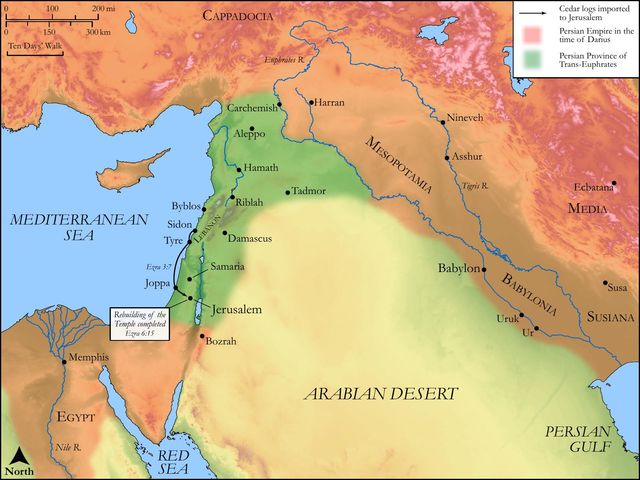
See on the biblical-era map
Study this verse
Public-domain commentary
Matthew Henry
From his Commentary on the Whole Bible. Henry comments on passages, not single verses — this entry covers Ezra 4:1–5. His three-level outline is real structure in the source text, so it is rendered as structure.
We have here an instance of the old enmity that was put between the seed of the woman and the seed of the serpent. God's temple cannot be built, but Satan will rage, and the gates of hell will fight against it. The gospel kingdom was, in like manner, to be set up with much struggling and contention. In this respect the glory of the latter house was greater than the glory of the former, and it was more a figure of the temple of Christ's church, in that Solomon built his temple when there was no adversary nor evil occurrent, (Kg1 5:4); but this second temple was built notwithstanding great opposition, in the removing and conquering of which, and the bringing of the work to perfection at last in spite of it, the wisdom, power, and goodness of God were much glorified, and the church was encouraged to trust in him.
I.The undertakers are here called the children of the captivity (Ezr 4:1), which makes them look very little.
They had newly come out of captivity, were born in captivity, had still the marks of their captivity upon them; though they were not now captives, they were under the control of those whose captives they had lately been. Israel was God's son, his first-born; but by their iniquity the people sold and enslaved themselves, and so became children of the captivity. But, it should seem, the thought of their being so quickened them to this work, for it was by their neglect of the temple that they lost their freedom.
II.The opposers of the undertaking are here said to be the adversaries of Judah and Benjamin, not the Chaldeans or Persians (they gave them no disturbance - "let them build and welcome"), but the relics of the ten tribes, and the foreigners that had joined themselves to them, and patched up that mongrel religion we had an account of, Kg2 17:33. They feared the Lord, and served their own gods too. They are called the people of the land, Ezr 4:4. The worst enemies Judah and Benjamin had were those that said they were Jews and were not, Rev 3:9.
III.The opposition they gave had in it much of the subtlety of the old serpent.
When they heard that the temple was in building they were immediately aware that it would be a fatal blow to their superstition, and set themselves to oppose it. They had not power to do it forcibly, but they tried all the ways they could to do it effectually.
1.They offered their service to build with the Israelites only that thereby they might get an opportunity to retard the work, while they pretended to further it. Now,
(1.)Their offer was plausible enough, and looked kind: "We will build with you, will help you to contrive, and will contribute towards the expense; for we seek your God as you do," Ezr 4:2. This was false, for, though they sought the same God, they did not seek him only, nor seek him in the way he appointed, and therefore did not seek him as they did. Herein they designed, if it were possible, to hinder the building of it, at least to hinder their comfortable enjoyment of it; as good almost not have it as not have it to themselves, for the pure worship of the true God and him only. Thus are the kisses of an enemy deceitful; his words are smoother than butter when war is in his heart. But,
(2.)The refusal of their proffered service was very just, Ezr 4:3. The chief of the fathers of Israel were soon aware that they meant them no kindness, whatever they pretended, but really designed to do them a mischief, and therefore (though they had need enough of help if it had been such as they could confide in) told them plainly, "You have nothing to do with us, have no part nor lot in this matter, are not true-born Israelites nor faithful worshippers of God; you worship you know not what, Joh 4:22. You are none of those with whom we dare hold communion, and therefore we ourselves will build it." They plead not to them the law of their God, which forbade them to mingle with strangers (though that especially they had an eye to), but that which they would take more notice of, the king's commission, which was directed to them only: "The king of Persia has commanded us to build this house, and we shall distrust and affront him if we call in foreign aid." Note, In doing good there is need of the wisdom of the serpent, as well as the innocency of the dove, and we have need, as it follows there, to beware of men, Mat 10:16, Mat 10:17. We should carefully consider with whom we are associated and on whose hand we lean. While we trust God with a pious confidence we must trust men with a prudent jealousy and caution.
2.When this plot failed they did what they could to divert them from the work and discourage them in it. They weakened their hands by telling them it was in vain to attempt it, calling them foolish builders, who began what they were not able to finish, and by their insinuations troubled them, and made them drive heavily in the work. All were not alike zealous in it. Those that were cool and indifferent were by these artifices drawn off from the work, which wanted their help, Ezr 4:4. And because what they themselves said the Jews would suspect to be ill meant, and not be influenced by, they, underhand, hired counsellors against them, who, pretending to advise them for the best, should dissuade them from proceeding, and so frustrate their purpose (Ezr 4:5), or dissuade the men of Tyre and Sidon from furnishing them with the timber they had bargained for (Ezr 3:7); or whatever business they had at the Persian court, to solicit for any particular grants or favours, pursuant to the general edict for their liberty, there were those that were hired and lay ready to appear of counsel against them. Wonder not at the restlessness of the church's enemies in their attempts against the building of God's temple. He whom they serve, and whose work they are doing, is unwearied in walking to and fro through the earth to do mischief. And let those who discourage a good work, and weaken the hands of those that are employed in it, see whose pattern they follow.
Continue studying Ezra 4:2 across the web’s major study libraries — every link below opens this exact verse, chapter, or book on the destination site.
Read & Compare
 BibleGatewayThis verse in more than 200 translations and 70 languages.
 Bible.comThe YouVersion reader — hundreds of translations, reading plans, and highlights.
 ESV.orgCrossway's official English Standard Version reader.
 NET BibleThe NET translation with 60,000+ translators' notes on every rendering decision.
 STEP BibleTyndale House's free study tool — original text, vocabulary, and scholarly resources.
 BibliaLogos Bible Software's free web reader.
 USCCBThe New American Bible (Revised Edition) with the U.S. bishops' study notes.
Commentaries
 BibleHub CommentariesDozens of classic commentaries on this verse, gathered on one page.
 StudyLightMore than 100 commentary sets — the largest collection on the web.
 BibleRefPlain-English commentary on what this verse means, verse by verse.
 Enduring WordDavid Guzik's free commentary on this chapter, widely used by Bible teachers.
 Bible Study ToolsVerse commentary alongside Greek and Hebrew study aids.
Original Language & Research
- BibleHub InterlinearThe verse word by word — original language, transliteration, and English.
- BibleHub LexiconEvery word's original-language definition and Strong's entry.
 Blue Letter BibleDeep-study tools — Strong's numbers, concordance, and word studies.
 SefariaThe Hebrew text with Rashi and centuries of Jewish commentary.
Sermons, Hymns & Audio


TrulyRandomVerse is not affiliated with these sites and doesn’t control their content. They’re linked because they’re genuinely useful.
Summary
Ezra 4:2 records the initial and deceptive overture from the "adversaries of Judah and Benjamin" to the recently returned Jewish exiles, offering to assist in the sacred task of rebuilding the temple in Jerusalem. These foreign peoples, who had been forcibly settled in Samaria by various Assyrian kings, asserted a shared devotion to Yahweh, claiming, "Let us build with you: for we seek your God, as ye [do]; and we do sacrifice unto him since the days of Esarhaddon king of Assur, which brought us up hither." This pivotal verse initiates the significant conflict between the nascent post-exilic community and their syncretistic neighbors, immediately highlighting the critical and non-negotiable issues of religious purity, the integrity of worship, and the distinct identity of God's covenant people.
Context
ShowHideLiterary Context
This verse is strategically placed immediately after the joyous and significant event of laying the temple's foundation, as detailed in Ezra 3. It serves as the dramatic narrative pivot, introducing the first and most insidious form of opposition to the rebuilding effort. The subsequent verses in Ezra 4:1-5 elaborate on the firm and principled refusal by Zerubbabel and the Jewish elders, who rightly discerned the impure motives and syncretistic religious practices of these "adversaries." This rejection, rather than ending the conflict, escalates into active harassment, intimidation, and political obstruction, leading to a significant and prolonged delay in the temple's construction, a struggle that dominates the remainder of Ezra 4. Thus, Ezra 4:2 functions as the crucial point where the narrative shifts from initial progress and celebration to a period of intense spiritual and practical conflict.
Historical & Cultural Context
The "they" in this verse refers to the diverse, mixed populations that the Assyrian Empire had settled in the former northern kingdom of Israel (Samaria) after the deportation of the Israelites, as recorded in 2 Kings 17. The specific mention of King Esarhaddon (reigned 681-669 BC) is crucial, as he, following predecessors like Sargon II, employed policies of forced population transfer to suppress rebellion, assimilate conquered peoples, and maintain control over his vast empire. These new inhabitants brought their own pantheon of deities and pagan religious practices. While some eventually adopted a superficial worship of Yahweh, often out of fear or superstition (as seen in 2 Kings 17:25-33), this resulted in a deeply syncretistic religion that blended elements of true Yahwism with idolatrous practices. This complex historical backdrop explains the returning Jews' profound vigilance; having just endured the seventy-year exile as a direct consequence of their own ancestors' idolatry and covenant unfaithfulness, they were acutely sensitive to any compromise that might again defile their worship or their relationship with God.
Key Themes
ShowHideEzra 4:2 is rich with theological and narrative themes. Foremost among them is the purity of worship, emphasizing the absolute necessity of unadulterated and exclusive devotion to Yahweh. This was particularly vital in the post-exilic era, as Israel sought to re-establish its covenant relationship with God on His terms. The verse also underscores the theme of spiritual discernment, as Zerubbabel and the elders faced the challenge of perceiving the true, impure nature of the adversaries' offer despite its seemingly cooperative and benevolent façade. Furthermore, it introduces the pervasive theme of opposition to God's work, illustrating that even seemingly helpful or benign overtures can be a subtle form of spiritual warfare, designed to compromise the integrity of God's people, His temple, and His divine purposes. Finally, the verse touches upon the critical theme of identity, as the returning exiles wrestled with defining themselves as a distinct, holy, and covenant-keeping people of God, set apart from those whose faith was fundamentally compromised by syncretism. This struggle for identity would continue to shape their post-exilic experience, as seen in later reforms under Nehemiah.
Exposition and Analysis
ShowHideKey Word Analysis
ShowHideThe Hebrew word אָב (ʼâb), translated here as "fathers," refers to the heads of the ancestral houses or clans. In this context, "chief of the fathers" (H7218 rôʼsh combined with H1 ʼâb) signifies the principal leaders or heads of families within the returning Jewish community. This term highlights the patriarchal structure of Israelite society and emphasizes that the adversaries' proposal was made to the established, authoritative leadership of the exiles, who represented the collective identity and heritage of the people.
The verb דָּרַשׁ (dârash) carries a broad semantic range, meaning "to tread or frequent," "to follow (for pursuit or search)," and by implication, "to seek or ask," and specifically "to worship." While it can denote a genuine and diligent pursuit of God (as in Psalm 105:4), its use by the adversaries here is deeply ironic. Their "seeking" was not exclusive or in accordance with the Mosaic Law, but rather a syncretistic practice where Yahweh was merely one deity among many they worshipped. This highlights the superficiality and impurity of their claim, demonstrating a pragmatic rather than covenantal approach to God.
The verb זָבַח (zâbach) means "to slaughter an animal," usually in the context of sacrifice, "to kill," "to offer," or "to slay." The adversaries' assertion, "we do sacrifice unto him," indicates a form of worship involving animal offerings. However, given their syncretistic background (as described in 2 Kings 17:29-33), their sacrifices were not pure offerings rendered according to God's specific commands in the Torah. Instead, they were part of a mixed religious system, fundamentally different from the exclusive, covenantal worship demanded by Yahweh from His people.
Verse Breakdown
ShowHide"Then they came to Zerubbabel, and to the chief of the fathers, and said unto them, Let us build with you:"
This opening clause details the direct and seemingly cooperative approach of the "adversaries of Judah and Benjamin" (identified in Ezra 4:1) to the leaders of the returning exiles. Zerubbabel, as the governor, and the "chief of the fathers" (representing the heads of the ancestral houses) constituted the spiritual and political leadership of the post-exilic community. Their offer to "build with you" presents a façade of unity and helpfulness, masking their underlying impure motives and intentions.
"for we seek your God, as ye [do];"
This is the central, yet deceptive, claim made by the adversaries. They attempt to establish a common religious identity and purpose with the Jews, asserting that they worship the same God. The phrase "as ye [do]" is a deliberate attempt to create an equivalency in their devotion, implying a shared commitment to Yahweh. However, the subsequent context and historical background reveal this claim to be fundamentally false, as their worship was far from the exclusive and pure devotion required by God.
"and we do sacrifice unto him since the days of Esarhaddon king of Assur, which brought us up hither."
This concluding clause provides the historical basis for the adversaries' claim, inadvertently exposing their true, syncretistic nature. By referencing Esarhaddon, king of Assyria, they identify themselves as the descendants of the foreign peoples whom the Assyrian king resettled in Samaria following the fall of the northern kingdom. This historical detail confirms their mixed ethnic and religious heritage, clarifying that their "worship" of Yahweh was part of a broader, impure religious system, not the exclusive, covenantal devotion that defined true Israel.
Literary Devices
ShowHideEzra 4:2 skillfully employs several significant literary devices. Irony is powerfully present, as the adversaries claim to "seek your God, as ye [do]" while simultaneously providing the historical detail (their resettlement by Esarhaddon) that immediately signals their syncretistic practices and impure worship. This makes their statement deeply insincere from the perspective of pure Yahwism. The verse also functions as a crucial piece of foreshadowing, as this seemingly benign offer of assistance sets the stage for the protracted, bitter, and multifaceted opposition that will plague the temple rebuilding effort for years, hinting at the deeper spiritual conflict between the covenant people of God and those who would compromise their faith. Furthermore, the verse establishes a stark contrast between the pure, exclusive, and covenantal worship sought by the returning exiles and the mixed, pragmatic, and idolatrous worship practiced by the adversaries, highlighting the profound theological tension that undergirds the entire narrative of the post-exilic restoration.
Theological and Thematic Connections
ShowHideEzra 4:2 stands as a powerful theological lesson on the nature of true worship and the indispensable necessity of spiritual discernment within the community of faith. It profoundly underscores that outward expressions of piety, such as claiming to "seek God" or offering sacrifices, are utterly insufficient if the underlying devotion is not pure, exclusive, and in full accordance with Yahweh's revealed will. The returning exiles, having just emerged from a seventy-year period of judgment directly attributable to their ancestors' idolatry and syncretism, possessed a heightened awareness of the critical importance of maintaining the absolute integrity of their faith and the sanctity of the temple. Their resolute refusal to partner with those of mixed faith was not an act of prejudice but a profound theological stand against spiritual compromise, a recognition that God's sacred work must be built solely on God's terms, characterized by unadulterated devotion. This principle remains eternally vital for believers today, serving as a solemn warning against alliances or collaborations that might dilute divine truth, compromise spiritual purity, or undermine the distinctiveness of Christian witness.
Reflection and Application
ShowHideThis passage from Ezra 4:2 offers a timeless and profound lesson for the contemporary believer on the critical importance of spiritual discernment and an unwavering commitment to the purity of faith. In a world increasingly characterized by religious pluralism, a desire for broad universal reach, and pragmatic approaches to unity, the temptation can be exceedingly strong to compromise theological distinctives for the sake of apparent harmony or expediency. However, this verse serves as a stark reminder that not all offers of help, even in seemingly spiritual endeavors, originate from pure motives or are aligned with God's ultimate truth. True partnership in ministry, worship, and the advancement of God's kingdom must be founded upon a shared, uncompromised devotion to the one true God, as He has definitively revealed Himself in Scripture. We are called to cultivate a spirit of vigilance, carefully testing spirits and discerning intentions, ensuring that our spiritual endeavors are built upon the solid, unshakeable foundation of biblical truth, free from any form of syncretism or mixed motives, lest we inadvertently construct something that does not truly honor God or advance His pure purposes.
Questions for Reflection
ShowHideFAQ
ShowHideWho were "they" who came to Zerubbabel in Ezra 4:2?
ShowHide"They" were the "adversaries of Judah and Benjamin" explicitly mentioned in Ezra 4:1. Historically, these were the mixed populations, primarily the ancestors of the Samaritans, who had been settled in the territory of the former northern kingdom of Israel (Samaria) by various Assyrian kings after the deportation of the Israelites. They were a people of mixed ethnic and religious heritage, practicing a syncretistic religion that combined elements of Yahwism with their native pagan beliefs, leading to a compromised form of worship.
Why did Zerubbabel and the Jewish leaders reject their offer to help build the temple?
ShowHideThe Jewish leaders rejected their offer because they recognized the fundamental impurity of their religious practices and their underlying mixed motives. While the adversaries claimed to "seek your God, as ye [do]," their worship was deeply syncretistic, incorporating pagan elements alongside a superficial acknowledgment of Yahweh (as detailed in 2 Kings 17:29-33). The returning exiles, having just endured a long and painful exile caused by their own ancestors' idolatry, were acutely aware of the absolute necessity for pure, exclusive worship of Yahweh according to the Mosaic Law. Partnering with those of mixed faith would have fundamentally compromised the sanctity of the temple and the spiritual integrity of the entire post-exilic community.
What is the significance of Esarhaddon King of Assur being mentioned?
ShowHideThe mention of Esarhaddon (reigned 681-669 BC) is profoundly significant because it provides the precise historical context for the adversaries' presence in the land and their compromised religious background. Esarhaddon, like other Assyrian monarchs, implemented policies of forced population transfer, bringing foreign peoples into Samaria after the fall of the northern kingdom of Israel. This specific historical detail immediately signals to Zerubbabel and the informed reader that these individuals were not true descendants of Israel who worshipped Yahweh exclusively, but rather foreign settlers whose "worship" was rooted in a syncretistic tradition established since their arrival. It confirms their identity as the mixed peoples who would eventually become the Samaritans, whose religious practices were fundamentally incompatible with the pure, covenantal Yahwism the returning Jews were committed to restoring.
Christ-Centered Fulfillment
ShowHideEzra 4:2, with its stark and critical contrast between pure, exclusive worship and syncretistic, compromised devotion, finds profound Christ-centered fulfillment in the New Testament. The adversaries' offer to "seek your God" with mixed motives and impure practices highlights humanity's inherent inability to truly approach a holy God on its own terms or through self-devised means. Jesus Christ, however, perfectly embodies the pure worship that God has always desired. He is not only the ultimate and true temple, the very dwelling place of God among humanity (John 2:19-21), but also the perfect High Priest and the spotless Lamb of God, whose atoning sacrifice on the cross makes it possible for all, regardless of their past or ethnic background, to genuinely "seek God" and worship Him "in spirit and truth" (John 4:23-24). Jesus' transformative encounter with the Samaritan woman at the well in John 4 powerfully demonstrates how He transcends the historical animosity and religious divisions rooted in the very syncretism of Ezra's day. He offers living water and true worship, not by compromising truth, but by uniting all believers—Jew and Gentile—in one Spirit, building a spiritual house founded on the pure, exclusive worship of God through Him (Ephesians 2:19-22). In Christ, the call to purity is not about exclusion based on ethnicity, but about inclusion through faith in Him, leading to unadulterated devotion to the Father.