


2 Kings 17:24
Bible text: King James Version (1769 Blayney text) · Public domain
Bible text: King James Version with Strong's numbers · Public domain
Bible text: Berean Standard Bible · Public domain
Bible text: American Standard Version (1901) · Public domain
Bible text: World English Bible, Messianic edition · Public domain
Bible text: Geneva Bible (1599) · Public domain
Bible text: Young's Literal Translation · Public domain
- וַיָּבֵאvai·ya·Ve'and he brought [people]H935Conj-w ¦ V-Hiphil-ConsecImperf-3msVerb Hiphil Consecutive Imperfect 3rd Singular Masculineוַandיָּבֵאhe brought [people]
- מֶלֶךְMe·lekh[the] king ofH4428N-mscNoun Singular Masculine Construct
- אַשּׁוּר'a·ShurAssyriaH804N-properNoun Proper Location
- מִבָּבֶלmi·ba·Velfrom BabylonH894Prep-m ¦ N-properNoun Proper LocationמִfromבָּבֶלBabylon
- וּמִכּוּתָהu·Mi·ku·tahand from Cuthah <towards>H3575Conj-w ¦ Prep-m ¦ N-proper ¦ SfxNoun Proper LocationוּandמִfromכּוּתָCuthahה<towards>
- וּמֵעַוָּאu·me·'a·Va'and from AvvaH5755Conj-w ¦ Prep-m ¦ N-properNoun Proper LocationוּandמֵfromעַוָּאAvva
- וּמֵחֲמָתu·me·cha·Matand from HamathH2574Conj-w ¦ Prep-m ¦ N-properNoun Proper LocationוּandמֵfromחֲמָתHamath
- וּסְפַרְוַיִםu·se·far·Va·yimand SepharvaimH5617Conj-w ¦ N-properNoun Proper LocationוּandסְפַרְוַיִםSepharvaim
- וַיֹּשֶׁבvai·Yo·shevand he caused [them] to dwellH3427Conj-w ¦ V-Hiphil-ConsecImperf-3msVerb Hiphil Consecutive Imperfect 3rd Singular Masculineוַandיֹּשֶׁבhe caused [them] to dwell
- בְּעָרֵיbe·'a·Reiin [the] cities ofH5892Prep-b ¦ N-mpcNoun Plural Masculine Constructבְּinעָרֵי[the] cities of
- שֹׁמְרוֹןsho·me·RonSamariaH8111N-properNoun Proper Location
- תַּחַתTa·chatin place ofH8478N-mscNoun Singular Masculine Construct
- בְּנֵיbe·Nei[the] people ofH1121N-mpcNoun Plural Masculine Construct
- יִשְׂרָאֵלYis·ra·'ElIsraelH3478N-properNoun Proper Location
- וַיִּרְשׁוּvai·yir·Shuand they took possession ofH3423Conj-w ¦ V-Qal-ConsecImperf-3mpVerb Qal Consecutive Imperfect 3rd Plural Masculineוַandיִּרְשׁוּthey took possession of
- אֶת'et<obj.>H853DirObjMParticle Object Indicator
- שֹׁמְרוֹןsho·me·RonSamariaH8111N-properNoun Proper Location
- וַיֵּשְׁבוּvai·ye·she·Vuand they dweltH3427Conj-w ¦ V-Qal-ConsecImperf-3mpVerb Qal Consecutive Imperfect 3rd Plural Masculineוַandיֵּשְׁבוּthey dwelt
- בְּעָרֶיהָbe·'a·Rei·hain its citiesH5892Prep-b ¦ N-mpc ¦ 3fsNoun Plural Masculine Constructבְּinעָרֶיcitiesהָits
English is a literal word-by-word gloss of the Hebrew, not the KJV's wording. Why?
This is the original text the KJV's translators worked from — each Hebrew word with its own literal English meaning in this verse, prepared by scholars at Tyndale House, Cambridge. The KJV translates whole sentences, not word by word, so its wording differs: one Hebrew word can become several English words, and the KJV may choose “the LORD” where the gloss reads “Yahweh”. Both are faithful — they answer different questions. For the KJV's own rendering, switch to the KJV text.
Details
See on the biblical-era map
Study this verse
Public-domain commentary
Matthew Henry
From his Commentary on the Whole Bible. Henry comments on passages, not single verses — this entry covers 2 Kings 17:24–41. His two-level outline is real structure in the source text, so it is rendered as structure.
Never was land lost, we say, for want of an heir. When the children of Israel were dispossessed, and turned out of Canaan, the king of Assyria soon transplanted thither the supernumeraries of his own country, such as it could well spare, who should be servants to him and masters to the Israelites that remained; and here we have an account of these new inhabitants, whose story is related here that we may take our leave of Samaria, as also of the Israelites that were carried captive into Assyria.
I.Concerning the Assyrians that were brought into the land of Israel we are here told,
1.That they possessed Samaria and dwelt in the cities thereof, Kg2 17:24. It is common for lands to change their owners, but sad that the holy land should become a heathen land again. See what work sin makes.
2.That at their first coming God sent lions among them. They were probably insufficient to people the country, which occasioned the beasts of the field to multiply against them (Exo 23:29); yet, besides the natural cause, there was a manifest hand of God in it, who is Lord of hosts, of all the creatures, and can serve his own purposes by which he pleases, small or great, lice or lions. God ordered them this rough welcome to check their pride and insolence, and to let them know that though they had conquered Israel the God of Israel had power enough to deal with them - that he could have prevented their settling here, by ordering lions into the service of Israel, and that he permitted it, not for their righteousness, but the wickedness of his own people - and that they were now under his visitation. They had lived without God in their own land, and were not plagued with lions; but, if they do so in this land, it is at their peril.
3.That they sent a remonstrance of this grievance to the king their master, setting forth, it is likely, the loss their infant colony had sustained by the lions and the continual fear they were in of them, and stating that they looked upon it to be a judgment upon them for not worshipping the God of the land, which they could not, because they knew not how, Kg2 17:26. The God of Israel was the God of the whole world, but they ignorantly call him the God of the land, apprehending themselves therefore within his reach, and concerned to be upon good terms with him. Herein they shamed the Israelites, who were not so ready to hear the voice of God's judgments as they were, and who had not served the God of that land, though he was the God of their fathers and their great benefactor, and though they were well instructed in the manner of his worship. Assyrians begged to be taught that which Israelites hated to be taught.
4.That the king of Assyria took care to have them taught the manner of the God of the land (Kg2 17:27, Kg2 17:28), not out of any affection to that God, but to save his subjects from the lions. On this errand he sent back one of the priests whom he had carried away captive. A prophet would have done them more good, for this was but one of the priests of the calves, and therefore chose to dwell at Bethel for old acquaintance' sake, and, though he might teach them to do better than they did, he was not likely to teach them to do well, unless he had taught his own people better. However, he came and dwelt among them, to teach them how they should fear the Lord. Whether he taught them out of the book of the law, or only by word of mouth, is uncertain.
5.That, being thus taught, they made a mongrel religion of it, worshipped the God of Israel for fear and their own idols for love (Kg2 17:33): They feared the Lord, but they served their own gods. They all agreed to worship the God of the land according to the manner, to serve the Jewish festivals and rites of sacrificing, but every nation made gods of their own besides, not only for their private use in their own families, but to be put in the houses of their high places, Kg2 17:9. The idols of each country are here named, Kg2 17:30, Kg2 17:31. The learned are at a loss for the signification of several of these names, and cannot agree by what representations these gods were worshipped. If we may credit the traditions of the Jewish doctors, they tell us that Succoth-Benoth was worshipped in a hen and chickens, Nergal in a cock, Ashima in a smooth goat, Nibhaz in a dog, Tartak in an ass, Adrammelech in a peacock, Anammelech in a pheasant. Our own tell us, more probably, that Succoth-Benoth (signifying the tents of the daughters) was Venus. Nergal, being worshipped by the Cuthites, or Persians, was the fire, Adrammelech and Anammelech were only distinctions of Moloch. See how vain idolaters were in their imaginations, and wonder at their sottishness. Our very ignorance concerning these idols teaches us the accomplishment of that word which God has spoken, that these false gods should all perish (Jer 10:11); they are all buried in oblivion, while the name of the true God shall continue for ever.
6.This medley superstition is here said to continue unto this day (Kg2 17:41), till the time when this book was written and long after, above 300 years in all, till the time of Alexander the Great, when Manasse, brother to Jaddus the high priest of the Jews, having married the daughter of Sanballat, governor of the Samaritans, went over to them, got leave of Alexander to build a temple in Mount Gerizim, drew over many of the Jews to him, and prevailed with the Samaritans to cast away all their idols and to worship the God of Israel only; yet their worship was mixed with so much superstition that our Saviour told them they knew not what they worshipped, Joh 4:22.
II.Concerning the Israelites that were carried into the land of Assyria.
This historian has occasion to speak of them (Kg2 17:22), showing that their successors in the land did as they had done (after the manner of the nations whom they carried away), they worshipped both the God of Israel and those other gods; but what did the captives do in the land of their affliction? Were they reformed, and brought to repentance, by their troubles? No, they did after the former manner, Kg2 17:34. When the two tribes were afterwards carried into Babylon, they were cured by it of their idolatry, and therefore, after seventy years, they were brought back with joy; but the ten tribes were hardened in the furnace, and therefore were justly lost in it and left to perish. This obstinacy of theirs is here aggravated by the consideration,
1.Of the honour God had put upon them, as the seed of Jacob, whom he named Israel, and from him they were so named, but were a reproach to that worthy name by which they were called.
2.Of the covenant he made with them, and the charge he gave them upon that covenant, which is here very fully recited, that they should fear and serve the Lord Jehovah only, who had brought them up out of Egypt (Kg2 17:36), that, having received his statutes and ordinances in writing, they should observe to do them for evermore (Kg2 17:37), and never forget that covenant which God had made with them, the promises and conditions of that covenant, especially that great article of it which is here thrice repeated, because it had been so often inculcated and so much insisted on, that they should not fear other gods. He had told them that, if they kept close to him, he would deliver them out of the hand of all their enemies (Kg2 17:39); yet when they were in the hand of their enemies, and stood in need of deliverance, they were so stupid, and had so little sense of their own interest, that they did after the former manner (Kg2 17:40), they served both the true God and false gods, as if they knew no difference. Ephraim is joined to idols, let him alone. So they did, and so did the nations that succeeded them. Well might the apostle ask, What then, Are we better than they? No, in no wise, for both Jews and Gentiles are all under sin, Rom 3:9.
Historical interpretation
Historical reception
4 surviving comments on this verse. Each one is dated, so this reads as a timeline rather than a list.
Select a marker to jump to its quote. Markers stagger vertically where authors wrote within a few decades of each other.
The Hebrews, however, call a guard somer, and thus they also hand on in their tradition that the Samaritans first received this name because the king of the Assyrians sent them to be guards of the land of Israel after the captivity, that is, that other Israel besides Judah, which was taken captive into Assyria because of their many sins.
“Faithless Israel has shown itself less guilty than false Judah.” The letter of the text just read has something unclear that we need to understand first. Then, after this, if God wills, we shall know his mystical plan. He wants us then to know in these words, just as it is written in Kings, that the people were divided in those times into the kingdom of ten tribes under Jeroboam and the kingdom of two tribes under Roboam. And those under Jeroboam were called Israel, and those under Roboam Judah. And the division of the people persisted, according to the history, until today. For we know of nothing in the history that united Israel and Judah “into the same nation.” Then Israel first, under Jeroboam and under his successors, sinned excessively, and Israel sinned so much beyond Judah that they were sentenced by providence to become captives “to the Assyrians until the sign,” as the Scripture says. After this, the people of Judah also sinned, and as captives they were sentenced to Babylon, not until a sign, as Israel, but for “seventy years,” as Jeremiah prophesied and Daniel also mentioned.
[The Lord] takes hold of two principal lions, the Assyrians and the Babylonians. According to the history in the fourth book of Kings, there are two. For Assyria removed the sons of Israel to Assyria “until today,” but Babylon removed the sons of Judah “to Babylon.” Except he did not say here first and second, but first and last. For the first lion is the antagonistic devil; he is a murderer. The very last lion at the completion of the age is “the man of sin, the son of perdition, who exalts himself above every so-called god or object of worship.”
Finally, how inseparable is the sacrament of unity and how hopeless are they and what greatest perdition they seek for themselves from the indignation of God—they who make a schism and, after having abandoned their bishop, appoint for themselves another false bishop from without—the divine Scripture declares in the book of Kings, when from the tribe of Judah and Benjamin ten tribes were separated and, abandoning their king, appointed themselves another from without. “And the Lord was offended,” it says, “at all the seed of Israel, and afflicted them and delivered them up to plunder till he cast them away from his face because Israel was torn from the house of David, and they made Jeroboam son of Nabath their king.” It said that the Lord was offended and gave them over to perdition because they had been dispersed from unity and had appointed another king for themselves.And so great indignation of the Lord remained against those who had made the schism that even when the man of God had been sent to Jeroboam to upbraid him for his sins and to foretell future vengeance, he was forbidden also to eat bread and to drink water among them. Since he had not heeded this and had dined contrary to the precept of God, he was immediately stricken by the majesty of divine censure; on his return, he was killed on the journey by the attack and bite of a lion. And does anyone of you dare to say that the life-giving water of baptism and heavenly grace can be common with schismatics with whom neither earthly food nor worldly drink ought to be common?
Moreover, the Lord satisfies us in his gospel and reveals a greater light of understanding that the same people who then had separated themselves from the tribe of Judah and Benjamin and, after having abandoned Jerusalem, had withdrawn to Samaria should be reputed among the profane and the Gentiles. For when he first sent his disciples upon the ministry of salvation, he commanded and said, “Do not go in the direction of the Gentiles or enter the town of the Samaritans.” Sending first to the Jews, he orders the Gentiles to be passed over as yet; but, adding that the city of the Samaritans, where there were schismatics, ought to be omitted, he shows that the schismatics were in the same category as the Gentiles.
Continue studying 2 Kings 17:24 across the web’s major study libraries — every link below opens this exact verse, chapter, or book on the destination site.
Read & Compare
 BibleGatewayThis verse in more than 200 translations and 70 languages.
 Bible.comThe YouVersion reader — hundreds of translations, reading plans, and highlights.
 ESV.orgCrossway's official English Standard Version reader.
 NET BibleThe NET translation with 60,000+ translators' notes on every rendering decision.
 STEP BibleTyndale House's free study tool — original text, vocabulary, and scholarly resources.
 BibliaLogos Bible Software's free web reader.
 USCCBThe New American Bible (Revised Edition) with the U.S. bishops' study notes.
Commentaries
 BibleHub CommentariesDozens of classic commentaries on this verse, gathered on one page.
 StudyLightMore than 100 commentary sets — the largest collection on the web.
 BibleRefPlain-English commentary on what this verse means, verse by verse.
 Enduring WordDavid Guzik's free commentary on this chapter, widely used by Bible teachers.
 Bible Study ToolsVerse commentary alongside Greek and Hebrew study aids.
Original Language & Research
- BibleHub InterlinearThe verse word by word — original language, transliteration, and English.
- BibleHub LexiconEvery word's original-language definition and Strong's entry.
 Blue Letter BibleDeep-study tools — Strong's numbers, concordance, and word studies.
 SefariaThe Hebrew text with Rashi and centuries of Jewish commentary.
Sermons, Hymns & Audio


TrulyRandomVerse is not affiliated with these sites and doesn’t control their content. They’re linked because they’re genuinely useful.
Summary
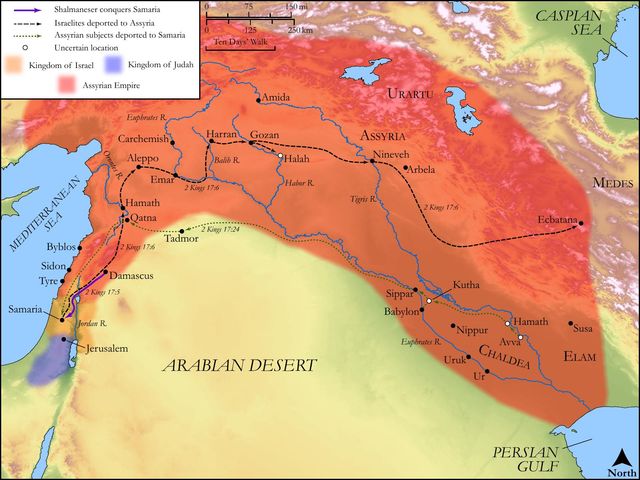
Second Kings 17:24 records a pivotal moment in the aftermath of the Northern Kingdom of Israel's fall, detailing the Assyrian Empire's strategic population transfer. Following the capture of Samaria, the Assyrian king implemented a policy of resettlement, bringing diverse peoples from conquered territories—specifically Babylon, Cuthah, Ava, Hamath, and Sepharvaim—and settling them in the cities of Samaria. These foreign populations replaced the exiled Israelites, effectively taking possession of the land and establishing a new demographic and cultural landscape that would profoundly shape the future identity of the Samaritans.
Context
ShowHideLiterary Context
This verse immediately follows a lengthy and somber theological explanation for the demise of the Northern Kingdom of Israel. The preceding verses, particularly 2 Kings 17:7-23, meticulously detail Israel's persistent idolatry, their rejection of God's covenant, their adoption of pagan practices, and their refusal to heed the prophets. The narrative culminates in the Lord's righteous judgment, where He "removed them out of his sight" (2 Kings 17:18), leading to the Assyrian conquest and the exile of the Israelite population. Verse 24, therefore, serves as the practical, historical consequence of this divine judgment, describing the physical replacement of the exiled Israelites with foreign peoples, thus solidifying the complete disruption of Israelite national and religious life in the region. It marks the final, devastating act of judgment against a rebellious nation.
Historical & Cultural Context
The events of 2 Kings 17 occurred around 722 BCE, during the reign of the Assyrian king Sargon II, who completed the conquest of Samaria initiated by Shalmaneser V. The Assyrian Empire was renowned for its brutal but highly effective imperial strategies, one of the most significant being mass deportation and population exchange. This policy served multiple purposes: it crushed national identity and loyalty, preventing future rebellions; it integrated conquered territories into the Assyrian economic system; and it diluted native cultures and religions, making assimilation easier. The peoples mentioned—from Babylon, Cuthah, Ava, Hamath, and Sepharvaim—represent diverse regions within the vast Assyrian empire, demonstrating the systematic and widespread nature of this resettlement policy. Their relocation to Samaria was a deliberate act to erase the memory of Israel and establish firm Assyrian control, effectively creating a new province.
Key Themes
ShowHideThis verse powerfully illustrates several major themes. Firstly, it underscores the consequences of disobedience and divine judgment, as Israel's unfaithfulness directly led to their displacement and the occupation of their land by foreigners, fulfilling earlier prophetic warnings (e.g., Deuteronomy 28:49-50). Secondly, it highlights the Assyrian imperial strategy as a tool in God's sovereign hand, demonstrating how even powerful empires unknowingly serve God's purposes in executing His justice. The Assyrian king, though acting out of his own geopolitical ambitions, was an unwitting instrument of divine wrath. Finally, and perhaps most significantly, this resettlement laid the foundational groundwork for the future Samaritan people. The intermingling of these foreign settlers with the remaining Israelites, and their eventual adoption of a syncretistic form of Israelite religion (as described in the subsequent verses of 2 Kings 17), created a distinct ethno-religious group. This mixed heritage and religious practice later contributed to the deep-seated animosity and theological division between Jews and Samaritans, a tension evident throughout the New Testament, notably in John 4:9.
Exposition and Analysis
ShowHideKey Word Analysis
ShowHideThis word, often translated as "son" or "child," here refers to the "children of Israel," signifying the descendants of Jacob and the entire Israelite nation. Its use emphasizes the complete displacement of the rightful heirs of the land, highlighting the profound loss of their ancestral inheritance and national identity. The phrase underscores the tragic fulfillment of covenant curses, as God's "children" are removed from the land He promised them.
This verb carries the meaning of "to occupy (by driving out previous tenants, and possessing in their place)," "to inherit," or "to dispossess." In this context, it signifies the complete and legal acquisition of the land by the foreign settlers, directly contrasting with Israel's previous possession of the land, which was granted by God as an inheritance. The new inhabitants now "possessed" what was once Israel's, underscoring the fulfillment of the covenant curses for disobedience and the transfer of ownership.
This primitive root means "to sit down," and by implication, "to dwell" or "to remain." When used causatively, as here ("placed them" also from this root), it means "to settle." The repetition of this root, first in "placed" and then in "dwelt," emphasizes the permanence and establishment of the foreign populations in Samaria. It indicates not merely a temporary encampment but a settled, long-term occupation, solidifying the new demographic reality.
Verse Breakdown
ShowHide"And the king of Assyria brought [men] from Babylon, and from Cuthah, and from Ava, and from Hamath, and from Sepharvaim"
This clause details the specific origins of the foreign populations. It underscores the Assyrian policy of mixing diverse conquered peoples to prevent unified resistance. Babylon, Cuthah (likely modern Tell Ibrahim), Ava (possibly Hit on the Euphrates), Hamath (on the Orontes in Syria), and Sepharvaim (likely Sippar in Mesopotamia) represent a wide geographical spread, emphasizing the vastness of the Assyrian Empire and the systematic nature of its resettlement program, designed to break national loyalties and assimilate new subjects.
"and placed [them] in the cities of Samaria instead of the children of Israel"
This central phrase explicitly states the purpose and consequence of the population transfer: the foreign peoples were settled in the very cities that had been inhabited by the Israelites. The phrase "instead of the children of Israel" highlights the complete displacement of the native population, signifying the end of the Northern Kingdom as a distinct political and religious entity in its homeland. It is a stark picture of divine judgment executed through human agents, where the covenant people are removed from their promised land.
"and they possessed Samaria, and dwelt in the cities thereof"
This final clause confirms the success and permanence of the Assyrian policy. The new inhabitants took full ownership and established residence in the former Israelite cities. This act of "possessing" the land, which was once God's gift to Israel, underscores the profound reversal of fortunes and the consequences of Israel's unfaithfulness, as their inheritance was now taken by strangers. The act of "dwelling" further solidifies their permanent presence, marking a new era for the region.
Literary Devices
ShowHideThe verse employs several literary devices to convey its profound message. Historical Narrative is the overarching device, presenting a factual account of a significant historical event that serves as the culmination of God's judgment on Israel. The specific naming of the foreign cities (Babylon, Cuthah, Ava, Hamath, Sepharvaim) functions as Verisimilitude, lending credibility and historical accuracy to the biblical record and emphasizing the widespread nature of the Assyrian Empire's control. There is also a powerful element of Irony present: the land that God had given to Israel as an eternal inheritance, contingent on their obedience, is now "possessed" by pagan foreigners due to Israel's idolatry and rebellion. Furthermore, this verse acts as Foreshadowing, laying the historical and demographic groundwork for the later emergence of the Samaritan people, whose mixed heritage and syncretistic religion would become a point of significant theological and social tension in subsequent biblical narratives, especially in the New Testament.
Theological and Thematic Connections
ShowHideThis verse serves as a stark reminder of God's covenant faithfulness and His unwavering justice. While seemingly a purely historical account of Assyrian imperial policy, it is deeply theological, demonstrating that God uses nations and empires as instruments of His will, even when they are unaware of it. The displacement of Israel was not merely a geopolitical event but the direct consequence of their persistent rebellion against the Lord, their covenant God. It underscores the severity of idolatry and spiritual compromise, illustrating that God's warnings are not empty threats. The land, which was a central component of God's covenant promise to Abraham's descendants, was effectively forfeited due to their unfaithfulness, emphasizing the conditional nature of their dwelling in the land and the solemnity of God's warnings concerning disobedience.
Reflection and Application
ShowHideThe account in 2 Kings 17:24 offers profound lessons for believers today. It serves as a powerful testament to the seriousness of spiritual compromise and the dire consequences of abandoning God's commands for the allure of worldly practices or syncretistic beliefs. Just as ancient Israel faced judgment and displacement for their persistent idolatry and unfaithfulness, we are called to unwavering devotion to God alone. This verse reminds us that God's justice is certain, and His warnings are to be taken with utmost seriousness, even when His judgment is executed through the actions of human empires or natural consequences. It highlights the long-term impact of spiritual choices, not only on individuals but on communities and future generations, as the events described here laid the foundation for the Samaritan identity and the subsequent tensions with the Jews. Our faithfulness, or lack thereof, has ripple effects far beyond our immediate circumstances, shaping the spiritual landscape for those who come after us.
Questions for Reflection
ShowHideFAQ
ShowHideWho was the king of Assyria responsible for this population transfer, and why did he do it?
ShowHideWhile 2 Kings 17:24 simply refers to "the king of Assyria," historical and archaeological evidence, particularly Assyrian inscriptions, identifies him as Sargon II. Sargon II completed the conquest of Samaria around 722 BCE, a campaign initiated by his predecessor, Shalmaneser V. His motivation for the population transfer was a standard Assyrian imperial strategy. By forcibly relocating conquered peoples from their homelands and settling them in new territories, the Assyrians aimed to break their national identity, sever their ties to their ancestral lands and deities, and prevent future rebellions. This policy also helped to integrate diverse populations into the Assyrian economic and administrative system, ensuring greater control and stability across the vast empire. It was a brutal but effective method of maintaining dominion over conquered lands, as seen throughout the Assyrian annals and further elaborated in 2 Kings 17:25-41.
Christ-Centered Fulfillment
ShowHideThe displacement of Israel and the repopulation of Samaria in 2 Kings 17:24 serve as a stark testament to the consequences of covenant unfaithfulness under the Old Covenant. This painful historical event, leading to a mixed and syncretistic people, highlights humanity's inability to achieve true unity and pure worship apart from God's intervention. Yet, this very division foreshadows the universal reach of the New Covenant established in Christ. Jesus Christ breaks down the "dividing wall of hostility" (Ephesians 2:14) between Jew and Gentile, creating one new humanity in Himself. He offers a new "possession"—not a physical land, but spiritual inheritance and citizenship in His eternal kingdom (Ephesians 1:11). The encounter with the Samaritan woman at the well (John 4:1-42) exemplifies this fulfillment, as Jesus, the true King, reclaims those who were once considered outsiders and brings them into the true worship of God in spirit and truth, transcending the historical and ethnic divisions forged in events like the one described in 2 Kings 17. Through Christ, a new spiritual "Samaria" is formed, comprised of all who believe, regardless of their earthly origin, possessing a true and pure relationship with God, fulfilling the promise of a global people of God (Revelation 7:9).