


Isaiah 37:13
Bible text: King James Version (1769 Blayney text) · Public domain
Bible text: Berean Standard Bible · Public domain
Bible text: American Standard Version (1901) · Public domain
Bible text: World English Bible, Messianic edition · Public domain
Bible text: Geneva Bible (1599) · Public domain
Bible text: Young's Literal Translation · Public domain
- אַיֵּה'ai·Yehwhere?H346InterrogParticle Interrogative
- מֶלֶךְMe·lekh[is] [the] king ofH4428N-mscNoun Singular Masculine Construct
- חֲמָתcha·MatHamathH2574N-properNoun Proper Location
- וּמֶלֶךְu·Me·lekhand [the] king ofH4428Conj-w ¦ N-mscNoun Singular Masculine Constructוּandמֶלֶךְ[the] king of
- אַרְפָּד'ar·PadArpadH774N-properNoun Proper Location
- וּמֶלֶךְu·Me·lekhand [the] king ofH4428Conj-w ¦ N-mscNoun Singular Masculine Constructוּandמֶלֶךְ[the] king of
- לָעִירla·'IrLairH5892N-fscNoun Singular Feminine Construct
- סְפַרְוָיִםse·far·Va·yimSepharvaimH5617N-properNoun Proper Location
- הֵנַעhe·Na'HenaH2012N-properNoun Proper Location
- וְעִוָּהve·'i·Vahand IvvahH5755Conj-w ¦ N-properNoun Proper LocationוְandעִוָּהIvvah
English is a literal word-by-word gloss of the Hebrew, not the KJV's wording. Why?
This is the original text the KJV's translators worked from — each Hebrew word with its own literal English meaning in this verse, prepared by scholars at Tyndale House, Cambridge. The KJV translates whole sentences, not word by word, so its wording differs: one Hebrew word can become several English words, and the KJV may choose “the LORD” where the gloss reads “Yahweh”. Both are faithful — they answer different questions. For the KJV's own rendering, switch to the KJV text.
Details
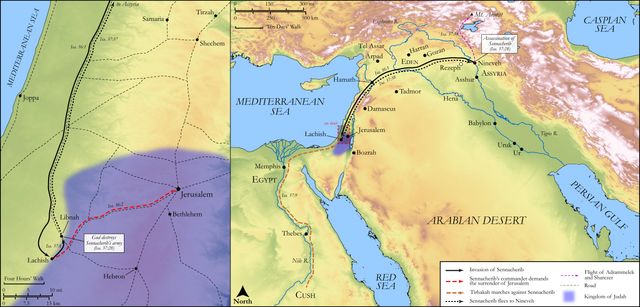
See on the biblical-era map
Study this verse
Public-domain commentary
Matthew Henry
From his Commentary on the Whole Bible. Henry comments on passages, not single verses — this entry covers Isaiah 37:8–20.
We may observe here, 1. That, if God give us inward satisfaction in his promise, this may confirm us in our silently bearing reproaches. God answered Hezekiah, but it does not appear that he, after deliberation, sent any answer to Rabshakeh; but, God having taken the work into his own hands, he quietly left the matter with him. So Rabshakeh returned to the king his master for fresh instructions. 2. Those that delight in war shall have enough of it. Sennacherib, without provocation given to him or warning given by him, went forth to war against Judah; and now with as little ceremony the king of Ethiopia goes forth to war against him, Isa 37:9. Those that are quarrelsome may expect to be quarrelled with; and God sometimes checks the rage of his enemies by giving it a powerful diversion. 3. It is bad to talk proudly and profanely, but it is worse to write so, for this argues more deliberation and design, and what is written spreads further, lasts longer, and does the more mischief. Atheism and irreligion, written, will certainly be reckoned for another day. 4. Great successes often harden sinners' hearts in their sinful ways and make them the more daring. Because the kings of Assyria have destroyed all lands (though, in fact, they were but a few that fell within their reach), therefore they doubt not but to destroy God's land; because the gods of the nations were unable to help they conclude the God of Israel is so; because the idolatrous kings of Hamath and Arphad became an easy prey to them therefore they doubt not but to destroy God's land; because the idolatrous kings of Hamath and Arphad became an easy prey to them therefore the religious reforming king of Judah must needs be so too. Thus is this proud man ripened for ruin by the sunshine of prosperity. 5. Liberty of access to the throne of grace, and liberty of speech there, are the unspeakable privilege of the Lord's people at all times, especially in times of distress and danger. Hezekiah took Sennacherib's letter, and spread it before the Lord, not designing to make any complaints against him but those grounded upon his own handwriting. Let the thing speak itself; here it is in black and white: Open thy eyes, O Lord! and see. God allows his praying people to be humbly free with him, to utter all their words, as Jephthah did, before him, to spread the letter, whether of a friend or an enemy, before him, and leave the contents, the concern of it, with him. 6. The great and fundamental principles of our religion, applied by faith and improved in prayer, will be of sovereign use to us in our particular exigencies and distresses, whatever they are; to them therefore we must have recourse, and abide by them; so Hezekiah did here. He encouraged himself with this, that the God of Israel is the Lord of hosts, of all hosts, of the hosts of Israel, to animate him, of the hosts of their enemies, to dispirit and restrain them, - that he is God alone, and there is none that can stand in competition with him, - that he is the God of all the kingdoms of the earth, and disposes of them all as he pleases; for he made heaven and earth, and therefore both can do any thing and does every thing. 7. When we are afraid of men that are great destroyers we may with humble boldness appeal to God as the great Saviour. They have indeed destroyed the nations, who had thrown themselves out of the protection of the true God by worshipping false gods, but the Lord, the God alone, is our God, our King, our lawgiver, and he will save us, who is the Saviour of those that believe. 8. We have enough to take hold of, in our wrestling with God by prayer, if we can but plead that his glory is interested in our case, that his name will be profaned if we are run down and glorified if we are relieved. Thence therefore will our most prevailing pleas be drawn: "Do it for thy glory's sake."
Historical interpretation
Historical reception
1 surviving comment on this verse from the historical church.
(Verse 8 and following) But when Rabshakeh returned, he found the king of Assyria fighting against Libnah, for he had heard that the king had left Lachish. And he heard that Tirhakah, the king of Ethiopia, had come out to fight against him. When he heard this, he sent messengers to Hezekiah saying: 'Thus you shall speak to Hezekiah, king of Judah, saying: Do not let your God deceive you, in whom you trust, saying: Jerusalem will not be given into the hand of the king of Assyria.' Behold, you have heard about all that the kings of Assyria have done to all the lands they have devastated, and can you be delivered? Have the gods of the nations delivered those whom my fathers have destroyed: Gozan, Haran, Rezeph, and the sons of Eden who were in Telassar? Where is the king of Hamath, the king of Arpad, the king of the city of Sepharvaim, or of Hena, or of Ivvah? These words were written in the Book of Kings and Chronicles, that the commander Rabshekah had left the siege of Jerusalem according to the will of the Lord, and went to his master, who he had learned was besieging Lachish, having either abandoned or captured it, to attack Libnah. He also, upon hearing that Tarachamregem, the king of the Ethiopians, was preparing to make war against him, went out to meet him, and yet sent messengers to Hezekiah and letters, in order to frighten those whom he had not yet conquered by force. And just as he had said to the people, 'Do not let Hezekiah deceive you' (2 Kings 18:29), he speaks the same blasphemy to the king, saying, 'Do not let your God deceive you' (2 Kings 19:10). And he gives examples from the past, how their gods were unable to deliver other lands from their hands, and therefore Jerusalem will not be able to be delivered either. In his enumeration of the other nations, Ana () and Ava () are mentioned, which the Seventy mixed, saying, anavegava, and they called it a conjunction, that is, vau, between the two nations Ana and Ava, in the Hebrew language, so that to those unaware it seems one nation or city. We pass over what is clear, so that we may dwell on uncertainties. Herodotus relates that Sennacherib, the king of the Assyrians, fought against the Egyptians and besieged Pelusium. And when the mounds for capturing the city had been built, Taracham, the king of the Ethiopians, came to their aid, and in one night, near Jerusalem, 185,000 of the Assyrian army perished from plague. This is reported by Herodotus and most fully by Berosus, a writer of Chaldean history, whose credibility must be sought from his own books.
Continue studying Isaiah 37:13 across the web’s major study libraries — every link below opens this exact verse, chapter, or book on the destination site.
Read & Compare
 BibleGatewayThis verse in more than 200 translations and 70 languages.
 Bible.comThe YouVersion reader — hundreds of translations, reading plans, and highlights.
 ESV.orgCrossway's official English Standard Version reader.
 NET BibleThe NET translation with 60,000+ translators' notes on every rendering decision.
 STEP BibleTyndale House's free study tool — original text, vocabulary, and scholarly resources.
 BibliaLogos Bible Software's free web reader.
 USCCBThe New American Bible (Revised Edition) with the U.S. bishops' study notes.
Commentaries
 BibleHub CommentariesDozens of classic commentaries on this verse, gathered on one page.
 StudyLightMore than 100 commentary sets — the largest collection on the web.
 BibleRefPlain-English commentary on what this verse means, verse by verse.
 Enduring WordDavid Guzik's free commentary on this chapter, widely used by Bible teachers.
 Bible Study ToolsVerse commentary alongside Greek and Hebrew study aids.
Original Language & Research
- BibleHub InterlinearThe verse word by word — original language, transliteration, and English.
- BibleHub LexiconEvery word's original-language definition and Strong's entry.
 Blue Letter BibleDeep-study tools — Strong's numbers, concordance, and word studies.
 SefariaThe Hebrew text with Rashi and centuries of Jewish commentary.
Sermons, Hymns & Audio


TrulyRandomVerse is not affiliated with these sites and doesn’t control their content. They’re linked because they’re genuinely useful.
Summary
Isaiah 37:13 captures a chilling rhetorical taunt from King Sennacherib of Assyria to King Hezekiah of Judah during the Assyrian siege of Jerusalem. Embedded within a threatening letter, this verse lists several prominent cities and their kings previously conquered by the seemingly invincible Assyrian Empire—Hamath, Arphad, Sepharvaim, Hena, and Ivah. By posing the question, "Where is...?", Sennacherib arrogantly implies the utter annihilation of these once-powerful realms, thereby asserting Jerusalem's inevitable and equally bleak fate. This serves as a psychological weapon, a direct challenge to Hezekiah's faith in the Lord, and a dramatic setup for God's powerful and miraculous intervention.
Context
ShowHideLiterary Context
Isaiah 37:13 is a direct quote from the second, more personal and blasphemous, letter that King Sennacherib sent to King Hezekiah. This letter follows an initial verbal assault by Sennacherib's field commander, the Rabshakeh, detailed in Isaiah 36, which failed to break Jerusalem's resolve. The immediate literary context of Isaiah 37:9-13 shows Sennacherib's escalating psychological warfare. Hezekiah's profound distress upon receiving this letter, marked by tearing his clothes and covering himself with sackcloth, immediately leads him to seek divine counsel through the prophet Isaiah, as seen in Isaiah 37:1-4. Sennacherib's rhetorical questions about the fate of other nations are strategically placed to undermine Hezekiah's trust in his God, setting the stage for a dramatic contrast between human arrogance and divine omnipotence.
Historical & Cultural Context
The events of Isaiah 37 are firmly rooted in the historical reality of the Assyrian invasion of Judah in 701 BCE, a period extensively documented in both biblical accounts (2 Kings 18-19 and 2 Kings 19) and Assyrian cuneiform records, such as Sennacherib's own annals. The Neo-Assyrian Empire was the dominant military and political force of that day, notorious for its brutal military campaigns, psychological warfare tactics (like the Rabshakeh's taunts), and the forced deportation of conquered populations to prevent rebellion. The cities listed—Hamath, Arphad (modern Tell Rifaat), Sepharvaim, Hena, and Ivah (likely Avva in Syria, associated with Assyrian resettlement in 2 Kings 17:24)—were real and significant places that had indeed fallen to Assyrian might. By enumerating these vanquished kingdoms, Sennacherib employed a common Assyrian tactic to demoralize the enemy, showcasing their overwhelming power and the futility of resistance, thereby coercing surrender without further bloodshed.
Key Themes
ShowHideThis verse powerfully contributes to several overarching themes within the book of Isaiah and the broader prophetic literature. Firstly, it vividly illustrates Assyrian Arrogance and Presumption, as Sennacherib, in his hubris, elevates his power above all earthly and even divine forces. This theme is consistently challenged by Isaiah's prophecies of divine judgment against proud nations and rulers, particularly against Assyria itself, as seen in Isaiah 10:12-19. Secondly, the verse underscores The Futility of Human Resistance Apart from God, demonstrating that without divine intervention, even fortified cities and powerful kings were helpless against the Assyrian war machine. This stark reality sets up the dramatic contrast with Jerusalem's miraculous deliverance. Finally, and most profoundly, the verse presents a direct Challenge to Faith, forcing Hezekiah and the people of Judah to confront whether their God was truly sovereign and able to deliver them, unlike the gods of the conquered nations. This challenge ultimately leads to a powerful affirmation of God's unique power and faithfulness, culminating in the divine intervention described in Isaiah 37:36-38.
Exposition and Analysis
ShowHideKey Word Analysis
ShowHideThis word (H4428) denotes a sovereign ruler, one who exercises dominion and authority over a kingdom or people. In Isaiah 37:13, the repeated mention of "the king of" each city emphasizes the complete subjugation of these once-powerful rulers and their realms. Sennacherib's boast implies that if these kings, with their armies and fortifications, could not stand against him, then Hezekiah, a mere "king" like them, would surely fall. This sets up a profound theological contrast, as the true King, the Lord of Hosts, is about to demonstrate His ultimate sovereignty over all earthly kings.
Derived from a root meaning "walled," Hamath (H2574) was a significant city-state in Syria, strategically located on the Orontes River. Its name itself suggests strength and fortification, implying a place difficult to conquer. Its inclusion in Sennacherib's list highlights the fall of a seemingly impregnable stronghold, serving as a powerful example of Assyria's destructive capability. The mention of such a prominent city underscores the comprehensive nature of Assyrian conquest and the futility of relying on human defenses against their might.
This term (H5892) refers to a fortified settlement, a place guarded by a watch. The phrase "the king of the city of Sepharvaim" emphasizes that not only were the kings defeated, but their very centers of power, their fortified cities, were also utterly destroyed or absorbed. The term evokes images of walls, defenses, and urban life, all of which were rendered powerless before the Assyrian onslaught. Sennacherib's rhetorical question about these cities underscores the total annihilation of their independent existence, leaving no doubt about the fate of those who resisted him.
Verse Breakdown
ShowHide"Where [is] the king of Hamath, and the king of Arphad,"
This opening clause immediately establishes the rhetorical and taunting nature of Sennacherib's message. By asking "Where is...?", Sennacherib implies the utter disappearance and destruction of these rulers and their authority. Hamath and Arphad were prominent Syrian city-states, known for their strength and strategic importance. Their inclusion serves as a stark reminder of Assyria's conquests to the north, demonstrating that no king, however mighty, could withstand their advance. The repetition of "the king of" reinforces the comprehensive nature of their defeat—not just the cities, but their leadership, their very autonomy, had vanished, making them non-existent in the face of Assyrian power.
"and the king of the city of Sepharvaim, Hena, and Ivah?"
This continuation of the rhetorical question further expands the list of vanquished territories, moving eastward into Mesopotamia. Sepharvaim, Hena, and Ivah were cities or regions that had also fallen under Assyrian dominion, often associated with the forced resettlement policies of the Assyrians, as seen in 2 Kings 17:24. The specific phrase "the king of the city of Sepharvaim" highlights the fall of a fortified urban center, emphasizing that even strongholds were no match. By enumerating these diverse locations, Sennacherib paints a comprehensive picture of his empire's reach and invincibility, aiming to instill despair and terror in Hezekiah, suggesting that Jerusalem, like these, would inevitably succumb to the same overwhelming power.
Literary Devices
ShowHideIsaiah 37:13 is rich in Rhetorical Questioning, a dominant literary device employed by Sennacherib. The repeated "Where is...?" is not a genuine inquiry but a powerful taunt designed to emphasize the complete absence and annihilation of the mentioned kings and their realms. This device implies that their power and existence have been utterly wiped away, serving as a chilling and undeniable warning to Hezekiah. Coupled with this is Enumeration, the deliberate listing of specific conquered cities and their kings (Hamath, Arphad, Sepharvaim, Hena, and Ivah). This detailed enumeration lends a sense of historical veracity and overwhelming scale to Sennacherib's boast, making his perceived invincibility seem concrete and undeniable. The cumulative effect of these names is to create a sense of dread and inevitability. Furthermore, there is an underlying Irony in Sennacherib's boast. While intended to demonstrate his absolute power, his words inadvertently set the stage for God's dramatic intervention, where the very pride he displays becomes the instrument of his downfall, ultimately revealing the true futility of human power when it opposes divine sovereignty.
Theological and Thematic Connections
ShowHideIsaiah 37:13, though spoken by an enemy, powerfully underscores the biblical theme of divine sovereignty over human pride and power. Sennacherib's arrogant boast, listing his conquests as undeniable proof of his invincibility, directly challenges the living God. This challenge is a recurring motif in Scripture, where human empires and their rulers, in their self-exaltation, inevitably confront the unyielding reality of God's ultimate authority. The verse highlights that all earthly power is transient and ultimately subject to the will of the Almighty. It sets the stage for God's vindication of His name and His people, demonstrating that no human boast, however grand, can stand against the Lord of Hosts.
Reflection and Application
ShowHideSennacherib's taunt in Isaiah 37:13 resonates deeply with the challenges believers face in every generation. Just as Hezekiah was confronted with an overwhelming earthly power that questioned the very existence and efficacy of his God, we too encounter "Sennacheribs" in our lives—seemingly insurmountable problems, pervasive injustices, or personal struggles that mock our faith and whisper doubts about God's presence and power. The world, with its loud boasts of self-sufficiency and its apparent triumphs, often asks, "Where is your God now?" This verse reminds us that such taunts are not new; they are ancient echoes of human pride attempting to intimidate divine truth. Our response, like Hezekiah's, must be to turn to the Lord in prayer and humble reliance, recognizing that true power resides not in human might or worldly achievements, but in the sovereign hand of God. It encourages us to stand firm, knowing that the Lord delights in confounding the proud and delivering those who trust in Him, often through means beyond human comprehension, thereby glorifying His name and strengthening our faith.
Questions for Reflection
ShowHideFAQ
ShowHideWhat was the ultimate fate of Sennacherib and his army after this boast?
ShowHideDespite Sennacherib's arrogant boasts and his perceived invincibility, his campaign against Jerusalem ended in a miraculous and devastating defeat for the Assyrians. According to Isaiah 37:36, the angel of the Lord struck down 185,000 Assyrian soldiers in a single night, forcing Sennacherib to withdraw in shame. He returned to Nineveh, his capital, where he was later assassinated by his own sons while worshipping in the temple of his god Nisroch (Isaiah 37:37-38). This dramatic turn of events powerfully demonstrated God's sovereignty over all earthly rulers and armies, proving that His word, spoken through Isaiah, was true.
Why did Sennacherib list these specific cities?
ShowHideSennacherib listed Hamath, Arphad, Sepharvaim, Hena, and Ivah because they were all prominent cities or regions that had previously fallen to the Assyrian Empire. By enumerating these conquests, Sennacherib was employing a sophisticated form of psychological warfare. His intention was to demoralize King Hezekiah and the people of Judah by showcasing the overwhelming power of the Assyrian army and the futility of resistance. The rhetorical question "Where is...?" implied that these places and their kings had been utterly destroyed or absorbed, suggesting that Jerusalem would inevitably suffer the same fate. This tactic was designed to compel surrender without further military engagement, playing on fear and despair by presenting a seemingly undeniable track record of Assyrian invincibility.
Christ-Centered Fulfillment
ShowHideIsaiah 37:13, with Sennacherib's arrogant boast and the subsequent divine intervention, finds profound Christ-centered fulfillment in the ultimate triumph of God's Kingdom over all earthly and spiritual powers, embodied in Jesus Christ. Sennacherib, in his pride, represents the epitome of human rebellion and the futility of any power that exalts itself against God. His question, "Where is the king...?", is ultimately answered in Christ, who is the King of kings and Lord of lords. Just as God miraculously delivered Jerusalem from the seemingly invincible Assyrian army, so too did Christ achieve the ultimate deliverance for humanity, conquering sin, death, and the powers of darkness through His crucifixion and resurrection. The "kings" and "cities" that fell to Sennacherib foreshadow the spiritual strongholds and principalities that seemed to hold humanity captive, but which were decisively defeated by Christ on the cross (Colossians 2:15). Sennacherib's boast was ultimately silenced by the Lord's power; similarly, every knee will one day bow and every tongue confess that Jesus Christ is Lord, to the glory of God the Father (Philippians 2:9-11). Thus, this Old Testament narrative points forward to the sovereign rule of Christ, whose victory ensures that no earthly or spiritual power can ultimately stand against His eternal Kingdom, bringing true and lasting peace.