


Isaiah 36:19
Bible text: King James Version (1769 Blayney text) · Public domain
Bible text: Berean Standard Bible · Public domain
Bible text: American Standard Version (1901) · Public domain
Bible text: World English Bible, Messianic edition · Public domain
Bible text: Geneva Bible (1599) · Public domain
Bible text: Young's Literal Translation · Public domain
- אַיֵּה'ai·Yehwhere?H346InterrogParticle Interrogative
- אֱלֹהֵי'e·lo·Hei[were] [the] gods ofH430N-mpcNoun Plural Masculine Construct
- חֲמָתcha·MatHamathH2574N-properNoun Proper Location
- וְאַרְפָּדve·'ar·Padand ArpadH774Conj-w ¦ N-properNoun Proper LocationוְandאַרְפָּדArpad
- אַיֵּה'ai·Yehwhere?H346InterrogParticle Interrogative
- אֱלֹהֵי'e·lo·Hei[were] [the] gods ofH430N-mpcNoun Plural Masculine Construct
- סְפַרְוָיִםse·far·Va·yimSepharvaimH5617N-properNoun Proper Location
- וְכִיve·khiand ifH3588Conj-w ¦ PrtParticle Conditionalוְandכִיif
- הִצִּילוּhi·Tzi·luthey have deliveredH5337V-Hiphil-Perf-3cpVerb Hiphil Perfect 3rd Plural common gender
- אֶת'et<obj.>H853DirObjMParticle Object Indicator
- שֹׁמְרוֹןsho·me·RonSamariaH8111N-properNoun Proper Location
- מִיָּדִיmi·ya·Difrom my handH3027Prep-m ¦ N-csc ¦ 1csNoun Singular common gender Constructמִfromיָּדִhandיmy
English is a literal word-by-word gloss of the Hebrew, not the KJV's wording. Why?
This is the original text the KJV's translators worked from — each Hebrew word with its own literal English meaning in this verse, prepared by scholars at Tyndale House, Cambridge. The KJV translates whole sentences, not word by word, so its wording differs: one Hebrew word can become several English words, and the KJV may choose “the LORD” where the gloss reads “Yahweh”. Both are faithful — they answer different questions. For the KJV's own rendering, switch to the KJV text.
Details
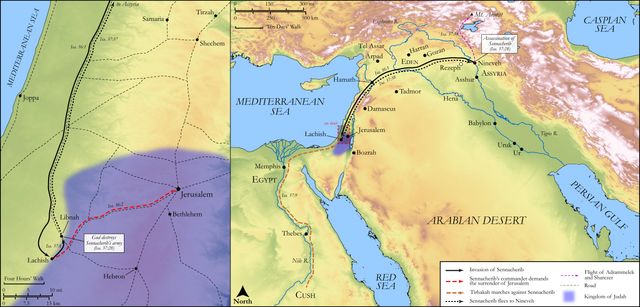
See on the biblical-era map
Study this verse
Public-domain commentary
Matthew Henry
From his Commentary on the Whole Bible. Henry comments on passages, not single verses — this entry covers Isaiah 36:11–22.
We may hence learn these lessons: - 1. That, while princes and counsellors have public matters under debate, it is not fair to appeal to the people. It was a reasonable motion which Hezekiah's plenipotentiaries made, that this parley should be held in a language which the people did not understand (Isa 36:11), because reasons of state are secret things and ought to be kept secret, the vulgar being incompetent judges of them. It is therefore an unfair practice, and not doing as men would be done by, to incense subjects against their rulers by base insinuations. 2. Proud and haughty scorners, the fairer they are spoken to, commonly speak the fouler. Nothing could be said more mildly and respectfully than that which Hezekiah's agents said to Rabshakeh. Besides that the thing itself was just which they desired, they called themselves his servants, they petitioned for it: Speak, we pray thee; but this made him the more spiteful and imperious. To give rough answers to those who give us soft answers is one way of rendering evil for good; and those are wicked indeed, and it is to be feared incurable, with whom that which usually turns away wrath does but make bad worse. 3. When Satan would tempt men from trusting in God, and cleaving to him, he does so by insinuating that in yielding to him they may better their condition; but it is a false suggestion, and grossly absurd, and therefore to be rejected with the utmost abhorrence. When the world and the flesh say to us, "Make an agreement with us and come out to us, submit to our dominion and come into our interests, and you shall eat every one of his own vine," they do but deceive us, promising liberty when they would lead us into the basest captivity and slavery. One might as well take Rabshakeh's word as theirs for kind usage and fair quarter; therefore, when they speak fair, believe them not. Let them say what they will, there is no land like the land of promise, the holy land. 4. Nothing can be more absurd in itself, nor a greater affront to the true and living God, than to compare him with the gods of the heathen; as if he could do no more for the protection of his worshippers than they can for the protection of theirs, and as if the God of Israel could as easily be mastered as the gods of Hamath and Arphad, whereas they are vanity and a lie. They are nothing; he is the great I AM: they are the creatures of men's fancy and the works of men's hands; he is the Creator of all things. 5. Presumptuous sinners are ready to think that, because they have been too hard for their fellow-creatures, they are therefore a match for their Creator. This and the other nation they have subdued, and therefore the Lord himself shall not deliver Jerusalem out of their hand. But, though the potsherds may strive with the potsherds of the earth, let them not strive with the potter. 6. It is sometimes prudent not to answer a fool according to his folly. Hezekiah's command was, "Answer him not; it will but provoke him to rail and blaspheme yet more and more; leave it to God to stop his mouth, for you cannot." They had reason enough on their side, but it would be hard to speak it to such an unreasonable adversary without a mixture of passion; and, if they should fall a railing like him, Rabshakeh would be much too hard for them at that weapon. 7. It becomes the people of God to lay to heart the dishonour done to God by the blasphemies of wicked men, though they do not think it prudent to reply to those blasphemies. Though they answered him not a word, yet they rent their clothes, in a holy zeal for the glory of God's name and a holy indignation at the contempt put upon it. They tore their garments when they heard blasphemy, as taking no pleasure in their own ornaments when God's honour suffered.
Historical interpretation
Historical reception
2 surviving comments on this verse. Each one is dated, so this reads as a timeline rather than a list.
Immediately then, he supplemented this threat with an enticement in order to deceive with counterpromises and temptations those whom he had not conquered with terror, saying on behalf of the king of the Assyrians: “Make peace with me and come to me,” or as we read in the book of Kings: “Do with me what is useful and come to me.” Both have the same meaning. Do, he said, what is to your own advantage and it will accrue to your blessing. In other words: Bless the king of Assyria and praise him, and confess him to be your lord that you might receive a reward. Also, live in your cities and enjoy your crops until I return from Egypt or until I restore captured Libnah. After I come, I will take you to a land much like your own, with grain and wine and oil. But he did not give a name for this land because he could not find an equal to the Promised Land. Yet he promised it nevertheless, for everyone desires to be in the land of his birth. Some think the land that he promised was Media, which has terrain similar in both location and foliage to that of Judea. Then he added: “Where is the god of Hamath and of Arpad and of Sepharvaim? Have they delivered Samaria from my hand?” This shows that Samaria will be subject to them for all of its days and therefore that it should be taken. If, he said, we were easily victorious over the ten tribes who had the protection of so many gods, how much more easily will we conquer you, even lonely Jerusalem, which has the protection of only one God?
(Verse 19 and following) Where is the God of Hamath and Arpad? Where is the God of Sepharvaim? Have they delivered Samaria from my hand? Who among all the gods of these lands has delivered their land from my hand, that the Lord should deliver Jerusalem from my hand? But they were silent and did not answer him a word. For the king had commanded, 'Do not answer him.' This shows that all these gods have served Samaria, and that is why it has been captured. But, he said, if we easily overcame ten tribes with such great gods presiding over them, how much more easily will we conquer you, or rather Jerusalem alone, with one God as our ruler? And all the people remained silent and did not answer him anything. For they had received a command from the king not to answer him. Truly, Ezechias is just, doing everything faithfully and with wisdom. Therefore, he had ordered them not to answer the Assyrian blasphemer, so as not to provoke him to greater blasphemies. Where it is written: Do not kindle the coals of a sinner (Ecclesiastes 8:13); and in the psalm we read: When the sinner rose up against me, I was silent and humbled myself, and I kept silent about the good things (Psalm 38:23); and again: Set, O Lord, a guard at my mouth, and a fortified gate at my lips: do not incline my heart to the words of evil (Psalm 140:3).
Continue studying Isaiah 36:19 across the web’s major study libraries — every link below opens this exact verse, chapter, or book on the destination site.
Read & Compare
 BibleGatewayThis verse in more than 200 translations and 70 languages.
 Bible.comThe YouVersion reader — hundreds of translations, reading plans, and highlights.
 ESV.orgCrossway's official English Standard Version reader.
 NET BibleThe NET translation with 60,000+ translators' notes on every rendering decision.
 STEP BibleTyndale House's free study tool — original text, vocabulary, and scholarly resources.
 BibliaLogos Bible Software's free web reader.
 USCCBThe New American Bible (Revised Edition) with the U.S. bishops' study notes.
Commentaries
 BibleHub CommentariesDozens of classic commentaries on this verse, gathered on one page.
 StudyLightMore than 100 commentary sets — the largest collection on the web.
 BibleRefPlain-English commentary on what this verse means, verse by verse.
 Enduring WordDavid Guzik's free commentary on this chapter, widely used by Bible teachers.
 Bible Study ToolsVerse commentary alongside Greek and Hebrew study aids.
Original Language & Research
- BibleHub InterlinearThe verse word by word — original language, transliteration, and English.
- BibleHub LexiconEvery word's original-language definition and Strong's entry.
 Blue Letter BibleDeep-study tools — Strong's numbers, concordance, and word studies.
 SefariaThe Hebrew text with Rashi and centuries of Jewish commentary.
Sermons, Hymns & Audio


TrulyRandomVerse is not affiliated with these sites and doesn’t control their content. They’re linked because they’re genuinely useful.
Summary
Isaiah 36:19 captures the audacious and blasphemous taunt of Rabshakeh, the Assyrian field commander, during Sennacherib's siege of Jerusalem. He contemptuously questions the whereabouts and efficacy of the gods of Hamath, Arphad, and Sepharvaim, along with the gods who failed to deliver Samaria, implying that Judah's God, Yahweh, would be equally powerless against the overwhelming might of Assyria. This pivotal verse highlights the stark contrast between pagan idolatry and the unique sovereignty of the one true God, setting the stage for a dramatic divine intervention that would decisively answer Rabshakeh's challenge.
Context
ShowHideLiterary Context
Isaiah 36:19 is deeply embedded within a crucial historical narrative spanning Isaiah 36-39, which recounts Sennacherib's invasion of Judah around 701 BC. This account closely parallels narratives found in 2 Kings 18-19 and 2 Chronicles 32. The immediate setting for this verse is Rabshakeh's public address to the people of Jerusalem, delivered in Hebrew to maximize its psychological impact and undermine their morale. His speech is a masterclass in psychological warfare, designed to persuade the Judeans that resistance is futile, as no god has ever successfully withstood Assyrian power. Verse 19 specifically serves as a rhetorical climax, aiming to discredit Yahweh by equating Him with the vanquished deities of other nations, thereby weakening the people's faith in divine protection and King Hezekiah's leadership.
Historical & Cultural Context
The late 8th century BC was dominated by the Neo-Assyrian Empire, a formidable military power renowned for its brutal tactics, including systematic deportation of conquered peoples and sophisticated psychological warfare. Sennacherib's campaign against Judah was a major event, occurring after the devastating fall of the Northern Kingdom of Israel and its capital, Samaria, to Assyria in 722 BC. Hamath, Arphad, and Sepharvaim were significant city-states in Syria and Mesopotamia that had previously succumbed to Assyrian might. Rabshakeh's taunt skillfully leverages this history of Assyrian military supremacy and the perceived impotence of local deities to instill profound fear and despair among the besieged Judeans. Culturally, the belief in local or national gods was pervasive, and a deity's power was often directly correlated with the military success of their worshippers. Rabshakeh expertly exploits this prevailing worldview to challenge Yahweh's unique claim to absolute sovereignty and power.
Key Themes
ShowHideThis verse powerfully contributes to several overarching themes within the book of Isaiah and the broader Old Testament narrative. Firstly, it starkly contrasts the impotence of idols with the omnipotence of the true God. Rabshakeh's rhetorical question, intended as a boast, inadvertently highlights the undeniable reality that these pagan gods were indeed powerless to protect their cities, thereby setting up a dramatic contrast with Yahweh's ultimate and miraculous deliverance of Jerusalem, as prophesied in Isaiah 37:33-35. Secondly, it exemplifies Assyrian arrogance and blasphemy. Sennacherib, speaking through his envoy Rabshakeh, directly challenges the Lord's unique sovereignty, equating Him with the defeated gods of other nations. This hubris is a recurring theme in Isaiah, often preceding divine judgment, as vividly portrayed in Isaiah 10:12-15. Finally, the verse implicitly but powerfully sets the stage for the resounding demonstration of divine sovereignty and deliverance. Despite the intimidating taunt, the unfolding narrative ultimately reveals that Yahweh alone is capable of delivering His people, thereby distinguishing Him from all false deities and affirming His unmatched power over all nations and their rulers, a theme that resonates throughout Isaiah, particularly in the later chapters like Isaiah 40.
Exposition and Analysis
ShowHideKey Word Analysis
ShowHideThis plural noun (H430) is employed here in its ordinary sense, referring to the various deities worshipped by the nations mentioned. Rabshakeh uses it with deliberate contempt, aiming to lump the God of Israel in with these defeated, impotent idols. While the term can also refer to the supreme God (Yahweh), in this context, it is strategically used to demean and strip Yahweh of His unique, incomparable status by reducing Him to the level of pagan deities.
This primitive root (H5337) signifies "to snatch away," "to rescue," or "to save." Rabshakeh's rhetorical question, "and have they delivered Samaria out of my hand?", directly challenges the capacity of any god to provide salvation, rescue, or protection from the overwhelming might of the Assyrian military. The word highlights the central issue of the taunt: the crucial question of divine intervention and the power to protect.
This primitive word (H3027) literally denotes a physical hand but is used extensively and profoundly in a figurative sense to represent power, authority, means, or control. When Rabshakeh asks if the gods delivered Samaria "out of my hand," he is asserting Assyria's absolute dominion, control, and perceived invincibility, implying that no power, whether human or divine, can wrest anything from their grasp. It powerfully emphasizes the Assyrian Empire's perceived ultimate authority and irresistible force.
Verse Breakdown
ShowHide"Where [are] the gods of Hamath and Arphad?"
This represents the initial, scornful rhetorical question posed by Rabshakeh. He deliberately names two prominent Syrian city-states that had already fallen decisively to Assyrian power. The question is not a genuine inquiry but a sarcastic, mocking assertion that their deities were utterly powerless to protect them, having either vanished or proven entirely useless in the face of Assyrian military supremacy.
"where [are] the gods of Sepharvaim?"
This clause reiterates and intensifies the rhetorical question, adding another city-state, Sepharvaim, from Mesopotamia, which had also previously succumbed to Assyrian conquest. The repetition serves to emphasize the consistent, undeniable pattern of Assyrian military success and the corresponding, consistent failure of local gods to prevent it, further aiming to erode the Judeans' confidence in their own God.
"and have they delivered Samaria out of my hand?"
This final, climactic clause brings the taunt directly and intimately closer to home for the Judeans. Samaria, the capital of the Northern Kingdom of Israel, had fallen to Assyria just decades earlier (722 BC). By referencing Samaria's demise, Rabshakeh directly challenges the notion that Judah's God could be any different or more powerful than the gods of these other conquered nations, including their own kin. The phrase "out of my hand" powerfully underscores Assyria's perceived absolute control, dominion, and the futility of resistance.
Literary Devices
ShowHideIsaiah 36:19 masterfully employs several potent literary devices to convey Rabshakeh's message of intimidation and psychological warfare. The most prominent is the Rhetorical Question, which is repeated three times ("Where [are] the gods of...?", "where [are] the gods of Sepharvaim?", "and have they delivered Samaria out of my hand?"). These are not genuine inquiries seeking information but forceful assertions designed to evoke despair, doubt, and a sense of futility, implying that the gods of the conquered cities were utterly impotent, and by extension, so too would be Yahweh. The Repetition of "where [are] the gods of" amplifies the scorn and emphasizes the consistent, undeniable failure of these defeated deities, creating a cumulative effect intended to overwhelm and demoralize the listeners. There is also a profound element of Irony at play, as Rabshakeh's boastful challenge to Yahweh's power inadvertently sets the stage for God's dramatic and miraculous demonstration of His unique sovereignty, ultimately proving the very opposite of Rabshakeh's arrogant assertion. Finally, the use of Metonymy is evident in the phrase "out of my hand," where "hand" represents the full, irresistible power, authority, and control of the Assyrian Empire.
Theological and Thematic Connections
ShowHideIsaiah 36:19, though spoken by an adversary, functions as a profound theological statement, starkly presenting the core conflict between the worship of lifeless idols and genuine faith in the living God. Rabshakeh's taunt, intended to diminish Yahweh, ultimately serves to highlight His incomparable nature and unique power. The undeniable failure of the gods of Hamath, Arphad, and Sepharvaim to deliver their people from Assyrian power underscores the foundational biblical truth that idols are "nothing in the world" and possess no true power (1 Corinthians 8:4). In stark contrast, the God of Israel is revealed as the sovereign Lord of history, whose power is not limited or constrained by human armies, political might, or the perceived invincibility of empires. This passage sets the stage for a dramatic and unequivocal demonstration of divine power, where God's unique ability to deliver His people is resoundingly affirmed, distinguishing Him from all false deities and revealing His ultimate authority over all creation, nations, and their rulers.
Reflection and Application
ShowHideIn a world that frequently places its trust in visible, tangible, or human-contrived sources of security, power, and identity, Isaiah 36:19 serves as a timeless and convicting mirror for self-examination. We may no longer bow to literal statues of Hamath or Arphad, but we often unconsciously invest our deepest hope and confidence in "gods" of our own making: financial security, career success, social status, political ideologies, technological advancements, or even our own intellect, self-sufficiency, and perceived control. Rabshakeh's taunt challenges us directly: "Where are these 'gods' when true crisis strikes? Can they truly deliver us from the ultimate threats of life's suffering, profound loss, or the inevitability of death?" This verse compels us to recognize the utter futility and ultimate emptiness of placing ultimate trust in anything other than the one true, living God, who alone possesses the power to save and deliver. It calls us to a radical reorientation of our trust, reminding us that only God is truly sovereign over all circumstances and uniquely capable of providing genuine and lasting deliverance, not just from physical enemies but from spiritual bondage, the power of sin, and the ultimate enemy, death itself. When faced with overwhelming challenges or seemingly insurmountable odds, this passage powerfully encourages us to look beyond human limitations and trust implicitly in God's unmatched power to intervene, just as He miraculously did for King Hezekiah and the besieged city of Jerusalem.
Questions for Reflection
ShowHideFAQ
ShowHideWhy does Rabshakeh mention these specific cities: Hamath, Arphad, and Sepharvaim?
ShowHideRabshakeh strategically mentions Hamath, Arphad, and Sepharvaim because they were prominent city-states in Syria and Mesopotamia that had already fallen decisively to the mighty Assyrian Empire. By citing these well-known examples, he aimed to demonstrate a consistent and undeniable pattern of Assyrian military invincibility and the corresponding impotence of the local gods worshipped by these nations. His message was clear and designed to instill fear: "If their gods couldn't save them from our hand, what makes you think your God can save you?" This was a calculated psychological tactic designed to undermine the morale and faith of the Judeans, suggesting that their God, Yahweh, was no different from the vanquished deities of other lands. The fall of these cities was a widely known historical fact, making them powerful and persuasive examples in Rabshakeh's propaganda.
What was the significance of Samaria's fall to the Assyrians in this taunt?
ShowHideThe mention of Samaria was particularly significant and devastating for the Judeans, bringing the threat uncomfortably close to home. Samaria was the capital of the Northern Kingdom of Israel, Judah's sister kingdom, and had fallen to Assyria just decades earlier, in 722 BC (2 Kings 17:5-6). By referencing Samaria, Rabshakeh reminded the Judeans that even their own kin, worshipping a similar God (though often in syncretistic ways), had not been delivered from Assyrian might. It served as a direct, undeniable historical precedent within their own national memory, reinforcing the Assyrian claim that no god, not even Yahweh, could withstand their power. This was a powerful psychological blow, aiming to sow deep doubt about Yahweh's unique ability to deliver Judah from the same catastrophic fate that befell their northern neighbors.
Christ-Centered Fulfillment
ShowHideIsaiah 36:19, with its stark contrast between the impotence of pagan gods and the implied, yet soon-to-be-demonstrated, sovereignty of Yahweh, finds its ultimate fulfillment and deepest meaning in the person and work of Jesus Christ. Rabshakeh's taunt, "Where are the gods... and have they delivered Samaria out of my hand?", highlights humanity's desperate and universal need for a true deliverer, one who can overcome not just earthly empires but the spiritual forces of darkness that hold humanity captive. The gods of Hamath and Arphad were utterly powerless because they were mere idols, unable to save or intervene in any meaningful way. In profound contrast, Jesus Christ is revealed as the true and living God, the very embodiment of Yahweh's saving power and authority. He is the one who truly "delivers" humanity, not merely from the hand of an earthly king or a conquering army, but from the far greater dominion of sin, death, and spiritual darkness (Colossians 1:13-14). His decisive victory on the cross disarmed the spiritual rulers and authorities, making a public spectacle of them (Colossians 2:15), thereby demonstrating that He alone possesses the ultimate power to rescue. Unlike the silent, impotent idols, Christ speaks with divine authority, heals the sick, forgives sins, and ultimately conquers death itself, offering eternal deliverance and resurrection life to all who believe in Him (John 11:25-26). Thus, Rabshakeh's rhetorical question, intended to mock and undermine faith, ultimately points forward to the unique and absolute power of God, fully revealed in the person and redemptive work of Jesus Christ, who truly delivers us from the hand of our ultimate enemy.