


Isaiah 36:20
Bible text: King James Version (1769 Blayney text) · Public domain
Bible text: Berean Standard Bible · Public domain
Bible text: American Standard Version (1901) · Public domain
Bible text: World English Bible, Messianic edition · Public domain
Bible text: Geneva Bible (1599) · Public domain
Bible text: Young's Literal Translation · Public domain
- מִיMiwho?H4310InterrogPronoun Interrogative
- בְּכָלbe·kholamong allH3605Prep-b ¦ N-mscNoun Singular Masculine Constructבְּamongכָלall
- אֱלֹהֵי'e·lo·Hei[the] gods ofH430N-mpcNoun Plural Masculine Construct
- הָאֲרָצוֹתha·'a·ra·tzOtthe landsH776Art ¦ N-fpNoun Plural Feminine Absoluteהָtheאֲרָצוֹתlands
- הָאֵלֶּהha·'E·leh<the> theseH428Art ¦ PrtParticle Demonstrativeהָ<the>אֵלֶּהthese
- אֲשֶׁר'a·Sher[are those] whichH834RelParticle Relative
- הִצִּילוּhi·Tzi·luthey have deliveredH5337V-Hiphil-Perf-3cpVerb Hiphil Perfect 3rd Plural common gender
- אֶת'et<obj.>H853DirObjMParticle Object Indicator
- אַרְצָם'ar·Tzamtheir landH776N-fsc ¦ 3mpNoun Singular Feminine Constructאַרְצָlandםtheir
- מִיָּדִיmi·ya·Difrom my handH3027Prep-m ¦ N-csc ¦ 1csNoun Singular common gender Constructמִfromיָּדִhandיmy
- כִּיkithatH3588PrtParticle Conditional
- יַצִּילya·Tzilhe will deliverH5337V-Hiphil-Imperf-3msVerb Hiphil Imperfect 3rd Singular Masculine
- יְהוָהYah·wehYahwehH3068N-properNoun Proper Title
- אֶת'et<obj.>H853DirObjMParticle Object Indicator
- יְרוּשָׁלִַםye·ru·sha·LimJerusalemH3389N-properNoun Proper Location
- מִיָּדִיmi·ya·Difrom my handH3027Prep-m ¦ N-csc ¦ 1csNoun Singular common gender Constructמִfromיָּדִhandיmy
English is a literal word-by-word gloss of the Hebrew, not the KJV's wording. Why?
This is the original text the KJV's translators worked from — each Hebrew word with its own literal English meaning in this verse, prepared by scholars at Tyndale House, Cambridge. The KJV translates whole sentences, not word by word, so its wording differs: one Hebrew word can become several English words, and the KJV may choose “the LORD” where the gloss reads “Yahweh”. Both are faithful — they answer different questions. For the KJV's own rendering, switch to the KJV text.
Details
See on the biblical-era map
Study this verse
Public-domain commentary
Matthew Henry
From his Commentary on the Whole Bible. Henry comments on passages, not single verses — this entry covers Isaiah 36:11–22.
We may hence learn these lessons: - 1. That, while princes and counsellors have public matters under debate, it is not fair to appeal to the people. It was a reasonable motion which Hezekiah's plenipotentiaries made, that this parley should be held in a language which the people did not understand (Isa 36:11), because reasons of state are secret things and ought to be kept secret, the vulgar being incompetent judges of them. It is therefore an unfair practice, and not doing as men would be done by, to incense subjects against their rulers by base insinuations. 2. Proud and haughty scorners, the fairer they are spoken to, commonly speak the fouler. Nothing could be said more mildly and respectfully than that which Hezekiah's agents said to Rabshakeh. Besides that the thing itself was just which they desired, they called themselves his servants, they petitioned for it: Speak, we pray thee; but this made him the more spiteful and imperious. To give rough answers to those who give us soft answers is one way of rendering evil for good; and those are wicked indeed, and it is to be feared incurable, with whom that which usually turns away wrath does but make bad worse. 3. When Satan would tempt men from trusting in God, and cleaving to him, he does so by insinuating that in yielding to him they may better their condition; but it is a false suggestion, and grossly absurd, and therefore to be rejected with the utmost abhorrence. When the world and the flesh say to us, "Make an agreement with us and come out to us, submit to our dominion and come into our interests, and you shall eat every one of his own vine," they do but deceive us, promising liberty when they would lead us into the basest captivity and slavery. One might as well take Rabshakeh's word as theirs for kind usage and fair quarter; therefore, when they speak fair, believe them not. Let them say what they will, there is no land like the land of promise, the holy land. 4. Nothing can be more absurd in itself, nor a greater affront to the true and living God, than to compare him with the gods of the heathen; as if he could do no more for the protection of his worshippers than they can for the protection of theirs, and as if the God of Israel could as easily be mastered as the gods of Hamath and Arphad, whereas they are vanity and a lie. They are nothing; he is the great I AM: they are the creatures of men's fancy and the works of men's hands; he is the Creator of all things. 5. Presumptuous sinners are ready to think that, because they have been too hard for their fellow-creatures, they are therefore a match for their Creator. This and the other nation they have subdued, and therefore the Lord himself shall not deliver Jerusalem out of their hand. But, though the potsherds may strive with the potsherds of the earth, let them not strive with the potter. 6. It is sometimes prudent not to answer a fool according to his folly. Hezekiah's command was, "Answer him not; it will but provoke him to rail and blaspheme yet more and more; leave it to God to stop his mouth, for you cannot." They had reason enough on their side, but it would be hard to speak it to such an unreasonable adversary without a mixture of passion; and, if they should fall a railing like him, Rabshakeh would be much too hard for them at that weapon. 7. It becomes the people of God to lay to heart the dishonour done to God by the blasphemies of wicked men, though they do not think it prudent to reply to those blasphemies. Though they answered him not a word, yet they rent their clothes, in a holy zeal for the glory of God's name and a holy indignation at the contempt put upon it. They tore their garments when they heard blasphemy, as taking no pleasure in their own ornaments when God's honour suffered.
Historical interpretation
Historical reception
2 surviving comments on this verse. Each one is dated, so this reads as a timeline rather than a list.
Immediately then, he supplemented this threat with an enticement in order to deceive with counterpromises and temptations those whom he had not conquered with terror, saying on behalf of the king of the Assyrians: “Make peace with me and come to me,” or as we read in the book of Kings: “Do with me what is useful and come to me.” Both have the same meaning. Do, he said, what is to your own advantage and it will accrue to your blessing. In other words: Bless the king of Assyria and praise him, and confess him to be your lord that you might receive a reward. Also, live in your cities and enjoy your crops until I return from Egypt or until I restore captured Libnah. After I come, I will take you to a land much like your own, with grain and wine and oil. But he did not give a name for this land because he could not find an equal to the Promised Land. Yet he promised it nevertheless, for everyone desires to be in the land of his birth. Some think the land that he promised was Media, which has terrain similar in both location and foliage to that of Judea. Then he added: “Where is the god of Hamath and of Arpad and of Sepharvaim? Have they delivered Samaria from my hand?” This shows that Samaria will be subject to them for all of its days and therefore that it should be taken. If, he said, we were easily victorious over the ten tribes who had the protection of so many gods, how much more easily will we conquer you, even lonely Jerusalem, which has the protection of only one God?
(Verse 19 and following) Where is the God of Hamath and Arpad? Where is the God of Sepharvaim? Have they delivered Samaria from my hand? Who among all the gods of these lands has delivered their land from my hand, that the Lord should deliver Jerusalem from my hand? But they were silent and did not answer him a word. For the king had commanded, 'Do not answer him.' This shows that all these gods have served Samaria, and that is why it has been captured. But, he said, if we easily overcame ten tribes with such great gods presiding over them, how much more easily will we conquer you, or rather Jerusalem alone, with one God as our ruler? And all the people remained silent and did not answer him anything. For they had received a command from the king not to answer him. Truly, Ezechias is just, doing everything faithfully and with wisdom. Therefore, he had ordered them not to answer the Assyrian blasphemer, so as not to provoke him to greater blasphemies. Where it is written: Do not kindle the coals of a sinner (Ecclesiastes 8:13); and in the psalm we read: When the sinner rose up against me, I was silent and humbled myself, and I kept silent about the good things (Psalm 38:23); and again: Set, O Lord, a guard at my mouth, and a fortified gate at my lips: do not incline my heart to the words of evil (Psalm 140:3).
Continue studying Isaiah 36:20 across the web’s major study libraries — every link below opens this exact verse, chapter, or book on the destination site.
Read & Compare
 BibleGatewayThis verse in more than 200 translations and 70 languages.
 Bible.comThe YouVersion reader — hundreds of translations, reading plans, and highlights.
 ESV.orgCrossway's official English Standard Version reader.
 NET BibleThe NET translation with 60,000+ translators' notes on every rendering decision.
 STEP BibleTyndale House's free study tool — original text, vocabulary, and scholarly resources.
 BibliaLogos Bible Software's free web reader.
 USCCBThe New American Bible (Revised Edition) with the U.S. bishops' study notes.
Commentaries
 BibleHub CommentariesDozens of classic commentaries on this verse, gathered on one page.
 StudyLightMore than 100 commentary sets — the largest collection on the web.
 BibleRefPlain-English commentary on what this verse means, verse by verse.
 Enduring WordDavid Guzik's free commentary on this chapter, widely used by Bible teachers.
 Bible Study ToolsVerse commentary alongside Greek and Hebrew study aids.
Original Language & Research
- BibleHub InterlinearThe verse word by word — original language, transliteration, and English.
- BibleHub LexiconEvery word's original-language definition and Strong's entry.
 Blue Letter BibleDeep-study tools — Strong's numbers, concordance, and word studies.
 SefariaThe Hebrew text with Rashi and centuries of Jewish commentary.
Sermons, Hymns & Audio


TrulyRandomVerse is not affiliated with these sites and doesn’t control their content. They’re linked because they’re genuinely useful.
Summary
Isaiah 36:20 stands as a profound moment of theological confrontation within the narrative of Sennacherib's siege of Jerusalem. Here, the Assyrian Rabshakeh, acting as a mouthpiece for his king, unleashes a blasphemous taunt, arrogantly challenging the unique power and sovereignty of the Lord. His rhetorical question, born of Assyrian military pride and a polytheistic worldview, attempts to equate the God of Israel with the defeated deities of other nations. This strategic verbal assault aims to shatter Judah's faith and compel their surrender by asserting that if no other god could deliver their land from Assyria's might, then the God of Israel would be equally impotent to deliver Jerusalem.
Context
ShowHideLiterary Context
Isaiah 36 inaugurates a pivotal historical narrative (chapters 36-39) that serves as a crucial interlude within Isaiah's broader prophetic messages, particularly following the pronouncements of judgment and hope in earlier chapters. This specific verse is embedded within the Rabshakeh's second, more aggressive speech, delivered directly to King Hezekiah's officials and the people gathered on the wall of Jerusalem. It immediately follows his attempts to sow disunity and despair by highlighting Judah's perceived lack of military support and the futility of trusting Egypt, as detailed in Isaiah 36:4-9. The Rabshakeh's challenge in Isaiah 36:20 marks a significant escalation from mere military and political taunts to a direct theological assault, setting the dramatic stage for Hezekiah's desperate and faithful prayer, and the Lord's subsequent miraculous intervention described in Isaiah 37.
Historical & Cultural Context
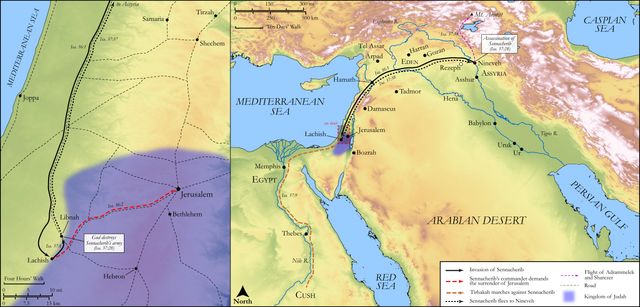
The events of Isaiah 36-39 are precisely dated to approximately 701 BC, during the reign of King Hezekiah of Judah and King Sennacherib of Assyria. At this time, Assyria stood as the preeminent superpower of that day, notorious for its brutal military campaigns, efficient siege warfare, and sophisticated psychological tactics. Sennacherib had already systematically conquered numerous fortified cities throughout Judah, leaving Jerusalem as the last major stronghold. The Rabshakeh, an Assyrian field commander, was employing a common Assyrian tactic: demoralizing the enemy through propaganda, intimidation, and calculated blasphemy before committing to a full-scale assault. The prevailing cultural context of the era was characterized by widespread polytheism, where nations believed their patron gods actively fought on their behalf. The Rabshakeh's challenge, therefore, assumes a pantheon of gods, placing YHWH among them, a direct and profound affront to Israel's foundational monotheistic faith and the unique nature of their covenant God, who had revealed Himself as the one true, self-existent God to Moses in Exodus 3:14.
Key Themes
ShowHideThis verse powerfully contributes to several overarching themes within the book of Isaiah and the broader Old Testament narrative. Firstly, it starkly underscores the theme of Divine Sovereignty vs. Human Arrogance. The Rabshakeh's boastful declaration of "my hand" in Isaiah 36:20 epitomizes human pride and perceived invincibility, which is then dramatically contrasted with the Lord's ultimate and absolute control over all nations and historical events. Secondly, the passage highlights the Uniqueness and Incomparability of God. The Rabshakeh's attempt to draw a false equivalency between YHWH and the impotent pagan deities of conquered lands directly challenges the very core of Israelite theology—that their God is incomparable, without peer, and transcends all other so-called gods, a truth eloquently articulated in passages like Isaiah 40:18-25. Finally, this dramatic confrontation sets up a profound Test of Faith. Faced with overwhelming military might and blasphemous taunts, Hezekiah and the people of Judah are compelled to choose between trusting in precarious human alliances or clinging steadfastly to their covenant God, a recurring and vital theme echoed throughout the prophetic books concerning Israel's faithfulness and reliance on the Lord.
Exposition and Analysis
ShowHideKey Word Analysis
ShowHideThis plural noun, though occasionally referring to the supreme God or even magistrates, is used by the Rabshakeh in its ordinary sense, referring to various local, pagan deities. His choice of word reveals his polytheistic worldview, where he lumps the God of Israel in with these territorial gods, demonstrating his profound ignorance of YHWH's unique, singular, and incomparable nature as the self-existent, eternal God.
This primitive root signifies "to snatch away," "rescue," "save," or "recover." It implies a powerful and decisive intervention to free someone or something from danger, bondage, or control. The Rabshakeh's challenge pivots on this concept: he asserts that no god has been able to "snatch away" their land from Assyrian control, implying YHWH will be no different. This word sets up the direct confrontation between human power and divine power, posing the critical question of who truly possesses the ability to rescue.
This versatile word, frequently translated as "hand," carries a broad semantic range, signifying power, authority, means, direction, or control. Its emphatic repetition by the Rabshakeh ("out of my hand") underscores his perceived overwhelming military might, dominion, and effective control. It represents the active, decisive power of the Assyrian empire. The central theological question then becomes whether the "hand" of the Lord (Yᵉhôvâh) is indeed superior to the "hand" of Sennacherib and his formidable army.
Verse Breakdown
ShowHide"Who [are they] among all the gods of these lands,"
This opening clause establishes the Rabshakeh's fundamental premise: he views the God of Israel as merely one among many national deities, all of whom, in his extensive experience of conquest, have proven utterly powerless against Assyrian might. This reflects a deeply ingrained polytheistic worldview where gods are territorial and their power is strictly limited to their respective lands and peoples.
"that have delivered their land out of my hand,"
This is the Rabshakeh's arrogant boast and the empirical basis for his challenge. He asserts with absolute confidence that no god of any conquered nation has successfully rescued its people or territory from the unyielding grip of the Assyrian army. The phrase "my hand" here is a powerful metonymy, signifying the overwhelming military power, dominion, and absolute control exercised by Sennacherib and his formidable empire.
"that the LORD should deliver Jerusalem out of my hand?"
This is the climactic rhetorical question, a direct and audacious challenge to YHWH, the covenant God of Israel. The Rabshakeh, drawing a false equivalency, applies his past military successes to the present situation, implying that if other gods failed, then the Lord, whom he presumptuously places in the same impotent category, will also inevitably fail to deliver Jerusalem from Assyrian conquest. This constitutes a profound act of blasphemy, demonstrating a complete underestimation of the unique power, incomparable nature, and absolute sovereignty of the God of Israel.
Literary Devices
ShowHideIsaiah 36:20 is replete with literary devices that significantly amplify its dramatic tension and theological impact. The most prominent is the Rhetorical Question, which the Rabshakeh employs not to elicit information, but to assert his absolute claim and to demoralize his audience. By posing the question, "Who [are they] among all the gods... that the LORD should deliver Jerusalem...?", he intends to convey the utter futility of Judah's hope and the perceived inevitability of their defeat. This question is steeped in profound Irony, as the Rabshakeh, in his overweening arrogance, unknowingly sets the stage for the Lord to dramatically demonstrate His unique and unparalleled power, thereby proving the Rabshakeh's premise to be utterly false. The repeated phrase "out of my hand" employs Synecdoche, where "hand" effectively represents the entirety of Assyrian military might, authority, and comprehensive control. This repetition also functions as a form of Anaphora (or simple Repetition), emphasizing the Rabshakeh's perceived dominance and the futility of resistance. Furthermore, the Rabshakeh's entire speech, and particularly this verse, is a prime example of Blasphemy, as he directly insults, belittles, and attempts to diminish the unique sovereignty and infinite power of the one true God by presumptuously equating Him with impotent pagan idols.
Theological and Thematic Connections
ShowHideIsaiah 36:20 serves as a stark and powerful reminder of the fundamental theological distinction between the one true God, YHWH, and the myriad of false gods worshipped by the nations. The Rabshakeh's taunt, deeply rooted in a polytheistic worldview where divine power is limited, localized, and contingent on human strength, directly challenges the biblical understanding of God's absolute sovereignty and His incomparable nature. This pivotal episode underscores that God's power is not merely superior to that of idols; it is of an entirely different order of being and operation, as He alone is the uncreated Creator and Sustainer of all things. The Lord's subsequent miraculous deliverance of Jerusalem, recounted in Isaiah 37:36, not only vindicates His holy name but also powerfully demonstrates that He acts not according to human expectations or the perceived limitations of other "gods," but solely according to His own divine will, omnipotence, and unwavering covenant faithfulness.
Reflection and Application
ShowHideThe Rabshakeh's audacious challenge in Isaiah 36:20 resonates deeply with the perennial human experience of facing overwhelming odds and encountering voices that seek to undermine our faith. In our contemporary lives, we too encounter "Rabshakehs"—whether they manifest as societal pressures, daunting personal struggles, internal doubts, or the seductive logic of secularism—that attempt to diminish God's power by equating Him with limited human capabilities or to suggest that He is no different from the "gods" of worldly success, fleeting security, or self-reliant autonomy. This verse calls us to a profound and searching reflection on the absolute uniqueness and incomparable nature of our God. When faced with seemingly insurmountable obstacles, do we succumb to the cynical logic of the world, or do we, like King Hezekiah, turn in humble and desperate prayer to the Lord, trusting implicitly in His incomparable power and unwavering faithfulness? The ultimate, miraculous deliverance of Jerusalem serves as an enduring testament that God is indeed able to deliver, even when all human hope seems utterly lost, and that His infinite power is not to be measured by the failures of false gods or the hollow boasts of human empires.
Questions for Reflection
ShowHideFAQ
ShowHideWho was the Rabshakeh, and what was his primary objective?
ShowHideThe Rabshakeh was a high-ranking Assyrian official, likely a chief cupbearer or field commander, serving directly under King Sennacherib. His primary objective in Isaiah 36 was to psychologically dismantle the morale of Jerusalem's inhabitants and King Hezekiah, thereby compelling them to surrender without the need for a prolonged and costly siege. He strategically achieved this through a calculated campaign of intimidation, deceptive promises, and, most crucially, blasphemous taunts against the God of Israel, aiming to demonstrate the futility of any resistance and the perceived impotence of their God against the overwhelming might of the Assyrian empire.
Christ-Centered Fulfillment
ShowHideThe Rabshakeh's blasphemous challenge in Isaiah 36:20, questioning the Lord's ability to deliver Jerusalem, finds its ultimate and profound refutation in the person and redemptive work of Jesus Christ. The Assyrian king's boast of an unconquerable "hand" is infinitely dwarfed by the omnipotent hand of God, fully and perfectly revealed in Christ. Just as Jerusalem faced a seemingly insurmountable military enemy, humanity faced an enemy far greater and more pervasive: the spiritual bondage of sin and the inevitability of death. No earthly power, no "god of these lands," could possibly deliver humanity from this profound spiritual captivity. It required the unique, incomparable, and divine power of the One True God. Jesus, the Lamb of God who takes away the sin of the world, demonstrated God's unparalleled power not through military might or earthly conquest, but by conquering sin and death itself through His sacrificial crucifixion and glorious resurrection (Colossians 2:15). His victory on the cross, often perceived as weakness by worldly standards, was in fact the ultimate act of divine deliverance, proving unequivocally that the God of Israel is not merely superior to pagan deities but is the only God capable of true, eternal salvation. Through Christ, we profoundly understand that God's "hand" is not limited by human expectations, the boasts of earthly empires, or the failures of false gods, but extends to deliver us from our spiritual enemies, offering eternal life and true freedom in Him (Romans 8:37-39). The miraculous deliverance of Jerusalem in Isaiah thus serves as a powerful foreshadowing of the far greater, spiritual deliverance offered to all who trust in the unparalleled power and sovereign authority of Jesus, the true King of kings and Lord of lords (Revelation 19:16).