


Isaiah 36:18
Bible text: King James Version (1769 Blayney text) · Public domain
Bible text: King James Version with Strong's numbers · Public domain
Bible text: Berean Standard Bible · Public domain
Bible text: American Standard Version (1901) · Public domain
Bible text: World English Bible, Messianic edition · Public domain
Bible text: Geneva Bible (1599) · Public domain
Bible text: Young's Literal Translation · Public domain
- פֶּןpenlestH6435PrtParticle Conditional
- יַסִּיתya·Sithe should misleadH5496V-Hiphil-Imperf-3msVerb Hiphil Imperfect 3rd Singular Masculine
- אֶתְכֶם'et·Khem<obj.> youH853DirObjM ¦ 2mpParticle Object Indicatorאֶתְ<obj.>כֶםyou
- חִזְקִיָּהוּchiz·ki·Ya·huHezekiahH2396N-proper-mNoun Proper Masculine
- לֵאמֹרle·Mor<to> sayingH559Prep-l ¦ V-Qal-InfVerb Qal Infinitive Constructלֵ<to>אמֹרsaying
- יְהוָהYah·wehYahwehH3068N-properNoun Proper Title
- יַצִּילֵנוּya·tzi·Le·nuhe will deliver usH5337V-Hiphil-Imperf-3ms ¦ 1cpVerb Hiphil Imperfect 3rd Singular Masculineיַצִּילֵhe will deliverנוּus
- הַהִצִּילוּha·hi·Tzi·lu¿ have they deliveredH5337Interrog ¦ V-Hiphil-Perf-3cpVerb Hiphil Perfect 3rd Plural common genderהַ¿הִצִּילוּhave they delivered
- אֱלֹהֵי'e·lo·Hei[the] gods ofH430N-mpcNoun Plural Masculine Construct
- הַגּוֹיִםha·go·Yimthe nationsH1471Art ¦ N-mpNoun Plural Masculine Absoluteהַtheגּוֹיִםnations
- אִישׁ'ishanyoneH376N-msNoun Singular Masculine Absolute
- אֶת'et<obj.>H853DirObjMParticle Object Indicator
- אַרְצוֹ'ar·Tzoits landH776N-fsc ¦ 3msNoun Singular Feminine Constructאַרְצlandוֹits
- מִיַּדmi·Yadfrom [the] hand ofH3027Prep-m ¦ N-cscNoun Singular common gender Constructמִfromיַּד[the] hand of
- מֶלֶךְMe·lekh[the] king ofH4428N-mscNoun Singular Masculine Construct
- אַשּׁוּר'a·ShurAssyriaH804N-properNoun Proper Location
English is a literal word-by-word gloss of the Hebrew, not the KJV's wording. Why?
This is the original text the KJV's translators worked from — each Hebrew word with its own literal English meaning in this verse, prepared by scholars at Tyndale House, Cambridge. The KJV translates whole sentences, not word by word, so its wording differs: one Hebrew word can become several English words, and the KJV may choose “the LORD” where the gloss reads “Yahweh”. Both are faithful — they answer different questions. For the KJV's own rendering, switch to the KJV text.
Details
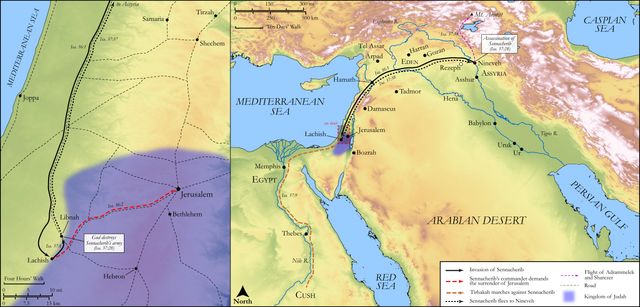
See on the biblical-era map
Study this verse
Public-domain commentary
Matthew Henry
From his Commentary on the Whole Bible. Henry comments on passages, not single verses — this entry covers Isaiah 36:11–22.
We may hence learn these lessons: - 1. That, while princes and counsellors have public matters under debate, it is not fair to appeal to the people. It was a reasonable motion which Hezekiah's plenipotentiaries made, that this parley should be held in a language which the people did not understand (Isa 36:11), because reasons of state are secret things and ought to be kept secret, the vulgar being incompetent judges of them. It is therefore an unfair practice, and not doing as men would be done by, to incense subjects against their rulers by base insinuations. 2. Proud and haughty scorners, the fairer they are spoken to, commonly speak the fouler. Nothing could be said more mildly and respectfully than that which Hezekiah's agents said to Rabshakeh. Besides that the thing itself was just which they desired, they called themselves his servants, they petitioned for it: Speak, we pray thee; but this made him the more spiteful and imperious. To give rough answers to those who give us soft answers is one way of rendering evil for good; and those are wicked indeed, and it is to be feared incurable, with whom that which usually turns away wrath does but make bad worse. 3. When Satan would tempt men from trusting in God, and cleaving to him, he does so by insinuating that in yielding to him they may better their condition; but it is a false suggestion, and grossly absurd, and therefore to be rejected with the utmost abhorrence. When the world and the flesh say to us, "Make an agreement with us and come out to us, submit to our dominion and come into our interests, and you shall eat every one of his own vine," they do but deceive us, promising liberty when they would lead us into the basest captivity and slavery. One might as well take Rabshakeh's word as theirs for kind usage and fair quarter; therefore, when they speak fair, believe them not. Let them say what they will, there is no land like the land of promise, the holy land. 4. Nothing can be more absurd in itself, nor a greater affront to the true and living God, than to compare him with the gods of the heathen; as if he could do no more for the protection of his worshippers than they can for the protection of theirs, and as if the God of Israel could as easily be mastered as the gods of Hamath and Arphad, whereas they are vanity and a lie. They are nothing; he is the great I AM: they are the creatures of men's fancy and the works of men's hands; he is the Creator of all things. 5. Presumptuous sinners are ready to think that, because they have been too hard for their fellow-creatures, they are therefore a match for their Creator. This and the other nation they have subdued, and therefore the Lord himself shall not deliver Jerusalem out of their hand. But, though the potsherds may strive with the potsherds of the earth, let them not strive with the potter. 6. It is sometimes prudent not to answer a fool according to his folly. Hezekiah's command was, "Answer him not; it will but provoke him to rail and blaspheme yet more and more; leave it to God to stop his mouth, for you cannot." They had reason enough on their side, but it would be hard to speak it to such an unreasonable adversary without a mixture of passion; and, if they should fall a railing like him, Rabshakeh would be much too hard for them at that weapon. 7. It becomes the people of God to lay to heart the dishonour done to God by the blasphemies of wicked men, though they do not think it prudent to reply to those blasphemies. Though they answered him not a word, yet they rent their clothes, in a holy zeal for the glory of God's name and a holy indignation at the contempt put upon it. They tore their garments when they heard blasphemy, as taking no pleasure in their own ornaments when God's honour suffered.
Historical interpretation
Historical reception
2 surviving comments on this verse. Each one is dated, so this reads as a timeline rather than a list.
Immediately then, he supplemented this threat with an enticement in order to deceive with counterpromises and temptations those whom he had not conquered with terror, saying on behalf of the king of the Assyrians: “Make peace with me and come to me,” or as we read in the book of Kings: “Do with me what is useful and come to me.” Both have the same meaning. Do, he said, what is to your own advantage and it will accrue to your blessing. In other words: Bless the king of Assyria and praise him, and confess him to be your lord that you might receive a reward. Also, live in your cities and enjoy your crops until I return from Egypt or until I restore captured Libnah. After I come, I will take you to a land much like your own, with grain and wine and oil. But he did not give a name for this land because he could not find an equal to the Promised Land. Yet he promised it nevertheless, for everyone desires to be in the land of his birth. Some think the land that he promised was Media, which has terrain similar in both location and foliage to that of Judea. Then he added: “Where is the god of Hamath and of Arpad and of Sepharvaim? Have they delivered Samaria from my hand?” This shows that Samaria will be subject to them for all of its days and therefore that it should be taken. If, he said, we were easily victorious over the ten tribes who had the protection of so many gods, how much more easily will we conquer you, even lonely Jerusalem, which has the protection of only one God?
(Vers. 16 seqq.) Join me in blessing, and come out to me, and each one eat his own vineyard, and each one eat his own fig tree, and each one drink the water of his own cistern, until I come and take you to a land, which is like your own land: a land of wheat and wine, a land of bread and vineyards. Do not let Hezekiah disturb you, saying: The Lord will deliver us. Have the gods of the nations ever delivered each one his own land from the hand of the king of Assyria? This is what is read in the Book of Kings: 'Do with me what is beneficial, and come out to me' (2 Kings 18:31). Therefore, the meaning is the same. 'Do what is profitable for you,' he says, 'and may it contribute to your blessing.' Whether he is saying this: 'Bless the Assyrian king and praise him, and confess the Lord, so that you may obtain rewards, and until I return from Egypt, or when Lobna is captured, I will return. Dwell in your city and enjoy your possessions.' Later, however, I will come and lead you to a land that is similar to your land, with wheat, wine, and oil. It does not mention the name of the region, because it could not find an equivalent land promise: but it promises similarity. For each person desires what they were born into. Some think that the land of Media is promised to them, which had a similarity to the land of Judaea, both in location and in crops. And this is what he brings up.
Continue studying Isaiah 36:18 across the web’s major study libraries — every link below opens this exact verse, chapter, or book on the destination site.
Read & Compare
 BibleGatewayThis verse in more than 200 translations and 70 languages.
 Bible.comThe YouVersion reader — hundreds of translations, reading plans, and highlights.
 ESV.orgCrossway's official English Standard Version reader.
 NET BibleThe NET translation with 60,000+ translators' notes on every rendering decision.
 STEP BibleTyndale House's free study tool — original text, vocabulary, and scholarly resources.
 BibliaLogos Bible Software's free web reader.
 USCCBThe New American Bible (Revised Edition) with the U.S. bishops' study notes.
Commentaries
 BibleHub CommentariesDozens of classic commentaries on this verse, gathered on one page.
 StudyLightMore than 100 commentary sets — the largest collection on the web.
 BibleRefPlain-English commentary on what this verse means, verse by verse.
 Enduring WordDavid Guzik's free commentary on this chapter, widely used by Bible teachers.
 Bible Study ToolsVerse commentary alongside Greek and Hebrew study aids.
Original Language & Research
- BibleHub InterlinearThe verse word by word — original language, transliteration, and English.
- BibleHub LexiconEvery word's original-language definition and Strong's entry.
 Blue Letter BibleDeep-study tools — Strong's numbers, concordance, and word studies.
 SefariaThe Hebrew text with Rashi and centuries of Jewish commentary.
Sermons, Hymns & Audio


TrulyRandomVerse is not affiliated with these sites and doesn’t control their content. They’re linked because they’re genuinely useful.
Summary
Isaiah 36:18 captures a critical moment during the Assyrian siege of Jerusalem, where the Rabshakeh, King Sennacherib's field commander, unleashes a sophisticated psychological attack. His aim is to dismantle the Judeans' trust in their king, Hezekiah, and more profoundly, in the LORD God of Israel. He does this by asserting that Judah's God is no different from the impotent deities of other nations that have already succumbed to Assyrian might, thereby challenging the very foundation of their faith and setting the stage for a dramatic theological confrontation between pagan pragmatism and divine sovereignty.
Context
ShowHideLiterary Context
Isaiah 36:18 is situated within the historical account of Isaiah chapters 36-39, which largely parallels 2 Kings 18-20. These chapters provide a detailed record of the Assyrian invasion of Judah during the reign of King Hezekiah, specifically focusing on Sennacherib's campaign against Jerusalem in 701 BC. The Rabshakeh's speech, delivered in Hebrew outside the city walls, is a pivotal element of this narrative, serving as a direct challenge to Judah's faith and Hezekiah's leadership. This verse is part of the Rabshakeh's extended address (Isaiah 36:4-20), a meticulously crafted piece of ancient psychological warfare designed to demoralize the people and coerce them into surrender without a fight. His words are strategically aimed at sowing seeds of doubt, questioning both Hezekiah's capacity to deliver them and the LORD's power to intervene, thereby intensifying the tension that precedes the dramatic divine intervention described in Isaiah 37.
Historical & Cultural Context
The historical backdrop for this passage is the late 8th century BC, a period dominated by the formidable Neo-Assyrian Empire. Renowned for its ruthless military campaigns, advanced siege technology, and sophisticated psychological tactics, Assyria had become the preeminent power of that day. King Sennacherib had already devastated many cities in Judah, and Jerusalem now faced an existential threat. Culturally, the nations round about held that each nation had its patron deity, and military victories were widely interpreted as irrefutable proof of a god's superiority over the gods of the conquered. The Rabshakeh's argument directly taps into this prevailing cultural understanding, presenting a pragmatic, worldly logic that suggests Judah's God, based on the empirical evidence of Assyrian conquests, was no different from any other defeated national deity. This stands in stark contrast to King Hezekiah's significant religious reforms, which involved purging idolatry and urging his people to place their sole trust in the LORD, rejecting reliance on foreign alliances, particularly with Egypt, as warned by Isaiah in passages such as Isaiah 30:1-3.
Key Themes
ShowHideThis verse powerfully contributes to several profound themes within the book of Isaiah and the broader biblical narrative. Firstly, it highlights the Challenge to Divine Sovereignty, as the Rabshakeh directly assaults the uniqueness and supremacy of the LORD, attempting to reduce Him to the level of impotent pagan idols. This sets up a theological showdown between the one true God and false deities. Secondly, it underscores the profound tension between Faith vs. Fear and Human Logic. The Rabshakeh appeals to a pragmatic, empirical worldview ("No other god has delivered, why would yours?"), directly contrasting with Hezekiah's unwavering call for trust in God's unseen power and promises, a theme echoed in Isaiah 37:6. Finally, the passage vividly illustrates the power of Propaganda and Deception. The Rabshakeh's speech is a masterful display of ancient psychological warfare, meticulously designed to sow doubt, fear, and division among the besieged. He employs half-truths and false equivalences to manipulate their perception of reality and God's power, thereby setting the stage for God's ultimate vindication of His own name and power, demonstrating His incomparable might, as seen in Isaiah 37:36.
Exposition and Analysis
ShowHideKey Word Analysis
ShowHideMeaning "to prick, i.e. (figuratively) stimulate; by implication, to seduce; entice, move, provoke, set on, take away." The Rabshakeh's intent is not merely to convince the Judeans through logical argument, but to actively "stimulate" or "seduce" them away from their loyalty to King Hezekiah and, more importantly, from their trust in the LORD. This word implies a manipulative and insidious attempt to undermine their resolve and faith through psychological pressure, suggesting a deeper, more sinister aim than simple persuasion.
Meaning "(the) self-Existent or Eternal; Jehovah, Jewish national name of God." This is the sacred, covenant name of God, YHWH, emphasizing His eternal, self-existent nature, His faithfulness to His covenant promises, and His unique identity as the one true God. The Rabshakeh's failure to distinguish YHWH from the created, powerless "gods of the nations" (H430) highlights his profound spiritual blindness and forms the core of the theological conflict within the passage. He assumes YHWH is merely another local deity, subject to the same limitations and defeats as the idols of other conquered lands.
Meaning "plural of אֱלוֹהַּ; gods in the ordinary sense; but specifically used (in the plural thus, especially with the article) of the supreme God; occasionally applied by way of deference to magistrates; and sometimes as a superlative." Here, it is used in the "ordinary sense," referring to the pagan deities of the surrounding nations. The Rabshakeh's argument hinges on equating the unique, sovereign LORD with these impotent, created entities, thereby attempting to diminish His power, authority, and distinctiveness in the eyes of the Judeans, stripping them of their unique hope.
Verse Breakdown
ShowHide"Beware lest Hezekiah persuade you, saying, The LORD will deliver us."
This opening clause functions as a direct, cunning warning, framing King Hezekiah's message of trust in the LORD as a dangerous and deceptive delusion. The Rabshakeh implicitly acknowledges Hezekiah's spiritual leadership and his call for faith, but immediately seeks to discredit it by presenting it as a false hope. The phrase "The LORD will deliver us" represents the very core of Hezekiah's message and Judah's hope, which the Assyrian commander aims to systematically dismantle through logical fallacy and intimidation.
"Hath any of the gods of the nations delivered his land out of the hand of the king of Assyria?"
This is a powerful and insidious rhetorical question, forming the crux of the Rabshakeh's argument. He appeals to the empirical evidence of Assyria's unbroken string of military victories, presenting a seemingly undeniable track record. By deliberately lumping the LORD in with the defeated "gods of the nations," he seeks to demonstrate that Judah's God is no exception to Assyria's overwhelming and seemingly unstoppable might. The phrase "out of the hand" signifies absolute power, control, and dominion, emphasizing that no deity has been able to wrest control or provide deliverance from the iron grip of the Assyrian king.
Literary Devices
ShowHideThe verse is exceptionally rich in Rhetorical Question, a device masterfully employed by the Rabshakeh not to elicit an answer, but to make a forceful, undeniable assertion: "Clearly, no god has delivered, so why would yours?" This technique is a crucial component of his Psychological Warfare, designed to sow deep doubt and paralyzing fear, thereby systematically undermining the morale and resolve of the besieged. There is profound Irony embedded within the Rabshakeh's seemingly triumphant words, as the very God he dismisses and equates with impotent idols is about to demonstrate His unique, incomparable power by miraculously delivering Jerusalem. The verse also effectively employs Contrast between the perceived impotence of "the gods of the nations" and the implied powerlessness of the LORD, a stark contrast that the subsequent narrative will dramatically and divinely overturn. Furthermore, the Rabshakeh's entire speech, encapsulated in this verse, serves as a prime example of ancient Propaganda, skillfully employing logical fallacies (specifically, false equivalence) and appeals to fear to achieve a military objective without the necessity of direct, costly combat.
Theological and Thematic Connections
ShowHideIsaiah 36:18 presents a stark and profound theological confrontation: the pragmatic, polytheistic worldview that equates God with finite, national deities versus the biblical truth of YHWH's incomparable sovereignty and unique identity. The Rabshakeh's challenge is a direct assault on the distinctiveness and supremacy of the LORD, implying that His power is limited and subject to human historical outcomes and military might, just like the impotent idols of other conquered nations. However, the Bible consistently and unequivocally declares God's absolute distinctiveness, His covenant faithfulness, and His power to deliver beyond human comprehension or expectation. This passage serves as a powerful and enduring reminder that God is not merely "a god" among many, a deity whose power can be measured by earthly success, but the one true, self-existent, and all-powerful Creator and Sustainer. His promises of deliverance are not contingent on the strength of armies, the logic of human experience, or the prevailing circumstances, but solely on His own immutable character and sovereign will.
Reflection and Application
ShowHideIn a world that incessantly bombards us with "Rabshakeh-like" voices—voices of doubt, fear, worldly pragmatism, and cynical realism—Isaiah 36:18 offers profound and timeless lessons for the believer. We are often subtly or overtly persuaded by statistics, past failures, or the seemingly insurmountable odds that our personal and collective challenges present, leading us to question God's power, His willingness to intervene, or even His very existence. This verse calls us to cultivate spiritual discernment, recognizing these pervasive voices as insidious attempts to undermine our faith in the unique, incomparable, and all-sufficient God. It serves as a powerful reminder that our God is not limited by human logic, historical precedent, the strength of any earthly power, or the prevailing narratives of despair. He is the LORD, the self-existent one, whose track record is not one of failure, but of perfect wisdom, sovereign control, and unfailing love, as dramatically demonstrated by the miraculous deliverance that immediately followed the Rabshakeh's taunts. Like King Hezekiah, we are called to stand firm in our convictions, encouraging ourselves and others to place our unwavering trust in God's immutable character and infinite power, rather than in our limited understanding or the seemingly overwhelming circumstances of the world.
Questions for Reflection
ShowHideFAQ
ShowHideWho was Rabshakeh and what was his purpose in speaking these words?
ShowHideRabshakeh was a high-ranking Assyrian official, likely a chief cup-bearer or field commander, serving directly under King Sennacherib. His primary purpose in speaking these words in Hebrew, the language of Judah, was to engage in a sophisticated form of psychological warfare. He aimed to demoralize the people of Jerusalem, sow division between them and their steadfast King Hezekiah, and ultimately persuade them to surrender without the Assyrians having to launch a costly and potentially difficult full-scale siege. By challenging the power of Judah's God and comparing Him to the defeated deities of other nations, he sought to strip the Judeans of their last hope and break their will to resist, as vividly detailed in Isaiah 36:4-20.
Why did Rabshakeh compare the LORD to other gods, and what was the theological significance of this comparison?
ShowHideRabshakeh compared the LORD to the gods of other conquered nations because, from his pagan, polytheistic worldview, all gods were essentially local deities whose power was limited to their national boundaries and whose effectiveness was measured by their nation's military success. Since Assyria had conquered many nations, it logically followed, in his mind, that their gods were inferior and impotent. The theological significance of this comparison was profound: it was a direct and blasphemous assault on the uniqueness, sovereignty, and transcendence of the LORD. The Bible, in stark contrast, consistently teaches that YHWH is the one true, self-existent God, the Creator of all, who is utterly incomparable to any created idol or false deity, as powerfully articulated in Isaiah 40:18. Rabshakeh's failure to distinguish between the transcendent God of Israel and the impotent idols of the Gentiles underscored his spiritual blindness and set the stage for God to dramatically vindicate His own name and demonstrate His incomparable power.
Christ-Centered Fulfillment
ShowHideRabshakeh's audacious challenge to the LORD's power in Isaiah 36:18, equating Him with impotent pagan gods, powerfully foreshadows the ultimate challenge to God's authority and redemptive power, which was decisively met and overcome in the person and work of Jesus Christ. Just as the Assyrian commander mocked the idea of the LORD delivering Judah, so too did the powers of darkness, human sin, and worldly authorities mock Christ on the cross, believing they had triumphed over God's anointed one. Yet, it was precisely through this apparent weakness and defeat—the crucifixion—that God's ultimate, incomparable, and eternal power of deliverance was revealed. Christ's glorious resurrection from the dead demonstrated unequivocally that He is indeed the Lamb of God who takes away the sin of the world, the one truly capable of delivering humanity not merely from earthly oppressors, but from the far greater enemies of sin, spiritual death, and the devil himself, as He triumphed over the one who holds the power of death (Hebrews 2:14-15). His victory on the cross disarmed the spiritual rulers and authorities, making a public spectacle of them and triumphing over them in it (Colossians 2:15). Therefore, when Christ declares, "In the world ye shall have tribulation: but be of good cheer; I have overcome the world" (John 16:33), He echoes the divine deliverance of Jerusalem, but on an eternal scale, assuring believers that the one who holds the keys of death and Hades (Revelation 1:18) is infinitely more powerful than any earthly or spiritual foe, offering a deliverance that is complete and everlasting.