


Isaiah 37:6
Bible text: King James Version (1769 Blayney text) · Public domain
Bible text: King James Version with Strong's numbers · Public domain
Bible text: Berean Standard Bible · Public domain
Bible text: American Standard Version (1901) · Public domain
Bible text: World English Bible, Messianic edition · Public domain
Bible text: Geneva Bible (1599) · Public domain
Bible text: Young's Literal Translation · Public domain
- וַיֹּאמֶרvai·Yo·merand he saidH559Conj-w ¦ V-Qal-ConsecImperf-3msVerb Qal Consecutive Imperfect 3rd Singular Masculineוַandיֹּאמֶרhe said
- אֲלֵיהֶם'a·lei·Hemto themH413Prep ¦ 3mpPrepositionאֲלֵיtoהֶםthem
- יְשַׁעְיָהוּye·sha'·Ya·huIsaiahH3470N-proper-mNoun Proper Masculine
- כֹּהkohthusH3541AdvAdverb
- תֹאמְרוּןtom·Runyou will say !H559V-Qal-Imperf-2mp ¦ SfxVerb Qal Imperfect 2nd Plural Masculineתֹאמְרוּyou will sayן!
- אֶל'eltoH413PrepPreposition
- אֲדֹנֵיכֶם'a·do·nei·Khemyour master<s>H113N-mpc ¦ 2mpNoun Plural Masculine Constructאֲדֹנֵיmaster<s>כֶםyour
- כֹּהkohthusH3541AdvAdverb
- אָמַר'a·Marhe saysH559V-Qal-Perf-3msVerb Qal Perfect 3rd Singular Masculine
- יְהוָהYah·wehYahwehH3068N-properNoun Proper Title
- אַל'almay notH408NegParticle Negative
- תִּירָאti·Ra'you be afraidH3372V-Qal-Imperf-2msVerb Qal Imperfect 2nd Singular Masculine
- מִפְּנֵיmi·pe·Neiof <the face of>H6440Prep-m ¦ N-mpcNoun Plural Masculine Constructמִofפְּנֵי<the face of>
- הַדְּבָרִיםha·de·va·Rimthe wordsH1697Art ¦ N-mpNoun Plural Masculine Absoluteהַtheדְּבָרִיםwords
- אֲשֶׁר'a·SherwhichH834RelParticle Relative
- שָׁמַעְתָּsha·Ma'·tayou have heardH8085V-Qal-Perf-2msVerb Qal Perfect 2nd Singular Masculine
- אֲשֶׁר'a·SherwhichH834RelParticle Relative
- גִּדְּפוּgi·de·Futhey have blasphemedH1442V-Piel-Perf-3cpVerb Piel Perfect 3rd Plural common gender
- נַעֲרֵיna·'a·Rei[the] servants ofH5288N-mpcNoun Plural Masculine Construct
- מֶלֶךְMe·lekh[the] king ofH4428N-mscNoun Singular Masculine Construct
- אַשּׁוּר'a·ShurAssyriaH804N-properNoun Proper Location
- אוֹתִי'o·Ti<obj.> meH853DirObjM ¦ 1csParticle Object Indicatorאוֹתִ<obj.>יme
English is a literal word-by-word gloss of the Hebrew, not the KJV's wording. Why?
This is the original text the KJV's translators worked from — each Hebrew word with its own literal English meaning in this verse, prepared by scholars at Tyndale House, Cambridge. The KJV translates whole sentences, not word by word, so its wording differs: one Hebrew word can become several English words, and the KJV may choose “the LORD” where the gloss reads “Yahweh”. Both are faithful — they answer different questions. For the KJV's own rendering, switch to the KJV text.
Details
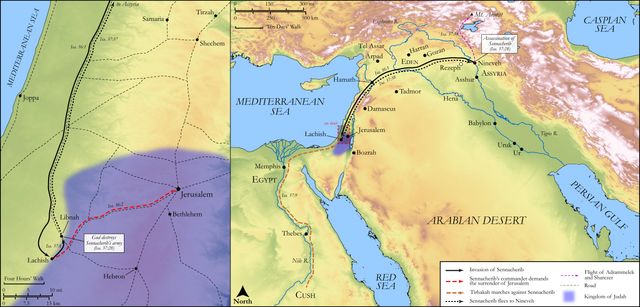
See on the biblical-era map
Study this verse
Public-domain commentary
Matthew Henry
From his Commentary on the Whole Bible. Henry comments on passages, not single verses — this entry covers Isaiah 37:1–7.
We may observe here, 1. That the best way to baffle the malicious designs of our enemies against us is to be driven by them to God and to our duty and so to fetch meat out of the eater. Rabshakeh intended to frighten Hezekiah from the Lord, but it proves that he frightens him to the Lord. The wind, instead of forcing the traveller's coat from him, makes him wrap it the closer about him. The more Rabshakeh reproaches God the more Hezekiah studies to honour him, by rending his clothes for the dishonour done to him and attending in his sanctuary to know his mind. 2. That it well becomes great men to desire the prayers of good men and good ministers. Hezekiah sent messengers, and honourable ones, those of the first rank, to Isaiah, to desire his prayers, remembering how much his prophecies of late had plainly looked towards the events of the present day, in dependence upon which, it is probable, he doubted not but that the issue would be comfortable, yet he would have it to be so in answer to prayer: This is a day of trouble, therefore let it be a day of prayer. 3. When we are most at a plunge we should be most earnest in prayer: Now that the children are brought to the birth, but there is not strength to bring forth, now let prayer come, and help at a dead lift. When pains are most strong let prayers be most lively; and, when we meet with the greatest difficulties, then is a time to stir up not ourselves only, but others also, to take hold on God. Prayer is the midwife of mercy, that helps to bring it forth. 4. It is an encouragement to pray though we have but some hopes of mercy (Isa 37:4): It may be the Lord thy God will hear; who knows but he will return and repent? The it may be of the prospect of the haven of blessings should quicken us with double diligence to ply the oar of prayer. 5. When there is a remnant left, and but a remnant, it concerns us to lift up a prayer for that remnant, Isa 37:4. The prayer that reaches heaven must be lifted up by a strong faith, earnest desires, and a direct intention to the glory of God, all which should be quickened when we come to the last stake. 6. Those that have made God their enemy we have no reason to be afraid of, for they are marked for ruin; and, though they may hiss, they cannot hurt. Rabshakeh has blasphemed God, and therefore let not Hezekiah be afraid of him, Isa 37:6. He has made God a party to the cause by his invectives, and therefore judgment will certainly be given against him. God will certainly plead his own cause. 7. Sinners' fears are but prefaces to their falls. He shall hear the rumour of the slaughter of his army, which shall oblige him to retire to his own land, and there he shall be slain, Isa 37:7. The terrors that pursue him shall bring him at last to the king of terrors, Job 18:11, Job 18:14. The curses that come upon sinners shall overtake them.
Historical interpretation
Historical reception
1 surviving comment on this verse from the historical church.
(Chapter 37, Verse 1 and following) Then Eliakim son of Hilkiah, who was in charge of the palace, and Shebna the secretary and Joah son of Asaph the recorder went to Hezekiah with their clothes torn and told him what the field commander had said. When King Hezekiah heard this, he tore his clothes and put on sackcloth and went into the temple of the Lord. He sent Eliakim the palace administrator, Shebna the secretary and the leading priests, all wearing sackcloth, to the prophet Isaiah son of Amoz. They told him, 'This is what Hezekiah says: This day is a day of distress and rebuke and disgrace, as when children come to the moment of birth and there is no strength to deliver them.' If you want to know how the Lord your God heard the words of Rabsaces, whom the king of the Assyrians, his lord, sent to blaspheme the living God and to reproach the words that the Lord your God heard, lift up a prayer for the remainder that have been found. Then the servants of King Hezekiah came to Isaiah, and Isaiah said to them: 'Thus you shall say to your master: Thus says the Lord: Do not be afraid of the words that you have heard, with which the servants of the king of Assyria blasphemed me.' Behold, I will give to him the spirit, and he will hear the message, and he will return to his land, and I will make him fall by the sword in his land. Leaving aside the clear things, let us discuss only those in which the hidden meaning is present. They tear their clothes because they hear Rabshekah blaspheming. The king himself tears his own clothes because he believed it to be his and the people's sins that Rabshekah has come all the way to the gate of Jerusalem and has spoken such things against the Lord. Whereupon, the high priest, because he believed that he had blasphemed the Savior, tore his garments (Matt. XXVI); and Paul and Barnabas, when the people of Lystra wanted to worship them as gods, tore their garments (Acts XIV). Therefore, he wrapped himself in sackcloth for the royal worship, and as he walked from the palace to the temple, he sent Eliakim the high priest, and Shebna the scribe, and the elders of the priests to Isaiah the son of Amos the prophet. In this, the humility and prudence of the king are worth considering. He himself proceeded to the Temple; the leaders of the people and the elders of the priests, not dressed in priestly garments but covered in sackcloth, sent to Isaiah son of Amos, the prophet. Concerning him, it is read in the Book of Kings: He himself was covered with a mantle, and entered the house of the Lord, Eliakim the steward of the house, and Shebna the scribe, and the elders of the priests sent covered in sacks to Isaiah the prophet, son of Amos (2 Kings 19:1-2). Here, because Isaiah himself was writing the history about himself, he did not call himself a Prophet, but the son of a Prophet; there, because another person was writing the history, he writes about him as a Prophet. Indeed, we read this also concerning the Evangelist Matthew, that Matthew himself said that he was a tax collector (Matt. IX); but the other Evangelists remained silent about the name tax collector, and only mentioned his apostolic dignity; and that in the ranks of the Apostles, he is second in his own account and first in the others'. And they said to him: Thus says Hezekiah, not a king, not swollen with the name of empire: The day of tribulation, and the day of corruption, and the day of blasphemy: the day of our tribulation, the day of God's correction, the day of the enemies' blasphemy. And the likeness of a woman in labor and in distress, that she has come to labor and cannot give birth, nor can she say: We have conceived, O Lord, from fear of you, and we have grieved and given birth to the spirit of salvation. It follows: As how should the Lord your God hear the words of Rabsaces (Isaiah XXVI, 18, according to the LXX). For we do not dare to say O Lord, Lord of all, when such great wrath is upon us; but we say, your Lord. And we have this confidence of vengeance: because the living God is blasphemed by the worshipper of dead idols. And they reproached with the words, which the Lord your God heard: Therefore, lift up our lying prayer: not for all the people who have already perished, but for the remnants that are besieged. And when the servants of King Hezekiah came to Isaiah, the name of the Prophet was silent again, so that he would preserve the humility that had been started. And Isaiah anticipated them: for with the same spirit with which he knew the future, he had also heard the absent king: and he said what they should respond to their Lord, humbled in this trust of conscience. He said, 'Say to your master, who is your Lord; for my Lord says these things: Do not fear the words by which not you, but I am blasphemed. Nor do I say that I am going to do all the things that the king of the Assyrians wishes, lest it seem that I am boasting of my power; but that a spirit, not of God, but an adversary, is to be given to him. And upon hearing the message, let him return to his own land, and let him fall by the sword in it, so that both things which Hezekiah desired equally, he would hear: that he would be freed from the siege and danger, and that the angry and hostile king would die in his own land.' If someone asks why the book of Prophecies, which is written in the volumes of Kings and Chronicles, seems mixed, let them consider that the prophecy of history is linked, both concerning the liberation of the city and the destruction of Assyria, and concerning the return of the sun with ten and fifteen years elapsed, which is both prophecy and history.
Continue studying Isaiah 37:6 across the web’s major study libraries — every link below opens this exact verse, chapter, or book on the destination site.
Read & Compare
 BibleGatewayThis verse in more than 200 translations and 70 languages.
 Bible.comThe YouVersion reader — hundreds of translations, reading plans, and highlights.
 ESV.orgCrossway's official English Standard Version reader.
 NET BibleThe NET translation with 60,000+ translators' notes on every rendering decision.
 STEP BibleTyndale House's free study tool — original text, vocabulary, and scholarly resources.
 BibliaLogos Bible Software's free web reader.
 USCCBThe New American Bible (Revised Edition) with the U.S. bishops' study notes.
Commentaries
 BibleHub CommentariesDozens of classic commentaries on this verse, gathered on one page.
 StudyLightMore than 100 commentary sets — the largest collection on the web.
 BibleRefPlain-English commentary on what this verse means, verse by verse.
 Enduring WordDavid Guzik's free commentary on this chapter, widely used by Bible teachers.
 Bible Study ToolsVerse commentary alongside Greek and Hebrew study aids.
Original Language & Research
- BibleHub InterlinearThe verse word by word — original language, transliteration, and English.
- BibleHub LexiconEvery word's original-language definition and Strong's entry.
 Blue Letter BibleDeep-study tools — Strong's numbers, concordance, and word studies.
 SefariaThe Hebrew text with Rashi and centuries of Jewish commentary.
Sermons, Hymns & Audio


TrulyRandomVerse is not affiliated with these sites and doesn’t control their content. They’re linked because they’re genuinely useful.
Summary
Isaiah 37:6 delivers a profound message of divine reassurance and sovereign authority to King Hezekiah and the people of Judah amidst the overwhelming threat posed by the Assyrian Empire. Through the prophet Isaiah, the LORD directly addresses the fear and despair gripping Judah, explicitly commanding them not to be intimidated by the blasphemous and arrogant words uttered by the Assyrian king's representatives, thereby asserting His ultimate control over all earthly powers and His unwavering commitment to defend His own name and people.
Context
ShowHideLiterary Context
This verse is strategically placed at a pivotal moment within the larger narrative of Sennacherib's invasion of Judah, detailed in Isaiah 36 through Isaiah 39. Immediately preceding this divine oracle, King Hezekiah, overwhelmed by the Assyrian taunts and the dire military situation, sends his chief officials to the prophet Isaiah. His plea, recorded in Isaiah 37:1-5, expresses Judah's desperate plight and acknowledges the Assyrians' open defiance of the living God. Isaiah 37:6 serves as God's swift, direct, and comforting response to Hezekiah's prayer, offering a divine word of assurance that directly counters the enemy's intimidation and foreshadows God's decisive action. The subsequent verses (Isaiah 37:7-8) detail the LORD's specific plan for Sennacherib's immediate retreat, setting the stage for the miraculous deliverance that follows.
Historical & Cultural Context
The late 8th century BCE was characterized by the formidable dominance of the Neo-Assyrian Empire, which had systematically conquered many nations, including the northern kingdom of Israel. Under King Sennacherib, Assyria had already devastated numerous fortified cities in Judah, leaving Jerusalem as the last remaining stronghold. The Assyrian military often employed psychological warfare, exemplified by the Rabshakeh's speeches outside Jerusalem's walls. These speeches, delivered in Hebrew to demoralize the populace, not only threatened military annihilation but also explicitly challenged the LORD's power, comparing Him to the defeated gods of other nations (Isaiah 36:18-20). This direct blasphemy against Judah's God was a calculated cultural affront, designed to break the people's will to resist and their faith in their divine protector. The people of Judah, having witnessed the fall of their neighbors and many of their own cities, were gripped by terror, making God's command "Be not afraid" profoundly significant in its immediate historical and cultural setting.
Key Themes
ShowHideIsaiah 37:6 powerfully contributes to several overarching themes prevalent throughout the book of Isaiah and the broader biblical narrative. Firstly, it underscores Divine Assurance and Sovereignty, demonstrating that despite overwhelming human threats and boasts, the LORD remains in absolute control, unmoved by earthly defiance. His command, "Be not afraid," is a recurring motif throughout Isaiah, consistently calling His people to trust in His power rather than succumbing to fear (Isaiah 41:10 and Isaiah 43:1). Secondly, the verse highlights God's Response to Blasphemy. The Assyrian's taunts were not merely political or military challenges; they were a direct assault on the LORD's holy name and unique identity as the one true God. God's immediate and decisive response underscores His jealousy for His glory and His commitment to vindicate His own reputation against those who defy Him, a theme that resonates throughout Scripture concerning God's judgment against those who mock Him (Galatians 6:7). Finally, the verse reinforces the theme of Faith Over Fear, urging Hezekiah and Judah to place their reliance on God's word and power, even when human strength and strategy appear utterly insufficient, emphasizing that true security lies in divine faithfulness.
Exposition and Analysis
ShowHideKey Word Analysis
ShowHideThis word (H3372) is a primitive root meaning "to fear," "to dread," or "to revere." In this context, the imperative "Be not afraid" is a direct divine command that counters the natural human response to an overwhelming and terrifying threat. It calls for a posture of courage and trust, not born of human resilience, but rooted in the unwavering power and faithfulness of God, urging a shift from fear of man to reverence for the LORD.
This versatile term (H1697) denotes "a word," "a matter," or "a thing." Here, it specifically refers to the verbal taunts, threats, and blasphemies uttered by the Assyrian king's representatives. The significance lies not merely in the sounds, but in the content, intent, and perceived power of these words: they were designed to demoralize Judah and challenge God's sovereignty. God's response indicates that while human words can instill fear, divine words possess the ultimate authority to nullify that fear and establish truth, demonstrating His supremacy over all human pronouncements.
This primitive root (H1442) means "to hack (with words)," implying to revile, defy, scorn, or treat with contempt. It signifies a direct and intentional insult or dishonor, specifically directed at God. The Assyrians' "blasphemy" was not merely an insult but a direct challenge to the LORD's unique power and identity, equating Him with the impotent idols of conquered nations. This profound act of defiance against the divine is highlighted as the primary catalyst for God's promised intervention, underscoring the gravity of dishonoring God's holy name.
Verse Breakdown
ShowHide"And Isaiah said unto them, Thus shall ye say unto your master,"
This opening clause establishes the authoritative chain of communication. Isaiah (H3470, Yᵉshaʻyâh), as God's prophet, serves as the divinely appointed conduit for the message. Hezekiah's officials, who had brought the king's plea to Isaiah, are now commissioned to deliver God's direct response back to the king ("your master," H113, ʼâdôwn). This highlights the immediate, personal, and direct nature of God's answer to Hezekiah's prayer, emphasizing that the message is for the king himself.
"Thus saith the LORD,"
This phrase serves as a powerful divine declaration, emphasizing that the words that follow are not Isaiah's own wisdom or comfort, but the direct, infallible utterance of Yahweh (H3068, Yᵉhôvâh), the self-existent, covenant-keeping God of Israel. It underscores the ultimate authority, reliability, and divine origin of the message, contrasting sharply with the empty boasts and lies of the Assyrian king. This formula signals an oracle of absolute truth and power.
"Be not afraid of the words that thou hast heard,"
This is the core command and comfort of the verse. The LORD directly addresses the fear that the Assyrian "words" (H1697, dâbâr —taunts, threats, blasphemies) had instilled in Hezekiah and his people. The imperative "Be not afraid" (H3372, yârêʼ) is a divine antidote to human terror, calling for faith in the face of overwhelming odds. It acknowledges the reality of the intimidating words but dismisses their power to harm those who trust in God, shifting the focus from the enemy's might to God's sovereign power.
"wherewith the servants of the king of Assyria have blasphemed me."
This final clause reveals the profound and personal reason for God's impending intervention: the Assyrians' words were not merely against Judah, but a direct act of "blasphemy" (H1442, gâdaph) against the LORD Himself. The "servants" (H5288, naʻar, often referring to young men or officials) of the "king" (H4428, melek) of "Assyria" (H804, ʼAshshûwr) had openly defied the God of Israel. This personal affront to God's honor and holy name is the ultimate justification for His impending judgment and miraculous deliverance, demonstrating His zealous defense of His own glory.
Literary Devices
ShowHideIsaiah 37:6 is rich in literary devices that amplify its profound message. The most prominent is Divine Speech, powerfully introduced by the formulaic phrase "Thus saith the LORD." This immediately elevates the message from mere human counsel to an authoritative, infallible oracle directly from God Himself, establishing His direct involvement and personal investment in the unfolding events. There is also a striking Contrast at play: the terrifying "words" of the Assyrian king, designed to instill fear and despair, are directly countered by the comforting and authoritative "word" of the LORD, which commands courage and promises deliverance. This juxtaposition highlights the ultimate power of God's voice over all human boasts and threats. Furthermore, the phrase "blasphemed me" employs a form of Anthropomorphism, attributing to God the human experience of being personally offended or insulted. This device emphasizes the gravity of the Assyrians' sin and the LORD's righteous indignation, underscoring His active defense of His own honor and reputation against those who dare to defy Him.
Theological and Thematic Connections
ShowHideIsaiah 37:6 stands as a powerful testament to God's unwavering sovereignty and His zealous defense of His own name and people. It teaches that true courage in the face of overwhelming adversity comes not from human strength or strategic prowess, but from a deep trust in the LORD's ultimate authority over all earthly powers. The Assyrian king's blasphemy, far from intimidating God, provoked His righteous indignation and set in motion His plan for their downfall, demonstrating that no human boast or power can stand against the Almighty. This episode reinforces the biblical truth that God is not a passive observer but an active participant in human history, intimately concerned with His glory and the welfare of His covenant people, especially when His name is maligned. It underscores that God's honor is inextricably linked to the well-being of His people, and He will act decisively to vindicate both.
Reflection and Application
ShowHideIn a world often filled with intimidating voices, overwhelming challenges, and direct assaults on faith, Isaiah 37:6 offers profound and timeless encouragement. We are frequently confronted with "words" that seek to instill fear, doubt, or despair – whether they come from societal pressures, personal anxieties, spiritual adversaries, or even our own internal critics. This verse reminds us that our ultimate security and peace are found not in the absence of threats, but in the powerful, reassuring presence and promise of the LORD. Just as Hezekiah was called to look beyond the Assyrian might to God's sovereign power, we too are called to fix our gaze on God, trusting that His word is more powerful than any opposing force. When our faith is maligned or God's truth is openly defied, we can rest in the assurance that God Himself is zealous for His glory and will ultimately vindicate His name. Our response to intimidation should not be fear, but a confident reliance on the God who hears, responds, and defends His own honor and His people. This confidence frees us to act boldly in faith, knowing that the battle ultimately belongs to the LORD.
Questions for Reflection
ShowHideFAQ
ShowHideWhat was the significance of the Assyrian king's "blasphemy" against the LORD?
ShowHideThe Assyrian king Sennacherib, through his representative Rabshakeh, openly defied the LORD by comparing Him to the impotent idols of other conquered nations and claiming that the LORD was incapable of delivering Jerusalem. This was not merely a military taunt but a direct challenge to God's unique identity, power, and sovereignty. Among the nations, the defeat of a nation's army was often seen as the defeat of its gods. By claiming that the LORD was no different from these gods, Sennacherib was directly insulting and dishonoring the one true God. This blasphemy was a grave offense in God's sight, as it directly attacked His holy name and reputation, prompting His swift and decisive intervention to defend His own glory, as seen in Isaiah 37.
How did God ultimately respond to the Assyrian threat and their blasphemy?
ShowHideGod responded dramatically and supernaturally, demonstrating His absolute sovereignty. Following Isaiah's prophecy, the angel of the LORD struck down 185,000 Assyrian soldiers in a single night (Isaiah 37:36). This devastating blow forced Sennacherib to withdraw his army from Judah and return to Nineveh. Later, Sennacherib was assassinated by his own sons while worshipping in the temple of his god Nisroch (Isaiah 37:37-38). This entire sequence of events served as a powerful demonstration of the LORD's absolute sovereignty, His faithfulness to His covenant people, and His unwavering commitment to defending His own name against all who blaspheme Him, proving that no earthly power can stand against Him.
Christ-Centered Fulfillment
ShowHideIsaiah 37:6, with its resounding command "Be not afraid" in the face of blasphemous words, finds its ultimate and most profound fulfillment in Jesus Christ. The Assyrian king's taunts were a temporal threat against God's people and His name, but Christ faced and conquered the ultimate spiritual adversary, Satan, whose "words" are lies and accusations designed to instill fear and doubt (John 8:44). Just as the LORD defended His name against Sennacherib, Jesus, as the incarnate God, perfectly upheld the Father's glory and silenced the blasphemies of the evil one through His life, death, and resurrection. He is the ultimate "master" (H113, ʼâdôwn) to whom all authority in heaven and on earth has been given (Matthew 28:18). In Christ, believers are given the ultimate assurance; His victory over sin, death, and the principalities and powers of darkness means we no longer need to fear the "words" of any earthly or spiritual foe (Colossians 2:15). He is the Lamb of God who takes away the sin of the world (John 1:29), and in Him, we find the courage to stand firm, knowing that the One who is for us is greater than all who are against us (Romans 8:31). His perfect obedience and sacrificial death vindicated God's righteousness and established His eternal kingdom, making His followers truly unafraid of any earthly or spiritual "blasphemy" against the name of the LORD, for His name is above every name (Philippians 2:9-11).