


Isaiah 7:4
- וְאָמַרְתָּve·'a·mar·Taand you will sayH559Conj-w ¦ V-Qal-ConsecPerf-2msVerb Qal Consecutive Perfect 2nd Singular Masculineוְandאָמַרְתָּyou will say
- אֵלָיו'E·lavto himH413Prep ¦ 3msPrepositionאֵלָיtoוhim
- הִשָּׁמֵרhi·sha·Mertake careH8104V-Niphal-Imp-2msVerb Niphal Imperative 2nd Singular Masculine
- וְהַשְׁקֵטve·hash·Ketand show quietnessH8252Conj-w ¦ V-Hiphil-Imp-2msVerb Hiphil Imperative 2nd Singular Masculineוְandהַשְׁקֵטshow quietness
- אַל'almay notH408NegParticle Negative
- תִּירָאti·Ra'you be afraidH3372V-Qal-Imperf-2msVerb Qal Imperfect 2nd Singular Masculine
- וּלְבָבְךָu·le·va·ve·Khaand your heartH3824Conj-w ¦ N-msc ¦ 2msNoun Singular Masculine Constructוּandלְבָבְheartךָyour
- אַל'almay notH408NegParticle Negative
- יֵרַךְye·Rakhit be weakH7401V-Qal-Imperf-3msVerb Qal Imperfect 3rd Singular Masculine
- מִשְּׁנֵיmi·she·Neifrom [the] twoH8147Prep-m ¦ Adj-cdcAdjective Numerical Dual common gender Constructמִfromשְּׁנֵי[the] two
- זַנְבוֹתzan·Vot[the] stumps ofH2180N-fpcNoun Plural Feminine Construct
- הָאוּדִיםha·'u·Dim<the> pieces of firewoodH181Art ¦ N-mpNoun Plural Masculine Absoluteהָ<the>אוּדִיםpieces of firewood
- הָעֲשֵׁנִיםha·'a·she·Nim<the> smokingH6226Art ¦ Adj-mpAdjective Plural Masculine Absoluteהָ<the>עֲשֵׁנִיםsmoking
- הָאֵלֶּהha·'E·leh<the> theseH428Art ¦ PrtParticle Demonstrativeהָ<the>אֵלֶּהthese
- בָּחֳרִיbo·cho·riby [the] heat ofH2750Prep-b ¦ N-mscNoun Singular Masculine Constructבָּbyחֳרִי[the] heat of
- אַף'af[the] anger ofH639N-mscNoun Singular Masculine Construct
- רְצִיןre·TzinRezinH7526N-proper-mNoun Proper Masculine
- וַאֲרָםva·'a·Ramand AramH758Conj-w ¦ N-properNoun Proper LocationוַandאֲרָםAram
- וּבֶןu·venand [the] son ofH1121Conj-w ¦ N-mscNoun Singular Masculine Constructוּandבֶן[the] son of
- רְמַלְיָהוּre·mal·Ya·huRemaliahH7425N-proper-mNoun Proper Masculine
English is a literal word-by-word gloss of the Hebrew, not the KJV's wording. Why?
This is the original text the KJV's translators worked from — each Hebrew word with its own literal English meaning in this verse, prepared by scholars at Tyndale House, Cambridge. The KJV translates whole sentences, not word by word, so its wording differs: one Hebrew word can become several English words, and the KJV may choose “the LORD” where the gloss reads “Yahweh”. Both are faithful — they answer different questions. For the KJV's own rendering, switch to the KJV text.
Details
See on the biblical-era map
Study this verse
Public-domain commentary
Matthew Henry
From his Commentary on the Whole Bible. Henry comments on passages, not single verses — this entry covers Isaiah 7:1–9. His four-level outline is real structure in the source text, so it is rendered as structure.
The prophet Isaiah had his commission renewed in the year that king Uzziah died, Isa 6:1. Jotham his son reigned, and reigned well, sixteen years. All that time, no doubt, Isaiah prophesied as he was commanded, and yet we have not in this book any of his prophecies dated in the reign of Jotham; but this, which is put first, was in the days of Ahaz the son of Jotham. Many excellent useful sermons he preached which were not published and left upon record; for, if all that was memorable had been written, the world could not have contained the books, Joh 21:25. Perhaps in the reign of Ahaz, a wicked king, he had not opportunity to preach so much at court as in Jotham's time, and therefore then he wrote the more, for a testimony against them. Here is,
I.A very formidable design laid against Jerusalem by Rezin king of Syria and Pekah king of Israel, two neighbouring potentates, who had of late made descents upon Judah severally. At the end of the reign of Jotham, the Lord began to send against Judah Rezin and Pekah, Kg2 15:37. But now, in the second or third year of the reign of Ahaz, encouraged by their former successes, they entered into an alliance against Judah. Because Ahaz, though he found the sword over his head, began his reign with idolatry, God delivered him into the hand of the king of Syria and of the king of Israel (Ch2 28:5), and a great slaughter they made in his kingdom, Isa 7:6, Isa 7:7. Flushed with this victory, they went up towards Jerusalem, the royal city, to war against it, to besiege it, and make themselves masters of it; but it proved in the issue that they could not gain their point. Note, The sin of a land brings foreign invasions upon it and betrays the most advantageous posts and passes to the enemy; and God sometimes makes one wicked nation a scourge to another; but judgment, ordinarily, begins at the house of God.
II.The great distress that Ahaz and his court were in when they received advice of this design:
It was told the house of David that Syria and Ephraim had signed a league against Judah, Isa 7:2. This degenerate royal family is called the house of David, to put us in mind of that article of God's covenant with David (Psa 89:30-33), If his children forsake my law, I will chasten their transgression with the rod; but my loving-kindness will I not utterly take away, which is remarkably fulfilled in this chapter. News being brought that the two armies of Syria and Israel were joined, and had taken the field, the court, the city, and the country, were thrown into consternation; The heart of Ahaz was moved with fear, and then no wonder that the heart of his people was so, as the trees of the wood are moved with the wind. They were tossed and shaken, and put into a great disorder and confusion, were wavering and uncertain in their counsels, hurried hither and thither, and could not fix in any steady resolution. They yielded to the storm, and gave up all for gone, concluding it in vain to make any resistance. Now that which caused this fright was the sense of guilt and the weakness of their faith. They had made God their enemy, and knew not how to make him their friend, and therefore their fears tyrannised over them; while those whose consciences are kept void of offence, and whose hearts are fixed, trusting in God, need not be afraid of evil tidings; though the earth be removed, yet will not they fear; but the wicked flee at the shaking of a leaf, Lev 26:36.
III.The orders and directions given to Isaiah to go and encourage Ahaz in his distress; not for his own sake (he deserved to hear nothing from God but words of terror, which might add affliction to his grief), but because he was a son of David and king of Judah. God had kindness for him for his father's sake, who must not be forgotten, and for his people's sake, who must not be abandoned, but would be encouraged if Ahaz were. Observe,
1.God appointed the prophet to meet Ahaz, though he did not send to the prophet to speak with him, nor desire him to enquire of the Lord for him (Isa 7:3): Go to meet Ahaz. Note, God is often found of those who seek him not, much more will he be found of those who seek him diligently. He speaks comfort to many who not only are not worthy of it, but do not so much as enquire after it.
3.He ordered him to take his little son with him, because he carried a sermon in his name, Shear-jashub - A remnant shall return. The prophets sometimes recorded what they preached in the significant names of their children (as Hos 1:4, Hos 1:6, Hos 1:9); therefore Isaiah's children are said to be for signs, Isa 8:18. This son was so called for the encouragement of those of God's people who were carried captive, assuring them that they should return, at least a remnant of them, which was more than they could pretend to merit; yet at this time God was better than his word; for he took care not only that a remnant should return, but the whole number of those whom the confederate forces of Syria and Israel had taken prisoners, Ch2 28:15.
3.He directed him where he should find Ahaz. He was to meet with him not in the temple, or the synagogue, or royal chapel, but at the end of the conduit of the upper pool, where he was, probably with many of his servants about him, contriving how to order the water-works, so as to secure them to the city, or deprive the enemy of the benefits of them (Isa 22:9-11; Ch2 32:3, Ch2 32:4), or giving some necessary directions for the fortifying of the city as well as they could; and perhaps finding every thing in a bad posture or defence, the conduit out of repair, as well as other things gone to decay, his fears increased, and he was now in greater perplexity than ever; therefore, Go, meet him there. Note, God sometimes sends comforts to his people very seasonably, and, what time they are most afraid, encourages them to trust in him.
4.He put words in his mouth, else the prophet would not have known how to bring a message of good to such a bad man, a sinner in Zion, that ought to be afraid; but God intended it for the support of faithful Israelites.
(1.)The prophet must rebuke their fears, and advise them by no means to yield to them, but keep their temper, and preserve the possession of their own souls (Isa 7:4): Take heed, and be quiet. Note, In order to comfort there is need of caution; that we may be quiet, it is necessary that we take heed and watch against those things that threaten to disquiet us. "Fear not with this amazement, this fear, that weakens, and has torment; neither let thy heart be tender, so as to melt and fail within thee; but pluck up thy spirits, have a good heart on it, and be courageous; let not fear betray the succours which reason and religion offer for thy support." Note, Those who expect God should help them must help themselves, Psa 27:14.
(2.)He must teach them to despise their enemies, not in pride, or security, or incogitancy (nothing more dangerous than so to despise an enemy), but in faith and dependence upon God. Ahaz's fear called them two powerful politic princes, for either of whom he was an unequal match, but, if united, he durst not look them in the face, nor make head against them. "No," says the prophet, "they are two tails of smoking firebrands; they are angry, they are fierce, they are furious, as firebrands, as fireballs; and they make one another worse by being in a confederacy, as sticks of fire put together burn the more violently. But they are only smoking firebrands: and where there is smoke there is some fire, but it may be not so much as was feared. Their threatenings will vanish into smoke. Pharaoh king of Egypt is but a noise (Jer 46:17), and Rezin king of Syria but a smoke; and such are all the enemies of God's church, smoking flax, that will soon be quenched. Nay, they are but tails of smoking firebrands, in a manner burnt out already; their force is spent; they have consumed themselves with the heat of their own anger; you may put your foot on them, and tread them out." The two kingdoms of Syria and Israel were now near expiring. Note, The more we have an eye to God as a consuming fire the less reason we shall have to fear men, though they are ever so furious, nay, we shall be able to despise them as smoking firebrands.
(3.)He must assure them that the present design of these high allies (so they thought themselves) against Jerusalem should certainly be defeated and come to nothing, Isa 7:5-7.
[1.]That very thing which Ahaz thought most formidable is made the ground of their defeat - and that was the depth of their designs and the height of their hopes: "Therefore they shall be baffled and sent back with shame, because they have taken evil counsel against thee, which is an offence to God. These firebrands are a smoke in his nose (Isa 65:5), and therefore must be extinguished." First, They are very spiteful and malicious, and, therefore they shall not prosper. Judah had done them no wrong; they had no pretence to quarrel with Ahaz; but, without any reason, they said, Let us go up against Judah, and vex it. Note, Those that are vexatious cannot expect to be prosperous, those that love to do mischief cannot expect to do well. Secondly, They are very secure, and confident of success. They will vex Judah by going up against it; yet that is not all: they do not doubt but to make a breach in the wall of Jerusalem wide enough for them to march their army in at; or they count upon dissecting or dividing the kingdom into two parts, one for the king of Israel, the other for the king of Syria, who had agreed in one viceroy - a king to be set in the midst of it, even the son of Tabeal, some obscure person, it is uncertain whether a Syrian or an Israelite. So sure were they of gaining their point that they divided the prey before they had caught it. Note, Those that are most scornful are commonly least successful, for surely God scorns the scorners.
[2.]God himself gives them his word that the attempt should not take effect (Isa 7:7): "Thus saith the Lord God, the sovereign Lord of all, who brings the counsel of the heathen to naught (Psa 33:10), It shall not stand, neither shall it come to pass; their measures shall all be broken, and they shall not be able to bring to pass their enterprise." Note, Whatever stands against God, or thinks to stand without him, cannot stand long. Man purposes, but God disposes; and who is he that saith and it cometh to pass if the Lord commands it not or countermands it? Lam 3:37. See Pro 19:21.
(4.)He must give them a prospect of the destruction of these enemies, at last, that were now such a terror to them.
[1.]They should neither of them enlarge their dominions, nor push their conquests any further; The head city of Syria is Damascus, and the head man of Damascus is Rezin; this he glories in, and this let him be content with, Isa 7:8. The head city of Ephraim has long been Samaria, and the head man in Samaria is now Pekah the son of Remaliah. These shall be made to know their own, their bounds are fixed, and they shall not pass them, to make themselves masters of the cities of Judah, much less to make Jerusalem their prey. Note, As God has appointed men the bounds of their habitation (Act 17:26), so he has appointed princes the bounds of their dominion, within which they ought to confine themselves, and not encroach upon their neighbours' rights.
[2.]Ephraim, which perhaps was the more malicious and forward enemy of the two, should shortly be quite rooted out, and should be so far from seizing other people's lands that they should not be able to hold their own. Interpreters are much at a loss how to compute the sixty-five years within which Ephraim shall cease to be a people; for the captivity of the ten tribes was but eleven years after this: and some make it a mistake of the transcriber, and think it should be read within six and five years, just eleven. But it is hard to allow that. Others make it to be sixty-five years from the time that the prophet Amos first foretold the ruin of the kingdom of the ten tribes; and some late interpreters make it to look as far forward as the last desolation of that country by Esarhaddon, which was about sixty-five years after this; then Ephraim was so broken that it was no more a people. Now it was the greatest folly in the world for those to be ruining their neighbours who were themselves marked for ruin, and so near to it. See what a prophet told them at this time, when they were triumphing over Judah, Ch2 28:10. Are there not with you, even with you, sins against the Lord your God?
(5.)He must urge them to mix faith with those assurances which he had given them (Isa 7:9): "If you will not believe what is said to you, surely you shall not be established; your shaken and disordered state shall not be established, your unquiet unsettled spirit shall not; though the things told you are very encouraging, yet they will not be so to you, unless you believe them, and be willing to take God's word." Note, The grace of faith is absolutely necessary to the quieting and composing of the mind in the midst of all the tosses of this present time, Ch2 20:20.
Historical interpretation
Historical reception
1 surviving comment on this verse from the historical church.
(Verse 3, 4 and following) And the Lord said to Isaiah: Go out to meet Ahaz, you and your son Shear-Jashub, at the end of the conduit of the upper pool on the highway to the Fuller's Field. And say to him: Take heed, be quiet, do not fear, and do not let your heart be faint because of these two smoldering stumps of firebrands, at the fierce anger of Rezin and Syria, and the son of Remaliah. Because Syria, Ephraim, and the son of Remaliah have plotted evil against you, saying: Let us go up against Judah and trouble it, and let us make a gap in its wall for ourselves, and set a king over it, the son of Tabeel. Thus says the Lord God, this will not stand, and this will not be, but the head of Syria is Damascus and the head of Damascus is Rezin, and yet sixty-five years, and Ephraim will cease to be a people. And the head of Ephraim is Samaria, and the head of Samaria is the son of Romelia. If you do not believe, you will not endure. Jasub, the son of Isaiah, who is interpreted as the remnant and turning back, in the likeness of the people of Judah, who was to be saved from the hands of the two kings, is commanded to go out with his parent and meet Ahaz, the king of Judah, by the upper pool of the aqueduct, on the road of the fuller's field, where later we will read, in the time of King Hezekiah, Rabshakeh stood to blaspheme the people of God by order of Sennacherib, the king of Assyria. The place they went out to was the one where the leaders of the city, sent by Hezekiah, were mentioned in the book of Kings. And it is commanded to Ahaz (2 Kings 18), even though he is a wicked king, by the mercy of the Lord, to be silent and not be terrified or afraid in his heart, thinking that he will suffer similar things that he had suffered before. However, he calls the two tails of burning wood, that is, the smoke towers, Rezin the king of Syria and Pekah the son of Remaliah king of Samaria, because the kingdom of Syria, that is, Damascus, and the kingdom of Samaria, that is, the ten tribes, which were called Ephraim by another name, end in them. For it is written (2 Kings 16) that Theglathphalassar, king of the Assyrians, ascended to Damascus under King Ahaz and laid it waste, and carried away its inhabitants to Cyrene, and killed Rasin, and that he plotted against Pekah son of Remaliah, and killed him, and reigned in Israel for nine years in his place, and that Salmanasar, king of Assyria, came and besieged Samaria, which is now called Sebaste, for three years, and in the ninth year of the reign of Hoshea he captured it, and he imprisoned Hoshea and carried Israel away to the Assyrians, and placed them in Halah and in Habor by the River Gozan and in the cities of Media, or as the Septuagint translated, in the mountains of Media (2 Kings 17). For although the wicked kings have devised a plan today to ascend to Judah, whose region is situated in the mountains, and to rouse him from his rest, and in a way, to subdue him to their authority; and to set over him the son of Tabeel, who is interpreted as 'good God', in order to show either a man with this name, or an idol. Nevertheless, thus says the Lord God: This plan shall not stand, but for the time being the head of Syria's cities shall be Damascus, and in that very metropolis, Rasin shall reign. Furthermore, in Ephraim because of Jeroboam the son of Nabath, who was the first ruler of Ephraim, there will be the head of Samaria, that is, the royal house in the city of Samaria, and the head of Samaria will be the son of Romelia, that is, Phacee: however, the kingdom of the ten tribes, that is, the people of Ephraim, will cease to exist after sixty-five years. If we do not pay closer attention, it will not be able to stand. For in the twelfth year of Achaz the son of Joatham in the tribe of Judah, Hoshia ruled over Samaria, and in the ninth year, he was captured by the Assyrian empire (2 Kings 17). However, Achaz reigned over Judah for sixteen years (2 Kings 16), after whose death in the seventh year of his reign, Hoshea was captured and Samaria was destroyed, and the entire people were transported to Media. Thus, if we were to add sixteen years for Achaz and seven for Hoshea, there would be a total of twenty-three years, or at most, twenty-four. So where are the sixty-five years in which the kingdom of Israel is said to be ended? Therefore, the Hebrews explained this passage as follows: Amos, who began prophesying during the reign of Uzziah, also known as Azariah, and Isaiah, who began his prophecy, was the first to prophesy against Israel, saying: But Israel shall be taken captive out of his own land (Amos 7:11, 17). The title of his prophecy against Samaria is: And he began to prophesy in the days of Uzziah, king of Judah, two years before the earthquake, which is said to have occurred at the time when Uzziah entered the temple of God and usurped the priesthood for himself, and the earth shook, and the ashes of the altar were poured out, and the king himself was struck with leprosy (II Chronicles 26). But Ozias wanted there to be twenty-five years when these things happened, of which there remain twenty-seven more years. For Ozias reigned for fifty-two years (2 Kings 15), after him his son Joatham reigned for sixteen years, and his son Achaz for another sixteen years. After him reigned Ezechias, and in the sixth year of his reign, Samaria was captured, making a total of sixty-five years (2 Kings 16). This, the Lord predicting through the prophet, Achaz and the people did not believe the future. Hence it is added: If you do not believe, you will not remain, as Symmachus translated, that is, you will not remain in your kingdom, but you will be led into captivity, enduring the punishment of those whose faithlessness you imitated. Or certainly according to the Septuagint, you will not understand. And the meaning is: because you do not believe what the Lord says will happen, you will not have understanding. These things we have spoken according to history. However, according to the intended symbolism, it should be considered that the prophet Isaiah is commanded to meet the impious king, going out from his place, not at the beginning of the aqueduct, but at the farthest ends of the upper pool, which was in the field of the clothiers, where impurities and stains were cleansed. Although Ahaz reigned over Judah, because he was impious, he dwelled at the farthest ends of the upper pool. Therefore, God does not have such pity on a king whom he regarded as unworthy of salvation as he has for his own people. However, the two tails of smoking torches, as we have previously mentioned, are called secular wisdom and heretical discourse, the end of which is destruction. Those who foolishly devised a plan to rise up against Judah, in order to capture him as if he were careless and asleep, and to associate him with their own errors, and to place the son of Tabeel, that is, a false god, on him. For both adversaries consider the truth to be with themselves, and they estimate that their own doctrine is the best. In the end, the heretic Marcion believes that Christ is the son of the good God, that is, of another, and not of the just one whose prophets he is. He calls him bloody, cruel, and a judge. While they are saying these things, the Lord threatens that their plan will not stand, but for the time being, as long as this world stands, and as long as the things of this world rule in their boundaries and cities. But when the time of the consummation comes, that is, sixty-five years, and both the things of the world that were made in six days, and all that pertains to the five senses, come to an end, then everything will be dissolved, which the gentiles and heretics do not believe will happen, and because of their disbelief, they do not understand what is being said.
Continue studying Isaiah 7:4 across the web’s major study libraries — every link below opens this exact verse, chapter, or book on the destination site.
Read & Compare
 BibleGatewayThis verse in more than 200 translations and 70 languages.
 Bible.comThe YouVersion reader — hundreds of translations, reading plans, and highlights.
 ESV.orgCrossway's official English Standard Version reader.
 NET BibleThe NET translation with 60,000+ translators' notes on every rendering decision.
 STEP BibleTyndale House's free study tool — original text, vocabulary, and scholarly resources.
 BibliaLogos Bible Software's free web reader.
 USCCBThe New American Bible (Revised Edition) with the U.S. bishops' study notes.
Commentaries
 BibleHub CommentariesDozens of classic commentaries on this verse, gathered on one page.
 StudyLightMore than 100 commentary sets — the largest collection on the web.
 BibleRefPlain-English commentary on what this verse means, verse by verse.
 Enduring WordDavid Guzik's free commentary on this chapter, widely used by Bible teachers.
 Bible Study ToolsVerse commentary alongside Greek and Hebrew study aids.
Original Language & Research
- BibleHub InterlinearThe verse word by word — original language, transliteration, and English.
- BibleHub LexiconEvery word's original-language definition and Strong's entry.
 Blue Letter BibleDeep-study tools — Strong's numbers, concordance, and word studies.
 SefariaThe Hebrew text with Rashi and centuries of Jewish commentary.
Sermons, Hymns & Audio


TrulyRandomVerse is not affiliated with these sites and doesn’t control their content. They’re linked because they’re genuinely useful.
Summary
Isaiah 7:4 presents a pivotal divine directive to King Ahaz of Judah, commanding him to abandon his paralyzing fear and embrace a posture of quiet trust amidst an overwhelming military threat. Through the prophet Isaiah, God reassures Ahaz that the formidable alliance of Syria and Israel, led by King Rezin and King Pekah (referred to as "the son of Remaliah"), is nothing more than "smoking firebrands"—dying embers whose destructive potential is fleeting and ultimately impotent against God's sovereign plan. This verse serves as a foundational call to faith, emphasizing God's absolute control over human affairs and His protective care for His people, even when faced with seemingly insurmountable opposition.
Context
ShowHideLiterary Context
This verse is strategically placed within the "Book of Immanuel" (chapters 7-12) in Isaiah, a section primarily addressing the Syro-Ephraimite War and God's promise of a coming deliverer. The immediate preceding verses, Isaiah 7:1-2, depict King Ahaz and the people of Judah gripped by intense fear as Syria (Aram) and the northern kingdom of Israel (Ephraim) form a coalition. Their objective is to attack Jerusalem, depose Ahaz, and install a puppet king, the "son of Tabeel." Recognizing Ahaz's terror and his inclination to seek a powerful human alliance, specifically with Assyria, God intervenes. He instructs Isaiah to meet Ahaz, accompanied by his son Shear-Jashub, at a significant location on the highway, as detailed in Isaiah 7:3. Verse 4 then records the very first words of God's direct message to the king, initiating a divine encounter that challenges Ahaz's reliance on human strategies and calls him to radical trust in God's protection.
Historical & Cultural Context
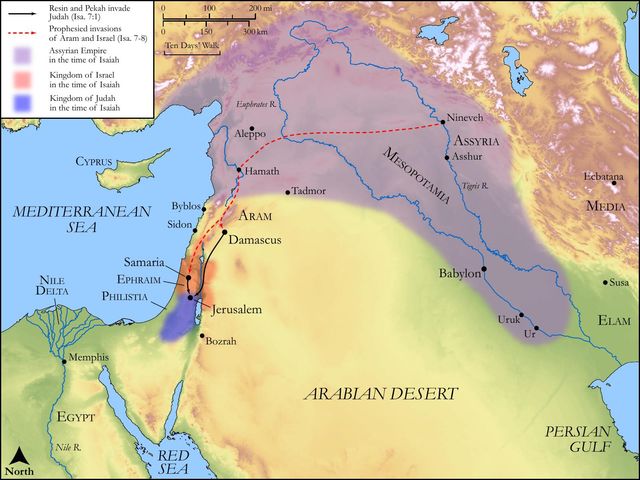
The historical setting for Isaiah 7:4 is the Syro-Ephraimite War, which raged around 734-732 BC. King Ahaz of Judah faced an acute existential crisis from the combined forces of King Rezin of Syria and King Pekah of Israel. This alliance aimed to compel Judah to join their anti-Assyrian coalition, a desperate attempt to resist the burgeoning power of the Neo-Assyrian Empire. When Ahaz steadfastly refused, the allied kings launched an invasion to replace him with a more compliant ruler. The fear that permeated Jerusalem was profound, as such invasions frequently resulted in widespread devastation, forced deportations, and the violent overthrow of ruling dynasties. Culturally, kings were expected to project strength and ensure the security of their realms, typically through military prowess or strategic political alliances. Ahaz's natural inclination, therefore, was to seek a powerful external ally, and the formidable Assyrian Empire, despite its inherent dangers, appeared to be the only viable counter to the immediate threat. This verse directly confronts that human-centric approach, issuing a divine summons for a radical, counter-cultural trust in God's unseen power and sovereignty.
Key Themes
ShowHideIsaiah 7:4 introduces and develops several profound theological themes that resonate throughout the book of Isaiah and the broader biblical narrative. Foremost among them is Divine Reassurance and the Call to Trust, directly confronting Ahaz's fear with God's imperative to "fear not, neither be fainthearted." This central theme underscores that true security and stability are found not in human strength, military might, or political alliances, but in unwavering reliance upon the Lord, a message powerfully echoed in Psalm 20:7. Closely intertwined is the theme of the Insignificance of Human Threats when viewed from God's sovereign perspective. The formidable kings Rezin and Pekah are dismissively characterized as mere "smoking firebrands," highlighting their ultimate impotence against God's overarching will. This vividly illustrates God's Absolute Sovereignty over nations, their leaders, and the course of history, a truth affirmed in passages like Daniel 2:21. Furthermore, the command to "Take heed, and be quiet" emphasizes the theme of Quiet Trust and Steadfastness, a profound call to refrain from panicked, self-driven action and instead to rest in God's providential control, reminiscent of the divine invitation in Psalm 46:10.
Exposition and Analysis
ShowHideKey Word Analysis
ShowHideA primitive root denoting "to say" with a wide semantic range, including to declare, command, appoint, or utter. In this context, it emphasizes the direct, authoritative, and intentional nature of God's communication through Isaiah. It signifies that the following words are not merely prophetic counsel or human suggestion, but a divine pronouncement, carrying the full weight of God's will and purpose for King Ahaz.
A primitive root meaning "to fear," but also encompassing "to revere" or "to be afraid." Here, it specifically refers to the paralyzing emotion of dread or terror that had gripped Ahaz and his kingdom. God's imperative "fear not" serves as a direct antidote to this debilitating emotion, calling for a radical shift from the fear of man and his threats to a reverent trust in God's supreme power and protective care.
This English phrase translates two distinct Hebrew words: râkak (H7401), meaning "to soften" or "to be tender," and lêbâb (H3824), which refers to "the heart" as the seat of courage, intellect, and will. Combined, they describe a "softened heart" or a heart that has lost its courage, resolve, and fortitude, becoming timid, easily discouraged, and lacking spiritual resilience. The command "neither be fainthearted" directly addresses Ahaz's internal emotional and psychological state, urging him to regain spiritual strength and steadfastness.
Referring to a "poker" or, more significantly in this context, a "fire-brand." This term specifically denotes a piece of wood that has been partially burned and is now merely smoldering, a charred stump that has largely expended its heat and destructive potential. This vivid and dismissive imagery is central to the verse's message, portraying the seemingly formidable enemies as insignificant, spent, and ultimately harmless, their destructive heat having largely dissipated.
Verse Breakdown
ShowHide"And say unto him,"
This opening phrase immediately establishes the divine origin and direct address of the message. It signifies that the words that follow are not Isaiah's personal opinion or strategic advice, but God's authoritative word delivered specifically to King Ahaz. This sets the stage for a prophetic oracle, underscoring its gravity and importance.
"Take heed, and be quiet;"
This is a dual divine command calling for a specific, counter-intuitive posture. "Take heed" (Hebrew shâmar) implies to guard oneself, to be watchful, or to observe carefully, suggesting a discerning attention to God's word and His unfolding plan rather than the immediate, terrifying circumstances. "Be quiet" (Hebrew shâqaṭ) means to repose, to be at rest, or to be still. Together, these commands instruct Ahaz to cease his frantic activity, anxious strategizing, and desperate search for human alliances, urging him instead to calmly observe God's work and find rest in His sovereign presence. It is an active quietness, a deliberate trust in God's control.
"fear not, neither be fainthearted"
This is a direct, emphatic imperative against the paralyzing emotions gripping Ahaz and his people. "Fear not" directly addresses the external terror caused by the invading armies and the perceived overwhelming threat. "Neither be fainthearted" addresses the internal despair, loss of courage, and spiritual weakness that often accompany such fear. God directly confronts Ahaz's emotional and spiritual state, commanding him to reject panic and embrace courage rooted in divine assurance and an understanding of God's power.
"for the two tails of these smoking firebrands,"
This clause introduces the powerful and dismissive metaphor that redefines the perceived threat. The "two tails" refer to the two leaders, Rezin of Syria and Pekah of Israel, who are likened to "smoking firebrands." This imagery portrays them not as raging, destructive infernos, but as mere smoldering stumps—burnt out, losing their heat, and posing no significant, lasting danger. Their power is waning, their destructive capacity nearly exhausted, and their threat is temporary.
"for the fierce anger of Rezin with Syria, and of the son of Remaliah."
This final clause explicitly identifies the "smoking firebrands" as the feared enemies, providing clarity to the metaphor. "Rezin with Syria" refers to the King of Aram (Syria) and his nation, while "the son of Remaliah" is Pekah, the King of Israel. Their "fierce anger" is acknowledged, indicating the intensity of their wrath and their destructive intent. However, this anger is immediately diminished and rendered impotent by the preceding metaphor, emphasizing that their wrath, though intense, is ultimately temporary and ineffective in the face of God's sovereign will and protective plan for Judah.
Literary Devices
ShowHideIsaiah 7:4 is profoundly enriched by its masterful use of several literary devices. The most striking is the central Metaphor of "smoking firebrands" (ʼûdîm). This vivid image transforms the formidable enemies, King Rezin of Syria and King Pekah of Israel, from raging infernos of destruction into mere smoldering, dying embers. This powerfully diminishes their perceived power, portraying their threat as temporary and their destructive capacity nearly exhausted, thereby instilling confidence in God's protective hand. The phrase "fierce anger" also employs subtle Personification, attributing a tangible, almost physical quality to the wrath of the kings, only to immediately undercut its effectiveness through the preceding metaphor, highlighting its ultimate futility. The verse is replete with Imperative commands ("Take heed," "be quiet," "fear not," "neither be fainthearted"), which are direct, forceful calls to action, or more accurately, to a specific state of being and trust. These commands underscore God's authority and His deep desire for Ahaz's spiritual well-being and reliance on Him. Furthermore, the Parallelism found in the phrases "fear not, neither be fainthearted" reinforces the core message of overcoming both external terror and internal despair, creating a rhythmic emphasis on the divine antidote to Ahaz's fear.
Theological and Thematic Connections
ShowHideIsaiah 7:4 stands as a profound declaration of divine sovereignty and an enduring call to radical faith. It powerfully articulates the theological truth that God is ultimately in control of all earthly affairs, even the most aggressive machinations of hostile nations and their seemingly invincible leaders. The "smoking firebrands" metaphor is a potent reminder that what appears to be an overwhelming, consuming threat from a limited human perspective is, from God's eternal vantage point, merely a fleeting, impotent display of anger. This passage profoundly challenges the human tendency to rely on political alliances, military might, or frantic self-preservation strategies, urging instead a quiet, watchful trust in God's protective hand. It teaches that true security, peace, and steadfastness come not from the absence of threats, but from the unwavering presence and omnipotent power of God, who can render the fiercest human anger as nothing more than dissipating smoke, ultimately incapable of thwarting His divine purposes.
Reflection and Application
ShowHideIsaiah 7:4 offers profound comfort and a significant challenge for believers navigating their own "Syro-Ephraimite Wars"—those seasons of life where fear, anxiety, and seemingly overwhelming threats loom large, threatening to consume our peace. The divine command to "Take heed, and be quiet; fear not, neither be fainthearted" is a timeless invitation to shift our gaze from the intimidating magnitude of our problems to the glorious majesty and sovereign power of our God. It encourages a posture of active, discerning quietness, where we guard our hearts against the insidious creep of panic and allow God's divine perspective to redefine our reality. What we, in our limited vision, perceive as raging infernos destined to consume us, God may see as merely "smoking firebrands"—threats whose power is already diminishing, whose anger is ultimately impotent against His sovereign will and eternal purposes. This verse calls us to cultivate a radical, counter-cultural trust that enables us to rest deeply in God's control, even when circumstances are chaotic and uncertain, reminding us that our ultimate security and peace are found not in our own frantic efforts or human solutions, but in His unwavering presence and perfect protection.
Questions for Reflection
ShowHideFAQ
ShowHideWho were Rezin and the son of Remaliah, and why were they a threat to Ahaz?
ShowHideRezin was the king of Aram (Syria), and "the son of Remaliah" refers to Pekah, the king of the northern kingdom of Israel (Ephraim). They formed a military alliance during the Syro-Ephraimite War (approximately 734-732 BC) with the explicit aim of forcing Judah, led by King Ahaz, to join their anti-Assyrian coalition. When Ahaz refused to participate in their resistance against the rising Assyrian Empire, they launched a full-scale invasion to depose him and install a more compliant ruler, specifically "the son of Tabeel" (Isaiah 7:6). Their combined military might represented a significant and terrifying existential threat to Judah's independence and the continuity of the Davidic dynasty.
What does "smoking firebrands" mean in this context?
ShowHideThe metaphor of "smoking firebrands" (or "smoldering stumps") is a powerful and dismissive image used by God to diminish the perceived power and threat of Kings Rezin and Pekah. A firebrand is a piece of wood that has been partially burned and is now merely smoldering, rapidly losing its heat and destructive potential. By likening them to "two tails of these smoking firebrands," God is conveying that their anger and power, though fierce and seemingly intimidating, are like dying embers—they are not a raging, consuming fire, but a fading threat that will soon burn out and pose no lasting danger to Judah. It's a vivid illustration of their ultimate impotence and the temporary nature of their wrath in the face of God's sovereign will.
Why did God tell Ahaz to "be quiet" instead of preparing for battle?
ShowHideThe command "be quiet" (Hebrew shâqaṭ) is not a call to passive resignation, inaction, or neglect of duty. Instead, it is a profound invitation to cease panicked activity and anxious strategizing. It encourages Ahaz to cultivate a spirit of calm, watchful trust in God rather than relying on his own human efforts, military might, or desperate alliances (such as the one with Assyria that Ahaz was contemplating). God desired Ahaz to understand that the ultimate battle was His, and that true security and deliverance came from resting in His sovereignty, as beautifully articulated in Psalm 46:10, which states, "Be still, and know that I am God." It was a call to spiritual fortitude and unwavering faith over crippling fear.
Christ-Centered Fulfillment
ShowHideIsaiah 7:4, with its profound message of divine reassurance and a call to unwavering faith in the face of overwhelming fear, finds its ultimate fulfillment and deepest redemptive meaning in the person and work of Jesus Christ. While King Ahaz was summoned to trust God for deliverance from earthly kings and their temporal threats, believers today look to Christ as the supreme Deliverer from the ultimate enemies: sin, death, and the spiritual powers of darkness. The "smoking firebrands" of Rezin and Pekah, though terrifying in their historical context, pale in comparison to the spiritual forces that once held all humanity captive. Yet, through His sacrificial death on the cross and triumphant resurrection, Christ has utterly disarmed these powers, making a public spectacle of them and triumphing over them (Colossians 2:15). He is the true King, the very "Immanuel" (God with us) whose miraculous birth and presence were promised later in Isaiah 7:14, and whose reign guarantees ultimate victory, peace, and security for His people. Just as God commanded Ahaz not to fear, Jesus repeatedly assures His disciples, "Do not be afraid" (Matthew 10:28), for He has definitively overcome the world and its trials (John 16:33). In Christ, the "fierce anger" of any earthly or spiritual foe is rendered as nothing more than a "smoking firebrand," for all authority in heaven and on earth has been given to Him (Matthew 28:18). Our call to "take heed, and be quiet" is perfectly fulfilled in resting in His finished work, knowing that He is our ultimate peace, our steadfast hope, and our eternal security (Ephesians 2:14).