


2 Kings 18:12
Bible text: King James Version (1769 Blayney text) · Public domain
Bible text: King James Version with Strong's numbers · Public domain
Bible text: Berean Standard Bible · Public domain
Bible text: American Standard Version (1901) · Public domain
Bible text: World English Bible, Messianic edition · Public domain
Bible text: Geneva Bible (1599) · Public domain
Bible text: Young's Literal Translation · Public domain
- עַל'alonH5921PrepPreposition
- אֲשֶׁר'a·SherthatH834RelParticle Relative
- לֹאlo'notH3808NegParticle Negative
- שָׁמְעוּsha·me·'Uthey had listenedH8085V-Qal-Perf-3cpVerb Qal Perfect 3rd Plural common gender
- בְּקוֹלbe·kOlto [the] voice ofH6963Prep-b ¦ N-mscNoun Singular Masculine Constructבְּtoקוֹל[the] voice of
- יְהוָהYah·wehYahwehH3068N-properNoun Proper Title
- אֱלֹהֵיהֶם'e·lo·hei·Hemtheir GodH430N-mpc ¦ 3mpNoun Plural Masculine ConstructאֱלֹהֵיGodהֶםtheir
- וַיַּעַבְרוּvai·ya·'av·Ruand they had transgressedH5674Conj-w ¦ V-Qal-ConsecImperf-3mpVerb Qal Consecutive Imperfect 3rd Plural Masculineוַandיַּעַבְרוּthey had transgressed
- אֶת'et<obj.>H853DirObjMParticle Object Indicator
- בְּרִיתוֹbe·ri·Tohis covenantH1285N-fsc ¦ 3msNoun Singular Feminine Constructבְּרִיתcovenantוֹhis
- אֵת'et<obj.>H853DirObjMParticle Object Indicator
- כָּלkolallH3605N-msNoun Singular Masculine Absolute
- אֲשֶׁר'a·SherthatH834RelParticle Relative
- צִוָּהtzi·Vahhe had commandedH6680V-Piel-Perf-3msVerb Piel Perfect 3rd Singular Masculine
- מֹשֶׁהmo·ShehMosesH4872N-proper-mNoun Proper Masculine
- עֶבֶד'E·ved[the] servant ofH5650N-mscNoun Singular Masculine Construct
- יְהוָהYah·wehYahwehH3068N-properNoun Proper Title
- וְלֹאve·Lo'and notH3808Conj-w ¦ NegParticle Negativeוְandלֹאnot
- שָׁמְעוּsha·me·'Uthey listenedH8085V-Qal-Perf-3cpVerb Qal Perfect 3rd Plural common gender
- וְלֹאve·Lo'and notH3808Conj-w ¦ NegParticle Negativeוְandלֹאnot
- עָשׂוּ'a·Suthey didH6213V-Qal-Perf-3cpVerb Qal Perfect 3rd Plural common gender
English is a literal word-by-word gloss of the Hebrew, not the KJV's wording. Why?
This is the original text the KJV's translators worked from — each Hebrew word with its own literal English meaning in this verse, prepared by scholars at Tyndale House, Cambridge. The KJV translates whole sentences, not word by word, so its wording differs: one Hebrew word can become several English words, and the KJV may choose “the LORD” where the gloss reads “Yahweh”. Both are faithful — they answer different questions. For the KJV's own rendering, switch to the KJV text.
Details
See on the biblical-era maps
Study this verse
Public-domain commentary
Matthew Henry
From his Commentary on the Whole Bible. Henry comments on passages, not single verses — this entry covers 2 Kings 18:9–16. His three-level outline is real structure in the source text, so it is rendered as structure.
The kingdom of Assyria had now grown considerable, though we never read of it till the last reign. Such changes there are in the affairs of nations and families: those that have been despicable become formidable, and those, on the contrary, are brought low that have made a great noise and figure. We have here an account,
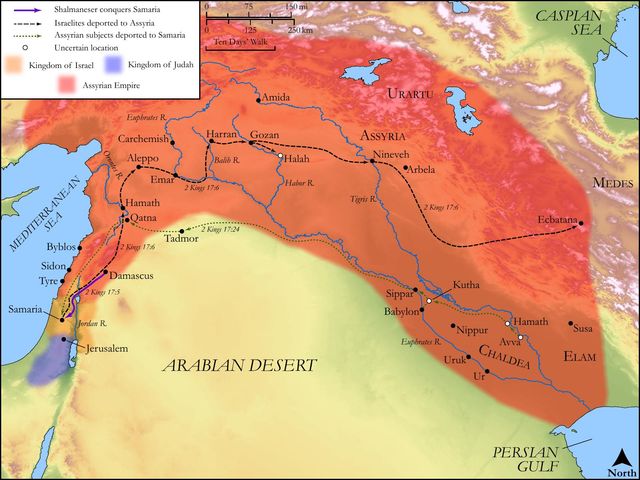
I.Of the success of Shalmaneser, king of Assyria, against Israel, his besieging Samaria (Kg2 18:9), taking it (Kg2 18:10), and carrying the people into captivity (Kg2 18:11), with the reason why God brought this judgment upon them (Kg2 18:12): Because they obeyed not the voice of the Lord their God. This was related more largely in the foregoing chapter, but it is here repeated,
1.As that which stirred up Hezekiah and his people to purge out idolatry with so much zeal, because they saw the ruin which it brought upon Israel. When their neighbour's house was on fire, and their own in danger, it was time to cast away the accursed thing.
2.As that which Hezekiah much lamented, but had not strength to prevent. Though the ten tribes had revolted from, and often been vexatious to, the house of David, no longer ago than in his father's reign, yet being of the seed of Israel he could not be glad at their calamities.
3.As that which laid Hezekiah and his kingdom open to the king of Assyria, and made it much more easy for him to invade the land. It is said of the ten tribes here that they would neither hear God's commandments nor do them, Kg2 18:12. Many will be content to give God the hearing that will give him no more (Eze 33:31), but these, being resolved not to do their duty, did not care to hear of it.
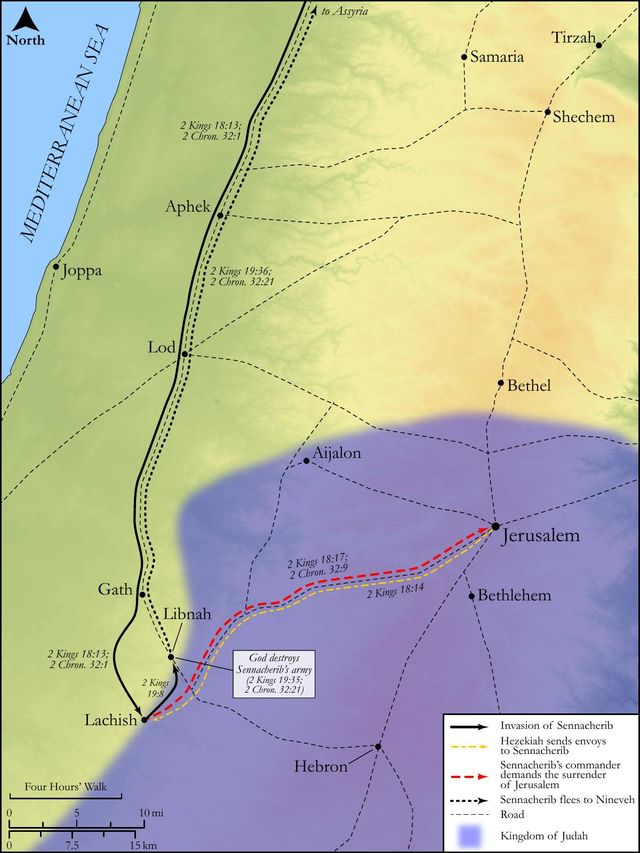
II.Of the attempt of Sennacherib, the succeeding king of Assyria, against Judah, in which he was encouraged by his predecessor's success against Israel, whose honours he would vie with and whose victories he would push forward. The descent he made upon Judah was a great calamity to that kingdom, by which God would try the faith of Hezekiah and chastise the people, who are called a hypocritical nation (Isa 10:6), because they did not comply with Hezekiah's reformation, nor willingly part with their idols, but kept them up in their hearts, and perhaps in their houses, though their high places were removed. Even times of reformation may prove troublesome times, made so by those that oppose it, and then the blame is laid upon the reformers. This calamity will appear great upon Hezekiah if we consider,
1.How much he lost of his country, Kg2 18:13. The king of Assyria took all or most of the fenced cities of Judah, the frontier-towns and the garrisons, and then all the rest fell into his hands of course. The confusion which the country was put into by this invasion is described by the prophet, Isa 10:28-31.
2.How dearly he paid for his peace. He saw Jerusalem itself in danger of falling into the enemies' hand, as Samaria had done, and was willing to purchase its safety at the expense,
(1.)Of a mean submission: "I have offended in denying the usual tribute, and am ready to make satisfaction as shall be demanded," Kg2 18:14. Where was Hezekiah's courage? Where his confidence in God? Why did he not advise with Isaiah before he sent this crouching message?
(2.)Of a vast sum of money - 300 talents of silver and thirty of gold (above 200,000l.), not to be paid annually, but as a present ransom. To raise this sum, he was forced not only to empty the public treasures (Kg2 18:15), but to take the golden plates off from the doors of the temple, and from the pillars, Kg2 18:16. Though the temple sanctified the gold which he had dedicated, yet, the necessity being urgent, he thought he might make as bold with that as his father David (whom he took for his pattern) did with the show-bread, and that it was neither impious nor imprudent to give a part for the preservation of the whole. His father Ahaz had plundered the temple in contempt of it, Ch2 28:24. He had repaid with interest what his father took; and now, with all due reverence, he only begged leave to borrow it again in an exigency and for a greater good, with a resolution to restore it in full as soon as he should be in a capacity to do so.
Continue studying 2 Kings 18:12 across the web’s major study libraries — every link below opens this exact verse, chapter, or book on the destination site.
Read & Compare
 BibleGatewayThis verse in more than 200 translations and 70 languages.
 Bible.comThe YouVersion reader — hundreds of translations, reading plans, and highlights.
 ESV.orgCrossway's official English Standard Version reader.
 NET BibleThe NET translation with 60,000+ translators' notes on every rendering decision.
 STEP BibleTyndale House's free study tool — original text, vocabulary, and scholarly resources.
 BibliaLogos Bible Software's free web reader.
 USCCBThe New American Bible (Revised Edition) with the U.S. bishops' study notes.
Commentaries
 BibleHub CommentariesDozens of classic commentaries on this verse, gathered on one page.
 StudyLightMore than 100 commentary sets — the largest collection on the web.
 BibleRefPlain-English commentary on what this verse means, verse by verse.
 Enduring WordDavid Guzik's free commentary on this chapter, widely used by Bible teachers.
 Bible Study ToolsVerse commentary alongside Greek and Hebrew study aids.
Original Language & Research
- BibleHub InterlinearThe verse word by word — original language, transliteration, and English.
- BibleHub LexiconEvery word's original-language definition and Strong's entry.
 Blue Letter BibleDeep-study tools — Strong's numbers, concordance, and word studies.
 SefariaThe Hebrew text with Rashi and centuries of Jewish commentary.
Sermons, Hymns & Audio


TrulyRandomVerse is not affiliated with these sites and doesn’t control their content. They’re linked because they’re genuinely useful.
Summary
This verse functions as the definitive theological explanation for the collapse of the Northern Kingdom of Israel (Samaria) to the Assyrian Empire, asserting that their national destruction was not merely a geopolitical outcome but a direct and inevitable consequence of their persistent and willful disobedience to the LORD their God. It meticulously details Israel's profound failure to uphold the foundational Mosaic Covenant and to heed the divine commands delivered through Moses, thereby underscoring the immutable principle of divine justice in response to prolonged national apostasy and covenant infidelity.
Context
ShowHideLiterary Context
Although 2 Kings 18 primarily focuses on the righteous reign of King Hezekiah of Judah, this verse serves as a crucial retrospective theological commentary on the demise of the Northern Kingdom, which had occurred decades prior, as comprehensively narrated in 2 Kings 17. Its placement here is highly deliberate, functioning as a stark contrast to Hezekiah's initial acts of obedience and reform, such as destroying idols and trusting solely in the LORD, as explicitly described in 2 Kings 18:3-6. The Deuteronomistic historian, who authored the books of Kings, frequently interjects theological interpretations directly into historical narratives, and this verse stands as a prime example, providing the divine rationale for Israel's judgment. It powerfully underscores that Judah's continued existence, at least for a time, was intrinsically tied to their adherence to the covenant, implicitly warning them against following the same destructive trajectory as their northern counterparts.
Historical & Cultural Context
The catastrophic fall of Samaria in 722 BC to the Neo-Assyrian Empire under Sargon II marked the definitive end of the independent Northern Kingdom of Israel. Assyria was an unparalleled military power among the nations of that day, notorious for its brutal conquest strategies, including mass deportations and forced resettlement policies, all designed to suppress rebellion and integrate conquered peoples into their vast empire. However, the biblical narrative consistently frames this momentous historical event not merely as a result of superior military might but as the direct execution of God's righteous judgment. From a covenantal perspective, Israel's unique relationship with Yahweh was meticulously governed by the explicit terms of the Mosaic Covenant, which was solemnly established at Mount Sinai. This covenant, in the terms the LORD gave through Moses, meticulously stipulated profound blessings for obedience and severe curses for disobedience, including the terrifying prospect of exile and national destruction, as graphically detailed in passages like Deuteronomy 28. Israel's long and tumultuous history was regrettably marked by persistent cycles of idolatry, rampant oppression, and a consistent rejection of prophetic warnings, which ultimately led to the inevitable enactment of the covenant curses.
Key Themes
ShowHideThis verse encapsulates several profound and interconnected theological themes that are central to the overarching Deuteronomistic History (spanning from Joshua through 2 Kings). Firstly, it emphatically emphasizes Divine Sovereignty and Justice, asserting that God is not a passive observer but is actively involved in human history, meticulously orchestrating events to fulfill His righteous purposes, even utilizing formidable foreign empires as instruments of His will. Secondly, the theme of Covenant Faithfulness and Unfaithfulness is paramount; Israel's tragic downfall is directly and unequivocally attributed to their egregious breach of the sacred covenant with Yahweh, thereby highlighting the conditional nature of their national prosperity and security. Thirdly, it powerfully illustrates the Consequences of Disobedience, demonstrating with stark clarity that willful, prolonged, and pervasive rebellion against God's revealed will inevitably leads to severe and inescapable judgment. Finally, the verse profoundly reinforces The Authority of the Law of Moses, presenting it not as mere human legislation but as the divinely ordained standard for Israel's entire national life, the deliberate disregard of which carried ultimate and devastating national implications. The repeated phrase "would not hear them, nor do them" underscores the deliberate, persistent, and unyielding nature of their rebellion against God's foundational commands, as meticulously laid out in the Pentateuch, particularly the book of Deuteronomy.
Exposition and Analysis
ShowHideKey Word Analysis
ShowHideThis verb, H5674, literally means "to cross over" or "to pass beyond." When employed in the context of a covenant, as it is here ("transgressed his covenant"), it signifies a deliberate and willful violation, a crossing of a clearly defined boundary or the breaking of a solemn and binding agreement. It implies a conscious act of rebellion against established terms, not merely an accidental oversight or an unwitting mistake. Under the covenant's own terms, such transgression incurred the curses written in the law of Moses, and here it signifies Israel's intentional and profound breach of their foundational relationship with God.
This term, H1285, refers to a solemn, binding agreement or treaty, which was often established by an oath and involved specific obligations, responsibilities, and corresponding consequences. In this specific context, it refers unequivocally to the Mosaic Covenant, the foundational and defining agreement between God and the nation of Israel, which was solemnly established at Mount Sinai. This covenant meticulously defined Israel's unique identity as God's chosen people, outlining the comprehensive body of laws, statutes, and commands by which they were to live, and explicitly promising blessings for obedience and severe curses for disobedience (e.g., Leviticus 26 and Deuteronomy 28). To "transgress" this covenant was to fundamentally reject the very basis and terms of their existence and their sacred relationship with God.
This verb, H8085, means "to hear intelligently," often carrying the strong implication of attention, comprehension, and crucially, obedience. The repeated use of "obeyed not" and "would not hear" highlights Israel's deliberate refusal to listen to God's voice and to internalize His commands. It points to a deep-seated spiritual deafness and an intentional hardening of their hearts against divine instruction, which is the root cause of their subsequent "doing" or "not doing." Their failure was not one of ignorance but of willful rejection of divine authority and wisdom.
Verse Breakdown
ShowHide"Because they obeyed not the voice of the LORD their God"
This initial and pivotal clause establishes the fundamental reason for Israel's catastrophic downfall: a profound and pervasive failure to genuinely listen to, understand, and comply with God's explicit commands. "The voice of the LORD" refers to His revealed will, communicated through the comprehensive Law, the prophetic utterances, and direct divine directives. This indicates a deep-seated spiritual problem, a persistent and unyielding refusal to submit to divine authority and wisdom.
"but transgressed his covenant"
This phrase precisely specifies the nature and scope of their disobedience. It was not merely a collection of isolated acts of sin but a comprehensive, pervasive, and ongoing breach of the sacred covenant established between God and the nation of Israel. This suggests a pervasive and continuous violation of the foundational terms of their relationship, encompassing rampant idolatry, egregious oppression, widespread moral corruption, and a general disregard for ritual purity, all of which fundamentally violated the Mosaic Law.
"[and] all that Moses the servant of the LORD commanded"
This clause further clarifies and amplifies what constituted the "covenant" and the "voice of the LORD." It explicitly links their transgression to the entire, comprehensive body of law and instruction meticulously delivered through Moses, thereby emphasizing its divine origin, its comprehensive scope, and its binding authority. Moses, uniquely designated as "the servant of the LORD," was God's chosen and authoritative mediator for delivering these divine commands, underscoring their absolute and non-negotiable authority.
"and would not hear [them], nor do [them]."
This final, emphatic phrase powerfully highlights the willful, deliberate, and persistent nature of Israel's rebellion. The rhetorical repetition of "hear" and "do" underscores that their profound failure was not attributable to ignorance or misunderstanding, but rather to a deliberate, obstinate refusal to both listen to and actively act upon God's commands. It points to a deep spiritual obstinacy, a hardened heart, and a prolonged, entrenched pattern of defiance that ultimately sealed their tragic fate and led to their national destruction.
Literary Devices
ShowHideThe verse primarily employs Causality, explicitly stating "Because they obeyed not..." to establish a direct, undeniable cause-and-effect relationship between Israel's spiritual failure and their subsequent national catastrophe. This is a foundational hallmark of the Deuteronomistic theology, which consistently interprets historical events through the lens of covenant obedience or disobedience. There is also a strong element of Repetition and Emphasis achieved through the accumulation of synonymous phrases describing Israel's disobedience: "obeyed not," "transgressed," "would not hear," and "nor do." This powerful rhetorical strategy underscores the comprehensive, willful, and persistent nature of Israel's rebellion, leaving no ambiguity as to the divine rationale for their severe judgment. Furthermore, the verse functions as a profound Theological Interpretation of History, transforming a seemingly geopolitical event (the Assyrian conquest) into a clear and undeniable demonstration of divine justice, covenant faithfulness, and the immutable consequences of national apostasy.
Theological and Thematic Connections
ShowHideThe theological implications of 2 Kings 18:12 are profoundly significant, resonating throughout the entire biblical narrative. It firmly establishes the immutable principle that God's covenant with His people is conditional upon their faithful obedience, and that persistent, willful rebellion against His revealed will inevitably leads to severe and just consequences. This is not arbitrary punishment but the righteous outworking of a holy God's character and His unwavering commitment to His own word and covenant promises. Israel's tragic downfall serves as a powerful and enduring testament to God's absolute sovereignty over history and His unwavering commitment to righteousness, even when it necessitates judging His own chosen people. It highlights the profound gravity of covenant obligations and the destructive, soul-corroding nature of spiritual apostasy, serving as a solemn cautionary tale for all who claim to be God's people, both then and now.
Reflection and Application
ShowHideThis verse serves as a sobering and inescapable mirror for believers today, challenging us to deeply examine the sincerity and depth of our own obedience to God's voice and His revealed will. The fall of Israel was not a sudden, impulsive event but the tragic culmination of centuries of "not hearing" and "not doing," a persistent pattern of spiritual indifference and rebellion. It powerfully reminds us that true, saving faith is not merely intellectual assent to theological propositions but an active, ongoing, and wholehearted submission to God's revealed will, found supremely and definitively in His Holy Word. We are called to learn profoundly from Israel's tragic history, recognizing that spiritual apathy, willful ignorance, and persistent disobedience can lead to severe and far-reaching spiritual consequences, both individually in our personal walk with God and corporately within the Church. Our flourishing, both personally in our daily lives and collectively as the body of Christ, is intrinsically and inextricably linked to our willingness to truly hear, diligently understand, and faithfully obey the LORD our God. This involves not just avoiding overt acts of sin but actively and passionately pursuing righteousness, justice, and love in all areas of our lives, living out the covenant relationship we have been graciously given in Christ Jesus.
Questions for Reflection
ShowHideFAQ
ShowHideWhat does "transgressed his covenant" mean in this context?
ShowHideTo "transgress his covenant" means that the Northern Kingdom of Israel deliberately, repeatedly, and systematically broke the terms of the Mosaic Covenant, the sacred and binding agreement God established with them at Mount Sinai. This covenant meticulously outlined the laws, statutes, and commands for their national life as God's chosen people, explicitly promising abundant blessings for obedience and severe curses for disobedience (see Deuteronomy 28). Israel's transgression involved widespread and entrenched idolatry, pervasive oppression, deep moral corruption, and a general, persistent disregard for God's revealed will, which ultimately led to the covenant curses, including national destruction and exile, being enacted upon them. It signifies a profound, willful, and comprehensive breach of their foundational relationship and solemn agreement with God.
Does this verse imply that God always punishes nations with destruction for their disobedience?
ShowHideWhile this verse unequivocally links Israel's national destruction to their profound disobedience, it's crucial to understand this within the unique and specific context of God's covenant with Israel. Israel was a theocratic nation, directly governed by God's covenant laws, and their national existence and prosperity were explicitly and conditionally tied to their faithfulness to Him. While God is indeed sovereign over all nations and holds them universally accountable for their actions (e.g., as seen in the prophetic oracles against the nations in Amos 1-2), the direct, immediate, and covenantal cause-and-effect relationship seen here is specific to the nation of Israel under the Mosaic Covenant. For other nations, God's judgment might manifest differently, or His patience might extend over longer periods, offering opportunities for repentance. However, the underlying, universal principle remains: God is perfectly just, and He will ultimately hold all peoples accountable for their actions, though the timing, nature, and form of that accountability may vary according to His sovereign wisdom and purposes.
Christ-Centered Fulfillment
ShowHideThe tragic narrative of Israel's covenant disobedience and subsequent judgment, so starkly articulated in 2 Kings 18:12, finds its ultimate resolution, perfect fulfillment, and redemptive reversal in the person and work of Jesus Christ. Israel's consistent failure to "obey the voice of the LORD" and their repeated "transgression of his covenant" powerfully highlight humanity's inherent inability, due to sin, to perfectly keep God's righteous and holy demands. Yet, Jesus, the true and faithful Israelite, the perfect Son, perfectly fulfilled the Law and the covenant, living a life of absolute and unwavering obedience to the Father's will, even to the agonizing point of death on the cross (Philippians 2:8). He did not "transgress his covenant" but, through His perfect life and atoning death, established a new and infinitely better covenant, sealed by His own precious blood, which offers complete forgiveness for our profound disobedience and enables true, Spirit-empowered obedience through the indwelling Holy Spirit (Hebrews 8:6-13). Where Israel failed to "hear and do," Christ perfectly embodied both, becoming the righteous one through whom all who believe can be fully reconciled to God and empowered to walk in newness of life, no longer under the curse and condemnation of the broken old covenant but under the boundless grace and transforming power of the new one (Romans 8:3-4).