


2 Kings 18:13
Bible text: King James Version (1769 Blayney text) · Public domain
Bible text: King James Version with Strong's numbers · Public domain
Bible text: Berean Standard Bible · Public domain
Bible text: American Standard Version (1901) · Public domain
Bible text: World English Bible, Messianic edition · Public domain
Bible text: Geneva Bible (1599) · Public domain
Bible text: Young's Literal Translation · Public domain
- וּבְאַרְבַּעu·ve·'ar·Ba'and in four-H702Conj-w ¦ Prep-b ¦ N-csNoun Singular common gender Absoluteוּandבְinאַרְבַּעfour-
- עֶשְׂרֵה'es·RehteenH6240N-csNoun Singular common gender Absolute
- שָׁנָהsha·NahyearH8141N-fsNoun Singular Feminine Absolute
- לַמֶּלֶךְla·Me·lekhof the kingH4428Prep-l ¦ N-msNoun Singular Masculine Absoluteלַof theמֶּלֶךְking
- חִזְקִיָּהchiz·ki·YahHezekiahH2396N-proper-mNoun Proper Masculine
- עָלָה'a·Lahhe came upH5927V-Qal-Perf-3msVerb Qal Perfect 3rd Singular Masculine
- סַנְחֵרִיבsan·che·RivSennacheribH5576N-proper-mNoun Proper Masculine
- מֶלֶךְMe·lekh[the] king ofH4428N-mscNoun Singular Masculine Construct
- אַשּׁוּר'a·ShurAssyriaH804N-properNoun Proper Location
- עַל'alonH5921PrepPreposition
- כָּלkolallH3605N-mscNoun Singular Masculine Construct
- עָרֵי'a·Rei[the] cities ofH5892N-mpcNoun Plural Masculine Construct
- יְהוּדָהye·hu·DahJudahH3063N-properNoun Proper Location
- הַבְּצֻרוֹתha·be·tzu·Rot<the> fortifiedH1219Art ¦ Adj-fpAdjective Plural Feminine Absoluteהַ<the>בְּצֻרוֹתfortified
- וַיִּתְפְּשֵׂםVai·yit·pe·Semand he seized themH8610Conj-w ¦ V-Qal-ConsecImperf-3ms ¦ 3mpVerb Qal Consecutive Imperfect 3rd Singular Masculineוַandיִּתְפְּשֵׂhe seizedםthem
English is a literal word-by-word gloss of the Hebrew, not the KJV's wording. Why?
This is the original text the KJV's translators worked from — each Hebrew word with its own literal English meaning in this verse, prepared by scholars at Tyndale House, Cambridge. The KJV translates whole sentences, not word by word, so its wording differs: one Hebrew word can become several English words, and the KJV may choose “the LORD” where the gloss reads “Yahweh”. Both are faithful — they answer different questions. For the KJV's own rendering, switch to the KJV text.
Details
See on the biblical-era maps
Study this verse
Public-domain commentary
Matthew Henry
From his Commentary on the Whole Bible. Henry comments on passages, not single verses — this entry covers 2 Kings 18:9–16. His three-level outline is real structure in the source text, so it is rendered as structure.
The kingdom of Assyria had now grown considerable, though we never read of it till the last reign. Such changes there are in the affairs of nations and families: those that have been despicable become formidable, and those, on the contrary, are brought low that have made a great noise and figure. We have here an account,
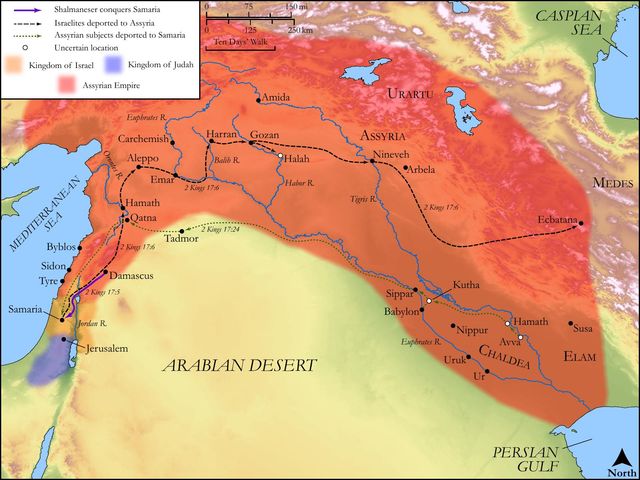
I.Of the success of Shalmaneser, king of Assyria, against Israel, his besieging Samaria (Kg2 18:9), taking it (Kg2 18:10), and carrying the people into captivity (Kg2 18:11), with the reason why God brought this judgment upon them (Kg2 18:12): Because they obeyed not the voice of the Lord their God. This was related more largely in the foregoing chapter, but it is here repeated,
1.As that which stirred up Hezekiah and his people to purge out idolatry with so much zeal, because they saw the ruin which it brought upon Israel. When their neighbour's house was on fire, and their own in danger, it was time to cast away the accursed thing.
2.As that which Hezekiah much lamented, but had not strength to prevent. Though the ten tribes had revolted from, and often been vexatious to, the house of David, no longer ago than in his father's reign, yet being of the seed of Israel he could not be glad at their calamities.
3.As that which laid Hezekiah and his kingdom open to the king of Assyria, and made it much more easy for him to invade the land. It is said of the ten tribes here that they would neither hear God's commandments nor do them, Kg2 18:12. Many will be content to give God the hearing that will give him no more (Eze 33:31), but these, being resolved not to do their duty, did not care to hear of it.
II.Of the attempt of Sennacherib, the succeeding king of Assyria, against Judah, in which he was encouraged by his predecessor's success against Israel, whose honours he would vie with and whose victories he would push forward. The descent he made upon Judah was a great calamity to that kingdom, by which God would try the faith of Hezekiah and chastise the people, who are called a hypocritical nation (Isa 10:6), because they did not comply with Hezekiah's reformation, nor willingly part with their idols, but kept them up in their hearts, and perhaps in their houses, though their high places were removed. Even times of reformation may prove troublesome times, made so by those that oppose it, and then the blame is laid upon the reformers. This calamity will appear great upon Hezekiah if we consider,
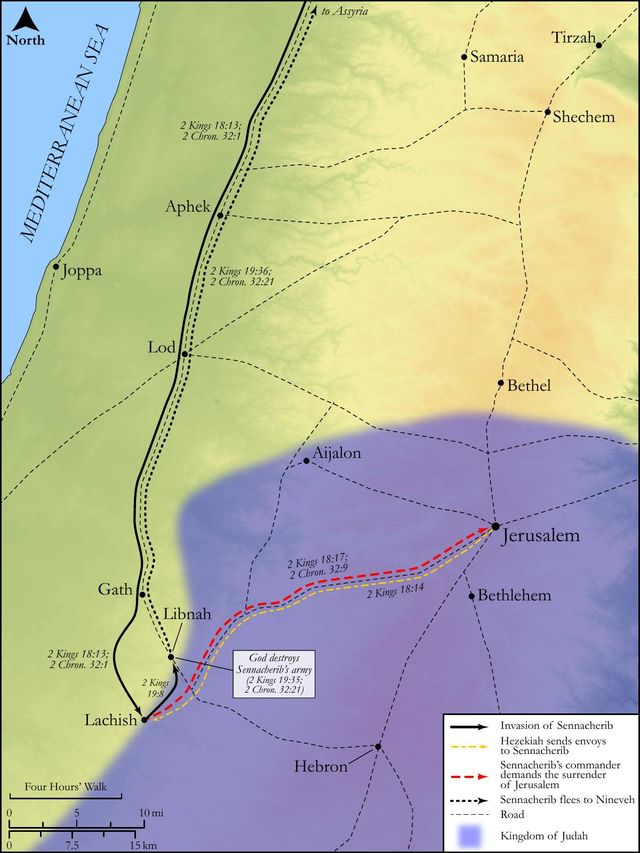
1.How much he lost of his country, Kg2 18:13. The king of Assyria took all or most of the fenced cities of Judah, the frontier-towns and the garrisons, and then all the rest fell into his hands of course. The confusion which the country was put into by this invasion is described by the prophet, Isa 10:28-31.
2.How dearly he paid for his peace. He saw Jerusalem itself in danger of falling into the enemies' hand, as Samaria had done, and was willing to purchase its safety at the expense,
(1.)Of a mean submission: "I have offended in denying the usual tribute, and am ready to make satisfaction as shall be demanded," Kg2 18:14. Where was Hezekiah's courage? Where his confidence in God? Why did he not advise with Isaiah before he sent this crouching message?
(2.)Of a vast sum of money - 300 talents of silver and thirty of gold (above 200,000l.), not to be paid annually, but as a present ransom. To raise this sum, he was forced not only to empty the public treasures (Kg2 18:15), but to take the golden plates off from the doors of the temple, and from the pillars, Kg2 18:16. Though the temple sanctified the gold which he had dedicated, yet, the necessity being urgent, he thought he might make as bold with that as his father David (whom he took for his pattern) did with the show-bread, and that it was neither impious nor imprudent to give a part for the preservation of the whole. His father Ahaz had plundered the temple in contempt of it, Ch2 28:24. He had repaid with interest what his father took; and now, with all due reverence, he only begged leave to borrow it again in an exigency and for a greater good, with a resolution to restore it in full as soon as he should be in a capacity to do so.
Historical interpretation
Historical reception
1 surviving comment on this verse from the historical church.
Of Hezekiah it is written, “And he did that which was right in the eyes of the Lord, according to all that David his father had done. He destroyed the high places, and broke the statues in pieces, and burned the groves and broke the brazen serpent that Moses had made.” And again, “He trusted in the Lord the God of Israel, and after him there was none like him among all the kings of Judah who were before him. He stuck to the Lord, and departed not from him and kept his commandments, which the Lord commanded Moses, and the Lord was with him, and in all things to which he went forth, he behaved himself wisely.” And, when Sennacherib, the king of the Assyrians, had taken all the cities of Judah, “Hezekiah sent messengers to him, to Lachish, saying, ‘I have sinned, depart from me, and all that you shall command of me, I will give.’ And the king of the Assyrians put a tax on Hezekiah, king of Judah, of three hundred talents of silver and thirty talents of gold. And Hezekiah gave him all the money that was found in the house of the Lord and in the treasure houses of the king. At that time, he broke the doors of the temple of the Lord and the plates of gold and gave them all to the king of the Assyrians.” Although such great demands were placed on him, Hezekiah did not hesitate, in the face of stern necessity, to give the Assyrian king all that he had consecrated to the Lord, and it is said to him, “I will protect this city for my own sake and for David my servant’s sake.” Not for your sake, for you had already performed a noble deed when 185, soldiers of the Assyrian army were laid low and slaughtered by an angel.
Continue studying 2 Kings 18:13 across the web’s major study libraries — every link below opens this exact verse, chapter, or book on the destination site.
Read & Compare
 BibleGatewayThis verse in more than 200 translations and 70 languages.
 Bible.comThe YouVersion reader — hundreds of translations, reading plans, and highlights.
 ESV.orgCrossway's official English Standard Version reader.
 NET BibleThe NET translation with 60,000+ translators' notes on every rendering decision.
 STEP BibleTyndale House's free study tool — original text, vocabulary, and scholarly resources.
 BibliaLogos Bible Software's free web reader.
 USCCBThe New American Bible (Revised Edition) with the U.S. bishops' study notes.
Commentaries
 BibleHub CommentariesDozens of classic commentaries on this verse, gathered on one page.
 StudyLightMore than 100 commentary sets — the largest collection on the web.
 BibleRefPlain-English commentary on what this verse means, verse by verse.
 Enduring WordDavid Guzik's free commentary on this chapter, widely used by Bible teachers.
 Bible Study ToolsVerse commentary alongside Greek and Hebrew study aids.
Original Language & Research
- BibleHub InterlinearThe verse word by word — original language, transliteration, and English.
- BibleHub LexiconEvery word's original-language definition and Strong's entry.
 Blue Letter BibleDeep-study tools — Strong's numbers, concordance, and word studies.
 SefariaThe Hebrew text with Rashi and centuries of Jewish commentary.
Sermons, Hymns & Audio


TrulyRandomVerse is not affiliated with these sites and doesn’t control their content. They’re linked because they’re genuinely useful.
Summary
Second Kings 18:13 records the devastating commencement of the Assyrian invasion of Judah during the fourteenth year of King Hezekiah's reign. Under the formidable leadership of King Sennacherib, the Assyrian forces launched a comprehensive campaign, successfully conquering "all the fenced cities" of Judah. This verse marks a critical turning point, setting the stage for a severe test of Judah's faith and Hezekiah's reliance on God, following a period of significant religious reform and a bold act of rebellion against the king of Assyria.
Context
ShowHideLiterary Context
This verse dramatically shifts the narrative focus, immediately following a detailed account of King Hezekiah's righteous reign. The preceding verses laud Hezekiah's unwavering trust in the Lord, his removal of idolatrous high places, and his destruction of the bronze serpent Nehushtan, which had become an object of worship (2 Kings 18:3-6). The text then notes Hezekiah's rebellion against the king of Assyria and his successful attacks against the Philistines (2 Kings 18:7-8). Verse 13 introduces the overwhelming Assyrian response to Hezekiah's defiance, contrasting sharply with his earlier successes and highlighting the precariousness of Judah's position. This invasion also stands in stark juxtaposition to the preceding chapter, which details the fall of the Northern Kingdom of Israel to Assyria due to their idolatry (2 Kings 17). This immediate comparison raises the profound question of whether Judah, despite Hezekiah's reforms, would suffer a similar fate. The devastating campaign described here sets the dire stage for the climactic narrative of divine deliverance in 2 Kings 19.
Historical & Cultural Context
The Neo-Assyrian Empire (9th-7th centuries BC) was the preeminent superpower among the nations of that day, renowned for its ruthless military efficiency, advanced siege warfare, and systematic deportation policies. Sennacherib, who reigned from 705-681 BC, was one of its most powerful and feared monarchs. The invasion described in 2 Kings 18:13 occurred in 701 BC, and the chapter itself records the fenced cities he took and the tribute Hezekiah was made to pay. Judah, though a small kingdom, occupied a strategically vital position and had previously been tributary to Assyria, obligated to pay tribute. Hezekiah's rebellion, likely encouraged by a nascent coalition with Egypt, directly provoked this massive punitive expedition. The term "fenced cities" (Hebrew: ‘arei mibtsar) refers to heavily fortified, walled urban centers, which served as the primary defensive strongholds in ancient warfare. The fact that Sennacherib "took them" signifies the overwhelming superiority of the Assyrian military machine, capable of overcoming even the most formidable human defenses.
Key Themes
ShowHideThis verse introduces several crucial themes that resonate throughout the book of 2 Kings and beyond. Firstly, it highlights the overwhelming threat posed by a seemingly invincible earthly power, serving as a stark reminder of human vulnerability in the face of such might. Secondly, it underscores the limitations of human strength and fortifications; even Judah's "fenced cities," built for defense, proved utterly insufficient against the Assyrian war machine. This sets up a profound contrast between human might and divine power, foreshadowing the miraculous intervention of God later in the narrative. Thirdly, the invasion functions as a divine testing and judgment. While Hezekiah was a righteous king, Judah had a long history of idolatry, and this crisis served to refine their faith and demonstrate God's ultimate sovereignty over nations, even those as powerful as Assyria. Finally, this verse serves as a prelude to deliverance, establishing the dire circumstances from which God's miraculous salvation of Jerusalem will shine even brighter, a theme central to the narrative in 2 Kings 19.
Exposition and Analysis
ShowHideKey Word Analysis
ShowHideOf foreign origin, this name identifies the specific Assyrian king (reigned 705-681 BC) who led this devastating campaign. His name was synonymous with military might and conquest among the nations of that day. The mention of Sennacherib immediately signals a threat of unparalleled magnitude, as Assyria had already conquered the northern kingdom of Israel and was the dominant global power.
A primitive root meaning "to clip off," and by extension, "to be isolated (i.e. inaccessible by height or fortification)." This word describes the cities as being fortified, walled, and presumably impregnable. The fact that Sennacherib came up against "all" these cities, and crucially, "took them," emphasizes the comprehensive and devastating nature of the Assyrian campaign. It highlights that no human defense, no matter how strong, could withstand the might of this empire, setting the stage for a divine intervention.
A primitive root meaning "to manipulate, i.e. seize; chiefly to capture, wield, specifically, to overlay; figuratively, to use unwarrantably." This verb succinctly conveys the successful outcome of the Assyrian military action. It signifies complete conquest and occupation, indicating that these fortified cities, despite their defenses, fell decisively to Sennacherib's forces, leaving Judah in a desperate and vulnerable state.
Verse Breakdown
ShowHide"Now in the fourteenth year of king Hezekiah"
This opening clause establishes the precise historical setting for the events to follow. It situates the invasion within the specific timeline of Hezekiah's reign, indicating that this was not an isolated incident but a significant event occurring at a particular juncture in Judah's history, likely in direct response to Hezekiah's earlier rebellion against Assyria. This chronological marker allows for correlation with extra-biblical historical records.
"did Sennacherib king of Assyria come up against all the fenced cities of Judah"
This clause identifies the formidable aggressor (Sennacherib, king of Assyria), the specific target (Judah), and the comprehensive scope of the invasion. "Come up against" signifies a deliberate and aggressive military campaign, an act of war. The phrase "all the fenced cities" emphasizes the systematic nature of the attack, suggesting a comprehensive conquest of Judah's fortified strongholds, leaving virtually no place of human refuge untouched.
"and took them"
This concise and chilling statement reveals the immediate and devastating success of the Assyrian campaign. It indicates that these fortified cities, despite their robust defenses, fell to Sennacherib's forces. This outcome underscores the overwhelming military superiority of Assyria and the dire predicament Judah found itself in, setting the stage for the subsequent narrative of Jerusalem's desperate situation and miraculous deliverance.
Literary Devices
ShowHideThe verse employs several potent literary devices to convey its powerful message. Foreshadowing is prominently featured, as the overwhelming success of Sennacherib's initial campaign against "all the fenced cities" creates a profound sense of impending doom for Jerusalem itself. This extreme vulnerability foreshadows the absolute necessity of divine intervention, making God's eventual deliverance all the more dramatic and miraculous. There is also a strong element of Contrast at play. The seemingly insurmountable human might of the Assyrian Empire, capable of conquering all fortified cities, is implicitly contrasted with the ultimate, transcendent power of God, who will later demonstrate His sovereignty over this very empire. This highlights the theological theme that human strength, no matter how formidable, is ultimately limited, paving the way for a demonstration of divine omnipotence. The phrase "all the fenced cities" might also contain a degree of Hyperbole, emphasizing the vast scope and thoroughness of the Assyrian conquest, even if not every single fortified city was literally captured, it conveys the complete devastation of Judah's defenses.
Theological and Thematic Connections
ShowHideThis verse, though a historical account of military conquest, is replete with profound theological implications. It serves as a stark reminder that even a righteous king like Hezekiah, who faithfully sought the Lord and initiated sweeping reforms, was not immune to severe trials and external threats. The invasion highlights God's sovereignty over the nations, demonstrating that even the most powerful earthly empires are ultimately instruments in His hand, whether for judgment or for the testing and refinement of His people. The fall of Judah's "fenced cities" underscores the theological truth that human strength, strategic planning, and material defenses are ultimately insufficient when faced with overwhelming spiritual or physical adversaries. It pushes the narrative towards a point where only divine intervention can provide salvation, thereby magnifying God's power and faithfulness. This event, therefore, becomes a crucible for faith, forcing Judah to look beyond its own capabilities and trust in the Lord alone for deliverance.
Reflection and Application
ShowHideThe historical account of Sennacherib's invasion and the fall of Judah's "fenced cities" offers timeless lessons for believers today. We often build our own "fenced cities"—our financial security, career stability, relationships, health, or even our meticulously planned spiritual disciplines—as bulwarks against life's uncertainties. This verse serves as a powerful reminder that even our most robust human defenses can prove insufficient when faced with overwhelming challenges, whether they be personal crises, societal upheavals, or spiritual attacks. It compels us to confront the limits of our own strength and resources. Just as Judah was stripped of its earthly security, we too may find ourselves in situations where our usual coping mechanisms fail, forcing us to recognize our utter dependence on God. This vulnerability is not a sign of weakness but an invitation to deeper faith, prompting us to turn from self-reliance to divine reliance, knowing that true security is found not in what we build, but in the One who is our ultimate refuge and strength.
Questions for Reflection
ShowHideFAQ
ShowHideWhy is the "fourteenth year" of King Hezekiah significant for this invasion?
ShowHideThe mention of the "fourteenth year" is significant because it provides a precise chronological marker for the Assyrian invasion, dating it to 701 BC. This timing places the invasion well into Hezekiah's reign, after his significant religious reforms (as described in 2 Kings 18:3-6) and his decision to rebel against the king of Assyria (2 Kings 18:7). It indicates that the invasion was not a random event but a direct consequence of Judah's geopolitical actions and a severe test of the faith Hezekiah had championed. This specific dating also sets the invasion eight years after the fall of Samaria, which fell in the sixth year of Hezekiah.
Is there extra-biblical evidence that corroborates Sennacherib's invasion of Judah?
ShowHideYes, there is significant extra-biblical evidence that corroborates Sennacherib's invasion of Judah as described in 2 Kings 18. The most prominent source is Sennacherib's own royal annals, inscribed on cuneiform prisms (like the Taylor Prism and the Oriental Institute Prism). These annals detail his third campaign, which includes a comprehensive account of his invasion of Judah in 701 BC. Sennacherib boasts of capturing 46 of Hezekiah's "strong, walled cities, as well as the small towns in their vicinity," and besieging Jerusalem, though he does not claim to have captured it. His account also mentions the massive tribute Hezekiah paid, which aligns with 2 Kings 18:14-16. This independent historical record provides powerful external validation for the biblical narrative, underscoring its historical accuracy.
Christ-Centered Fulfillment
ShowHideThe narrative of Sennacherib's overwhelming invasion of Judah and the fall of its "fenced cities" in 2 Kings 18:13 finds its ultimate Christ-centered fulfillment in the far greater invasion of sin and death into humanity's domain, and the subsequent, far more glorious, divine deliverance wrought by Jesus Christ. Just as Judah's fortified cities proved utterly insufficient against the Assyrian war machine, so too are all human efforts, wisdom, and strength utterly incapable of overcoming the spiritual enemies of sin, death, and the devil. Humanity, in its fallen state, built its own "fenced cities" of self-righteousness, legalism, or philosophical systems, all of which ultimately fell before the overwhelming power of spiritual bondage and eternal judgment. However, the seemingly dire situation in Judah foreshadows the ultimate triumph of God. In Christ, we see the true King who "came up against" the ultimate enemy, not with human armies, but through His sacrificial death and glorious resurrection. He disarmed the spiritual powers and authorities, triumphing over them by the cross (Colossians 2:15). Where human defenses failed, Christ's perfect obedience and atoning sacrifice secured ultimate victory, delivering us from the power of death and the one who holds that power (Hebrews 2:14-15). He is our true and impregnable fortress, the one in whom we find security far beyond any earthly "fenced city," for He has swallowed up death in victory (1 Corinthians 15:54-57).