


Isaiah 36:1
Bible text: King James Version (1769 Blayney text) · Public domain
Bible text: King James Version with Strong's numbers · Public domain
Bible text: Berean Standard Bible · Public domain
Bible text: American Standard Version (1901) · Public domain
Bible text: World English Bible, Messianic edition · Public domain
Bible text: Geneva Bible (1599) · Public domain
Bible text: Young's Literal Translation · Public domain
- וַיְהִיvay·Hiand it wasH1961Conj-w ¦ V-Qal-ConsecImperf-3msVerb Qal Consecutive Imperfect 3rd Singular Masculineוַandיְהִיit was
- בְּאַרְבַּעbe·'ar·Ba'in four-H702Prep-b ¦ Adj-csAdjective Numerical Singular common gender Absoluteבְּinאַרְבַּעfour-
- עֶשְׂרֵה'es·RehteenH6240Adj-csAdjective Numerical Singular common gender Absolute
- שָׁנָהsha·NahyearH8141N-fsNoun Singular Feminine Absolute
- לַמֶּלֶךְla·Me·lekhof the kingH4428Prep-l ¦ N-msNoun Singular Masculine Absoluteלַof theמֶּלֶךְking
- חִזְקִיָּהוּchiz·ki·Ya·huHezekiahH2396N-proper-mNoun Proper Masculine
- עָלָה'a·Lahhe went upH5927V-Qal-Perf-3msVerb Qal Perfect 3rd Singular Masculine
- סַנְחֵרִיבsan·che·RivSennacheribH5576N-proper-mNoun Proper Masculine
- מֶלֶךְMe·lekh[the] king ofH4428N-mscNoun Singular Masculine Construct
- אַשּׁוּר'a·ShurAssyriaH804N-properNoun Proper Location
- עַל'alonH5921PrepPreposition
- כָּלkolallH3605N-mscNoun Singular Masculine Construct
- עָרֵי'a·Rei[the] cities ofH5892N-mpcNoun Plural Masculine Construct
- יְהוּדָהye·hu·DahJudahH3063N-properNoun Proper Location
- הַבְּצֻרוֹתha·be·tzu·Rot<the> fortifiedH1219Art ¦ Adj-fpAdjective Plural Feminine Absoluteהַ<the>בְּצֻרוֹתfortified
- וַיִּתְפְּשֵׂםVai·yit·pe·Semand he seized themH8610Conj-w ¦ V-Qal-ConsecImperf-3ms ¦ 3mpVerb Qal Consecutive Imperfect 3rd Singular Masculineוַandיִּתְפְּשֵׂhe seizedםthem
English is a literal word-by-word gloss of the Hebrew, not the KJV's wording. Why?
This is the original text the KJV's translators worked from — each Hebrew word with its own literal English meaning in this verse, prepared by scholars at Tyndale House, Cambridge. The KJV translates whole sentences, not word by word, so its wording differs: one Hebrew word can become several English words, and the KJV may choose “the LORD” where the gloss reads “Yahweh”. Both are faithful — they answer different questions. For the KJV's own rendering, switch to the KJV text.
Details
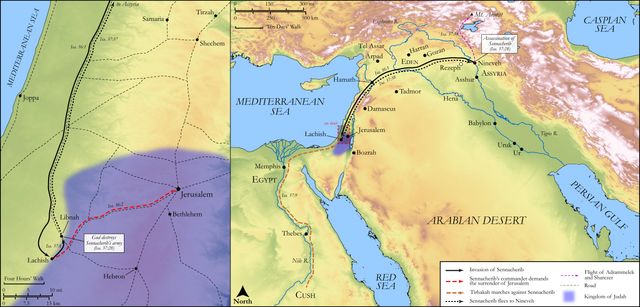
See on the biblical-era map
Study this verse
Public-domain commentary
Matthew Henry
From his Commentary on the Whole Bible. Henry comments on passages, not single verses — this entry covers Isaiah 36:1–10.
We shall here only observe some practical lessons. 1. A people may be in the way of their duty and yet meet with trouble and distress. Hezekiah was reforming, and his people were in some measure reformed; and yet their country is at that time invaded and a great part of it laid waste. Perhaps they began to grow remiss and cool in the work of reformation, were doing it by halves, and ready to sit down short of a thorough reformation; and then God visited them with this judgment, to put life into them and that good cause. We must not wonder if, when we are doing well, God sends afflictions to quicken us to do better, to do our best, and to press forward towards perfection. 2. That we must never be secure of the continuance of our peace in this world, nor think our mountain stands so strong that it cannot be moved. Hezekiah was not only a pious king, but prudent, both in his administration at home and in his treaties abroad. His affairs were in a good posture, and he seemed particularly to be upon good terms with the king of Assyria, for he had lately made his peace with him by a rich present (Kg2 18:14), and yet that perfidious prince pours an army into his country all of a sudden and lays it waste. It is good for us therefore always to keep up an expectation of trouble, that, when it comes, it may be no surprise to us, and then it will be the less a terror. 3. God sometimes permits the enemies of his people, even those that are most impious and treacherous, to prevail far against them. The king of Assyria took all, or most, of the defenced cities of Judah, and then the country would of course be an easy prey to him. Wickedness may prosper awhile, but cannot prosper always. 4. Proud men love to talk big, to boast of what they are, and have, and have done, nay and of what they will do, to insult over others, and set all mankind at defiance, though thereby they render themselves ridiculous to all wise men and obnoxious to the wrath of that God who resists the proud. But thus they think to make themselves feared, though they make themselves hated, and to carry their point by great swelling words of vanity, Jde 1:16. 5. The enemies of God's people endeavour to conquer them by frightening them, especially by frightening them from their confidence in God. Thus Rabshakeh here, with noise and banter, runs down Hezekiah as utterly unable to cope with his master, or in the least to make head against him. It concerns us therefore, that we may keep our ground against the enemies of our souls, to keep up our spirits by keeping up our hope in God. 6. It is acknowledged, on all hands, that those who forsake God's service forfeit his protection. If that had been true which Rabshakeh alleged, that Hezekiah had thrown down God's altars, he might justly infer that he could not with any assurance trust in him for succour and relief, Isa 36:7, We may say thus to presuming sinners, who say that they trust in the Lord and in his mercy. Is not this he whose commandments they have lived in the contempt of, whose name they have dishonoured, and whose ordinances they have slighted? How then can they expect to find favour with him? 7. It is an easy thing, and very common, for those that persecute the church and people of God to pretend a commission from him for so doing. Rabshakeh could say, Have I now come up without the Lord? when really he had come up against the Lord, Isa 37:28. Those that kill the servants of the Lord think they do him service and say, Let the Lord be glorified. But, sooner or later, they will be made to know their error to their cost, to their confusion.
Historical interpretation
Historical reception
4 surviving comments on this verse. Each one is dated, so this reads as a timeline rather than a list.
Select a marker to jump to its quote. Markers stagger vertically where authors wrote within a few decades of each other.
(Chapter 36—Verse 1 and following) And it came to pass in the fourteenth year of King Hezekiah, Sennacherib king of Assyria came up against all the fortified cities of Judah and captured them. And the king of Assyria sent Rabshakeh from Lachish to Jerusalem to King Hezekiah with a great army. And he stood by the conduit of the upper pool, on the highway to the washer's field. And Eliakim the son of Hilkiah, who was over the household, and Shebna the secretary, and Joah the son of Asaph, the recorder, came out to him. And Rabshakeh said to them, "Say to Hezekiah, 'Thus says the great king, the king of Assyria: On what do you rest this trust of yours?' By what plan and courage do you prepare to rebel? On whom do you have confidence, because you have turned away from me? Look, you trust in this broken reed staff, in Egypt: if a man leans on it, it will enter into his hand and pierce it. So is Pharaoh, the king of Egypt, to all who trust in him. But if you say to me, 'We trust in the LORD our God,' is it not he whose heights and altars Hezekiah has taken away, and said to Judah and Jerusalem, 'You shall worship before this altar'? And now make a deal with my master the king of Assyria, and I will give you two thousand horses, and you will not be able to provide riders for them. And how will you withstand the face of one judge from my lord's servants? And if you rely on Egypt: and on chariots, and on horsemen: and now, did I ascend to this land without the Lord, to destroy it? The Lord said to me: Go up on this land and destroy it. The history is clear and does not require interpretation: and this same thing is reported more fully in the volumes of Kings and Chronicles. In the third year of Hosea the son of Elah, king of Israel, Hezekiah the son of Ahaz king of Judah began to reign. He was twenty-five years old when he began to reign, and he reigned twenty-nine years in Jerusalem. And he did what was right in the eyes of the LORD, according to all that David his father had done. And afterwards: In the Lord God of Israel he trusted, and there was no one like him among all the kings of Judah, nor among those who came before him. He clung to the Lord and did not turn away from his commandments. He did the commandments that the Lord had given to Moses. Therefore, the Lord was with him, and he acted wisely in all that he did (2 Kings 18:2,7). But he rebelled against the king of Assyria and did not serve him. In the sixth year of his reign, Shalmaneser, the king of Assyria, captured Samaria and took away the ten tribes of Israel that were called Israel. He deported them to Assyria and settled them in Halah and Habor, along the rivers of the Gozan, in the cities of the Medes (2 Kings 17 and 18). After seven years, that is, in the fourteenth year of King Hezekiah, the king of Assyria, Sennacherib, entered Judah and besieged its fortified cities, intending to capture them. And when he besieged Lachish, Hezekiah sent messengers to him, saying: 'I have sinned, withdraw from me and whatever you impose on me, I will bear.' And when he had paid three hundred talents of silver and thirty talents of gold to the king's command, the king of Assyria broke down the doors of the temple of the Lord and took away its panels, which he himself had put up, and he sent the Tartan and the Rab-saris and the Rabshakeh with a great army from Lachish to King Hezekiah at Jerusalem. And when they had come up, they came and stood by the conduit of the upper pool, which is on the highway to the washer's field, and they called for the king. But Eliakim, the son of Hilkiah, who was in charge of the palace, went out to them, along with the court secretary, Shebna, and the court historian, Joah, the son of Asaph. Rabshekah addressed them as follows: “Tell Hezekiah: This is what the great king, the king of Assyria, says... and so on, as recorded in the history. In this, we can see the arrogance of Rabshekah, who, in a manner contrary to true strength, imitates the custom of the prophets. While they usually begin their pronouncements with 'This is what the Lord says,' he now says, 'This is what the great king, the king of Assyria, says.' But Eliakim son of Hilkiah, who was in charge of the palace, went out to him, along with the royal secretary Shebna and the court official Joah son of Asaph. Eliakim is the same person mentioned in the Vision of the Valley of Zion (see Isaiah 22:20-21): I will call my servant Eliakim son of Hilkiah, and I will clothe him in your robe and fasten your sash around him. I will hand your authority over to him, and he will be like a father to the inhabitants of Jerusalem and the people of Judah, and so on. But these things are said to Shebna, who was the governor of the Temple before him, of whom it is written in the same vision: Go and enter to him who dwells in the tabernacle, to Shebna the governor of the Temple, whom the Hebrews say handed over his hands to the Assyrians, terrified by Rabsaris' threats, and betrayed the lower part of Jerusalem to the enemy, and except for the fortress of Zion and the Temple, nothing else remained that the Assyrian did not hold. Where are those who think that Sobna, who is now going out with Eliacim and Joahe to meet Rabsacen, is the same person as before. There, Sobna, the head of the Temple, is said to be captured by the Assyrians; but here Sobna is a scribe, that is, a γραμματεὶς, who is called Sopher in Hebrew, and is the same as the previous one. Rabsacen, on the other hand, is believed to be the son of Isaiah the Jewish prophet, who also was a traitor; and the other son of Isaiah, who is called Jasub, is said to be left behind, which means 'left' in our language. Others, on the other hand, think that he was a Samaritan, and therefore knew the Hebrew language, and boldly and impiously blasphemed the Lord. Let us consider the words of Rabshakeh; and first what he says: You trust in this broken reed, in Egypt, is false: for no history tells that Hezekiah sent to the Egyptians and asked for the help of Pharaoh. And what he infers: If you answer me, we trust in the Lord our God, is true. But again, he joins a lie to the truth, that Ezechias took away its high places and altars. For he did this not against God, but for God, so that idolatry and ancient error being destroyed, he commanded God to be worshipped in Jerusalem, where his Temple was: although we read that by a very bad custom, the people offered sacrifices to God on altars already built on mountains and hills. And he, wanting to show the scarcity of the besieged, promises two thousand horses, of which Ezechias cannot provide the riders, not because of the weakness of the people of Judah, who lacked knowledge of riding: but by observing the commandments of God, who had commanded Israel through Moses concerning the king: He shall not multiply horses for himself, nor have many wives. And he said to me, 'By yourself, you cannot withstand the servant of Sennacherib, who am the least of his servants, how then will you withstand the great power of the king? And to what he had said, if you answer me, we trust in the Lord our God, he cunningly and wisely responded that he had come not by his own will, but by the command of the Lord. The Lord said to me, Go upon this land and destroy it. And this is the proof: certainly, without the will of the Lord, I could not have come here.' But when I come and capture many cities, and part of Jerusalem remains untouched, it is evident that I have come by its will. I read in a certain Commentary that the same person is Sennacherib who also captured Samaria, which is completely false. For the Sacred History recounts that first Phul, the king of the Assyrians, devastated the ten tribes under Manahen, the king of Israel. Secondly, Theglathphalasar came against Samaria under Phacee, the son of Romelia of Israel. Salmanasar III, under the reign of King Hoshea of Israel, supposedly captured the entire city of Samaria (2 Kings 15:17). Sargon II is said to be the fourth king who captured Ashdod (Isaiah 20). Asarhaddon, the fifth king, supposedly relocated Israel and sent the Samaritans as guardians to the land of Judah (2 Kings 17). Sennacherib, the sixth king, besieged Jerusalem after capturing Lachish and other cities of Judah during the reign of King Hezekiah (2 Kings 18). However, some believe that these names could refer to one and the same king with multiple names.
I read in the commentary of a certain man that it was the same Sennacherib who also captured Samaria, which is altogether false. For sacred history reports that Pul, under Menahem the king of Israel, was the first king of the Assyrians to have plundered the ten tribes. Second, Tiglath-pileser came to Samaria under Pekah the son of Remaliah. Shalmaneser was then the third to have taken all of Samaria. Fourth came Sargon, who fought against Ashdod, and the fifth was Essarhadon, who held the Samaritans captive in the land of Judea. Sennacherib was the sixth who, under Hezekiah king of Israel, laid siege to Jerusalem after he had captured Lachish and other cities of Judea. But others think that these many names apply to one and the same person.
But the Jews claim that the Rabshakeh, who spoke the Hebrew language, was the son of the prophet Isaiah and was himself a betrayer, and that another remaining son of Isaiah was called Jashub, who also spoke our tongue. Others, moreover, believe that he was a Samaritan and that this is why he knew the Hebrew language and why he blasphemed the Lord with such audacity and impiety. We should therefore regard the words of the Rabshakeh to be false, first of all this: “You trust in that broken staff of a reed, in Egypt.” For there is no history that sends Hezekiah to Egypt and makes Pharoah his assistant. But what he infers, “If you respond to me, ‘We trust in the Lord our God,’ ” is true. Yet again he joins this truth to a lie, saying that Hezekiah removed God’s high places and altars. For he did not do this against God but on behalf of God, so that with idolatry and the old error destroyed, he could command God to be worshiped in Jerusalem where his temple was located, although we observe the terrible custom of appointing people to sacrifice victims to God in the mountains and hills, where altars are already built. And wishing to demonstrate the paucity of hostages, the Rabshakeh promises two thousand horses, riders for whom Hezekiah is unable to produce. Thus it was not out of stupidity that he approached the Jewish people, who lacked a knowledge of horsemanship, but due to his observation of the commandments of God, who had enjoined through Moses on the king of Israel, “He will not multiply horses for himself, and he will not have many wives.” But, the Rabshakeh said, if you are unable to withstand me, a servant of Sennacherib—even the least of his servants—how will you withstand such great power of the king? But to the possibility of Hezekiah responding “We trust in the Lord our God” the Rabshakeh replies cleverly and with prudence that he had not come on his own initiative, but at the request of the Lord. “The Lord said to me, ‘Go up to that land and destroy it.’ ” This in short is his argument: Surely I would not have been able to come if it were not the will of the Lord. But since I came and captured many cities, with Jerusalem remaining intact, it is manifestly his will that I came.
The book of 2 Kings also speaks of this event. Isaiah has included it to his prophecy in order to show that his prophecy is true. Previously the prophet has made announcements concerning Babylon, Tyre, Egypt and other nations, but he is mostly concerned with the incarnation of our Savior, the unbelief and resultant judgment of Israel, and the call and salvation of the Gentiles. He has also announced Assyria’s attack and their ultimate destruction. It follows that he would include this event here to demonstrate that his prophecies are true. By showing that the announcement related to Sennacherib is true, he can show that all his other prophecies will be fulfilled in the same way.
Continue studying Isaiah 36:1 across the web’s major study libraries — every link below opens this exact verse, chapter, or book on the destination site.
Read & Compare
 BibleGatewayThis verse in more than 200 translations and 70 languages.
 Bible.comThe YouVersion reader — hundreds of translations, reading plans, and highlights.
 ESV.orgCrossway's official English Standard Version reader.
 NET BibleThe NET translation with 60,000+ translators' notes on every rendering decision.
 STEP BibleTyndale House's free study tool — original text, vocabulary, and scholarly resources.
 BibliaLogos Bible Software's free web reader.
 USCCBThe New American Bible (Revised Edition) with the U.S. bishops' study notes.
Commentaries
 BibleHub CommentariesDozens of classic commentaries on this verse, gathered on one page.
 StudyLightMore than 100 commentary sets — the largest collection on the web.
 BibleRefPlain-English commentary on what this verse means, verse by verse.
 Enduring WordDavid Guzik's free commentary on this chapter, widely used by Bible teachers.
 Bible Study ToolsVerse commentary alongside Greek and Hebrew study aids.
Original Language & Research
- BibleHub InterlinearThe verse word by word — original language, transliteration, and English.
- BibleHub LexiconEvery word's original-language definition and Strong's entry.
 Blue Letter BibleDeep-study tools — Strong's numbers, concordance, and word studies.
 SefariaThe Hebrew text with Rashi and centuries of Jewish commentary.
Sermons, Hymns & Audio


TrulyRandomVerse is not affiliated with these sites and doesn’t control their content. They’re linked because they’re genuinely useful.
Summary
Isaiah 36:1 inaugurates a pivotal historical narrative within the book of Isaiah, marking a dramatic shift from prophetic pronouncements to the unfolding of divine judgment and deliverance. This verse precisely dates the formidable invasion of Judah by Assyrian King Sennacherib in the fourteenth year of King Hezekiah's reign, detailing the initial, devastating success of the Assyrian forces as they swept through and captured numerous fortified cities across the Judean landscape. It meticulously sets the stage for a profound test of faith for Hezekiah and the people of Judah, highlighting the overwhelming human threat against which God's ultimate sovereignty would be powerfully demonstrated.
Context
ShowHideLiterary Context
Isaiah 36 marks a significant structural and thematic transition in the book, moving from the extensive prophetic oracles and warnings of chapters 1-35 to a crucial historical narrative spanning chapters 36-39. These chapters serve as a vital historical interlude, providing the concrete backdrop and validation for many of Isaiah's preceding prophecies concerning Judah's sin, God's impending judgment, and His ultimate salvation. Specifically, Isaiah 36-37 recounts the Assyrian invasion and God's miraculous deliverance of Jerusalem, powerfully demonstrating the veracity of Isaiah's prophetic word. Chapters 38-39 then detail King Hezekiah's illness and miraculous recovery, followed by his ill-advised display of treasures to Babylonian envoys, which ominously foreshadows the future Babylonian exile. This strategically placed historical section serves to ground the theological messages of the book in tangible, verifiable events, thereby illustrating God's faithfulness to His promises, both of judgment and salvation, in real-time history.
Historical & Cultural Context
The "fourteenth year of king Hezekiah" corresponds to approximately 701 BC, a period when the Neo-Assyrian Empire stood as the dominant superpower in the ancient Near East, renowned for its brutal military tactics, systematic deportations, and ruthless efficiency. Sennacherib, who succeeded his father Sargon II, was a formidable and ambitious monarch determined to consolidate Assyrian control over the entire Levant. Judah, under King Hezekiah, had previously paid tribute to Assyria but had recently joined a coalition of states rebelling against Assyrian hegemony, likely encouraged by promises of support from Egypt. This act of defiance provoked Sennacherib's massive retaliatory campaign, which aimed to reassert Assyrian dominance and crush all resistance. The "defenced cities" (fortified cities) of Judah were crucial strongholds designed to protect the kingdom, but their rapid fall, as recorded here and corroborated by Assyrian annals, starkly underscores the overwhelming military might of Sennacherib's forces and the dire, seemingly hopeless, predicament in which Judah found itself.
Key Themes
ShowHideThis opening verse immediately introduces and sets the stage for several profound theological and narrative themes that will be extensively developed throughout the subsequent chapters and the broader book of Isaiah. Firstly, it highlights the Sovereignty of God amidst overwhelming human threats; despite Assyria's apparent invincibility and Judah's vulnerability, God's ultimate control over history and human affairs will be powerfully revealed. Secondly, it underscores Human Vulnerability and Divine Reliance, as Judah's "defenced cities" prove utterly insufficient against Sennacherib's onslaught, thereby forcing Hezekiah and the people to look beyond their own strength and resources. This theme resonates deeply with Isaiah's earlier prophetic calls for trust in God rather than reliance on fleeting human alliances or military might, as seen in passages like Isaiah 30:1-7. Thirdly, the verse initiates the overarching theme of Judgment and Deliverance, presenting the initial, devastating phase of God's judgment upon Judah for its unfaithfulness and rebellion. Yet, precisely because of this initial devastation, it also sets the stage for the dramatic and miraculous deliverance of Jerusalem, which will unequivocally demonstrate God's unwavering commitment to His covenant people, as prophesied in passages such as Isaiah 31:4-5.
Exposition and Analysis
ShowHideKey Word Analysis
ShowHideThis significant name, derived from the Hebrew root meaning "to strengthen" and the divine name "Yah" (Yahweh), translates to "strengthened of Jah" or "Yahweh strengthens." In the context of Isaiah 36:1, this etymology is profoundly ironic and prophetic. At the moment of Judah's greatest weakness and vulnerability, facing the overwhelming might of Sennacherib, the king's very name points to the divine source of strength that Hezekiah would desperately need and ultimately receive. Hezekiah was a righteous king who initiated significant religious reforms, purging idolatry and restoring proper worship of Yahweh, making his character and actions central to understanding God's subsequent intervention on behalf of Judah.
This is the proper name of the powerful and ruthless king of Assyria, whose massive invasion is the central external conflict in this historical account. As the Strong's data notes, it is of foreign origin, highlighting his identity as an outsider and a pagan ruler. His name represents the overwhelming, seemingly unstoppable force that God's people faced. The confrontation between King Hezekiah and King Sennacherib is thus not merely a geopolitical conflict between two nations but a profound theological one, pitting the sovereign God of Israel against the formidable might and arrogant pride of a pagan empire.
This word, derived from a primitive root meaning "to clip off" or "to be isolated," specifically refers to cities that are "fortified," "inaccessible," or "walled up" by height or strong fortifications. The phrase "came up against all the defenced cities of Judah, and took them" powerfully emphasizes the sheer scale and devastating success of Sennacherib's initial campaign. The fact that even the strongest human defenses were futile against the Assyrian onslaught underscores Judah's utter helplessness. This detail serves to magnify the miraculous nature of Jerusalem's eventual deliverance, as it highlights that salvation would come not through human strength or fortifications, but solely through divine intervention.
Verse Breakdown
ShowHide"Now it came to pass in the fourteenth year of king Hezekiah,"
This opening clause serves as a precise chronological marker, anchoring the narrative in a specific historical moment. The "fourteenth year" of Hezekiah's reign (approximately 701 BC) provides a verifiable date, linking Isaiah's prophecy to a well-documented period in ancient Near Eastern history. This immediate establishment of Hezekiah as the reigning monarch sets the stage for his central role in the unfolding events and the profound test of his faith.
"[that] Sennacherib king of Assyria came up against all the defenced cities of Judah,"
This clause introduces the primary antagonist and vividly describes the overwhelming scope of his devastating campaign. Sennacherib, the powerful Assyrian king, launched a full-scale invasion, targeting not just isolated towns but "all the defenced cities." This signifies a comprehensive and relentless military assault aimed at subjugating the entire kingdom of Judah, demonstrating the immense, existential threat faced by God's covenant people.
"and took them."
This concise yet impactful phrase dramatically concludes the initial phase of the invasion, confirming Sennacherib's immediate and widespread success. The swift and decisive capture of these fortified cities underscores the severity of Judah's predicament, indicating that human defenses were utterly insufficient. This leaves Jerusalem as the sole remaining stronghold, thereby heightening the tension and underscoring the desperate need for divine intervention, as all human avenues of defense have failed.
Literary Devices
ShowHideIsaiah 36:1 primarily employs Historical Narrative, serving as a factual and precise recounting of events to establish the critical context for the subsequent divine intervention. The meticulous dating and the explicit naming of key figures such as Hezekiah and Sennacherib lend Verisimilitude and undeniable authority to the account, grounding the theological message in verifiable history. The phrase "came up against all the defenced cities of Judah, and took them" utilizes Conciseness to powerfully convey the swift, overwhelming, and comprehensive success of the Assyrian campaign, creating a palpable sense of dire urgency and foreshadowing the immense challenge that Jerusalem, as the last remaining stronghold, would inevitably face. Furthermore, there is a profound element of Irony in the fall of "defenced cities," highlighting the ultimate futility of human strength, military might, and even the most formidable fortifications when confronted with a superior power. This irony serves to dramatically set the stage for the subsequent demonstration of God's unparalleled divine power and sovereignty.
Theological and Thematic Connections
ShowHideIsaiah 36:1 serves as a stark and sobering reminder that even God's chosen people are not immune to the consequences of a fallen world, and at times, their own unfaithfulness. The overwhelming invasion by Sennacherib, a seemingly unstoppable force, underscores the profound biblical theme of divine judgment and the absolute necessity of radical reliance on God alone. Yet, this initial devastation also meticulously sets the stage for one of the most dramatic and powerful demonstrations of God's protective power in the Old Testament, where His sovereignty is unequivocally vindicated against the arrogant pride and might of human empires. The rapid fall of the "defenced cities" prepares the reader for the ultimate test of faith and the subsequent miraculous deliverance of Jerusalem, illustrating with vivid clarity that true security, ultimate victory, and enduring salvation are found not in human might, military fortifications, or strategic alliances, but solely and exclusively in the Lord God Almighty.
Reflection and Application
ShowHideThis ancient historical account, though rooted in a specific time and place, resonates deeply with contemporary experiences of overwhelming challenges and seemingly insurmountable obstacles. Just as Judah faced a powerful and relentless enemy that swept away its "defenced cities," we too encounter situations in life—whether personal crises, societal pressures, spiritual battles, or global uncertainties—where our own strength, resources, and carefully constructed defenses prove utterly inadequate. This verse compels us to humbly acknowledge the inherent limits of human capability and to recognize that true security, lasting peace, and ultimate deliverance are found not in our fortifications, but in a radical and unwavering dependence on God. It invites us to critically consider where we place our trust when the walls around us begin to crumble and the foundations of our perceived security are shaken, prompting us to shift our gaze from the visible threats to the invisible, yet all-powerful, hand of God. The subsequent narrative, directly sparked by this initial invasion, profoundly reveals that God often allows us to reach the very end of our own strength precisely so that His power, faithfulness, and sovereign deliverance can be unmistakably and gloriously demonstrated.
Questions for Reflection
ShowHideFAQ
ShowHideWhat was the significance of the "fourteenth year of king Hezekiah"?
ShowHideThe "fourteenth year of king Hezekiah" refers to approximately 701 BC. This precise dating is highly significant because it firmly anchors the biblical narrative in verifiable historical events. It was the year of Sennacherib's major campaign against Judah, a campaign extensively documented not only in the Bible (e.g., 2 Kings 18) but also in extra-biblical sources, most notably Sennacherib's own prism inscription, which boasts of his conquests in Judah. This historical accuracy lends immense credibility to the biblical account and underscores the profound reality of the existential crisis that Judah faced, meticulously setting the stage for God's miraculous and undeniable intervention.
Why did Sennacherib invade Judah, and what was his objective?
ShowHideSennacherib invaded Judah primarily because King Hezekiah had rebelled against Assyrian overlordship. Judah, along with other states in the Levant, had ceased paying tribute to Assyria and had formed alliances, possibly with Egypt, in direct defiance of Assyrian hegemony. Sennacherib's objective was multifaceted: to reassert Assyrian dominance over the rebellious vassal states, to punish those who had challenged his authority, and to secure the strategically vital western frontier of his vast empire. His campaign was comprehensive and brutal, aiming to subdue the entire kingdom of Judah, as evidenced by his capture of "all the defenced cities" before he turned his formidable attention to Jerusalem, the capital. This invasion was a terrifying demonstration of Assyrian military might and its ruthless policy of crushing all dissent.
Christ-Centered Fulfillment
ShowHideIsaiah 36:1, while a precise historical account of an ancient invasion, finds profound Christ-centered fulfillment in its powerful foreshadowing of the ultimate spiritual battle and God's sovereign deliverance. The seemingly insurmountable threat of Sennacherib against Judah's "defenced cities" mirrors humanity's utterly helpless state against the overwhelming and relentless forces of sin, death, and the spiritual enemy. Just as Hezekiah and Judah's only hope lay in Yahweh's miraculous and unexpected intervention, so too is humanity utterly dependent on divine rescue from a foe far more formidable than any earthly army. The dramatic and miraculous deliverance of Jerusalem, detailed in the subsequent chapters, where God Himself fights for His people without human sword or bow, powerfully prefigures the salvation wrought by Jesus Christ. He is the true King, far greater than Hezekiah, who did not merely defend a physical city but conquered sin and death on the cross, providing ultimate spiritual deliverance and eternal security for all who believe (e.g., Colossians 2:13-15). Christ Himself is the ultimate "defenced city," the secure refuge and impregnable fortress for His people, whose decisive victory ensures that the gates of hell shall not prevail against His Church (e.g., Matthew 16:18). The invasion of Sennacherib and God's subsequent, unexpected triumph thus serve as a powerful Old Testament type, pointing to the Lamb of God who takes away the sin of the world and ultimately defeats all of God's enemies, securing eternal peace and victory (e.g., John 1:29).