


Isaiah 8:8
- וְחָלַףve·cha·Lafand it will pass onH2498Conj-w ¦ V-Qal-ConsecPerf-3msVerb Qal Consecutive Perfect 3rd Singular Masculineוְandחָלַףit will pass on
- בִּיהוּדָהbi·hu·Dahin JudahH3063Prep-b ¦ N-properNoun Proper LocationבִּinיהוּדָהJudah
- שָׁטַףsha·Tafit will overflowH7857V-Qal-Perf-3msVerb Qal Perfect 3rd Singular Masculine
- וְעָבַרve·'a·Varand it will pass overH5674Conj-w ¦ V-Qal-ConsecPerf-3msVerb Qal Consecutive Perfect 3rd Singular Masculineוְandעָבַרit will pass over
- עַד'adtoH5704PrepPreposition
- צַוָּארtza·Var[the] neckH6677N-msNoun Singular Masculine Absolute
- יַגִּיעַya·Gi·a'it will reachH5060V-Hiphil-Imperf-3msVerb Hiphil Imperfect 3rd Singular Masculine
- וְהָיָהve·ha·Yahand it will beH1961Conj-w ¦ V-Qal-ConsecPerf-3msVerb Qal Consecutive Perfect 3rd Singular Masculineוְandהָיָהit will be
- מֻטּוֹתmu·Tot[the] spreading<s> ofH4298N-fpcNoun Plural Feminine Construct
- כְּנָפָיוke·na·Favits wingsH3671N-fdc ¦ 3msNoun Dual Feminine Constructכְּנָפָיwingsוits
- מְלֹאme·Lo'[the] fullness ofH4393N-mscNoun Singular Masculine Construct
- רֹחַבro·chav[the] breadth ofH7341N-mscNoun Singular Masculine Construct
- אַרְצְךָ'ar·tze·Khayour landH776N-fsc ¦ 2msNoun Singular Feminine Constructאַרְצְlandךָyour
- עִמָּנוּ'i·Ma·nuO Immanu-H6005N-proper-mNoun Proper Masculine
- אֵל'El-elH6005N-proper-mNoun Proper Masculine
English is a literal word-by-word gloss of the Hebrew, not the KJV's wording. Why?
This is the original text the KJV's translators worked from — each Hebrew word with its own literal English meaning in this verse, prepared by scholars at Tyndale House, Cambridge. The KJV translates whole sentences, not word by word, so its wording differs: one Hebrew word can become several English words, and the KJV may choose “the LORD” where the gloss reads “Yahweh”. Both are faithful — they answer different questions. For the KJV's own rendering, switch to the KJV text.
Details
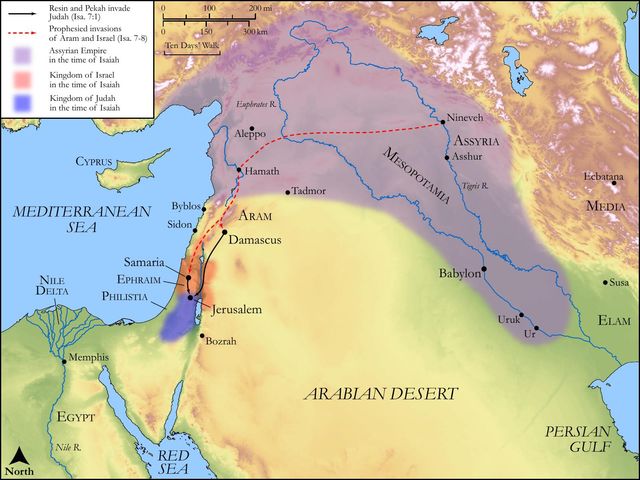
See on the biblical-era map
Study this verse
Public-domain commentary
Matthew Henry
From his Commentary on the Whole Bible. Henry comments on passages, not single verses — this entry covers Isaiah 8:1–8. His three-level outline is real structure in the source text, so it is rendered as structure.
In these verses we have a prophecy of the successes of the king of Assyria against Damascus, Samaria, and Judah, that the two former should be laid waste by him, and the last greatly frightened. Here we have,
I.Orders given to the prophet to write this prophecy, and publish it to be seen and read of all men, and to leave it upon record, that when the thing came to pass they might know that God had sent him; for that was one end of prophecy, Joh 14:29. He must take a great roll, which would contain those five chapters fairly written in words at length; and he must write in it all that he had foretold concerning the king of Assyria's invading the country; he must write it with a man's pen, in the usual way and style of writing, so as that it might be legible and intelligible by all. See Hab 2:2, Write the vision, and make it plain. Those that speak and write of the things of God should avoid obscurity, and study to speak and write so as to be understood, Co1 14:19. Those that write for men should write with a man's pen, and not covet the pen or tongue of angels. And forasmuch as it is usual to put some short, but significant comprehensive title before books that are published, the prophet is directed to call his book Maher-shalal-hash-baz - Make speed to the spoil, hasten to the prey, intimating that the Assyrian army should come upon them with great speed and make great spoil. By this title the substance and meaning of the book would be enquired after by those that heard of it, and remembered by those that had read it or heard it read. It is sometimes a good help to memory to put much matter in few words, which serve as handles by which we take hold of more.
II.The care of the prophet to get this record well attested (Isa 8:2):
I took unto me faithful witnesses to record; he wrote the prophecy in their sight and presence, and made them subscribe their names to it, that they might be ready, if afterwards there should be occasion, to make oath of it, that the prophet had so long before foretold the descent which the Assyrians made upon that country. He names his witnesses for the greater certainty, that they might be appealed to by any. They were two in number (for out of the mouth of two witnesses shall every word be established); one was Uriah the priest; he is mentioned in the story of Ahaz, but for none of his good deeds, for he humoured Ahaz with an idolatrous altar (Kg2 16:10, Kg2 16:11); however, at this time, no exception lay against him, being a faithful witness. See what full satisfaction the prophets took care to give to all persons concerned of the sincerity of their intentions, that we might know with a full assurance the certainty of the things wherein we have been instructed, and that we have not followed cunningly-devised fables.
III.The making of the title of his book the name of his child, that it might be the more taken notice of and the more effectually perpetuated, Isa 8:3. His wife (because the wife of a prophet) is called the prophetess; she conceived and bore a son, another son, who must carry a sermon in his name, as the former had done (Isa 7:3), but with this difference, that spoke mercy, Shear-jashub - The remnant shall return; but, that being slighted, this speaks judgment, Maher-shalal-hash-baz - In making speed to the spoil he shall hasten, or he has hastened, to the prey. The prophecy is doubled, even in this one name, for the thing was certain. I will hasten my word, Jer 1:12. Every time the child was called by his name, or any part of it, it would serve as a memorandum of the judgments approaching. Note, It is good for us often to put ourselves in mind of the changes and troubles we are liable to in this world, and which perhaps are at the door. When we look with pleasure on our children it should be with the allay of this thought, We know not what they are yet reserved for.
IV.The prophecy itself, which explains this mystical name.
1.That Syria and Israel, who were now in confederacy against Judah, should in a very little time become an easy prey to the king of Assyria and his victorious army (Isa 8:4): "Before the child, now newly born and named, shall have knowledge to cry, My father, and My mother" (which are usually some of the first things that children know and some of the first words that children speak), that is, "in about a year or two, the riches of Damascus, and the spoil of Samaria, those cities that are now so secure themselves and so formidable to their neighbours, shall be taken away before the king of Assyria, who shall plunder both city and country, and send the best effects of both into his own land, to enrich that, and as trophies of his victory." Note, Those that spoil others must expect to be themselves spoiled (Isa 33:1); for the Lord is righteous, and those that are troublesome shall be troubled.
2.That forasmuch as there were many in Judah that were secretly in the interests of Syria and Israel, and were disaffected to the house of David, God would chastise them also by the king of Assyria, who should create a great deal of vexation to Judah, as was foretold, Isa 7:17. Observe,
(1.)What was the sin of the discontented party in Judah (Isa 8:6): This people, whom the prophet here speaks to, refuse the waters of Shiloah that go softly, despise their own country and the government of it, and love to run it down, because it does not make so great a figure, and so great a noise, in the world, as some other kings and kingdoms do. They refuse the comforts which God's prophets offer them from the word of God, speaking to them in a still small voice, and make nothing of them; but they rejoice in Rezin and Remaliah's son, who were the enemies of their country, and were now actually invading it; they cried them up as brave men, magnified their policies and strength, applauded their conduct, were well pleased with their successes, and were hearty well-wishers to their designs, and resolved to desert and go over to them. Such vipers does many a state foster in its bosom, that eat its bread, and yet adhere to its enemies, and are ready to quit its interests if they but seem to totter.
(2.)The judgment which God would bring upon them for this sin. The same king of Assyria that should lay Ephraim and Syria waste should be a scourge and terror to those of their party in Judah, Isa 8:7, Isa 8:8. Because they refuse the waters of Shiloah, and will not accommodate themselves to the government God has set over them, but are uneasy under it, therefore the Lord brings upon them the waters of the river, strong and many, the river Euphrates. They slighted the land of Judah, because it had no river to boast of comparable to that; the river at Jerusalem was a very inconsiderable one. "Well," says God, "if you be such admirers of Euphrates, you shall have enough of it; the king of Assyria, whose country lies upon that river, shall come with his glory, with his great army, which you cry up as his glory, despising your own king because he cannot bring such an army as that into the field; God shall bring that army upon you." If we value men, if we over-value them, for their worldly wealth and power, it is just with God to make them thereby a scourge to us. It is used as an argument against magnifying rich men that rich men oppress us, Jam 2:3, Jam 2:5. Let us be best pleased with the waters of Shiloah, that go softly, for rapid streams are dangerous. It is threatened that the Assyrian army should break in upon them like a deluge, or inundation of waters, bearing down all before it, should come up over all his channels, and overflow all his banks. It would be to no purpose to oppose or withstand them. Sennacherib and his army should pass through Judah, and meet with so little resistance that it should look more like a march through the country than a descent upon it. He shall reach even to the neck, that is, he shall advance so far as to lay siege to Jerusalem, the head of the kingdom, and nothing but that shall be kept out of his hands; for that was the holy city. Note, In the greatest deluge of trouble God can and will keep the head of his people above water, and so preserve their comforts and spiritual lives; the waters that come into their souls may reach to the neck (Psa 69:1), but there shall their proud waves be stayed. And here is another comfortable intimation that though the stretching out of the wings of the Assyrian, that bird of prey, though the right and left wing of his army, should fill the breadth of the land of Judah, yet still it was Immanuel's land. It is thy land, O Immanuel! It was to be Christ's land; for there he was to be born, and live, and preach, and work miracles. He was Zion's King, and therefore had a peculiar interest in and concern for that land. Note, The lands that Immanuel owns for his, as he does all those lands that own him, though they may be deluged, shall not be destroyed; for, when the enemy shall come in like a flood, Immanuel shall secure his own, and shall lift up a standard against him, Isa 59:19.
Historical interpretation
Two Centuries of Reception
3 surviving comments on this verse. Each one is dated, so this reads as a timeline rather than a list.
Select a marker to jump to its quote. Markers stagger vertically where authors wrote within a few decades of each other.
[Isaiah] uses the “king of Assyria” as a symbol for the Antichrist.
Obviously the only way to preserve the understanding of this passage is to explain its spiritual meaning. By the softly proceeding water of Siloam it means the gospel teaching of the word of salvation, because Siloam means “sent with a message.” This would be God the Word, who was sent by the Father, of whom Moses says, “A ruler will not fail from Judah, nor a prince from his loins, until the one for whom it is stored up comes, and he is the expectation of the nations.” For rather than “for whom it is stored up” the Hebrew has “Siloam.” The same word, Siloam, is used the same way in this passage for Isaiah, that is to say, “the one who is sent.”
(Verse 5, et seq.) And the Lord added, speaking to me again, saying: Because this people has rejected the waters of Siloam that flow gently, and has preferred Rezin and the son of Remaliah, therefore behold, the Lord will bring upon them the mighty and abundant waters of the river, the king of Assyria and all his glory. And it will rise above all its channels, and overflow over all its banks. And it will pass through Judah, flooding and reaching up to the neck. And the spreading of its wings will fill the breadth of your land, O Emmanuel. He had said before that the strength of Damascus should be taken away, and the spoils of Samaria should be seen by the king of the Assyrians, and that two kings should be captured while the Assyrian was fighting: now God speaks to the Prophet in the usual style of the Scriptures, through the translation of the Siloam spring in Jerusalem, and the very violent river of the Assyrians, that the whole land of Israel will be flooded by its waters, and it will overflow its riverbanks with such force that after it has occupied the land of the ten tribes, it will reach Judah and, passing through, it will reach the neck: by which it signifies the nearby captivity. For Judas was not captured at that time, but after all the cities of the two tribes were conquered, only Jerusalem remained, which was liberated by the incredible mercy of God. Therefore, the power of the Assyrians and their countless army, which he had described as being under the flood of the river, now shows through another translation, namely, that he has covered the land of Emmanuel, that is, the land defended by God, with his other wings, that is, his leaders, and an infinite multitude. However, he did not possess it, although Emmanuel is connected in the following chapter to the seventy, not by his own name as he is called among the Hebrews, but by an interpretation, that is, "God with us. But we cannot doubt that Silo is a fountain at the foot of Mount Zion, which does not flow continuously, but only at certain times and days, and comes through the underground caves and dens of the hardest rock with a great noise. Especially we who dwell in this province. The meaning is that the people of the ten tribes preferred to be subject to Rezin and the son of Romelia, that is, the kings of Damascus and Samaria, rather than to the lineage of David, who began to reign by my judgment. I will make him not serve these kings whom he took, but serve the Assyrian king, whose power is compared to the flooding of the river that covers the land of Samaria. And an apostrophe is made to Emmanuel, that is, to the present God, that the Assyrian has exalted himself to such an extent that he has even tried to possess his own land, Judah. According to the spiritual sense, every heretic who joins his secular wisdom and desires to attack Jerusalem, that is, the Church, abandoning the waters of the Siloam fountain (John 9), which is interpreted as 'sent', and who ascends to eternal life, will be handed over to the prince of Assyria (which sense we will read later), and by the power of the one to whom he is handed over, he will come into the depth of sins. Such is the arrogance, that he dared to show to the Savior all the kingdoms of the earth and say: 'All these have been given to me' (Matthew and Luke IV). He will also try to enter into Judah, that is, the house of confession, and he will often come up to the neck through those who are negligent in the Church, wishing to suffocate those who believe in Christ, and he will spread his wings, filling the whole region of Emmanuel; but he will not be able to prevail, because Judas has the presence of God. We read in the Gospel according to John (John 9) that a blind man from birth, whose eyes the Lord had anointed with clay made from his own saliva, was sent to the pool of Siloam, and when the blind man washed the clay away, his blindness was removed and he received clear vision. This miracle signifies that the blindness of the Jews and all unbelievers can only be healed by the teachings of Christ's waters, which flow gently without noise or clamor, dispelling the darkness of previous error. What is read in the Septuagint: And he shall walk over all your walls, and he shall take away from Judah the man who can lift up his head, or perhaps do anything: in Hebrew it is not found, and in the Greek manuscripts ÷ it is cut off by the true killer.
Continue studying Isaiah 8:8 across the web’s major study libraries — every link below opens this exact verse, chapter, or book on the destination site.
Read & Compare
 BibleGatewayThis verse in more than 200 translations and 70 languages.
 Bible.comThe YouVersion reader — hundreds of translations, reading plans, and highlights.
 ESV.orgCrossway's official English Standard Version reader.
 NET BibleThe NET translation with 60,000+ translators' notes on every rendering decision.
 STEP BibleTyndale House's free study tool — original text, vocabulary, and scholarly resources.
 BibliaLogos Bible Software's free web reader.
 USCCBThe New American Bible (Revised Edition) with the U.S. bishops' study notes.
Commentaries
 BibleHub CommentariesDozens of classic commentaries on this verse, gathered on one page.
 StudyLightMore than 100 commentary sets — the largest collection on the web.
 BibleRefPlain-English commentary on what this verse means, verse by verse.
 Enduring WordDavid Guzik's free commentary on this chapter, widely used by Bible teachers.
 Bible Study ToolsVerse commentary alongside Greek and Hebrew study aids.
Original Language & Research
- BibleHub InterlinearThe verse word by word — original language, transliteration, and English.
- BibleHub LexiconEvery word's original-language definition and Strong's entry.
 Blue Letter BibleDeep-study tools — Strong's numbers, concordance, and word studies.
 SefariaThe Hebrew text with Rashi and centuries of Jewish commentary.
Sermons, Hymns & Audio


TrulyRandomVerse is not affiliated with these sites and doesn’t control their content. They’re linked because they’re genuinely useful.
Summary
Isaiah 8:8 presents a stark prophetic warning to Judah, vividly depicting the impending Assyrian invasion as an overwhelming, devastating flood that will sweep across the land, reaching a point of near-total submersion. This imagery underscores the severe consequences of Judah's unfaithfulness and its reliance on foreign alliances rather than on the Lord. Yet, amidst this dire pronouncement of judgment and near-catastrophe, the verse culminates in the profound and paradoxical declaration, "O Immanuel," transforming a message of doom into a powerful affirmation of God's enduring presence, covenant faithfulness, and ultimate sovereignty, even in the depths of national tribulation.
Context
ShowHideLiterary Context
Isaiah 8:8 is strategically placed within a pivotal section of Isaiah's prophecies (chapters 7-12) that addresses the Syro-Ephraimite War and its far-reaching implications. Following the sign of Immanuel given to King Ahaz in Isaiah 7:14, chapter 8 continues to detail the unfolding consequences of Ahaz's profound lack of trust in the Lord. Isaiah's symbolic actions, such as publicly writing "Maher-Shalal-Hash-Baz" (meaning "Hasten Booty, Swift Prey") on a large tablet (Isaiah 8:1) and naming his newborn son with this prophetic name (Isaiah 8:3), serve as living prophecies of the swift and decisive Assyrian conquest of both Syria and the northern kingdom of Israel. Verse 8 specifically extends this judgment to Judah, portraying the Assyrian army as an unstoppable, overflowing river. This destructive flood is presented as a direct consequence of Judah's rejection of "the gently flowing waters of Shiloah" (representing God's quiet, faithful provision and presence) in Isaiah 8:6. Thus, Isaiah 8:8 functions as the climactic warning within this immediate prophetic oracle, signaling the imminent and comprehensive nature of the Assyrian threat against Judah.
Historical & Cultural Context
The historical backdrop for Isaiah 8:8 is the tumultuous Syro-Ephraimite War, which occurred around 734-732 BC, a period marked by intense geopolitical instability in the Ancient Near East. The northern kingdom of Israel (Ephraim) and Aram (Syria), led by Pekah and Rezin respectively, formed an anti-Assyrian alliance and attempted to compel King Ahaz of Judah to join their coalition. When Ahaz refused, they launched an attack on Judah with the intention of deposing him and installing a puppet king (Isaiah 7:1-6). Tragically, instead of heeding Isaiah's call to trust in the Lord's protection, Ahaz chose to appeal for military assistance from Tiglath-Pileser III, the powerful king of Assyria (2 Kings 16:7-9). This act of profound faithlessness invited Assyrian intervention, which, while initially directed against Israel and Aram, ultimately turned against Judah itself, transforming a potential ally into the very instrument of divine judgment. The imagery of an overflowing, devastating river was a common and potent metaphor in the ancient Near East for invading armies, particularly fitting for the formidable Assyrian war machine known for its overwhelming force and destructive campaigns that swept through lands like an unstoppable deluge.
Key Themes
ShowHideIsaiah 8:8 powerfully encapsulates several foundational themes that resonate throughout the book of Isaiah. Firstly, it prominently displays the theme of Divine Judgment, illustrating that God sovereignly uses foreign nations, even formidable empires like Assyria, as instruments of His righteous wrath to discipline His disobedient people (Isaiah 10:5-6). Secondly, the verse underscores God's Sovereignty and Control, even over the very instruments of judgment. The flood is depicted as reaching "to the neck" but no further, subtly implying a divinely appointed limit to the devastation. This crucial limitation hints at the theme of the Remnant, suggesting that a portion of Judah will be preserved despite the overwhelming judgment, a concept developed further in passages like Isaiah 10:20-22. Finally, and most profoundly, the concluding phrase "O Immanuel" introduces the overarching theme of God's Enduring Presence and Covenant Faithfulness. Despite the impending catastrophe and the consequences of Judah's sin, God remains "with us," a steadfast promise of ultimate hope and restoration that transcends the immediate judgment, pointing to the future fulfillment of His redemptive plan for His people and land, a promise woven throughout the entirety of the book of Isaiah.
Exposition and Analysis
ShowHideKey Word Analysis
ShowHideThis primitive root (H2498) signifies rapid, unhindered movement, conveying the idea of something that "slides by," "hastens away," or "passes on." In the context of an overflowing flood, it vividly portrays the unstoppable, swift, and pervasive nature of the Assyrian advance. It implies an overwhelming force that will not be hindered but will sweep through the land with destructive speed, leaving no area untouched.
This word (H6677) refers to the back of the neck, often associated with carrying burdens, being yoked, or being subjugated. In the powerful imagery of a flood, reaching "to the neck" implies a state of near-total submersion, where only the head remains above water. It signifies a profound level of distress, subjugation, and extreme peril for the land and its inhabitants—a near-death experience for the nation, yet crucially, not complete annihilation.
Derived from "with us" (ʻim) and "God" (ʼêl, H410), this name (H6005) literally means "God with us." Its inclusion at the very end of a prophecy of such dire judgment is profoundly significant. It is not merely an address to the land but a profound theological declaration, asserting God's active, covenantal presence and ultimate sovereignty over His people and their land, even when they face overwhelming destruction. It transforms a warning of impending judgment into a powerful statement of divine promise, hope, and enduring faithfulness.
Verse Breakdown
ShowHide"And he shall pass through Judah; he shall overflow and go over"
This opening clause immediately introduces the subject of the prophecy—the Assyrian king, referred to as "he"—and establishes the central imagery of an overwhelming, unstoppable force. The verbs "pass through," "overflow," and "go over" collectively depict a rapid, unhindered, and pervasive invasion, akin to a mighty river bursting its banks and inundating the surrounding territory. This signifies the complete penetration of Judah's defenses and the widespread, comprehensive nature of the impending devastation.
"he shall reach [even] to the neck"
This phrase intensifies the preceding flood imagery, indicating the extreme depth and severity of the invasion. Reaching "to the neck" implies that the land and its people will be almost completely submerged in the metaphorical waters of judgment, teetering on the very brink of drowning. It conveys a state of profound distress, near-total defeat, and extreme subjugation, where the nation is barely able to keep its head above the deluge, signifying a loss of autonomy and a dire existential threat.
"and the stretching out of his wings shall fill the breadth of thy land, O Immanuel."
This final, powerful clause introduces a shift in metaphor, moving from a flood to a massive bird of prey, specifically an eagle or vulture, whose outstretched wings cover the entire land. This imagery emphasizes the vast reach and comprehensive nature of the Assyrian occupation, implying that no part of Judah will remain untouched by the invading force. The concluding address, "O Immanuel," is a sudden, striking, and deeply paradoxical theological declaration. It transforms the dire prophecy into a statement of profound hope, affirming that even in this moment of overwhelming judgment, the land remains "thy land, O Immanuel"—God's land, where His presence, covenant promise, and ultimate sovereignty endure.
Literary Devices
ShowHideIsaiah 8:8 is exceptionally rich in Imagery, primarily employing an extended Metaphor of a devastating flood. The Assyrian army is powerfully likened to an overflowing river that "shall overflow and go over" and "reach even to the neck," vividly portraying the overwhelming, pervasive, and near-fatal nature of the invasion. This potent flood imagery is then masterfully complemented by a second, equally powerful Metaphor: "the stretching out of his wings shall fill the breadth of thy land." This evokes the image of a massive bird of prey, such as an eagle or vulture, whose vast wingspan casts a dominating shadow over and completely occupies the entire territory. This striking Juxtaposition of flood and winged predator effectively communicates the dual aspects of the Assyrian threat: its overwhelming force and its pervasive, inescapable reach. The verse also employs a profound Paradox in its conclusion: the land, facing such dire judgment and near-annihilation, is still addressed as "thy land, O Immanuel." This unexpected declaration of God's enduring presence amidst destruction creates a powerful Irony and serves as a profound theological statement, transforming a prophecy of doom into an ultimate promise of unwavering divine faithfulness and sovereignty.
Theological and Thematic Connections
ShowHideIsaiah 8:8 stands as a profound testament to God's absolute sovereign control over human history and His unwavering covenant faithfulness, even when His people face the dire consequences of their disobedience. The Assyrian invasion, while a human act of aggression driven by imperial ambition, is unequivocally depicted as an instrument of divine judgment, demonstrating that God is actively involved in the affairs of nations and holds His people accountable for their choices. Yet, the crucial limitation—the flood reaching only "to the neck"—signifies God's profound mercy and His steadfast promise to preserve a remnant, ensuring that His ultimate redemptive purposes for Judah and, by extension, for the world, will not be thwarted. The culminating address, "O Immanuel," elevates the prophecy from a mere historical prediction to a profound theological declaration, asserting that God's presence is not contingent upon human righteousness or political stability but is an enduring reality rooted in His steadfast covenant love. This divine presence provides the ultimate hope that transcends immediate suffering and points to a future where God's "with us" reality is fully and gloriously realized.
Reflection and Application
ShowHideIsaiah 8:8 offers a profound and enduring spiritual lesson for believers navigating overwhelming challenges in their lives. Just as ancient Judah faced a "flood" that threatened to engulf their nation, we too encounter trials, crises, or periods of intense pressure that can feel like they are "reaching to the neck," pushing us to the very brink of despair, exhaustion, or spiritual drowning. This powerful verse reminds us that even in such moments of extreme peril, God's sovereignty is absolute; He sets the boundaries for our trials, ensuring they do not utterly consume us. The "neck" signifies a point of extreme vulnerability and distress, but crucially, also a point of preservation—we may be deeply afflicted, but we are not destroyed. More importantly, the name "Immanuel—God with us" serves as an immovable anchor for our souls, affirming that God is neither distant nor indifferent to our suffering. He is "with us," actively present in our struggles, providing strength, comfort, and unwavering hope. This truth encourages us to look beyond the immediate, overwhelming circumstances, trusting in His faithful presence and His ultimate, good plan, even when the "waters" of life are high and threatening.
Questions for Reflection
ShowHideFAQ
ShowHideWhat is the primary meaning of the "flood" imagery in Isaiah 8:8?
ShowHideThe "flood" imagery in Isaiah 8:8 primarily represents the overwhelming, unstoppable, and devastating invasion of Judah by the Assyrian army. It conveys the idea of a pervasive military force that will sweep through the land, submerging it in destruction, subjugation, and widespread suffering. This powerful metaphor emphasizes the vastness of the Assyrian military might and the severe judgment that would befall Judah due to its unfaithfulness and its tragic reliance on foreign powers rather than on the Lord God.
What is the significance of the flood reaching "to the neck" but no further?
ShowHideThe phrase "he shall reach even to the neck" is profoundly significant because it implies a divinely imposed limit on the extent of the destruction. While the flood signifies immense suffering, profound distress, and near-total subjugation, reaching "to the neck" means that complete annihilation is averted. It suggests that Judah will be brought to the very brink of destruction, on the verge of being overwhelmed, but will not be entirely consumed or drowned. This crucial limitation subtly points to God's mercy, His ultimate control over the instruments of judgment, and His steadfast promise to preserve a remnant, a recurring and vital theme in Isaiah, indicating that His ultimate covenant purposes for His people will endure despite the severe judgment (Isaiah 10:20-22).
Christ-Centered Fulfillment
ShowHideIsaiah 8:8, with its paradoxical declaration "O Immanuel," finds its ultimate, most profound, and glorious fulfillment in the person of Jesus Christ. While the immediate historical context refers to God's protective presence with Judah amidst the Assyrian judgment, the name "Immanuel" ("God with us") becomes the very identity and essence of the Messiah in the New Testament. Matthew's Gospel explicitly connects the miraculous virgin birth of Jesus to Isaiah's ancient prophecy, stating, "Behold, the virgin shall conceive and bear a son, and they shall call his name Immanuel (which means, God with us)" (Matthew 1:23). Jesus is not merely a sign or a symbolic representation of God's presence; He is God Himself, the Second Person of the Trinity, truly dwelling among humanity, sharing in our trials, and ultimately overcoming the "flood" of sin, death, and all the forces of evil. The "stretching out of his wings" that fills the breadth of the land, initially a symbol of Assyrian oppression, is ultimately transformed and fulfilled in Christ into the expansive, life-giving, and redemptive presence of God's kingdom, which knows no earthly bounds (Colossians 1:19-20). Through Christ's incarnation, atoning death, and glorious resurrection, God is truly "with us" in a way that transcends temporary national preservation, offering eternal salvation, reconciliation, and the unwavering promise of His abiding presence through the Holy Spirit until the very end of the age (Matthew 28:20). Thus, the glimmer of hope and divine presence hinted at in Isaiah 8:8 reaches its full, radiant dawn in the person and work of Jesus, the true and eternal Immanuel.