


Isaiah 28:22
Bible text: King James Version (1769 Blayney text) · Public domain
Bible text: King James Version with Strong's numbers · Public domain
Bible text: Berean Standard Bible · Public domain
Bible text: American Standard Version (1901) · Public domain
Bible text: World English Bible, Messianic edition · Public domain
Bible text: Geneva Bible (1599) · Public domain
Bible text: Young's Literal Translation · Public domain
- וְעַתָּהve·'a·Tahand thereforeH6258Conj-w ¦ AdvAdverbוְandעַתָּהtherefore
- אַל'almay notH408NegParticle Negative
- תִּתְלוֹצָצוּtit·lo·Tza·tzuyou show yourself a mockerH3887V-Hithpael-Imperf-2mpVerb Hithpael Imperfect 2nd Plural Masculine
- פֶּןpenlestH6435PrtParticle Conditional
- יֶחְזְקוּyech·ze·Kuthey should become strongH2388V-Qal-Imperf-3mpVerb Qal Imperfect 3rd Plural Masculine
- מוֹסְרֵיכֶםmos·rei·Khemyour fettersH4147N-mpc ¦ 2mpNoun Plural Masculine Constructמוֹסְרֵיfettersכֶםyour
- כִּיkiforH3588PrtParticle Conditional
- כָלָהkha·Lahcomplete destructionH3617N-fsNoun Singular Feminine Absolute
- וְנֶחֱרָצָהve·ne·che·ra·Tzahand [what] has been decidedH2782Conj-w ¦ V-Niphal-Prtcpl-fsVerb Niphal Participle Singular Feminine Absoluteוְandנֶחֱרָצָה[what] has been decided
- שָׁמַעְתִּיsha·Ma'·tiI have heardH8085V-Qal-Perf-1csVerb Qal Perfect 1st Singular common gender
- מֵאֵתme·'Etfrom withH854Prep-m ¦ PrepPrepositionמֵfromאֵתwith
- אֲדֹנָי'a·do·Nai[the] LordH136N-properNoun Proper Title
- יְהוִהYah·wehYahwehH3069N-properNoun Proper Title
- צְבָאוֹתtze·va·'otof hostsH6635N-fpNoun Plural Feminine Absolute
- עַל'alonH5921PrepPreposition
- כָּלkolallH3605N-mscNoun Singular Masculine Construct
- הָאָרֶץha·'A·retzthe landH776Art ¦ N-fsNoun Singular Feminine Absoluteהָtheאָרֶץland
English is a literal word-by-word gloss of the Hebrew, not the KJV's wording. Why?
This is the original text the KJV's translators worked from — each Hebrew word with its own literal English meaning in this verse, prepared by scholars at Tyndale House, Cambridge. The KJV translates whole sentences, not word by word, so its wording differs: one Hebrew word can become several English words, and the KJV may choose “the LORD” where the gloss reads “Yahweh”. Both are faithful — they answer different questions. For the KJV's own rendering, switch to the KJV text.
Details
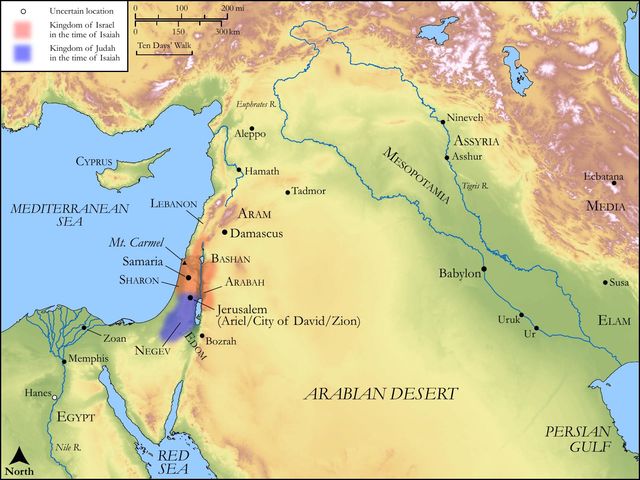
See on the biblical-era map
Study this verse
Public-domain commentary
Matthew Henry
From his Commentary on the Whole Bible. Henry comments on passages, not single verses — this entry covers Isaiah 28:14–22. His four-level outline is real structure in the source text, so it is rendered as structure.
The prophet, having reproved those that made a jest of the word of God, here goes on to reprove those that made a jest of the judgments of God, and set them at defiance; for he is a jealous God, and will not suffer either his ordinances or his providences to be brought into contempt. He addressed himself to the scornful men who ruled in Jerusalem, who were the magistrates of the city, Isa 28:14. It is bad with a people when their thrones of judgment become the seats of the scornful, when rulers are scorners; but that the rulers of Jerusalem should be men of such a character, that they should make light of God's judgments and scorn to take notice of the tokens of his displeasure, is very sad. Who will be mourners in Zion if they are scorners? Observe,
I.How these scornful men lulled themselves asleep in carnal security, and even challenged God Almighty to do his worst (Isa 28:15) You have said, We have made a covenant with death and the grave. They thought themselves as sure of their lives, even when the most destroying judgments were abroad, as if they had made a bargain with death, upon a valuable consideration, not to come till they sent for him or not to take them away by any violence, but by old age. If we be at peace with God, and have made a covenant with him, we have in effect made a covenant with death that it shall come in the fittest time, that whenever it comes, it shall be no terror to us, nor do us any real damage; death is ours if we be Christ's (Co1 3:22, Co1 3:23): but to think of making death our friend, or being in league with it, while by sin we are making God our enemy and are at war with him, is the greatest absurdity that can be. It was fond conceit which these scorners had, "When the overflowing scourge shall pass through our country, and others shall fall under it, yet it shall not come to us, not reach us, though it extend far, not bear us down, though it is an overflowing scourge." It is the greatest folly imaginable for impenitent sinners to think that either in this world or the other they shall fare better than their neighbours. But what is the ground of their confidence? Why, truly, We have made lies our refuge. Either,
1.Those things which the prophets told them would be lies and falsehood to them and would deceive, but which they themselves looked upon as substantial fences. The protection of their idols, the promises with which their false prophets soothed them, their policy, their wealth, their interest in the people; these they confided in, and not in God; nay, these they confided in against God. Or,
2.Those things which should be lies and falsehood to the enemy, who was flagellum Dei - the scourge of God, the overflowing scourge; they would secure themselves by imposing upon the enemy with their stratagems of war, or their feigned submissions in treaties of peace. The rest of the cities of Judah were taken because they made an obstinate defence; but the rulers of Jerusalem hope to succeed better. They think themselves greater politicians than those of the country towns; they will compliment the king of Assyria with a promise to surrender their city, or to become tributaries to him, with a purpose at the same time to shake off his yoke as soon as the danger is over, not caring though they be found liars to him, as the expression is, Deu 33:29. Note, Those put a cheat upon themselves that think to gain their point by putting cheats upon those they deal with. Those that pursue their designs by trick and fraud, by mean and paltry shifts, may perhaps compasss them, but cannot expect comfort in them. Honesty is the best policy. But such refuges as these are those driven to that depart from God, and throw themselves out of his protection.
II.How God, by the prophet, awakens them out of this sleep, and shows them the folly of their security.
1.He tells them upon what grounds they might be secure. He does not disturb their false confidences, till he has first shown them a firm bottom on which they may repose themselves (Isa 28:16): Behold, I lay in Zion for a foundation a stone. This foundation is,
(1.)The promises of God in general - his word, upon which he has caused his people to hope - his covenant with Abraham, that he would be a God to him and his; this is a foundation, a foundation of stone, firm and lasting, for faith to build upon; it is a tried stone, for all the saints have stayed themselves upon it and it never failed them.
(2.)The promise of Christ in particular; for to him this is expressly applied in the New Testament, Pe1 2:6-8. He is that stone which has become the head of the corner. The great promise of the Messiah and his kingdom, which was to begin at Jerusalem, was sufficient to make God's people easy in the worst of times; for they knew well that till he came the sceptre should not depart from Judah. Zion shall continue while this foundation is yet to be laid there. "Thus saith the Lord Jehovah, for the comfort of those that dare not make lies their refuge, Behold, and look upon me as one that has undertaken to lay in Zion a Stone," Jesus Christ is a foundation of God's laying. This is the Lord's doing. He is laid in Zion, in the church, in the holy hill. He is a tried stone, a trying stone (so some), a touch-stone, that shall distinguish between true and counterfeit. He is a precious stone, for such are the foundations of the New Jerusalem (Rev 21:19), a corner-stone, in whom the sides of the building are united, the head-stone of the corner. And he that believes these promises, and rests upon them, shall not make haste, shall not run to and fro in a hurry, as men at their wits' end, shall not be shifting hither and thither for his own safety, nor be driven to his feet by any terrors, as the wicked man is said to be (Job 18:11), but with a fixed heart shall quietly wait the event, saying, Welcome the will of God. He shall not make haste in his expectations, so as to anticipate the time set in the divine counsels, but, though it tarry, will wait the appointed hour, knowing that he that shall come will come, and will not tarry. He that believes will not make more haste than good speed, but be satisfied that God's time is the best time, and wait with patience for it. The apostle from the Septuagint explains this, Pe1 2:6. He that believes on him shall not be confounded; his expectations shall not be frustrated, but far out-done.
2.He tells them that upon the grounds which they now built on they could not be safe, but their confidences would certainly fail them (Isa 28:17): Judgment will I lay to the line, and righteousness to the plummet. This denotes,
(1.)The building up of his church; having laid the foundation (Isa 28:16), he will raise the structure, as builders do, by line and plummet, Zac 4:10. Righteousness shall be the line and judgment the plummet. The church, being grounded on Christ, shall be formed and reformed by the scripture, the standing rule of judgment and righteousness. Judgment shall return unto righteousness, Psa 94:15. Or,
(2.)The punishing of the church's enemies, against whom he will proceed in strict justice, according to the threatenings of the law. He will give them their deserts, and bring upon them the judgments they have challenged, but in wisdom too, and by an exact rule, that the tares may not be plucked up with the wheat. And when God comes thus to execute judgment,
[1.]These scornful men will be made ashamed of the vain hopes with which they had deluded themselves. First, They designed to make lies their refuge; but it will indeed prove a refuge of lies, which the hail shall sweep away, that tempest of hail spoken of Isa 28:2. Those that make lies their refuge build upon the sand, and the building will fall when the storm comes, and bury the builder in the ruins of it. Those that make any thing their hiding place but Christ shall find that the waters will overflow it, as every shelter but the ark was over-topped and overthrown by the waters of the deluge. Such is the hope of the hypocrite; this will come of all his confidences. Secondly, They boasted of a covenant with death, and an agreement with the grave; but it shall be disannulled, as made without his consent who has the keys and sovereign command of hell and death. Those do but delude themselves that think by any wiles to evade the judgments of God. Thirdly, They fancied that when the overflowing scourge should pass through the land it should not come near them; but the prophet tells them that then, when others were falling by the common calamity, they should not only share in it, but should be trodden down by it: "You shall be to it for a treading down; it shall triumph over you as much as over any other, and you shall become its easy prey." They are further told (Isa 28:19), 1. That it shall begin with them; they shall be so far from escaping it that they shall be the first that shall fall by it: "From the time it goes forth it shall take you, as if it came on purpose to seize you." 2. That it shall pursue them closely: "Morning by morning shall it pass over; as duly as the day returns you shall hear of some desolation or other made by it; for divine justice will follow its blow; you shall never be safe nor easy by day nor by night; there shall be a pestilence walking in darkness and a destruction wasting at noonday." 3. That there shall be no avoiding it: "The understanding of the report of its approach shall not give you any opportunity to make your escape, for there shall be no way of escape open; but it shall be only a vexation, you shall see it coming, and not see how to help yourselves." Or, "The very report of it at a distance will be a terror to you; what then will the thing itself be?" Evil tidings are a terror and vexation to scorners, but he whose heart is fixed, trusting in God, is not afraid of them; whereas, when the overflowing scourge comes, then all the comforts and confidences of scorners fail them, Isa 28:20. (1.) That in which they thought to repose themselves reaches not to the length of their expectations: The bed is shorter than that a man can stretch himself upon it, so that he is forced to cramp and contract himself. (2.) That in which they thought to shelter themselves proves insufficient to answer the intention: The covering is narrower than that a man can wrap himself in it. Those that do not build upon Christ as their foundation, but rest in a righteousness of their own, will prove in the end thus to have deceived themselves; they can never be easy, safe, nor warm; the bed is too short, the covering is too narrow; like our first parents' fig-leaves, the shame of their nakedness will still appear.
[2.]God will be glorified in the accomplishment of his counsels, Isa 28:21. When God comes to contend with these scorners, First, He will do his work, and bring to pass his act, he will work for his own honour and glory, according to his own purpose; the work shall appear to all that see it to be the work of God as the righteous Judge of the earth. Secondly, He will do it now against his people, as formerly he did it against their enemies, by which his justice will appear to be impartial; he will now rise up against Jerusalem as, in David's time, against the Philistines in Mount Perazim (Sa2 5:20), and as, in Joshua's time, against the Canaanites in the valley of Gibeon. If those that profess themselves members of God's church by their pride and scornfulness make themselves like Philistines and Canaanites, they must expect to be dealt with as such. Thirdly, This will be his strange work, his strange act, his foreign deed. It is work that he is backward to: he rather delights in showing mercy, and does not afflict willingly. It is work that he is not used to as to his own people; he protects and favours them. It is a strange work indeed if he turn to be their enemy and fight against them, ch. 63:10. It is a work that all the neighbours will stand amazed at (Deu 29:24), and therefore the ruins of Jerusalem are said to be an astonishment, Jer 25:18.
Lastly, We have the use and application of all this (Isa 28:22): "Therefore be you not mockers; dare not to ridicule either the reproofs of God's word or the approaches of his judgments." Mocking the messengers of the Lord was Jerusalem's measure-filling sin. The consideration of the judgments of God that are coming upon hypocritical professors should effectually silence mockers, and make them serious: "Be you not mockers, lest your bands be made strong, both the bands by which you are bound under the dominion of sin" (for there is little hope of the conversion of mockers) "and the bands by which you are bound over to the judgments of God." God has bands of justice strong enough to hold those that break all the bonds of his law asunder and cast away all his cord from them. Let not these mockers make light of divine threatenings, for the prophet (who is one of those with whom the secret of the Lord is) assures them that the Lord God of hosts has, in his hearing, determined a consumption upon the whole earth; and can they think to escape? or shall their unbelief invalidate the threatening?
Historical interpretation
Two Centuries of Reception
2 surviving comments on this verse. Each one is dated, so this reads as a timeline rather than a list.
Select a marker to jump to its quote. Markers stagger vertically where authors wrote within a few decades of each other.
(Verse 21, 22.) For just as the Lord will stand on the mountain of divisions, and will be angry in the valley of Gibeon, to do his work, his strange work, to carry out his task, his alien task. And now do not mock: lest perhaps your chains be tightened. For I have heard from the Lord God of hosts a conclusion and an abbreviation over all the earth. LXX: As the mountain of the wicked rises, the Lord will arise, and it will be in the valley of Gibeon, when he does his work with fury, the work of bitterness and his fury he will use as if it were alien: and his bitterness as if it were foreign. And do not rejoice, neither let your bonds be strengthened, for I have heard from the Lord God of Hosts that the things which he will do upon the whole earth are consummated and abbreviated. The Lord has promised to place a precious stone in the foundations of Zion, in order to overturn falsehood and the hope of the wicked; and to abolish the covenant with death and the agreement with hell by a powerful storm. Because the princes did not want to accept Him, just as in the past against the Allophyli, when David reigned on the mountain of divisions, which in Hebrew is called Pharasim, the Lord brought down his adversaries, from where the place also received its name. And as in the valley of Gibeon, under the leadership of Joshua, when the confidence of the inhabitants in themselves spoke to God: Sun, stand still in Gibeon, and moon, in the valley of Aijalon ((or Elon)) (Joshua 10:12); and the sun stood still for the space of a whole day; and many of the foreign invaders perished: so the Lord will be angry with the wicked and the mockers, in order to accomplish His work. For it is not the work of the Lord to destroy those whom He has created; but to perform a work that belongs more to cruelty than to clemency. And again the same thing is repeated in other words, so that it may accomplish its work. It is not his task to punish sinners, but the stranger, and alien from him, that he may punish who is the Savior. Therefore, since the Lord is about to rise again from his patience, and will not spare: just as he did not spare on Mount Pharasim, and in the valley of Gibeon: I warn you, O mocking men, that you should not at all laugh at my prophets, and that you should not think that the things they proclaim are not going to happen, lest if you persist in mocking, the bonds of your sins may be tightened (For by the cords of his own sins each one is bound (Prov. V, 22), or lest the time of captivity may come upon you. Indeed, what the Lord delayed in time, the bonds, captivity, and punishments, or the final day of judgment, He is now about to fulfill, accomplish, and shorten. Therefore, as a prophet, I announce to you the things that I have known from the Lord God Almighty that will happen over the whole earth, so that you may prevent the impending wrath with repentance. According to the Septuagint, the Lord Himself is said to rise like a mountain of the wicked and to be present in the valley of Gibeon, in order to perform His works, which are all one work of bitterness: which should by no means be seen as blasphemous. For the Lord does not say that the mountain of the wicked will come, but that it is like a mountain, which appears to be very heavy to the wicked and those who endure them. Just as if one careless son and another sick son, the father and the doctor could be cruel if they restore them to health with beatings and cauterization. For the Lord will rise and will be in the valley of Gibeon, on account of those who, because of their sins, remain in a humble place, and because of the swelling of their souls, are raised up in pride. For Gabaon, the hill interprets: that it may do its works, which are works of bitterness; when forced to change mercy, it becomes bitter instead of sweet. Therefore, you who are about to suffer these things, do not now rejoice in that joy in which he rejoiced and was richly clothed in purple at the feast, while neglecting Lazarus the poor (Luke 16): lest your chains become stronger. For what the Lord is going to do and how he will fulfill his judgement, these things I have both heard and announced to you. And what it means: According to history, understand it as referring to the borders of Judea extending over all the land; according to allegory, understand it as referring to the entire world.
They do not understand that God grants to each period of time what is appropriate. As he commanded marriage in the law, so in the gospel does he recommend virginity. In the law, an eye is to be offered for an eye, but in the gospel, the other side of the cheek is to be offered to one’s assailant. The former arrangement was for a weak people, whereas the latter is for the perfect. Nevertheless each order was adapted to its proper time. Yet it is not to be believed on the basis of this change that God is mutable. Instead, it should be proclaimed a miracle that while remaining immutable himself, God gave to each era its own distinctly appropriate order.Sins were of lesser guilt under the Old Testament because only a shadow of the truth, not truth itself, was present therein. For the higher precepts of the New Testament reveal that we are to forsake some of those things to which the people of the shadow of truth were bound. Previously, for instance, fornication and the taking of retribution for injuries were permitted without punishment. In the New Testament, however, they are condemned with severe punishments.
The creed and the Lord’s Prayer replace the whole law in sufficing to obtain the kingdom of heaven for the little ones of the church. For the entire breadth of Scripture is contained briefly in the Lord’s Prayer and the creed. Thus does the prophet Isaiah say, “I heard from the Lord God of hosts about an abbreviation upon all the earth.”
Continue studying Isaiah 28:22 across the web’s major study libraries — every link below opens this exact verse, chapter, or book on the destination site.
Read & Compare
 BibleGatewayThis verse in more than 200 translations and 70 languages.
 Bible.comThe YouVersion reader — hundreds of translations, reading plans, and highlights.
 ESV.orgCrossway's official English Standard Version reader.
 NET BibleThe NET translation with 60,000+ translators' notes on every rendering decision.
 STEP BibleTyndale House's free study tool — original text, vocabulary, and scholarly resources.
 BibliaLogos Bible Software's free web reader.
 USCCBThe New American Bible (Revised Edition) with the U.S. bishops' study notes.
Commentaries
 BibleHub CommentariesDozens of classic commentaries on this verse, gathered on one page.
 StudyLightMore than 100 commentary sets — the largest collection on the web.
 BibleRefPlain-English commentary on what this verse means, verse by verse.
 Enduring WordDavid Guzik's free commentary on this chapter, widely used by Bible teachers.
 Bible Study ToolsVerse commentary alongside Greek and Hebrew study aids.
Original Language & Research
- BibleHub InterlinearThe verse word by word — original language, transliteration, and English.
- BibleHub LexiconEvery word's original-language definition and Strong's entry.
 Blue Letter BibleDeep-study tools — Strong's numbers, concordance, and word studies.
 SefariaThe Hebrew text with Rashi and centuries of Jewish commentary.
Sermons, Hymns & Audio


TrulyRandomVerse is not affiliated with these sites and doesn’t control their content. They’re linked because they’re genuinely useful.
Summary
Isaiah 28:22 delivers a stark and urgent prophetic warning to the scornful leaders of Judah and Ephraim, exhorting them to abandon their derisive attitude lest their impending judgment and spiritual bondage intensify. The prophet emphatically declares that he has received an unalterable decree directly from the sovereign Lord GOD of hosts: a complete and devastating "consumption" that is "determined upon the whole earth," signifying the inescapable and universal nature of God's righteous judgment against those who defiantly mock His divine word and authority.
Context
ShowHideLiterary Context
Isaiah 28 opens with a severe "Woe" pronounced against the "proud crown of the drunkards of Ephraim" (Isaiah 28:1), condemning the northern kingdom's arrogance, revelry, and spiritual blindness. The prophet contrasts their fleeting glory with God's enduring foundation, the precious cornerstone laid in Zion (Isaiah 28:16). The narrative then shifts focus to the leaders in Jerusalem, who exhibit a similarly mocking spirit, dismissing Isaiah's simple, repetitive messages as babbling suitable only for infants (Isaiah 28:9-10). They boast of a deceptive "covenant with death and an agreement with Sheol" (Isaiah 28:15), believing they are immune to divine judgment. Verse 22 serves as a direct and stern rebuttal to this scoffing, emphasizing the terrifying certainty of the judgment they so flippantly disregard, setting the stage for the parable of the farmer in Isaiah 28:23-29, which illustrates God's wise and purposeful actions, even in the execution of His judgments.
Historical & Cultural Context
The prophecy of Isaiah 28 is situated against the ominous backdrop of the Assyrian Empire's relentless expansion and dominance in the 8th century BCE. Both the northern kingdom of Israel (Ephraim/Samaria) and the southern kingdom of Judah faced existential threats from this formidable power. Ephraim, having repeatedly rejected God's covenant, was relying on precarious political alliances and military strength, often involving treaties with pagan nations, rather than trusting in the Lord's protective hand. Their culture was characterized by moral decay, widespread drunkenness, and a dismissive attitude towards the prophetic warnings sent by God. Judah's leaders, while perhaps less overtly idolatrous than their northern counterparts, shared a similar spiritual arrogance and a dangerous tendency to seek security in human schemes and political maneuvering rather than in divine providence. The "consumption...determined upon the whole earth" likely refers to the widespread devastation brought by the Assyrian war machine, which God was using as an instrument of His judgment, but it also carries broader implications of an ultimate divine reckoning that transcends their immediate historical context.
Key Themes
ShowHideThis verse profoundly contributes to several overarching themes woven throughout the book of Isaiah. It underscores the danger of spiritual arrogance and mockery, powerfully demonstrating that scoffing at God's word and His messengers only invites more severe consequences, tightening the "bands" of judgment upon the defiant. It highlights the inevitability and certainty of divine judgment, emphasizing that God's decrees are "determined" and cannot be thwarted by human resistance, disbelief, or clever schemes. The majestic title "Lord GOD of hosts" reinforces God's absolute sovereignty and omnipotent power over all nations, armies, and historical events, including the Assyrian invasion, which is seen as His divinely orchestrated instrument. Furthermore, it subtly introduces the theme of God's purposeful work, even in judgment, as seen in the broader context of Isaiah 28, which contrasts the impending destruction with the ultimate establishment of God's righteous cornerstone in Zion (Isaiah 28:16), revealing His ultimate redemptive plan amidst punitive actions.
Exposition and Analysis
ShowHideKey Word Analysis
ShowHideThis term describes individuals who scoff, scorn, or deride, often displaying cynical contempt for what is sacred, serious, or true. In this context, it refers specifically to the leaders of Judah and Ephraim who dismiss God's warnings and His prophets with disdain, treating divine truth as foolishness or irrelevant babble. Their persistent mockery hardens their hearts, rendering them unreceptive to repentance and sealing their fate under impending judgment.
This word literally refers to bonds, fetters, or chains. Figuratively, it denotes restraint, oppression, or captivity. The warning "lest your bands be made strong" implies that their continued mockery will not lead to liberation or escape from their troubles. Instead, it will tighten the grip of their impending judgment, leading to increased spiritual, social, or physical bondage, making their distress more severe and inescapable.
This word signifies a completion, a full end, or utter destruction. It denotes something utterly consumed, brought to an end, or entirely spent. Coupled with the word "determined," it emphasizes the decisive, complete, and devastating nature of the judgment that God has decreed, leaving no room for evasion, reversal, or partial escape.
Verse Breakdown
ShowHide"Now therefore be ye not mockers,"
This serves as a direct, urgent, and impassioned admonition from the prophet to the scornful leaders. The prophet implores them to cease their derisive attitude towards God's warnings and His messengers. It is a solemn call to recognize the profound gravity of their spiritual state and the serious, perilous implications of their disdain for divine truth.
"lest your bands be made strong:"
This clause reveals the dire and inevitable consequence of continued mockery and spiritual hardening. Their rejection of divine truth and their hardened hearts will not lead to freedom or immunity but to a deepening of their existing or impending bondage. The "bands" represent the oppressive forces or judgments that will tighten their grip on them, making their suffering, captivity, or spiritual enslavement more severe and inescapable.
"for I have heard from the Lord GOD of hosts a consumption,"
This introduces the divine authority, absolute certainty, and terrifying nature behind the prophetic warning. Isaiah emphasizes that his message is not a human opinion but a direct, authoritative revelation from "the Lord GOD of hosts," a majestic title highlighting God's supreme sovereignty over all creation, heavenly armies, and earthly powers. The "consumption" refers to a complete, utter, and devastating destruction or end, signifying the severity and finality of the impending judgment.
"even determined upon the whole earth."
This final phrase underscores the unalterable and universal scope of this divine decree. The judgment is not merely a possibility or a conditional threat but a fixed, unchangeable decision ("determined" by God's sovereign will). While it has immediate implications for Judah and Ephraim, the phrase "upon the whole earth" suggests a broader, perhaps ultimate, eschatological judgment that transcends their immediate historical context, demonstrating God's universal dominion and His righteous governance over all humanity.
Literary Devices
ShowHideIsaiah 28:22 employs several potent literary devices to convey its urgent and severe message. The direct command, "be ye not mockers," functions as a Prophetic Warning, a common and critical feature in prophetic literature designed to elicit immediate repentance and avert impending disaster. The phrase "lest your bands be made strong" utilizes Metaphor to vividly portray the escalating consequences of their actions; "bands" symbolize the oppressive forces of judgment, captivity, or the tightening grip of sin that will ensnare them. The concept of a "consumption... determined upon the whole earth" serves as a Divine Oracle, a solemn pronouncement directly from the sovereign God, emphasizing the unalterable and universal nature of His decree. Furthermore, there is a profound element of Irony embedded in the verse: the mockers, in their arrogance, believe they are clever and immune to consequence, yet their very act of mockery is precisely what strengthens the chains and intensifies the judgment they seek to avoid, leading them deeper into the bondage they disdain.
Theological and Thematic Connections
ShowHideThis verse powerfully articulates God's unwavering resolve to execute righteous judgment against unrepentant sin, spiritual arrogance, and mocking defiance. It reveals that God's warnings are never idle threats but are expressions of His holy character, His commitment to justice, and His desire for humanity to turn from destructive paths. The "consumption" is presented as a divine decree, illustrating that God is not merely reactive to human sin but is sovereignly active in history, bringing about His determined purposes. This judgment is not arbitrary but a direct and just consequence of human rejection of divine truth and persistent rebellion against His authority.
Reflection and Application
ShowHideIsaiah 28:22 stands as a timeless and profoundly sobering reminder of the seriousness with which God regards our response to His revealed word. It compels us to diligently examine our own hearts for any subtle traces of cynicism, dismissiveness, or spiritual apathy towards divine truths, especially those pronouncements that call us to repentance, warn of consequences, or challenge our comfortable assumptions. A mocking spirit is not merely a personality quirk or an intellectual posture; it is a dangerous spiritual condition that hardens the heart, rendering it impervious to the very grace, wisdom, and guidance designed to set us free from sin's oppressive grip. This verse challenges us to cultivate a posture of humility, to listen intently and receptively to God's voice as revealed in Scripture, and to understand that His warnings are not intended to frighten us into submission but to lovingly guide us away from paths that inevitably lead to deeper bondage and inescapable judgment. To take God's word seriously, even its sternest pronouncements, is to walk in true wisdom and to open ourselves to His transformative power, thereby preventing the "bands" of sin and its devastating consequences from tightening their hold on our lives.
Questions for Reflection
ShowHideFAQ
ShowHideWhat does "lest your bands be made strong" mean in this context?
ShowHideThe phrase "lest your bands be made strong" is a powerful and dire warning indicating that continued mockery and defiance of God's word will not lead to freedom or escape from trouble, but rather to an intensification of their current or impending bondage. "Bands" (Hebrew: môwçêr) literally refers to fetters, chains, or restraints used to bind. Figuratively, it represents the oppressive consequences of their sin, such as political subjugation, spiritual captivity to their own hardened hearts, or the tightening grip of their own destructive choices. The more the leaders scoffed at divine warnings and rejected the path of repentance, the more they hardened their hearts, making them less likely to turn to God and thus ensuring that the judgment God had "determined" would fall upon them with greater severity, binding them more tightly in their distress. This is a direct, divinely ordained consequence of their spiritual arrogance and rebellion, as seen throughout the broader context of Isaiah 28.
Christ-Centered Fulfillment
ShowHideIsaiah 28:22, with its stark warning against mockery and its declaration of a "consumption... determined upon the whole earth," finds its ultimate Christ-centered fulfillment in the person and redemptive work of Jesus Christ. While the verse speaks of a judgment that tightens the "bands" of sin and rebellion, Christ is the one who ultimately breaks these very bonds. He came not to strengthen the chains of humanity but to proclaim liberty to the captives and the opening of the prison to those who are bound, as prophesied in Isaiah 61:1 and powerfully fulfilled in His inaugural sermon in Luke 4:18-19. The "consumption" of sin and its devastating consequences, which was determined by God's righteous decree, was fully and perfectly borne by Christ on the cross. He became the ultimate sacrifice, the Lamb of God who takes away the sin of the world (John 1:29), thereby consuming the power of sin, death, and the law's condemnation for all who believe. Furthermore, while Isaiah warns of a judgment "determined upon the whole earth," Christ is the one appointed by God to be the Judge of the living and the dead (Acts 10:42). His first coming offered grace and deliverance from the "bands" of sin, and His second coming will bring the final, righteous judgment, fulfilling the "determined consumption" for those who persist in mocking defiance, while ushering in eternal freedom and life for those who have placed their faith and trust in Him.