


Isaiah 28:15
Bible text: King James Version (1769 Blayney text) · Public domain
Bible text: King James Version with Strong's numbers · Public domain
Bible text: Berean Standard Bible · Public domain
Bible text: American Standard Version (1901) · Public domain
Bible text: World English Bible, Messianic edition · Public domain
Bible text: Geneva Bible (1599) · Public domain
Bible text: Young's Literal Translation · Public domain
- כִּיkiforH3588PrtParticle Conditional
- אֲמַרְתֶּם'a·mar·Temyou have saidH559V-Qal-Perf-2mpVerb Qal Perfect 2nd Plural Masculine
- כָּרַתְנוּka·Rat·nuwe have madeH3772V-Qal-Perf-1cpVerb Qal Perfect 1st Plural common gender
- בְרִיתve·Rita covenantH1285N-fsNoun Singular Feminine Absolute
- אֶת'etwithH854PrepPreposition
- מָוֶתMa·vetdeathH4194N-msNoun Singular Masculine Absolute
- וְעִםve·'imand withH5973Conj-w ¦ PrepPrepositionוְandעִםwith
- שְׁאוֹלshe·'olSheolH7585N-csNoun Singular common gender Absolute
- עָשִׂינוּ'a·Si·nuwe have madeH6213V-Qal-Perf-1cpVerb Qal Perfect 1st Plural common gender
- חֹזֶהcho·Zehan agreementH2374N-msNoun Singular Masculine Absolute
- שׁוֹטshita scourgeH7752N-msNoun Singular Masculine Absolute
- שׁוֹטֵףsho·TefoverflowingH7857V-Qal-Prtcpl-msVerb Qal Participle Singular Masculine Absolute
- כִּיkiifH3588PrtParticle Conditional
- יַעֲבֹרa·varit will pass byH5674V-Qal-Imperf-3msVerb Qal Imperfect 3rd Singular Masculine
- לֹאlo'notH3808NegParticle Negative
- יְבוֹאֵנוּye·vo·'E·nuit will come to usH935V-Qal-Imperf-3ms ¦ 1cpVerb Qal Imperfect 3rd Singular Masculineיְבוֹאֵit will come toנוּus
- כִּיkiforH3588PrtParticle Conditional
- שַׂמְנוּSam·nuwe have madeH7760V-Qal-Perf-1cpVerb Qal Perfect 1st Plural common gender
- כָזָבkha·ZavfalsehoodH3577N-msNoun Singular Masculine Absolute
- מַחְסֵנוּmach·Se·nuour refugeH4268N-msc ¦ 1cpNoun Singular Masculine Constructמַחְסֵrefugeנוּour
- וּבַשֶּׁקֶרu·va·She·kerand in <the> deceptionH8267Conj-w ¦ Prep-b ¦ N-msNoun Singular Masculine Absoluteוּandבַin <the>שֶּׁקֶרdeception
- נִסְתָּרְנוּnis·Ta·re·nuwe have hidden ourselvesH5641V-Niphal-Perf-1cpVerb Niphal Perfect 1st Plural common gender
English is a literal word-by-word gloss of the Hebrew, not the KJV's wording. Why?
This is the original text the KJV's translators worked from — each Hebrew word with its own literal English meaning in this verse, prepared by scholars at Tyndale House, Cambridge. The KJV translates whole sentences, not word by word, so its wording differs: one Hebrew word can become several English words, and the KJV may choose “the LORD” where the gloss reads “Yahweh”. Both are faithful — they answer different questions. For the KJV's own rendering, switch to the KJV text.
Details
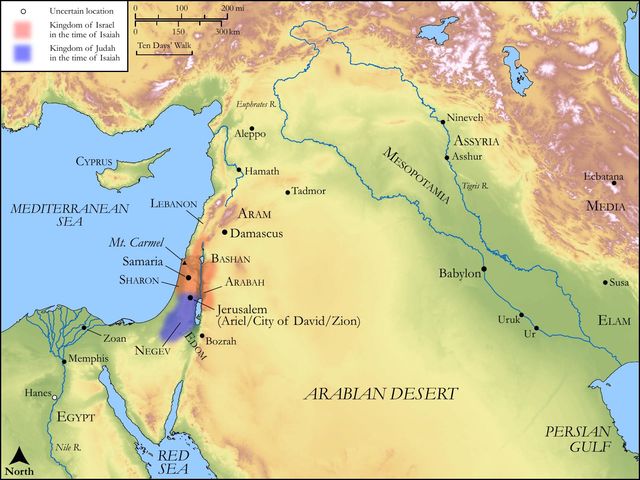
See on the biblical-era map
Study this verse
Public-domain commentary
Matthew Henry
From his Commentary on the Whole Bible. Henry comments on passages, not single verses — this entry covers Isaiah 28:14–22. His four-level outline is real structure in the source text, so it is rendered as structure.
The prophet, having reproved those that made a jest of the word of God, here goes on to reprove those that made a jest of the judgments of God, and set them at defiance; for he is a jealous God, and will not suffer either his ordinances or his providences to be brought into contempt. He addressed himself to the scornful men who ruled in Jerusalem, who were the magistrates of the city, Isa 28:14. It is bad with a people when their thrones of judgment become the seats of the scornful, when rulers are scorners; but that the rulers of Jerusalem should be men of such a character, that they should make light of God's judgments and scorn to take notice of the tokens of his displeasure, is very sad. Who will be mourners in Zion if they are scorners? Observe,
I.How these scornful men lulled themselves asleep in carnal security, and even challenged God Almighty to do his worst (Isa 28:15) You have said, We have made a covenant with death and the grave. They thought themselves as sure of their lives, even when the most destroying judgments were abroad, as if they had made a bargain with death, upon a valuable consideration, not to come till they sent for him or not to take them away by any violence, but by old age. If we be at peace with God, and have made a covenant with him, we have in effect made a covenant with death that it shall come in the fittest time, that whenever it comes, it shall be no terror to us, nor do us any real damage; death is ours if we be Christ's (Co1 3:22, Co1 3:23): but to think of making death our friend, or being in league with it, while by sin we are making God our enemy and are at war with him, is the greatest absurdity that can be. It was fond conceit which these scorners had, "When the overflowing scourge shall pass through our country, and others shall fall under it, yet it shall not come to us, not reach us, though it extend far, not bear us down, though it is an overflowing scourge." It is the greatest folly imaginable for impenitent sinners to think that either in this world or the other they shall fare better than their neighbours. But what is the ground of their confidence? Why, truly, We have made lies our refuge. Either,
1.Those things which the prophets told them would be lies and falsehood to them and would deceive, but which they themselves looked upon as substantial fences. The protection of their idols, the promises with which their false prophets soothed them, their policy, their wealth, their interest in the people; these they confided in, and not in God; nay, these they confided in against God. Or,
2.Those things which should be lies and falsehood to the enemy, who was flagellum Dei - the scourge of God, the overflowing scourge; they would secure themselves by imposing upon the enemy with their stratagems of war, or their feigned submissions in treaties of peace. The rest of the cities of Judah were taken because they made an obstinate defence; but the rulers of Jerusalem hope to succeed better. They think themselves greater politicians than those of the country towns; they will compliment the king of Assyria with a promise to surrender their city, or to become tributaries to him, with a purpose at the same time to shake off his yoke as soon as the danger is over, not caring though they be found liars to him, as the expression is, Deu 33:29. Note, Those put a cheat upon themselves that think to gain their point by putting cheats upon those they deal with. Those that pursue their designs by trick and fraud, by mean and paltry shifts, may perhaps compasss them, but cannot expect comfort in them. Honesty is the best policy. But such refuges as these are those driven to that depart from God, and throw themselves out of his protection.
II.How God, by the prophet, awakens them out of this sleep, and shows them the folly of their security.
1.He tells them upon what grounds they might be secure. He does not disturb their false confidences, till he has first shown them a firm bottom on which they may repose themselves (Isa 28:16): Behold, I lay in Zion for a foundation a stone. This foundation is,
(1.)The promises of God in general - his word, upon which he has caused his people to hope - his covenant with Abraham, that he would be a God to him and his; this is a foundation, a foundation of stone, firm and lasting, for faith to build upon; it is a tried stone, for all the saints have stayed themselves upon it and it never failed them.
(2.)The promise of Christ in particular; for to him this is expressly applied in the New Testament, Pe1 2:6-8. He is that stone which has become the head of the corner. The great promise of the Messiah and his kingdom, which was to begin at Jerusalem, was sufficient to make God's people easy in the worst of times; for they knew well that till he came the sceptre should not depart from Judah. Zion shall continue while this foundation is yet to be laid there. "Thus saith the Lord Jehovah, for the comfort of those that dare not make lies their refuge, Behold, and look upon me as one that has undertaken to lay in Zion a Stone," Jesus Christ is a foundation of God's laying. This is the Lord's doing. He is laid in Zion, in the church, in the holy hill. He is a tried stone, a trying stone (so some), a touch-stone, that shall distinguish between true and counterfeit. He is a precious stone, for such are the foundations of the New Jerusalem (Rev 21:19), a corner-stone, in whom the sides of the building are united, the head-stone of the corner. And he that believes these promises, and rests upon them, shall not make haste, shall not run to and fro in a hurry, as men at their wits' end, shall not be shifting hither and thither for his own safety, nor be driven to his feet by any terrors, as the wicked man is said to be (Job 18:11), but with a fixed heart shall quietly wait the event, saying, Welcome the will of God. He shall not make haste in his expectations, so as to anticipate the time set in the divine counsels, but, though it tarry, will wait the appointed hour, knowing that he that shall come will come, and will not tarry. He that believes will not make more haste than good speed, but be satisfied that God's time is the best time, and wait with patience for it. The apostle from the Septuagint explains this, Pe1 2:6. He that believes on him shall not be confounded; his expectations shall not be frustrated, but far out-done.
2.He tells them that upon the grounds which they now built on they could not be safe, but their confidences would certainly fail them (Isa 28:17): Judgment will I lay to the line, and righteousness to the plummet. This denotes,
(1.)The building up of his church; having laid the foundation (Isa 28:16), he will raise the structure, as builders do, by line and plummet, Zac 4:10. Righteousness shall be the line and judgment the plummet. The church, being grounded on Christ, shall be formed and reformed by the scripture, the standing rule of judgment and righteousness. Judgment shall return unto righteousness, Psa 94:15. Or,
(2.)The punishing of the church's enemies, against whom he will proceed in strict justice, according to the threatenings of the law. He will give them their deserts, and bring upon them the judgments they have challenged, but in wisdom too, and by an exact rule, that the tares may not be plucked up with the wheat. And when God comes thus to execute judgment,
[1.]These scornful men will be made ashamed of the vain hopes with which they had deluded themselves. First, They designed to make lies their refuge; but it will indeed prove a refuge of lies, which the hail shall sweep away, that tempest of hail spoken of Isa 28:2. Those that make lies their refuge build upon the sand, and the building will fall when the storm comes, and bury the builder in the ruins of it. Those that make any thing their hiding place but Christ shall find that the waters will overflow it, as every shelter but the ark was over-topped and overthrown by the waters of the deluge. Such is the hope of the hypocrite; this will come of all his confidences. Secondly, They boasted of a covenant with death, and an agreement with the grave; but it shall be disannulled, as made without his consent who has the keys and sovereign command of hell and death. Those do but delude themselves that think by any wiles to evade the judgments of God. Thirdly, They fancied that when the overflowing scourge should pass through the land it should not come near them; but the prophet tells them that then, when others were falling by the common calamity, they should not only share in it, but should be trodden down by it: "You shall be to it for a treading down; it shall triumph over you as much as over any other, and you shall become its easy prey." They are further told (Isa 28:19), 1. That it shall begin with them; they shall be so far from escaping it that they shall be the first that shall fall by it: "From the time it goes forth it shall take you, as if it came on purpose to seize you." 2. That it shall pursue them closely: "Morning by morning shall it pass over; as duly as the day returns you shall hear of some desolation or other made by it; for divine justice will follow its blow; you shall never be safe nor easy by day nor by night; there shall be a pestilence walking in darkness and a destruction wasting at noonday." 3. That there shall be no avoiding it: "The understanding of the report of its approach shall not give you any opportunity to make your escape, for there shall be no way of escape open; but it shall be only a vexation, you shall see it coming, and not see how to help yourselves." Or, "The very report of it at a distance will be a terror to you; what then will the thing itself be?" Evil tidings are a terror and vexation to scorners, but he whose heart is fixed, trusting in God, is not afraid of them; whereas, when the overflowing scourge comes, then all the comforts and confidences of scorners fail them, Isa 28:20. (1.) That in which they thought to repose themselves reaches not to the length of their expectations: The bed is shorter than that a man can stretch himself upon it, so that he is forced to cramp and contract himself. (2.) That in which they thought to shelter themselves proves insufficient to answer the intention: The covering is narrower than that a man can wrap himself in it. Those that do not build upon Christ as their foundation, but rest in a righteousness of their own, will prove in the end thus to have deceived themselves; they can never be easy, safe, nor warm; the bed is too short, the covering is too narrow; like our first parents' fig-leaves, the shame of their nakedness will still appear.
[2.]God will be glorified in the accomplishment of his counsels, Isa 28:21. When God comes to contend with these scorners, First, He will do his work, and bring to pass his act, he will work for his own honour and glory, according to his own purpose; the work shall appear to all that see it to be the work of God as the righteous Judge of the earth. Secondly, He will do it now against his people, as formerly he did it against their enemies, by which his justice will appear to be impartial; he will now rise up against Jerusalem as, in David's time, against the Philistines in Mount Perazim (Sa2 5:20), and as, in Joshua's time, against the Canaanites in the valley of Gibeon. If those that profess themselves members of God's church by their pride and scornfulness make themselves like Philistines and Canaanites, they must expect to be dealt with as such. Thirdly, This will be his strange work, his strange act, his foreign deed. It is work that he is backward to: he rather delights in showing mercy, and does not afflict willingly. It is work that he is not used to as to his own people; he protects and favours them. It is a strange work indeed if he turn to be their enemy and fight against them, ch. 63:10. It is a work that all the neighbours will stand amazed at (Deu 29:24), and therefore the ruins of Jerusalem are said to be an astonishment, Jer 25:18.
Lastly, We have the use and application of all this (Isa 28:22): "Therefore be you not mockers; dare not to ridicule either the reproofs of God's word or the approaches of his judgments." Mocking the messengers of the Lord was Jerusalem's measure-filling sin. The consideration of the judgments of God that are coming upon hypocritical professors should effectually silence mockers, and make them serious: "Be you not mockers, lest your bands be made strong, both the bands by which you are bound under the dominion of sin" (for there is little hope of the conversion of mockers) "and the bands by which you are bound over to the judgments of God." God has bands of justice strong enough to hold those that break all the bonds of his law asunder and cast away all his cord from them. Let not these mockers make light of divine threatenings, for the prophet (who is one of those with whom the secret of the Lord is) assures them that the Lord God of hosts has, in his hearing, determined a consumption upon the whole earth; and can they think to escape? or shall their unbelief invalidate the threatening?
Historical interpretation
Three Centuries of Reception
4 surviving comments on this verse. Each one is dated, so this reads as a timeline rather than a list.
Select a marker to jump to its quote. Markers stagger vertically where authors wrote within a few decades of each other.
What, then, are the burdens that he censures? None but those which they were accumulating of their own accord, when they taught for commandments the doctrines of men; for the sake of private advantage joining house to house, so as to deprive their neighbor of his own; cajoling the people, loving gifts, pursuing rewards, robbing the poor of the right of judgment, that they might have the widow for a prey and the fatherless for a spoil. Of these Isaiah also says, “woe to them that are strong in Jerusalem!”
When you renounce Satan, trampling underfoot every covenant with him, then you annul that ancient “league with hell,” and God’s paradise opens before you, that Eden, planted in the east, from which for his transgression our first father was banished.
(Verse 14, 15). Therefore, hear the word of the Lord, you mockers who rule over my people in Jerusalem. For you have said: We have made a covenant with death, and with the grave we have made a pact. When the overwhelming whip passes through, it will not come to us, for we have made falsehood our refuge, and we have hidden behind deceit. LXX: Therefore, hear the word of the Lord, you men, and leaders of this people in Jerusalem, who are in distress: For you have said: We have made a pact with the grave, and with death we have made a covenant. If the storm passes through, it will not come to us, because we have made falsehood our refuge, and we will be protected by deceit. As we stated above, the leaders of the Jews are accustomed to mock the prophets by saying: Command, re-command; wait, re-wait, and other similar things, by which it is shown that they did not believe in the words of the prophets, but held their prophecies in contempt. The present chapter proves this, through which they are called mocking men. These are the scribes and Pharisees who rule over the people of God in Jerusalem, whom the Seventy call troubled men, and the leaders of the people of Jerusalem. For they said not in word, but in deed: We are like the other nations, we have a pact and covenant with hell and with death: once we have despaired of salvation. Certainly captivity will come after a long time, they will say to you: Yet a little while, yet a little while: wait and wait again. Therefore, when we are dead, we will not feel this scourge of captivity and this storm. For once we believed in falsehood, that is, we had hope in vain in God and in His Law. And so we were protected by a lie, because we avoided impending captivity. The Hebrew word Sot (), Aquila and Symmachus interpreted as a whip, the LXX as a storm; Chasab () also translated it as a lie, in which the Jews hoped, according to the Gospel of John, the father is the devil.
“He has become my help and my protector unto salvation.” They are said to be helpers who grant us their cooperation through specific acts. Protectors, however, are those who defend us with their power. Protection can take a variety of forms. For some, God is a protection, but deception becomes a protection for others, who lie about themselves, as Isaiah said: “We have established deception as our hope, and we are protected by lies.”
Continue studying Isaiah 28:15 across the web’s major study libraries — every link below opens this exact verse, chapter, or book on the destination site.
Read & Compare
 BibleGatewayThis verse in more than 200 translations and 70 languages.
 Bible.comThe YouVersion reader — hundreds of translations, reading plans, and highlights.
 ESV.orgCrossway's official English Standard Version reader.
 NET BibleThe NET translation with 60,000+ translators' notes on every rendering decision.
 STEP BibleTyndale House's free study tool — original text, vocabulary, and scholarly resources.
 BibliaLogos Bible Software's free web reader.
 USCCBThe New American Bible (Revised Edition) with the U.S. bishops' study notes.
Commentaries
 BibleHub CommentariesDozens of classic commentaries on this verse, gathered on one page.
 StudyLightMore than 100 commentary sets — the largest collection on the web.
 BibleRefPlain-English commentary on what this verse means, verse by verse.
 Enduring WordDavid Guzik's free commentary on this chapter, widely used by Bible teachers.
 Bible Study ToolsVerse commentary alongside Greek and Hebrew study aids.
Original Language & Research
- BibleHub InterlinearThe verse word by word — original language, transliteration, and English.
- BibleHub LexiconEvery word's original-language definition and Strong's entry.
 Blue Letter BibleDeep-study tools — Strong's numbers, concordance, and word studies.
 SefariaThe Hebrew text with Rashi and centuries of Jewish commentary.
Sermons, Hymns & Audio


TrulyRandomVerse is not affiliated with these sites and doesn’t control their content. They’re linked because they’re genuinely useful.
Summary
Isaiah 28:15 powerfully exposes the profound spiritual delusion and arrogant self-reliance of Jerusalem's leaders. Facing the existential threat of the Assyrian Empire, they defiantly boasted of having forged a perverse "covenant with death" and an "agreement with hell." This declaration reflected their misguided confidence that their cunning political strategies and deceitful alliances would shield them from the "overflowing scourge" of divine judgment. The verse unmasks their true refuge: a treacherous foundation built upon "lies" and "falsehood," revealing a deep moral corruption and a tragic rejection of God as their true deliverer.
Context
ShowHideLiterary Context
Isaiah 28 begins with a severe "Woe" oracle initially aimed at the northern kingdom of Israel (Ephraim), condemning their pride, spiritual intoxication, and imminent downfall (e.g., Isaiah 28:1-8). However, the prophetic focus swiftly shifts to the southern kingdom of Judah, particularly its leaders in Jerusalem. Isaiah confronts their similar spiritual arrogance, their dismissive attitude towards God's clear, yet simple, instruction—likened to "line upon line, precept upon precept" in Isaiah 28:9-10—and their dangerous reliance on human wisdom and foreign political maneuvering. Verse 15 specifically captures the defiant and profoundly deluded mindset of these Judean leaders, setting the immediate stage for God's direct response of judgment and, crucially, His subsequent promise of a true, divine cornerstone in Isaiah 28:16.
Historical & Cultural Context
The historical setting for Isaiah 28 is the tumultuous 8th century BCE, a period dominated by the relentless and brutal expansion of the Neo-Assyrian Empire. Both the northern kingdom of Israel and the southern kingdom of Judah faced immense pressure to either submit to Assyrian hegemony or form precarious alliances with other regional powers, such as Egypt. While Israel ultimately fell to Assyria in 722 BCE, Judah, under kings like Ahaz and Hezekiah, often wavered between trusting in the Lord and seeking political security through treaties with powerful, often pagan, nations. The "overflowing scourge" is a clear and terrifying reference to the impending Assyrian invasion, which God would indeed use as an instrument of judgment against His rebellious people. Culturally, covenants (Hebrew: bᵉrîyth) were profoundly sacred, binding agreements, often solemnized with elaborate oaths and rituals, sometimes involving the cutting of animals. To speak of a "covenant with death" was thus a grotesque and blasphemous perversion of this sacred concept, highlighting the depth of Judah's spiritual depravity and their desperate, unholy attempts to control their own destiny outside of God's will.
Key Themes
ShowHideThis verse powerfully contributes to several overarching themes prominent in the book of Isaiah and across the broader prophetic literature. It starkly illustrates the theme of False Security, demonstrating the utter futility of relying on human schemes, deceptive alliances, and self-made solutions rather than on God's divine protection and faithfulness. The leaders' audacious boast reveals profound Spiritual Arrogance and Self-Deception, as they narcissistically believed themselves immune to God's judgment—a recurring motif throughout the prophets when addressing Israel's and Judah's rebellion. The explicit mention of "lies" and "falsehood" underscores the critical theme of Truth vs. Deceit, sharply contrasting the deceptive nature of human strategies with the steadfast, immutable truth of God. Ultimately, the verse serves as a dramatic prelude to the theme of Divine Judgment, which, despite their boasts, is inevitable and serves to expose the hollowness and fragility of their false refuge, thereby paving the way for the subsequent revelation of God's true and Reliable Foundation in the promised cornerstone (Isaiah 28:16).
Exposition and Analysis
ShowHideKey Word Analysis
ShowHideFrom a root meaning "to cut" (like H3772, kârath), signifying a solemn, binding agreement, often made by passing between pieces of flesh. Here, it is perversely applied to an alliance with "death" and "hell," indicating a formal, intentional, and deeply misguided commitment to unholy powers or deceptive strategies, rather than to a covenant with the living God.
Refers to physical death, the state of the dead, or the realm of the dead (Hades). In this context, it personifies the destructive forces and ultimate end that the leaders believe they have circumvented through their illicit agreements, highlighting the spiritual deadness and ruin inherent in their chosen path of rebellion.
Denotes falsehood, untruth, or deceit, often with the implication of something that disappoints or fails. This word emphasizes the deliberate nature of their deception and the unreliable, illusory foundation upon which their perceived security was built. It contrasts sharply with the character of God, who is truth, and highlights the moral bankruptcy of their chosen refuge.
Verse Breakdown
ShowHide"Because ye have said, We have made a covenant with death,"
This opening clause lays bare the arrogant and blasphemous declaration of Jerusalem's leaders. They openly boast of having forged a formal, binding agreement, not with a human power or with God, but with "death" itself. This signifies a profound spiritual perversion, a belief that they have somehow mastered, appeased, or allied themselves with the very forces of destruction, making themselves immune to their power. It implies a reliance on dark, unholy, or purely humanistic means to secure their future, utterly rejecting divine providence.
"and with hell are we at agreement;"
This parallel clause reinforces the first, using "hell" (Sheol, the grave or underworld) to further personify the realm of ultimate destruction and demise. To be "at agreement" with it suggests a comfortable, settled understanding or pact, implying a sense of control over the inevitable. This emphasizes their deep-seated delusion that they are beyond the reach of divine judgment, having struck a deal with the very forces that typically signify ultimate defeat and separation from God.
"when the overflowing scourge shall pass through, it shall not come unto us:"
This is the core of their boastful and defiant confidence. The "overflowing scourge" is a vivid and terrifying metaphor for God's impending judgment, specifically referring to the devastating Assyrian invasion that threatened Judah. They are convinced that their "covenant with death and hell" will act as an impenetrable shield, diverting this destructive force and ensuring their safety, demonstrating a profound underestimation of God's sovereignty, justice, and the futility of human schemes against His will.
"for we have made lies our refuge, and under falsehood have we hid ourselves:"
This concluding statement exposes the true, treacherous nature of their perceived security. Their "refuge" (a place of safety or shelter, H4268 machăçeh) is not in God, the true shelter, but in "lies" (H3577 kâzâb) and "falsehood" (H8267 sheqer). This reveals that their entire strategy is built on deceit, treachery, and a deliberate denial of reality. They have actively chosen to conceal themselves under the cloak of untruth, believing that deception can provide ultimate protection, a stark and tragic contrast to the true refuge found only in the unwavering truth of God.
Literary Devices
ShowHideIsaiah 28:15 is rich with impactful literary devices that amplify its message of condemnation. Personification is strikingly evident in the leaders' declaration of a "covenant with death, and with hell are we at agreement." Death and hell, abstract concepts representing the grave and ultimate destruction, are treated as sentient entities with whom a formal treaty can be forged, highlighting the grotesque and blasphemous nature of their spiritual perversion. The phrase "overflowing scourge" functions as a powerful Metaphor, vividly portraying the impending divine judgment as an overwhelming, destructive force, much like a relentless flood or a devastating whip. There is profound Irony in their boast: they believe their lies and false agreements will protect them, yet these very actions are precisely what invite and ensure the "scourge" of God's judgment. Their confident assertion, "it shall not come unto us," is a classic example of Dramatic Irony, as the reader, privy to God's warnings and the historical outcome, knows their schemes are futile and their destruction is imminent, making their boast all the more tragic and poignant.
Theological and Thematic Connections
ShowHideIsaiah 28:15 serves as a profound theological warning against the perennial human tendency to seek security and salvation through self-devised means rather than through humble trust in divine providence. The leaders' "covenant with death and hell" represents humanity's fallen inclination to assert control over its own destiny, to negotiate with spiritual darkness, and to rely on deceptive strategies when faced with overwhelming threats. This grotesque perversion of the sacred covenant concept underscores the deep-seated rebellion against God's sovereignty and His exclusive right to offer true refuge and deliverance. Their reliance on "lies" and "falsehood" highlights the inherent instability, moral bankruptcy, and ultimate futility of any foundation not built upon God's truth and faithfulness. The passage implicitly contrasts this false refuge with the true, divine refuge that God Himself provides, a theme echoed throughout Scripture where God is portrayed as the ultimate shelter, rock, and deliverer for His people.
Reflection and Application
ShowHideIsaiah 28:15 offers a timeless and piercing indictment of spiritual self-reliance and the deceptive allure of false security. In our contemporary world, the "overflowing scourge" may not always manifest as a literal invading army, but it can appear as economic collapse, social upheaval, global pandemics, personal crises, or the inevitable reality of death and judgment itself. This verse compels us to honestly examine where we place our ultimate trust. Do we, like the leaders of Jerusalem, attempt to make "covenants" with our own cunning, our financial portfolios, our social status, our political ideologies, or even our intellectual prowess, believing these can shield us from life's storms or divine accountability? The "lies" and "falsehood" we hide under can be anything from self-deception about our spiritual state to embracing worldly philosophies that deny absolute truth or moral consequences. True refuge is found not in human ingenuity or illicit agreements, but in humble submission to God and reliance on His unfailing truth and sovereign power. This passage challenges us to dismantle any false refuges we have constructed and to build our lives on the solid rock of Christ, the only true and eternal shelter against all scourges.
Questions for Reflection
ShowHideFAQ
ShowHideWhat is the "overflowing scourge" mentioned in Isaiah 28:15?
ShowHideThe "overflowing scourge" (Hebrew: shot shotef) is a vivid prophetic metaphor representing God's impending judgment, typically understood in this specific context as the devastating invasion of the Assyrian army. For the northern kingdom of Israel, this judgment culminated in their fall in 722 BCE. For Judah, it manifested in the Assyrian siege of Jerusalem under Sennacherib, though God miraculously delivered the city (as detailed in Isaiah 36-37). More broadly, it symbolizes any overwhelming, destructive force that God permits or sends as a consequence of human rebellion and a refusal to trust in Him, highlighting the inevitability of divine justice for those who reject His covenant and seek refuge in lies.
How does this verse relate to the concept of "covenant" in the Bible?
ShowHideThe biblical concept of "covenant" (Hebrew: bᵉrîyth) is foundational to understanding God's relationship with humanity, signifying a solemn, binding agreement initiated by God with His people (e.g., the Noahic Covenant, the Abrahamic Covenant, the Mosaic Covenant, the Davidic Covenant, and ultimately the New Covenant). These covenants establish a relationship based on God's faithfulness and His people's obedience. In Isaiah 28:15, the leaders of Judah pervert this sacred concept by claiming to have made a "covenant with death, and with hell are we at agreement." This is a profound act of spiritual rebellion and apostasy, as they turn away from the life-giving covenant with the living God to forge a pact with the forces of destruction and deceit. It underscores the severity of their spiritual depravity and their desperate, futile attempt to find security outside of God's divine provision and truth.
Christ-Centered Fulfillment
ShowHideIsaiah 28:15, with its stark portrayal of a people desperately seeking refuge in a "covenant with death" and "lies," finds its ultimate fulfillment and profound reversal in the person and work of Jesus Christ. The "overflowing scourge" of divine judgment, which the leaders of Judah foolishly tried to evade through their false agreements, ultimately fell upon Christ on the cross. He became the "scourge" for our sins, taking upon Himself the full weight of God's righteous wrath, so that all who trust in Him might not perish but have eternal life (Isaiah 53:5 and 2 Corinthians 5:21). While the leaders made a pact with death, Christ decisively conquered death, rising victorious from the grave and disarming the power of Sheol (Hebrews 2:14-15 and Revelation 1:18). Their "lies" and "falsehood" as a chosen refuge stand in stark contrast to Christ, who unequivocally declared Himself to be "the way, the truth, and the life" (John 14:6). The very next verse in Isaiah, Isaiah 28:16, speaks of a "precious cornerstone" laid in Zion, a sure and tested foundation. This cornerstone is none other than Christ Himself, upon whom believers are built as living stones, finding in Him a true, eternal, and unshakable refuge from the "overflowing scourge" of sin and judgment (1 Peter 2:6-8). Thus, what Judah sought in vain through their perverse and self-destructive covenant, humanity finds perfectly and eternally in the person and redemptive work of Jesus Christ.