


Isaiah 8:9
- רֹעוּRo·'ube badH7489V-Qal-Imp-2mpVerb Qal Imperative 2nd Plural Masculine
- עַמִּים'a·MimO peoplesH5971N-mpNoun Plural Masculine Absolute
- וָחֹתּוּva·Cho·tuand be shatteredH2865Conj-w ¦ V-Qal-Imp-2mpVerb Qal Imperative 2nd Plural Masculineוָandחֹתּוּbe shattered
- וְהַאֲזִינוּve·ha·'a·Zi·nuand give earH238Conj-w ¦ V-Hiphil-Imp-2mpVerb Hiphil Imperative 2nd Plural Masculineוְandהַאֲזִינוּgive ear
- כֹּלkolO allH3605N-mscNoun Singular Masculine Construct
- מֶרְחַקֵּיmer·cha·kei[the] distant places ofH4801N-mpcNoun Plural Masculine Construct
- אָרֶץ'A·retz[the] earthH776N-fsNoun Singular Feminine Absolute
- הִתְאַזְּרוּhit·'a·ze·Rugird yourselvesH247V-Hithpael-Imp-2mpVerb Hithpael Imperative 2nd Plural Masculine
- וָחֹתּוּva·Cho·tuand be shatteredH2865Conj-w ¦ V-Qal-Imp-2mpVerb Qal Imperative 2nd Plural Masculineוָandחֹתּוּbe shattered
- הִתְאַזְּרוּhit·'a·ze·Rugird yourselvesH247V-Hithpael-Imp-2mpVerb Hithpael Imperative 2nd Plural Masculine
- וָחֹתּוּva·Cho·tuand be shatteredH2865Conj-w ¦ V-Qal-Imp-2mpVerb Qal Imperative 2nd Plural Masculineוָandחֹתּוּbe shattered
English is a literal word-by-word gloss of the Hebrew, not the KJV's wording. Why?
This is the original text the KJV's translators worked from — each Hebrew word with its own literal English meaning in this verse, prepared by scholars at Tyndale House, Cambridge. The KJV translates whole sentences, not word by word, so its wording differs: one Hebrew word can become several English words, and the KJV may choose “the LORD” where the gloss reads “Yahweh”. Both are faithful — they answer different questions. For the KJV's own rendering, switch to the KJV text.
Details
See on the biblical-era map
Study this verse
Public-domain commentary
Matthew Henry
From his Commentary on the Whole Bible. Henry comments on passages, not single verses — this entry covers Isaiah 8:9–15. His four-level outline is real structure in the source text, so it is rendered as structure.
The prophet here returns to speak of the present distress that Ahaz and his court and kingdom were in upon account of the threatening confederacy of the ten tribes and the Syrians against them. And in these verses,
I.He triumphs over the invading enemies, and, in effect, sets them at defiance, and bids them do their worst (Isa 8:9, Isa 8:10):
"O you people, you of far countries, give ear to what the prophet says to you in God's name." 1. "We doubt not but you will now make your utmost efforts against Judah and Jerusalem. You associate yourselves in a strict alliance. You gird yourselves, and again you gird yourselves; you prepare for action; you address yourselves to it with resolution; you gird on your swords; you gird up your loins. You animate and encourage yourselves and one another with all the considerations you can think of: you take counsel together, call councils of war, and all heads are at work about the proper methods for making yourselves masters of the land of Judah. You speak the word; you come to resolutions concerning it, and are not always deliberating; you determine what to do, and are very confident of the success of it, that the matter will be accomplished with a word's speaking." Note, It is with a great deal of policy, resolution, and assurance, that the church's enemies carry on their designs against it; and abundance of pains they take to roll a stone that will certainly return upon them. 2. "This is to let you know that all your efforts will be ineffectual. You cannot, you shall not, gain your point, nor carry the day: You shall be broken in pieces. Though you associate yourselves, though you gird yourselves, though you proceed with all the policy and precaution imaginable, yet, I tell you again and again, all your projects shall be baffled, you shall be broken in pieces. Nay, not only shall your attempts be ruined, but your attempts shall be your ruin; you shall be broken by those designs you have formed against Jerusalem: Your counsels shall come to nought; for there is no wisdom nor counsel against the Lord. Your resolves will not be put in execution; they shall not stand. You speak the word, but who is he that saith, and it cometh to pass, if the Lord commandeth it not? What sets up itself against God, and his cause and counsel, cannot stand, but must inevitably fall. For God is with us" (this refers to the name of Immanuel - God with us); "the Messiah is to be born among us, and a people designed for such an honour cannot be given up to utter ruin. We have now the special presence of God with us in his temple, his oracles, his promises, and these are our defence. God is with us; he is on our side, to take our part and fight for us; and, if God be for us, who can be against us?" Thus does the daughter of Zion despise them.
II.He comforts and encourages the people of God with the same comforts and encouragements which he himself had received.
The attempt made upon them was very formidable; the house of David, the court and royal family, were at their wits' end (Isa 7:2), and then no marvel if the people were in a consternation. Now,
1.The prophet tells us how he was himself taught of God not to give way to such amazing fears as the people were disturbed with, nor to run into the same measures with them (Isa 8:11): "The Lord spoke to me with a strong hand not to walk in the way of this people, not to say as they say nor do as they do, not to entertain the same frightful apprehensions of things nor to approve of their projects of making peace upon any terms, or calling in the help of the Assyrians." God instructed the prophet not to go down the stream. Note,
(1.)There is a proneness in the best of men to be frightened at threatening clouds, especially when fears are epidemic. We are all too apt to walk in the way of the people we live among, though it be not a good way.
(2.)Those whom God loves and owns he will instruct and enable to swim against the stream of common corruptions, particularly of common fears. He will find ways to teach his own people not to walk in the way of other people, but in a sober singularity.
(3.)Corruption is sometimes so active in the hearts even of good men that they have need to be taught their duty with a strong hand, and it is God's prerogative to teach so, for he only can give an understanding and overpower the contradiction of unbelief and prejudice. He can teach the heart; and herein none teaches like him.
(4.)Those that are to teach others have need to be themselves well instructed in their duty, and then they teach most powerfully when they teach experimentally. The word that comes from the heart is most likely to reach to the heart; and what we are ourselves by the grace of God instructed in we should, as we are able, teach others also.
2.Now what is it that he says to God's people?
(1.)He cautions them against a sinful fear, Isa 8:12. It seems it was the way of this people at this time, and fear is catching. He whose heart fails him makes his brethren's heart to fail, like his heart (Deu 20:8); therefore Say you not, A confederacy, to all those to whom this people shall say, A confederacy; that is, [1.] "Be not associated with them in the confederacies they are projecting and forecasting for. Do not join with those that, for the securing of themselves, are for making a league with the Assyrians, through unbelief, and distrust of God and their cause. Do not come into any such confederacy." Note, It concerns us, in time of trouble, to watch against all such fears as put us upon taking any indirect courses for our own security. [2.] "Be not afraid of the confederacies they frighten themselves and one another with. Do not distress yourselves with the apprehension of a confederacy upon every thing that stirs, nor, when any little thing is amiss, cry out presently, There is a plot, a plot. When they talk what dismal news there is, Syria is joined with Ephraim, what will become of us? must we fight, or must we flee, or must we yield? do not you fear their fear: Be not afraid of the signs of heaven, as the heathen are, Jer 10:2. Be not afraid of evil tidings on earth, but let your hearts be fixed. Fear not that which they fear, nor be afraid as they are. Be not put into such a fright as causes trembling and shaking;" so the word signifies. Note, When the church's enemies have sinful confederacies on foot the church's friends should watch against the sinful fears of those confederacies.
(2.)He advises them to a gracious religious fear: But sanctify the Lord of hosts himself, Isa 8:13. Note, The believing fear of God is a special preservative against the disquieting fear of man; see Pe1 3:14, Pe1 3:15, where this is quoted, and applied to suffering Christians.
[1.]We must look upon God as the Lord of hosts, that has all power in his hand and all creatures at his beck.
[2.]We must sanctify him accordingly, give him the glory due to that name, and behave towards him as those that believe him to be a holy God.
[3.]We must make him our fear, the object of our fear, and make him our dread, keep up a reverence of his providence and stand in awe of his sovereignty, be afraid of his displeasure and silently acquiesce in all his disposals. Were we but duly affected with the greatness and glory of God, we should see the pomp of our enemies eclipsed and clouded, and all their power restrained and under check; see Neh 4:14. Those that are afraid of the reproach of men forget the Lord their Maker, Isa 51:12, Isa 51:13. Compare Luk 12:4, Luk 12:5.
(3.)He assures them of a holy security and serenity of mind in so doing (Isa 8:14): "He shall be for a sanctuary; make him your fear, and you shall find him your hope, your help, your defence, and your mighty deliverer. He will sanctify and preserve you. He will be for a sanctuary," [1.] "To make you holy. He will be your sanctification;" so some read it. If we sanctify God by our praises, he will sanctify us by his grace. [2.] "To make you easy. He will be your sanctuary," to which you may flee for safety, and where you are privileged form all the arrests of fear; you shall find an inviolable refuge and security in him, and see yourselves our of the reach of danger. Those that truly fear God shall not need to fear any evil.
III.He threatens the ruin of the ungodly and unbelieving, both in Judah and Israel.
They have no part nor lot in the foregoing comforts; that God who will be a sanctuary to those who trust in him will be a stone of stumbling, and a rock of offence, to those who leave these waters of Shiloah, and rejoice in Rezin and Remaliah's son, (Isa 8:6), who make the creature their fear and their hope, Isa 8:14, Isa 8:15. The prophet foresees that the greatest part of both the houses of Israel would not sanctify the Lord of hosts, and to them he would be for a gin and a snare; he would be a terror to them, as he would be a support and stay to those that trusted in him. Instead of profiting by the word of God, they should be offended at it; and the providences of God, instead of leading them to him, would drive them from him. What was a savour of life unto life to others would be a savour of death unto death to them. "So that many among them shall stumble and fall; they shall fall both into sin and into ruin; they shall fall by the sword, shall be taken prisoners, and go into captivity." Note, If the things of God be an offence to us, they will be an undoing to us. Some apply this to the unbelieving Jews, who rejected Christ, and to whom he became a stone of stumbling; for the apostle quotes this scripture with application to all those who persisted in their unbelief of the gospel of Christ (Pe1 2:8); to them he is a rock of offence, because, being disobedient to the word, they stumble at it.
Historical interpretation
Two Centuries of Reception
2 surviving comments on this verse. Each one is dated, so this reads as a timeline rather than a list.
Select a marker to jump to its quote. Markers stagger vertically where authors wrote within a few decades of each other.
And what the same prophet said has been fulfilled. “God is with us. Know this, O nations, and be conquered.” For we who are from the nations have been conquered and overcome. And we who bend our necks beneath his grace stand forth as a kind of spoils of his victory.
(Verse 9, 10.) Gather together, O people, and be conquered, and listen, all far away lands: be strengthened and be conquered. Gird yourselves, and be conquered: take counsel, and it shall be dissipated: speak a word, and it shall not be, because God is with us. Regarding the phrase 'gather together, or be weakened, and be broken,' as others have interpreted, the Septuagint translated it as 'know.' For the Hebrew word, Rou (), because of the resemblance of the letter Res () and Daleth (), they understood it as Dou (). Therefore, know that the people of Samaria and Syria are weak and feeble, and in the presence of Emmanuel, they are unable to do anything against the city of God, Jerusalem. And not only you, who are neighbors, but the whole distant land should know this. For even if you gather an army and prepare for battle, and the number of those besieging is greater than the number of those being besieged, I say to you again, you will be defeated. And whatever plan you make against Jerusalem will be destroyed. And although you have said above (Isaiah 7:6): Let us go up to Judah and harass it, and make a breach in it, and set a king over it, the son of Tabeel; you speak a word, but it will not stand, for God is with us, that is, Emmanuel. We can use this testimony against the nations in the time of persecution, that although they may seem strong and overcome us in those who have fallen, they will be defeated in those who have shed their blood for Christ, and that after the wars, peace will be restored to the Churches, and all their plans against Emmanuel will be scattered, for God is with us. They also listen beneficially to contradict the truth, so that they may ultimately be overcome by reason, and never desire to prevail in falsehood, because whatever they say, wickedness can never overcome what is right.
Continue studying Isaiah 8:9 across the web’s major study libraries — every link below opens this exact verse, chapter, or book on the destination site.
Read & Compare
 BibleGatewayThis verse in more than 200 translations and 70 languages.
 Bible.comThe YouVersion reader — hundreds of translations, reading plans, and highlights.
 ESV.orgCrossway's official English Standard Version reader.
 NET BibleThe NET translation with 60,000+ translators' notes on every rendering decision.
 STEP BibleTyndale House's free study tool — original text, vocabulary, and scholarly resources.
 BibliaLogos Bible Software's free web reader.
 USCCBThe New American Bible (Revised Edition) with the U.S. bishops' study notes.
Commentaries
 BibleHub CommentariesDozens of classic commentaries on this verse, gathered on one page.
 StudyLightMore than 100 commentary sets — the largest collection on the web.
 BibleRefPlain-English commentary on what this verse means, verse by verse.
 Enduring WordDavid Guzik's free commentary on this chapter, widely used by Bible teachers.
 Bible Study ToolsVerse commentary alongside Greek and Hebrew study aids.
Original Language & Research
- BibleHub InterlinearThe verse word by word — original language, transliteration, and English.
- BibleHub LexiconEvery word's original-language definition and Strong's entry.
 Blue Letter BibleDeep-study tools — Strong's numbers, concordance, and word studies.
 SefariaThe Hebrew text with Rashi and centuries of Jewish commentary.
Sermons, Hymns & Audio


TrulyRandomVerse is not affiliated with these sites and doesn’t control their content. They’re linked because they’re genuinely useful.
Summary
Isaiah 8:9 delivers a powerful divine declaration, functioning as both a prophetic taunt and an unequivocal warning to the nations conspiring against Judah. It asserts God's absolute sovereignty, proclaiming that any human alliance, no matter how formidable or extensively prepared for battle, that sets itself in opposition to His divine purposes will inevitably be shattered, utterly defeated, and brought to ruin. This verse forcefully underscores the futility of human might and strategic planning when it contends with the omnipotence and unshakeable will of the Lord.
Context
ShowHideLiterary Context
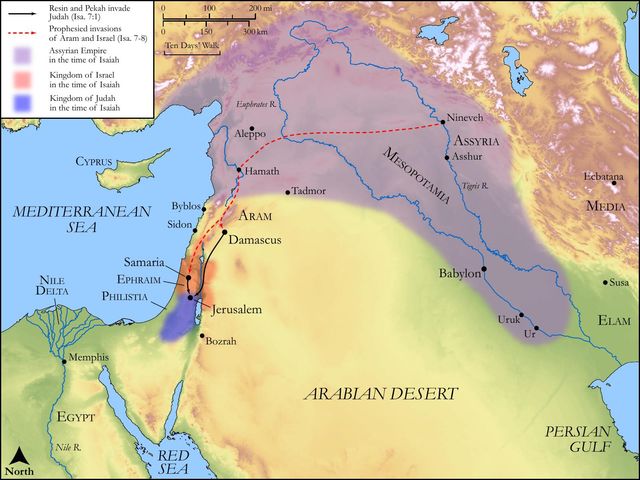
Isaiah 8:9 is strategically placed within a pivotal prophetic section of Isaiah (chapters 7-12) that primarily addresses the Syro-Ephraimitic War. King Ahaz of Judah, confronting a severe threat from a military alliance between Aram (Syria) and the Northern Kingdom of Israel (Ephraim), was divinely urged through the prophet Isaiah to place his trust in God's protection rather than succumbing to fear or seeking human alliances. The preceding verses in chapter 8 detail Isaiah's symbolic actions and prophecies concerning the swift defeat of these immediate aggressors, while also foreshadowing the coming Assyrian invasion as a divine instrument of judgment. Verse 9 directly follows a declaration of God's protective presence for His people, even amidst the rising "flood" of enemy forces, metaphorically described as the waters of the River (Assyria) overflowing (Isaiah 8:7-8). Thus, this verse functions as a direct, confident, and challenging pronouncement of the certain downfall of hostile nations in the face of God's unwavering purpose.
Historical & Cultural Context
The historical backdrop for Isaiah 8:9 is the mid-8th century BCE, a period marked by profound geopolitical instability across the Ancient Near East. The burgeoning Assyrian Empire was aggressively expanding its dominion, prompting smaller kingdoms like Aram (Damascus) and Israel (Samaria) to form an alliance. Their objective was to compel Judah to join their anti-Assyrian coalition. When King Ahaz of Judah refused, they launched a military campaign to depose him and install a more compliant ruler (2 Kings 16:5-9). Judah was gripped by widespread fear, and despite Isaiah's repeated prophetic assurances of divine deliverance, Ahaz tragically chose to seek aid from Assyria, thereby ironically inviting a far greater long-term threat. Culturally, the idiom "girding oneself" was a widely understood reference to preparing for battle, involving the tightening of one's long outer garments to allow for freedom of movement during combat, or the donning of armor. The "far countries" could refer to the broader network of nations that might align against God's people, or prophetically extend to encompass all future powers that oppose God's will, emphasizing the universal scope and timeless relevance of this divine warning.
Key Themes
ShowHideThis verse powerfully contributes to several overarching themes prominent in the book of Isaiah and the broader prophetic literature. Foremost among these is the theme of Divine Sovereignty and the Futility of Human Opposition. Isaiah 8:9 unequivocally declares that God is the ultimate ruler of nations and the orchestrator of history. Any human scheme, military alliance, or display of might arrayed against Him or His purposes for His people is inherently doomed to failure. This resonates deeply with other biblical declarations of God's supremacy, such as the defiant yet ultimately vain rage of earthly rulers against the Lord and His Anointed (Psalm 2:1-4). Another prominent theme is the Certainty of Judgment. The emphatic, threefold repetition of "ye shall be broken in pieces" is a potent rhetorical device designed to convey the absolute, undeniable, and irreversible nature of the impending defeat. It highlights that God's word is not merely a suggestion or a possibility, but an unalterable decree that will be executed with precision and power. Implicitly, the verse also reinforces the theme of God's Unwavering Protection for His People. Even as Judah faced immediate threats and their king demonstrated a profound lack of faith, this divine taunt to their enemies serves as a profound assurance that God Himself would defend them, demonstrating that His purposes cannot be thwarted.
Exposition and Analysis
ShowHideKey Word Analysis
ShowHideThis word (H7489) is a primitive root meaning "to spoil (literally, by breaking to pieces); figuratively, to make (or be) good for nothing, i.e. bad (physically, socially or morally)." While often translated as "associate yourselves" in the context of forming an alliance, the root's primary sense of "breaking to pieces" or "spoiling" adds a profound layer of divine irony. The very act of "associating" or forming an alliance, which they intend for strength and cohesion, is inherently linked to their own "breaking" or ruin, even in the very word used to describe their action. This suggests that their attempt at unity will paradoxically lead to their disintegration.
This term (H2865) signifies "to prostrate; hence, to break down, either (literally) by violence, or (figuratively) by confusion and fear." The repeated use of this word throughout the verse emphasizes a complete, utter, and irreversible demolition. It conveys not just defeat but a shattering, a state of terror, dismay, and demoralization, where all strength, cohesion, and hope are utterly lost. It paints a vivid picture of absolute destruction and disarray.
This primitive root (H247) means "to belt; bind (compass) about, gird (up, with)." In the context of ancient warfare, to "gird oneself" was an essential act of preparing for battle, involving the tightening of one's long outer garments to enable swift movement, or the donning of armor for protection. The command here is a divine challenge or taunt, inviting the nations to prepare with all their might, only to underscore the absolute futility of their preparations against God's decree. Their very act of preparing for strength will only hasten their inevitable demise.
Verse Breakdown
ShowHide"Associate yourselves, O ye people,"
This opening phrase is a direct, imperative challenge issued by God through the prophet Isaiah. It addresses the hostile nations, primarily the Syro-Ephraimitic alliance, daring them to gather, conspire, and prepare their military forces. The tone is one of divine confidence, almost a taunt, inviting them to do their worst, knowing their efforts are in vain.
"and ye shall be broken in pieces;"
This is the immediate and certain consequence of their association and opposition to God's purposes. The Hebrew word implies not merely defeat but a complete shattering, a state of terror and utter destruction. It is the swift, decisive divine verdict pronounced upon their rebellious efforts.
"and give ear, all ye of far countries:"
The scope of this divine warning expands significantly beyond the immediate adversaries of Judah to encompass all distant nations, or perhaps even future generations, who might contemplate opposing God's sovereign will. It functions as a universal declaration of God's absolute sovereignty over all peoples and lands, demanding their attention to this profound and enduring truth.
"gird yourselves, and ye shall be broken in pieces; gird yourselves, and ye shall be broken in pieces."
This triple repetition of the command to "gird yourselves" (prepare for battle) immediately followed by the declaration of being "broken in pieces" is highly emphatic. It serves to underscore the absolute futility and ultimate self-defeating nature of their military preparations. No matter how thoroughly they prepare, how much strength they muster, or how many times they attempt to rally their forces, their efforts will inevitably culminate in their complete and utter destruction by divine decree.
Literary Devices
ShowHideIsaiah 8:9 is exceptionally rich in literary devices that powerfully amplify its message of divine sovereignty and inevitable judgment. The most prominent device is Repetition, particularly the phrase "ye shall be broken in pieces," which appears three times. This emphatic repetition serves not only to underscore the absolute certainty and severity of the impending judgment but also to create a rhythmic, almost chant-like pronouncement of doom, reinforcing its unalterable nature. Coupled with this is profound Irony: the very act of "girding themselves" (preparing for war and mustering strength) is presented as the direct and unavoidable path to their "breaking in pieces." Their concerted efforts to secure victory will paradoxically lead directly to their own undoing and disintegration. The verse also employs a strong Imperative Mood ("Associate yourselves," "give ear," "gird yourselves"), which functions as a direct divine challenge or taunt. This direct address highlights God's active involvement in human affairs and His absolute authority over the nations, daring them to oppose Him while simultaneously declaring their inevitable and catastrophic failure. The language itself is vivid and evocative, painting a clear and terrifying picture of violent, complete disintegration.
Theological and Thematic Connections
ShowHideIsaiah 8:9 powerfully articulates the foundational theological truth that God's sovereignty is absolute, unchallenged, and ultimately unthwarted by any human or nationalistic endeavor. It reveals that the Lord of Hosts is not merely a tribal deity, but the supreme ruler over all nations, meticulously orchestrating history according to His divine purpose. Any alliance, military might, or strategic plan that presumes to defy His will is ultimately futile, destined for utter collapse and disintegration. This verse provides profound assurance to God's people that their ultimate security rests not in political maneuvering, military strength, or human alliances, but in the unshakeable power, faithfulness, and covenant commitment of their God, who defends His people and His divine agenda. It stands as a profound declaration of God's unassailable authority, reminding all humanity that His plans will always prevail, regardless of the intensity or scale of opposition.
Reflection and Application
ShowHideIsaiah 8:9 offers profound encouragement to believers facing overwhelming odds and serves as a stark warning to those who foolishly choose to oppose God's will. In a world often characterized by persistent political turmoil, escalating international conflicts, and pervasive societal anxieties, this verse stands as a powerful reminder that no human power, no matter how formidable its alliances, how extensive its preparations, or how cunning its strategies, can ultimately thwart the sovereign purposes of God. For the believer, it is a clarion call to radical and unwavering trust, urging us to fix our gaze solely on the Lord rather than succumbing to fear induced by human threats or the perceived strength of adversaries. It encourages us to align our lives, our endeavors, and our hopes with God's revealed will, knowing with certainty that only efforts rooted in His eternal purposes will endure and truly prosper. Conversely, for those who stand in opposition to God, it serves as a sobering reminder that any defiance against His kingdom is ultimately self-defeating, leading to inevitable and complete ruin. This verse compels us to deeply examine where our ultimate trust truly lies and to confidently rest in the unshakeable, omnipotent power of the Almighty God.
Questions for Reflection
ShowHideFAQ
ShowHideWho are the "people" and "far countries" addressed in this verse?
ShowHideThe "people" primarily refer to the immediate adversaries of Judah during Isaiah's time: specifically, the Syro-Ephraimitic alliance, which consisted of Aram (Syria) and the Northern Kingdom of Israel (Ephraim). The phrase "far countries" significantly broadens the scope of the divine warning, indicating that this decree applies not just to the immediate enemies of Judah but to any and all nations, whether near or distant, who might conspire against God's chosen people or His divine will. This expansion gives the prophecy a universal and timeless application, encompassing all future opposition to God's kingdom and purposes, much like the declaration in Psalm 2:8-9 that the nations are given as an inheritance to the Son, to be broken with a rod of iron.
Why is the phrase "broken in pieces" repeated so many times in this verse?
ShowHideThe triple repetition of "ye shall be broken in pieces" is a powerful literary and rhetorical device employed for extreme emphasis and dramatic effect. It underscores the absolute certainty, the complete nature, and the irreversible finality of the defeat awaiting those who oppose God. This repetition conveys that their destruction will be total, shattering them into fragments, leaving no hope of recovery or reassembly. This emphatic repetition serves to instill both terror in the enemies of God and profound assurance in God's people, highlighting the utter futility of any human effort or alliance against the divine decree, much like the repeated warnings of judgment and destruction found throughout prophetic books such as Jeremiah 25:15-29.
Christ-Centered Fulfillment
ShowHideIsaiah 8:9, with its potent declaration of the futility of human opposition against God's sovereign purposes, finds its ultimate and most glorious fulfillment in the person and work of Jesus Christ. The prophecy of Immanuel, "God with us," which immediately precedes and frames this very warning in Isaiah 7-8, finds its perfect embodiment in Christ's incarnation (Matthew 1:23). While the nations of Isaiah's day conspired against Judah, ultimately, all the powers of darkness and humanity conspired against God's ultimate redemptive purpose in Christ. Yet, just as the earthly alliances were prophesied to be "broken in pieces," so too were the spiritual forces of evil, sin, and death utterly vanquished by Christ's crucifixion and triumphant resurrection. The "girding themselves" of earthly kings and spiritual principalities to oppose God's plan was ultimately revealed as futile, for all authority in heaven and on earth has been given to Jesus (Matthew 28:18). He is the true Lamb of God who takes away the sin of the world (John 1:29), and through His decisive triumph on the cross, all opposing powers were disarmed and publicly triumphed over (Colossians 2:15). The kingdom He inaugurated is an everlasting kingdom that will never be broken, and at His glorious second coming, He will shatter all nations that oppose Him with a rod of iron, establishing His righteous reign forever (Revelation 19:15). Thus, Isaiah 8:9 powerfully foreshadows the absolute and final victory of Christ over every earthly and spiritual foe, assuring believers that their security is eternally found in Him, the King of Kings and Lord of Lords.