


1 Kings 20:11
Bible text: King James Version (1769 Blayney text) · Public domain
Bible text: Berean Standard Bible · Public domain
Bible text: American Standard Version (1901) · Public domain
Bible text: World English Bible, Messianic edition · Public domain
Bible text: Geneva Bible (1599) · Public domain
Bible text: Young's Literal Translation · Public domain
- וַיַּעַןvai·Ya·'anand he answeredH6030Conj-w ¦ V-Qal-ConsecImperf-3msVerb Qal Consecutive Imperfect 3rd Singular Masculineוַandיַּעַןhe answered
- מֶלֶךְMe·lekh[the] king ofH4428N-mscNoun Singular Masculine Construct
- יִשְׂרָאֵלYis·ra·'ElIsraelH3478N-properNoun Proper Location
- וַיֹּאמֶרvai·Yo·merand he saidH559Conj-w ¦ V-Qal-ConsecImperf-3msVerb Qal Consecutive Imperfect 3rd Singular Masculineוַandיֹּאמֶרhe said
- דַּבְּרוּda·be·RuspeakH1696V-Piel-Imp-2mpVerb Piel Imperative 2nd Plural Masculine
- אַל'almay notH408NegParticle Negative
- יִתְהַלֵּלyit·ha·Lelhe boastH1984V-Hithpael-Imperf-3msVerb Hithpael Imperfect 3rd Singular Masculine
- חֹגֵרcho·Ger[one who] girds onH2296V-Qal-Prtcpl-msVerb Qal Participle Singular Masculine Absolute
- כִּמְפַתֵּחַkim·fa·Te·achlike [one who] loosensH6605Prep-k ¦ V-Piel-Prtcpl-msVerb Piel Participle Singular Masculine Absoluteכִּlikeמְפַתֵּחַ[one who] loosens
English is a literal word-by-word gloss of the Hebrew, not the KJV's wording. Why?
This is the original text the KJV's translators worked from — each Hebrew word with its own literal English meaning in this verse, prepared by scholars at Tyndale House, Cambridge. The KJV translates whole sentences, not word by word, so its wording differs: one Hebrew word can become several English words, and the KJV may choose “the LORD” where the gloss reads “Yahweh”. Both are faithful — they answer different questions. For the KJV's own rendering, switch to the KJV text.
Details
See on the biblical-era maps
Study this verse
Public-domain commentary
Matthew Henry
From his Commentary on the Whole Bible. Henry comments on passages, not single verses — this entry covers 1 Kings 20:1–11. His three-level outline is real structure in the source text, so it is rendered as structure.
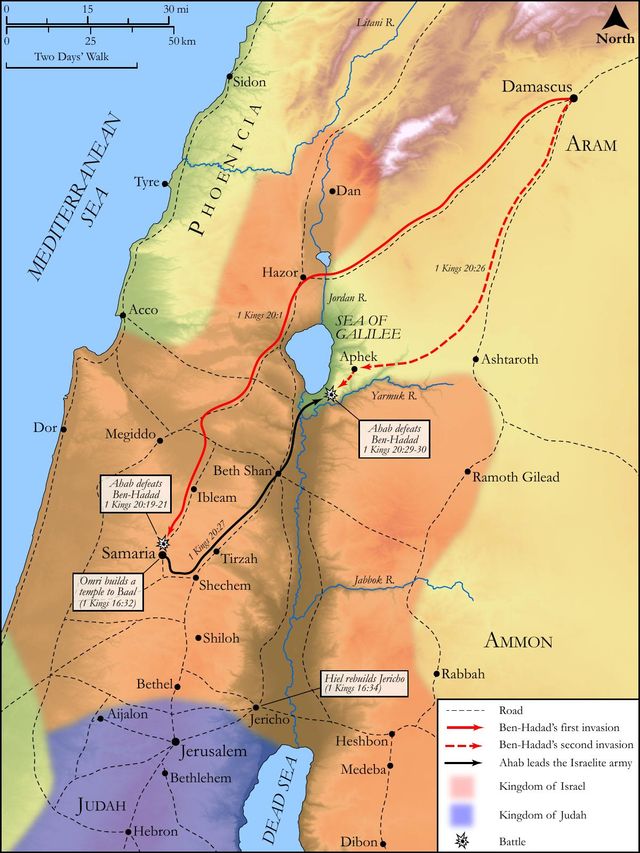
Here is, I. The threatening descent which Ben-hadad made upon Ahab's kingdom, and the siege he laid to Samaria, his royal city, Kg1 20:1. What the ground of the quarrel was we are not told; covetousness and ambition were the principle, which would never want some pretence or other. David in his time had quite subdued the Syrians and made them tributaries to Israel, but Israel's apostasy from God makes them formidable again. Asa had tempted the Syrians to invade Israel once (Kg1 15:18-20), and now they did it of their own accord. It is dangerous bringing a foreign force into the country: posterity may pay dearly for it. Ben-hadad had with him thirty-two kings, who were either tributaries to him, and bound in duty to attend him, or confederates with him, and bound in interest to assist him. How little did the title of king look when all these poor petty governors pretended to it!
II.The treaty between these two kings.
Surely Israel's defence had departed from them, or else the Syrians could not have marched so readily, and with so little opposition, to Samaria, the head and heart of the country, a city lately built, and therefore, we may suppose, not well fortified, but likely to fall quickly into the hands of the invaders; both sides are aware of this, and therefore,
1.Ben-hadad's proud spirit sends Ahab a very insolent demand, Kg1 20:2, Kg1 20:3. A parley is sounded, and a trumpeter (we may suppose) is sent into the city, to let Ahab know that he will raise the siege upon condition that Ahab become his vassal (Nay, his villain), and not only pay him a tribute out of what he has, but make over his title to Ben-hadad, and hold all at his will, even his wives and children, the godliest of them. The manner of expression is designed to gall them; "All shall be mine, without exception."
2.Ahab's poor spirit sends Ben-hadad a very disgraceful submission. It is general indeed (he cannot mention particulars in his surrender with so much pleasure as Ben-hadad did in his demand), but it is effectual: I am thine, and all that I have, Kg1 20:4. See the effect of sin.
(1.)If he had not by sin provoked God to depart from him, Ben-hadad could not have made such a demand. Sin brings men into such straits, by putting them out of divine protection. If God may not rule us, our enemies shall. A rebel to God is a slave to all besides. Ahab had prepared his silver and gold for Baal, Hos 2:8. Justly therefore is it taken from him; such an alienating amounts to a forfeiture.
(2.)If he had not by sin wronged his own conscience, and set that against him, he could not have made such a mean surrender. Guilt dispirits men, and makes them cowards. He knew Baal could not help, and had no reason to think that God would, and therefore was content to buy his life upon any terms. Skin for skin, and all that is dear to him, he will give for it; he will rather live a beggar than not die a prince.
3.Ben-hadad's proud spirit rises upon his submission, and becomes yet more insolent and imperious, Kg1 20:5, Kg1 20:6. Ahab had laid his all at his feet, at his mercy, expecting that one king would use another generously, that this acknowledgment of Ben-hadad's sovereignty would content him, the honour was sufficient for the present, and he might hereafter make use of it if he saw cause (Satis est prostrasse leoni - It suffices the lion to have laid his victim prostrate); but this will not serve.
(1.)Ben-hadad is as covetous as he is proud, and cannot go away unless he have the possession as well as the dominion. He thinks it not enough to call it his, unless he have it in his hands. He will not so much as lend Ahab the use of his own goods above a day longer.
(2.)He is as spiteful as he is haughty. Had he come himself to select what he had a mind for, it would have shown some respect to a crowned head; but he will send his servants to insult the prince, and hector over him, to rifle the palace, and strip it of all its ornaments; nay, to give Ahab the more vexation, they shall be ordered, not only to take what they please, but, if they can learn which are the persons or things that Ahab is in a particular manner fond of, to take those: Whatsoever is pleasant in thy eyes they shall take away. We are often crossed in that which we most dote upon; and that proves least safe which is most dear.
(3.)He is as unreasonable as he is unjust, and will construe the surrender Ahab made for himself as made for all his subjects too, and will have them also to lie at his mercy: "They shall search, not only thy house, but the houses of thy servants too, and plunder them at discretion." Blessed be God for peace and property, and that what we have we can call our own.
4.Ahab's poor spirit begins to rise too, upon this growing insolence; and, if it becomes not bold, yet it becomes desperate, and he will rather hazard his life than give up all thus.
(1.)How he takes advice of his privy-council, who encourage him to stand it out. He speaks but poorly (Kg1 20:7), appeals to them whether Ben-hadad be not an unreasonable enemy, and do not seek mischief. What else could he expect from one who, without any provocation given him, had invaded his country and besieged his capital city? He owns to them how he had truckled to him before, and will have them advise him what he should do in this strait; and they speak bravely (Hearken not to him, nor consent, Kg1 20:8), promising no doubt to stand by him in the refusal.
(2.)Yet he expresses himself very modestly in his denial, Kg1 20:9. He owns Ben-hadad's dominion over him: "Tell my lord the king I have no design to affront him, nor to receded from the surrender I have already made; what I offered at first I will stand to, but this thing I may not do; I must not give what is none of my own." It was a mortification to Ben-hadad that even such an abject spirit as Ahab's durst deny him; yet it should seem, by his manner of expressing himself, that he durst not have done it if his people had not animated him.
5.Ben-hadad proudly swears the ruin of Samaria. The threatening waves of his wrath, meeting with this check, rage and foam, and make a noise. In his fury, he imprecates the impotent revenge of his gods, if the dust of Samaria serve for handfuls for his army (Kg1 20:10), so numerous, so resolute, an army will be bring into the field against Samaria, and so confident is he of their success; it will be done as easily as the taking up of a handful of dust; all shall be carried away, even the ground on which the city stands. Thus confident is his pride, thus cruel is his malice; this prepares him to be ruined, though such a prince and such a people are unworthy of the satisfaction of seeing him ruined.
6.Ahab sends him a decent rebuke to his assurance, dares not defy his menaces, only reminds him of the uncertain turns of war (Kg1 20:11): "Let not him that begins a war, and is girding on his sword, his armour, his harness, boast of victory, or think himself sure of it, as if he had put it off, and had come home a conqueror." This was one of the wisest words that ever Ahab spoke, and is a good item or momento to us all; it is folly to boast beforehand of any day, since we know not what it may bring forth (Pro 27:1), but especially to boast of a day of battle, which may prove as much against us as we promise ourselves it will be for us. It is impolitic to despise an enemy, and to be too sure of victory is the way to be beaten. Apply it to our spiritual conflicts. Peter fell by his confidence. While we are here we are but girding on the harness, and therefore must never boast as though we had put it off. Happy is the man that feareth always, and is never off his watch.
Historical interpretation
Thirteen Centuries of Reception
3 surviving comments on this verse. Each one is dated, so this reads as a timeline rather than a list.
Select a marker to jump to its quote. Markers stagger vertically where authors wrote within a few decades of each other.
For a hump is, as it were, to think or to do something base of soul, and it is a kind of twisted deformity of mind always to incline toward unclean things and to be withdrawn from the holy threshold of the church by worldly concerns. Hence it seems to me that the prophet, when he spoke spiritually of this bodily deformity, alluded instead to a moral hideousness when he said, “Let no one who is crooked boast as if he were upright.” It is as if he were saying, “Let not the sinner boast who is distorted by the wickedness of his vices, as the righteous boasts who is made upright by the sincerity of a good conscience.” For although, O sinner, you rejoice in your tall stature, although you are glad because of the straightness of your shoulders, nonetheless your soul is deformed by your evil way of life. Rightly, then, is a rich person compared with a camel, since bodily ungainliness prevents the one from passing through a needle, while concern for his property hinders the other from entering the church. And just as a small needle cannot receive the one that is burdened by the grossness of its body, so also the sacred portal cannot take in the other, who is encumbered by the weight of his offenses. Each has his own burden: the one is weighed down by his physiognomy, the other by his sins. And just as the one cannot pass through the needle’s tiny eye, so the other is unfit for the most blessed kingdom of God, except that the camel’s body is disordered by nature, while the rich person’s will makes him evil. - "Sermon 32.1"
The hump alludes to thinking or doing something that is ugly for the soul, and it is always a certain twisted deformity of mind that reaches for impure things and is distracted from the sacred threshold of the church by worldly concerns. It seems to me that the prophet spoke in a spiritual sense of this physical deformity to describe instead a deformity of character, when he says: “Let not the crooked boast in the same way as the upright,” as if he were saying: “Let not the sinner who is deformed by the perversion of his own vices boast as the just person boasts when he is made upright by the sincerity of a good conscience.” For though, O sinner, you rejoice in the stature of your body and you find pleasure in the straightness of your shoulders, your soul is still deformed because of the crookedness of your character. It is only right that the rich person is compared to the camel since the density of its body hinders it from the passing through the needle, while concern for inheritance holds the rich person back from entering the church. For as a small opening does not let the camel in, weighed down by the mass of its members, so also this holy entrance does not accept the rich, weighed down by the mass of transgressions. Each has its own burden: the camel is burdened by his own flesh and the rich by his sins. As the camel is not able to inhabit the extremely confined hole of the needle, so also the rich person is not suitable for the most blessed kingdom of God. The only difference between the two is that the camel is not well suited due to the nature of his body, while his own will renders the rich person crooked.
Let not the girded: Let him not boast before the victory: it will then be time to glory when he putteth off his armour, having overcome his adversary.
Continue studying 1 Kings 20:11 across the web’s major study libraries — every link below opens this exact verse, chapter, or book on the destination site.
Read & Compare
 BibleGatewayThis verse in more than 200 translations and 70 languages.
 Bible.comThe YouVersion reader — hundreds of translations, reading plans, and highlights.
 ESV.orgCrossway's official English Standard Version reader.
 NET BibleThe NET translation with 60,000+ translators' notes on every rendering decision.
 STEP BibleTyndale House's free study tool — original text, vocabulary, and scholarly resources.
 BibliaLogos Bible Software's free web reader.
 USCCBThe New American Bible (Revised Edition) with the U.S. bishops' study notes.
Commentaries
 BibleHub CommentariesDozens of classic commentaries on this verse, gathered on one page.
 StudyLightMore than 100 commentary sets — the largest collection on the web.
 BibleRefPlain-English commentary on what this verse means, verse by verse.
 Enduring WordDavid Guzik's free commentary on this chapter, widely used by Bible teachers.
 Bible Study ToolsVerse commentary alongside Greek and Hebrew study aids.
Original Language & Research
- BibleHub InterlinearThe verse word by word — original language, transliteration, and English.
- BibleHub LexiconEvery word's original-language definition and Strong's entry.
 Blue Letter BibleDeep-study tools — Strong's numbers, concordance, and word studies.
 SefariaThe Hebrew text with Rashi and centuries of Jewish commentary.
Sermons, Hymns & Audio


TrulyRandomVerse is not affiliated with these sites and doesn’t control their content. They’re linked because they’re genuinely useful.
Summary
records a profound and timeless proverb spoken by King Ahab of Israel in response to the audacious and arrogant King Ben-Hadad of Aram. This statement, delivered during a tense siege of Samaria, serves as a powerful rebuke against premature celebration and overconfidence, asserting that true victory is only known at the conclusion of a struggle, not at its outset. It underscores the wisdom of humility, diligent perseverance, and a realistic assessment of challenges, cautioning against the folly of boasting about an unachieved triumph.
Context
ShowHideLiterary Context
This pointed proverb is strategically placed within the narrative of 1 Kings 20, which chronicles two significant and unexpected victories of Israel over the powerful Aramean kingdom. The immediate setting is the siege of Samaria by Ben-Hadad, who, with a vast army, issues increasingly insolent demands for tribute and plunder from King Ahab. Initially, Ahab shows a surprising willingness to concede, but Ben-Hadad's escalating threats, culminating in a boast to utterly dismantle Samaria, provoke Ahab's sharp and memorable response. This proverb not only serves as a direct challenge to Ben-Hadad's hubris but also foreshadows the dramatic and divinely orchestrated defeat of the Aramean forces, which unfolds later in the chapter, notably in 1 Kings 20:20-21. The literary placement highlights a rare moment of sagacity from Ahab, contrasting with his usual depiction as a weak and idolatrous king.
Historical & Cultural Context
The period of the Divided Monarchy was marked by frequent conflicts between Israel and its northern neighbor, Aram (Syria), with Damascus as its capital. Ben-Hadad II was a formidable Aramean king, and his siege of Samaria was a common military strategy among the nations of that day, designed to force surrender through attrition or overwhelming display of force. In this culture, honor, public declarations, and boasting played a crucial role in inter-state relations and military psychology. Kings often engaged in rhetorical sparring and grandstanding to demoralize opponents. Ben-Hadad's threats were thus not merely military but also a psychological tactic. Ahab's proverb, though concise, was a potent and culturally significant challenge to Ben-Hadad's honor, implying that his boasts were empty and unproven, thereby turning the psychological tables and asserting a surprising defiance. This exchange vividly illustrates the volatile geopolitical landscape and the blend of military might and strategic wisdom required for leadership in that era.
Key Themes
ShowHideThe proverb in 1 Kings 20:11 powerfully contributes to several overarching themes found within 1 Kings and the broader biblical narrative. Central among these is the theme of humility versus pride. Ben-Hadad's arrogant boasting is directly contrasted with the wisdom of caution and patience, echoing biblical warnings against hubris, such as "Pride goes before destruction, a haughty spirit before a fall" (Proverbs 16:18). Another significant theme is divine sovereignty over human endeavors. Despite Ben-Hadad's seemingly overwhelming military superiority and Ahab's general wickedness, God ultimately intervenes to grant Israel victory, demonstrating that human strength, boasts, and plans are ultimately subject to the Lord's will and power (Psalm 33:16-17). The proverb also touches on the nature of true strength and wisdom, suggesting that genuine power is not found in empty threats or premature celebrations, but in diligent action, perseverance, and a realistic understanding of the challenges ahead.
Exposition and Analysis
ShowHideKey Word Analysis
ShowHideFrom the primitive root H2296, meaning "to gird on (as a belt, armor, etc.)" or "to put on." In a military context, this verb vividly describes the act of a soldier preparing for battle by donning his armor, tightening his belt, or strapping on his weapons. It signifies the initial, often arduous, and uncertain phase of engagement, where one is equipping for conflict and the outcome remains unknown. It implies readiness but not yet resolution.
From the primitive root H1984, meaning "to be clear (orig. of sound, but usually of color); to shine; hence, to make ashow, to boast; and thus to be (clamorously) foolish; to rave." In this context, it refers to self-exaltation, vainglory, or arrogant self-congratulation. The reflexive form (Hithpael) emphasizes that the boasting is directed at oneself or about oneself, highlighting a self-centered, presumptuous, and often foolish attitude.
From the primitive root H6605, meaning "to open wide (literally or figuratively); specifically, to loosen, begin, plough, carve." In the military context of this proverb, it describes the act of a soldier disarming himself after the battle is over. This implies that the conflict has concluded, victory has been achieved, and the warrior is now at rest, having successfully completed the endeavor. It stands in stark contrast to "girdeth on," representing the state of triumph and security after the struggle.
Verse Breakdown
ShowHide"And the king of Israel answered and said, Tell [him],"
This opening phrase sets the scene for Ahab's surprising and direct retort to Ben-Hadad's insolent demands. It highlights a moment of unexpected wisdom and defiance from a king often portrayed as morally compromised, indicating that truth can emerge from unlikely sources, especially when under duress.
"Let not him that girdeth on [his harness] boast himself"
This is the first, prohibitive clause of the proverb. It establishes the central subject: the warrior who is merely in the process of preparing for battle. The imperative "Let not" functions as a strong warning against premature boasting, cautioning against pride and overconfidence when one is only at the beginning of a challenging endeavor and the outcome is far from certain. It speaks to the folly of celebrating before the work is done.
"as he that putteth it off."
This is the contrasting second clause, completing the proverb's wisdom. It refers to the warrior who has successfully completed the battle, emerged victorious, and is now disarming or resting. The comparison underscores that only the one who has finished the fight and achieved victory has legitimate grounds for celebration or boasting; the one still preparing for or engaged in the struggle does not. It emphasizes that true boasting follows proven success.
Literary Devices
ShowHideThe verse primarily functions as a Proverb, a concise and memorable saying that encapsulates a general truth or practical piece of wisdom. Its profound insight is conveyed through a vivid Metaphor drawn from the familiar realm of military life: the act of "girding on his harness" (preparing for battle) is contrasted with "putting it off" (resting after victory). This military imagery makes the abstract concept of premature boasting concrete and relatable. The proverb also employs Antithesis, a rhetorical device that juxtaposes two sharply contrasting ideas or images ("girding on" versus "putting off," the act of preparing versus the state of having completed) to highlight their differences and powerfully emphasize the intended message. This sharp contrast effectively underscores the folly of celebrating before the work is done or the battle is decisively won.
Theological and Thematic Connections
ShowHideThe profound wisdom embedded in 1 Kings 20:11 transcends its immediate historical context, offering timeless theological and thematic connections relevant to all believers. It serves as a stark reminder of the inherent dangers of human pride and self-sufficiency, particularly when facing challenges or anticipating future success. The proverb implicitly points to the absolute necessity of humility and a deep reliance on God's strength, rather than presuming upon one's own abilities or anticipated triumphs. True victory, whether in physical battles, spiritual warfare, or daily life, ultimately belongs to the Lord. It is His power that brings about the desired outcome, not human boasting or premature declarations. This theme resonates throughout the entirety of Scripture, consistently emphasizing that "God opposes the proud but gives grace to the humble."
Reflection and Application
ShowHideThe ancient wisdom of 1 Kings 20:11 remains remarkably pertinent for believers navigating the complexities of modern life. In a culture that often champions self-promotion, instant gratification, and the illusion of control, this proverb calls us to embrace a posture of profound humility, patient endurance, and diligent perseverance. It serves as a vital reminder that our primary focus should be on faithfully "girding on our harness"—diligently preparing, working with integrity, and trusting God through every step of the process—rather than prematurely "putting it off" by boasting about unachieved goals, anticipated victories, or even our spiritual accomplishments. This principle applies to every facet of our existence: our spiritual growth, professional endeavors, personal challenges, and ministry efforts. We are called to rely on God's strength and perfect timing, understanding that true success is not measured by our boasts but by His sovereign hand and our faithful obedience. It encourages us to actively combat spiritual pride, which can lead to a devastating fall, and instead cultivate a spirit of utter dependence on the Lord, acknowledging that all good outcomes, all true victories, are ultimately His gracious gift.
Questions for Reflection
ShowHideFAQ
ShowHideWhy would Ahab, a generally wicked king, speak such a wise proverb?
ShowHideWhile King Ahab is consistently portrayed in Scripture as one of Israel's most wicked kings, largely due to his egregious idolatry, his persecution of prophets, and his moral failings, this moment in 1 Kings 20:11 reveals that even unrighteous individuals can, at times, utter profound truths or act with surprising wisdom. In this particular instance, Ahab's proverb is a shrewd, common-sense response to Ben-Hadad's overweening arrogance, perhaps even a divinely inspired moment of clarity given the dire circumstances and the need for a strong, defiant reply. It demonstrates that God, in His sovereignty, can utilize anyone, regardless of their moral standing, to convey a message or accomplish His purposes, even if that person does not consistently walk in righteousness. It also highlights that practical wisdom is not exclusively confined to the righteous, though true, lasting, and redemptive wisdom is always rooted in the fear of the Lord.
Is this proverb unique to the Bible, or are similar sentiments found elsewhere?
ShowHideWhile the precise wording and specific historical context of 1 Kings 20:11 are unique to this biblical narrative, the underlying sentiment—the caution against premature boasting, overconfidence, or "counting one's chickens before they hatch"—is a universal truth found in various forms across many cultures and ancient wisdom traditions. Similar proverbs exist in different languages and historical periods, reflecting a shared human understanding of the inherent uncertainty of future events and the folly of pride. For instance, the Latin proverb "Ne triumphum ante victoriam canas" (Do not sing triumph before victory) conveys a remarkably similar message. The biblical account, however, grounds this universal wisdom within a specific historical event and imbues it with profound theological significance, linking it directly to themes of divine sovereignty, the dangers of human hubris, and the ultimate source of true victory.
Christ-Centered Fulfillment
ShowHideThe profound proverb in 1 Kings 20:11 finds its ultimate and most glorious fulfillment in the person and redemptive work of Jesus Christ. Unlike human kings who boast before battle, Jesus, the true and eternal King, never boasted of His ultimate victory before it was decisively accomplished. Instead, He perfectly embodied the one who humbly "girded on His harness" for the greatest spiritual battle in human history—the conquest of sin, death, and the powers of darkness. From His incarnation and humble birth (Philippians 2:5-8), through His life of perfect obedience, His suffering, and His sacrificial death on the cross, Jesus exemplified the one who diligently and humbly prepared for His divine mission. He did not declare victory until He uttered the triumphant cry, "It is finished" (John 19:30), signifying the complete and perfect accomplishment of His redemptive work. His glorious resurrection from the dead was the definitive "putting off the harness," the irrefutable proof of His triumph over all spiritual foes, securing eternal salvation and righteousness for all who believe. Thus, Christ's journey from humble service to ultimate exaltation (Philippians 2:9-11) perfectly embodies the proverb's wisdom, demonstrating that true glory and legitimate boasting belong solely to the One who humbly endures, faithfully completes His mission, and ultimately conquers. He is the Lamb who was slain, yet is now eternally worthy to receive all power and wealth and wisdom and strength and honor and glory and praise (Revelation 5:9-12).