


1 Samuel 17:44
Bible text: King James Version (1769 Blayney text) · Public domain
Bible text: Berean Standard Bible · Public domain
Bible text: American Standard Version (1901) · Public domain
Bible text: World English Bible, Messianic edition · Public domain
Bible text: Geneva Bible (1599) · Public domain
Bible text: Young's Literal Translation · Public domain
- וַיֹּאמֶרvai·Yo·merand he saidH559Conj-w ¦ V-Qal-ConsecImperf-3msVerb Qal Consecutive Imperfect 3rd Singular Masculineוַandיֹּאמֶרhe said
- הַפְּלִשְׁתִּיha·pe·lish·Tithe PhilistineH6430Art ¦ N-msNoun Gentilic Singular Masculine AbsoluteהַtheפְּלִשְׁתִּיPhilistine
- אֶל'eltoH413PrepPreposition
- דָּוִדda·VidDavidH1732N-proper-mNoun Proper Masculine
- לְכָהle·Khahcome !H1980V-Qal-Imp-2ms ¦ SfxVerb Qal Imperative 2nd Singular Masculineלְכָcomeה!
- אֵלַי'e·Laito meH413Prep ¦ 1csPreposition Definiteאֵלַtoיme
- וְאֶתְּנָהve·'e·te·Nahso let me giveH5414Conj-w ¦ V-Qal-Imperf-1csVerb Qal Imperfect 1st Singular common genderוְsoאֶתְּנָהlet me give
- אֶת'et<obj.>H853DirObjMParticle Object Indicator
- בְּשָׂרְךָbe·Sa·re·khayour fleshH1320N-msc ¦ 2msNoun Singular Masculine Constructבְּשָׂרְfleshךָyour
- לְעוֹףle·'ofto [the] bird[s] ofH5775Prep-l ¦ N-mscNoun Singular Masculine Constructלְtoעוֹף[the] bird[s] of
- הַשָּׁמַיִםha·sha·Ma·yimthe heavensH8064Art ¦ N-mpNoun Plural Masculine Absoluteהַtheשָּׁמַיִםheavens
- וּלְבֶהֱמַתu·le·ve·he·Matand to [the] animal[s] ofH929Conj-w ¦ Prep-l ¦ N-fscNoun Singular Feminine Constructוּandלְtoבֶהֱמַת[the] animal[s] of
- הַשָּׂדֶהha·sa·Dehthe fieldH7704Art ¦ N-msNoun Singular Masculine Absoluteהַtheשָּׂדֶהfield
English is a literal word-by-word gloss of the Hebrew, not the KJV's wording. Why?
This is the original text the KJV's translators worked from — each Hebrew word with its own literal English meaning in this verse, prepared by scholars at Tyndale House, Cambridge. The KJV translates whole sentences, not word by word, so its wording differs: one Hebrew word can become several English words, and the KJV may choose “the LORD” where the gloss reads “Yahweh”. Both are faithful — they answer different questions. For the KJV's own rendering, switch to the KJV text.
Details
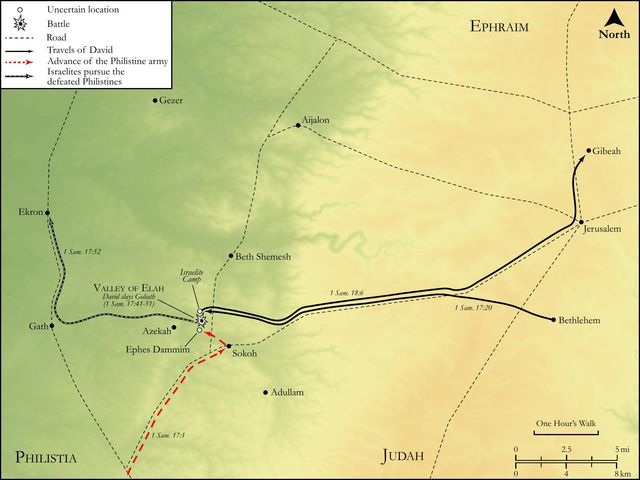
See on the biblical-era map
Study this verse
Public-domain commentary
Matthew Henry
From his Commentary on the Whole Bible. Henry comments on passages, not single verses — this entry covers 1 Samuel 17:40–47. His four-level outline is real structure in the source text, so it is rendered as structure.
We are now coming near this famous combat, and have in these verses the preparations and remonstrances made on both sides.
I.The preparations made on both sides for the encounter.
The Philistine was already fixed, as he had been daily for the last forty days. Well might he go with his armour, for he had sufficiently proved it. Only we are told (Sa1 17:41) that he came on and drew near, a signal, it is likely, being given that his challenge was accepted, and, as if he distrusted his helmet and coat of mail, a man went before him, carrying his shield, for his own hands were full with his sword and spear, Sa1 17:45. But what arms and ammunition is David furnished with? Truly none but what he brought with him as a shepherd; no breastplate, nor corselet, but his plain shepherd's coat; no spear, but his staff; no sword nor bow, but his sling; no quiver, but his scrip; nor any arrows, but, instead of them, five smooth stones picked up out of the brook, Sa1 17:40. By this it appeared that his confidence was purely in the power of God, and not in any sufficiency of his own, and that now at length he who put it into his heart to fight the Philistine put it into his head with what weapons to do it.
II.The conference which precedes the encounter, in which observe,
1.How very proud Goliath was, (1.) With what scorn he looked upon his adversary, Sa1 17:42. He looked about, expecting to meet some tall strong man, but, when he saw what a mean figure he made with whom he was to engage, he disdained him, thought it below him to enter the lists with him, fearing that the contemptibleness of the champion he contended with would lessen the glory of his victory. He took notice of his person, that he was but a youth, not come to his strength, ruddy and of a fair countenance, fitter to accompany the virgins of Israel in their dances (if mixed dancing was then in use) than to lead on the men of Israel in their battles. He took notice of his array with great indignation (Sa1 17:43): "Am I a dog, that thou comest to me with staves? Dost thou think to beat me as easily as thou dost thy shepherd's dog?" (2.) With what confidence he presumed upon his success. He cursed David by his gods, imprecating the impotent vengeance of his idols against him, thinking these fire-balls thrown about him would secure his success: and therefore, in confidence of that, he darts his grimaces, as if threatening words would kill (Sa1 17:44): "Come to me, and I will give thy flesh to the fowls of the air, it will be a tender and delicate feast for them." Thus the security and presumption of fools destroy them.
2.How very pious David was. His speech savours nothing of ostentation, but God is all in all in it, Sa1 17:45-47.
(1.)He derives his authority from God: "I come to thee by warrant and commission from heaven, in the name of the Lord, who has called me to and anointed me for this undertaking, who, by his universal providence, is the Lord of hosts, of all hosts, and therefore has power to do what he pleases, and, by the special grace of his covenant, is the God of the armies of Israel, and therefore has engaged and will employ his power for their protection, and against thee who hast impiously defied them." The name of God David relied on, as Goliath did on his sword and spear. See Psa 20:7; Psa 118:10, Psa 118:11.
(2.)He depends for success upon God, Sa1 17:46. David speaks with as much assurance as Goliath had done, but upon better ground; it is his faith that says, "This day will the Lord deliver thee into my hand, and not only thy carcase, but the carcases of the host of the Philistines, shall be given to the birds and beasts of prey." (3.) He devotes the praise and glory of all to God. He did not, like Goliath, seek his own honour, but the honour of God, not doubting but by the success of this action,
[1.]All the world should be made to know that there is a God, and that the God of Israel is the one only living and true God, and all other pretended deities are vanity and a lie.
[2.]All Israel (whom he calls not this army, but this assembly, or church, because they were now religiously attending the goings of their God and King, as they used to do in the sanctuary) shall know that the Lord saveth not with sword and spear (Sa1 17:47), but can, when he pleases, save without either and against both, Psa 46:9. David addresses himself to this combat rather as a priest that was going to offer a sacrifice to the justice of God than as a soldier that was going to engage an enemy of his country.
Continue studying 1 Samuel 17:44 across the web’s major study libraries — every link below opens this exact verse, chapter, or book on the destination site.
Read & Compare
 BibleGatewayThis verse in more than 200 translations and 70 languages.
 Bible.comThe YouVersion reader — hundreds of translations, reading plans, and highlights.
 ESV.orgCrossway's official English Standard Version reader.
 NET BibleThe NET translation with 60,000+ translators' notes on every rendering decision.
 STEP BibleTyndale House's free study tool — original text, vocabulary, and scholarly resources.
 BibliaLogos Bible Software's free web reader.
 USCCBThe New American Bible (Revised Edition) with the U.S. bishops' study notes.
Commentaries
 BibleHub CommentariesDozens of classic commentaries on this verse, gathered on one page.
 StudyLightMore than 100 commentary sets — the largest collection on the web.
 BibleRefPlain-English commentary on what this verse means, verse by verse.
 Enduring WordDavid Guzik's free commentary on this chapter, widely used by Bible teachers.
 Bible Study ToolsVerse commentary alongside Greek and Hebrew study aids.
Original Language & Research
- BibleHub InterlinearThe verse word by word — original language, transliteration, and English.
- BibleHub LexiconEvery word's original-language definition and Strong's entry.
 Blue Letter BibleDeep-study tools — Strong's numbers, concordance, and word studies.
 SefariaThe Hebrew text with Rashi and centuries of Jewish commentary.
Sermons, Hymns & Audio


TrulyRandomVerse is not affiliated with these sites and doesn’t control their content. They’re linked because they’re genuinely useful.
Summary
In the Philistine champion Goliath issues a contemptuous and terrifying threat to the young Israelite, David, boasting that he will deliver David's body to be devoured by scavenging birds and wild beasts. This pronouncement, intended to intimidate and demoralize David, was a profound curse among the nations, signifying not only a violent death but also the ultimate dishonor of an unburied corpse, deprived of proper burial rites and eternal remembrance. Goliath's arrogant words set the stage for the dramatic confrontation that would demonstrate the stark contrast between human might and divine power, culminating in God's unexpected victory through an unlikely hero.
Context
ShowHideLiterary Context
This verse is a pivotal moment within the epic narrative of David and Goliath, found in 1 Samuel 17. For forty days, Goliath, the champion of the Philistines, had daily taunted the armies of Israel, challenging them to single combat and striking paralyzing fear into their hearts, as detailed in 1 Samuel 17:1-16. When the young shepherd David, visiting his brothers at the battlefront, heard Goliath's blasphemous challenge against the armies of the living God, he was moved to volunteer, despite King Saul's initial skepticism (1 Samuel 17:32-37). Goliath's words in 1 Samuel 17:44 immediately follow his initial disdain for David's youthful appearance and lack of traditional warrior equipment, as recorded in 1 Samuel 17:42-43. This verse serves as Goliath's ultimate declaration of presumed victory and contempt, directly preceding David's iconic declaration of faith and his counter-prophecy in 1 Samuel 17:45-47.
Historical & Cultural Context
In Israel, proper burial was of paramount importance, deeply intertwined with one's dignity, honor, and the well-being of their memory. To be left unburied, exposed to scavengers, was considered the most egregious form of dishonor and a profound curse, signifying complete annihilation and a lack of remembrance. This was a fate often reserved for the most despised enemies or those under severe divine judgment, as seen in prophetic warnings like Deuteronomy 28:26 and Jeremiah 7:33. Goliath's threat was therefore not merely about killing David but about utterly degrading him and his lineage, demonstrating his absolute power and the perceived impotence of David's God. The Philistines, known for their military prowess and advanced weaponry, would have viewed Goliath as an invincible champion. His challenge for single combat was a common practice in ancient warfare, intended to settle conflicts with minimal casualties, but Goliath's specific threat amplified the psychological warfare, aiming to break the spirit of the Israelite army.
Key Themes
ShowHideGoliath's boast in this verse powerfully contributes to several key themes within 1 Samuel 17 and the broader narrative of 1 Samuel. Firstly, it underscores the theme of Arrogance vs. Humility, as Goliath's overconfidence in his physical might and military superiority stands in stark contrast to David's humble reliance on God. Secondly, it highlights the theme of Human Might vs. Divine Power, demonstrating that worldly strength, even when overwhelming, is ultimately no match for the power of the living God working through a faithful servant (1 Samuel 17:47). Thirdly, the threat of desecration emphasizes the theme of Honor and Dishonor, particularly in the context of covenant relationship with God. Goliath's intention was to dishonor David and, by extension, the God of Israel, but the narrative ultimately reverses this, bringing shame upon Goliath and glory to God. Finally, the verse sets the stage for the theme of God's Deliverance Through the Unexpected, as David, an unlikely hero, is chosen by God to bring victory and demonstrate His sovereignty, fulfilling the divine pattern of choosing the weak to shame the strong (1 Corinthians 1:27).
Exposition and Analysis
ShowHideKey Word Analysis
ShowHideThe term בָּשָׂר (bâsâr, H1320) refers to the physical body or meat, often emphasizing its vulnerability and mortality. In Goliath's threat, it highlights the utter indignity of David's presumed fate: his living body would be reduced to a mere carcass, devoid of life, honor, or proper burial. This choice of word underscores the Philistine's complete contempt for David and his God, reducing him to nothing more than animal fodder, a stark contrast to the sanctity of the human body in Israelite thought.
The imperative "Come" (הָלַךְ, yâlak, H3212) is a direct command, an arrogant summons from Goliath to David. It is not an invitation to a fair fight but a demand for David to approach his perceived inevitable doom. This word choice emphasizes Goliath's immense confidence in his own power and his perception of David as an insignificant opponent who poses no real threat, merely a lamb led to slaughter.
The verb "give" (נָתַן, nâthan, H5414) here carries the sense of delivering, handing over, or appointing. Goliath claims absolute power over David's life and death, asserting his intention to not only kill him but to control the fate of his body after death. This deliberate act of "giving" David's flesh to scavengers highlights Goliath's desire to inflict the ultimate desecration and dishonor, a fate he believes is entirely within his power to orchestrate.
Verse Breakdown
ShowHide"And the Philistine said to David, Come to me,"
This opening clause establishes Goliath's arrogant command, an invitation to a duel he believes is already won. The imperative "Come to me" is not an offer of fair combat but a summons for David to approach his inevitable doom, underscoring Goliath's immense confidence and his perception of David as an insignificant opponent who poses no real threat.
"and I will give thy flesh"
This is the core of Goliath's boast and threat, articulating his intention to not only kill David but to control the fate of his body after death. The verb "give" implies a deliberate act of desecration, turning David's body into an object of ultimate dishonor, stripped of its dignity and destined for a gruesome end.
"unto the fowls of the air,"
This specifies the first recipient of David's desecrated body. The "fowls of the air" (scavenging birds like vultures or ravens) represent a horrifying end, as they would strip the flesh from the bones, leaving no intact remains. This was a particularly potent curse among the nations, where the integrity of the body and proper burial were crucial for dignity and remembrance.
"and to the beasts of the field."
This adds another layer of horror and dishonor to the threat. "Beasts of the field" (wild animals) further emphasize the complete destruction and consumption of David's body, ensuring that nothing would remain for burial. Together with the "fowls," this imagery paints a vivid picture of a body utterly abandoned, unmourned, and consumed by the wild, a fate worse than death itself in the ancient mindset.
Literary Devices
ShowHideGoliath's declaration in this verse is rich with Hyperbole, as he exaggerates his power and David's impending demise to instill maximum fear and intimidation. His words are a form of Verbal Irony, though unintended by Goliath, as the very fate he promises David will ultimately befall himself (1 Samuel 17:46). The phrase "fowls of the air, and to the beasts of the field" functions as a powerful Idiom or Merism, representing the complete and utter dishonor of an unburied body and a humiliating defeat. This gruesome imagery also serves as Foreshadowing, ironically predicting not David's demise, but Goliath's own ignominious end, which David explicitly states in his counter-boast. The stark contrast between Goliath's physical might and David's spiritual confidence creates a dramatic Antithesis, setting the stage for the narrative's central conflict and highlighting the divine reversal of human expectations.
Theological and Thematic Connections
ShowHideGoliath's arrogant threat in 1 Samuel 17:44 serves as a stark illustration of human pride and self-reliance pitted against the sovereignty and power of God. His words embody the world's boastful challenges against God's people, relying on visible strength and intimidation tactics rather than divine truth. The profound theological significance lies in the dramatic reversal of this threat: what Goliath intends as a curse upon David and his God, God transforms into Goliath's own fate, demonstrating that the battle truly belongs to the Lord. This narrative powerfully communicates that God's strength is made perfect in weakness, and His honor cannot be ultimately diminished by human arrogance. It underscores the biblical principle that those who exalt themselves will be humbled, and those who humble themselves before God will be exalted, revealing God's unwavering commitment to defend His name and His people.
Reflection and Application
ShowHideGoliath's intimidating boast in 1 Samuel 17:44 resonates deeply with the "Goliaths" we face in our own lives—overwhelming challenges, seemingly insurmountable obstacles, or adversaries who seek to demoralize and defeat us. These "Goliaths" may manifest as financial crises, health struggles, relational conflicts, professional pressures, or even internal battles with doubt and fear. Like Goliath, they often boast of their power and promise our utter defeat, attempting to strip us of our hope and dignity. This verse calls us to remember that the world's threats, no matter how formidable, are ultimately hollow when confronted with faith in the living God. Our confidence should never be in our own limited abilities or resources, but in the infinite power of the One who empowers the weak and confounds the wise. Just as David refused to be intimidated by Goliath's words and instead focused on God's honor, we are called to stand firm, trusting that the battle is the Lord's, and He will fight for us. This narrative encourages us to look beyond the immediate, intimidating circumstances and fix our gaze on the unshakeable character and power of our God, who delights in using the humble to accomplish His mighty purposes.
Questions for Reflection
ShowHideFAQ
ShowHideWhat was the significance of Goliath's threat to leave David's body unburied?
ShowHideIn Israel, proper burial was a profoundly significant cultural and religious practice. It was believed to be essential for the dignity of the deceased, for their memory to be preserved, and for their spirit to find rest. To be left unburied, exposed to scavengers like "fowls of the air" and "beasts of the field," was considered the ultimate dishonor and a severe curse. It implied that the individual was utterly despised, unworthy of remembrance, and that their very existence was to be erased from the collective memory. This fate was often associated with divine judgment or the complete subjugation of an enemy, signifying a total lack of respect for the deceased and their family. Goliath's threat was therefore not just a promise of death, but of total annihilation and the most profound humiliation imaginable, both for David and, by extension, for the God he served. It was a common motif in ancient curses and prophecies of doom, as seen in passages like Deuteronomy 28:26 and Jeremiah 7:33.
How does Goliath's threat contrast with David's response in the narrative?
ShowHideGoliath's threat in 1 Samuel 17:44 is a declaration rooted in human pride, physical might, and a reliance on conventional warfare. He boasts of his own power and the perceived weakness of his opponent, promising a gruesome and dishonorable end. In stark contrast, David's response, particularly in 1 Samuel 17:45-47, is a declaration rooted in humble faith and absolute reliance on the living God. David does not boast of his own strength or skill but declares that he comes "in the name of the Lord of hosts, the God of the armies of Israel, whom you have defied!" (1 Samuel 17:45). He prophesies that Goliath's own fate will be the very one he threatened David with, stating that he will give Goliath's "carcasses this day unto the fowls of the air, and to the wild beasts of the earth" (1 Samuel 17:46). This profound contrast highlights the central theme of the narrative: the clash between worldly power and divine sovereignty, demonstrating that "the battle is the Lord's" (1 Samuel 17:47) and that God uses the weak to confound the strong.
Christ-Centered Fulfillment
ShowHideGoliath's arrogant boast and his promise to deliver David's flesh to scavengers find a profound Christ-centered fulfillment in the ultimate victory of Jesus over the powers of sin and death. Goliath, the seemingly invincible champion of the enemy, represents the overwhelming forces of evil and spiritual death that hold humanity captive. His threat of utter annihilation and dishonor mirrors the spiritual death and separation from God that sin imposes, leaving humanity's "flesh" (our mortal, fallen nature) vulnerable to decay and ultimate destruction. However, just as David, the shepherd-king, stood against Goliath not in his own strength but in the name of the Lord, so too did Jesus, the true Shepherd-King, confront the ultimate "Goliath"—Satan, sin, and death. Christ's victory on the cross disarmed the spiritual powers and authorities, triumphing over them in it (Colossians 2:15). He tasted death for us, but unlike the unburied corpse Goliath promised David, Christ's body did not see decay (Acts 2:27). Through His glorious resurrection, Jesus defeated the one who had the power of death, that is, the devil (Hebrews 2:14-15), reversing the curse of spiritual death and offering eternal life and true honor to all who believe. Thus, Goliath's boast becomes an ironic foreshadowing of the enemy's own ultimate defeat at the hands of the greater Son of David, who ensures that His followers will never be left to the "fowls of the air" but will inherit incorruptible life and a glorious resurrection (1 Corinthians 15:54-57).