


1 Samuel 17:46
Bible text: King James Version (1769 Blayney text) · Public domain
Bible text: King James Version with Strong's numbers · Public domain
Bible text: Berean Standard Bible · Public domain
Bible text: American Standard Version (1901) · Public domain
Bible text: World English Bible, Messianic edition · Public domain
Bible text: Geneva Bible (1599) · Public domain
Bible text: Young's Literal Translation · Public domain
- הַיּוֹםhai·Yomthe dayH3117Art ¦ N-msNoun Singular Masculine Absoluteהַtheיּוֹםday
- הַזֶּהha·Zeh<the> thisH2088Art ¦ PrtParticle Demonstrativeהַ<the>זֶּהthis
- יְסַגֶּרְךָye·sa·ger·Khahe will deliver up youH5462V-Piel-Imperf-3ms ¦ 2msVerb Piel Imperfect 3rd Singular Masculineיְסַגֶּרְhe will deliver upךָyou
- יְהוָהYah·wehYahwehH3068N-properNoun Proper Title
- בְּיָדִיbe·ya·Diin my handH3027Prep-b ¦ N-csc ¦ 1csNoun Singular common gender Constructבְּinיָדִhandיmy
- וְהִכִּיתִךָve·hi·ki·Ti·khaand I will strike down youH5221Conj-w ¦ V-Hiphil-ConsecPerf-1cs ¦ 2msVerb Hiphil Consecutive Perfect 1st Singular common genderוְandהִכִּיתִI will strike downךָyou
- וַהֲסִרֹתִיva·ha·si·ro·Tiand I will removeH5493Conj-w ¦ V-Hiphil-ConsecPerf-1csVerb Hiphil Consecutive Perfect 1st Singular common genderוַandהֲסִרֹתִיI will remove
- אֶת'et<obj.>H853DirObjMParticle Object Indicator
- רֹאשְׁךָro·she·Khayour headH7218N-msc ¦ 2msNoun Singular Masculine Constructרֹאשְׁheadךָyour
- מֵעָלֶיךָme·'a·Lei·khafrom on <the> youH5921Prep-m ¦ Prep ¦ 2msPreposition Definiteמֵfromעָלֶיon <the>ךָyou
- וְנָתַתִּיve·Na·ta·Tiand I will giveH5414Conj-w ¦ V-Qal-ConsecPerf-1csVerb Qal Consecutive Perfect 1st Singular common genderוְandנָתַתִּיI will give
- פֶּגֶרPe·ger[the] corpse[s] ofH6297N-mscNoun Singular Masculine Construct
- מַחֲנֵהma·cha·Neh[the] army ofH4264N-fscNoun Singular Feminine Construct
- פְלִשְׁתִּיםfe·lish·Tim[the] PhilistinesH6430N-mpNoun Gentilic Plural Masculine Absolute
- הַיּוֹםhai·Yomthe dayH3117Art ¦ N-msNoun Singular Masculine Absoluteהַtheיּוֹםday
- הַזֶּהha·Zeh<the> thisH2088Art ¦ PrtParticle Demonstrativeהַ<the>זֶּהthis
- לְעוֹףle·'ofto [the] bird[s] ofH5775Prep-l ¦ N-mscNoun Singular Masculine Constructלְtoעוֹף[the] bird[s] of
- הַשָּׁמַיִםha·sha·Ma·yimthe heavensH8064Art ¦ N-mpNoun Plural Masculine Absoluteהַtheשָּׁמַיִםheavens
- וּלְחַיַּתu·le·chai·Yatand to [the] animal[s] ofH2416Conj-w ¦ Prep-l ¦ N-fscNoun Singular Feminine Constructוּandלְtoחַיַּת[the] animal[s] of
- הָאָרֶץha·'A·retzthe earthH776Art ¦ N-fsNoun Singular Feminine Absoluteהָtheאָרֶץearth
- וְיֵדְעוּve·ye·de·'Uso they may knowH3045Conj-w ¦ V-Qal-ConjImperf-3mpVerb Qal Conjunction+Imperfect 3rd Plural Masculineוְsoיֵדְעוּthey may know
- כָּלkolallH3605N-mscNoun Singular Masculine Construct
- הָאָרֶץha·'A·retzthe earthH776Art ¦ N-fsNoun Singular Feminine Absoluteהָtheאָרֶץearth
- כִּיkithatH3588PrtParticle Conditional
- יֵשׁyeshthereH3426Adj-csAdjective Numerical Singular common gender Absolute
- אֱלֹהִים'E·lo·Hima GodH430N-mpNoun Plural Masculine Absolute
- לְיִשְׂרָאֵלle·Yis·ra·'El[belongs] to IsraelH3478Prep-l ¦ N-properNoun Proper Locationלְ[belongs] toיִשְׂרָאֵלIsrael
English is a literal word-by-word gloss of the Hebrew, not the KJV's wording. Why?
This is the original text the KJV's translators worked from — each Hebrew word with its own literal English meaning in this verse, prepared by scholars at Tyndale House, Cambridge. The KJV translates whole sentences, not word by word, so its wording differs: one Hebrew word can become several English words, and the KJV may choose “the LORD” where the gloss reads “Yahweh”. Both are faithful — they answer different questions. For the KJV's own rendering, switch to the KJV text.
Details
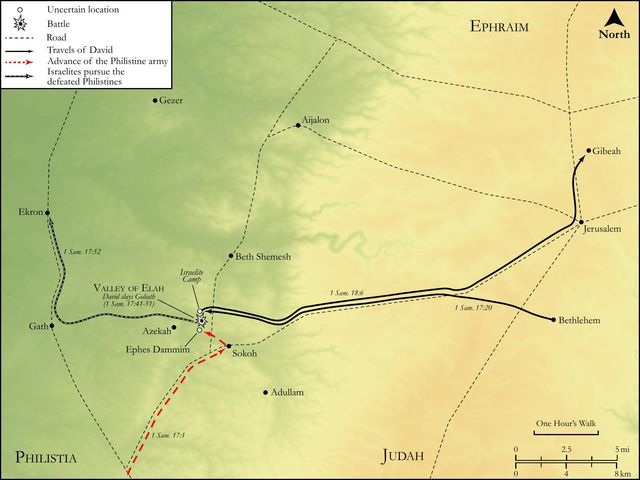
See on the biblical-era map
Study this verse
Public-domain commentary
Matthew Henry
From his Commentary on the Whole Bible. Henry comments on passages, not single verses — this entry covers 1 Samuel 17:40–47. His four-level outline is real structure in the source text, so it is rendered as structure.
We are now coming near this famous combat, and have in these verses the preparations and remonstrances made on both sides.
I.The preparations made on both sides for the encounter.
The Philistine was already fixed, as he had been daily for the last forty days. Well might he go with his armour, for he had sufficiently proved it. Only we are told (Sa1 17:41) that he came on and drew near, a signal, it is likely, being given that his challenge was accepted, and, as if he distrusted his helmet and coat of mail, a man went before him, carrying his shield, for his own hands were full with his sword and spear, Sa1 17:45. But what arms and ammunition is David furnished with? Truly none but what he brought with him as a shepherd; no breastplate, nor corselet, but his plain shepherd's coat; no spear, but his staff; no sword nor bow, but his sling; no quiver, but his scrip; nor any arrows, but, instead of them, five smooth stones picked up out of the brook, Sa1 17:40. By this it appeared that his confidence was purely in the power of God, and not in any sufficiency of his own, and that now at length he who put it into his heart to fight the Philistine put it into his head with what weapons to do it.
II.The conference which precedes the encounter, in which observe,
1.How very proud Goliath was, (1.) With what scorn he looked upon his adversary, Sa1 17:42. He looked about, expecting to meet some tall strong man, but, when he saw what a mean figure he made with whom he was to engage, he disdained him, thought it below him to enter the lists with him, fearing that the contemptibleness of the champion he contended with would lessen the glory of his victory. He took notice of his person, that he was but a youth, not come to his strength, ruddy and of a fair countenance, fitter to accompany the virgins of Israel in their dances (if mixed dancing was then in use) than to lead on the men of Israel in their battles. He took notice of his array with great indignation (Sa1 17:43): "Am I a dog, that thou comest to me with staves? Dost thou think to beat me as easily as thou dost thy shepherd's dog?" (2.) With what confidence he presumed upon his success. He cursed David by his gods, imprecating the impotent vengeance of his idols against him, thinking these fire-balls thrown about him would secure his success: and therefore, in confidence of that, he darts his grimaces, as if threatening words would kill (Sa1 17:44): "Come to me, and I will give thy flesh to the fowls of the air, it will be a tender and delicate feast for them." Thus the security and presumption of fools destroy them.
2.How very pious David was. His speech savours nothing of ostentation, but God is all in all in it, Sa1 17:45-47.
(1.)He derives his authority from God: "I come to thee by warrant and commission from heaven, in the name of the Lord, who has called me to and anointed me for this undertaking, who, by his universal providence, is the Lord of hosts, of all hosts, and therefore has power to do what he pleases, and, by the special grace of his covenant, is the God of the armies of Israel, and therefore has engaged and will employ his power for their protection, and against thee who hast impiously defied them." The name of God David relied on, as Goliath did on his sword and spear. See Psa 20:7; Psa 118:10, Psa 118:11.
(2.)He depends for success upon God, Sa1 17:46. David speaks with as much assurance as Goliath had done, but upon better ground; it is his faith that says, "This day will the Lord deliver thee into my hand, and not only thy carcase, but the carcases of the host of the Philistines, shall be given to the birds and beasts of prey." (3.) He devotes the praise and glory of all to God. He did not, like Goliath, seek his own honour, but the honour of God, not doubting but by the success of this action,
[1.]All the world should be made to know that there is a God, and that the God of Israel is the one only living and true God, and all other pretended deities are vanity and a lie.
[2.]All Israel (whom he calls not this army, but this assembly, or church, because they were now religiously attending the goings of their God and King, as they used to do in the sanctuary) shall know that the Lord saveth not with sword and spear (Sa1 17:47), but can, when he pleases, save without either and against both, Psa 46:9. David addresses himself to this combat rather as a priest that was going to offer a sacrifice to the justice of God than as a soldier that was going to engage an enemy of his country.
Historical interpretation
Historical reception
1 surviving comment on this verse from the historical church.
And the Lord will deliver you into my hands, etc. And by the power of my divinity, he says, you will be overcome, you who, beholding the vileness of my flesh, are proud and exalt yourself, and I will remove you, who are the head of all evils, from the unjustly attached mortal members; and I will give your falling members and those of your followers, that is, men separated from you and humbled by my power or grace, who, deceived by your godless cults, had stuck with you: I will, I say, give them to be instructed by my own, and joined to my own ministers, who are partly heavenly beings of angelic nature and partly mortal in earthly flesh, so that with the Gospel preached throughout the entire world, every man may know that there is one true God who is now known in Judea, and in Israel his name is great (Psalm 75). Then by the universal praise of the catholic, that is, universal, from the ends of the earth those who cry out to God will say: Lord our God, how admirable is your name in all the earth (Psalm 8)! Nor should anyone find it absurd that we have said the depths of the flesh, the birds of the air, and the beasts of the earth signify the teachers who eagerly capture and draw in through faith the souls that were formerly carnal. For even the Lord himself is most openly called the lion from the tribe of Judah, and the Church is typically called a lioness: not only on account of its strength, but also to signify the diligent pursuit of holy rapaciousness. For the patriarch Jacob says of the Lord, "Judah is a lion’s whelp; from the prey, my son, you have gone up" (Gen. 49). And the Lord himself says of the Church to Job: "Will you take the prey for the lioness, and fill the soul of her young ones?" (Job 39). But the Savior is also symbolized by the four living creatures. Just as he wanted to indicate the humility of incarnation and offering through the man and the ox, so through the lion and the eagle he wanted to indicate the power and sublimity of his resurrection and ascension into heaven. He also speaks to blessed Job about the Church, saying: "Does the eagle mount up at your command and make its nest on high?" (Job 39). So that you would not think it typifies only the height of nesting or flying, or even the sharp vision of gazing at the sun, but also the unity of devouring, he added at the end: "And where the carcass is, there immediately it is present." Wherever he sees someone having fallen from a fitting state of life, he promptly takes care to restore such a one, as if raised from death, to catholic life through the biting corrections of his words. We thought it should be given as an example concerning two of them, so that through these whoever reads may also know what he may think without the scruple of faith about the other birds and beasts.
Continue studying 1 Samuel 17:46 across the web’s major study libraries — every link below opens this exact verse, chapter, or book on the destination site.
Read & Compare
 BibleGatewayThis verse in more than 200 translations and 70 languages.
 Bible.comThe YouVersion reader — hundreds of translations, reading plans, and highlights.
 ESV.orgCrossway's official English Standard Version reader.
 NET BibleThe NET translation with 60,000+ translators' notes on every rendering decision.
 STEP BibleTyndale House's free study tool — original text, vocabulary, and scholarly resources.
 BibliaLogos Bible Software's free web reader.
 USCCBThe New American Bible (Revised Edition) with the U.S. bishops' study notes.
Commentaries
 BibleHub CommentariesDozens of classic commentaries on this verse, gathered on one page.
 StudyLightMore than 100 commentary sets — the largest collection on the web.
 BibleRefPlain-English commentary on what this verse means, verse by verse.
 Enduring WordDavid Guzik's free commentary on this chapter, widely used by Bible teachers.
 Bible Study ToolsVerse commentary alongside Greek and Hebrew study aids.
Original Language & Research
- BibleHub InterlinearThe verse word by word — original language, transliteration, and English.
- BibleHub LexiconEvery word's original-language definition and Strong's entry.
 Blue Letter BibleDeep-study tools — Strong's numbers, concordance, and word studies.
 SefariaThe Hebrew text with Rashi and centuries of Jewish commentary.
Sermons, Hymns & Audio


TrulyRandomVerse is not affiliated with these sites and doesn’t control their content. They’re linked because they’re genuinely useful.
Summary
In 1 Samuel 17:46, David, standing before the intimidating Philistine champion Goliath, boldly proclaims his unwavering conviction that the LORD will sovereignly hand Goliath over to him. He prophesies not only Goliath's swift and decisive defeat, including his beheading, but also the ignominious destruction of the entire Philistine army, whose corpses will be left for scavengers. The ultimate and profound purpose of this impending victory, David declares, is to reveal to "all the earth" the unique, active, and supreme reality of the God of Israel, thereby demonstrating that true power and ultimate victory belong exclusively to the Sovereign God, not to human might, military prowess, or imposing stature.
Context
ShowHideLiterary Context
This verse represents the powerful climax of David's defiant verbal confrontation with Goliath, immediately following David's profound declaration in 1 Samuel 17:45 that he comes against the giant "in the name of the LORD of hosts, the God of the armies of Israel." The preceding narrative has meticulously built dramatic tension, detailing Goliath's intimidating challenge issued for forty consecutive days, which instilled paralyzing fear in King Saul and the entire Israelite army. David's unexpected arrival, fueled by righteous indignation over Goliath's blasphemy, sets the stage. His words in verse 46 are not mere youthful bravado but a prophetic utterance, deeply rooted in his prior experiences of divine deliverance while protecting his flock from lions and bears (1 Samuel 17:34-37). This faith-filled declaration serves as a direct prelude to the swift and decisive victory that immediately follows, showcasing the immediate and tangible fulfillment of David's divinely inspired words.
Historical & Cultural Context
The confrontation between David and Goliath is set against the backdrop of "champion warfare," a common practice among the nations. In this form of combat, two opposing armies would select their strongest warriors to engage in a single duel, with the outcome determining the victor of the larger conflict, thereby minimizing widespread casualties. The Philistines, a formidable "Sea People" who had settled along the coastal plain of Canaan, were a persistent and significant military threat to Israel, possessing superior iron weaponry and a highly organized military structure. Goliath, described as an imposing figure over nine feet tall and heavily armored, was the terrifying embodiment of this existential threat. David's challenge, therefore, transcended a personal duel; it was a proxy battle for the very existence, honor, and theological standing of Israel and its covenant God. While the Philistines worshipped deities such as Dagon, Israel worshipped Yahweh, the one true covenant God. The outcome of this duel would be perceived as a divine judgment, revealing which deity was truly supreme, a concept central to the ancient worldview where national gods were believed to fight for their people.
Key Themes
ShowHideThe primary themes converging in this verse are Divine Sovereignty and Deliverance, powerfully illustrating that God is the ultimate actor in history, actively intervening on behalf of His people. David's complete and utter reliance on the LORD underscores the profound theme of Faith Over Sight, where a young, seemingly unarmed shepherd confronts a seasoned, heavily armored warrior, not through his own strength or military training, but through an unwavering trust in God's omnipotence (Hebrews 11:32-34). Furthermore, David's explicit declaration, "that all the earth may know that there is a God in Israel," emphasizes the crucial theme of God's Glory and Testimony. This victory was not merely for Israel's national security or David's personal renown, but was primarily intended to reveal Yahweh's unique identity, unparalleled power, and active presence to the surrounding nations, demonstrating His absolute supremacy over all other gods. This motif is a recurring thread throughout the Old Testament, from the plagues in Egypt to the exodus account itself, as seen in Exodus 9:16.
Exposition and Analysis
ShowHideKey Word Analysis
ShowHideThis is the sacred, covenant name of God (H3068), often translated as "Yahweh," emphasizing His personal, relational, and self-existent nature ("the self-Existent or Eternal"). David's use of "the LORD" signifies that he is not appealing to a generic deity but to the specific, living God who has established a covenant relationship with Israel. It underscores God's faithfulness to His promises and His active, sovereign presence in the affairs of His people, highlighting that the battle's outcome is determined by His will and character.
The Hebrew word (H5462) translated "deliver" means "to shut up; figuratively, to surrender; close up, give over (up)." In this context, it signifies God's active and decisive act of "surrendering" or "giving over" Goliath into David's hand. It is not a passive allowance but an intentional, sovereign act of divine transfer, asserting God's complete control over Goliath's fate and the battle's outcome. David's confidence is rooted in God's active intervention, not merely His permission.
This word (H3045) implies more than mere intellectual assent; it denotes an experiential, relational, and often revelatory knowledge. When David declares "that all the earth may know that there is a God in Israel," he means that through this miraculous and undeniable victory, the nations will come to experientially acknowledge the unique reality, power, and supremacy of Yahweh. This knowledge is not just cognitive but involves a recognition of His active presence and power among His people, in stark contrast to the impotent idols worshipped by the Philistines and other nations.
Verse Breakdown
ShowHide"This day will the LORD deliver thee into mine hand;"
David begins with an immediate and absolute declaration of divine intervention. The phrase "this day" emphasizes the certainty and imminence of God's action, signaling that the decisive moment is now. David's profound confidence is not in his own strength or skill but entirely in the sovereign power of the LORD, who will actively "deliver" Goliath, placing him under David's authority and control. This statement immediately shifts the focus from a human contest to a divinely orchestrated event.
"and I will smite thee, and take thine head from thee;"
Following the divine act of deliverance, David boldly outlines the precise physical consequences for Goliath. "Smite thee" indicates a decisive, fatal blow, and "take thine head from thee" explicitly predicts beheading, a graphic but common practice in ancient warfare used to confirm victory, humiliate the enemy, and display the champion's triumph. This shows David's full commitment to executing God's will and his understanding of the complete and humiliating nature of the victory God will grant.
"and I will give the carcases of the host of the Philistines this day unto the fowls of the air, and to the wild beasts of the earth;"
David extends his prophecy beyond Goliath to encompass the entire Philistine army. He predicts their utter defeat and the gruesome fate of their unburied corpses, left as carrion for scavengers. This was a severe dishonor among the nations, signifying a complete and humiliating rout, denying the fallen dignity even in death. The phrase "this day" again underscores the immediate and total nature of the impending judgment upon the Philistines, leaving no doubt about the comprehensiveness of God's victory.
"that all the earth may know that there is a God in Israel."
This final clause reveals the ultimate, overarching purpose and profound theological significance of the battle. David's primary motivation is not personal glory, nationalistic pride, or even merely Israel's security, but the universal recognition of Yahweh's supremacy. The victory over Goliath and the Philistines is intended to be a global testimony, demonstrating to all nations that the God of Israel is the one true, living, and powerful God, actively present and sovereign in the world, unlike the false, impotent gods worshipped by other peoples.
Literary Devices
ShowHide1 Samuel 17:46 is powerfully imbued with literary devices that amplify its meaning and impact. Prophetic Declaration is central, as David speaks with the authority of a divine messenger, foretelling the precise and gruesome outcome of the battle. His words are not merely boastful but are framed as a divinely inspired pronouncement of God's certain victory. Hyperbole, while the outcome itself is literal, is subtly employed in the sweeping prediction of "all the earth" knowing God, emphasizing the universal scope of God's intended revelation. Contrast is a pervasive theme throughout the chapter and culminates powerfully in this verse: the stark contrast between Goliath's overwhelming physical might and David's spiritual power rooted in God, between the paralyzing human fear of Israel and David's audacious divine courage, and most significantly, between the impotence of pagan gods and the living, active reality of the God of Israel. The verse also employs Repetition of the phrase "this day," reinforcing the immediacy, certainty, and divine orchestration of the prophesied events.
Theological and Thematic Connections
ShowHideDavid's declaration in 1 Samuel 17:46 profoundly articulates the foundational biblical principle that true victory and deliverance come from God alone, not from human strength, military might, or impressive stature. It underscores God's active, sovereign involvement in human history, His unwavering commitment to His covenant people, and His ultimate, overarching desire for His glory and unique identity to be known throughout the entire earth. This event serves as a powerful testament to the fact that God often chooses the weak, the overlooked, and the unlikely to accomplish His mighty purposes, thereby ensuring that all glory redounds to Him alone. It is a foundational narrative for understanding divine sovereignty, the call to audacious faith in the face of seemingly overwhelming odds, and the global scope of God's redemptive plan.
Reflection and Application
ShowHideDavid's bold declaration in 1 Samuel 17:46 offers a timeless and profound blueprint for confronting the "Goliaths" in our own lives—whether they are overwhelming personal challenges, seemingly insurmountable obstacles, societal injustices, or spiritual adversaries. It calls us to radically shift our gaze from the magnitude and apparent invincibility of the problem to the omnipotence and faithfulness of our God. Like David, our confidence should not be rooted in our own limited abilities, meager resources, or even past successes, but solely and completely in the LORD's power to deliver. This verse challenges us to live lives that are not just privately faithful but publicly demonstrative of God's living reality. Our responses to life's trials, our unwavering trust in God's promises, and our willingness to step out in audacious faith can serve as a powerful and undeniable testimony to a watching world, "that all the earth may know that there is a God." It encourages us to speak and act with prophetic certainty, believing that God will fulfill His word and powerfully use our obedience to reveal His glory to those who do not yet know Him.
Questions for Reflection
ShowHideFAQ
ShowHideWas David being arrogant or boastful in his declaration?
ShowHideNo, David's declaration was not born of arrogance or personal boastfulness, but of profound, God-centered faith and an intense zeal for God's honor. His words were a prophetic utterance, confidently proclaiming what God would do through him, not what he would do in his own strength. Throughout the narrative, David consistently deflects glory from himself, attributing all power and victory to the LORD. His preceding statement in 1 Samuel 17:45 explicitly states he comes "in the name of the LORD of hosts." The ultimate purpose of his actions, as stated in verse 46, was "that all the earth may know that there is a God in Israel," clearly indicating a divine, not a personal, agenda. This distinguishes his confidence from human pride, rooting it firmly in divine power and purpose.
Why did David mention giving the Philistine carcasses to the birds and beasts?
ShowHideDavid's mention of the Philistine carcasses being left for scavengers was a common and deeply humiliating consequence of defeat in ancient warfare. To be left unburied was a grave dishonor, denying the fallen warrior a proper burial and the dignity associated with it, ensuring their memory would be one of shame. This prophecy served multiple purposes: it underscored the totality and certainty of the Philistines' defeat, it was a direct insult and challenge to Goliath and his army, and it demonstrated David's understanding that God's judgment would be complete, leaving no doubt about the outcome of the battle and the absolute supremacy of Israel's God. It was a stark visual prophecy of utter destruction and humiliation for the enemies of God.
Christ-Centered Fulfillment
ShowHideDavid's audacious victory over Goliath, so powerfully declared in 1 Samuel 17:46, serves as a profound Old Testament type and foreshadowing of Christ's ultimate triumph over the forces of evil. Just as David, an unlikely and humble shepherd, confronted the seemingly invincible giant to deliver Israel from its formidable oppressor, so too did Jesus, the true "Lamb of God, who takes away the sin of the world!" (John 1:29), confront the ultimate "Goliath" of sin, death, and the devil. David confidently declared, "This day will the LORD deliver thee into mine hand," a declaration that echoes Christ's own confident pronouncements of victory over the powers of darkness. Through His sacrificial death on the cross and His glorious resurrection, Jesus "disarmed the rulers and authorities and put them to open shame, by triumphing over them in Him" (Colossians 2:15). He definitively defeated the one who holds the power of death, that is, the devil, thereby setting free those who were held in slavery by their fear of death (Hebrews 2:14-15). The ultimate purpose of David's victory was "that all the earth may know that there is a God in Israel"; similarly, Christ's victory on the cross and His resurrection ensure that God's glory and His unique identity as the Savior of the world are proclaimed to "every nation, tribe, people and language" (Revelation 7:9), demonstrating that indeed, there is one true God, and His name is Jesus Christ, the victorious Son of David and King of kings.