


Daniel 6:27
- מְשֵׁיזִבme·shei·Ziv[he is] deliveringH7804V-Shaphel-Prtcpl-msVerb Shaphel Participle Singular Masculine Absolute
- וּמַצִּלu·ma·Tziland [he is] rescuingH5338Conj-w ¦ V-Hiphil-Prtcpl-msVerb Hiphil Participle Singular Masculine Absoluteוּandמַצִּל[he is] rescuing
- וְעָבֵדve·'a·Vedand [he is] doingH5648Conj-w ¦ V-Qal-Prtcpl-msVerb Qal Participle Singular Masculine Absoluteוְandעָבֵד[he is] doing
- אָתִין'a·TinsignsH852N-mpNoun Plural Masculine Absolute
- וְתִמְהִיןve·tim·Hinand wondersH8540Conj-w ¦ N-mpNoun Plural Masculine Absoluteוְandתִמְהִיןwonders
- בִּשְׁמַיָּאbish·mai·Ya'in heavens theH8065Prep-b ¦ N-mp ¦ ArtNoun Plural Masculine Definiteבִּinשְׁמַיָּheavensאthe
- וּבְאַרְעָאu·ve·'ar·'A'and on earth theH772Conj-w ¦ Prep-b ¦ N-cs ¦ ArtNoun Singular common gender Definiteוּandבְonאַרְעָearthאthe
- דִּיdiwhoH1768ConjConjunction
- שֵׁיזִיבshei·Zivhe has deliveredH7804V-Shaphel-Perf-3msVerb Shaphel Perfect 3rd Singular Masculine
- לְדָנִיֵּאלle·da·ni·Yel<obj.> DanielH1841Prep-l ¦ N-proper-mNoun Proper Masculineלְ<obj.>דָנִיֵּאלDaniel
- מִןminfromH4481PrepPreposition
- יַדyad[the] hand ofH3028N-cscNoun Singular common gender Construct
- אַרְיָוָתָא'ar·ya·va·Ta'lions theH744N-fs ¦ ArtNoun Singular Feminine Definiteאַרְיָוָתָlionsאthe
English is a literal word-by-word gloss of the Hebrew, not the KJV's wording. Why?
This is the original text the KJV's translators worked from — each Hebrew word with its own literal English meaning in this verse, prepared by scholars at Tyndale House, Cambridge. The KJV translates whole sentences, not word by word, so its wording differs: one Hebrew word can become several English words, and the KJV may choose “the LORD” where the gloss reads “Yahweh”. Both are faithful — they answer different questions. For the KJV's own rendering, switch to the KJV text.
Details
See on the biblical-era map
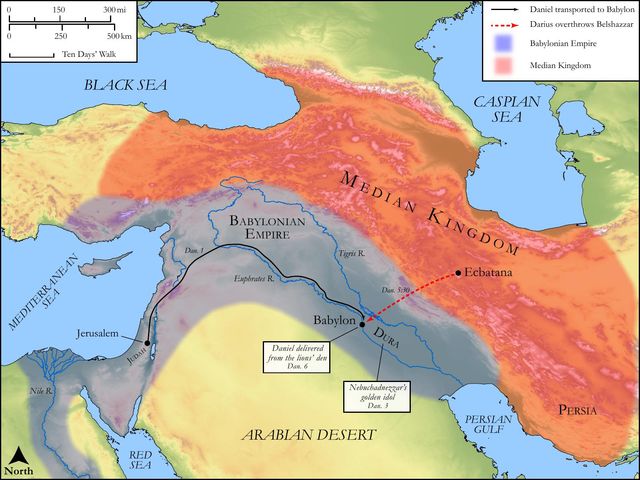
Study this verse
Public-domain commentary
Matthew Henry
From his Commentary on the Whole Bible. Henry comments on passages, not single verses — this entry covers Daniel 6:25–28. His two-level outline is real structure in the source text, so it is rendered as structure.
Darius here studies to make some amends for the dishonour he had done both to God and Daniel, in casting Daniel into the lions' den, by doing honour to both.
I.He gives honour to God by a decree published to all nations, by which they are required to fear before him.
And this is a decree which is indeed fit to be made unalterable, according to the laws of the Medes and Persians, for it is the everlasting gospel, preached to those that dwell on the earth, Rev 14:7. Fear God, and give glory to him. Observe,
1.To whom he sends this decree - to all people, nations and languages, that dwell in all the earth, Dan 6:25. These are great words, and it is true that all the inhabitants of the earth are obliged to that which is here decreed; but here they mean no more than every dominion of his kingdom, which, though it contained many nations, did not contain all nations; but so it is, those that have much are ready to think they have all.
2.What the matter of the decree is - that men tremble and fear before the God of Daniel. This goes further than Nebuchadnezzar's decree upon a similar occasion, for that only restrained people from speaking amiss of this God, but this requires them to fear before him, to keep up and express awful reverent thoughts of him. And well might this decree he prefaced, as it is, with Peace be multiplied unto you, for the only foundation of true and abundant peace is laid in the fear of God, for that is true wisdom. If we live in the fear of God, and walk according to that rule, peace shall be upon us, peace shall be multiplied to us. But, though this decree goes far, it does not go far enough; had he done right, and come up to his present convictions, he would have commanded all men not only to tremble and fear before this God, but to love him and trust in him, to forsake the service of their idols, and to worship him only, and call upon him as Daniel did. But idolatry had been so long and so deeply rooted that it was not to be extirpated by the edicts of princes, nor by any power less than that which went along with the glorious gospel of Christ.
3.What are the causes and considerations moving him to make this decree. They are sufficient to have justified a decree for the total suppression of idolatry, much more will they serve to support this. There is good reason why all men should fear before this God, for, (1.) His being is transcendent. "He is the living God, lives as a God, whereas the gods we worship are dead things, have not so much as an animal life." (2.) His government is incontestable. He has a kingdom, and a dominion; he not only lives, but reigns as an absolute sovereign. (3.) Both his being and his government are unchangeable. He is himself stedfast for ever, and with him is no shadow of turning. And his kingdom too is that which shall not be destroyed by any external force, nor has his dominion any thing in itself that threatens a decay or tends towards it, and therefore it shall be even to the end. (4.) He has an ability sufficient to support such an authority, Dan 6:27. He delivers his faithful servants from trouble and rescues them out of trouble; he works signs and wonders, quite above the utmost power of nature to effect, both in heaven and on earth, by which it appears that he is sovereign Lord of both. (5.) He has given a fresh proof of all this in delivering his servant Daniel from the power of the lions. This miracle, and that of the delivering of the three children, were wrought in the eyes of the world, were seen, published, and attested by two of the greatest monarchs that ever were, and were illustrious confirmations of the first principles of religion, abstracted from the narrow scheme of Judaism, effectual confutations of all the errors of heathenism, and very proper preparations for pure catholic Christianity.
II.He puts honour upon Daniel (Dan 6:28):
So this Daniel prospered. See how God brought to him good out of evil. This bold stroke which his enemies made at his life was a happy occasion of taking them off, and their children too, who otherwise would still have stood in the way of his preferment, and have been upon all occasions vexatious to him; and now he prospered more than ever, was more in favour with his prince and in reputation with the people, which gave him a great opportunity of doing good to his brethren. Thus out of the eater (and that was a lion too) comes forth meat, and out of the strong sweetness.
Historical interpretation
Historical reception
1 surviving comment on this verse from the historical church.
Verses 25-27. "Then king Darius wrote unto all the peoples, tribes and language-groups who dwelt in all the earth, saying: 'Your peace be multiplied! I have enacted a decree that in all my empire and kingdom men are to dread and tremble before the God of Daniel. For it is He who is the living God and the One who abides forever, and His rule shall not be overthown, and His power shall eternally endure. It is He who is the Deliverer and Savior, who performs signs and wonders in heaven and on earth, and who has delivered Daniel from the pit of lions.'" Just as in the case of Nebuchadnezzar's writing unto the language-groups and nations one authority has interpreted them to signify hostile powers, so also this same man interprets the action of Darius, on the ground that he summons them all to repentance. And he poses the question as to whether this will take place in this world or in the other world, or even after other worlds have intervened. We deem these speculations to be absurd and account them as empty fables, and make this single observation: that the reason why signs are performed amid barbarian peoples through the agency of God's servants is that the worship and religion of the only God may be proclaimed.
Continue studying Daniel 6:27 across the web’s major study libraries — every link below opens this exact verse, chapter, or book on the destination site.
Read & Compare
 BibleGatewayThis verse in more than 200 translations and 70 languages.
 Bible.comThe YouVersion reader — hundreds of translations, reading plans, and highlights.
 ESV.orgCrossway's official English Standard Version reader.
 NET BibleThe NET translation with 60,000+ translators' notes on every rendering decision.
 STEP BibleTyndale House's free study tool — original text, vocabulary, and scholarly resources.
 BibliaLogos Bible Software's free web reader.
 USCCBThe New American Bible (Revised Edition) with the U.S. bishops' study notes.
Commentaries
 BibleHub CommentariesDozens of classic commentaries on this verse, gathered on one page.
 StudyLightMore than 100 commentary sets — the largest collection on the web.
 BibleRefPlain-English commentary on what this verse means, verse by verse.
 Enduring WordDavid Guzik's free commentary on this chapter, widely used by Bible teachers.
 Bible Study ToolsVerse commentary alongside Greek and Hebrew study aids.
Original Language & Research
- BibleHub InterlinearThe verse word by word — original language, transliteration, and English.
- BibleHub LexiconEvery word's original-language definition and Strong's entry.
 Blue Letter BibleDeep-study tools — Strong's numbers, concordance, and word studies.
 SefariaThe Hebrew text with Rashi and centuries of Jewish commentary.
Sermons, Hymns & Audio


TrulyRandomVerse is not affiliated with these sites and doesn’t control their content. They’re linked because they’re genuinely useful.
Summary
Daniel 6:27 presents King Darius's profound and climactic declaration, a royal decree acknowledging the supreme power and active intervention of Daniel's God. Issued immediately following Daniel's miraculous deliverance from the lions' den, Darius proclaims that God is the one who consistently delivers and rescues, performing extraordinary signs and wonders both in heaven and on earth. This universal assertion culminates in the specific, undeniable, and recent rescue of Daniel from the jaws of death, serving as an irrefutable testament to God's sovereignty and His unparalleled ability to vindicate His faithful servant, compelling even a pagan monarch to recognize His unique might.
Context
ShowHideLiterary Context
This verse serves as the powerful conclusion to the dramatic narrative of Daniel 6, immediately following the miraculous preservation of Daniel's life. The chapter begins by establishing Daniel's exemplary administrative service under King Darius, which, ironically, incites intense jealousy and conspiracy among other satraps and administrators. Unable to find fault in Daniel's work, they exploit his unwavering devotion to God, crafting an unchangeable royal decree forbidding prayer to any god or man other than the king for thirty days (Daniel 6:7). Despite knowing the dire consequences, Daniel faithfully continues his daily prayers, leading to his condemnation and placement in the lions' den. Darius, though deeply distressed, is legally bound by his own law. However, God intervenes supernaturally, sending an angel to shut the lions' mouths (Daniel 6:22). Upon discovering Daniel unharmed the next morning, Darius is overwhelmed with joy and immediately orders Daniel's accusers and their families to be thrown into the den, where they are instantly devoured. This dramatic sequence culminates in Darius's decree in Daniel 6:25-27, which not only praises Daniel's God but commands reverence for Him throughout his vast kingdom, solidifying the chapter's theme of divine vindication.
Historical & Cultural Context
The book of Daniel is set against the backdrop of the Babylonian and Persian empires. King Darius, often identified as "Darius the Mede," is likely a viceroy or administrative ruler under Cyrus the Great, who conquered Babylon in 539 BC. A crucial aspect of the Medo-Persian legal system was its renowned immutability; once a decree was signed by the king and sealed, it could not be altered (Daniel 6:8). This legal rigidity profoundly highlights the extraordinary nature of God's intervention, as it directly circumvented a law that even the king himself could not undo. Lions were common in the ancient Near East, frequently used in royal hunts, and served as powerful symbols of strength and sovereignty. Dens for criminals or wild animals were a known form of execution or containment. The Aramaic language of this portion of Daniel (chapters 2-7) reflects the lingua franca of the Persian Empire, making Darius's decree understandable across his vast, multi-ethnic domain, thereby emphasizing the universal scope of his declaration about Daniel's God.
Key Themes
ShowHideDaniel 6:27 contributes significantly to several overarching themes within the book of Daniel and broader biblical theology. Firstly, it powerfully underscores God's absolute sovereignty over human rulers and earthly powers. Even a pagan king is compelled to acknowledge and declare the supremacy of the God of Israel, demonstrating that no earthly authority can thwart His divine will. Secondly, it exemplifies the theme of divine deliverance and protection for those who remain faithful under persecution. Daniel's unwavering commitment to God, even unto death, is met with miraculous intervention, demonstrating God's faithfulness to His covenant people. Thirdly, the verse highlights the universal proclamation of God's glory. Through the extraordinary events surrounding Daniel, God's name and power are made known not just within Israel, but powerfully among the Gentiles, fulfilling a broader missional purpose. This theme resonates with other instances in Daniel where pagan kings, like Nebuchadnezzar in Daniel 4:34-37, are brought to acknowledge the Most High God.
Exposition and Analysis
ShowHideKey Word Analysis
ShowHideThis Aramaic verb (H7804), corresponding to the Hebrew ʻazab, means "to leave" or, in its causative form, "to free." In this context, it denotes God's active, powerful act of setting someone free from a perilous situation. It implies a forceful and decisive liberation, not merely a passive allowance of escape, but a direct intervention to ensure safety.
The Aramaic verb (H5338), corresponding to the Hebrew natsal, carries the meaning "to extricate" or "to snatch away." It emphasizes the urgency and immediacy of God's saving action, pulling someone out of danger's grasp. Paired with "delivereth," it forms a strong hendiadys, underscoring the comprehensive and complete nature of God's salvation.
This Aramaic noun (H852), corresponding to the Hebrew 'oth, refers to a "portent" or a "miraculous sign." These are not mere coincidences but divinely orchestrated events that serve as undeniable evidence of God's power, presence, and purpose. They are intended to capture attention and convey a message about the nature and authority of the one performing them.
Verse Breakdown
ShowHide"He delivereth and rescueth"
This opening phrase immediately establishes God's core character as an active, intervening deity. The dual verbs emphasize the comprehensive nature of His saving power – He frees from bondage and snatches from danger. It speaks to His capacity to act decisively in human affairs, especially on behalf of His faithful, demonstrating His constant readiness to intervene for His people.
"and he worketh signs and wonders in heaven and in earth"
This clause expands on God's power, declaring His universal dominion. "Signs and wonders" are miraculous acts that defy natural explanation, demonstrating God's supernatural control over all creation, both celestial ("in heaven") and terrestrial ("in earth"). It asserts that God's power is not limited to specific locations or circumstances but is operative everywhere, at all times, showcasing His boundless authority.
"who hath delivered Daniel from the power of the lions"
This final clause provides the irrefutable, concrete evidence for the preceding claims. The general declarations of God's delivering power and ability to perform miracles are substantiated by the specific, recent, and undeniable event witnessed by King Darius himself. It highlights the direct application of God's universal power to a particular, desperate situation, demonstrating His personal care for His servant. "From the power of the lions" (H3028, yad, meaning "hand" or "power") emphasizes the complete removal of Daniel from the destructive capability of the beasts.
Literary Devices
ShowHideDaniel 6:27 is rich in literary devices that amplify its message and underscore the profound nature of God's intervention. The use of Parallelism is evident in the pairing of "delivereth and rescueth," which emphasizes the comprehensive and complete nature of God's salvation. Similarly, "signs and wonders" and "in heaven and in earth" employ parallelism to convey the breadth and scope of God's miraculous activity, asserting His universal dominion. There is a powerful element of Testimony, as the declaration comes from a pagan king, lending an undeniable credibility and universality to the praise of God, demonstrating His ability to compel even His adversaries to acknowledge Him. The phrase "in heaven and in earth" also functions as Merism, a figure of speech in which two contrasting parts represent a whole, effectively underscoring the boundless and unrestricted nature of God's power and influence over all creation. Finally, the entire passage is a testament to Divine Irony, where the very decree intended to destroy Daniel ultimately serves as the catalyst for a pagan king to issue a decree proclaiming the greatness of Daniel's God throughout his vast empire, turning human malice into an occasion for divine glory.
Theological and Thematic Connections
ShowHideDaniel 6:27 stands as a profound theological statement on the character of God, affirming His active sovereignty, His unwavering faithfulness to His covenant people, and His unparalleled power to intervene in the natural order. It reveals a God who is not distant or detached but intimately involved in the affairs of humanity, capable of overturning the most rigid human laws and delivering His servants from seemingly inescapable doom. This passage underscores that God's glory is not confined to a single nation but is powerfully displayed to the nations, compelling even those outside the covenant to acknowledge His supreme authority. It is a testament to the fact that God uses the faithfulness of His people, even in their suffering, as a means to reveal His power and draw others to Himself, demonstrating His providential care and ultimate triumph over all opposition.
Reflection and Application
ShowHideDaniel 6:27 offers immense encouragement and a powerful call to unwavering faith for believers today. It reminds us that no circumstance, no human decree, and no "lions' den" is too formidable for our God. When we face our own trials—whether they are professional pressures, health crises, relational conflicts, or spiritual battles—this verse assures us that the same God who delivered Daniel is still active, powerful, and intimately concerned with our well-being. Our faithfulness in the face of adversity, much like Daniel's, can become a profound and undeniable testimony to those around us, even compelling unbelievers to acknowledge God's reality and power. This passage challenges us to trust God's sovereignty even when His methods are mysterious and His deliverance seems improbable, knowing that His ultimate purpose is to bring glory to His name through our lives. It calls us to live with integrity and prayerful dependence, confident that our God "delivereth and rescueth" and is capable of working signs and wonders even in our contemporary world.
Questions for Reflection
ShowHideFAQ
ShowHideWhy is King Darius, a pagan king, making such a declaration about the God of Daniel?
ShowHideKing Darius's declaration is a direct result of witnessing an undeniable and profound miracle that defied all natural explanation. Despite being a pagan ruler, he was confronted with irrefutable evidence of God's power when Daniel emerged unharmed from the lions' den, a situation that by all natural laws should have resulted in his immediate death. Furthermore, the subsequent fate of Daniel's accusers, who were instantly devoured by the same lions, served as a stark and terrifying contrast, further solidifying the proof of divine intervention. Darius, though initially distressed by his own decree, was compelled by these supernatural events to acknowledge the supreme authority of Daniel's God. This highlights God's ability to use even pagan rulers and extraordinary circumstances to reveal His glory and establish His name among the nations, as seen in other instances like Pharaoh's experience in Exodus 9:16, where God raised him up to display His power.
What is the significance of "signs and wonders" in this verse and throughout the Bible?
ShowHideThe phrase "signs and wonders" (Aramaic ʼâthîn wəṯimhayyā) refers to extraordinary, miraculous events that serve as undeniable evidence of divine power and presence. In Daniel 6:27, Darius attributes these acts to Daniel's God, acknowledging His supernatural control over creation and His ability to transcend natural laws. Throughout the Bible, signs and wonders are often used by God to authenticate His messengers, confirm His word, demonstrate His sovereignty, and call people to repentance and faith. They are not merely displays of power but purposeful acts designed to reveal God's character and advance His redemptive plan. Examples include the plagues in Egypt (Exodus 7:3), the miracles performed by Elijah and Elisha, and most significantly, the miracles of Jesus Christ, which testified to His divine identity and mission (John 20:30-31).
Christ-Centered Fulfillment
ShowHideDaniel 6:27, King Darius's declaration of God's delivering power, finds its ultimate and most glorious fulfillment in the person and work of Jesus Christ. While Daniel's physical deliverance from the lions was a powerful "sign and wonder" demonstrating God's ability to rescue from temporal death, Christ's resurrection is the supreme act of deliverance, rescuing humanity from the ultimate "power of the lions"—the power of sin and eternal death itself. Jesus is the ultimate "sign and wonder" God has worked in heaven and on earth, His life, miracles, atoning death, and glorious resurrection serving as the irrefutable proof of God's saving power and His unique identity as the Son of God (Acts 2:22). Just as Daniel was found blameless before God and delivered, so too is Christ the perfectly righteous one, whose sacrifice delivers all who believe from condemnation and the curse of the law (Romans 8:1). Through His atoning work, Jesus, the Lamb of God who takes away the sin of the world, delivers us from the spiritual "power of the lions" that seeks to devour our souls, granting us eternal life and true freedom from sin's dominion (John 8:36). Thus, Daniel's rescue foreshadows the greater, spiritual rescue offered to all humanity through faith in Christ, the ultimate Deliverer and Rescuer.