


Daniel 5:19
- וּמִןu·minand fromH4481Conj-w ¦ PrepPrepositionוּandמִןfrom
- רְבוּתָאre·vu·Ta'greatness theH7238N-fs ¦ ArtNoun Singular Feminine Definiteרְבוּתָgreatnessאthe
- דִּיdiwhichH1768ConjConjunction
- יְהַבye·havhe gaveH3052V-Peal-Perf-3msVerb Peal Perfect 3rd Singular Masculine
- לֵהּLehto himPrep-l ¦ 3msSuffix Personal 3rd Singular Masculineלֵtoהּhim
- כֹּלkolallH3606N-cscNoun Singular common gender Construct
- עַמְמַיָּא'a·mai·Ya'peoples theH5972N-mp ¦ ArtNoun Plural Masculine Definiteעַמְמַיָּpeoplesאthe
- אֻמַיָּא'u·mai·Ya'nations theH524N-mp ¦ ArtNoun Plural Masculine Definiteאֻמַיָּnationsאthe
- וְלִשָּׁנַיָּאve·li·Sha·nai·Ya'and languages theH3961Conj-w ¦ N-mp ¦ ArtNoun Plural Masculine Definiteוְandלִשָּׁנַיָּlanguagesאthe
- הֲווֹha·Vothey wereH1934V-Peal-Perf-3mpVerb Peal Perfect 3rd Plural Masculine
- זָיְעִיןza·'a·'intremblingH2112V-Peal-Prtcpl-mpVerb Peal Participle Plural Masculine Absolute
- וְדָחֲלִיןve·da·cha·Linand fearingH1763Conj-w ¦ V-Qal-Prtcpl-mpVerb Qal Participle Plural Masculine Absoluteוְandדָחֲלִיןfearing
- מִןminfromH4481PrepPreposition
- קֳדָמוֹהִיko·da·Mo·hibefore himH6925N-mpc ¦ 3msNoun Plural Masculine Constructקֳדָמוֹbeforeהִיhim
- דִּיdiwhomH1768ConjConjunction
- הֲוָהha·Vahhe wasH1934V-Peal-Perf-3msVerb Peal Perfect 3rd Singular Masculine
- צָבֵאtza·Ve'pleasedH6634V-Peal-Prtcpl-msVerb Peal Participle Singular Masculine Absolute
- הֲוָאha·Va'he wasH1934V-Peal-Perf-3msVerb Peal Perfect 3rd Singular Masculine
- קָטֵלka·TelkillingH6992V-Peal-Prtcpl-msVerb Peal Participle Singular Masculine Absolute
- וְדִיve·diand whomH1768Conj-w ¦ ConjConjunctionוְandדִיwhom
- הֲוָהha·Vahhe wasH1934V-Peal-Perf-3msVerb Peal Perfect 3rd Singular Masculine
- צָבֵאtza·Ve'pleasedH6634V-Peal-Prtcpl-msVerb Peal Participle Singular Masculine Absolute
- הֲוָהha·Vahhe wasH1934V-Peal-Perf-3msVerb Peal Perfect 3rd Singular Masculine
- מַחֵאma·Che'letting liveH2418V-Haphel-Prtcpl-msVerb Haphel Participle Singular Masculine Absolute
- וְדִיve·diand whomH1768Conj-w ¦ ConjConjunctionוְandדִיwhom
- הֲוָהha·Vahhe wasH1934V-Peal-Perf-3msVerb Peal Perfect 3rd Singular Masculine
- צָבֵאtza·Ve'pleasedH6634V-Peal-Prtcpl-msVerb Peal Participle Singular Masculine Absolute
- הֲוָהha·Vahhe wasH1934V-Peal-Perf-3msVerb Peal Perfect 3rd Singular Masculine
- מָרִיםma·Rimlifting upH7313V-Haphel-Prtcpl-msVerb Haphel Participle Singular Masculine Absolute
- וְדִיve·diand whomH1768Conj-w ¦ ConjConjunctionוְandדִיwhom
- הֲוָהha·Vahhe wasH1934V-Peal-Perf-3msVerb Peal Perfect 3rd Singular Masculine
- צָבֵאtza·Ve'pleasedH6634V-Peal-Prtcpl-msVerb Peal Participle Singular Masculine Absolute
- הֲוָהha·Vahhe wasH1934V-Peal-Perf-3msVerb Peal Perfect 3rd Singular Masculine
- מַשְׁפִּילmash·Pilbringing lowH8214V-Haphel-Prtcpl-msVerb Haphel Participle Singular Masculine Absolute
English is a literal word-by-word gloss of the Hebrew, not the KJV's wording. Why?
This is the original text the KJV's translators worked from — each Hebrew word with its own literal English meaning in this verse, prepared by scholars at Tyndale House, Cambridge. The KJV translates whole sentences, not word by word, so its wording differs: one Hebrew word can become several English words, and the KJV may choose “the LORD” where the gloss reads “Yahweh”. Both are faithful — they answer different questions. For the KJV's own rendering, switch to the KJV text.
Details
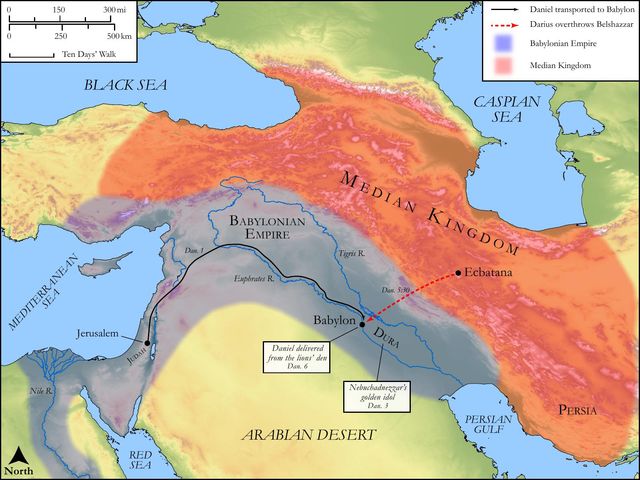
See on the biblical-era map
Study this verse
Public-domain commentary
Matthew Henry
From his Commentary on the Whole Bible. Henry comments on passages, not single verses — this entry covers Daniel 5:10–29. His four-level outline is real structure in the source text, so it is rendered as structure.
Here is, I. The information given to the king, by the queen-mother, concerning Daniel, how fit he was to be consulted in this difficult case. It is supposed that this queen was the widow of Evil-Merodach, and was that famous Nitocris whom Herodotus mentions as a woman of extraordinary prudence. She was not present at the feast, as the king's wives and concubines were (Dan 5:2); it was not agreeable to her age and gravity to keep a merry night. But, tidings of the fright which the king and his lords were put into being brought to her apartment, she came herself to the banqueting-house, to recommend to the king a physician for his melancholy. She entreated him not to be discouraged by the insufficiency of his wise men to solve this riddle, for that there was a man in his kingdom that had more than once helped his grandfather at such a dead lift, and, no doubt, could help him, Dan 5:11, Dan 5:12. She could not undertake to read the writing herself, but directed him to one that could; let Daniel be called now, who should have been called first. Now observe, 1. The high character she gives of Daniel: He is a man in whom is the spirit of the holy gods, who has something in him more than human, not only the spirit of a man, which, in all, is the candle of the Lord, but a divine spirit. According to the language of her country and religion, she could not give a higher encomium of any man; she speaks honourably of him as a man that had, (1.) An admirably good head: Light, and understanding, and wisdom, like the wisdom of the gods, were found in him. Such an insight had he into things secret, and such a foresight of things to come, that it was evident he was divinely inspired; he had knowledge and understanding beyond all the other wise men for interpreting dreams, explaining enigmas or hard sentences, untying knots, and resolving doubts. Solomon had a wonderful sagacity of this kind; but it should seem that in these things Daniel had more of an immediate divine direction. Behold, a greater than Solomon himself is here. Yet what was the wisdom of them both compared with the treasures of wisdom hidden in Christ? (2.) He had an admirably good heart: An excellent spirit was found in him, which was a great ornament to his wisdom and knowledge, and qualified him to receive that gift; for God gives to a man that is good in his sight wisdom, and knowledge, and joy. He was of a humble, holy, heavenly spirit, had a devout and gracious spirit, a spirit of zeal for the glory of God and the good of men. This was indeed an excellent spirit. 2. The account she gives of the respect that Nebuchadnezzar had for him; he was much in his favour, and was preferred by him: "The king thy father" (that is, thy grandfather, but even to many generations Nebuchadnezzar might well be called the father of that royal family, for he it was that raised it to such a pitch of grandeur), "the king, I say, thy father, made him master of the magicians." Perhaps Belshazzar had sometimes, in his pride, spoken slightly of Nebuchadnezzar, and his politics, and the methods of his government, and the ministers he employed, and thought himself wiser than he; and therefore his mother harps upon that. "The king, I say, thy father, to whose good management all thou hast owing, he pronounced him chief of, and gave him dominion over, all the wise men of Babylon, and named him Belteshazzar, according to the name of his god, thinking thereby to put honour upon him;" but Daniel, by constantly making use of his Jewish name himself (which he resolved to keep, in token of his faithful adherence to his religion), had worn out that name; only the queen-dowager remembered it, otherwise he was generally called Daniel. Note, It is a very good office to revive the remembrance of the good services of worthy men, who are themselves modest, and willing that they should be forgotten. 3. The motion she makes concerning him: Let Daniel be called, and he will show the interpretation. By this it appears that Daniel was now forgotten at court. Belshazzar was a stranger to him, knew not that he had such a jewel in his kingdom. With the new king there came in a new ministry, and the old one was laid aside. Note, There are a great many valuable men, and such as might be made very useful, that lie long buried in obscurity, and some that have done eminent services that live to be overlooked and taken no notice of; but, whatever men are, God is not unrighteous to forget the services done to his kingdom. Daniel, being turned out of his place, lived privately, and sought not any opportunity to come into notice again; yet he lived near the court and within call, though Babylon was now besieged, that he might be ready, if there were occasion, to do any good office, by what interest he had among the great ones, for the children of his people. But Providence so ordered it that now, just at the fall of that monarchy, he should by the queen's means be brought to court again, that he might lie there ready for preferment in the ensuing government. Thus do the righteous shine forth out of obscurity, and before honour is humility.
II.The introducing of Daniel to the king, and his request to him to read and expound the writing.
Daniel was brought in before the king, Dan 5:13. He was now nearly ninety years of age, so that his years, and honours, and former preferments, might have entitled him to a free admission into the king's presence; yet he was willing to be conducted in, as a stranger, by the master of the ceremonies. Note,
1.The king asks, with an air of haughtiness: Art thou that Daniel who art of the children of the captivity? Being a Jew, and a captive, he was loth to be beholden to him if he could help it.
2.He tells him what an encomium he had heard of him (Dan 5:14), that the spirit of the gods was in him; and he had sent for him to try whether he deserved so high a character or no.
3.He acknowledges that all the wise men of Babylon were baffled; they could not read this writing, nor show the interpretation, Dan 5:16. But,
4.He promises him the same rewards that he had promised them if he would do it, Dan 5:16. It was strange that the magicians, when now, and in Nebuchadnezzar's time, once and again, they were nonplussed, did not attempt something to save their credit; if they had with a good assurance said, "This is the meaning of such a dream, such a writing," who could disprove them? But God so ordered it that they had nothing at all to say, as, when Christ was born, the heathen oracles were struck dumb.
III.The interpretation which Daniel gave of these mystic characters, which was so far from easing the king of his fears that we may suppose it increased them rather. Daniel was now in years, and Belshazzar was young; and therefore he seems to take a greater liberty of dealing plainly and roundly with him than he had done upon the like occasions with Nebuchadnezzar. In reproving any man, especially great men, there is need of wisdom to consider all circumstances; for they are the reproofs of instruction that are the way of life. In Daniel's discourse here,
1.He undertakes to read the writing which gave them this alarm, and to show them the interpretation of it, Dan 5:17. He slights the offer he made him of rewards, is not pleased that it was mentioned, for he is not one of those that divine for money; what gratuities Nebuchadnezzar gave him afterwards he gladly accepted, but he scorned to bargain for them, or to read the writing to the king for and in consideration of such and such honours promised him. No: "Let thy gifts be to thyself, for they will not be long thine, and give thy fee to another, to any of the wise men whom thou wouldst have most wished to earn it; I value it not." Daniel sees his kingdom now at its last gasp, and therefore looks with contempt upon his gifts and rewards. And thus should we despise all the gifts and rewards that this world can give did we see, as we may by faith, its final period hastening on. Let it give its perishing gifts to another; there are better gifts which we have our eyes and hearts upon; but let us do our duty in the world, do it all the real service we can, read God's writing to it in a profession of religion, and by an agreeable conversation make known the interpretation of it, and then trust God for his gifts, his rewards, in comparison with which all the world can give is mere trash and trifles.
2.He largely recounts to the king God's dealings with his father Nebuchadnezzar, which were intended for instruction and warning to him, Dan 5:18, Dan 5:21. This is not intended for a flourish or an amusement, but is a necessary preliminary to the interpretation of the writing. Note, That we may understand aright what God is doing with us, it is of use to us to review what he has done with others.
(1.)He describes the great dignity and power to which the divine Providence had advanced Nebuchadnezzar, Dan 5:18, Dan 5:19. He had a kingdom, and majesty, and glory, and honour, for aught we know, above what any heathen prince ever had before him; he thought that he got his glory by his own extraordinary conduct and courage, and ascribed his successes to a projecting active genius of his own; but Daniel tells him who now enjoyed what he had laboured for that it was the most high God, the God of gods and Lord of kings (as Nebuchadnezzar himself had called him), that gave him that kingdom, that vast dominion, that majesty wherewith he presided in the affairs of it, and that glory and honour which by his prosperous management he acquired. Note, Whatever degree of outward prosperity any arrive at, they must own that it is of God's giving, not their own getting. Let it never be said, My might, and the power of my hand, have gotten me this wealth, this preferment; but let it always be remembered that it is God that gives men power to get wealth, and gives success to their endeavours. Now the power which God gave to Nebuchadnezzar is here described to be very great in respect both of ability and of authority.
[1.]His ability was so strong that it was irresistible; such was the majesty that God gave him, so numerous were the forces he had at command, and such an admirable dexterity he had at commanding them, that, which way soever his sword turned, it prospered. He could captivate and subdue nations by threatening them, without striking a stroke, for all people trembled and feared before him, and would compound with him for their lives upon any terms. See what force is, and what the fear of it does. It is that by which the brutal part of the world, even of the world of mankind, both governs and is governed.
[2.]His authority was so absolute that it was uncontrollable. The power which was allowed him, which descended upon him, or which, at least, he assumed, was without contradiction, was absolute and despotic, none shared with him either in the legislative or in the executive part of it. In dispensing punishments he condemned or acquitted at pleasure: Whom he would he slew, and whom he would he saved alive, though both were equally innocent or equally guilty. The jus vitae et necis - the power of life and death was entirely in his hand. In dispensing rewards he granted or denied preferment at pleasure: Whom he would he set up, and whom he would he put down, merely for a humour, and without giving a reason so much as to himself; but it is all ex mero motu - of his own good pleasure, and stat pro ratione voluntas - his will stands for a reason. Such was the constitution of the eastern monarchies, such the manner of their kings.
(2.)He sets before him the sins which Nebuchadnezzar had been guilty of, whereby he had provoked God against him. [1.] He behaved insultingly towards those that were under him, and grew tyrannical and oppressive. The description given of his power intimates his abuse of his power, and that he was directed in what he did by humour and passion, not by reason and equity; so that he often condemned the innocent and acquitted the guilty, both which are an abomination to the Lord. He deposed men of merit and preferred unworthy men, to the great detriment of the public, and for this he was accountable to the most high God, that gave him his power. Note, It is a very hard and rare thing for men to have an absolute arbitrary power, and not to make an ill use of it. Camden has a distich of Giraldus, wherein he speaks of it as a rare instance, concerning our king Henry II of England, that never any man had so much power and did so little hurt with it.
Glorior hoc uno, quod nunquam vidimus unum,
Nec potuisse magis, nec nocuisse minus -
Of him I can say, exulting, that with the same power
to do harm no one was ever more inoffensive.
But that was not all. [2.] He behaved insolently towards the God above him, and grew proud and haughty (Dan 5:20): His heart was lifted up, and there his sin and ruin began; his mind was hardened in pride, hardened against the commands of God and his judgments; he was willful and obstinate, and neither the word of God nor his rod made any lasting impression upon him. Note, Pride is a sin that hardens the heart in all other sin and renders the means of repentance and reformation ineffectual.
(3.)He reminds him of the judgments of God that were brought upon him for his pride and obstinacy, how he was deprived of his reason, and so deposed from his kingly throne (Dan 5:20), driven from among men, to dwell with the wild asses, Dan 5:21. He that would not govern his subjects by rules of reason had not reason sufficient for the government himself. Note, Justly does God deprive men of their reason when they become unreasonable and will not use it, and of their power when they become oppressive and use it ill. He continued like a brute till he knew and embraced that first principle of religion, That the most high God rules. And it is rather by religion than reason that man is distinguished from, and dignified above, the beasts; and it is more his honour to be a subject to the supreme Creator than to be lord of the inferior creatures. Note, Kings must know, or shall be made to know, that the most high God rules in their kingdoms (that is an imperium in imperio - an empire within an empire, not to be excepted against), and that he appoints over them whomsoever he will. As he makes heirs, so he makes princes.
3.In God's name, he exhibits articles of impeachment against Belshazzar. Before he reads him his doom, from the hand-writing on the wall, he shows him his crime, that God may be justified when he speaks, and clear when he judges. Now that which he lays to his charge is,
(1.)That he had not taken warning by the judgments of God upon his father (Dan 5:22): Thou his son, O Belshazzar! hast not humbled thy heart, though thou knewest all this. Note, It is a great offence to God if our hearts be not humbled before him to comply both with his precepts and with his providences, humbled by repentance, obedience, and patience; nay, he expects from the greatest of men that their hearts should be humbled before him, by an acknowledgment that, great as they are, to him they are accountable. And it is a great aggravation of the unhumbledness of our hearts when we know enough to humble them but do not consider and improve it, particularly when we know how others have been broken that would not bend, how others have fallen that would not stoop, and yet we continue stiff and inflexible. It makes the sin of children the more heinous if they tread in the steps of their parents' wickedness, though they have seen how dearly it has cost them, and how pernicious the consequences of it have been. Do we know this, do we know all this, and yet are we not humbled?
(2.)That he had affronted God more impudently than Nebuchadnezzar himself had done, witness the revels of this very night, in the midst of which he was seized with this horror (Dan 5:23): "Thou hast lifted up thyself against the Lord of heaven, hast swelled with rage against him, and taken up arms against his crown and dignity, in this particular instance, that thou hast profaned the vessels of his house, and made the utensils of his sanctuary instruments of thy iniquity, and, in an actual designed contempt of him, hast praised the gods of silver and gold, which see not, nor hear, nor know anything, as if they were to be preferred before the God that sees, and hears, and knows every thing." Sinners that are resolved to go on in sin are well enough pleased with gods that neither see, nor hear, nor know, for then they may sin securely; but they will find, to their confusion, that though those are the gods they choose those are not the gods they must be judged by, but one to whom all things are naked and open.
(3.)That he had not answered the end of his creation and maintenance: The God in whose hand thy breath is, and whose are all thy ways, hast thou not glorified. This is a general charge, which stands good against us all; let us consider how we shall answer it. Observe,
[1.]Our dependence upon God as our creator, preserver, benefactor, owner, and ruler; not only from his hand our breath was at first, but in his hand our breath is still; it is he that holds our souls in life, and, if he take away our breath, we die. Our times being in his hand, so is our breath, by which our times are measured. In him we live, and move, and have our being; we live by him, live upon him, and cannot live without him. The way of man is not in himself, not at his own command, at his own disposal, but his are all our ways; for our hearts are in his hand, and so are the hearts of all men, even of kings, who seem to act most as free-agents.
[2.]Our duty to God, in consideration of this dependence; we ought to glorify him, to devote ourselves to his honour and employ ourselves in his service, to make it our care to please him and our business to praise him.
[3.]Our default in this duty, notwithstanding that dependence; we have not done it; for we have all sinned, and come short of the glory of God. This is the indictment against Belshazzar; there needs no proof, it is made good by the notorious evidence of the fact, and his own conscience cannot but plead guilty to it. And therefore,
4.He now proceeds to read the sentence, as he found it written upon the wall: "Then" (says Daniel) "when thou hast come to such a height of impiety as thus to trample upon the most sacred things, then when thou wast in the midst of thy sacrilegious idolatrous feast, then was the part of the hand, the writing fingers, sent from him, from that God whom thou didst so daringly affront, and who had borne so long with thee, but would bear no longer; he sent them, and this writing, thou now seest, was written, Dan 5:24. It is he that now writes bitter things against thee, and makes thee to possess thy iniquities," Job 13:26. Note, As the sin of sinners is written in the book of God's omniscience, so the doom of sinners is written in the book of God's law; and the day is coming when those books shall be opened, and they shall be judged by them. Now the writing was, Mene, Mene, Tekel, Upharsin, Dan 5:25. It is well that we have an authentic exposition of these words annexed, else we could make little of them, so concise are they; the signification of them is, He has numbered, he has weighed, and they divide. The Chaldean wise men, because they knew not that there is but one God only, could not understand who this He should be, and for that reason (some think) the writing puzzled them. (1.) Mene; that is repeated, for the thing is certain - Mene, mene; that signifies, both in Hebrew and Chaldee, He has numbered and finished, which Daniel explains thus (Dan 5:26): "God has numbered thy kingdom, the years and days of the continuance of it; these were numbered in the counsel of God, and now they are finished; the term has expired for and during which thou wast to hold it, and now it must be surrendered. Here is an end of thy kingdom." (2.) Tekel; that signifies, in Chaldee, Thou art weighed, and, in Hebrew, Thou art too light. So Dr. Lightfoot. For this king and his actions are weighed in the just and unerring balances of divine equity. God does as perfectly know his true character as the goldsmith knows the weight of that which he has weighed in the nicest scales. God does not give judgment against him till he has first pondered his actions, and considered the merits of his case. "But thou art found wanting, unworthy to have such a trust lodged in thee, a vain, light, empty man, a man of no weight or consideration." (3.) Upharsin, which should be rendered, and Pharsin, or Peres. Parsin, in Hebrew, signifies the Persians; Paresin, in Chaldee, signifies dividing; Daniel puts both together (Dan 5:28): "Thy kingdom is divided, is rent from thee, and given to the Medes and Persians, as a prey to be divided among them." Now this may, without any force, be applied to the doom of sinners. Mene, Tekel, Peres, may easily be made to signify death, judgment, and hell. At death, the sinner's days are numbered and finished; after death the judgment, when he will be weighed in the balance and found wanting; and after judgment the sinner will be cut asunder, and given as a prey to the devil and his angels. Daniel does not here give Belshazzar such advice and encouragement to repent as he had given Nebuchadnezzar, because he saw the decree had gone forth and he would not be allowed any space to repent.
One would have thought that Belshazzar would be exasperated against Daniel, and, seeing his own case desperate, would be in a rage against him. But he was so far convicted by his own conscience of the reasonableness of all he said that he objected nothing against it; but, on the contrary, gave Daniel the reward he promised him, put on him the scarlet gown and the gold chain, and proclaimed him the third ruler in the kingdom (Dan 5:29), because he would be as good as his word, and because it was not Daniel's fault if the exposition of the hand-writing was not such as he desired. Note, Many show great respect to God's prophets who yet have no regard to his word. Daniel did not value these titles and ensigns of honour, yet would not refuse them, because they were tokens of his prince's good-will: but we have reason to think that he received them with a smile, foreseeing how soon they would all wither with him that bestowed them. They were like Jonah's gourd, which came up in a night and perished in a night, and therefore it was folly for him to be exceedingly glad of them.
Historical interpretation
Historical reception
1 surviving comment on this verse from the historical church.
Verse 19. "'He slew whomever he would and smote to death whomever he wished to; those whom he wished he set on high, and brought low whomever he would.'" Thus he sets forth the example of the king's great-grandfather, in order to teach him the justice of God and make it clear that his great-grandson too was to suffer similar treatment because of his pride. Now if Nebuchadnezzar slew whomever he would and smote to death whomever he wished to; if he set on high those whom he would and brought low whomever he wished to, there is certainly no Divine providence or Scriptural injunction behind these honors and slayings, these acts of promotion and humiliation. But rather, such things ensue from the will of the men themselves who do the slaying and promoting to honor, and all the rest. If this be the case, the question arises as to how we are to understand the Scripture: "The heart of a king reposes in the hand of God; He will incline it in whatever direction He wishes" (Proverbs 21:1). Perhaps we might say that every saint is a king, for sin does not reign in his mortal body, and his heart therefore is kept safe, for he is in God's hand (Romans 6:1-23). And whatever has once come into the hand of God the Father, according to the Gospel, no man is able to take it away (John 10:28). And whoever is taken away, it is understood that he never was in God's hand at all.
Continue studying Daniel 5:19 across the web’s major study libraries — every link below opens this exact verse, chapter, or book on the destination site.
Read & Compare
 BibleGatewayThis verse in more than 200 translations and 70 languages.
 Bible.comThe YouVersion reader — hundreds of translations, reading plans, and highlights.
 ESV.orgCrossway's official English Standard Version reader.
 NET BibleThe NET translation with 60,000+ translators' notes on every rendering decision.
 STEP BibleTyndale House's free study tool — original text, vocabulary, and scholarly resources.
 BibliaLogos Bible Software's free web reader.
 USCCBThe New American Bible (Revised Edition) with the U.S. bishops' study notes.
Commentaries
 BibleHub CommentariesDozens of classic commentaries on this verse, gathered on one page.
 StudyLightMore than 100 commentary sets — the largest collection on the web.
 BibleRefPlain-English commentary on what this verse means, verse by verse.
 Enduring WordDavid Guzik's free commentary on this chapter, widely used by Bible teachers.
 Bible Study ToolsVerse commentary alongside Greek and Hebrew study aids.
Original Language & Research
- BibleHub InterlinearThe verse word by word — original language, transliteration, and English.
- BibleHub LexiconEvery word's original-language definition and Strong's entry.
 Blue Letter BibleDeep-study tools — Strong's numbers, concordance, and word studies.
 SefariaThe Hebrew text with Rashi and centuries of Jewish commentary.
Sermons, Hymns & Audio


TrulyRandomVerse is not affiliated with these sites and doesn’t control their content. They’re linked because they’re genuinely useful.
Summary
Daniel 5:19 powerfully describes the immense, divinely bestowed authority of King Nebuchadnezzar, which commanded absolute fear and obedience from all peoples, nations, and languages under his dominion. It highlights his sovereign power over life and death, elevation and demotion, emphasizing that this extraordinary, comprehensive rule was a direct grant from God. This portrayal serves as a critical backdrop for Daniel's subsequent warning to King Belshazzar about the dire consequences of disregarding divine authority and failing to humble oneself before the Most High.
Context
ShowHideLiterary Context
This verse is a pivotal component of Daniel's confrontational message and interpretation delivered to King Belshazzar during the infamous feast described in Daniel 5. Following the mysterious, terrifying hand-writing on the palace wall, Daniel is summoned as the last resort to interpret the enigmatic message. Before revealing the ominous words, Daniel recounts the historical trajectory of Belshazzar's predecessor, Nebuchadnezzar. He specifically focuses on how God, in His sovereignty, granted Nebuchadnezzar unparalleled power, only to humble him profoundly when pride consumed his heart. Verse 19 encapsulates the zenith of Nebuchadnezzar's God-given authority, serving as a stark and deliberate contrast to Belshazzar's current arrogance, sacrilege, and profound disregard for the Most High God. This theme of divine sovereignty over human rulers and the accountability of kings is central to the entire narrative of Daniel. The verse directly precedes Daniel's explanation of Nebuchadnezzar's humbling due to pride, providing the necessary theological and narrative foundation for understanding the severe judgment Belshazzar is about to incur.
Historical & Cultural Context
The historical setting is the Babylonian Empire in the 6th century BCE, a period characterized by powerful, autocratic monarchs who ruled with absolute authority. Kings in the ancient Near East often asserted claims of divine favor, or even outright divinity, to legitimize their absolute control over their subjects. Nebuchadnezzar, as the ruler of the dominant empire of his era, wielded unparalleled military, political, and economic power, extending his dominion over a vast territory. His decrees were law, and his decisions carried immediate life-or-death implications for the diverse populations within his expansive realm. The mention of "all people, nations, and languages" accurately reflects the multi-ethnic and multi-lingual composition of the Babylonian Empire, which had conquered and assimilated numerous distinct peoples. The "trembled and feared" described in the verse was not merely a rhetorical flourish but a genuine societal reality under such a potent and often ruthless regime, where defiance meant certain death and unquestioning obedience was paramount for survival.
Key Themes
ShowHideDaniel 5:19 profoundly underscores the theme of Divine Sovereignty over Human Rulers. The explicit phrase "that he gave him" unequivocally attributes Nebuchadnezzar's vast power and "majesty" directly to God, challenging any notion of inherent human authority or self-made greatness. This foundational truth sets the stage for the subsequent theme of Accountability of Rulers to God, as Nebuchadnezzar's humbling (detailed in Daniel 4) demonstrates that even the most powerful earthly kings are ultimately subject to the Most High God. The verse also highlights the Absolute Nature of Earthly Power when delegated by God, showcasing the king's unchallengeable authority over life and death, elevation and demotion. This profound display of human power, however, is presented within the larger narrative as a test of humility, leading to the crucial theme of Pride and Humility, which is central to the entire prophetic and historical narrative of Daniel and serves as a direct indictment of Belshazzar's hubris.
Exposition and Analysis
ShowHideKey Word Analysis
ShowHideThis Aramaic term, derived from a root meaning "to increase" or "to be great," signifies greatness, dignity, and exalted status. In Daniel 5:19, it refers to the immense, awe-inspiring power and regal authority that God graciously bestowed upon Nebuchadnezzar, elevating him above all other earthly rulers. It speaks to the grandeur, might, and extensive influence of his kingdom.
Corresponding to the Hebrew zāḥal, this Aramaic word means "to slink" or, by implication, "to fear." It can also carry the causative sense of "to be formidable" or "to make afraid." Here, it vividly describes the profound and pervasive terror, awe, and submission that Nebuchadnezzar's divinely granted authority instilled in all the diverse peoples under his vast dominion. Their fear was a direct and necessary response to his formidable and absolute power.
This Aramaic word means "to please" or "to will," often in the sense of summoning one's wishes or desires into action. Its repeated use in the verse ("whom he would he slew; and whom he would he kept alive; and whom he would he set up; and whom he would he put down") powerfully emphasizes the absolute, unconstrained, and personal nature of Nebuchadnezzar's will and discretion in exercising his power. His decisions were final, unchallenged, and dictated by his own pleasure, reflecting a supreme and arbitrary authority over the lives and destinies of his subjects.
Verse Breakdown
ShowHide"And for the majesty that he gave him"
This opening clause immediately establishes the ultimate divine source of Nebuchadnezzar's extraordinary power and regal splendor. His "majesty" (greatness, dignity, authority, and dominion) was not self-acquired, earned, or inherent to his person, but rather a direct, sovereign gift from God. This foundational truth underscores God's absolute and ultimate sovereignty over all earthly rulers and kingdoms, a central and recurring message throughout the book of Daniel.
"all people, nations, and languages, trembled and feared before him"
As a direct consequence of this divinely bestowed majesty, Nebuchadnezzar commanded universal awe, dread, and submission. The comprehensive phrase "all people, nations, and languages" highlights the vast, multi-ethnic, and multi-lingual scope of the Babylonian Empire, signifying that his authority was recognized, respected, and feared across its entire dominion. The twin verbs "trembled and feared" convey the profound psychological, emotional, and even physical impact of his absolute and formidable rule on his subjects, who lived under the constant awareness of his power.
"whom he would he slew; and whom he would he kept alive; and whom he would he set up; and whom he would he put down"
This powerful series of parallel clauses vividly illustrates the absolute, unconstrained, and life-altering nature of Nebuchadnezzar's authority. His personal will and arbitrary discretion alone determined the ultimate fate of individuals: whether they would live or die, be elevated to positions of power and honor, or be demoted to obscurity and disgrace. This demonstrates the immense extent of the power God can delegate to human agents, highlighting the king's unparalleled and unchallengeable dominion over his subjects' very existence, social standing, and destiny within his realm.
Literary Devices
ShowHideThe verse employs several potent literary devices to convey its message with maximum impact. Anaphora is prominently featured in the repetitive phrasing "whom he would he slew; and whom he would he kept alive; and whom he would he set up; and whom he would he put down." This striking repetition at the beginning of successive clauses emphasizes the absolute, unchallengeable, and comprehensive nature of Nebuchadnezzar's power, underscoring that his personal will was the sole determinant of life, death, and social status. Hyperbole is also present in the description of "all people, nations, and languages" trembling and fearing. While not literally every single individual across the entire empire, this exaggeration effectively communicates the pervasive and overwhelming extent of his dominion and the universal recognition of his formidable authority. Furthermore, the verse uses Juxtaposition by contrasting the ultimate source of power ("that he gave him," referring to God) with the immediate, earthly exercise of that power (Nebuchadnezzar's absolute control). This highlights the crucial theological point that even supreme earthly authority is ultimately derived from, and therefore accountable to, a higher divine power.
Theological and Thematic Connections
ShowHideDaniel 5:19 serves as a profound theological statement on the nature of divine sovereignty and the delegated authority of human rulers. It unequivocally asserts that all earthly power, even that wielded by the most formidable emperors, originates from God. This truth challenges human pride and self-sufficiency, reminding us that no ruler governs by inherent right or might alone, but by divine permission and appointment. The absolute control Nebuchadnezzar exercised, including the power over life and death, is presented not as a testament to his own divinity, but as a demonstration of the immense authority God can grant, and subsequently withdraw, from human leaders. This sets a crucial precedent for understanding God's active involvement in human history and His ultimate control over the rise and fall of nations and their leaders, a theme consistently woven throughout the biblical narrative.
Reflection and Application
ShowHideThis verse offers a powerful and enduring truth for believers in every age: God is utterly sovereign over all earthly powers and authorities. In a world where political leaders often seem to wield unchecked authority, and where fear, frustration, or even despair with governance can easily consume our thoughts, Daniel 5:19 provides an essential theological anchor. It reminds us that even the most formidable human authority is merely a delegated power, ultimately subject to the will of the Most High God. This perspective encourages us to place our ultimate trust not in human systems, political ideologies, or fallible leaders, but in the God who raises up and puts down nations and kings according to His divine purpose. It calls us to humility, recognizing that any influence, authority, or position we possess is also a gift from God, to be stewarded responsibly and for His glory. Furthermore, it challenges us to pray earnestly for our leaders, knowing that their hearts and decisions are ultimately in God's hand, and to live as citizens of God's unshakable kingdom, unafraid of human power, but reverently fearing and obeying the One who grants all authority.
Questions for Reflection
ShowHideFAQ
ShowHideWhat does Daniel 5:19 reveal about the source of Nebuchadnezzar's power?
ShowHideDaniel 5:19 explicitly states that Nebuchadnezzar's "majesty" was something "that he gave him," clearly indicating that his immense power and authority originated directly from God. This refutes any notion that his dominion was self-achieved or merely a result of human might, emphasizing God's ultimate sovereignty over all earthly rulers and kingdoms, a theme consistently highlighted throughout the book of Daniel.
How did people respond to Nebuchadnezzar's power as described in this verse?
ShowHideThe verse states that "all people, nations, and languages, trembled and feared before him." This illustrates the profound and widespread awe, submission, and even terror that Nebuchadnezzar's divinely granted authority inspired across his vast, multi-ethnic empire. His word was absolute, and his power over life and death was universally recognized and dreaded, compelling obedience from all his subjects.
What is the significance of Nebuchadnezzar's power to "slew," "kept alive," "set up," and "put down"?
ShowHideThis series of phrases highlights the absolute and unconstrained nature of Nebuchadnezzar's authority. It signifies that his will alone determined the fate of individuals, demonstrating the full extent of the life-and-death power and the power to elevate or demote that God had delegated to him. This serves as a powerful illustration of the immense, comprehensive authority that God can entrust to a human ruler, as seen in Daniel 2:37-38, and underscores the responsibility that comes with such power.
Christ-Centered Fulfillment
ShowHideWhile Daniel 5:19 describes the delegated, yet absolute, authority of an earthly king, it ultimately points to the infinitely greater and inherent sovereignty of Jesus Christ. Nebuchadnezzar's power was given by God and could be, and indeed was, taken away; but Christ's authority is eternal, inherent, and unchallengeable. The very power over life and death, setting up and putting down, which Nebuchadnezzar exercised by divine grant, finds its ultimate and perfect embodiment in Christ. He is the one who, after His resurrection, declares, "All power is given unto me in heaven and in earth" (Matthew 28:18). Unlike Nebuchadnezzar, whose power was temporal and often wielded imperfectly or even arrogantly, Christ's authority is exercised with perfect justice, infinite wisdom, and boundless love. He is the true "King of kings, and Lord of lords" (Revelation 19:16), before whom "every knee should bow, of things in heaven, and things in earth, and things under the earth" (Philippians 2:10). His "will" is not arbitrary but perfectly aligned with the Father's redemptive plan, and He has the divine prerogative to "give eternal life to as many as thou hast given him" (John 17:2). Thus, Daniel 5:19, in its portrayal of a monarch's vast, God-given dominion, serves as a shadow pointing to the glorious, inherent, and everlasting dominion of the resurrected Christ, who truly holds the keys of death and hell (Revelation 1:18) and whose kingdom shall have no end.