


Jeremiah 27:7
- וְעָבְדוּve·'a·ve·Duand they will serveH5647Conj-w ¦ V-Qal-ConsecPerf-3cpVerb Qal Consecutive Perfect 3rd Plural common genderוְandעָבְדוּthey will serve
- אֹתוֹ'o·To<obj.> himH853DirObjM ¦ 3msParticle Object Indicatorאֹת<obj.>וֹhim
- כָּלkolallH3605N-mscNoun Singular Masculine Construct
- הַגּוֹיִםha·go·Yimthe nationsH1471Art ¦ N-mpNoun Plural Masculine Absoluteהַtheגּוֹיִםnations
- וְאֶתve·'Etand <obj.>H853Conj-w ¦ DirObjMParticle Object Indicatorוְandאֶת<obj.>
- בְּנוֹbe·Nohis sonH1121N-msc ¦ 3msNoun Singular Masculine Constructבְּנsonוֹhis
- וְאֶתve·'Etand <obj.>H853Conj-w ¦ DirObjMParticle Object Indicatorוְandאֶת<obj.>
- בֶּןben[the] son ofH1121N-mscNoun Singular Masculine Construct
- בְּנוֹbe·Nohis sonH1121N-msc ¦ 3msNoun Singular Masculine Constructבְּנsonוֹhis
- עַד'aduntilH5704PrepPreposition
- בֹּאbo'comesH935V-Qal-InfVerb Qal Infinitive Construct
- עֵת'et[the] time ofH6256N-cscNoun Singular common gender Construct
- אַרְצוֹ'ar·Tzohis landH776N-fsc ¦ 3msNoun Singular Feminine Constructאַרְצlandוֹhis
- גַּםgamalsoH1571AdvAdverb
- הוּאHu'heH1931Pro-3msPronoun Personal 3rd Singular Masculine
- וְעָבְדוּve·'A·ve·duand they will workH5647Conj-w ¦ V-Qal-ConsecPerf-3cpVerb Qal Consecutive Perfect 3rd Plural common genderוְandעָבְדוּthey will work
- בוֹvoby <the> himPrep-b ¦ 3msSuffix Personal 3rd Singular Masculineבby <the>וֹhim
- גּוֹיִםgo·YimnationsH1471N-mpNoun Plural Masculine Absolute
- רַבִּיםra·BimmanyH7227Adj-mpAdjective Plural Masculine Absolute
- וּמְלָכִיםu·me·la·Khimand kingsH4428Conj-w ¦ N-mpNoun Plural Masculine Absoluteוּandמְלָכִיםkings
- גְּדֹלִיםge·do·LimgreatH1419Adj-mpAdjective Plural Masculine Absolute
English is a literal word-by-word gloss of the Hebrew, not the KJV's wording. Why?
This is the original text the KJV's translators worked from — each Hebrew word with its own literal English meaning in this verse, prepared by scholars at Tyndale House, Cambridge. The KJV translates whole sentences, not word by word, so its wording differs: one Hebrew word can become several English words, and the KJV may choose “the LORD” where the gloss reads “Yahweh”. Both are faithful — they answer different questions. For the KJV's own rendering, switch to the KJV text.
Details
See on the biblical-era map
Study this verse
Public-domain commentary
Matthew Henry
From his Commentary on the Whole Bible. Henry comments on passages, not single verses — this entry covers Jeremiah 27:1–11. His two-level outline is real structure in the source text, so it is rendered as structure.
Some difficulty occurs in the date of this prophecy. This word is said to come to Jeremiah in the beginning of the reign of Jehoiakim (Jer 27:1), and yet the messengers, to whom he is to deliver the badges of servitude, are said (Jer 27:3) to come to Zedekiah king of Judah, who reigned not till eleven years after the beginning of Jehoiakim's reign. Some make it an error of the copy, and think that it should be read (Jer 27:1), In the beginning of the reign of Zedekiah, for which some negligent scribe, having his eye on the title of the foregoing chapter, wrote Jehoiakim. And, if one would admit a mistake any where, it should be here, for Zedekiah is mentioned again (Jer 27:12), and the next prophecy is dated the same year, and said to be in the beginning of the reign of Zedekiah, Jer 28:1. Dr. Lightfoot solves it thus: In the beginning of Jehoiakim's reign Jeremiah is to make these bonds and yokes, and to put them upon his own neck, in token of Judah's subjection to the king of Babylon, which began at that time; but he is to send them to the neighbouring kings afterwards in the reign of Zedekiah, of whose succession to Jehoiakim, and the ambassadors sent to him, mention is made by way of prediction.
I.Jeremiah is to prepare a sign of the general reduction of all these countries into subjection to the king of Babylon (Jer 27:2):
Make thee bonds and yokes, yokes with bonds to fasten them, that the beast may not slip his neck out of the yoke. Into these the prophet must put his own neck to make them taken notice of as a prophetic representation; for every one would enquire, What is the meaning of Jeremiah's yokes? We find him with one on, Jer 28:10. Hereby he intimated that he advised them to nothing but what he was resolved to do himself; for he was not one of those that bind heavy burdens on others, which they themselves will not touch with one of their fingers. Ministers must thus lay themselves under the weight and obligation of what they preach to others.
II.He is to send this, with a sermon annexed to it, to all the neighbouring princes; those are mentioned (Jer 27:3) that lay next to the land of Canaan. It should seem, there was a treaty of alliance on foot between the king of Judah and all those other kings. Jerusalem was the place appointed for the treaty. Thither they all sent their plenipotentiaries; and it was agreed that they should bind themselves in a league offensive and defensive, to stand by one another, in opposition to the growing threatening greatness of the king of Babylon, and to reduce his exorbitant power. They had great confidence in their strength thus united, and were ready to call themselves the high allies; but, when the envoys were returning to their respective masters with the ratification of this treaty, Jeremiah gives each of them a yoke to carry to his master, to signify to him that he must either by consent or by compulsion become a servant to the king of Babylon, let him choose which he will. In the sermon upon this sign,
1.God asserts his own indisputable right to dispose of kingdoms as he pleases, Jer 27:5. He is the Creator of all things; he made the earth at first, established it, and it abides: it is still the same, though one generation passes away and another comes. He still by a continued creation produces man and beast upon the ground, and it is by his great power and outstretched arm. His arm has infinite strength, though it be stretched out. Upon this account he may give and convey a property and dominion to whomsoever he pleases. As he hath graciously given the earth to the children of men in general (Psa 115:16), so he give to each his share of it, be it more or less. Note, Whatever any have of the good things of this world, it is what God sees fit to give them; we ourselves should therefore be content, though we have ever so little, and not envy any their share, though they have ever so much.
2.He publishes a grant of all these countries to Nebuchadnezzar. Know all men by these presents. Sciant praesentes et futuri - Let those of the present and those of the future age know. "This is to certify to all whom it may concern that I have given all these lands, with all the wealth of them, into the hands of the king of Babylon; even the beasts of the field, whether tame or wild, have I given to him, parks and pastures; they are all his own." Nebuchadnezzar was a proud wicked man, an idolater; and yet God, in his providence, gives him this large dominion, these vast possessions. Note, The things of this world are not the best things, for God often gives the largest share of them to bad men, that are rivals with him and rebels against him. He was a wicked man, and yet what he had he had by divine grant. Note, Dominion is not founded in grace. Those that have not any colourable title to eternal happiness may yet have a justifiable title to their temporal good things. Nebuchadnezzar is a very bad man, and yet God calls him his servant, because he employed him as an instrument of his providence for the chastising of the nations, and particularly his own people; and for his service therein he thus liberally repaid him. Those whom God makes use of shall not lose by him; much more will he be found the bountiful rewarder of all those that designedly and sincerely serve him.
3.He assures them that they should all be unavoidably brought under the dominion of the king of Babylon for a time (Jer 27:7): All nations, all these nations and many others, shall serve him, and his son, and his son's son. His son was Evil-merodach, and his son's son Belshazzar, in whom his kingdom ceased: then the time of reckoning with his land came, when the tables were turned, and many nations and great kings, incorporated into the empire of the Medes and Persians, served themselves of him, as before, Jer 25:14. Thus Adonibezek was trampled upon himself, as he had trampled on other kings.
4.He threatens those with military execution that stood out and would not submit to the king of Babylon (Jer 27:8): That nation that will not put their neck under his yoke I will punish with sword and famine, with one judgment after another, till it is consumed by his hand. Nebuchadnezzar was very unjust and barbarous in invading the rights and liberties of his neighbours thus, and forcing them into a subjection to him; yet God had just and holy ends in permitting him to do so, to punish these nations for their idolatry and gross immoralities. Those that would not serve the God that made them were justly made to serve their enemies that sought to ruin them.
5.He shows them the vanity of all the hopes they fed themselves with, that they should preserve their liberties, Jer 27:9, Jer 27:10. These nations had their prophets too, that pretended to foretell future events by the stars, or by dreams, or enchantments; and they, to please their patrons, and because they would themselves have it so, flattered them with assurances that they should not serve the king of Babylon. Thus they designed to animate them to a vigorous resistance; and, though they had no ground for it, they hoped hereby to do them service. But he tells them that it would prove to their destruction; for by resisting they would provoke the conqueror to deal severely with them, to remove them, and drive them out into a miserable captivity, in which they should all be lost and buried in oblivion. Particular prophecies against these nations that bordered on Israel severally, the ruin of which is here foretold in the general, we shall meet with, ch. 48 and 49, and Eze. 25, which had the same accomplishment with this here. Note, When God judges he will overcome.
6.He puts them in a fair way to prevent their destruction by a quiet and easy submission, Jer 27:11. The nations that will be content to serve the king of Babylon, and pay him tribute for seventy years (ten apprenticeships), those will I let remain still in their own land. Those that will bend shall not break. Perhaps the dominion of the king of Babylon may bear no harder upon them than that of their own kings had done. It is often more a point of honour than true wisdom to prefer liberty before life. It is not mentioned to the disgrace of Issachar that because he saw rest was good, and the land pleasant, that he might peaceably enjoy it, he bowed his shoulder to bear, and became a servant to tribute (Gen 49:14, Gen 49:15), as these are here advised to do: Serve the king of Babylon and you shall till the land and dwell therein. Some would condemn this as the evidence of a mean spirit, but the prophet recommends it as that of a meek spirit, which yields to necessity, and by a quiet submission to the hardest turns of Providence makes the best of bad: it is better to do so than by struggling to make it worse.
- Levius fit patientia
Quicquid corrigere est nefas.
- Hor.
- When we needs must bear,
Enduring patience makes the burden light.
- Creech.
Many might have prevented destroying providences by humbling themselves under humbling providences. It is better to take up a lighter cross in our way than to pull a heavier on our own head.
Historical interpretation
Historical reception
1 surviving comment on this verse from the historical church.
(Verse 6, 7.) Now therefore I have given all these lands into the hand of my servant Nebuchadnezzar, the king of Babylon: and the beasts of the field I have also given him to serve him. And all nations shall serve him, and his son, and his son's son. How then is Israel in a state of misery, when compared to him, Nebuchadnezzar, the servant of God? It is written in the Gospel: The world was made through him, and the world did not know him. He came to his own, and his own people did not receive him. (John 1:10). Therefore, the creator rightly hands over his creation to whom he wishes. Moreover, even the devil, in whose likeness Nebuchadnezzar preceded, confesses: all these things have been handed over to me. And what he has brought in: Moreover, I have also given him the beasts of the field to serve him, or rather we should understand all kinds of animals; for indeed, both man and those things that are subject to them are handed over to them; or certainly, let us accept that wild beasts are also savage tribes, in that they also serve, whereas previously they did not know how to serve. But his son, and the son of his son, according to the Hebrew, is called Belshazzar and Evil-Merodach, about whom Daniel writes.
Until the time comes for its land and itself. So that the kingdom of Nebuchadnezzar would not be thought to be everlasting, it is said that it will be taken by the Medes and Persians. For this is what it means: Until the time comes for its land and itself. But this is not included in the Septuagint.
And many nations and great kings shall serve him. It is not said, all: for this empire properly belongs to Christ, even though it is not read according to Symmachus: And many nations and great kings shall serve him; but many nations and great kings shall subject themselves to him in servitude, so that he himself may also serve the Medes and Persians, to whom all nations had previously served. This is what we have put from the Hebrew: I have given him that they may serve him, and all nations shall serve him, and his son, and his grandson, until the time of his land and himself come: and in servitude when many nations and great kings shall subject themselves, it is not read in the Septuagint (as we have already said) edition.
Continue studying Jeremiah 27:7 across the web’s major study libraries — every link below opens this exact verse, chapter, or book on the destination site.
Read & Compare
 BibleGatewayThis verse in more than 200 translations and 70 languages.
 Bible.comThe YouVersion reader — hundreds of translations, reading plans, and highlights.
 ESV.orgCrossway's official English Standard Version reader.
 NET BibleThe NET translation with 60,000+ translators' notes on every rendering decision.
 STEP BibleTyndale House's free study tool — original text, vocabulary, and scholarly resources.
 BibliaLogos Bible Software's free web reader.
 USCCBThe New American Bible (Revised Edition) with the U.S. bishops' study notes.
Commentaries
 BibleHub CommentariesDozens of classic commentaries on this verse, gathered on one page.
 StudyLightMore than 100 commentary sets — the largest collection on the web.
 BibleRefPlain-English commentary on what this verse means, verse by verse.
 Enduring WordDavid Guzik's free commentary on this chapter, widely used by Bible teachers.
 Bible Study ToolsVerse commentary alongside Greek and Hebrew study aids.
Original Language & Research
- BibleHub InterlinearThe verse word by word — original language, transliteration, and English.
- BibleHub LexiconEvery word's original-language definition and Strong's entry.
 Blue Letter BibleDeep-study tools — Strong's numbers, concordance, and word studies.
 SefariaThe Hebrew text with Rashi and centuries of Jewish commentary.
Sermons, Hymns & Audio


TrulyRandomVerse is not affiliated with these sites and doesn’t control their content. They’re linked because they’re genuinely useful.
Summary
Jeremiah 27:7 delivers a profound prophetic declaration within a broader message of God's absolute sovereignty over nations and the rise and fall of empires. This verse specifically foretells the extensive dominion of the Babylonian Empire under King Nebuchadnezzar and his immediate successors, asserting that a vast array of "nations" would be compelled to "serve" them. Crucially, it also establishes a divinely ordained limit to this power, indicating that Babylon's supremacy would endure "until the very time of his land come," after which the empire itself would face judgment and be subjected by "many nations and great kings," signifying its inevitable downfall and the transfer of global power.
Context
ShowHideLiterary Context
Jeremiah 27 is situated within a series of prophecies concerning Judah and surrounding nations, delivered during the tumultuous reign of King Zedekiah, likely around 594 BC. The chapter opens with a striking symbolic act: the Lord commands Jeremiah to fashion and wear wooden yokes, then to send similar yokes to the kings of Edom, Moab, Ammon, Tyre, and Sidon. This visual aid powerfully communicated God's decree that these nations, including Judah, were to submit to the heavy yoke of servitude under Nebuchadnezzar, whom God explicitly designates as "my servant" (Jeremiah 27:6). The core message is unequivocal: resistance to Babylon is tantamount to rebellion against God's sovereign plan, incurring severe divine judgment (Jeremiah 27:8). Jeremiah 27:7 specifically elaborates on the duration and comprehensive scope of this divinely appointed Babylonian supremacy, setting the stage for both its formidable rise and its eventual, divinely determined end.
Historical & Cultural Context
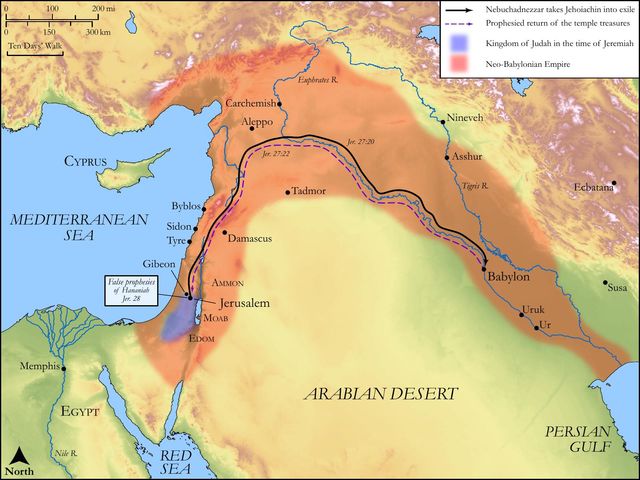
The late 7th and early 6th centuries BC marked a period of dramatic geopolitical shifts in the Ancient Near East. The once-dominant Assyrian Empire was in rapid decline, paving the way for the ascendance of the Neo-Babylonian Empire under the formidable leadership of Nebuchadnezzar II. Judah and its neighboring states found themselves precariously positioned between the waning influence of Egypt and the burgeoning might of Babylon. Despite this reality, many nations clung to hopes of forming alliances to resist Babylonian expansion and preserve their independence. Jeremiah's prophetic message, however, was radically counter-cultural and deeply unpopular: God had ordained Babylon as His instrument of judgment and discipline, and submission, though painful, was the only path to survival. The concept of "serving" a foreign king was a well-understood practice of vassalage in the ancient world, involving the payment of tribute, oaths of loyalty, and military support. Here, however, it is presented not merely as a political reality but as a direct, unalterable divine decree.
Key Themes
ShowHideJeremiah 27:7 contributes significantly to several overarching themes pervasive in the book of Jeremiah and the broader prophetic corpus. Foremost is the theme of Divine Sovereignty over Nations. God is not confined to Israel but is the Lord of all creation, actively orchestrating the rise and fall of empires according to His will (compare the declaration in Daniel 2:21 that God "changes times and seasons; he removes kings and sets up kings"). Even a pagan ruler like Nebuchadnezzar is God's "servant," used to accomplish His specific purposes. Secondly, the verse powerfully highlights the Temporal Nature of Earthly Power. While Babylon's dominion is vast, encompassing "all nations," it is explicitly limited by a divine timetable ("until the very time of his land come"), underscoring that no human kingdom is eternal or ultimately autonomous. This theme resonates throughout prophetic literature, emphasizing that only God's kingdom endures forever. Finally, the verse introduces the theme of Prophetic Fulfillment and Judgment, not only for the nations subjugated by Babylon but also for Babylon itself. The latter part of the verse foreshadows Babylon's eventual downfall, a theme extensively developed and vividly portrayed in later prophetic chapters, such as Jeremiah 50 and Jeremiah 51.
Exposition and Analysis
ShowHideKey Word Analysis
ShowHideThis term, often translated as "Gentile" or "heathen," refers to foreign peoples, ethnic groups, or political entities distinct from Israel. In this context, "all nations" signifies the widespread and comprehensive reach of Babylon's dominion, encompassing not just Judah but all surrounding kingdoms mentioned in the chapter. It emphasizes the universality of God's judgment and Babylon's divinely appointed role as the dominant world power, bringing many diverse peoples under its sway.
This verb carries a wide semantic range, from "to work" or "to till" to "to be a servant" or "to enslave." Here, it denotes forced labor, the payment of tribute, and complete subjugation under a foreign power. It implies a state of dependency, obedience, and often hardship, highlighting the heavy yoke that Babylon would impose not merely through military conquest but through an established system of vassalage, economic exploitation, and political subservience.
While literally meaning "son," this term is used in a broader sense to include descendants, such as a grandson or even an entire lineage. The phrase "his son, and his son's son" specifically indicates the continuity of the Babylonian Empire's rule beyond Nebuchadnezzar himself, extending through at least two generations of his direct successors. This emphasizes the divinely ordained longevity and stability of this period of Babylonian supremacy.
This word refers to a specific, appointed period or season, often implying a divinely set moment. The phrase "until the very time of his land come" signifies a divinely determined limit to Babylon's power. It implies that Babylon's dominion, though extensive and generational, is not open-ended but has a precise, predetermined end-point set by God, after which its own judgment and downfall will occur.
Verse Breakdown
ShowHide"And all nations shall serve him,"
This opening clause establishes the vast scope of Babylon's divinely ordained dominion. "Him" refers to Nebuchadnezzar, the king of Babylon, whom God has designated as His "servant" (Jeremiah 27:6). It prophesies that a multitude of surrounding kingdoms, and indeed a wide array of peoples, would be brought under Babylonian subjugation, compelled to pay tribute, offer loyalty, and acknowledge its supreme authority.
"and his son, and his son's son,"
This phrase extends the prophecy beyond Nebuchadnezzar's personal reign, indicating that the period of Babylonian supremacy would not be limited to one king but would continue through his direct lineage. Historically, this refers to Nebuchadnezzar's son, Evil-Merodach, and his grandson, Belshazzar, ensuring a generational continuity of this divinely appointed empire, thereby emphasizing the stability and duration of the decreed servitude.
"until the very time of his land come:"
This crucial phrase introduces a clear, divinely appointed boundary to Babylon's power. It signifies that Babylon's dominion, though extensive and generational, is not eternal. There is a specific, predetermined "time" for its own land (Babylon itself) to face judgment and experience its downfall, marking the precise end of its global supremacy as determined by God's sovereign will.
"and then many nations and great kings shall serve themselves of him."
This final clause prophesies a dramatic reversal of fortunes. Once Babylon's appointed time is fulfilled, it will no longer be the master but will become the object of plunder and subjugation. "Many nations and great kings" (specifically the Medes and Persians under Cyrus the Great) will conquer and plunder Babylon, effectively "serving themselves" of its immense wealth, power, and resources, bringing about its ruin and the decisive end of its empire.
Literary Devices
ShowHideJeremiah 27:7 employs several powerful literary devices to convey its profound message. Prophecy is the overarching device, as the verse directly foretells future events concerning the rise and fall of empires, thereby demonstrating God's omniscient foreknowledge and absolute control over human history. The phrase "all nations" can be seen as a form of Hyperbole, emphasizing the widespread and comprehensive nature of Babylon's dominion, even if not every single nation on earth was literally subjugated. The phrase "his son, and his son's son" is a clear example of Merism or Synecdoche, representing the continuity of the Babylonian dynasty through subsequent generations, rather than strictly limiting it to just two specific individuals. Finally, the verse exhibits striking Irony and Reversal in its latter half, where the mighty Babylon, which had forced "all nations" to "serve him," would itself eventually be "served" (meaning plundered, conquered, and subjected) by "many nations and great kings," powerfully highlighting the cyclical nature of earthly power and the certainty of divine judgment.
Theological and Thematic Connections
ShowHideJeremiah 27:7 powerfully articulates God's absolute sovereignty over human history and the affairs of nations. It reveals that even pagan empires like Babylon are not autonomous but are instruments in God's hand, raised up to execute His purposes of judgment and discipline, and then brought down according to His precise divine timetable. This understanding profoundly challenges any notion of human autonomy or the ultimate power of earthly rulers, asserting that all authority is ultimately derived from and subject to the Creator. It underscores the temporal and transient nature of all human kingdoms and the certainty of divine judgment, providing a foundational framework for understanding the ebb and flow of world powers throughout history from a theological perspective.
Reflection and Application
ShowHideJeremiah 27:7 offers profound comfort and a vital perspective for believers navigating a world often dominated by powerful, seemingly uncontrollable forces and geopolitical upheaval. It serves as a potent reminder that God remains enthroned, actively orchestrating world events, even when human empires rise and fall with great violence, apparent chaos, or oppressive might. This foundational truth calls us to cultivate a deep trust in God's overarching and infallible plan, even when immediate circumstances seem bleak or oppressive. It teaches us not to place our ultimate hope, fear, or allegiance in earthly powers, for they are all temporary, provisional, and ultimately subject to God's supreme authority. Our primary allegiance is to the King of kings, whose kingdom is eternal, unshakable, and ultimately triumphant. This divine perspective fosters patience, resilience, and a deep-seated hope, assuring us that God is working all things together for His glory and the ultimate good of His people, steadily bringing about His righteous and everlasting kingdom.
Questions for Reflection
ShowHideFAQ
ShowHideWho is the "him" that "all nations shall serve" in Jeremiah 27:7?
ShowHideThe "him" unequivocally refers to Nebuchadnezzar, the king of Babylon. In the immediately preceding verse, Jeremiah 27:6, God explicitly declares, "Now I have given all these lands into the hand of Nebuchadnezzar the king of Babylon, my servant." This highlights God's sovereign and deliberate choice to use Nebuchadnezzar, despite his pagan identity, as His chosen instrument to execute judgment and discipline upon Judah and the surrounding nations.
What is the significance of "his son, and his son's son" in the prophecy?
ShowHideThis phrase signifies the generational continuity and extended duration of the Babylonian Empire's dominion. It means that the period of servitude under Babylon would not abruptly end with Nebuchadnezzar's death but would extend through his direct successors. Historically, this refers to Nebuchadnezzar's son, Evil-Merodach, and his grandson, Belshazzar, who was the last king of Babylon before its dramatic fall to the Medes and Persians, as vividly recounted in Daniel 5. This specific detail underscores the divinely appointed stability and full duration of Babylon's supremacy.
What does "until the very time of his land come" mean?
ShowHideThis crucial phrase indicates that Babylon's period of global dominance was not indefinite or open-ended but had a precise, divinely predetermined end. "His land" refers to Babylon itself. The prophecy asserts that there would come a specific "time" when Babylon's own judgment would arrive, marking the definitive end of its empire and its global supremacy. This points directly to the ultimate downfall of Babylon, which occurred when Cyrus the Great of Persia conquered it in 539 BC, an event prophesied in various biblical texts, including Isaiah 13 and Jeremiah 50 and Jeremiah 51.
Christ-Centered Fulfillment
ShowHideJeremiah 27:7, while specifically addressing the temporal dominion of the Babylonian Empire, finds its ultimate Christ-centered fulfillment in the eternal and universal reign of Jesus Christ. The prophecy of earthly nations serving a human king, even for a limited time, powerfully foreshadows the coming of a true and everlasting King to whom all nations will ultimately bow. While Nebuchadnezzar was God's "servant" for a season of judgment and discipline, Christ is the perfect, eternal, and obedient Servant of the Lord, who, through His sacrificial life, atoning death, and glorious resurrection, established an everlasting kingdom that transcends all earthly powers. The temporary nature of Babylon's rule, explicitly ending with its own subjection, highlights that all earthly powers are fleeting, provisional, and designed by God to serve His greater redemptive purposes. In stark contrast, Christ's kingdom is not of this world, nor is it subject to the rise and fall of human empires; it is an eternal dominion that will never be destroyed or given to another people, as prophesied in Daniel 7:13-14. The "many nations and great kings" who eventually "serve themselves" of Babylon point to the ultimate judgment that awaits all earthly powers that oppose God, culminating in the final triumph of Christ, who will reign until He has put all His enemies under His feet (1 Corinthians 15:25). Therefore, Jeremiah 27:7, with its declaration of divine sovereignty over temporal kingdoms, ultimately directs our gaze to the Lamb of God, who is the King of kings and Lord of lords, whose dominion is forever and ever, and before whom every knee will one day bow (Revelation 17:14).