


Revelation 13:10
into captivity he goes!
If anyone is to be killed with the sword,
with the sword he is to be killed!”
This is when God’s holy people must persevere and trust!
- εἴeiIfG1487CONDConjunction
- τιςtisanyoneG5100X-NSMIndefinite pronoun Nominative Singular Masculine
- αἰχμαλωσίανaichmalōsiancaptivityG161N-ASFNoun Accusative Singular Feminine
- συνάγειsunageigathersG4863V-PAI-3SVerb Present Active Indicative 3rd Singular
- εἰςeisintoG1519PREPPreposition
- αἰχμαλωσίανaichmalōsiancaptivityG161N-ASFNoun Accusative Singular Feminine
- ὑπάγειhupageihe goesG5217V-PAI-3SVerb Present Active Indicative 3rd Singular
- εἴeiIfG1487CONDConjunction
- τιςtisanyoneG5100X-NSMIndefinite pronoun Nominative Singular Masculine
- ἐνenwithG1722PREPPreposition
- μαχαίρῃmachairē[the] swordG3162N-DSFNoun Dative Singular Feminine
- ἀποκτανθῆναιapoktanthēnaiis to be killedG615V-APNVerb Aorist Passive Infinitive
- δεῖdeiit is necessary forG1163V-PAI-3SVerb Present Active Indicative 3rd Singular
- αὐτὸνautonhimG846P-ASMPersonal pronoun Accusative Singular Masculine
- ἐνenbyG1722PREPPreposition
- μαχαίρῃmachairē[the] swordG3162N-DSFNoun Dative Singular Feminine
- ἀποκτανθῆναι·apoktanthēnai[is] to be killedG615V-APNVerb Aorist Passive Infinitive
- ὧδέhōdeHereG5602ADVAdverb
- ἐστινestinisG1510V-PAI-3SVerb Present Active Indicative 3rd Singular
- ἡhētheG3588T-NSFDefinite article Nominative Singular Feminine
- ὑπομονὴhupomonēenduranceG5281N-NSFNoun Nominative Singular Feminine
- καὶkaiandG2532CONJConjunction
- ἡhētheG3588T-NSFDefinite article Nominative Singular Feminine
- πίστιςpistisfaithG4102N-NSFNoun Nominative Singular Feminine
- τῶνtōnof theG3588T-GPMDefinite article Genitive Plural Masculine
- ἁγίωνhagiōnsaintsG40A-GPMAdjective Genitive Plural Masculine
English is a literal word-by-word gloss of the Greek, not the KJV's wording. Why?
This is the original text the KJV's translators worked from — each Greek word with its own literal English meaning in this verse, prepared by scholars at Tyndale House, Cambridge. The KJV translates whole sentences, not word by word, so its wording differs: one Greek word can become several English words, and the KJV may choose “charity” where the gloss reads “love”. Both are faithful — they answer different questions. For the KJV's own rendering, switch to the KJV text.
Details
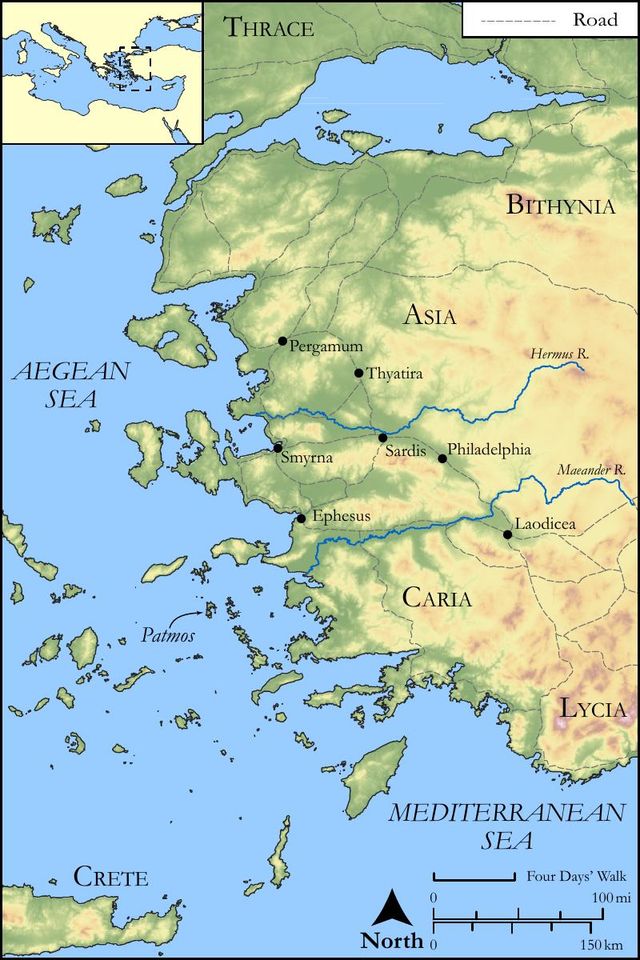
See on the biblical-era map

Study this verse
Public-domain commentary
Matthew Henry
From his Commentary on the Whole Bible. Henry comments on passages, not single verses — this entry covers Revelation 13:1–10.
We have here an account of the rise, figure, and progress of the first beast; and observe, 1. From what situation the apostle saw this monster. He seemed to himself to stand upon the sea-shore, though it is probable he was still in a rapture; but he took himself to be in the island Patmos, but whether in the body or out of the body he could not tell. 2. Whence this beast came - out of the sea; and yet, by the description of it, it would seem more likely to be a land-monster; but the more monstrous every thing about it was the more proper an emblem it would be to set forth the mystery of iniquity and tyranny. 3. What was the form and shape of this beast. It was for the most part like a leopard, but its feet were like the feet of a bear and its mouth as the mouth of a lion; it had seven heads, and ten horns, and upon its heads the name of blasphemy: the most horrid and hideous monster! In some part of this description here seems to be an allusion to Daniel's vision of the four beasts, which represented the four monarchies, Dan 7:1-3, etc. One of these beasts was like a lion, another like a bear, and another like a leopard; this beast was a sort of composition of those three, with the fierceness, strength, and swiftness, of them all; the seven heads and the ten horns seem to design its several powers; the ten crowns, its tributary princes; the word blasphemy on its forehead proclaims its direct enmity and opposition to the glory of God, by promoting idolatry. 4. The source and spring of his authority - the dragon; he gave him his power, and seat, and great authority. He was set up by the devil, and supported by him to do his work and promote his interest; and the devil lent him all the assistance he could. 5. A dangerous wound given him, and yet unexpectedly healed, Rev 13:3. Some think that by this wounded head we are to understand the abolishing of pagan idolatry; and by the healing of the wound the introducing of the popish idolatry, the same in substance with the former, only in a new dress, and which as effectually answers the devil's design as that did. 6. The honour and worship paid to this infernal monster: All the world wondered after the beast; they all admired his power, and policy, and success, and they worshipped the dragon that gave power to the beast, and they worshipped the beast; they paid honour and subjection to the devil and his instruments, and thought there was no power able to withstand them: so great were the darkness, degeneracy, and madness of the world! 7. How he exercised his infernal power and policy: He had a mouth, speaking great things, and blasphemies; he blasphemed God, the name of God, the tabernacle of God, and all those that dwell in heaven; and he made war with the saints, and overcame them, and gained a sort of universal empire in the world. His malice was principally levelled at the God of heaven, and his heavenly attendants - at God, in making images of him that is invisible, and in worshipping them; - at the tabernacle of God, that is, say some, at the human nature of the Lord Jesus Christ, in which God dwells as in a tabernacle; this is dishonoured by their doctrine of transubstantiation, which will not suffer his body to be a true body, and will put it into the power of every priest to prepare a body for Christ; - and against those that dwell in heaven, the glorified saints, by putting them into the place of the pagan demons, and praying to them, which they are so far from being pleased with that they truly judge themselves wronged and dishonoured by it. Thus the malice of the devil shows itself against heaven and the blessed inhabitants of heaven. These are above the reach of his power. All he can do is to blaspheme them; but the saints on earth are more exposed to his cruelty, and he sometimes is permitted to triumph over them and trample upon them. 8. The limitation of the devil's power and success, and that both as to time and persons. He is limited in point of time; his reign is to continue forty-and-two months (Rev 13:5), suitable to the other prophetical characters of the reign of antichrist. He is also limited as to the persons and people that he shall entirely subject his will and power; it will be only those whose names are not written in the Lamb's book of life. Christ had a chosen remnant, redeemed by his blood, recorded in his book, sealed by his Spirit; and though the devil and antichrist might overcome their bodily strength, and take away their natural life, they could never conquer their souls, nor prevail with them to forsake their Saviour and revolt to his enemies. 9. Here is a demand of attention to what is here discovered of the great sufferings and troubles of the church, and an assurance given that when God has accomplished his work on mount Zion, his refining work, then he will turn his hand against the enemies of his people, and those who have killed with the sword shall themselves fall by the sword (Rev 13:10), and those who led the people of God into captivity shall themselves be made captives. Here now is that which will be proper exercise for the patience and faith of the saints - patience under the prospect of such great sufferings, and faith in the prospect of so glorious a deliverance.
Historical interpretation
Four Centuries of Reception
4 surviving comments on this verse. Each one is dated, so this reads as a timeline rather than a list.
Select a marker to jump to its quote. Markers stagger vertically where authors wrote within a few decades of each other.
Every one will receive a recompense worthy of his deeds. Those who are willing to harm their neighbor will be captured by the devil and will undergo the death of his soul by the satanic sword. For, as the great James says, they are made slaves of that one by whom they have been conquered through their works. But those who have a pure faith and unshakeable endurance in trials will be indelibly written in the book of life. With such may the all-merciful God also find us partakers who consider “that the sufferings of this present time are not worth comparing with the glory that is to be revealed" to the saints and who walk valiantly the narrow way, so that, finding at the end of it glory in the coming age and rest and paradise, we might reign with Christ, with whom to the Father be all thanksgiving and worship with the Holy Spirit forever. Amen.
Here is the patience and the faith of the saints. He had promised that the murderer would be killed, but because no one is crowned unless he competes lawfully, now he says there is a need for strong spirits and firm hearts. Having first described the beast generally in hypocrisy, then with an open mouth blaspheming, he now describes it among the rulers alone, similarly in hypocrisy, then revealed.
He who kills with the sword must be killed with the sword. He who now persecutes the Church with either carnal or even spiritual death, the Lord Jesus will kill with the breath of His mouth, and destroy with the brightness of His coming.
If anyone prepared for murders, he will die the spiritual death in the worship of the Devil. Therefore, he says, is the endurance and the faith of the saints. Therefore one becomes innocent of the slavery to the evil one, from which slavery may we all be shown to be free by the grace of the God who called us to the knowledge of Him. To Him be glory to the ages, amen.
Continue studying Revelation 13:10 across the web’s major study libraries — every link below opens this exact verse, chapter, or book on the destination site.
Read & Compare
 BibleGatewayThis verse in more than 200 translations and 70 languages.
 Bible.comThe YouVersion reader — hundreds of translations, reading plans, and highlights.
 ESV.orgCrossway's official English Standard Version reader.
 NET BibleThe NET translation with 60,000+ translators' notes on every rendering decision.
 STEP BibleTyndale House's free study tool — original text, vocabulary, and scholarly resources.
 BibliaLogos Bible Software's free web reader.
 USCCBThe New American Bible (Revised Edition) with the U.S. bishops' study notes.
Commentaries
 BibleHub CommentariesDozens of classic commentaries on this verse, gathered on one page.
 StudyLightMore than 100 commentary sets — the largest collection on the web.
 BibleRefPlain-English commentary on what this verse means, verse by verse.
 Enduring WordDavid Guzik's free commentary on this chapter, widely used by Bible teachers.
 Bible Study ToolsVerse commentary alongside Greek and Hebrew study aids.
Original Language & Research
- BibleHub InterlinearThe verse word by word — original language, transliteration, and English.
- BibleHub LexiconEvery word's original-language definition and Strong's entry.
 Blue Letter BibleDeep-study tools — Strong's numbers, concordance, and word studies.
 CNTR CollationThe earliest Greek manuscripts of this verse, collated letter by letter.
Sermons, Hymns & Audio


TrulyRandomVerse is not affiliated with these sites and doesn’t control their content. They’re linked because they’re genuinely useful.
Summary
Revelation 13:10 serves as a profound declaration of divine justice and a powerful call to endurance for believers facing severe persecution under the oppressive practices represented by the Beast. It asserts the principle of divine retribution, promising that those who inflict violence and captivity will ultimately suffer a similar fate, thereby providing a bedrock of hope and a mandate for steadfast faith and patient perseverance amidst trials.
Context
ShowHideLiterary Context
This verse is strategically positioned within Revelation chapter 13, a pivotal chapter describing the rise and activity of two Beasts. The first Beast, emerging from the sea, embodies a powerful, blasphemous, and persecuting political or spiritual authority, granted power to wage war against the saints and conquer them (Revelation 13:7). The preceding verses detail its origin, its blasphemous claims, and its global dominion, setting a scene of overwhelming evil and seemingly unchecked power. In this context of intense suffering and the apparent triumph of evil, verse 10 functions as a crucial prophetic interjection. It offers a divine counter-narrative, assuring God's people of ultimate justice for their oppressors and simultaneously exhorting them to unwavering endurance and faith, rather than resorting to violence or despair. It acts as a divine commentary on the nature of the conflict and the required response from the faithful.
Historical & Cultural Context
John's original audience, primarily Christians in Asia Minor, faced significant pressure and persecution from the Roman Empire. This persecution ranged from social ostracism and economic hardship to imprisonment and martyrdom, largely due to their refusal to participate in emperor worship or the pervasive pagan cults. The imagery of "captivity" and "sword" would have resonated deeply with their lived experience of Roman imperial power, which enforced its rule through military might and often exiled or executed dissenters. The Beast's description in Revelation 13:1-8 would have been readily identifiable with the Roman Empire and its emperors, particularly those like Nero or Domitian who demanded divine honors and persecuted Christians. Thus, the promise of divine retribution in verse 10 would have offered immense comfort and vindication to a community experiencing severe oppression, while the call to "patience and faith" served as a vital spiritual directive for navigating such a hostile environment without compromising their witness.
Key Themes
ShowHideRevelation 13:10 powerfully contributes to several overarching themes within the book of Revelation and the broader biblical narrative. Firstly, it underscores the theme of Divine Retribution and Justice, articulating a principle of "lex talionis" (law of retaliation) where the oppressor's fate mirrors their actions. This assures believers that God's justice, though often delayed, is certain and will ultimately prevail over all forms of evil, echoing principles found in passages like Galatians 6:7. Secondly, it highlights the critical theme of Perseverance and Endurance of the Saints (often translated as "patience"). In the face of overwhelming evil and suffering, believers are called to active, steadfast endurance, not passive resignation. This "patience" is deeply intertwined with Faith in God's Sovereignty, emphasizing an unwavering trust in God's ultimate control, His promises, and His eventual victory over all evil, even when circumstances are dire. This connection between faith and endurance is a recurring motif in the New Testament, notably in Hebrews 10:36.
Exposition and Analysis
ShowHideKey Word Analysis
ShowHideFrom the root meaning "spear-prisoner," this term refers to the state of being taken captive, especially in war. In Revelation 13:10, it signifies the act of leading others into bondage or imprisonment. Its use here in both the action and the consequence ("leadeth into captivity shall go into captivity") emphasizes a direct, reciprocal judgment.
This word denotes a knife or short sword, often used in combat or for judicial execution. Figuratively, it represents war, violence, or judicial punishment. In this verse, it symbolizes the instrument of death and oppression, and its reciprocal use highlights the principle of divine justice where the means of oppression become the means of judgment.
This impersonal verb signifies necessity, indicating something that "behoved," "is meet," "must needs," or "ought" to happen. Its presence in "must be killed with the sword" underscores the divine imperative and certainty of the retribution. It is not merely a possibility but a divinely ordained certainty.
This term signifies cheerful, hopeful endurance or constancy. It implies an active, steadfast perseverance under trial, not passive resignation. It is the quality of remaining firm under suffering, maintaining one's convictions and hope despite adversity.
This word encompasses persuasion, credence, and moral conviction, especially reliance upon Christ for salvation. It denotes unwavering trust in God's truthfulness, His promises, and His ultimate victory. In this context, it refers to the saints' steadfast loyalty and active trust in God despite intense pressure and persecution.
Verse Breakdown
ShowHide"He that leadeth into captivity shall go into captivity:"
This clause declares a principle of divine retribution. Those who actively oppress, imprison, or enslave others will themselves experience a similar fate. It is a direct statement of poetic justice, indicating that the very means by which the wicked inflict suffering will be turned upon them. This serves as a warning to oppressors and a promise of vindication for the oppressed.
"he that killeth with the sword must be killed with the sword."
This second clause reinforces the principle of reciprocal justice, extending it to the act of killing. It asserts that those who use violence and bloodshed as instruments of power and persecution will inevitably face violent judgment themselves. The word "must" (Greek: deî) emphasizes the divine necessity and certainty of this judgment, highlighting God's unyielding commitment to justice.
"Here is the patience and the faith of the saints."
This concluding statement shifts focus from the judgment of the wicked to the required response of believers. "Here is" (Greek: hōde estí) acts as an emphatic declaration, drawing attention to the essential qualities needed by God's people in such times. "Patience" (or endurance) refers to their steadfast perseverance under persecution, while "faith" signifies their unwavering trust in God's sovereignty and His promises, even when His justice seems delayed. These two virtues are presented as the defining characteristics of the saints in the face of the Beast's power.
Literary Devices
ShowHideRevelation 13:10 employs several potent literary devices to convey its message. The most prominent is Lex Talionis, or the law of retribution, expressed through Parallelism in the opening two clauses ("He that leadeth into captivity shall go into captivity: he that killeth with the sword must be killed with the sword"). This structure creates a strong sense of poetic justice, where the punishment directly mirrors the crime, emphasizing the certainty and appropriateness of divine judgment. The "sword" and "captivity" function as Symbolism, representing instruments of violence and oppression, but also becoming symbols of the inevitable judgment that awaits the oppressors. The verse also serves as a direct Exhortation or call to action in its latter half, "Here is the patience and the faith of the saints." This shifts from prophetic declaration to pastoral instruction, highlighting the virtues essential for believers to navigate the trials described in the preceding verses. The abrupt shift in focus underscores the immediate spiritual relevance of the preceding declaration of justice for the suffering church.
Theological and Thematic Connections
ShowHideRevelation 13:10 powerfully articulates the biblical principle of divine retribution, assuring believers that God is a God of justice who will ultimately repay evil. This principle, deeply rooted in the Old Testament concept of "an eye for an eye" (Exodus 21:24), finds its ultimate fulfillment in God's sovereign judgment over all oppressive powers. It serves as a profound comfort to those suffering injustice, reminding them that their oppressors will not escape accountability. Furthermore, the verse highlights the crucial role of patient endurance and unwavering faith for the saints during times of intense persecution, emphasizing that their victory is not achieved through worldly means but through steadfast reliance on God's promises and His ultimate triumph. This call to patient faith is a recurring theme throughout Revelation, preparing God's people for the final confrontation with evil.
Reflection and Application
ShowHideRevelation 13:10 offers profound solace and a stern challenge for believers in every age. In a world often marked by injustice, violence, and systems that seem to oppress the vulnerable with impunity, this verse stands as a powerful reminder that God's justice is not an abstract concept but a certain reality. It calls us to trust in God's sovereign hand, even when His intervention seems delayed, knowing that evil will not ultimately triumph. For us, this means cultivating a deep, active "patience" – not passive resignation, but a hopeful, steadfast endurance that holds firm to our convictions amidst trials, opposition, or the apparent success of unrighteousness. Coupled with this is "faith," an unwavering trust in God's character, His promises, and His ultimate victory. This verse encourages us to resist the temptation to retaliate in kind or to lose hope, instead empowering us to live faithfully and patiently, knowing that God holds the final word and will bring all things to account. It reminds us that our ultimate vindication rests in His hands, not our own.
Questions for Reflection
ShowHideFAQ
ShowHideDoes Revelation 13:10 advocate for Christians to seek vengeance or engage in violence against their oppressors?
ShowHideNo, quite the opposite. While the first part of the verse declares a principle of divine retribution, stating that oppressors will face the same fate they inflict ("He that leadeth into captivity shall go into captivity: he that killeth with the sword must be killed with the sword"), this is a declaration of God's ultimate justice, not a command for believers to act. The latter part of the verse, "Here is the patience and the faith of the saints," explicitly calls believers to endure with steadfastness and trust in God. This passage emphasizes that the saints' response to persecution is not to take up the sword themselves, but to rely on God's timing and His sovereign judgment. This aligns with New Testament teachings that call believers to love their enemies (Matthew 5:44), to not repay evil for evil (Romans 12:17), and to leave vengeance to God (Romans 12:19).
Christ-Centered Fulfillment
ShowHideRevelation 13:10 finds its ultimate Christ-centered fulfillment not in human vengeance, but in the redemptive and judicial work of Jesus Christ. While the verse declares a principle of reciprocal justice for oppressors, it is Christ Himself who embodies both the suffering saint and the righteous judge. He was "led into captivity" and "killed with the sword" (or its equivalent, crucifixion), yet He did not retaliate but endured with perfect "patience" and "faith" (1 Peter 2:21-23). His suffering and death, however, were not the end; they were the means by which He disarmed the powers of evil (Colossians 2:15). Ultimately, it is Christ, the Lamb who was slain, who is given all authority in heaven and on earth (Matthew 28:18), and who will execute divine justice upon all who oppose God and His people. The "patience and faith of the saints" is therefore a reflection of Christ's own endurance and faithfulness, empowering them to follow in His footsteps, trusting that He, the true Judge, will bring about the final and just resolution, making all things new (Revelation 21:5).