


Revelation 14:12
- ὯδεHōdeHereG5602ADVAdverb
- ἡhētheG3588T-NSFDefinite article Nominative Singular Feminine
- ὑπομονὴhupomonēenduranceG5281N-NSFNoun Nominative Singular Feminine
- τῶνtōnof theG3588T-GPMDefinite article Genitive Plural Masculine
- ἁγίωνhagiōnsaintsG40A-GPMAdjective Genitive Plural Masculine
- ἐστίνestinisG1510V-PAI-3SVerb Present Active Indicative 3rd Singular
- ὧδεhōdehereG5602ADVAdverb
- οἱhoithoseG3588T-NPMDefinite article Nominative Plural Masculine
- τηροῦντεςtērounteskeepingG5083V-PAP-NPMVerb Present Active Participle Nominative Plural Masculine
- τὰςtastheG3588T-APFDefinite article Accusative Plural Feminine
- ἐντολὰςentolascommandmentsG1785N-APFNoun Accusative Plural Feminine
- τοῦtou<the>G3588T-GSMDefinite article Genitive Singular Masculine
- θεοῦtheouof GodG2316N-GSM-TNoun Genitive Singular Masculine Title
- καὶkaiandG2532CONJConjunction
- τὴνtēntheG3588T-ASFDefinite article Accusative Singular Feminine
- πίστινpistinfaithG4102N-ASFNoun Accusative Singular Feminine
- ἸησοῦIēsouof JesusG2424N-GSM-PNoun Genitive Singular Masculine Individual
English is a literal word-by-word gloss of the Greek, not the KJV's wording. Why?
This is the original text the KJV's translators worked from — each Greek word with its own literal English meaning in this verse, prepared by scholars at Tyndale House, Cambridge. The KJV translates whole sentences, not word by word, so its wording differs: one Greek word can become several English words, and the KJV may choose “charity” where the gloss reads “love”. Both are faithful — they answer different questions. For the KJV's own rendering, switch to the KJV text.
Details
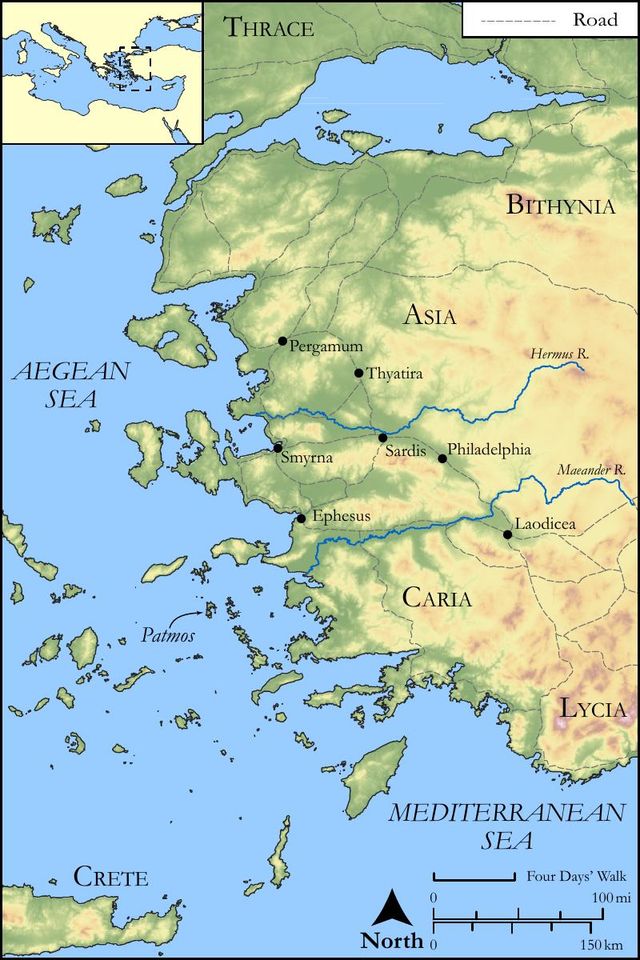
See on the biblical-era map

Study this verse
Public-domain commentary
Matthew Henry
From his Commentary on the Whole Bible. Henry comments on passages, not single verses — this entry covers Revelation 14:6–12. His two-level outline is real structure in the source text, so it is rendered as structure.
In this part of the chapter we have three angels or messengers sent from heaven to give notice of the fall of Babylon, and of those things that were antecedent and consequent to that great event.
I.The first angel was sent on an errand antecedent to it, and that was to preach the everlasting gospel, Rev 14:6, Rev 14:7. Observe,
1.The gospel is an everlasting gospel; it is so in its nature, and it will be so in its consequences. Though all flesh be grass, the word of the Lord endureth for ever.
2.It is a work fit for an angel to preach this everlasting gospel; such is the dignity, and such is the difficulty of that work! And yet we have this treasure in earthen vessels.
3.The everlasting gospel is of great concern to all the world; and, as it is the concern of all, it is very much to be desired that it should be made known to all, even to every nation, and kindred, and tongue, and people.
4.The gospel is the great means whereby men are brought to fear God, and to give glory to him. Natural religion is not sufficient to keep up the fear of God, nor to secure to him glory from men; it is the gospel that revives the fear of God, and retrieves his glory in the world.
5.When idolatry creeps into the churches of God, it is by the preaching of the gospel, attended by the power of the Holy Spirit, that men are turned from idols to serve the living God, as the Creator of the heaven, and the earth, and the sea, and the fountains of waters, Rev 14:7. To worship any God besides him who created the world is idolatry.
II.The second angel follows the other, and proclaims the actual fall of Babylon.
The preaching of the everlasting gospel had shaken the foundations of antichristianism in the world, and hastened its downfall. By Babylon is generally understood Rome, which was before called Sodom and Egypt, for wickedness and cruelty, and is now first called Babylon, for pride and idolatry. Observe,
1.What God has fore-ordained and foretold shall be done as certainly as if it were done already.
2.The greatness of the papal Babylon will not be able to prevent her fall, but will make it more dreadful and remarkable.
3.The wickedness of Babylon, in corrupting, debauching, and intoxicating the nations round about her, will make her fall just and will declare the righteousness of God in her utter ruin, Rev 14:8. Her crimes are recited as the just cause of her destruction.
III.A third angel follows the other two, and gives warning to all of that divine vengeance which would overtake all those that obstinately adhered to the antichristian interest after God had thus proclaimed its downfall, Rev 14:9, Rev 14:10. If after this (this threatening denounced against Babylon, and in part already executed) any should persist in their idolatry, professing subjection to the beast and promoting his cause, they must expect to drink deep of the wind of the wrath of God; they shall be for ever miserable in soul and body; Jesus Christ will inflict this punishment upon them, and the holy angels will behold it and approve of it. Idolatry, both pagan and papal, is a damning sin in its own nature, and will prove fatal to those who persist in it, after fair warning given by the word of Providence; those who refuse to come out of Babylon, when thus called, and resolve to partake of her sins, must receive of her plagues; and the guilt and ruin of such incorrigible idolaters will serve to set forth the excellency of the patience and obedience of the saints. These graces shall be rewarded with salvation and glory. When the treachery and rebellion of others shall be punished with everlasting destruction, then it will be said, to the honour of the faithful (Rev 14:12): Here is the patience of the saints; you have before seen their patience exercised, now you see it rewarded.
Historical interpretation
Four Centuries of Reception
4 surviving comments on this verse. Each one is dated, so this reads as a timeline rather than a list.
Select a marker to jump to its quote. Markers stagger vertically where authors wrote within a few decades of each other.
The Lord says, “He who endures to the end will be saved,” and the apostle says, “You have need of endurance.” So also in this passage it says that the endurance of the saints consists in this, that those who persevere to the end escape the fellowship of the beast and the mark of its name.
While the impious will be tormented eternally in the coming age, the saints here below show their patient endurance, keeping inviolate the commandments of God and their faith in Christ during the present time, which is quickly passing away.
Here is the patience of the saints. Although the beast rages, yet the temporary suffering does not sadden the saints, which is to be rewarded with eternal happiness, while on the contrary, the persecutors, temporarily prideful, see themselves suffering eternal punishment with the beast.
Therefore, he says: Here is the patience of the saints. He says that in that time of the Antichrist, and in that temptation it is shown forth. For as great as the danger and the affliction then, so great a need of perseverance. Then the discourse is shaped as if from a question. And who, he says, are those whom you call holy and patient?
He says: those who keep the commandments of God and the faith of Jesus. For such people, even when trials and death are present, will set everything second to the faith and love of God.
Continue studying Revelation 14:12 across the web’s major study libraries — every link below opens this exact verse, chapter, or book on the destination site.
Read & Compare
 BibleGatewayThis verse in more than 200 translations and 70 languages.
 Bible.comThe YouVersion reader — hundreds of translations, reading plans, and highlights.
 ESV.orgCrossway's official English Standard Version reader.
 NET BibleThe NET translation with 60,000+ translators' notes on every rendering decision.
 STEP BibleTyndale House's free study tool — original text, vocabulary, and scholarly resources.
 BibliaLogos Bible Software's free web reader.
 USCCBThe New American Bible (Revised Edition) with the U.S. bishops' study notes.
Commentaries
 BibleHub CommentariesDozens of classic commentaries on this verse, gathered on one page.
 StudyLightMore than 100 commentary sets — the largest collection on the web.
 BibleRefPlain-English commentary on what this verse means, verse by verse.
 Enduring WordDavid Guzik's free commentary on this chapter, widely used by Bible teachers.
 Bible Study ToolsVerse commentary alongside Greek and Hebrew study aids.
Original Language & Research
- BibleHub InterlinearThe verse word by word — original language, transliteration, and English.
- BibleHub LexiconEvery word's original-language definition and Strong's entry.
 Blue Letter BibleDeep-study tools — Strong's numbers, concordance, and word studies.
 CNTR CollationThe earliest Greek manuscripts of this verse, collated letter by letter.
Sermons, Hymns & Audio


TrulyRandomVerse is not affiliated with these sites and doesn’t control their content. They’re linked because they’re genuinely useful.
Summary
Revelation 14:12 serves as a pivotal declaration within the apocalyptic visions, sharply delineating the defining characteristics of God's faithful people amidst intense global deception and impending judgment. It presents a profound contrast to those who succumb to the Beast's authority, highlighting that true saints are marked by their enduring perseverance, their unwavering obedience to God's divine commands, and their steadfast reliance upon, and emulation of, the faithfulness of Jesus Christ. This verse offers both a clear identity marker for believers in tribulation and a powerful exhortation to steadfastness.
Context
ShowHideLiterary Context
Revelation 14:12 is strategically positioned as a concluding statement to a series of urgent angelic proclamations. Following the terrifying descriptions of the Beast's global dominion and the enforcement of its mark in Revelation 13, chapter 14 introduces the Lamb standing with the 144,000 on Mount Zion, symbolizing God's redeemed. This is immediately followed by three angelic messages: the first proclaiming the eternal gospel to all nations (Revelation 14:6-7), the second announcing the fall of Babylon (Revelation 14:8), and the third delivering a severe warning against worshipping the Beast and receiving its mark, detailing the eternal consequences (Revelation 14:9-11). Verse 12 then serves as a powerful counterpoint and affirmation, defining the identity and character of those who do not succumb to the Beast's system, but rather remain faithful to God, even in the face of death, as implied by the beatitude that follows in Revelation 14:13.
Historical & Cultural Context
The book of Revelation was written during a period of intense persecution of Christians, likely under the Roman Emperor Domitian (c. AD 90-96). Christians faced immense pressure to participate in emperor worship, which was seen as a test of loyalty to the Roman state. Refusal often led to social ostracism, economic hardship (as implied by the "mark of the Beast" controlling buying and selling in Revelation 13:17), imprisonment, and even martyrdom. The cultural landscape demanded conformity to pagan practices and loyalty to the imperial cult, making the "commandments of God" and "faith of Jesus" a direct challenge to the prevailing societal norms. John's message provided comfort, warning, and a call to steadfastness for the churches in Asia Minor, reminding them that their true allegiance was to God and Christ, not to Rome.
Key Themes
ShowHideThis verse encapsulates several major theological and narrative themes central to Revelation and the broader biblical narrative. Firstly, it underscores the theme of perseverance or endurance (patience), a crucial quality for believers facing tribulation, as seen in passages like James 1:2-4 and Romans 5:3-4. Secondly, it emphasizes obedience to God's commandments, highlighting that true faith is not merely intellectual assent but is demonstrated through ethical living and adherence to divine will, a principle echoed throughout Scripture, from the Mosaic Law to Jesus' teachings in John 14:15. Thirdly, the phrase "the faith of Jesus" introduces the dual theme of faith in Christ (as the object of belief) and Christ's own faithfulness (as the model and enabler of belief), which is foundational to Christian identity and perseverance. Finally, the verse contributes to the overarching theme of the identity of God's people in contrast to those who follow the Beast, defining the "saints" by their distinct spiritual and behavioral characteristics in the midst of spiritual warfare and global apostasy.
Exposition and Analysis
ShowHideKey Word Analysis
ShowHideMeaning "cheerful (or hopeful) endurance, constancy." This is not passive waiting but an active, steadfast perseverance in the face of adversity, trials, and persecution. It implies a resolute determination to remain faithful despite overwhelming pressure.
Meaning "to guard (from loss or injury, properly, by keeping the eye upon; and thus differing from φυλάσσω, which is properly to prevent escaping; and from κουστωδία, which implies a fortress or full military lines of apparatus), i.e. to note (a prophecy; figuratively, to fulfil a command); by implication, to detain (in custody; figuratively, to maintain); by extension, to withhold (for personal ends; figuratively, to keep unmarried)." In this context, it signifies a diligent, watchful adherence to, and preservation of, the commandments, implying both obedience and protection of their integrity.
Meaning "persuasion, i.e. credence; moral conviction (of religious truth, or the truthfulness of God or a religious teacher), especially reliance upon Christ for salvation; abstractly, constancy in such profession; by extension, the system of religious (Gospel) truth itself." This word encompasses both the act of believing in Jesus and the steadfastness or faithfulness of Jesus himself, which serves as the foundation and example for believers' own faith.
Verse Breakdown
ShowHide"Here is the patience of the saints:"
This opening clause points to the defining characteristic of God's faithful people ("saints" - G40, hágios, meaning "holy ones"). In a context of intense tribulation and persecution, their most prominent quality is their "patience" or steadfast endurance. This endurance is not a mere passive waiting, but an active, hopeful, and courageous perseverance in the face of suffering, demonstrating an unwavering commitment to Christ despite severe opposition. It is the spiritual fortitude that enables them to remain loyal to God.
"here [are] they that keep the commandments of God,"
This phrase further specifies the nature of the saints' endurance. Their patience is manifested through their active obedience to God's divine injunctions (G1785, entolḗ). In a world that demands allegiance to the Beast and its ungodly system, the saints distinguish themselves by their unwavering commitment to God's moral and spiritual laws. This obedience is a tangible expression of their love and loyalty to God, setting them apart from those who compromise their faith.
"and the faith of Jesus."
This crucial final clause presents a dual meaning. It refers to the believers' unwavering faith in Jesus Christ as their Lord and Savior, the object of their trust and devotion. Simultaneously, it encompasses the faithfulness of Jesus Himself (G2424, Iēsoûs), whose perfect obedience to the Father, even unto death, serves as the ultimate model and enabling power for the saints' own steadfastness. Their perseverance and obedience are sustained by, and rooted in, Christ's own fidelity and the truth of the gospel he embodies.
Literary Devices
ShowHideRevelation 14:12 employs several potent literary devices to convey its profound message. The most prominent is Contrast, as this verse stands in stark opposition to the preceding warnings against those who worship the Beast and receive its mark (Revelation 14:9-11). It defines the true followers of God by their antithetical behavior and allegiance. Repetition of "Here is" (G5602, hōde) emphasizes the presence and distinct identity of these faithful ones, drawing the reader's attention to their unique qualities. The verse also utilizes a form of Parallelism, presenting two core characteristics of the saints ("keep the commandments of God" and "the faith of Jesus") that are intrinsically linked and mutually reinforcing, defining their internal disposition and external conduct. Finally, the phrase "patience of the saints" serves as a powerful Summary Statement, encapsulating the essence of their enduring faithfulness in a concise and memorable way.
Theological and Thematic Connections
ShowHideRevelation 14:12 is a profound theological statement on the nature of true discipleship, particularly in times of intense spiritual warfare and persecution. It asserts that genuine faith is not passive but is characterized by active endurance, unwavering obedience to divine commands, and a steadfast reliance on Christ's faithfulness. This verse connects the eschatological reality of the end times with the timeless biblical principles of sanctification and perseverance, affirming that God's people will be identifiable by their commitment to His Word and their loyalty to Jesus, even when it demands great sacrifice. It underscores the truth that salvation by grace through faith in Christ inevitably leads to a life of obedience and steadfastness, distinguishing the redeemed from those who succumb to worldly pressures and idolatry.
Reflection and Application
ShowHideRevelation 14:12 offers a timeless and challenging blueprint for authentic Christian living, especially relevant in an increasingly complex and often hostile world. It calls believers to cultivate a spirit of steadfast perseverance, recognizing that trials are not merely obstacles but opportunities for faith to be refined and character to be developed. This verse reminds us that our love for God is tangibly expressed through our obedience to His commandments, even when adherence to biblical truth is counter-cultural or costly. Furthermore, it anchors our ability to endure and obey in the unwavering faithfulness of Jesus Himself, urging us to maintain a deep, abiding trust in Him. In an age of compromise and shifting values, Revelation 14:12 serves as a powerful call to radical fidelity, assuring us that our commitment to God's Word and our loyalty to Jesus are the hallmarks of true sainthood, distinguishing us as His own.
Questions for Reflection
ShowHideFAQ
ShowHideWhat is the significance of "patience" in this verse, particularly in the context of Revelation?
ShowHideThe "patience" (Greek, hypomonḗ) referred to in Revelation 14:12 is far more than passive waiting; it signifies active, hopeful, and courageous endurance or steadfast perseverance. In the context of Revelation, where believers face intense persecution, economic exclusion, and the threat of martyrdom for refusing to worship the Beast or receive its mark (Revelation 13:16-17), this patience is a divinely enabled fortitude. It is the unwavering commitment to Christ that allows saints to remain faithful despite suffering, knowing that their ultimate vindication and reward come from God. It's a quality essential for navigating the trials of the end times.
Does "the faith of Jesus" mean our faith in Him, or His faithfulness?
ShowHideThe phrase "the faith of Jesus" (Greek, tēn pistin Iēsou) is a genitive construction that scholars generally agree carries a dual meaning, encompassing both the objective and subjective genitive. It refers to the believers' unwavering faith in Jesus Christ as their Savior and Lord, recognizing Him as the object of their trust and devotion. Simultaneously, it refers to the faithfulness of Jesus Himself—His perfect obedience to God the Father, His steadfastness in fulfilling His redemptive mission, and His enduring loyalty to His people. This dual understanding is crucial: believers' faith is not only directed towards Jesus but is also empowered by and modeled after His own perfect faithfulness, enabling them to persevere even unto death. This concept is beautifully illustrated in Hebrews 12:2, where Jesus is described as the "author and perfecter of our faith."
Christ-Centered Fulfillment
ShowHideRevelation 14:12, though defining the characteristics of the saints, finds its ultimate fulfillment and enabling power in Jesus Christ. He is the supreme embodiment of the "patience" or steadfast endurance that the saints are called to display; His journey to the cross, His suffering, and His unwavering commitment to the Father's will exemplify perfect hypomonē (Hebrews 12:2-3). Furthermore, Jesus perfectly "kept the commandments of God," living a sinless life of complete obedience to the Father's every decree, thereby becoming the perfect sacrifice and the standard for all righteousness (John 8:29; Philippians 2:8). Most profoundly, "the faith of Jesus" points directly to His own faithfulness—His unswerving loyalty to God's plan of salvation and His steadfast love for humanity, which culminates in His atoning death and resurrection (Romans 5:8; Hebrews 2:17). Believers are enabled to exhibit the patience, obedience, and faith described in this verse not by their own strength, but by being united with Christ through the Holy Spirit, drawing from His inexhaustible faithfulness and empowered by His finished work on the cross (Galatians 2:20; Ephesians 3:16-17). Thus, the characteristics of the saints are not merely human virtues, but reflections of Christ's own character, made possible through His redemptive work and indwelling presence.