


Revelation 6:10
Bible text: King James Version (1769 Blayney text) · Public domain
Bible text: King James Version with Strong's numbers · Public domain
Bible text: Berean Standard Bible · Public domain
Bible text: American Standard Version (1901) · Public domain
Bible text: World English Bible, Messianic edition · Public domain
Bible text: Geneva Bible (1599) · Public domain
Bible text: Young's Literal Translation · Public domain
- καὶkaiAndG2532CONJConjunction
- ἔκραξανekraxanthey were cryingG2896V-AAI-3PVerb Aorist Active Indicative 3rd Plural
- φωνῇphōnēain a voiceG5456N-DSFNoun Dative Singular Feminine
- μεγάλῃmegalēloudG3173A-DSFAdjective Dative Singular Feminine
- λέγοντες·legontessayingG3004V-PAP-NPMVerb Present Active Participle Nominative Plural Masculine
- ἕωςhe'ōsUntilG2193PREPPreposition
- πότεpotewhenG4219PRT-IInterrogative Particle Interrogative
- ὁhoOG3588T-VSMDefinite article Vocative Singular Masculine
- δεσπότηςdespotēsLordG1203N-VSMNoun Vocative Singular Masculine
- ὁho<the>G3588T-VSMDefinite article Vocative Singular Masculine
- ἅγιοςhagiosholyG40A-VSMAdjective Vocative Singular Masculine
- καὶkaiandG2532CONJConjunction
- ὁho<the>G3588T-NSMDefinite article Nominative Singular Masculine
- ἀληθινόςalēthinostrueG228A-VSMAdjective Vocative Singular Masculine
- οὐounotG3756PRT-NNegative Particle Negative
- κρίνειςkrineisdo You judgeG2919V-PAI-2SVerb Present Active Indicative 2nd Singular
- καὶkaiandG2532CONJConjunction
- ἐκδικεῖςekdikeisyou avengeG1556V-PAI-2SVerb Present Active Indicative 2nd Singular
- τὸtotheG3588T-ASNDefinite article Accusative Singular Neuter
- αἷμαhaimabloodG129N-ASNNoun Accusative Singular Neuter
- ἡμῶνhēmōnof usG3165P-1GPPersonal pronoun Genitive 1st Plural
- ἐκekfromG1537PREPPreposition
- τῶνtōnthoseG3588T-GPMDefinite article Genitive Plural Masculine
- κατοικούντωνkatoikountōndwellingG2730V-PAP-GPMVerb Present Active Participle Genitive Plural Masculine
- ἐπὶepiuponG1909PREPPreposition
- τῆςtēstheG3588T-GSFDefinite article Genitive Singular Feminine
- γῆς;gēsearth?G1093N-GSFNoun Genitive Singular Feminine
English is a literal word-by-word gloss of the Greek, not the KJV's wording. Why?
This is the original text the KJV's translators worked from — each Greek word with its own literal English meaning in this verse, prepared by scholars at Tyndale House, Cambridge. The KJV translates whole sentences, not word by word, so its wording differs: one Greek word can become several English words, and the KJV may choose “charity” where the gloss reads “love”. Both are faithful — they answer different questions. For the KJV's own rendering, switch to the KJV text.
Details
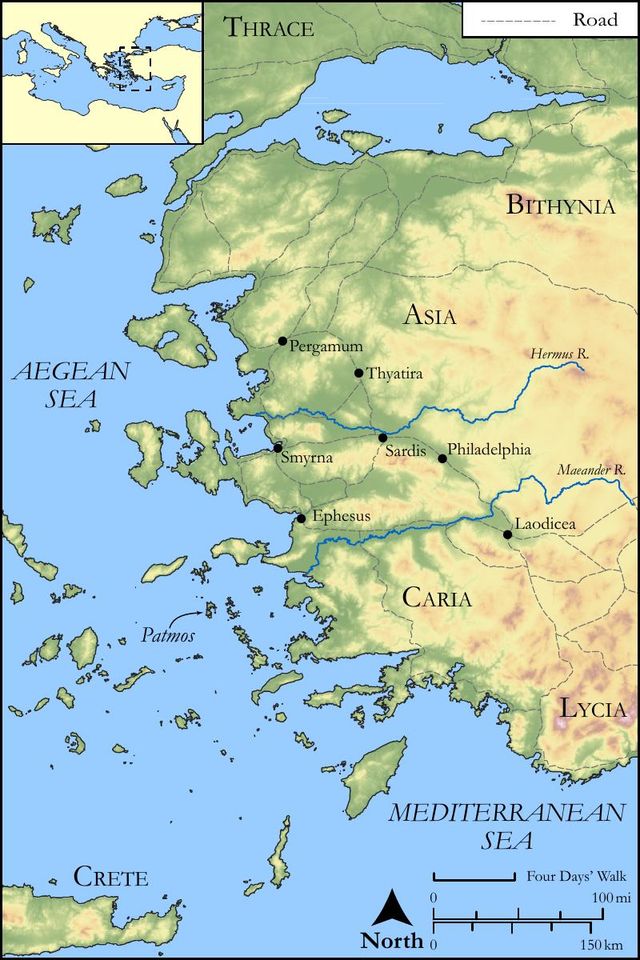
See on the biblical-era maps

Study this verse
Public-domain commentary
Matthew Henry
From his Commentary on the Whole Bible. Henry comments on passages, not single verses — this entry covers Revelation 6:9–17. His four-level outline is real structure in the source text, so it is rendered as structure.
In the remaining part of this chapter we have the opening of the fifth and the sixth seals.
I.The fifth seal.
Here is no mention made of any one who called the apostle to make his observation, probably because the decorum of the vision was to be observed, and each of the four living creatures had discharged its duty of a monitor before, or because the events here opened lay out of the sight, and beyond the time, of the present ministers of the church; or because it does not contain a new prophecy of any future events, but rather opens a spring of support and consolation to those who had been and still were under great tribulation for the sake of Christ and the gospel. Here observe,
1.The sight this apostle saw at the opening of the fifth seal; it was a very affecting sight (Rev 6:9): I saw under the altar the souls of those that were slain for the word of God, and for the testimony which they held. He saw the souls of the martyrs. Here observe,
(1.)Where he saw them - under the altar; at the foot of the altar of incense, in the most holy place; he saw them in heaven, at the foot of Christ. Hence note,
[1.]Persecutors can only kill the body, and after that there is no more that they can do; their souls live.
[2.]God has provided a good place in the better world for those who are faithful to death and are not allowed a place any longer on earth.
[3.]Holy martyrs are very near to Christ in heaven, they have the highest place there.
[4.]It is not their own death, but the sacrifice of Christ, that gives them a reception into heaven and a reward there; they do not wash their robes in their own blood, but in the blood of the Lamb.
(2.)What was the cause in which they suffered - the word of God and the testimony which they held, for believing the word of God, and attesting or confessing the truth of it; this profession of their faith they held fast without wavering, even though they died for it. A noble cause, the best that any man can lay down his life for - faith in God's word and a confession of that faith.
2.The cry he heard; it was a loud cry, and contained a humble expostulation about the long delay of avenging justice against their enemies: How long, O Lord, holy and true, dost thou not judge and avenge our blood on those that dwell on the earth? Rev 6:10. Observe,
(1.)Even the spirits of just men made perfect retain a proper resentment of the wrong they have sustained by their cruel enemies; and though they die in charity, praying, as Christ did, that God would forgive them, yet they are desirous that, for the honour of God, and Christ, and the gospel, and for the terror and conviction of others, God will take a just revenge upon the sin of persecution, even while he pardons and saves the persecutors.
(2.)They commit their cause to him to whom vengeance belongeth, and leave it in his hand; they are not for avenging themselves, but leave all to God.
(3.)There will be joy in heaven at the destruction of the implacable enemies of Christ and Christianity, as well as at the conversion of other sinners. When Babylon falls, it will be said, Rejoice over her, O thou heaven, and you holy apostles and prophets, for God hath avenged you on her, Rev 18:20.
3.He observed the kind return that was made to this cry (Rev 6:11), both what was given to them and what was said to them.
(1.)What was given to them - white robes, the robes of victory and of honour; their present happiness was an abundant recompence of their past sufferings.
(2.)What was said to them - that they should be satisfied, and easy in themselves, for it would not be long ere the number of their fellow-sufferers would be fulfilled. This is a language rather suited to the imperfect state of the saints in this world than to the perfection of their state in heaven; there is no impatience, no uneasiness, no need of admonition; but in this world there is great need of patience. Observe,
[1.]There is a number of Christians, known to God, who are appointed as sheep for the slaughter, set apart to be God's witnesses.
[2.]As the measure of the sin of persecutors is filling up, so is the number of the persecuted martyred servants of Christ.
[3.]When this number is fulfilled, God will take a just and glorious revenge upon their cruel persecutors; he will recompense tribulation to those who trouble them, and to those that are troubled full and uninterrupted rest.
II.We have here the sixth seal opened, Rev 6:12.
Some refer this to the great revolutions in the empire at Constantine's time, the downfall of paganism; others, with great probability, to the destruction of Jerusalem, as an emblem of the general judgment, and destruction of the wicked, at the end of the world; and, indeed, the awful characters of this event are so much the same with those signs mentioned by our Saviour as foreboding the destruction of Jerusalem, as hardly to leave any room for doubting but that the same thing is meant in both places, though some think that event was past already. See Mat 24:29, Mat 24:30. Here observe,
1.The tremendous events that were hastening; and here are several occurrences that contribute to make that day and dispensation very dreadful: - (1.) There was a great earthquake. This may be taken in a political sense; the very foundations of the Jewish church and state would be terribly shaken, though they seemed to be as stable as the earth itself. (2.) The sun became black as sackcloth of hair, either naturally, by a total eclipse, or politically, by the fall of the chief rulers and governors of the land. (3.) The moon should become as blood; the inferior officers, or their military men, should be all wallowing in their own blood. (4.) The stars of heaven shall fall to the earth (Rev 6:13), and that as a fig-tree casteth her untimely figs, when she is shaken of a mighty wind. The stars may signify all the men of note and influence among them, though in lower spheres of activity; there should be a general desolation. (5.) The heaven should depart as a scroll when it is rolled together. This may signify that their ecclesiastical state should perish and be laid aside for ever. (6.) Every mountain and island shall be moved out of its place. The destruction of the Jewish nation should affect and affright all the nations round about, those who were highest in honour and those who seemed to be best secured; it would be a judgment that should astonish all the world. This leads to,
2.The dread and terror that would seize upon all sorts of men in that great and awful day, Rev 6:15. No authority, nor grandeur, nor riches, nor valour, nor strength, would be able to support men at that time; yea, the very poor slaves, who, one would think, had nothing to fear, because they had nothing to lose, would be all in amazement at that day. Here observe,
(1.)The degree of their terror and astonishment: it should prevail so far as to make them, like distracted desperate men, call to the mountains to fall upon them, and to the hills to cover them; they would be glad to be no more seen; yea, to have no longer any being.
(2.)The cause of their terror, namely, the angry countenance of him that sits on the throne, and the wrath of the Lamb. Observe,
[1.]That which is matter of displeasure to Christ is so to God; they are so entirely one that what pleases or displeases the one pleases or displeases the other.
[2.]Though God be invisible, he can make the inhabitants of this world sensible of his awful frowns.
[3.]Though Christ be a lamb, yet he can be angry, even to wrath, and the wrath of the Lamb is exceedingly dreadful; for if the Redeemer, that appeases the wrath of God, himself be our wrathful enemy, where shall we have a friend to plead for us? Those perish without remedy who perish by the wrath of the Redeemer.
[4.]As men have their day of opportunity, and their seasons of grace, so God has his day of righteous wrath; and, when that day shall come, the most stout-hearted sinners will not be able to stand before him: all these terrors actually fell upon the sinners in Judea and Jerusalem in the day of their destruction, and they will all, in the utmost degree, fall upon impenitent sinners, at the general judgment of the last day.
Historical interpretation
Eight Centuries of Reception
9 surviving comments on this verse. Each one is dated, so this reads as a timeline rather than a list.
Select a marker to jump to its quote. Markers stagger vertically where authors wrote within a few decades of each other.
Our hope is that we may sooner reign and not be slaves any longer. Even if it were not prescribed to ask in prayer for the coming of his kingdom, we would, of our own accord, have expressed this desire in our eagerness to embrace the object of our hope. With indignation the souls of the martyrs beneath the altar cry aloud to the Lord, “How long, O Lord, will you refrain from avenging our blood on those who dwell on the earth?” For at least from the end of the world vengeance for them is ordained. Indeed, as quickly as possible, O Lord, may your kingdom come! This is the prayer of Christians; this shall bring shame to the heathens; this shall bring joy to the angels; it is for the coming of this kingdom that we are harassed now, or rather, it is for this coming that we pray.
The souls of the martyrs beneath the altar cry in jealousy unto the Lord "How long, Lord, dost Thou not avenge our blood on the inhabitants of the earth? " for, of course, their avenging is regulated by the end of the age.
"And when He had opened the fifth seal, I saw under the altar the souls of them that were slain." He relates that he saw under the altar of God, that is, under the earth, the souls of them that were slain. For both heaven and earth are called God's altar, as saith the law, commanding in the symbolical form of the truth two altars to be made,-a golden one within, and a brazen one without. But we perceive that the golden altar is thus called heaven, by the testimony that our Lord bears to it; for He says, "When thou bringest thy gift to the altar" (assuredly our gifts are the prayers which we offer), "and there rememberest that thy brother hath ought against thee, leave there thy gift before the altar." Assuredly prayers ascend to heaven. Therefore heaven is understood to be the golden altar which was within; for the priests also were accustomed to enter once in the year-as they who had the anointing-to the golden altar, the Holy Spirit signifying that Christ should do this once for all. As the golden altar is acknowledged to be heaven, so also by the brazen altar is understood the earth, under which is the Hades,-a region withdrawn from punishments and fires, and a place of repose for the saints, wherein indeed the righteous are seen and heard by the wicked, but they cannot be carried across to them. He who sees all things would have us to know that these saints, therefore-that is, the souls of the slain-are asking for vengeance for their blood, that is, of their body, from those that dwell upon the earth; but because in the last time, moreover, the reward of the saints will be perpetual, and the condemnation of the wicked shall come, it was told them to wait. And for a solace to their body, there were given unto each of them white robes. They received, says he, white robes, that is, the gift of the Holy Spirit.
This ought not be understood in a carnal manner, as though they were inflamed by animosity and wished revenge. We know that we are to love our enemies through an abundance of love, but it is manifest that they prayed against the kingdom of sin and were praying out of a desire for that kind of kingdom for which we say, “Thy kingdom come!”
[The psalmist begs] that the Lord avenge the blood of the faithful, who endured martyrdom for his name. Vengeance is the means by which force and injustice are repelled by just retribution. But there the prayer seems to be directed toward the conversion of the enemy. For when temporal vengeance is exacted from them in this world, they escape the destruction of eternal damnation; it is in this sense that we read in Revelation that the souls of martyrs under God’s altar demand to be avenged by divine decree. This vengeance is to be interpreted as we have defined it, for saintly people do not seek a cruel vengeance since they accept the precept “Pray for your enemies, do good to those that hate you,” and the like. Finally the Lord himself, who executes most powerfully his own commands, spoke these words on the cross: “Father, forgive them, for they know not what they do.”
How long, O Lord, holy and true, will You not judge and avenge, etc.? They do not pray out of hatred for their enemies, for whom they interceded in this world, but out of love for justice, which they, as near the Judge, harmoniously support. They pray for the day of judgment to come, when the kingdom of sin will be destroyed and the resurrection of extinguished bodies will arrive. For we too, although commanded to pray for our enemies, nonetheless say to the Lord in our prayers: Your kingdom come (Matt. 6).
And they cried out with a loud voice, saying. The great cry of souls signifies their immense desire for what they know the Lord wishes to do. For it is not proper to believe they desire anything against God's will, as their desires depend on His will.
And they cried with a loud voice, saying: How long, O Lord (holy and true) dost thou not revenge our blood on them that dwell on the earth? What does it mean that the souls of the saints ask for revenge for their blood about the persecutions, if not that they are waiting for the day of the last judgment? It is not by the stomach being drawn by the gullet that the words of the souls are formed, but their great cry is a great longing. However, since a mind that is asking for something is generally moved in a different way from a mind that is asked for something, and since the souls of the saints cling to God in such a way that they rest in clinging to him, how can they be said to ask for this, while it is certain that they are ignorant of neither the will of God nor things that will happen? One should know then that the reason why they are said to ask something from him while they are in him is not that they long for a revenge because it is in disagreement with the will of him whom they see, but they receive from him himself the task to ask from him what they know he wants to do.
And they cried out with a loud voice, saying: "How long, O Master, holy and true, will You not judge and avenge our blood from those who dwell on the earth?" They directed their prayer not against men, but against the demons who dwell among earthly passions; for it was not characteristic of the love of the saints to rise up against their fellow kindred, but against those who lead men into destruction against them.
Continue studying Revelation 6:10 across the web’s major study libraries — every link below opens this exact verse, chapter, or book on the destination site.
Read & Compare
 BibleGatewayThis verse in more than 200 translations and 70 languages.
 Bible.comThe YouVersion reader — hundreds of translations, reading plans, and highlights.
 ESV.orgCrossway's official English Standard Version reader.
 NET BibleThe NET translation with 60,000+ translators' notes on every rendering decision.
 STEP BibleTyndale House's free study tool — original text, vocabulary, and scholarly resources.
 BibliaLogos Bible Software's free web reader.
 USCCBThe New American Bible (Revised Edition) with the U.S. bishops' study notes.
Commentaries
 BibleHub CommentariesDozens of classic commentaries on this verse, gathered on one page.
 StudyLightMore than 100 commentary sets — the largest collection on the web.
 BibleRefPlain-English commentary on what this verse means, verse by verse.
 Enduring WordDavid Guzik's free commentary on this chapter, widely used by Bible teachers.
 Bible Study ToolsVerse commentary alongside Greek and Hebrew study aids.
Original Language & Research
- BibleHub InterlinearThe verse word by word — original language, transliteration, and English.
- BibleHub LexiconEvery word's original-language definition and Strong's entry.
 Blue Letter BibleDeep-study tools — Strong's numbers, concordance, and word studies.
 CNTR CollationThe earliest Greek manuscripts of this verse, collated letter by letter.
Sermons, Hymns & Audio


TrulyRandomVerse is not affiliated with these sites and doesn’t control their content. They’re linked because they’re genuinely useful.
Summary
Revelation 6:10 presents the impassioned cry of martyred saints, depicted as souls beneath the heavenly altar, who appeal to God for righteous judgment. Their collective voice, echoing a long-standing biblical lament, questions the delay in divine retribution against those who persecuted and murdered them. This verse powerfully underscores the unwavering faith of the suffering righteous in God's holy and truthful character, anticipating the certain and just vindication of His people and the ultimate reckoning for the ungodly inhabitants of the earth.
Context
ShowHideLiterary Context
This verse immediately follows the opening of the fifth seal by the Lamb, revealing a profound scene of martyred souls. These souls are explicitly identified as those "slain for the word of God, and for the testimony which they held." Their positioning "under the altar" is highly symbolic, suggesting their sacrificial death for Christ, much like offerings laid upon an altar, and their immediate presence in God's heavenly sanctuary. The cry in Revelation 6:10 is a direct response to their sacrificial state and sets the stage for God's subsequent response in Revelation 6:11, where they are given white robes and instructed to rest for a "little season" until the full number of their fellow servants and brethren are martyred. This sequence highlights the tension between the martyrs' desire for immediate justice and God's sovereign timing for the consummation of His plan.
Historical & Cultural Context
The book of Revelation was written during a period of intense persecution of Christians, likely under the Roman Emperor Domitian (c. AD 95). Early Christians faced immense pressure to conform to Roman imperial cult worship, which involved venerating the emperor as divine. Refusal often led to social ostracism, economic hardship, imprisonment, and even martyrdom. The imagery of "blood" and "slain" reflects the brutal reality of these persecutions. The concept of divine justice and vengeance was deeply rooted in the Old Testament, where God was consistently portrayed as the righteous Judge who would ultimately vindicate His people and punish the wicked. The martyrs' cry for God to "judge and avenge our blood" resonates with the biblical understanding that bloodshed, especially of the innocent, cries out to God from the earth (Genesis 4:10). This cultural backdrop of suffering and the theological expectation of divine intervention make the martyrs' lament profoundly relevant to the original audience.
Key Themes
ShowHideRevelation 6:10 contributes significantly to several overarching themes within Revelation and the broader biblical narrative. Firstly, it powerfully reinforces the theme of Divine Justice and Vengeance. The martyrs' plea is not for personal revenge, but for God's righteous character to be upheld by judging the wickedness of "them that dwell on the earth." This aligns with the repeated declaration throughout Revelation that God's judgments are "true and righteous" (Revelation 16:7 and Revelation 19:2). Secondly, the verse highlights the Suffering and Perseverance of the Saints. It acknowledges the reality of martyrdom and the cost of faithfulness, while simultaneously affirming the ultimate triumph of those who endure. This theme is central to the encouragement offered to the seven churches in Revelation 2-3 and is a recurring motif for believers facing tribulation. Finally, it underscores the Sovereignty of God over History and Evil. Despite the apparent triumph of evil and the delay in justice, the martyrs' appeal to "Lord, holy and true" demonstrates their unwavering trust that God remains in control and will execute His perfect plan in His perfect timing, ultimately bringing an end to all injustice and establishing His eternal kingdom.
Exposition and Analysis
ShowHideKey Word Analysis
ShowHideThis term, meaning "absolute ruler" or "master," signifies God's supreme authority and sovereignty. The martyrs address God not merely as a benevolent father but as the ultimate sovereign who holds all power and has the unquestionable right to judge and execute justice. This title emphasizes His unchallengeable dominion over all creation and all human affairs, including the actions of persecutors.
Derived from a word meaning "an awful thing" or "sacred," this attribute speaks to God's moral purity, separateness from sin, and absolute righteousness. The martyrs appeal to God's inherent holiness, which demands that evil be confronted and punished. A holy God cannot tolerate injustice indefinitely; His very nature necessitates a response to the shedding of innocent blood.
This word carries the meaning "to vindicate, retaliate, or punish." It is not a call for personal, vindictive revenge but for God's righteous vindication of His martyred saints and the just punishment of their persecutors. It implies a legal or judicial act where God, as the supreme judge, sets things right and brings about equitable retribution for the wrongs committed against His faithful witnesses.
Verse Breakdown
ShowHide"And they cried with a loud voice, saying,"
This opening clause vividly portrays the intensity and urgency of the martyrs' plea. The "loud voice" (Greek: megas phōnē) indicates a collective, unified, and fervent cry, not a whisper of despair. It signifies a powerful, undeniable appeal that demands attention, underscoring the depth of their suffering and their confident expectation that God hears and will respond. Their cry is a direct address, a formal petition to the divine throne.
"How long, O Lord, holy and true,"
This is a classic lament, echoing numerous Old Testament passages (e.g., Psalm 13:1). The question "How long?" expresses a profound yearning for divine intervention and the end of injustice, reflecting the human perception of delayed justice. Addressing God as "Lord" (despótēs), "holy" (hágios), and "true" (alēthinós) establishes the theological basis for their appeal. They are not questioning God's ability or willingness, but appealing to His very character: His absolute sovereignty, His moral purity, and His unfailing faithfulness to His promises. These attributes guarantee that He must act.
"dost thou not judge and avenge our blood"
This is the core of their petition. "Judge" (krínō) implies a judicial process, a discerning and deciding act, leading to condemnation and punishment. "Avenge" (ekdikéō) means to vindicate or retaliate justly. The phrase "our blood" refers to their lives sacrificially given, emphasizing the heinousness of their murder and the biblical principle that innocent blood cries out for justice. They are asking God to act as the righteous judge, to bring an end to the impunity of their persecutors and to vindicate their faithfulness.
"on them that dwell on the earth?"
This phrase, "them that dwell on the earth" (Greek: hoi katoikountes epi tēs gēs), is a significant and recurring term in Revelation. It typically refers to the ungodly, those whose allegiance is to the earthly realm and its systems, who are hostile to God and His people. It contrasts sharply with the heavenly-minded, faithful saints. The martyrs' cry is specifically directed at these earthly inhabitants who have committed acts of persecution and murder, distinguishing them from God's elect. It highlights a collision of kingdoms, the kingdom of God against the kingdoms of this world.
Literary Devices
ShowHideThe verse employs several powerful literary devices. Lament is central, expressed through the rhetorical question "How long?", a common biblical motif that conveys deep anguish and an urgent plea for divine intervention. This is coupled with Interrogative Rhetoric, as the question is not for information but to express fervent desire and to prompt action from the divine. Symbolism is evident in the "blood" of the martyrs, which represents their sacrificial lives and the injustice of their deaths, echoing the concept of Abel's blood crying out from the ground (Genesis 4:10). The phrase "them that dwell on the earth" functions as a Synecdoche or Metonymy, representing the entire ungodly, rebellious world system and its inhabitants, in contrast to God's heavenly people. Finally, the Apostrophe of addressing "O Lord, holy and true" directly invokes God's character as the foundation for their petition, highlighting His attributes as the ultimate source of justice and truth.
Theological and Thematic Connections
ShowHideThe cry of the martyrs in Revelation 6:10 is a profound theological statement on divine justice, the nature of suffering, and the ultimate triumph of God's righteousness. It affirms that God is not indifferent to the suffering of His people; their cries are heard, and their blood is remembered. The appeal to God's holiness and truthfulness underscores the biblical conviction that God's character necessitates a response to evil, ensuring that injustice will not have the final word. While human justice systems may fail or be delayed, God's perfect timing and unwavering commitment to justice guarantee that all wrongs will eventually be righted. This passage provides comfort and assurance that the persecution faced by believers is not in vain and that a day of reckoning will surely come for those who oppose God and harm His faithful.
Reflection and Application
ShowHideRevelation 6:10 offers profound comfort and challenge to believers today. In a world often marked by injustice, violence, and the apparent impunity of the wicked, this verse reminds us that God sees, hears, and remembers the suffering of His people. It validates the deep human yearning for justice and assures us that our cries are not ignored. For those facing persecution or hardship for their faith, it serves as a powerful reminder that their endurance is not in vain and that their ultimate vindication rests in the hands of a holy and true God. While we are called to love our enemies and pray for those who persecute us, this passage also affirms that there is a righteous anger against evil that aligns with God's character. It encourages us to trust God's perfect timing for justice, even when it seems delayed from our perspective, and to rest in the certainty that He will ultimately set all things right. Our role is to remain faithful, to bear witness, and to leave ultimate judgment to the One who is holy and true.
Questions for Reflection
ShowHideFAQ
ShowHideWhy are the martyrs asking "How long?" if God is sovereign?
ShowHideThe question "How long?" is a common biblical lament (e.g., Psalm 13:1) that expresses the human experience of suffering and the longing for God's promised intervention. It is not a questioning of God's sovereignty or power, but rather a fervent plea for the consummation of His righteous plan. It acknowledges the tension between God's ultimate control and the present reality of evil and suffering, appealing to His character as "holy and true" to bring about His perfect justice in His perfect timing. The martyrs, though in heaven, still long for the full establishment of God's kingdom on earth and the vindication of His name.
What does "avenge our blood" mean in this context? Is it a call for revenge?
ShowHideThe phrase "avenge our blood" (Greek: ekdikéō) is not a call for personal, vindictive revenge in the human sense. Instead, it is a plea for divine vindication and righteous judgment. In biblical terms, "avenging blood" refers to God's judicial act of holding perpetrators accountable for the shedding of innocent blood and bringing about a just recompense. It is a request for God, as the supreme and righteous Judge, to set right the injustice caused by the murder of His faithful servants. This aligns with the principle that God is the one who repays evil (Romans 12:19) and will ultimately punish those who reject Him and persecute His people (2 Thessalonians 1:6-8).
Christ-Centered Fulfillment
ShowHideRevelation 6:10, while a cry from martyred saints, finds its ultimate fulfillment and deepest meaning in the person and work of Jesus Christ. He is the preeminent martyr, whose innocent blood was shed not for His own sins, but as the perfect, atoning sacrifice for the sins of the world (Hebrews 9:22). The "blood" of the martyrs in this verse echoes the cry of righteous blood throughout history, culminating in the blood of Christ, which "speaks a better word than the blood of Abel" (Hebrews 12:24). Furthermore, the "Lord, holy and true" to whom the martyrs appeal is none other than Jesus Himself, who is identified as "He that is holy, He that is true" in Revelation 3:7. It is Christ, the Lamb who was slain (Revelation 5:6), who has the authority to open the seals and execute God's judgments. The martyrs' longing for judgment and vengeance on "them that dwell on the earth" will be fully realized when Christ returns as the righteous Judge, bringing justice to the oppressed and wrath upon the ungodly (Revelation 19:11-16). Thus, the cry of the martyrs is a prophetic anticipation of Christ's final, triumphant return to establish His kingdom of perfect justice, vindicating His saints and avenging all the righteous blood shed on the earth (Matthew 23:35).