


Revelation 6:15
Bible text: King James Version (1769 Blayney text) · Public domain
Bible text: King James Version with Strong's numbers · Public domain
Bible text: Berean Standard Bible · Public domain
Bible text: American Standard Version (1901) · Public domain
Bible text: World English Bible, Messianic edition · Public domain
Bible text: Geneva Bible (1599) · Public domain
Bible text: Young's Literal Translation · Public domain
- καὶkaiAndG2532CONJConjunction
- οἱhoitheG3588T-NPMDefinite article Nominative Plural Masculine
- βασιλεῖςbasileiskingsG935N-NPMNoun Nominative Plural Masculine
- τῆςtēsof theG3588T-GSFDefinite article Genitive Singular Feminine
- γῆςgēsearthG1093N-GSFNoun Genitive Singular Feminine
- καὶkaiandG2532CONJConjunction
- οἱhoitheG3588T-NPMDefinite article Nominative Plural Masculine
- μεγιστᾶνεςmegistanesgreat onesG3175N-NPMNoun Nominative Plural Masculine
- καὶkaiandG2532CONJConjunction
- οἱhoitheG3588T-NPMDefinite article Nominative Plural Masculine
- χιλίαρχοιchiliarchoicommandersG5506N-NPMNoun Nominative Plural Masculine
- καὶkaiandG2532CONJConjunction
- οἱhoitheG3588T-NPMDefinite article Nominative Plural Masculine
- πλούσιοιplousioirichG4145A-NPMAdjective Nominative Plural Masculine
- καὶkaiandG2532CONJConjunction
- οἱhoitheG3588T-NPMDefinite article Nominative Plural Masculine
- ἰσχυροὶischuroipowerfulG2478A-NPMAdjective Nominative Plural Masculine
- καὶkaiandG2532CONJConjunction
- πᾶςpaseveryG3956A-NSMAdjective Nominative Singular Masculine
- δοῦλοςdoulosslaveG1401N-NSMNoun Nominative Singular Masculine
- καὶkaiandG2532CONJConjunction
- πᾶςpaseveryoneG3956A-NSMAdjective Nominative Singular Masculine
- ἐλεύθεροςeleutherosfreeG1658A-NSMAdjective Nominative Singular Masculine
- ἔκρυψανekrupsanhidG2928V-2AAI-3PVerb 2nd Aorist Active Indicative 3rd Plural
- ἑαυτοὺςhe'autousthemselvesG1438F-3APMReflexive pronoun Accusative 3rd Plural Masculine
- εἰςeisinG1519PREPPreposition
- τὰtatheG3588T-APNDefinite article Accusative Plural Neuter
- σπήλαιαspēlaiacavesG4693N-APNNoun Accusative Plural Neuter
- καὶkaiandG2532CONJConjunction
- εἰςeisamongG1519PREPPreposition
- τὰςtastheG3588T-APFDefinite article Accusative Plural Feminine
- πέτραςpetrasrocksG4073N-APFNoun Accusative Plural Feminine
- τῶνtōnof theG3588T-GPNDefinite article Genitive Plural Neuter
- ὀρέωνoreōnmountainsG3735N-GPNNoun Genitive Plural Neuter
English is a literal word-by-word gloss of the Greek, not the KJV's wording. Why?
This is the original text the KJV's translators worked from — each Greek word with its own literal English meaning in this verse, prepared by scholars at Tyndale House, Cambridge. The KJV translates whole sentences, not word by word, so its wording differs: one Greek word can become several English words, and the KJV may choose “charity” where the gloss reads “love”. Both are faithful — they answer different questions. For the KJV's own rendering, switch to the KJV text.
Details
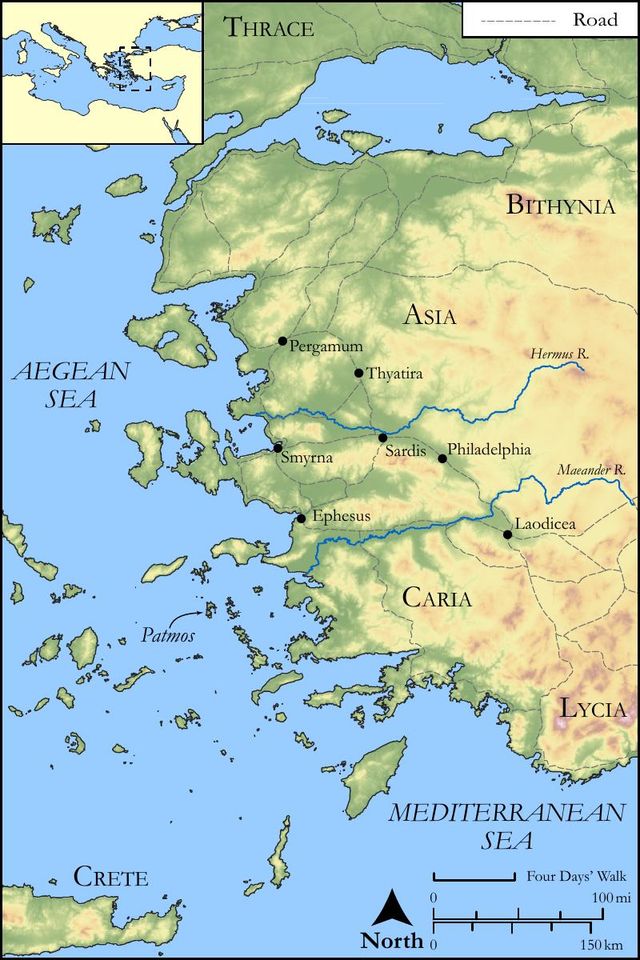
See on the biblical-era maps

Study this verse
Public-domain commentary
Matthew Henry
From his Commentary on the Whole Bible. Henry comments on passages, not single verses — this entry covers Revelation 6:9–17. His four-level outline is real structure in the source text, so it is rendered as structure.
In the remaining part of this chapter we have the opening of the fifth and the sixth seals.
I.The fifth seal.
Here is no mention made of any one who called the apostle to make his observation, probably because the decorum of the vision was to be observed, and each of the four living creatures had discharged its duty of a monitor before, or because the events here opened lay out of the sight, and beyond the time, of the present ministers of the church; or because it does not contain a new prophecy of any future events, but rather opens a spring of support and consolation to those who had been and still were under great tribulation for the sake of Christ and the gospel. Here observe,
1.The sight this apostle saw at the opening of the fifth seal; it was a very affecting sight (Rev 6:9): I saw under the altar the souls of those that were slain for the word of God, and for the testimony which they held. He saw the souls of the martyrs. Here observe,
(1.)Where he saw them - under the altar; at the foot of the altar of incense, in the most holy place; he saw them in heaven, at the foot of Christ. Hence note,
[1.]Persecutors can only kill the body, and after that there is no more that they can do; their souls live.
[2.]God has provided a good place in the better world for those who are faithful to death and are not allowed a place any longer on earth.
[3.]Holy martyrs are very near to Christ in heaven, they have the highest place there.
[4.]It is not their own death, but the sacrifice of Christ, that gives them a reception into heaven and a reward there; they do not wash their robes in their own blood, but in the blood of the Lamb.
(2.)What was the cause in which they suffered - the word of God and the testimony which they held, for believing the word of God, and attesting or confessing the truth of it; this profession of their faith they held fast without wavering, even though they died for it. A noble cause, the best that any man can lay down his life for - faith in God's word and a confession of that faith.
2.The cry he heard; it was a loud cry, and contained a humble expostulation about the long delay of avenging justice against their enemies: How long, O Lord, holy and true, dost thou not judge and avenge our blood on those that dwell on the earth? Rev 6:10. Observe,
(1.)Even the spirits of just men made perfect retain a proper resentment of the wrong they have sustained by their cruel enemies; and though they die in charity, praying, as Christ did, that God would forgive them, yet they are desirous that, for the honour of God, and Christ, and the gospel, and for the terror and conviction of others, God will take a just revenge upon the sin of persecution, even while he pardons and saves the persecutors.
(2.)They commit their cause to him to whom vengeance belongeth, and leave it in his hand; they are not for avenging themselves, but leave all to God.
(3.)There will be joy in heaven at the destruction of the implacable enemies of Christ and Christianity, as well as at the conversion of other sinners. When Babylon falls, it will be said, Rejoice over her, O thou heaven, and you holy apostles and prophets, for God hath avenged you on her, Rev 18:20.
3.He observed the kind return that was made to this cry (Rev 6:11), both what was given to them and what was said to them.
(1.)What was given to them - white robes, the robes of victory and of honour; their present happiness was an abundant recompence of their past sufferings.
(2.)What was said to them - that they should be satisfied, and easy in themselves, for it would not be long ere the number of their fellow-sufferers would be fulfilled. This is a language rather suited to the imperfect state of the saints in this world than to the perfection of their state in heaven; there is no impatience, no uneasiness, no need of admonition; but in this world there is great need of patience. Observe,
[1.]There is a number of Christians, known to God, who are appointed as sheep for the slaughter, set apart to be God's witnesses.
[2.]As the measure of the sin of persecutors is filling up, so is the number of the persecuted martyred servants of Christ.
[3.]When this number is fulfilled, God will take a just and glorious revenge upon their cruel persecutors; he will recompense tribulation to those who trouble them, and to those that are troubled full and uninterrupted rest.
II.We have here the sixth seal opened, Rev 6:12.
Some refer this to the great revolutions in the empire at Constantine's time, the downfall of paganism; others, with great probability, to the destruction of Jerusalem, as an emblem of the general judgment, and destruction of the wicked, at the end of the world; and, indeed, the awful characters of this event are so much the same with those signs mentioned by our Saviour as foreboding the destruction of Jerusalem, as hardly to leave any room for doubting but that the same thing is meant in both places, though some think that event was past already. See Mat 24:29, Mat 24:30. Here observe,
1.The tremendous events that were hastening; and here are several occurrences that contribute to make that day and dispensation very dreadful: - (1.) There was a great earthquake. This may be taken in a political sense; the very foundations of the Jewish church and state would be terribly shaken, though they seemed to be as stable as the earth itself. (2.) The sun became black as sackcloth of hair, either naturally, by a total eclipse, or politically, by the fall of the chief rulers and governors of the land. (3.) The moon should become as blood; the inferior officers, or their military men, should be all wallowing in their own blood. (4.) The stars of heaven shall fall to the earth (Rev 6:13), and that as a fig-tree casteth her untimely figs, when she is shaken of a mighty wind. The stars may signify all the men of note and influence among them, though in lower spheres of activity; there should be a general desolation. (5.) The heaven should depart as a scroll when it is rolled together. This may signify that their ecclesiastical state should perish and be laid aside for ever. (6.) Every mountain and island shall be moved out of its place. The destruction of the Jewish nation should affect and affright all the nations round about, those who were highest in honour and those who seemed to be best secured; it would be a judgment that should astonish all the world. This leads to,
2.The dread and terror that would seize upon all sorts of men in that great and awful day, Rev 6:15. No authority, nor grandeur, nor riches, nor valour, nor strength, would be able to support men at that time; yea, the very poor slaves, who, one would think, had nothing to fear, because they had nothing to lose, would be all in amazement at that day. Here observe,
(1.)The degree of their terror and astonishment: it should prevail so far as to make them, like distracted desperate men, call to the mountains to fall upon them, and to the hills to cover them; they would be glad to be no more seen; yea, to have no longer any being.
(2.)The cause of their terror, namely, the angry countenance of him that sits on the throne, and the wrath of the Lamb. Observe,
[1.]That which is matter of displeasure to Christ is so to God; they are so entirely one that what pleases or displeases the one pleases or displeases the other.
[2.]Though God be invisible, he can make the inhabitants of this world sensible of his awful frowns.
[3.]Though Christ be a lamb, yet he can be angry, even to wrath, and the wrath of the Lamb is exceedingly dreadful; for if the Redeemer, that appeases the wrath of God, himself be our wrathful enemy, where shall we have a friend to plead for us? Those perish without remedy who perish by the wrath of the Redeemer.
[4.]As men have their day of opportunity, and their seasons of grace, so God has his day of righteous wrath; and, when that day shall come, the most stout-hearted sinners will not be able to stand before him: all these terrors actually fell upon the sinners in Judea and Jerusalem in the day of their destruction, and they will all, in the utmost degree, fall upon impenitent sinners, at the general judgment of the last day.
Historical interpretation
Four Centuries of Reception
6 surviving comments on this verse. Each one is dated, so this reads as a timeline rather than a list.
Select a marker to jump to its quote. Markers stagger vertically where authors wrote within a few decades of each other.
This signifies that the whole world, among the good and the saints, is going to find refuge in the church, so that made firm under [the church’s] protection it is able to endure unto eternal life, with the help of our Lord Jesus Christ, who lives and reigns forever and ever. Amen.
“The kings of the earth,” that is, those who exert power over it and possess nothing in heaven, they too shall pray with all the great and rich and with the servants of the things below and those free of the service of Christ, that they be hidden by the caves and the rocks and the mountains. For they do not want to experience the divine wrath that with divine consent will pour down upon them either at the coming of the antichrist in the form of punishments from famine and other plagues or in endless torments which are expected after the resurrection. For then the divine anger will burn righteously as a furnace, consuming those who built upon the foundation of faith with wood and chaff and stubble, as though food for the fire.
They hid in caves and among the rocks of the mountains, etc. When the weaker ones seek to be strengthened by the examples of the high ones in the Church, to be fortified by their advice, and to be protected by their warnings and prayers, they figuratively ask these mountains to fall on them through their compassionate affection. For the high mountains are a refuge for the deer, and the rocks a shelter for the hedgehogs (Ps. 104:18).
And the kings of the earth and the great men and the commanders. We understand kings as powerful people. He means to encompass every rank and condition. Besides, who but the persecutor will be kings then?
And the kings of the earth, and the princes, and tribunes, and the rich, and the strong, and every bondman, and every freeman, hid themselves in the dens and in the rocks of mountains. The kings are those who govern themselves well. Likewise for the princes, who do not resist vices as well as the kings, but still do so as they can. Likewise, the tribunes have still less power than the princes, but they too nonetheless resist the Devil as they can. By the rich he means the rich in virtues, not in possessions; and by the strong also he means not the strong in body, but in mind. So these people, in the last persecution, presuming nothing of their virtues, hide themselves in the caves and dens of mountains because they seek the intercessions of saints, who are rightly called mountains because they are high in virtues and look down on earthly things, and rightly called rocks because they are strong, as they are necessarily strengthened in Christ, who is a rock. Hence the Lord says in the Gospel, Then they that are in Judea, let them flee to the mountains; [Matt. 24:16] and Solomon, The rabbit, a weak people, maketh its bed in the rock; [Variant of Prov. 30:26] and Isaiah says, They shall go into the holes of rocks, and into the caves of the earth from the face of the strength of the Lord, and from the glory of his majesty, when he shall rise up to strike the earth. [Variant of Is. 2:19] He even tells us that one should do so, saying, Enter thou into the rock, and hide thee in a pit in the ground. [Ibid. 10] These things may also mean heavenly virtues, according to what we read in the book of Job: She abideth among the rocks, and dwelleth among cragged flints, and stony hills, where there is no access. [Job 39:28] But let us hear what the fleeing people say to either the angels or the saints.
And, he says, the kings of the earth and the great men and the commanders and the rich and the powerful and every slave and free man hid themselves in the caves and among the rocks of the mountains; and they said to the mountains and to the rocks, "Fall on us and hide us from the face of Him who sits on the throne and from the wrath of the Lamb, for the great day of their wrath has come, and who can stand?" Kings again and great men, commanders and the rich and powerful, he calls wretched demons, as those who began to oppress the earth through violence and deceit; but slaves and free men, those who excel among the demons and are subject to them.
As for hiding themselves in caves and in the rocks of the mountains, and yet saying, "You will fall upon us and hide us," this is spoken figuratively; it hints at fugitives attempting to escape the punishment imposed on them by Christ. For if an invisible punishment and retribution were not inflicted upon them, what is the meaning of what was said by the prophet Isaiah concerning Christ's presence: "I have trodden the winepress alone, and among the nations there is no man with me; I have trampled them in my anger, and crushed them in my wrath, and their blood I have poured out upon the earth"? (Isa. 63:2-3) And what is the meaning of calling the God-hated [θεοστυγεῖς] demons by Matthew: "What have we to do with you, Son of God? Have you come to torment us?" (Matt. 8:29) But one might understand that these things spoken in the Revelation are not only the sufferings of demons, but also of the lawless Jews who crucified the Lord on the cross, who, being oppressed by the war against the Romans, became fugitives in the mountains and caves and the clefts of the earth, and were everywhere tormented by distress and anguish.
Continue studying Revelation 6:15 across the web’s major study libraries — every link below opens this exact verse, chapter, or book on the destination site.
Read & Compare
 BibleGatewayThis verse in more than 200 translations and 70 languages.
 Bible.comThe YouVersion reader — hundreds of translations, reading plans, and highlights.
 ESV.orgCrossway's official English Standard Version reader.
 NET BibleThe NET translation with 60,000+ translators' notes on every rendering decision.
 STEP BibleTyndale House's free study tool — original text, vocabulary, and scholarly resources.
 BibliaLogos Bible Software's free web reader.
 USCCBThe New American Bible (Revised Edition) with the U.S. bishops' study notes.
Commentaries
 BibleHub CommentariesDozens of classic commentaries on this verse, gathered on one page.
 StudyLightMore than 100 commentary sets — the largest collection on the web.
 BibleRefPlain-English commentary on what this verse means, verse by verse.
 Enduring WordDavid Guzik's free commentary on this chapter, widely used by Bible teachers.
 Bible Study ToolsVerse commentary alongside Greek and Hebrew study aids.
Original Language & Research
- BibleHub InterlinearThe verse word by word — original language, transliteration, and English.
- BibleHub LexiconEvery word's original-language definition and Strong's entry.
 Blue Letter BibleDeep-study tools — Strong's numbers, concordance, and word studies.
 CNTR CollationThe earliest Greek manuscripts of this verse, collated letter by letter.
Sermons, Hymns & Audio


TrulyRandomVerse is not affiliated with these sites and doesn’t control their content. They’re linked because they’re genuinely useful.
Summary
Revelation 6:15 vividly portrays the universal terror and desperate attempts of all humanity, from the most powerful rulers to the lowliest slaves, to escape the overwhelming divine judgment unleashed during the opening of the sixth seal. Faced with cataclysmic disturbances in the heavens, they seek futile refuge in the natural world, highlighting the utter inability of human strength, wealth, or status to withstand the wrath of God and the Lamb. This verse underscores the inescapable reality of divine accountability for all people.
Context
ShowHideLiterary Context
Revelation 6:15 is situated within the dramatic unfolding of the sixth seal, described in Revelation 6:12-14. Preceding this verse, John witnesses a profound upheaval of the heavens and the earth: a great earthquake, the sun turning black like sackcloth, the moon becoming like blood, and stars falling to the earth. The sky recedes like a scroll, and every mountain and island is moved out of its place. These are not mere natural disasters but supernatural signs, signaling the direct, terrifying intervention of God's judgment upon the earth. Verse 15 details the immediate, universal human reaction to these terrifying phenomena, setting the stage for the desperate cry in Revelation 6:16-17 for mountains and rocks to fall on them, hiding them from the face of Him who sits on the throne and from the wrath of the Lamb. It marks a crescendo of judgment, moving from physical devastation to the psychological and spiritual terror of humanity.
Historical & Cultural Context
In Israel, particularly during times of war, invasion, or natural catastrophe, seeking refuge in caves, dens, or mountainous terrain was a common survival strategy. Such places offered natural concealment and protection from immediate threats. For the powerful—kings, military leaders (chief captains), and the wealthy—their usual strongholds (palaces, fortified cities) would prove useless against such a divine onslaught. The mention of "bondman" and "free man" reflects the pervasive social structure of the Roman Empire, where society was sharply divided between those enslaved and those who were free. This distinction was fundamental to identity and status. The verse's depiction of all these groups hiding together underscores the leveling effect of divine judgment, where all human hierarchies become meaningless in the face of God's wrath.
Key Themes
ShowHideRevelation 6:15 contributes significantly to several major themes within the book of Revelation and biblical theology. Firstly, it powerfully illustrates the Universality of Judgment and Accountability, demonstrating that no one, regardless of their social standing, power, or wealth, is exempt from God's righteous wrath. The comprehensive list of societal strata emphasizes that all humanity will face divine reckoning. Secondly, it highlights the Futility of Human Resistance and Evasion against God's sovereign will. Despite their desperate attempts to "hide themselves in the dens and in the rocks of the mountains," the subsequent verse reveals their understanding that they cannot escape the "wrath of the Lamb" (Revelation 6:16). This echoes themes found throughout Scripture, such as in Psalm 139:7-12, which declares the impossibility of fleeing from God's Spirit or presence. Thirdly, the verse underscores the Humiliation of Earthly Power and Prestige. Those who once commanded armies and controlled vast wealth are reduced to the same terrified, vulnerable state as the lowliest slave, revealing the ultimate impotence of worldly authority when confronted with the Creator's power.
Exposition and Analysis
ShowHideKey Word Analysis
ShowHideThis primary verb means "to conceal, properly, by covering." The use of the aorist tense ("hid") indicates a decisive, completed action, emphasizing the immediate and desperate nature of their attempt to find refuge. The reflexive pronoun "themselves" (ἑαυτοὺς, heautoûs) further stresses that this hiding was a self-initiated, frantic effort driven by profound fear, rather than being forced by an external agent. It speaks to a primal instinct for self-preservation in the face of overwhelming terror.
Derived from a word meaning "to bind," this term refers to a slave, whether literal or figurative, involuntary or voluntary. It denotes a state of subjection or subserviency. In this context, it represents the lowest rung of the social ladder, highlighting the complete spectrum of humanity included in this universal fear and judgment.
This word implies being "unrestrained (to go at pleasure)," signifying someone who is not a slave, whether freeborn or manumitted, or exempt from obligation. It represents the opposite end of the social spectrum from the bondman. The juxtaposition of "bondman" and "free man" with the other powerful social classes underscores the absolute universality of the terror and the leveling effect of God's judgment, where all human distinctions become meaningless.
Probably from an obsolete root meaning "to rise or 'rear'," this word refers to a mountain as lifting itself above the plain. Mountains often symbolize stability, power, or even divine presence in biblical literature. Here, however, the mountains, along with "dens" and "rocks," become places of sought-after, yet ultimately futile, refuge. The irony is profound: what might normally offer a sense of security or majesty now serves as a desperate, inadequate hiding place from a far greater power.
Verse Breakdown
ShowHide"And the kings of the earth, and the great men, and the rich men, and the chief captains, and the mighty men"
This extensive list meticulously details the highest echelons of human power, wealth, and authority. "Kings of the earth" signifies supreme political rulers; "great men" (megistânes) refers to grandees or nobles; "rich men" speaks to economic power; "chief captains" (chilíarchos) denotes high-ranking military commanders (literally, commanders of a thousand); and "mighty men" (dynatós) encompasses those powerful in strength, influence, or ability. The enumeration emphasizes that worldly dominion, wealth, and military might offer no protection or advantage when confronted with divine judgment.
"and every bondman, and every free man"
This phrase expands the scope of those affected to include every social stratum, from the lowest (bondman/slave) to the most common citizen (free man). This demonstrates the comprehensive and inescapable nature of the impending judgment, affecting all humanity without exception or discrimination based on social status. It reinforces the idea that all human distinctions are rendered irrelevant before the sovereign God.
"hid themselves in the dens and in the rocks of the mountains;"
This clause describes the desperate, self-initiated action of all these individuals. "Dens" (spḗlaion) refers to caves or caverns, often used as hiding places. "Rocks" (pétra) denotes large masses of rock. Their flight to these natural, seemingly secure, but ultimately inadequate, hiding places highlights the profound terror that grips them. It signifies their futile attempt to escape the omnipresent and overwhelming power of God's wrath, revealing the utter helplessness of humanity when faced with divine reckoning.
Literary Devices
ShowHideRevelation 6:15 employs several potent literary devices to convey its message. The most prominent is Merism, a rhetorical device where two contrasting parts are used to represent the whole. By listing "the kings of the earth... and every bondman, and every free man," John encompasses the entire spectrum of humanity, from the most powerful to the most vulnerable, signifying "everyone" or "all humanity without exception." This emphasizes the universal impact of God's judgment. Hyperbole is also present in the description of the disturbances in the heavens preceding this verse, and the universal, desperate hiding can be seen as an extension of this, underscoring the extreme nature of the fear and the overwhelming power of the divine wrath. Furthermore, Symbolism is evident in the "dens and in the rocks of the mountains." These natural formations, typically associated with refuge or stability, become symbols of false security and the utter futility of human attempts to escape God's omnipresent power. The very earth they seek to hide in is itself reeling from God's judgment, highlighting the inescapable nature of their predicament.
Theological and Thematic Connections
ShowHideRevelation 6:15 serves as a stark reminder of the biblical truth regarding God's ultimate sovereignty and the universal accountability of all humanity before Him. It shatters any illusion that worldly power, accumulated wealth, or social standing can provide refuge or exemption from divine judgment. The terror depicted is not merely a response to physical calamities but to the dawning realization of God's righteous wrath. This scene powerfully contrasts the fleeting nature of human authority with the eternal, unchallengeable power of the Creator. It underscores that true security is never found in earthly strongholds or human achievements, but only in a right relationship with God. The desperate attempts to hide reveal a profound spiritual truth: humanity, left to its own devices, cannot stand before a holy God in judgment, nor can it escape His gaze.
Reflection and Application
ShowHideRevelation 6:15 compels us to confront the profound reality of God's ultimate judgment and the inescapable accountability that awaits all humanity. This verse challenges our contemporary reliance on power, wealth, and status, reminding us that in the face of divine reckoning, these earthly securities offer no protection. It serves as a powerful call to humility, urging us to recognize the fleeting nature of our worldly achievements and to place our hope and trust in something far more enduring. For believers, this passage deepens our appreciation for the grace and mercy found in Christ, who delivers us from the wrath to come. It also underscores the urgency of our mission to share the Gospel, offering the true refuge and security that only God provides to a world that will one day face His inescapable judgment. For those who have not yet acknowledged God, it is a stark warning about the consequences of rejecting His mercy and the utter futility of resisting His sovereign will. This verse compels us to examine our standing before God now, before the Day of the Lord.
Questions for Reflection
ShowHideFAQ
ShowHideWhat is the significance of "every bondman, and every free man" being mentioned alongside kings and mighty men?
ShowHideThe meticulous enumeration of "kings of the earth," "great men," "rich men," "chief captains," "mighty men," and then "every bondman, and every free man" is profoundly significant. It functions as a powerful rhetorical device, a merism, to emphasize the absolute universality of the terror and the judgment. It signifies that no one, regardless of their social standing, power, wealth, or freedom, is exempt from the wrath of God. In the face of divine judgment, all human distinctions and hierarchies collapse, revealing that all humanity stands equally accountable before the Creator. This highlights that worldly status offers no protection or special privilege when confronted with the overwhelming power of God, as seen in the disturbances in the heavens described in Revelation 6:12-14.
Why do they hide in "dens and in the rocks of the mountains"?
ShowHideTheir desperate flight to "dens and in the rocks of the mountains" is a primal, instinctive response to overwhelming fear and a futile attempt to escape the divine judgment they now recognize. In that day, caves and mountainous terrain often served as natural hiding places during times of war or disaster. However, in this context, these seemingly secure natural shelters symbolize the utter inadequacy and futility of human efforts to hide from an omnipresent and omnipotent God. They are seeking refuge in creation itself, which is simultaneously being shaken by the Creator's wrath. This imagery echoes Old Testament prophecies where people call for mountains to fall on them to hide them from the terror of the Lord (Hosea 10:8 and Isaiah 2:19-21). It underscores that there is no place on earth, no matter how remote or fortified, that can offer true sanctuary from the wrath of Him who sits on the throne and the Lamb (Revelation 6:16-17).
Christ-Centered Fulfillment
ShowHideRevelation 6:15, with its terrifying depiction of universal flight from divine wrath, finds its profound Christ-centered fulfillment in the person and work of Jesus Christ. The very "wrath of the Lamb" mentioned in the subsequent verse (Revelation 6:16) points to Christ as the ultimate dispenser of divine justice, a role given to Him by the Father (John 5:22). Yet, it is this same Lamb who, through His sacrificial death on the cross, offers the only true refuge from this impending wrath. While the world seeks to hide in mountains and rocks, the Gospel proclaims that believers are hidden in Christ (Colossians 3:3), having been delivered from the wrath to come through His atoning blood (Romans 5:9). The desperate fear of Revelation 6:15 stands in stark contrast to the peace and security offered by Jesus, who invites all who are weary and burdened to come to Him for rest (Matthew 11:28-30). Thus, the terrifying judgment described in this verse serves to magnify the glorious salvation found in Christ, who is not only the righteous Judge but also the compassionate Savior, providing the ultimate and only true hiding place for all who believe (Psalm 32:7).