


Genesis 4:10
Bible text: King James Version (1769 Blayney text) · Public domain
Bible text: Berean Standard Bible · Public domain
Bible text: American Standard Version (1901) · Public domain
Bible text: World English Bible, Messianic edition · Public domain
Bible text: Geneva Bible (1599) · Public domain
Bible text: Young's Literal Translation · Public domain
- וַיֹּאמֶרvai·Yo·merand he saidH559Conj-w ¦ V-Qal-ConsecImperf-3msVerb Qal Consecutive Imperfect 3rd Singular Masculineוַandיֹּאמֶרhe said
- מֶהmehwhat?H4100InterrogPronoun Interrogative
- עָשִׂיתָ'a·Si·tahave you doneH6213V-Qal-Perf-2msVerb Qal Perfect 2nd Singular Masculine
- קוֹלKol[the] voice ofH6963N-mscNoun Singular Masculine Construct
- דְּמֵיde·Mei[the] blood<s> ofH1818N-mpcNoun Plural Masculine Construct
- אָחִיךָ'a·Chi·khayour brotherH251N-msc ¦ 2msNoun Singular Masculine Constructאָחִיbrotherךָyour
- צֹעֲקִיםtzo·'a·Kim[are] crying outH6817V-Qal-Prtcpl-mpVerb Qal Participle Plural Masculine Absolute
- אֵלַי'e·Laito meH413Prep ¦ 1csPreposition Definiteאֵלַtoיme
- מִןminfromH4480PrepPreposition
- הָאֲדָמָהHa·'a·da·Mahthe groundH127Art ¦ N-fsNoun Singular Feminine Absoluteהָtheאֲדָמָהground
English is a literal word-by-word gloss of the Hebrew, not the KJV's wording. Why?
This is the original text the KJV's translators worked from — each Hebrew word with its own literal English meaning in this verse, prepared by scholars at Tyndale House, Cambridge. The KJV translates whole sentences, not word by word, so its wording differs: one Hebrew word can become several English words, and the KJV may choose “the LORD” where the gloss reads “Yahweh”. Both are faithful — they answer different questions. For the KJV's own rendering, switch to the KJV text.
Details
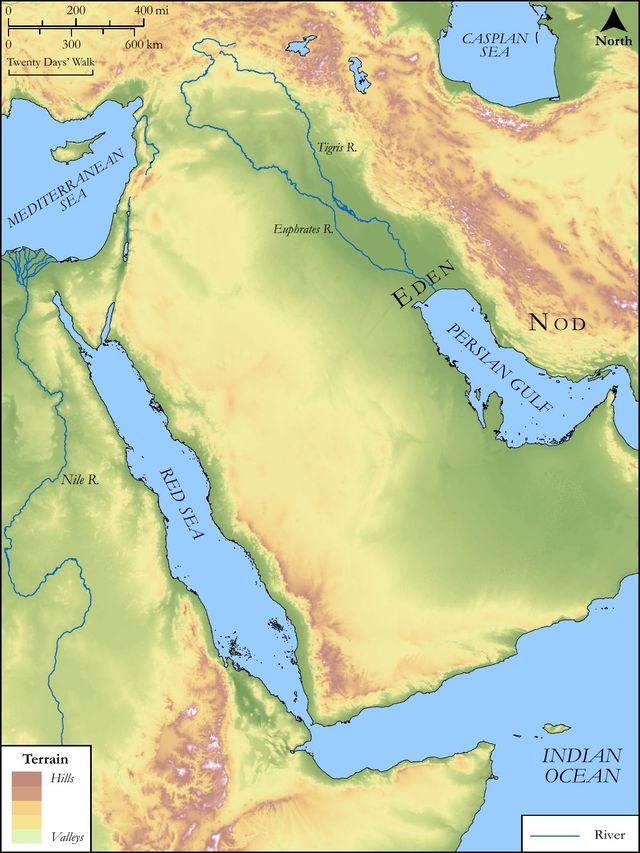
See on the biblical-era maps


Study this verse
Public-domain commentary
Matthew Henry
From his Commentary on the Whole Bible. Henry comments on passages, not single verses — this entry covers Genesis 4:9–12. His four-level outline is real structure in the source text, so it is rendered as structure.
We have here a full account of the trial and condemnation of the first murderer. Civil courts of judicature not being yet erected for this purpose, as they were afterwards (Gen 9:6), God himself sits Judge; for he is the God to whom vengeance belongs, and who will be sure to make inquisition for blood, especially the blood of saints. Observe,
I.The arraignment of Cain:
The Lord said unto Cain, Where is Abel thy brother? Some think Cain was thus examined the next sabbath after the murder was committed, when the sons of God came, as usual, to present themselves before the Lord, in a religious assembly, and Abel was missing, whose place did not use to be empty; for the God of heaven takes notice who is present at and who is absent from public ordinances. Cain is asked, not only because there is just cause to suspect him, he having discovered a malice against Abel and having been last with him, but because God knew him to be guilty; yet he asks him, that he may draw from him a confession of his crime, for those who would be justified before God must accuse themselves, and the penitent will do so.
II.Cain's plea: he pleads not guilty, and adds rebellion to his sin. For,
1.He endeavours to cover a deliberate murder with a deliberate lie: I know not. He knew well enough what had become of Abel, and yet had the impudence to deny it. Thus, in Cain, the devil was both a murderer and a liar from the beginning. See how sinners' minds are blinded, and their hearts hardened by the deceitfulness of sin: those are strangely blind that think it possible to conceal their sins from a God that sees all, and those are strangely hard that think it desirable to conceal them from a God who pardons those only that confess.
2.He impudently charges his Judge with folly and injustice, in putting this question to him: Am I my brother's keeper? He should have humbled himself, and have said, Am not I my brother's murderer? But he flies in the face of God himself, as if he had asked him an impertinent question, to which he was no way obliged to give an answer: "Am I my brother's keeper? Surely he is old enough to take care of himself, nor did I ever take any charge of him." Some think he reflects on God and his providence, as if he had said, "Art not thou his keeper? If he be missing, on thee be the blame, and not on me, who never undertook to keep him." Note, A charitable concern for our brethren, as their keepers, is a great duty, which is strictly required of us, but is generally neglected by us. Those who are unconcerned in the affairs of their brethren, and take no care, when they have opportunity, to prevent their hurt in their bodies, goods, or good name, especially in their souls, do, in effect, speak Cain's language. See Lev 19:17; Phi 2:4.
III.The conviction of Cain, Gen 4:10.
God gave no direct answer to his question, but rejected his plea as false and frivolous: "What hast thou done? Thou makest a light matter of it; but hast thou considered what an evil thing it is, how deep the stain, how heavy the burden, of this guilt is? Thou thinkest to conceal it, but it is to no purpose, the evidence against thee is clear and incontestable: The voice of thy brother's blood cries." He speaks as if the blood itself were both witness and prosecutor, because God's own knowledge testified against him and God's own justice demanded satisfaction. Observe here,
1.Murder is a crying sin, none more so. Blood calls for blood, the blood of the murdered for the blood of the murderer; it cries in the dying words of Zechariah (Ch2 24:22), The Lord look upon it and require it; or in those of the souls under the altar (Rev 6:10), How long, Lord, holy, and true? The patient sufferers cried for pardon (Father, forgive them), but their blood cries for vengeance. Though they hold their peace, their blood has a loud and constant cry, to which the ear of the righteous God is always open.
2.The blood is said to cry from the ground, the earth, which is said to open her mouth to receive his brother's blood from his hand, v. 11. The earth did, as it were, blush to see her own face stained with such blood, and therefore opened her mouth to hide that which she could no hinder. When the heaven revealed Cain's iniquity, the earth also rose up against him (Job 20:27), and groaned on being thus made subject to vanity, Rom 8:20, Rom 8:22. Cain, it is likely, buried the blood and the body, to conceal his crime; but "murder will out." He did not bury them so deep but the cry of them reached heaven. 3. In the original the word is plural, thy brother's bloods, not only his blood, but the blood of all those that might have descended from him; or the blood of all the seed of the woman, who should, in like manner, seal the truth with their blood. Christ puts all on one score (Mat 23:35); or because account was kept of every drop of blood shed. How well is it for us that the blood of Christ speaks better things than that of Abel! Heb 12:24. Abel's blood cried for vengeance, Christ's blood cries for pardon.
IV.The sentence passed upon Cain: And now art thou cursed from the earth, Gen 4:11. Observe here,
1.He is cursed, separated to all evil, laid under the wrath of God, as it is revealed from heaven against all ungodliness and unrighteousness of men, Rom 1:18. Who knows the extent and weight of a divine curse, how far it reaches, how deep it pierces? God's pronouncing a man cursed makes him so; for those whom he curses are cursed indeed. The curse for Adam's disobedience terminated on the ground: Cursed is the ground for thy sake; but that for Cain's rebellion fell immediately upon himself: Thou art cursed; for God had mercy in store for Adam, but none for Cain. We have all deserved this curse, and it is only in Christ that believers are saved from it and inherit the blessing, Gal 3:10, Gal 3:13.
2.He is cursed from the earth. Thence the cry came up to God, thence the curse came up to Cain. God could have taken vengeance by an immediate stroke from heaven, by the sword of an angel, or by a thunderbolt; but he chose to make the earth the avenger of blood, to continue him upon the earth, and not immediately to cut him off, and yet to make even this his curse. The earth is always near us, we cannot fly from it; so that, if this is made the executioner of divine wrath, our punishment is unavoidable: it is sin, that is, the punishment of sin, lying at the door. Cain found his punishment where he chose his portion and set his heart. Two things we expect from the earth, and by this curse both are denied to Cain and taken from him: sustenance and settlement.
(1.)Sustenance out of the earth is here withheld from him. It is a curse upon him in his enjoyments, and particularly in his calling: When thou tillest the ground, it shall not henceforth yield unto thee its strength. Note, Every creature is to us what God makes it, a comfort or a cross, a blessing or a curse. If the earth yield not her strength to us, we must therein acknowledge God's righteousness; for we have not yielded our strength to him. The ground was cursed before to Adam, but it was now doubly cursed to Cain. That part of it which fell to his share, and of which he had the occupation, was made unfruitful and uncomfortable to him by the blood of Abel. Note, The wickedness of the wicked brings a curse upon all they do and all they have (Deu 28:15, etc.), and this curse embitters all they have and disappoints them in all they do.
(2.)Settlement on the earth is here denied him: A fugitive and a vagabond shalt thou be in the earth. By this he was condemned,
[1.]To perpetual disgrace and reproach among men. It should be ever looked upon as a scandalous thing to harbour him, converse with him, or show him any countenance. And justly was a man that had divested himself of all humanity abhorred and abandoned by all mankind, and made infamous.
[2.]To perpetual disquietude and horror in his own mind. His own guilty conscience should haunt him wherever he went, and make him Magormissabib, a terror round about. What rest can those find, what settlement, that carry their own disturbance with them in their bosoms wherever they go? Those must needs be fugitives that are thus tossed. There is not a more restless fugitive upon earth than he that is continually pursued by his own guilt, nor a viler vagabond than he that is at the beck of his own lusts.
This was the sentence passed upon Cain; and even in this there was mercy mixed, inasmuch as he was not immediately cut off, but had space given him to repent; for God is long-suffering to us-ward, not willing that any should perish.
Historical interpretation
Five Centuries of Reception
7 surviving comments on this verse. Each one is dated, so this reads as a timeline rather than a list.
Select a marker to jump to its quote. Markers stagger vertically where authors wrote within a few decades of each other.
We also know that what was said of Abel, when he was slain by the wicked murderer Cain, is suitable for all whose blood has been shed wickedly. Let us suppose that the verse "The voice of your brother's blood is crying to me from the ground" is said as well for each of the martyrs, the voice of whose blood cries to God from the ground.
God appeared to Cain with kindness, so that if he repented, the sin of murder that his fingers had committed might be effaced by the compunction on his lips. If he did not repent, however, there would be decreed on him a bitter punishment in proportion to his evil folly.
But Cain was filled with wrath instead of compunction. To him who knows all, who asked him about his brother in order to win him back, Cain retorted angrily and said, “I do not know, am I my brother’s keeper?” … What then would you say, Cain? Should Justice take vengeance for the blood that cried out to it? Or not? Did it not delay so that you might repent? Did Justice not distance itself from its own knowledge and ask you as if it did not know, so that you might confess? What it said to you did not please you, so you came to that sin to which it had warned you beforehand not to come.
The divine Scripture always cries out and speaks; hence God also says to Cain, “The voice of your brother’s blood cries out to me.” Blood, to be sure, has no voice, but innocent blood that has been spilled is said to cry out not by words but by its very existence. [It makes] demands of the Lord not with eloquent discourse but with anger over the crime committed. It does not accuse the wrongdoer with words so much as bind him by the accusation of his own conscience. The evil deed may seem to be excused when it is explained away with words. But it cannot be excused if it is made present to the conscience. For in silence and without contradiction the wrongdoer’s conscience always convicts and judges him.
Cain was at once the most wicked and foolish of men in believing that for committing the greatest of crimes it would be sufficient if he avoided other human witnesses. In fact God was the primary witness to his fratricide. Because of this, I think he then shared the opinion held by many today: that God pays no attention to earthly affairs; neither does he see those done by wicked men. There is no doubt that Cain, when summoned by the word of God after his misdeed, answered that he knew nothing of his brother’s murder. He believed God was so ignorant of what had been done that he thought this most deadly crime could be covered by a lie. But it turned out otherwise than he thought. When God condemned him, he realized that God, whom he thought had not seen his crime of murder, had seen him.
And He said to him: What have you done? The voice of your brother's blood cries out to me from the ground. The blood has a great voice, not only of Abel, but of all those slain for the Lord: for the voice of their blood is the very steadfastness of their faith, the very fervor of their charity, through which they merited to suffer for the Lord. It cries out to the Lord from the earth: for even if they have been slain by the impious in the hidden recesses of the earth as Abel was, nevertheless the very cause of their death is precious and clear in the sight of the internal Judge, justly demanding that those who were unjustly slain in their simplicity be crowned; and those who unjustly persecuted and slaughtered them be condemned. Therefore, the blood of the slain cries out to the Lord, and it is proven that their life before death cried out to Him as well, for they used to say: "I cried out with all my heart, hear me, O Lord; I will seek your justifications" (Psalm 118:145). For he indeed cries out to the Lord in his heart, who asks for great things, who prays for heavenly things, who hopes for the eternal, who seeks from Him not the glory of this world, but the keeping of His justifications. The Apostle teaches where this cry is born in the hearts of the just, saying: "God sent the Spirit of His Son into our hearts, crying out, 'Abba, Father'" (Galatians 4:6); he says that the Spirit cries out in our hearts to the Father, because surely He Himself kindles this yearning to cry out. John reveals that the souls of martyrs possess this cry of pious devotion even after death when he says: "I saw under the altar the souls of those who had been slain because of the word of God and the testimony they maintained. They called out in a loud voice, 'How long, Sovereign Lord, holy and true, until you judge the inhabitants of the earth and avenge our blood?'" (Revelation 6:9-10). The souls of the saints cry out not out of hatred for their enemies, but out of love for justice, which they always learned to hunger and thirst for, as well as the desire to reclaim their body, so that the flesh they gave to death for the Lord might merit to stand before Him immortal and incorruptible. Great indeed is the voice of their cry, great is their desire for justice. As the blood of the saints cries out to the Lord, seeking just retribution for their unjust death, what befalls their persecutors is subsequently revealed, with the Lord saying to Cain:
God said to Cain: What have you done? The voice of your brother's blood cries to me from the ground. In the same way, the divine voice in the holy Scriptures reproaches the Jews. For Christ's blood speaks with a great voice on the earth, when all the nations respond Amen upon receiving it. This is the clear voice of the blood which the blood itself expresses from the mouths of the faithful redeemed by the same blood of which the Apostle rightly says to the faithful: You have come to Jesus, the mediator of the new covenant, and to the sprinkled blood that speaks better than the blood of Abel (Heb. 12:24). For the blood of Christ certainly speaks better than that of Abel, since the latter cried to the Lord in condemnation of the fratricide, but the former raises its voice to heaven for the salvation of Christ's faithful brethren.
Continue studying Genesis 4:10 across the web’s major study libraries — every link below opens this exact verse, chapter, or book on the destination site.
Read & Compare
 BibleGatewayThis verse in more than 200 translations and 70 languages.
 Bible.comThe YouVersion reader — hundreds of translations, reading plans, and highlights.
 ESV.orgCrossway's official English Standard Version reader.
 NET BibleThe NET translation with 60,000+ translators' notes on every rendering decision.
 STEP BibleTyndale House's free study tool — original text, vocabulary, and scholarly resources.
 BibliaLogos Bible Software's free web reader.
 USCCBThe New American Bible (Revised Edition) with the U.S. bishops' study notes.
Commentaries
 BibleHub CommentariesDozens of classic commentaries on this verse, gathered on one page.
 StudyLightMore than 100 commentary sets — the largest collection on the web.
 BibleRefPlain-English commentary on what this verse means, verse by verse.
 Enduring WordDavid Guzik's free commentary on this chapter, widely used by Bible teachers.
 Bible Study ToolsVerse commentary alongside Greek and Hebrew study aids.
Original Language & Research
- BibleHub InterlinearThe verse word by word — original language, transliteration, and English.
- BibleHub LexiconEvery word's original-language definition and Strong's entry.
 Blue Letter BibleDeep-study tools — Strong's numbers, concordance, and word studies.
 SefariaThe Hebrew text with Rashi and centuries of Jewish commentary.
Sermons, Hymns & Audio


TrulyRandomVerse is not affiliated with these sites and doesn’t control their content. They’re linked because they’re genuinely useful.
Summary
Genesis 4:10 captures a pivotal moment of divine confrontation following the world's first murder. In this verse, God directly interrogates Cain, not out of ignorance, but to expose his guilt. The profound imagery of Abel's spilled blood crying out from the ground to God underscores the sanctity of human life, the inescapable nature of divine justice, and God's omniscient awareness of hidden sin, revealing that no act of violence or injustice goes unnoticed by the Creator.
Context
ShowHideLiterary Context
This verse is the climax of God's direct interaction with Cain after the murder of Abel. The narrative in Genesis 4 begins with the birth of Cain and Abel, their respective offerings to God, and God's acceptance of Abel's sacrifice while rejecting Cain's. This rejection fuels Cain's anger, leading to God's initial warning in Genesis 4:7 about sin crouching at the door. Despite this warning, Cain lures Abel into a field and murders him in Genesis 4:8. Genesis 4:10 immediately follows Cain's evasive answer to God's initial question in Genesis 4:9, "Where is Abel thy brother?" God's statement in verse 10 serves as a divine indictment, revealing His full knowledge of Cain's heinous act and setting the stage for the curse and judgment that follow in Genesis 4:11-12.
Historical & Cultural Context
Among men from the beginning, blood was universally understood as the essence of life, often associated with the soul or life-force (Leviticus 17:11). The shedding of innocent blood was considered a profound defilement of the land and a grave offense against both humanity and the divine order. Blood vengeance, or the requirement for a life for a life, was a deeply ingrained cultural and legal principle, though here it is God Himself who acts as the avenger. The concept of the "ground" (אֲדָמָה, ʼădâmâh) also carries significance, as humanity was formed from the dust of the ground (Genesis 2:7) and the ground was cursed after Adam's sin (Genesis 3:17-19). Abel's blood soaking into the ground thus represents a further defilement of creation by human sin, demanding a divine response.
Key Themes
ShowHideGenesis 4:10 powerfully contributes to several overarching themes in the book of Genesis and the broader biblical narrative. It highlights the consequences of sin, demonstrating how jealousy and unaddressed anger escalate to violence and murder, leading to divine judgment and alienation from both God and the land. It profoundly establishes the sanctity of human life, emphasizing that life, especially human life created in God's image (Genesis 1:27), is sacred and its unlawful taking demands divine retribution. Furthermore, the verse underscores God's omniscience and justice, revealing that no sin, however hidden, escapes His notice, and He is the ultimate arbiter of justice who hears the cries of the oppressed. This initial act of bloodshed and its divine response sets a precedent for the ongoing struggle between good and evil, and the necessity of divine intervention in human affairs, a theme that reverberates throughout the biblical story of redemption.
Exposition and Analysis
ShowHideKey Word Analysis
ShowHideThis interrogative particle (H4100) is used by God not to gain information, but as a rhetorical probe. It conveys a sense of astonishment, accusation, and the demand for an account. God's "What hast thou done?" is a direct challenge to Cain's evasiveness, forcing him to confront the enormity of his actions and the inescapable reality of his guilt, echoing God's earlier confrontation with Adam in Genesis 3:9.
The Hebrew word (H1818) refers to the literal blood of a man or animal, understood as the very essence of life. Here, it is not merely a physical substance but is imbued with a powerful metaphorical "voice." The shedding of blood signifies the taking of life, and in this context, the innocent life of Abel. Its "cry" signifies the profound spiritual offense and the demand for justice that emanates from such a heinous act, connecting the physical act of murder to its spiritual repercussions.
This primitive root (H6817) means "to shriek" or "to cry out," often in distress, for help, or for justice. The use of this verb for inanimate blood is a powerful anthropomorphism, indicating an urgent, impassioned plea that rises directly to God's ears. It emphasizes that the violation of life is not a silent matter in the divine economy; it resonates through creation and demands a divine hearing and response.
Verse Breakdown
ShowHide"And he said, What hast thou done?"
This opening clause marks God's direct, confrontational interrogation of Cain. It is a rhetorical question, not born of ignorance, but designed to expose Cain's guilt and illicit confession, similar to a judge presenting undeniable evidence to a defendant. God, as the omniscient Creator, already knows the heinous act committed, and His question serves to highlight the inescapable nature of sin's consequences, forcing Cain to confront the reality of his hidden deed.
"the voice of thy brother's blood"
This is a profound and haunting anthropomorphism. Abel's spilled blood, the very essence of his life, is personified as having a "voice." This "voice" is not an audible sound but a spiritual reality—a silent, yet piercing, appeal for justice that rises directly to God. It underscores the sacredness of human life and the profound spiritual offense committed when innocent blood is shed. The emphasis on "thy brother's blood" highlights the grievous nature of fratricide, a sin against familial bonds and divine order.
"crieth unto me from the ground."
This final clause completes the powerful imagery. The "cry" of Abel's blood is directed specifically "unto me" (God), signifying that murder is ultimately a sin against God Himself, a violation of His created order and His image in humanity. The "ground" (אֲדָמָה, ʼădâmâh), which has absorbed Abel's lifeblood, becomes a silent witness, testifying against Cain. This concept highlights that the impact of murder cannot be contained or concealed; it defiles the very earth and demands divine intervention and retribution, a truth reinforced throughout Scripture (e.g., Numbers 35:33).
Literary Devices
ShowHideThe verse employs several powerful literary devices. The most prominent is Anthropomorphism, where Abel's inanimate "blood" is given the human quality of having a "voice" and "crying out." This vivid personification imbues the spilled blood with agency, making it a powerful witness and an active participant in demanding justice from God. This is further enhanced by Metonymy, where "blood" stands for the life that was violently taken, and the "voice" represents the silent yet undeniable plea for retribution. The phrase "What hast thou done?" functions as a Rhetorical Question, posed not for information but to expose guilt and compel a response, emphasizing God's omniscience and judicial authority. The imagery of the blood crying "from the ground" also contains Symbolism, where the ground represents both the place of the crime and the defiled earth that bears witness to human sin, requiring divine cleansing or judgment.
Theological and Thematic Connections
ShowHideThis verse establishes foundational theological truths about God's character and the nature of sin. It reveals God as an omniscient and righteous Judge who is intimately aware of every hidden transgression, especially those involving violence against human life. The "cry" of Abel's blood underscores the inherent sanctity of human life, created in God's image, and the profound offense that murder constitutes against the Creator. This act of fratricide further deepens the curse upon the earth, demonstrating that human sin not only affects individuals but also reaches the earth itself, defiling the very ground. The divine response to Abel's blood sets a precedent for the biblical principle of justice for bloodshed, highlighting that God will ultimately hold humanity accountable for its actions, particularly those that violate the sacredness of life. This yearning for divine justice, however, finds its ultimate resolution not in vengeance, but in the redemptive work of Christ.
Reflection and Application
ShowHideGenesis 4:10 serves as a profound and sobering reminder that no act of injustice, violence, or hidden sin escapes the all-seeing eye of God. For us today, this verse compels us to reflect deeply on the intrinsic value God places on every human life, created in His image. It challenges us to confront the reality of violence and injustice in our world, whether it be physical harm, pervasive oppression, or the quiet suffering of the lowly. We are called to be those who not only refrain from shedding innocent blood but also actively seek justice, seeking to give voice to the defenseless and to stand against anything that devalues human life. This passage assures us that God hears the cries of the oppressed, even when human systems fail, and that ultimately, divine justice will prevail. It encourages us to live with integrity, knowing that our actions, both visible and hidden, are known to God, and to cultivate a profound respect for the sanctity of life in all its forms.
Questions for Reflection
ShowHideFAQ
ShowHideWhy does God ask "What hast thou done?" if He already knows?
ShowHideGod's question is not born of ignorance but is a rhetorical device, a divine invitation for Cain to confess and acknowledge his sin. It serves to expose his guilt and demonstrate that no sin is hidden from the all-knowing Creator. This mirrors God's earlier approach with Adam and Eve in the Garden, where He questioned them after their disobedience to prompt confession and accountability. It emphasizes God's desire for humanity to acknowledge their actions and the consequences that follow.
What does it mean that Abel's blood "crieth from the ground"?
ShowHideThis is a powerful anthropomorphism, signifying that the shedding of innocent blood is such a heinous act that it demands divine attention and justice. The "cry" represents the victim's silent, yet urgent, plea for retribution, which God hears and will respond to. It underscores the sanctity of human life and the gravity of murder as an offense against God's created order, implying that the very earth bears witness to such a violation and cries out for divine intervention.
Does this imply that the earth itself is affected by human sin?
ShowHideYes, the text strongly suggests a deep connection between human sin and the created order. The ground, which was previously cursed because of Adam's sin (Genesis 3:17), now absorbs Abel's blood and metaphorically cries out. This indicates that human violence further defiles and disrupts creation. This theme of creation groaning under the weight of sin and awaiting redemption is echoed later in Scripture, notably in Romans 8:22, where creation groans for its liberation.
How does Abel's blood crying out relate to other biblical instances of blood?
ShowHideAbel's blood cries for vengeance and justice, setting a precedent for the severity of bloodshed and the divine demand for retribution. This stands in stark contrast to other significant instances of blood in the Bible. For example, the blood of the Passover lamb brought protection and deliverance from judgment. Most significantly, it contrasts with the blood of Jesus Christ, which "speaks a better word" of forgiveness and cleansing, offering atonement and reconciliation for sin, rather than demanding retribution from humanity.
Christ-Centered Fulfillment
ShowHideWhile Abel's blood cries out for vengeance and justice, exposing the depth of human sin and the demand for divine retribution, it ultimately points to the profound need for a different kind of blood—the blood of the ultimate innocent one, Jesus Christ. Abel's death, the first shedding of innocent blood, established the grievous consequence of sin and the principle that life demands life. However, Jesus' own blood, shed on the cross, was not poured out to cry for vengeance against humanity, but to speak a better word of forgiveness, mercy, and reconciliation. His voluntary sacrifice provides the atonement for sin that Abel's sacrifice could only prefigure, satisfying God's righteous justice while extending boundless grace. Thus, the horrifying cry of Abel's blood foreshadows the glorious, life-giving "cry" of Christ's blood, which silences the accusations of sin and inaugurates the new covenant of grace, offering redemption where only condemnation was due.