


Genesis 4:8
Bible text: King James Version (1769 Blayney text) · Public domain
Bible text: King James Version with Strong's numbers · Public domain
Bible text: Berean Standard Bible · Public domain
Bible text: American Standard Version (1901) · Public domain
Bible text: World English Bible, Messianic edition · Public domain
Bible text: Geneva Bible (1599) · Public domain
Bible text: Young's Literal Translation · Public domain
- וַיֹּאמֶרvai·Yo·merand he saidH559Conj-w ¦ V-Qal-ConsecImperf-3msVerb Qal Consecutive Imperfect 3rd Singular Masculineוַandיֹּאמֶרhe said
- קַיִןKa·yinCainH7014N-proper-mNoun Proper Masculine
- אֶל'eltoH413PrepPreposition
- הֶבֶלHe·velAbelH1893N-proper-mNoun Proper Masculine
- אָחִיו'a·Chivhis brotherH251N-msc ¦ 3msNoun Singular Masculine Constructאָחִיbrotherוhis
- וַיְהִיvay·Hiand it wasH1961Conj-w ¦ V-Qal-ConsecImperf-3msVerb Qal Consecutive Imperfect 3rd Singular Masculineוַandיְהִיit was
- בִּהְיוֹתָםbih·yo·Tamwhen they wereH1961Prep-b ¦ V-Qal-Inf ¦ 3mpVerb Qal Infinitive Constructבִּwhenהְיוֹתָwereםthey
- בַּשָּׂדֶהba·sa·Dehin the fieldH7704Prep-b ¦ N-msNoun Singular Masculine Absoluteבַּin theשָּׂדֶהfield
- וַיָּקָםvai·Ya·komand he rose upH6965Conj-w ¦ V-Qal-ConsecImperf-3msVerb Qal Consecutive Imperfect 3rd Singular Masculineוַandיָּקָםhe rose up
- קַיִןKa·yinCainH7014N-proper-mNoun Proper Masculine
- אֶל'elagainstH413PrepPreposition
- הֶבֶלHe·velAbelH1893N-proper-mNoun Proper Masculine
- אָחִיו'a·Chivhis brotherH251N-msc ¦ 3msNoun Singular Masculine Constructאָחִיbrotherוhis
- וַיַּהַרְגֵהוּvai·ya·har·Ge·huand he killed himH2026Conj-w ¦ V-Qal-ConsecImperf-3ms ¦ 3msVerb Qal Consecutive Imperfect 3rd Singular Masculineוַandיַּהַרְגֵhe killedהוּhim
- נֵלְכָהne·le·Khahlet us goH1980V-Qal-Imperf-1cpVerb Qal Imperfect 1st Plural common gender
- הַשָּׂדֶהha·sa·Deh[into] the fieldH7704Art ¦ N-csNoun Singular common gender Absoluteהַ[into] theשָּׂדֶהfield
English is a literal word-by-word gloss of the Hebrew, not the KJV's wording. Why?
This is the original text the KJV's translators worked from — each Hebrew word with its own literal English meaning in this verse, prepared by scholars at Tyndale House, Cambridge. The KJV translates whole sentences, not word by word, so its wording differs: one Hebrew word can become several English words, and the KJV may choose “the LORD” where the gloss reads “Yahweh”. Both are faithful — they answer different questions. For the KJV's own rendering, switch to the KJV text.
Details
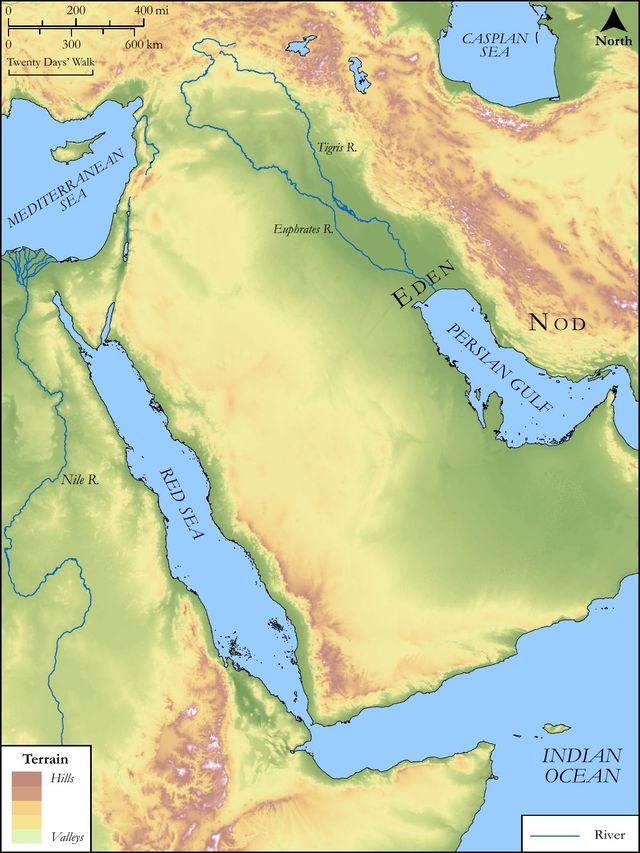
See on the biblical-era maps


Study this verse
Public-domain commentary
Matthew Henry
From his Commentary on the Whole Bible. Henry comments on passages, not single verses — this entry covers Genesis 4:8. His three-level outline is real structure in the source text, so it is rendered as structure.
We have here the progress of Cain's anger, and the issue of it in Abel's murder, which may be considered two ways: -
I.As Cain's sin; and a scarlet, crimson, sin it was, a sin of the first magnitude, a sin against the light and law of nature, and which the consciences even of bad men have startled at. See in it,
1.The sad effects of sin's entrance into the world and into the hearts of men. See what a root of bitterness the corrupt nature is, which bears this gall and wormwood. Adam's eating forbidden fruit seemed but a little sin, but it opened the door to the greatest.
2.A fruit of the enmity which is in the seed of the serpent against the seed of the woman. As Abel leads the van in the noble army of martyrs (Mat 23:35), so Cain stand in the front of the ignoble army of persecutors, Jde 1:11. So early did he that was after the flesh persecute him that was after the Spirit; and so it is now, more or less (Gal 4:29), and so it will be till the war shall end in the eternal salvation of all the saints and the eternal perdition of all that hate them.
3.See also what comes of envy, hatred, malice, and all uncharitableness; if they be indulged and cherished in the soul, they are in danger of involving men in the horrid guilt of murder itself. Rash anger is heart-murder, Mat 5:21, Mat 5:22. Much more is malice so; he that hates his brother is already a murderer before God; and, if God leave him to himself, he wants nothing but an opportunity to render him a murderer before the world. Many were the aggravations of Cain's sin.
(1.)It was his brother, his own brother, that he murdered, his own mother's son (Psa 50:20), whom he ought to have loved, his younger brother, whom he ought to have protected.
(2.)He was a good brother, one who had never done him any wrong, nor given him the least provocation in word or deed, but one whose desire had been always towards him, and who had been, in all instances, dutiful and respectful to him.
(3.)He had fair warning given him, before, of this. God himself had told him what would come of it, yet he persisted in his barbarous design.
(4.)It should seem that he covered it with a show of friendship and kindness: He talked with Abel his brother, freely and familiarly, lest Abel should suspect danger, and keep out of his reach. Thus Joab kissed Abner, and then killed him. Thus Absalom feasted his brother Amnon and then killed him. According to the Septuagint [a Greek version of the Old Testament, supposed to have been translated by seventy-two Jews, at the desire of Ptolemy Philadelphus, above 200 years before Christ], Cain said to Abel, Let us go into the field; if so, we are sure Abel did not understand it (according to the modern sense) as a challenge, else he would not have accepted it, but as a brotherly invitation to go together to their work. The Chaldee paraphrast adds that Cain, when they were in discourse in the field, maintained that there was no judgment to come, no future state, no rewards and punishments in the other world, and that when Abel spoke in defence of the truth Cain took that occasion to fall upon him. However,
(5.)That which the scripture tells us was the reason why he slew him was a sufficient aggravation of the murder; it was because his own works were evil and his brother's righteous, so that herein he showed himself to be of that wicked one (Jo1 3:12), a child of the devil, as being an enemy to all righteousness, even in his own brother, and, in this, employed immediately by the destroyer. Nay,
(6.)In killing his brother, he directly struck at God himself; for God's accepting Abel was the provocation pretended, and for this very reason he hated Abel, because God loved him.
(7.)The murder of Abel was the more inhuman because there were now so few men in the world to replenish it. The life of a man is precious at any time; but it was in a special manner precious now, and could ill be spared.
II.As Abel's suffering.
Death reigned ever since Adam sinned, but we read not of any taken captive by him till now; and now,
1.The first that dies is a saint, one that was accepted and beloved of God, to show that, though the promised seed was so far to destroy him that had the power of death as to save believers from its sting, yet still they should be exposed to its stroke. The first that went to the grave went to heaven. God would secure to himself the first-fruits, the first-born to the dead, that first opened the womb into another world. Let this take off the terror of death, that it was betimes the lot of God's chosen, which alters the property of it. Nay,
2.The first that dies is a martyr, and dies for his religion; and of such it may more truly be said than of soldiers that they die on the bed of honour. Abel's death has not only no curse in it, but it has a crown in it; so admirably well is the property of death altered that it is not only rendered innocent and inoffensive to those that die in Christ, but honourable and glorious to those that die for him. Let us not think it strange concerning the fiery trial, nor shrink if we be called to resist unto blood; for we know there is a crown of life for all that are faithful unto death.
Historical interpretation
Nine Centuries of Reception
6 surviving comments on this verse. Each one is dated, so this reads as a timeline rather than a list.
Select a marker to jump to its quote. Markers stagger vertically where authors wrote within a few decades of each other.
Every kind of honour and happiness was bestowed upon you, and then was fulfilled that which is written, "My beloved ate and drank, and was enlarged and became fat, and kicked." [Deuteronomy 32:15] Hence flowed emulation and envy, strife and sedition, persecution and disorder, war and captivity. So the worthless rose up against the honoured, those of no reputation against such as were renowned, the foolish against the wise, the young against those advanced in years. For this reason righteousness and peace are now far departed from you, inasmuch as every one abandons the fear of God, and has become blind in His faith, neither walks in the ordinances of His appointment, nor acts a part becoming a Christian, but walks after his own wicked lusts, resuming the practice of an unrighteous and ungodly envy, by which death itself entered into the world. [Wisdom 2:24]
For thus it is written: "And it came to pass after certain days, that Cain brought of the fruits of the earth a sacrifice unto God; and Abel also brought of the firstlings of his sheep, and of the fat thereof. And God had respect to Abel and to his offerings, but Cain and his sacrifices He did not regard. And Cain was deeply grieved, and his countenance fell. And God said to Cain, Why are you grieved, and why is your countenance fallen? If you offer rightly, but do not divide rightly, have you not sinned? Be at peace: your offering returns to yourself, and you shall again possess it. And Cain said to Abel his brother, Let us go into the field. And it came to pass, while they were in the field, that Cain rose up against Abel his brother, and slew him." [Genesis 4:3-8] You see, brethren, how envy and jealousy led to the murder of a brother. Through envy, also, our father Jacob fled from the face of Esau his brother [Genesis 27:41-45]. Envy made Joseph be persecuted unto death, and to come into bondage. [Genesis 37:18-28] Envy compelled Moses to flee from the face of Pharaoh king of Egypt, when he heard these words from his fellow-countryman, "Who made you a judge or a ruler over us? Will you kill me, as you killed the Egyptian yesterday?" [Exodus 2:14] On account of envy, Aaron and Miriam had to make their abode without the camp. [Numbers 12:14-15] Envy brought down Dathan and Abiram alive to Hades, through the sedition which they excited against God's servant Moses. [Numbers 16:33] Through envy, David not only underwent the hatred of foreigners, but was also persecuted by Saul king of Israel. [1 Samuel 21:10-15]
(Verse 8) And Cain said to his brother Abel. It is understood what the Lord said. Therefore, it is superfluous, what is found in the Samaritan and our volume, Let us go to the field.
And Cain said to Abel his brother: Let us go out into the field. And when they were in the field, Cain rose up against Abel his brother, and killed him. And here the treachery of Cain and the innocence of Abel are both demonstrated: the innocence of Abel indeed, in that he simply followed his elder brother as a brother, being commanded, though his brother was inflamed with hostile hatred towards him; the treachery of Cain, in that he leads his brother outside to kill him, as if he could avoid divine presence in a more secret place: not considering, nor understanding that He who knew the secret things of his heart which reproved him, could also see wherever he withdrew and whatever he did in secret.
Cain led his brother out into the field and killed him. The Jewish people led the Lord out of their city Jerusalem and crucified Him at Calvary; from both instances of this ordeal we are reminded typically to go out to the Lord outside the camp, bearing His reproach, that is, leaving behind the fellowship of the world and the company of the wicked, we should willingly endure all worldly contempt for the love of our heavenly homeland. When the Lord asked Cain where his brother Abel was, he replied that he did not know, and that it was not his duty to be his brother's keeper. Even to this day, when the faithful, the members of Christ, inquire of the Jews about Christ, they say they do not know. They would themselves have been keepers of Christ if they had been willing to receive and uphold the Christian faith. For whoever keeps Christ in their heart does not say, like Cain, that they do not know their brother, or that they are not their brother's keeper.
Some understand the murderer Cain as the Jews’ lack of faith, the killing of Abel as the passion of the Lord and Savior, and the earth that opened its mouth and received Abel’s blood from Cain’s hand as the church (which received, in the mystery of its renewal, the blood of Christ poured out by the Jews). Undoubtedly those who have this understanding find water turned into wine, for they have a more sacred understanding of the saying of the sacred law.
Why did Cain become a fratricide? Was it not by his evil will? He preferred himself to his Creator and followed after evil thoughts and so became abandoned to envy and committed murder.
Continue studying Genesis 4:8 across the web’s major study libraries — every link below opens this exact verse, chapter, or book on the destination site.
Read & Compare
 BibleGatewayThis verse in more than 200 translations and 70 languages.
 Bible.comThe YouVersion reader — hundreds of translations, reading plans, and highlights.
 ESV.orgCrossway's official English Standard Version reader.
 NET BibleThe NET translation with 60,000+ translators' notes on every rendering decision.
 STEP BibleTyndale House's free study tool — original text, vocabulary, and scholarly resources.
 BibliaLogos Bible Software's free web reader.
 USCCBThe New American Bible (Revised Edition) with the U.S. bishops' study notes.
Commentaries
 BibleHub CommentariesDozens of classic commentaries on this verse, gathered on one page.
 StudyLightMore than 100 commentary sets — the largest collection on the web.
 BibleRefPlain-English commentary on what this verse means, verse by verse.
 Enduring WordDavid Guzik's free commentary on this chapter, widely used by Bible teachers.
 Bible Study ToolsVerse commentary alongside Greek and Hebrew study aids.
Original Language & Research
- BibleHub InterlinearThe verse word by word — original language, transliteration, and English.
- BibleHub LexiconEvery word's original-language definition and Strong's entry.
 Blue Letter BibleDeep-study tools — Strong's numbers, concordance, and word studies.
 SefariaThe Hebrew text with Rashi and centuries of Jewish commentary.
Sermons, Hymns & Audio


TrulyRandomVerse is not affiliated with these sites and doesn’t control their content. They’re linked because they’re genuinely useful.
Summary
Genesis 4:8 recounts the chilling and tragic narrative of the world's first murder, a pivotal moment that starkly illustrates the devastating progression of sin from internal resentment to outward violence. In this verse, Cain, consumed by unchecked anger and jealousy over God's rejection of his offering and acceptance of Abel's, lures his unsuspecting brother Abel into a desolate field and brutally slays him. This act of fratricide not only marks a grim escalation of humanity's fallen state but also sets a somber precedent for the pervasive nature of sin's corruption and its immediate, destructive impact on human relationships.
Context
ShowHideLiterary Context
This verse is the climactic and tragic culmination of the narrative arc initiated in Genesis 4:1-7. Following the birth of Cain and Abel, the narrative quickly shifts to their offerings to God. God accepts Abel's offering, which is presented from the firstborn of his flock with faith, but rejects Cain's offering from the fruit of the ground. This rejection ignites a deep-seated anger and dejection in Cain, prompting a direct divine intervention. In Genesis 4:6-7, God graciously confronts Cain, questioning his anger and warning him about the insidious nature of sin, personified as a beast "crouching at the door" with a desire to master him, yet affirming Cain's capacity to "rule over it." Genesis 4:8 thus represents Cain's tragic failure to heed this divine counsel, choosing instead to succumb to sin's mastery, leading directly to the horrific act of fratricide. The subsequent verses detail God's confrontation with Cain, the curse placed upon him, and his banishment, further developing the themes of sin's consequences and divine justice.
Historical & Cultural Context
From the beginning, the concept of sacrifice was central to worship, involving agricultural produce or animal offerings brought to God in devotion. The distinction between Cain's and Abel's offerings, while not explicitly detailed in terms of type, is understood by the narrative as one of quality and heart, as later elaborated in Hebrews 11:4. Fratricide, the killing of a brother, was considered an exceptionally heinous crime, violating the most fundamental bonds of kinship and community. Land, particularly fertile ground, was vital for sustenance, and being cursed from the ground, as Cain was in Genesis 4:11-12, represented a severe form of punishment, impacting one's livelihood and connection to the very source of life. The "field" (sadeh) in which the murder occurs is a common setting for isolated acts in ancient narratives, providing a private space away from witnesses, highlighting the premeditated nature of Cain's act.
Key Themes
ShowHideGenesis 4:8 contributes significantly to several overarching themes within the book of Genesis and the broader biblical narrative. Firstly, it vividly portrays the progression and escalation of sin following the Fall in Genesis 3, demonstrating how internal discontent quickly metastasizes into outward violence, echoing God's warning in Genesis 4:7. Secondly, it underscores the pervasiveness of the Fall's impact, showing how sin immediately corrupts human relationships, even within the first family, leading to brokenness and death. Thirdly, the narrative introduces the theme of divine justice and human accountability, as God, despite the hidden nature of the crime, sees and confronts Cain, establishing a foundational principle that sin will not go unpunished, as seen in Genesis 4:9-16. Lastly, Abel's death as a result of his righteous standing before God introduces the concept of the suffering of the righteous, foreshadowing the persecution of God's faithful throughout history, a theme that finds its ultimate expression in the New Testament, particularly in the life and death of Christ.
Exposition and Analysis
ShowHideThe narrative of Genesis 4:8 is presented with a chilling economy of words, yet it conveys an immense weight of human depravity and divine tragedy, marking a profound turning point in humanity's story after the Fall.
Key Word Analysis
ShowHideThis primitive root (H559) signifies "to say (used with great latitude)." In this context, it suggests a seemingly innocuous conversation, perhaps a feigned reconciliation or a calculated lure. The text does not record the content of their conversation, leaving a haunting silence that amplifies the ensuing horror. This deliberate omission underscores the deceptive calm before the storm, hinting at Cain's premeditated intent to draw Abel away to an isolated location. The word choice here highlights the insidious nature of Cain's deception, using the very act of communication as a tool for betrayal.
This primitive root (H6965) means "to rise (in various applications, literal, figurative, intensive and causative)." Here, "rose up against" (וַיָּקָם קַיִן אֶל־הֶבֶל אָחִיו, wayyāqom Qayin ʾel-Hevel ʾāḥîw) signifies a deliberate, aggressive posture, not a spontaneous outburst. It implies a calculated movement, a turning against his own kin, a reversal of the natural order of brotherly affection. This act of "rising up" is a direct contravention of God's earlier invitation for Cain to "do well" and master sin, revealing his conscious choice to yield to its destructive power.
This primitive root (H2026) means "to smite with deadly intent; destroy, out of hand, kill, murder(-er)." The final word, "slew him" (וַיַּהַרְגֵהוּ, wayyahargehû), is blunt and final, marking the first instance of human-on-human murder in biblical history. This verb conveys the brutal and fatal nature of the act, emphasizing its intentionality and the complete cessation of life. It is not an accident but a direct consequence of unaddressed anger and jealousy, demonstrating how sin, once conceived, brings forth death.
Verse Breakdown
ShowHide"And Cain talked with Abel his brother:"
This opening clause establishes a seemingly normal, even intimate, interaction between the two brothers. The verb "talked" (Hebrew: ʼâmar) is broad, but in light of what follows, it suggests a deceptive or manipulative conversation, possibly to lure Abel away. The text's silence on the content of their discussion heightens the suspense and underscores the hidden malice in Cain's heart.
"and it came to pass, when they were in the field,"
This clause sets the scene for the impending tragedy. The "field" (Hebrew: sâdeh) denotes an open, isolated area, away from the family dwelling and potential witnesses. This detail strongly implies premeditation on Cain's part, as he intentionally led his brother to a place where his dark design could be executed without immediate intervention. The isolation of the setting mirrors the internal isolation of Cain's heart, consumed by his destructive emotions.
"that Cain rose up against Abel his brother,"
This marks the dramatic shift from deceptive calm to violent action. The phrase "rose up against" (Hebrew: qûwm ʾel) indicates a deliberate, aggressive movement, a hostile posture taken by Cain against his own sibling. It signifies a betrayal of the familial bond and a direct defiance of God's earlier warning to master sin. This action is a conscious choice, not a spontaneous outburst, revealing the depth of Cain's unaddressed anger and jealousy.
"and slew him."
This final, stark clause delivers the horrific outcome. The verb "slew" (Hebrew: hârag) is direct and unambiguous, denoting a fatal act of murder. This is the first recorded human death by violence in the biblical narrative, a chilling testament to the immediate and devastating impact of the Fall on human relationships. It is the ultimate consequence of unbridled sin, demonstrating its power to bring forth death, as later expounded in James 1:15.
Literary Devices
ShowHideGenesis 4:8 masterfully employs several literary devices to convey its profound message. The most striking is Understatement, particularly in the phrase "And Cain talked with Abel his brother." This seemingly innocuous detail, juxtaposed with the brutal act that follows, creates a chilling effect, hinting at a deceptive calm or a calculated lure rather than a genuine conversation. The narrative's brevity and lack of detail regarding the conversation itself amplify the horror of the ensuing violence. Irony is also present, as Cain, who was warned by God to "master" sin, instead allows sin to master him, leading to the murder of his own brother, the very person whose righteous offering provoked his anger. The "field" serves as Symbolism, representing a place of isolation and vulnerability, allowing for the hidden execution of Cain's dark intent, and later, the place from which Abel's blood cries out. Furthermore, the entire episode acts as Foreshadowing, setting a grim precedent for the pervasive nature of sin and violence in human history, from the widespread wickedness before the flood in Genesis 6:11 to the continuous struggle against sin throughout the biblical narrative.
Theological and Thematic Connections
ShowHideGenesis 4:8 stands as a profound theological statement on the immediate and devastating consequences of humanity's fallen nature. It vividly demonstrates how sin, if left unchecked, escalates rapidly from internal resentment and dejection to outward violence and murder, directly defying God's gracious warning and invitation to master it. This primal act of fratricide underscores the deep corruption that entered the human heart through Adam and Eve's disobedience, revealing sin's pervasive power to fracture the most fundamental human relationships and bring forth death. Despite the hidden nature of the crime, God's immediate awareness and subsequent confrontation with Cain establish a foundational principle of divine omniscience, justice, and human accountability, affirming that no sin goes unnoticed or unjudged in His sight. Abel's death, as a result of his righteous offering and faith, also introduces the significant theme of the righteous suffering at the hands of the unrighteous, a pattern that tragically recurs throughout biblical history and finds its ultimate fulfillment in Christ.
Reflection and Application
ShowHideGenesis 4:8 serves as a stark and timeless warning to every human heart about the deceptive and destructive power of unaddressed anger, jealousy, and resentment. It compels us to look inward, recognizing that the seeds of sin, if left untended and allowed to fester, can blossom into actions that devastate relationships, incur divine displeasure, and lead to profound regret. This tragic narrative calls us to actively heed God's warnings about sin "crouching at the door," urging us to exercise self-control and choose the path of righteousness, reconciliation, and obedience to divine counsel. It reminds us that our internal battles have external consequences, and that true spiritual health requires confronting and mastering sinful impulses before they lead to destructive behaviors. By reflecting on Cain's failure, we are challenged to cultivate hearts of humility, gratitude, and love, seeking God's grace to overcome the temptations that seek to master us, and striving to live in harmony with our fellow human beings, honoring the sacredness of life.
Questions for Reflection
ShowHideFAQ
ShowHideWhy did Cain kill Abel?
ShowHideCain killed Abel primarily out of deep-seated jealousy and unaddressed anger. God had accepted Abel's offering, which was given in faith and from the firstborn of his flock, but rejected Cain's offering of the fruit of the ground (Genesis 4:3-5). This divine preference, coupled with Cain's refusal to "do well" and master his sinful impulses despite God's direct warning in Genesis 4:6-7, allowed his resentment to fester into murderous rage.
What does "Cain talked with Abel" imply before the murder?
ShowHideThe phrase "Cain talked with Abel his brother" is chillingly understated. It suggests a deceptive calm or a calculated lure. Cain likely initiated conversation to draw Abel away to the isolated field, indicating a premeditated act rather than a spontaneous outburst. The brevity of the text leaves the content of their conversation unspoken, highlighting the dark intent beneath the surface and Cain's deliberate deception, making the ensuing violence even more shocking.
How does this event relate to the Fall in Genesis 3?
ShowHideCain's murder of Abel is a direct and devastating consequence of the Fall recorded in Genesis 3. Adam and Eve's sin introduced sin, death, and brokenness into the world. Genesis 4:8 demonstrates the immediate and escalating impact of this corruption on human relationships, even within the first family. It shows how the fracturing of humanity's relationship with God quickly leads to the fracturing of human fellowship, violence, and the ultimate consequence of sin: death.
Did God warn Cain before the murder?
ShowHideYes, God directly warned Cain in Genesis 4:6-7. God asked him why he was angry and dejected, and explicitly told him, "If you do well, will you not be accepted? And if you do not do well, sin is crouching at the door; its desire is for you, but you must rule over it." Cain chose to disregard this divine counsel, allowing sin to master him, leading to the tragic outcome.
Christ-Centered Fulfillment
ShowHideThe gruesome act in Genesis 4:8 tragically underscores humanity's desperate need for a redeemer, a need that finds its ultimate answer in Jesus Christ. Abel's shed blood, crying out from the ground for justice and vengeance, stands in stark contrast to the blood of Jesus, which speaks a better word. While Abel's blood demands retribution for an innocent life taken, Christ's blood, shed on the cross, speaks of forgiveness, atonement, and reconciliation, providing the means to cleanse humanity from the very sin that led to Cain's heinous act. Jesus, the perfect and righteous Lamb of God, became the ultimate sacrifice, overcoming the power of sin and death that entered the world through the Fall and was so vividly displayed in Cain's fratricide. He is the ultimate answer to the violent brokenness of humanity, offering peace with God and the potential for true reconciliation among people, fulfilling the need for a righteous one whose innocent death brings life and salvation to all who believe, as prophesied in Isaiah 53:5 and fulfilled in John 3:16. Through Christ, the cycle of violence inaugurated by Cain is broken, and a new way of life, characterized by love and forgiveness, becomes possible, echoing the call for brotherly love found in 1 John 3:11-18.