


Galatians 4:29
- ἀλλ᾽all᾽ButG235CONJConjunction
- ὥσπερhōsperjust asG5618CONJConjunction
- τότεtoteat that timeG5119ADVAdverb
- ὁhothe [one]G3588T-NSMDefinite article Nominative Singular Masculine
- κατὰkataaccording toG2596PREPPreposition
- σάρκαsarkafleshG4561N-ASFNoun Accusative Singular Feminine
- γεννηθεὶςgennētheishaving been bornG1080V-APP-NSMVerb Aorist Passive Participle Nominative Singular Masculine
- ἐδίωκενediōkenhe was persecutingG1377V-IAI-3SVerb Imperfect Active Indicative 3rd Singular
- τὸνtonthe [one born]G3588T-ASMDefinite article Accusative Singular Masculine
- κατὰkataaccording toG2596PREPPreposition
- πνεῦμαpneumaSpiritG4151N-ASNNoun Accusative Singular Neuter
- οὕτωςhoutōssoG3779ADVAdverb
- καὶkaialsoG2532CONJConjunction
- νῦν·nun[it is] nowG3568ADVAdverb
English is a literal word-by-word gloss of the Greek, not the KJV's wording. Why?
This is the original text the KJV's translators worked from — each Greek word with its own literal English meaning in this verse, prepared by scholars at Tyndale House, Cambridge. The KJV translates whole sentences, not word by word, so its wording differs: one Greek word can become several English words, and the KJV may choose “charity” where the gloss reads “love”. Both are faithful — they answer different questions. For the KJV's own rendering, switch to the KJV text.
Details
See on the biblical-era maps
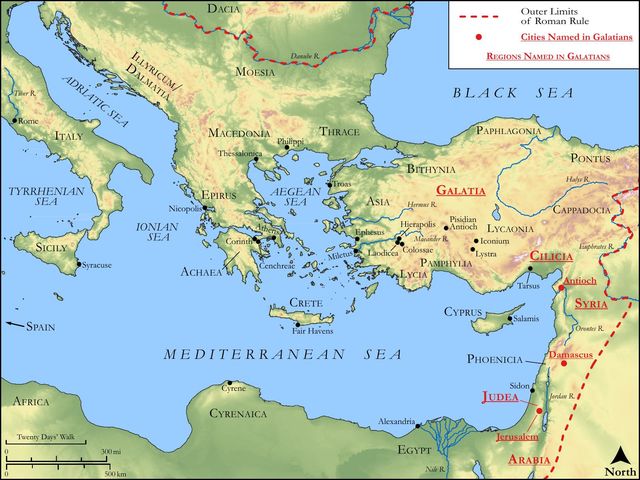

Study this verse
Public-domain commentary
Matthew Henry
From his Commentary on the Whole Bible. Henry comments on passages, not single verses — this entry covers Galatians 4:21–31.
In these verses the apostle illustrates the difference between believers who rested in Christ only and those judaizers who trusted in the law, by a comparison taken from the story of Isaac and Ishmael. This he introduces in such a manner as was proper to strike and impress their minds, and to convince them of their great weakness in departing from the truth, and suffering themselves to be deprived of the liberty of the gospel: Tell me, says he, you that desire to be under the law, do you not hear the law? He takes it for granted that they did hear the law, for among the Jews it was wont to be read in their public assemblies every sabbath day; and, since they were so very fond of being under it, he would have them duly to consider what is written therein (referring to what is recorded Gen. 16 and 21), for, if they would do this, they might soon see how little reason they had to trust in it. And here, 1. He sets before them the history itself (Gal 4:22, Gal 4:23): For it is written, Abraham had two sons, etc. Here he represents the different state and condition of these two sons of Abraham - that the one, Ishmael, was by a bond-maid, and the other, Isaac, by a free-woman; and that whereas the former was born after the flesh, or by the ordinary course of nature, the other was by promise, when in the course of nature there was no reason to expect that Sarah should have a son. 2. He acquaints them with the meaning and design of this history, or the use which he intended to make of it (Gal 4:24-27): These things, says he, are an allegory, wherein, besides the literal and historical sense of the words, the Spirit of God might design to signify something further to us, and that was, That these two, Agar and Sarah, are the two covenants, or were intended to typify and prefigure the two different dispensations of the covenant. The former, Agar, represented that which was given from mount Sinai, and which gendereth to bondage, which, though it was a dispensation of grace, yet, in comparison of the gospel state, was a dispensation of bondage, and became more so to the Jews, through their mistake of the design of it, and expecting to be justified by the works of it. For this Agar is mount Sinai in Arabia (mount Sinai was then called Agar by the Arabians), and it answereth to Jerusalem which now is, and is in bondage with her children; that is, it justly represents the present state of the Jews, who, continuing in their infidelity and adhering to that covenant, are still in bondage with their children. But the other, Sarah, was intended to prefigure Jerusalem which is above, or the state of Christians under the new and better dispensation of the covenant, which is free both from the curse of the moral and the bondage of the ceremonial law, and is the mother of us all - a state into which all, both Jews and Gentiles, are admitted, upon their believing in Christ. And to this greater freedom and enlargement of the church under the gospel dispensation, which was typified by Sarah the mother of the promised seed, the apostle refers that of the prophet, Isa 54:1, where it is written, Rejoice, thou barren that bearest not; break forth and cry, thou that travailest not; for the desolate hath many more children than she who hath a husband. 3. He applies the history thus explained to the present case (Gal 4:28); Now we, brethren, says he, as Isaac was, are the children of the promise. We Christians, who have accepted Christ, and rely upon him, and look for justification and salvation by him alone, as hereby we become the spiritual, though we are not the natural, seed of Abraham, so we are entitled to the promised inheritance and interested in the blessings of it. But lest these Christians should be stumbled at the opposition they might meet with from the Jews, who were so tenacious of their law as to be ready to persecute those who would not submit to it, he tells them that this was no more than what was pointed to in the type; for as then he that was born after the flesh persecuted him that was born after the Spirit, they must expect it would be so now. But, for their comfort in this case, he desires them to consider what the scripture saith (Gen 21:10), Cast out the bond-woman and her son, for the son of the bond-woman shall not be heir with the son of the free-woman. Though the judaizers should persecute and hate them, yet the issue would be that Judaism would sink, and wither, and perish; but true Christianity should flourish and last for ever. And then, as a general inference from the whole of the sum of what he had said, he concludes (Gal 4:31), So then, brethren, we are not children of the bond-woman, but of the free.
Historical interpretation
Historical reception
3 surviving comments on this verse. Each one is dated, so this reads as a timeline rather than a list.
Select a marker to jump to its quote. Markers stagger vertically where authors wrote within a few decades of each other.
What! does all this consolation consist in showing that freemen are persecuted by bond-men? By no means, he says, I do not stop here, listen to what follows, and then, if you be not pusillanimous under persecution, you will be sufficiently comforted. And what is it that follows? "Cast out the son of the handmaid, for he shall not inherit with the son of the freewoman." Behold the reward of tyranny for a season, and of recklessness out of season! the son is cast out of his father's house, and becomes, together with his mother, an exile and a wanderer. And consider too the wisdom of the remark; for he says not that he was cast forth merely because he persecuted, but that he should not be heir. For this punishment was not exacted from him on account of his temporary persecution, (for that would have been of little moment, and nothing to the point,) but he was not suffered to participate in the inheritance provided for the son. And this proves that, putting the persecution aside, this very thing had been typified from the beginning, and did not originate in the persecution, but in the purpose of God. Nor does he say, "the son of Abraham shall not be heir," but, "the son of the handmaid," distinguishing him by his inferior descent. Now Sarah was barren, and so is the Gentile Church; observe how the type is preserved in every particular, as the former, through all the by-gone years, conceived not, and in extreme old age became a mother, so the latter, when the fulness of time is come, brings forth. And this the prophets have proclaimed, saying, "Rejoice, thou barren that bearest not; break forth and cry, thou that travailest not; for more are the children of the desolate than of her which hath the husband." And hereby they intend the Church; for she knew not God, but as soon as she knew Him, she surpassed the fruitful synagogue.
(Vers. 29-31.) But as then he that was born according to the flesh persecuted him that was born according to the spirit, even so it is now. But what saith the scripture? Cast out the bondwoman and her son: for the son of the bondwoman shall not be heir with the son of the freewoman. So then, brethren, we are not children of the bondwoman, but of the free. In this liberty Christ hath made us free. I do not think it impossible to find where Ishmael persecuted Isaac; but only this, that when the son of the Egyptian, who was elder, played with Isaac, Sara was indignant, and said to Abraham: Cast out the bondwoman and her son: for the son of the bondwoman shall not be heir with my son Isaac. (Gen. XXI, 10). And certainly, a simple game among children is unworthy of expulsion and abandonment. But the Apostle, like a Hebrew among Hebrews, and instructed at the feet of the teacher Gamaliel, who once restrained the raging Pharisees against the Lord by council, understood from the words of Sarah saying: for the son of the maidservant will not inherit with my son Isaac, that that simple game was not. But because perhaps Ishmael, as the older one, and at that time already circumcised when he could understand and feel what he suffered, claimed for himself the right of the firstborn, the Scripture called the quarrel of the little ones a game. Unable to bear these words, Sarah, not enduring the custom of the firstborn claiming the rights of a slave woman's son from a young age, burst out in a voice: Cast out the slave woman and her son, for the son of the slave woman shall not inherit with my son Isaac. When this seemed harsh to Abraham (for greater things are always due to the firstborn), not only did Ishmael cease to be the firstborn, but he did not even receive an equal portion with his younger brother: God, who wanted the free woman to be inside and the slave woman to be expelled, confirms Sarah's words and speaks to Abraham: Let it not be harsh in your sight concerning the boy and the slave woman. Everything that Sara tells you, listen to her voice: for it is through Isaac that you will have descendants. Just as in the past, the older brother Ishmael persecuted the infant Isaac, claiming the privilege of circumcision and the rights of the firstborn; so now, according to the flesh, Israel (formerly Ishmael) rises up against the younger brother, the Christian people from the nations. Let us consider the foolishness of the Jews, who killed the Lord, persecuted the prophets and apostles, and opposed the will of God; and we will see much greater persecutions, as History also teaches us, stirred up by the Jews against the Christians than by the Gentiles. Do we marvel at the Jews? Even today, those who are born again in Christ and live spiritually are persecuted by those who still live in the flesh. And as they rise with Christ, they seek the things that are above, not the things that are below. Let them do what they want: let them persecute Isaac with Ishmael; let them cast out the bondwoman and her Egyptian mother. They will not inherit the promise, which only those who are born of the promise will obtain. And elegantly also, he who is born according to the flesh persecutes the spiritual. For the spiritual does not pursue the carnal; but forgives him as to a country brother: he knows that he can improve over time. And if at any time he sees the Egyptian son angry, he remembers the one father who created light, cattle, and mosquitoes: and in a great house, there are not only golden and silver vessels; but also wooden and earthen vessels. Therefore, let us say with the Apostle Paul: We are not slaves of the son, but free (2 Timothy 2); and being renewed in Christ, let us hear the words of the Lord speaking to the Jews: If you abide in my word, you will know the truth, and the truth will set you free (John 8:31, 32). The Apostle, liberated by this freedom, used to say: 'For although I am free from all, he who sins is a slave of sin' (I Cor. IX, 19). He, knowing himself free from all vices, from every desire and error, rightly rejoiced in the freedom of Christ saying: 'We are not slaves, but free: in this freedom Christ has set us free' (John VIII, 34).
Ishmael, the elder brother, persecuted him while still a nursing infant, claiming for himself the prior right of circumcision and the inheritance of the firstborn.… And it is aptly said that he who is born according to nature persecutes the spiritual. The spiritual one never persecutes the natural one but forgives him like an untutored brother, for he knows that he may progress.
Continue studying Galatians 4:29 across the web’s major study libraries — every link below opens this exact verse, chapter, or book on the destination site.
Read & Compare
 BibleGatewayThis verse in more than 200 translations and 70 languages.
 Bible.comThe YouVersion reader — hundreds of translations, reading plans, and highlights.
 ESV.orgCrossway's official English Standard Version reader.
 NET BibleThe NET translation with 60,000+ translators' notes on every rendering decision.
 STEP BibleTyndale House's free study tool — original text, vocabulary, and scholarly resources.
 BibliaLogos Bible Software's free web reader.
 USCCBThe New American Bible (Revised Edition) with the U.S. bishops' study notes.
Commentaries
 BibleHub CommentariesDozens of classic commentaries on this verse, gathered on one page.
 StudyLightMore than 100 commentary sets — the largest collection on the web.
 BibleRefPlain-English commentary on what this verse means, verse by verse.
 Enduring WordDavid Guzik's free commentary on this chapter, widely used by Bible teachers.
 Bible Study ToolsVerse commentary alongside Greek and Hebrew study aids.
Original Language & Research
- BibleHub InterlinearThe verse word by word — original language, transliteration, and English.
- BibleHub LexiconEvery word's original-language definition and Strong's entry.
 Blue Letter BibleDeep-study tools — Strong's numbers, concordance, and word studies.
 CNTR CollationThe earliest Greek manuscripts of this verse, collated letter by letter.
Sermons, Hymns & Audio


TrulyRandomVerse is not affiliated with these sites and doesn’t control their content. They’re linked because they’re genuinely useful.
Summary
Galatians 4:29 serves as a potent conclusion to Paul's allegory of Sarah and Hagar, drawing a direct parallel between the historical animosity within Abraham's household and the contemporary conflict faced by the Galatian believers. Paul asserts that just as Ishmael, born "after the flesh" through human effort, persecuted Isaac, born "after the Spirit" through divine promise, so too do those who cling to legalism and human works now persecute those who embrace the freedom and new life found in the Holy Spirit through faith in Christ. This verse underscores the enduring spiritual tension between two opposing principles of relating to God: one based on human achievement, the other on divine grace.
Context
ShowHideLiterary Context
This verse is the climactic point of Paul's allegorical argument in Galatians 4:21-31. Having established the two covenants represented by Hagar (slavery, Mount Sinai, Jerusalem that now is) and Sarah (freedom, heavenly Jerusalem), Paul uses the historical interaction between Ishmael and Isaac to illustrate the ongoing conflict. Ishmael, born of human effort (the flesh), represents those under the Law, while Isaac, born of divine promise (the Spirit), represents those who are children of God through faith. Verse 29 directly applies this historical pattern to the Galatian church, demonstrating that the spiritual conflict between legalism and grace is not new but a continuation of an ancient tension. It sets the stage for Paul's urgent call to stand firm in Christian liberty in Galatians 5:1.
Historical & Cultural Context
Paul is writing to churches in Galatia, a region in Asia Minor, where Gentile converts were being pressured by Judaizers to adopt Jewish customs, particularly circumcision, as a prerequisite for full salvation and inclusion in God's people. These Judaizers argued that faith in Christ was insufficient without adherence to the Mosaic Law. This cultural pressure created a deep division within the early Christian community. The reference to Ishmael "persecuting" Isaac likely alludes to Genesis 21:9, where Ishmael is described as "mocking" or "playing" (a word that can imply hostile or derisive behavior) Isaac. In a culture where family lineage and adherence to tradition were paramount, the conflict between Abraham's two sons would have been a well-known narrative, providing a powerful and relatable metaphor for the Galatians' current struggles with legalistic factions.
Key Themes
ShowHideGalatians 4:29 powerfully encapsulates several major themes central to the book of Galatians and Paul's broader theology. Firstly, it highlights the Conflict of "Flesh" vs. "Spirit", portraying two distinct ways of life and relating to God: one based on human effort and the Law (flesh), and the other on divine grace and the Holy Spirit's work (Spirit). This theme is further developed in Galatians 5:16-18. Secondly, the verse underscores the Persecution of the Righteous, demonstrating that those who live by God's promise and the Spirit often face opposition from those who cling to legalistic systems. This echoes the broader New Testament teaching that believers will experience tribulation for their faith, as seen in John 15:20 and 2 Timothy 3:12. Lastly, it reinforces the theme of True Sonship, emphasizing that genuine belonging to God's family is not determined by human lineage or adherence to the Law, but by being born of the Spirit and receiving God's promise through faith in Christ, a concept foundational to Paul's argument in Galatians 3.
Exposition and Analysis
ShowHideKey Word Analysis
ShowHideThis word, derived from a root meaning "to procreate," signifies the act of bringing forth life, whether physically or figuratively. In Galatians 4:29, Paul employs it to distinguish between two types of birth: one "after the flesh" (natural, human-initiated) and the other "after the Spirit" (divinely initiated, miraculous). This distinction is crucial for understanding the nature of true sonship in God's family, which is not a result of human effort or lineage but of divine regeneration.
While literally referring to the physical body, in Pauline theology, "flesh" often denotes human nature in its fallen state, characterized by weakness, sinfulness, and a reliance on human effort rather than God's grace. In this context, "born after the flesh" signifies a life or identity derived from human ability, natural descent, or adherence to the Mosaic Law as a means of righteousness, contrasting sharply with the Spirit-empowered life.
This verb means "to pursue" or "to chase," and by implication, "to persecute." It suggests active hostility, opposition, and harassment. Paul's use of this term indicates that Ishmael's "mocking" of Isaac (Genesis 21:9) was not a trivial matter but an act of genuine antagonism. By applying this to the Galatian situation, Paul reveals that the Judaizers' pressure was not merely theological disagreement but a form of spiritual persecution against those who embraced the freedom of the Spirit.
Verse Breakdown
ShowHide"But as then he that was born after the flesh"
This clause introduces the historical precedent. "He that was born after the flesh" refers to Ishmael, Abraham's son by Hagar. His birth was according to natural human means and Abraham's own initiative, not solely through divine promise. This represents the principle of human effort and the Old Covenant, which relies on adherence to the Law. The "then" refers to that historical time in Abraham's household.
"persecuted him [that was born] after the Spirit"
This describes Ishmael's hostile action towards Isaac. Isaac was "born after the Spirit" in the sense that his birth was a miraculous fulfillment of God's promise to Abraham and Sarah, defying natural human possibility. This represents the principle of divine grace and the New Covenant, which relies on God's sovereign work. The persecution highlights the inherent conflict between these two opposing principles.
"even so [it is] now."
This powerful concluding phrase draws a direct, contemporary parallel. Paul asserts that the same dynamic of conflict and persecution is occurring in the Galatian church. Those who are "born after the flesh" (the Judaizers, relying on law-keeping and human merit) are persecuting those who are "born after the Spirit" (the Gentile believers who embrace salvation by grace through faith). This makes the historical allegory immediately relevant to their present struggle.
Literary Devices
ShowHidePaul employs several potent literary devices in Galatians 4:29 to amplify his argument. The primary device is Analogy or Comparison, explicitly stated with "as then... even so now," drawing a direct parallel between the historical conflict in Abraham's family and the contemporary struggle in Galatia. This analogy is part of a larger Allegory (Galatians 4:21-31), where Ishmael and Isaac, along with their mothers, symbolize two covenants and two ways of life. Furthermore, there is a stark Contrast between "flesh" and "Spirit," which are used as Symbolism for two opposing principles: human effort/legalism versus divine grace/freedom. The term "persecuted" also carries significant Irony, as those who claim to be God's true people (the Judaizers) are acting with hostility towards those who are truly God's children by promise, mirroring Ishmael's behavior.
Theological and Thematic Connections
ShowHideGalatians 4:29 is a profound theological statement on the enduring conflict between two fundamentally different approaches to God: one based on human performance and the other on divine grace. It reveals that the spiritual battle between legalism and liberty is not merely an intellectual debate but often manifests as active opposition and persecution. Paul demonstrates that this tension is not new, but a recurring pattern throughout redemptive history, originating in the very household of Abraham. Those who seek to establish their own righteousness through works inevitably clash with those who humbly receive righteousness as a gift through the Spirit. This verse underscores the radical nature of the Gospel of grace, which often provokes hostility from those committed to self-justification, highlighting that true sonship is a spiritual reality, not a matter of lineage or adherence to external codes.
Reflection and Application
ShowHideGalatians 4:29 serves as a timeless reminder that the spiritual conflict between reliance on human effort and reliance on divine grace is an ever-present reality, both within the church and in our individual lives. We are constantly tempted to revert to a "flesh-based" approach, seeking to earn God's favor through our performance, rules, or traditions, rather than resting in the finished work of Christ. This verse calls us to examine where our security truly lies: in our own efforts or in God's unmerited favor. Moreover, it prepares us for the reality of opposition. When we genuinely embrace the freedom and radical grace of the Gospel, it often challenges the pride and self-righteousness of those around us, even within religious circles. We should not be surprised when our Spirit-led freedom is met with misunderstanding, criticism, or even active hostility. Instead, we are called to stand firm in the liberty Christ has given us, recognizing that our identity as children of promise, born of the Spirit, is secure, regardless of external pressures.
Questions for Reflection
ShowHideFAQ
ShowHideWhat is the significance of "born after the flesh" versus "born after the Spirit"?
ShowHide"Born after the flesh" refers to a natural birth, resulting from human will and effort, as was the case with Ishmael. Theologically, it symbolizes reliance on human ability, the Mosaic Law, and works for righteousness. "Born after the Spirit," on the other hand, refers to a supernatural birth, a divine act of God's promise and power, as was the case with Isaac. Theologically, it symbolizes new life and righteousness received through God's grace and the work of the Holy Spirit, apart from human merit or legal observance. Paul uses this distinction to highlight the two opposing ways people relate to God: through human performance or divine gift.
Who are the "persecutors" Paul refers to in the Galatian context?
ShowHideIn the context of Galatians, the "persecutors" are primarily the Judaizers—Jewish Christians who insisted that Gentile converts must be circumcised and adhere to the Mosaic Law to be truly saved and fully accepted into the Christian community. Their insistence on law-keeping undermined the sufficiency of Christ's work and the freedom of the Gospel. While they may not have engaged in physical violence, their theological pressure and condemnation of those living by grace constituted a form of spiritual and social persecution, drawing a parallel to Ishmael's hostile "mocking" of Isaac in Genesis 21:9.
How does this verse apply to believers "now"?
ShowHidePaul's declaration, "even so it is now," signifies that the conflict between "flesh" and "Spirit" is an enduring spiritual reality. For believers today, this means two things: First, there is an ongoing internal struggle between our old nature (the flesh) and the new life in the Spirit, as described in Galatians 5:17. Second, believers who live by grace and the freedom of the Spirit may still face opposition or "persecution" from those who cling to legalism, human tradition, or self-righteousness, whether inside or outside the church. This verse reminds us that genuine faith in Christ, which embraces radical grace, often challenges human pride and therefore can provoke hostility.
Christ-Centered Fulfillment
ShowHideGalatians 4:29, while rooted in the Old Testament narrative of Abraham's sons, finds its ultimate fulfillment and resolution in Jesus Christ. The conflict between those born "after the flesh" and those born "after the Spirit" points to the fundamental division between humanity's fallen nature and God's redemptive work. Jesus, as the true "seed" of Abraham (as emphasized in Galatians 3:16), embodies the ultimate "one born after the Spirit." His miraculous conception by the Holy Spirit (as seen in Luke 1:35) and His life lived in perfect obedience to God's will represent the pinnacle of Spirit-led existence. Moreover, Christ Himself experienced ultimate persecution from those who clung to a legalistic interpretation of the Law, culminating in His crucifixion (as foretold in John 15:20). His death and resurrection not only broke the power of sin and the Law, but also inaugurated the new covenant, making it possible for all believers to be "born of the Spirit" (as Jesus taught in John 3:5-8) and become true children of God by adoption through faith in Him. Thus, the persecution experienced by the Spirit-born is a participation in Christ's own suffering, and their ultimate victory is secured in His triumph over the flesh and the Law.