


Galatians 4:22
- γέγραπταιgegraptaiIt has been writtenG1125V-RPI-3SVerb Perfect Passive Indicative 3rd Singular
- γὰρgarforG1063CONJConjunction
- ὅτιhotithatG3754CONJConjunction
- ἈβραὰμAbraamAbrahamG11N-NSM-PNoun Nominative Singular Masculine Individual
- δύοduotwoG1417A-NUIAdjective
- υἱοὺςhuioussonsG5207N-APMNoun Accusative Plural Masculine
- ἔσχενeschenhadG2192V-2AAI-3SVerb 2nd Aorist Active Indicative 3rd Singular
- ἕναhenaoneG1520A-ASMAdjective Accusative Singular Masculine
- ἐκekofG1537PREPPreposition
- τῆςtēstheG3588T-GSFDefinite article Genitive Singular Feminine
- παιδίσκηςpaidiskēsslave womanG3814N-GSFNoun Genitive Singular Feminine
- καὶkaiandG2532CONJConjunction
- ἕναhenaoneG1520A-ASMAdjective Accusative Singular Masculine
- ἐκekofG1537PREPPreposition
- τῆςtēstheG3588T-GSFDefinite article Genitive Singular Feminine
- ἐλευθέραςeleutherasfreeG1658A-GSFAdjective Genitive Singular Feminine
English is a literal word-by-word gloss of the Greek, not the KJV's wording. Why?
This is the original text the KJV's translators worked from — each Greek word with its own literal English meaning in this verse, prepared by scholars at Tyndale House, Cambridge. The KJV translates whole sentences, not word by word, so its wording differs: one Greek word can become several English words, and the KJV may choose “charity” where the gloss reads “love”. Both are faithful — they answer different questions. For the KJV's own rendering, switch to the KJV text.
Details
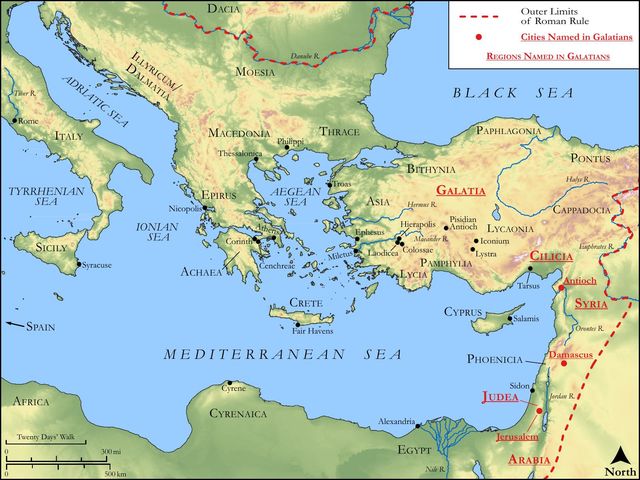
See on the biblical-era map

Study this verse
Public-domain commentary
Matthew Henry
From his Commentary on the Whole Bible. Henry comments on passages, not single verses — this entry covers Galatians 4:21–31.
In these verses the apostle illustrates the difference between believers who rested in Christ only and those judaizers who trusted in the law, by a comparison taken from the story of Isaac and Ishmael. This he introduces in such a manner as was proper to strike and impress their minds, and to convince them of their great weakness in departing from the truth, and suffering themselves to be deprived of the liberty of the gospel: Tell me, says he, you that desire to be under the law, do you not hear the law? He takes it for granted that they did hear the law, for among the Jews it was wont to be read in their public assemblies every sabbath day; and, since they were so very fond of being under it, he would have them duly to consider what is written therein (referring to what is recorded Gen. 16 and 21), for, if they would do this, they might soon see how little reason they had to trust in it. And here, 1. He sets before them the history itself (Gal 4:22, Gal 4:23): For it is written, Abraham had two sons, etc. Here he represents the different state and condition of these two sons of Abraham - that the one, Ishmael, was by a bond-maid, and the other, Isaac, by a free-woman; and that whereas the former was born after the flesh, or by the ordinary course of nature, the other was by promise, when in the course of nature there was no reason to expect that Sarah should have a son. 2. He acquaints them with the meaning and design of this history, or the use which he intended to make of it (Gal 4:24-27): These things, says he, are an allegory, wherein, besides the literal and historical sense of the words, the Spirit of God might design to signify something further to us, and that was, That these two, Agar and Sarah, are the two covenants, or were intended to typify and prefigure the two different dispensations of the covenant. The former, Agar, represented that which was given from mount Sinai, and which gendereth to bondage, which, though it was a dispensation of grace, yet, in comparison of the gospel state, was a dispensation of bondage, and became more so to the Jews, through their mistake of the design of it, and expecting to be justified by the works of it. For this Agar is mount Sinai in Arabia (mount Sinai was then called Agar by the Arabians), and it answereth to Jerusalem which now is, and is in bondage with her children; that is, it justly represents the present state of the Jews, who, continuing in their infidelity and adhering to that covenant, are still in bondage with their children. But the other, Sarah, was intended to prefigure Jerusalem which is above, or the state of Christians under the new and better dispensation of the covenant, which is free both from the curse of the moral and the bondage of the ceremonial law, and is the mother of us all - a state into which all, both Jews and Gentiles, are admitted, upon their believing in Christ. And to this greater freedom and enlargement of the church under the gospel dispensation, which was typified by Sarah the mother of the promised seed, the apostle refers that of the prophet, Isa 54:1, where it is written, Rejoice, thou barren that bearest not; break forth and cry, thou that travailest not; for the desolate hath many more children than she who hath a husband. 3. He applies the history thus explained to the present case (Gal 4:28); Now we, brethren, says he, as Isaac was, are the children of the promise. We Christians, who have accepted Christ, and rely upon him, and look for justification and salvation by him alone, as hereby we become the spiritual, though we are not the natural, seed of Abraham, so we are entitled to the promised inheritance and interested in the blessings of it. But lest these Christians should be stumbled at the opposition they might meet with from the Jews, who were so tenacious of their law as to be ready to persecute those who would not submit to it, he tells them that this was no more than what was pointed to in the type; for as then he that was born after the flesh persecuted him that was born after the Spirit, they must expect it would be so now. But, for their comfort in this case, he desires them to consider what the scripture saith (Gen 21:10), Cast out the bond-woman and her son, for the son of the bond-woman shall not be heir with the son of the free-woman. Though the judaizers should persecute and hate them, yet the issue would be that Judaism would sink, and wither, and perish; but true Christianity should flourish and last for ever. And then, as a general inference from the whole of the sum of what he had said, he concludes (Gal 4:31), So then, brethren, we are not children of the bond-woman, but of the free.
Historical interpretation
Two Centuries of Reception
3 surviving comments on this verse. Each one is dated, so this reads as a timeline rather than a list.
Select a marker to jump to its quote. Markers stagger vertically where authors wrote within a few decades of each other.
But why enlarge on such a subject? When the very apostle whom our heretics adopt, interprets the law which allows an unmuzzled mouth to the oxen that tread out the corn, not of cattle, but of ourselves; and also alleges that the rock which followed (the Israelites) and supplied them with drink was Christ; teaching the Galatians, moreover, that the two narratives of the sons of Abraham had an allegorical meaning in their course; and to the Ephesians giving an intimation that, when it was declared in the beginning that a man should leave his father and mother and become one flesh with his wife, he applied this to Christ and the church.
He returns again to Abraham, not in the way of repetition, but, inasmuch as the Patriarch's fame was great among the Jews, to show that the types had their origin from thence, and that present events were pictured aforetime in him. Having previously shown that the Galatians were sons of Abraham, now, in that the Patriarch's sons were not of equal dignity, one being by a bondwoman, the other by a free-woman, he shows that they were not only his sons, but sons in the same sense as he that was freeborn and noble. Such is the power of Faith.
(Verse 22, 23.) For it is written that Abraham had two sons, one by a slave woman and one by a free woman. But the son of the slave was born according to the flesh, while the son of the free woman was born through the promise. It is of great difficulty to demonstrate that only Isaac, who was born of Sarah, was generated through the promise, and not also Ishmael, who was born of the Egyptian slave Hagar. For the Scripture refers that when Hagar, fleeing from Sarah, who was mistreating her, came to her in the desert, an angel appeared to her and instructed her to submit to her mistress's authority. This same angel also spoke these words: "I will surely multiply your offspring exceedingly, so that they will not be counted for multitude" (Genesis 16:10). And afterwards concerning Ishmael (of which surely no one doubted the words of the promise): He will be a rustic man, his hand against everyone, and everyone's hand against him, and he will dwell opposite the face of all his brothers. But it can be answered that the promise of an angel is of less authority than that of God himself. For just as a star, when the sun rises, does not shine: so the words of angels are obscured, and vanish, and are considered as nothing in comparison to the promise of God. Indeed, this response seems to have some importance; but it is immediately countered by the authority of the following Scripture. For it is written: And Abraham said to God: May Ismael live in your sight (Ibid., XVII, 18 seqq.); and God answered him as follows: Behold, your wife Sara shall bear you a son, and you shall name him Isaac, and I will establish my covenant with him, as an everlasting covenant, and with his descendants after him. And regarding Ismael: Behold, I have heard you, and behold, I have blessed him, and I will multiply him, and increase him greatly. Twelve nations will he beget, and I will make him into a great nation. But my covenant I will establish with Isaac, whom Sarah will bear to you at this time next year. From these statements of God it is evident that Ishmael was also born according to the promise. But this is how it is resolved: the promise is properly fulfilled in the giving of the covenant, and it is different to bless, increase, and multiply greatly, which is written concerning Ishmael. It is different to make someone an heir through the covenant, which is said regarding Isaac: I will establish my covenant with him as an everlasting covenant, and with his descendants after him. And in the following: But my covenant I will establish with Isaac, whom Sarah shall bear to you (Gen., XVII, 19). And how different are gifts from assets: different are bequests from inheritance (for we read that gifts were given to the sons of Abraham by his concubines, but the inheritance of all his assets was left to the son of Sarah); so, as we have said, blessings and bequests are different from a covenant. But this can also be said of Ishmael, after his conception, whether by an angel or by God speaking. But concerning Isaac, before he was conceived in Sarah's womb, God had promised. These things, however, let them be said as much as the modesty of our intelligence allows. But if anyone can find something greater, how is it that Ishmael, who was born of a slave woman, is not the son of the promise, but Isaac, who was born of a free woman: he should rather be heard. And if anything, says the Apostle, you think differently, and God has revealed this to you. Now, briefly, we must strive for higher things, so that we may say that each one of us is born first, not according to the promise, as long as he is instructed by the simple words of the Scriptures and still delights in Jewish explanations: but when he surpasses to higher things and understands the spiritual law, then he is generated from the promise: and, to speak more clearly, every day those who do the works of Abraham are born from Abraham. But those who have the spirit of slavery, again in fear, are born of the Egyptian servant girl; but those who have received the spirit of adoption, are free through Sarah: by this freedom we are given by Christ. The Lord speaks to the Jews who still preferred to be the sons of the servant girl: If you remain in my word, you will truly be my disciples, and you will know the truth, and the truth will set you free (John 8:31-32). So, those ignorant of the mystery that was being spoken, say: We are descendants of Abraham, and we have never been slaves to anyone: how can you say that we will be set free? Jesus answered them: Amen, amen I say to you, whoever commits sin is the slave of sin. But a slave does not remain in the house forever; but the son remains forever. If therefore we are the servants of sin, Agar has begotten us, the Egyptian: if sin reigns not in our mortal body, we are the sons of God indeed.
Continue studying Galatians 4:22 across the web’s major study libraries — every link below opens this exact verse, chapter, or book on the destination site.
Read & Compare
 BibleGatewayThis verse in more than 200 translations and 70 languages.
 Bible.comThe YouVersion reader — hundreds of translations, reading plans, and highlights.
 ESV.orgCrossway's official English Standard Version reader.
 NET BibleThe NET translation with 60,000+ translators' notes on every rendering decision.
 STEP BibleTyndale House's free study tool — original text, vocabulary, and scholarly resources.
 BibliaLogos Bible Software's free web reader.
 USCCBThe New American Bible (Revised Edition) with the U.S. bishops' study notes.
Commentaries
 BibleHub CommentariesDozens of classic commentaries on this verse, gathered on one page.
 StudyLightMore than 100 commentary sets — the largest collection on the web.
 BibleRefPlain-English commentary on what this verse means, verse by verse.
 Enduring WordDavid Guzik's free commentary on this chapter, widely used by Bible teachers.
 Bible Study ToolsVerse commentary alongside Greek and Hebrew study aids.
Original Language & Research
- BibleHub InterlinearThe verse word by word — original language, transliteration, and English.
- BibleHub LexiconEvery word's original-language definition and Strong's entry.
 Blue Letter BibleDeep-study tools — Strong's numbers, concordance, and word studies.
 CNTR CollationThe earliest Greek manuscripts of this verse, collated letter by letter.
Sermons, Hymns & Audio


TrulyRandomVerse is not affiliated with these sites and doesn’t control their content. They’re linked because they’re genuinely useful.
Summary
Galatians 4:22 serves as the foundational historical premise for Paul's profound allegory contrasting the covenants of law and grace. By referencing the well-known Old Testament account of Abraham's two sons, Ishmael and Isaac, born to Hagar (a bondmaid) and Sarah (a freewoman) respectively, Paul sets the stage for a theological argument that underscores the spiritual heritage of believers through promise rather than through adherence to the Mosaic Law. This verse, seemingly a simple historical statement, is strategically placed to introduce a complex yet crucial distinction between spiritual bondage and spiritual freedom, central to the Galatian epistle's message of justification by faith.
Context
ShowHideLiterary Context
Galatians 4:22 initiates a pivotal allegorical argument (Galatians 4:21-31) that culminates Paul's defense of justification by faith alone, which began in earnest in chapter 3. Prior to this, Paul has passionately argued that believers are "heirs according to promise" (Galatians 3:29) and are no longer under the "custodian" of the Law (Galatians 3:24-25). He has just reminded the Galatians of their adoption as sons of God, crying "Abba, Father!" (Galatians 4:6). The introduction of Abraham's two sons directly follows Paul's lament over the Galatians' potential return to "weak and worthless elementary principles" (Galatians 4:9), making the allegory a direct and powerful illustration of the spiritual freedom they risk forfeiting by embracing legalism.
Historical & Cultural Context
The Galatian churches were facing a significant challenge from Judaizers—Jewish Christians who insisted that Gentile converts must be circumcised and observe aspects of the Mosaic Law to be truly saved. This was not merely a theological debate but a cultural clash, as adherence to Jewish customs was seen by some as essential for full inclusion in God's people. Paul's audience would have been intimately familiar with the Genesis narrative of Abraham, Hagar, Ishmael, Sarah, and Isaac, as it was a cornerstone of Jewish identity and heritage. By drawing upon this shared history, Paul strategically reinterprets a foundational narrative to expose the spiritual implications of their choices, challenging their understanding of true lineage and covenant. The concept of "bondmaid" and "freewoman" would have resonated deeply in a society where slavery was a common institution, making the spiritual analogy of bondage to the Law versus freedom in Christ particularly potent.
Key Themes
ShowHideThis verse directly contributes to the overarching theme of Justification by Faith vs. Works of the Law, serving as a historical anchor for Paul's allegorical argument. It introduces the Contrast Between Covenants, specifically the old covenant of Law (represented by Hagar and Ishmael, leading to bondage) and the new covenant of Promise/Grace (represented by Sarah and Isaac, leading to freedom). It also highlights the theme of Spiritual Sonship and Inheritance, emphasizing that true spiritual lineage is determined by God's promise and not by human effort or fleshly birth, echoing Paul's earlier assertion that those who are of faith are "sons of Abraham" (Galatians 3:7). The verse sets the stage for understanding Freedom in Christ as opposed to Bondage to the Law, which is a central message throughout the entire letter, culminating in the declaration to "stand firm therefore in the freedom with which Christ has set us free" (Galatians 5:1).
Exposition and Analysis
ShowHideKey Word Analysis
ShowHideThis verb signifies "to grave" or "to write," often used in the New Testament to refer to the authoritative, divinely inspired Old Testament Scriptures. Paul's use of "it is written" (γέγραπται, a perfect passive indicative) emphasizes the established, unchangeable nature of the historical fact he is about to present, grounding his theological argument in the undeniable truth of God's Word. It signals that what follows is not merely Paul's opinion but a truth derived from foundational biblical history.
This term refers to a "girl" or, more specifically, a "female slave or servant." In the context of Abraham's household, Hagar was Sarah's Egyptian slave, given to Abraham to bear a child when Sarah was barren. Paul's choice of this term is crucial for his allegory, as Hagar and her offspring, Ishmael, will come to represent those born "according to the flesh" and, allegorically, the covenant of Law, which leads to spiritual bondage.
Meaning "unrestrained (to go at pleasure)" or "not a slave," this term directly contrasts with "bondmaid." Sarah, Abraham's wife, was a free woman. In Paul's allegory, Sarah and her son, Isaac, represent those born "through promise" and, allegorically, the covenant of grace, which leads to spiritual freedom and true inheritance. The legal status of these women becomes a powerful metaphor for spiritual states.
Verse Breakdown
ShowHide"For it is written,"
Paul begins by appealing to the authority of Scripture, specifically the Old Testament. This phrase, "γέγραπται γάρ" (gar gegraptai), introduces a foundational truth from the Hebrew Bible that serves as the basis for his subsequent allegorical interpretation. It underscores that his argument is not novel but rooted in divine revelation.
"that Abraham had two sons,"
This states the undisputed historical fact from Genesis. Abraham, the patriarch revered by both Jews and Christians, indeed had two prominent sons: Ishmael, born to Hagar, and Isaac, born to Sarah. This simple statement provides the historical data upon which Paul will build his complex theological argument.
"the one by a bondmaid,"
This refers to Ishmael, born to Hagar, Sarah's Egyptian servant, as recorded in Genesis 16:1-4. The term "bondmaid" (paidískē) is critical, emphasizing Hagar's enslaved status, which Paul will allegorically link to spiritual bondage under the Law.
"the other by a freewoman."
This refers to Isaac, born to Sarah, Abraham's wife, as recorded in Genesis 21:1-3. The term "freewoman" (eleútheros) highlights Sarah's free status, which Paul will allegorically connect to spiritual freedom and the covenant of promise.
Literary Devices
ShowHidePaul employs a significant literary device in Galatians 4:22 and the verses that follow: Allegory. While this specific verse states a historical fact, it functions as the launching point for the entire allegorical narrative that follows in Galatians 4:23-31. Paul takes the historical account of Abraham's two sons and reinterprets it to convey a deeper spiritual truth about the two covenants—Law and Grace. This is not merely an illustration but a sustained comparison where the characters and events (Hagar, Ishmael, Sarah, Isaac, their births, and their status) stand for abstract concepts (covenants, spiritual bondage, spiritual freedom, inheritance). Furthermore, the phrase "For it is written" indicates an Allusion to the Old Testament, specifically the Genesis narratives concerning Abraham's family. This allusion grounds Paul's argument in the shared sacred texts, lending authority and familiarity to his otherwise challenging reinterpretation.
Theological and Thematic Connections
ShowHideGalatians 4:22 is a theological linchpin, setting the stage for Paul's most direct and sustained allegorical argument against legalism and for justification by faith. The distinction between the "bondmaid" and the "freewoman" is not merely a historical detail but a profound theological metaphor for the two ways one can relate to God: through the works of the Law, which leads to spiritual slavery and exclusion from the true inheritance, or through faith in God's promise, which leads to spiritual freedom and adoption as a child of God. This verse underscores that true spiritual lineage is not determined by physical descent or adherence to external regulations, but by participation in the covenant of grace through faith, echoing the New Testament's consistent emphasis on the spiritual over the carnal.
Reflection and Application
ShowHideWhile Galatians 4:22 presents a historical fact, its placement within Paul's letter invites us to reflect deeply on the nature of our spiritual identity and the source of our salvation. It challenges us to examine whether we are living as "children of the bondwoman," striving to earn God's favor through our own efforts, rules, or religious performance, or as "children of the freewoman," resting in the unmerited grace and promise of God through faith in Christ. This verse serves as a powerful reminder that true freedom and belonging in God's family come not from what we do, but from what God has done for us. It calls us to embrace our identity as children of promise, living in the liberty that Christ has secured, rather than reverting to any form of legalism that would put us back under a yoke of slavery.
Questions for Reflection
ShowHideFAQ
ShowHideWhy does Paul begin his allegory with such a simple historical statement?
ShowHidePaul begins with a simple historical statement ("For it is written, that Abraham had two sons, the one by a bondmaid, the other by a freewoman") to establish an undeniable, universally accepted fact from the Old Testament. This common ground allows him to then introduce his allegorical interpretation in the subsequent verses (Galatians 4:23-31), recontextualizing a familiar narrative to reveal profound theological truths about the nature of the Law and Grace. By starting with "it is written," he grounds his spiritual argument in the authority of Scripture, making his reinterpretation of Abraham's family history a divinely inspired lesson rather than a mere human invention.
Christ-Centered Fulfillment
ShowHideGalatians 4:22, though a historical prelude, points profoundly to Christ as the ultimate fulfillment of God's promise and the source of true spiritual freedom. The distinction between the son of the bondmaid (Ishmael, born according to the flesh, representing the Law and its inability to give life) and the son of the freewoman (Isaac, born through divine promise, representing grace) ultimately finds its resolution in Jesus Christ. He is the true "seed" of Abraham (Galatians 3:16), through whom all the promises of God are fulfilled. We, as believers, are not children of the Law, bound by its demands, but "children of the promise" (Galatians 4:28), because we are "in Christ" (Galatians 3:28). His perfect obedience under the Law and His atoning sacrifice on the cross (Galatians 3:13) have liberated us from its curse, allowing us to receive the Spirit of adoption and cry "Abba, Father!" (Galatians 4:6). Thus, the freedom symbolized by Sarah and Isaac is fully realized in the new covenant established by Christ, making Him the very embodiment of the "freewoman's" offspring, bringing true spiritual liberty to all who believe.