


Genesis 16:15
Bible text: King James Version (1769 Blayney text) · Public domain
Bible text: Berean Standard Bible · Public domain
Bible text: American Standard Version (1901) · Public domain
Bible text: World English Bible, Messianic edition · Public domain
Bible text: Geneva Bible (1599) · Public domain
Bible text: Young's Literal Translation · Public domain
- וַתֵּלֶדva·Te·ledand she boreH3205Conj-w ¦ V-Qal-ConsecImperf-3fsVerb Qal Consecutive Imperfect 3rd Singular Feminineוַandתֵּלֶדshe bore
- הָגָרha·GarHagarH1904N-proper-fNoun Proper Feminine
- לְאַבְרָםle·'av·Ramto AbramH87Prep-l ¦ N-proper-mNoun Proper MasculineלְtoאַבְרָםAbram
- בֵּןBena sonH1121N-msNoun Singular Masculine Absolute
- וַיִּקְרָאvai·yik·Ra'and he calledH7121Conj-w ¦ V-Qal-ConsecImperf-3msVerb Qal Consecutive Imperfect 3rd Singular Masculineוַandיִּקְרָאhe called
- אַבְרָם'av·RamAbramH87N-proper-mNoun Proper Masculine
- שֶׁםshem[the] name ofH8034N-mscNoun Singular Masculine Construct
- בְּנוֹbe·Nohis sonH1121N-msc ¦ 3msNoun Singular Masculine Constructבְּנsonוֹhis
- אֲשֶׁר'a·SherwhomH834RelParticle Relative
- יָלְדָהYal·dahshe had borneH3205V-Qal-Perf-3fsVerb Qal Perfect 3rd Singular Feminine
- הָגָרha·GarHagarH1904N-proper-fNoun Proper Feminine
- יִשְׁמָעֵאלyish·ma·'ElIshmaelH3458N-proper-mNoun Proper Masculine
English is a literal word-by-word gloss of the Hebrew, not the KJV's wording. Why?
This is the original text the KJV's translators worked from — each Hebrew word with its own literal English meaning in this verse, prepared by scholars at Tyndale House, Cambridge. The KJV translates whole sentences, not word by word, so its wording differs: one Hebrew word can become several English words, and the KJV may choose “the LORD” where the gloss reads “Yahweh”. Both are faithful — they answer different questions. For the KJV's own rendering, switch to the KJV text.
Details
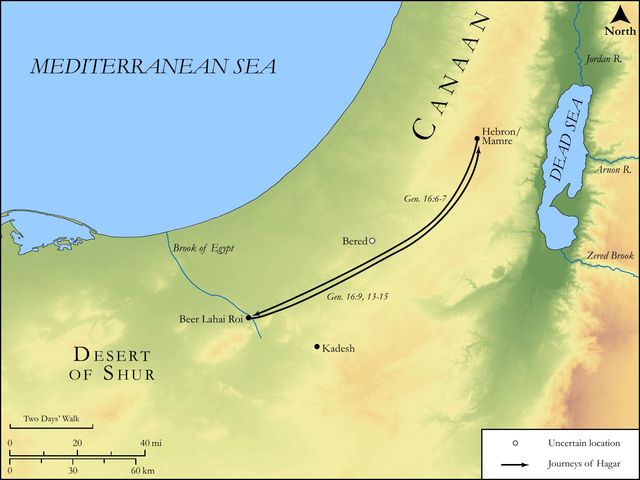
See on the biblical-era maps


Study this verse
Public-domain commentary
Matthew Henry
From his Commentary on the Whole Bible. Henry comments on passages, not single verses — this entry covers Genesis 16:15–16.
It is here taken for granted, though not expressly recorded, that Hagar did as the angel commanded her, returning to here mistress and submitting herself; and then, in the fulness of time, she brought forth her son. Note, Those who obey divine precepts shall have the comfort of divine promises. This was the son of the bond-woman that was born after the flesh (Gal 4:23), representing the unbelieving Jews, v. 25. Note, 1. Many who can call Abraham father are yet born after the flesh, Mat 3:9. 2. The carnal seed in the church are sooner brought forth than the spiritual. It is an easier thing to persuade men to assume the form of godliness than to submit to the power of godliness.
Historical interpretation
Historical reception
1 surviving comment on this verse from the historical church.
There was indeed on earth, so long as it was needed, a symbol and foreshadowing image of this city, which served the purpose of reminding men that such a city was to be rather than of making it present; and this image was itself called the holy city, as a symbol of the future city, though not itself the reality. Of this city which served as an image, and of that free city it typified, Paul writes to the Galatians in these terms: "Tell me, you that desire to be under the law, do you not hear the law? For it is written, that Abraham had two sons, the one by a bond maid, the other by a free woman. But he who was of the bond woman was born after the flesh, but he of the free woman was by promise. Which things are an allegory: for these are the two covenants; the one from the mount Sinai, which genders to bondage, which is Agar. For this Agar is mount Sinai in Arabia, and answers to Jerusalem which now is, and is in bondage with her children. But Jerusalem which is above is free, which is the mother of us all. For it is written, Rejoice, you barren that bear not; break forth and cry, you that travail not, for the desolate has many more children than she which has an husband. Now we, brethren, as Isaac was, are the children of promise. But as then he that was born after the flesh persecuted him that was born after the Spirit, even so it is now. Nevertheless, what says the Scripture? Cast out the bond woman and her son: for the son of the bond woman shall not be heir with the son of the free woman. And we, brethren, are not children of the bond woman, but of the free, in the liberty wherewith Christ has made us free." [Galatians 4:21-31] This interpretation of the passage, handed down to us with apostolic authority, shows how we ought to understand the Scriptures of the two covenants — the old and the new. One portion of the earthly city became an image of the heavenly city, not having a significance of its own, but signifying another city, and therefore serving, or "being in bondage." For it was founded not for its own sake, but to prefigure another city; and this shadow of a city was also itself foreshadowed by another preceding figure. For Sarah's handmaid Agar, and her son, were an image of this image. And as the shadows were to pass away when the full light came, Sarah, the free woman, who prefigured the free city (which again was also prefigured in another way by that shadow of a city Jerusalem), therefore said, "Cast out the bond woman and her son; for the son of the bond woman shall not be heir with my son Isaac," or, as the apostle says, "with the son of the free woman." In the earthly city, then, we find two things — its own obvious presence, and its symbolic presentation of the heavenly city. Now citizens are begotten to the earthly city by nature vitiated by sin, but to the heavenly city by grace freeing nature from sin; whence the former are called "vessels of wrath," the latter "vessels of mercy." [Romans 9:22-23] And this was typified in the two sons of Abraham — Ishmael, the son of Agar the handmaid, being born according to the flesh, while Isaac was born of the free woman Sarah, according to the promise. Both, indeed, were of Abraham's seed; but the one was begotten by natural law, the other was given by gracious promise. In the one birth, human action is revealed; in the other, a divine kindness comes to light.
Continue studying Genesis 16:15 across the web’s major study libraries — every link below opens this exact verse, chapter, or book on the destination site.
Read & Compare
 BibleGatewayThis verse in more than 200 translations and 70 languages.
 Bible.comThe YouVersion reader — hundreds of translations, reading plans, and highlights.
 ESV.orgCrossway's official English Standard Version reader.
 NET BibleThe NET translation with 60,000+ translators' notes on every rendering decision.
 STEP BibleTyndale House's free study tool — original text, vocabulary, and scholarly resources.
 BibliaLogos Bible Software's free web reader.
 USCCBThe New American Bible (Revised Edition) with the U.S. bishops' study notes.
Commentaries
 BibleHub CommentariesDozens of classic commentaries on this verse, gathered on one page.
 StudyLightMore than 100 commentary sets — the largest collection on the web.
 BibleRefPlain-English commentary on what this verse means, verse by verse.
 Enduring WordDavid Guzik's free commentary on this chapter, widely used by Bible teachers.
 Bible Study ToolsVerse commentary alongside Greek and Hebrew study aids.
Original Language & Research
- BibleHub InterlinearThe verse word by word — original language, transliteration, and English.
- BibleHub LexiconEvery word's original-language definition and Strong's entry.
 Blue Letter BibleDeep-study tools — Strong's numbers, concordance, and word studies.
 SefariaThe Hebrew text with Rashi and centuries of Jewish commentary.
Sermons, Hymns & Audio


TrulyRandomVerse is not affiliated with these sites and doesn’t control their content. They’re linked because they’re genuinely useful.
Summary
Genesis 16:15 chronicles the birth of Ishmael, Abram's first son, born to Hagar, Sarai's Egyptian handmaid. This pivotal event in the patriarchal narrative serves as a profound illustration of the immediate and far-reaching consequences when human ingenuity and impatience attempt to fulfill divine promises through their own means, rather than patiently trusting in God's perfect timing and sovereign plan. Simultaneously, it powerfully demonstrates God's unwavering compassion and attentiveness, even amidst the complexities arising from human error.
Context
ShowHideLiterary Context
Genesis 16:15 is situated within the broader narrative of God's covenant promises to Abram, particularly the promise of countless descendants and a great nation, first articulated in Genesis 12:2-3. Years have passed since these initial promises, and Abram and Sarai remain childless. The immediate preceding verses of Genesis 16 detail Sarai's desperation and her culturally-sanctioned, yet divinely-unintended, solution: giving her handmaid Hagar to Abram to bear an heir on her behalf (Genesis 16:1-3). This act leads to conflict between Sarai and Hagar, Hagar's flight into the wilderness, and a divine encounter where an angel instructs Hagar to return and prophesies about her son, Ishmael, whose name signifies "God hears" (Genesis 16:7-14). Thus, Genesis 16:15 marks the culmination of this episode, the physical manifestation of human striving to fulfill a divine promise, setting the stage for the subsequent narrative of God's faithfulness in bringing forth the true son of promise, Isaac, through Sarai.
Historical & Cultural Context
The practice of a barren wife providing her husband with a handmaid to bear children on her behalf was a recognized custom among the patriarchs, as when Rachel gave her handmaid Bilhah to Jacob. In this cultural framework, the children born to the handmaid were legally considered the children of the primary wife, ensuring the continuation of the family line and inheritance. Sarai's suggestion to Abram (Genesis 16:2) was therefore culturally acceptable and aimed at addressing the profound social and personal shame associated with barrenness in that society. However, while culturally permissible, this practice was outside God's specific divine plan for the promised heir to come directly from Sarai's own body (Genesis 15:4). The birth of Ishmael, therefore, highlights the tension between human cultural norms and divine covenantal promises, setting the stage for future complications.
Key Themes
ShowHideThis verse contributes significantly to several overarching themes in Genesis and the broader biblical narrative. Firstly, it underscores the theme of divine promise versus human impatience. Abram and Sarai's decision to act outside God's perfect timing illustrates the human tendency to take matters into their own hands when God's promises seem delayed. Secondly, it highlights God's sovereignty and compassion. Even though Ishmael's birth arises from human misjudgment, God does not abandon Hagar or Ishmael. His compassionate attentiveness is evident in the angel's encounter with Hagar and the very name "Ishmael" ("God hears"), affirming His care for all individuals, even those born into complex circumstances (Genesis 16:11). Thirdly, the event establishes the distinction of covenant lines, clearly differentiating Ishmael's lineage from the divinely appointed line through which the Abrahamic covenant would ultimately be fulfilled, destined to come through Isaac (Genesis 17:19). This distinction is crucial for understanding the unfolding of God's redemptive plan throughout salvation history.
Exposition and Analysis
ShowHideGenesis 16:15 succinctly records the fulfillment of Hagar's pregnancy and Abram's subsequent action: "And Hagar bare Abram a son: and Abram called his son's name, which Hagar bare, Ishmael." This verse is a concise yet profoundly significant statement marking the arrival of Abram's firstborn son, an event with lasting implications for the unfolding biblical narrative and the history of nations.
Key Word Analysis
ShowHideOf uncertain derivation, Hagar is identified as the mother of Ishmael. Her presence here is crucial, as she is the instrument through whom Abram attempts to fulfill God's promise. Her identity as an Egyptian handmaid also foreshadows future interactions and tensions between the descendants of the covenant line and other nations.
This primitive root means "to bear young; causatively, to beget." Here, it signifies the act of giving birth, emphasizing the physical reality of Ishmael's arrival. The use of "bare" highlights Hagar's role as the birth mother, distinct from Sarai's legal claim on the child, setting up the complex familial dynamics that follow.
This root means "to call out to; to address by name." In this context, it signifies Abram's act of naming his son. The father's act of naming was a significant cultural and legal act, signifying paternity, acceptance, and authority over the child. Abram's naming of Ishmael confirms his acknowledgment of the child as his own son.
Derived from the Hebrew words for "to hear" (שָׁמַע, shama) and "God" (אֵל, El), the name literally means "God will hear" or "God has heard." This name is deeply significant, as it was given to Hagar by the angel of the Lord prior to his birth (Genesis 16:11), in response to Hagar's affliction. Abram's adoption of this name for his son underscores the divine involvement in Ishmael's story, even though his birth was a result of human initiative.
Verse Breakdown
ShowHide"And Hagar bare Abram a son"
This clause directly states the outcome of Hagar's pregnancy, confirming the birth of a male child. The phrasing emphasizes Hagar as the biological mother and Abram as the father, establishing the immediate familial relationship. This birth is the direct consequence of Sarai's plan to obtain an heir through her handmaid, a culturally accepted practice but one that would ultimately lead to significant tension and deviation from God's intended covenantal path.
"and Abram called his son's name, which Hagar bare, Ishmael."
This second clause details Abram's formal act of naming the child. The repetition "which Hagar bare" subtly reinforces Hagar's role as the birth mother, even as Abram claims paternity by naming him. The chosen name, "Ishmael," is highly significant, carrying the theological meaning "God hears." This name serves as a divine commentary on the preceding events, reminding the reader of God's compassionate awareness of Hagar's distress and His promise to bless Ishmael, despite the circumstances of his conception.
Literary Devices
ShowHideThe verse employs several significant literary devices. Conciseness is evident in its direct and factual reporting of the birth and naming, yet it carries immense narrative weight. The Repetition of "which Hagar bare" emphasizes Hagar's role as the birth mother, subtly highlighting the distinction from Sarai, even though the child is legally Abram's. Most profoundly, the Symbolism of the name "Ishmael" ("God hears") is paramount. It functions as a theological statement, not merely a personal identifier, symbolizing God's omnipresent awareness and compassion, even in situations born of human impatience and misdirection. This name also carries a degree of Irony, as the son born from human impatience is named for God's attentiveness, suggesting that God's plan is not thwarted by human error, but rather His compassion extends even to the consequences of such actions.
Theological and Thematic Connections
ShowHideGenesis 16:15 is a foundational verse for understanding the complex interplay between divine promise and human agency. It powerfully illustrates that while God's promises are certain, human attempts to "help" God fulfill them through their own means often lead to unintended complications and consequences. Ishmael's birth, though not the fulfillment of the specific covenantal promise for the "seed" through whom all nations would be blessed, nevertheless demonstrates God's enduring faithfulness and compassion. God hears Hagar's cry and blesses Ishmael, establishing him as the progenitor of a great nation, even as He maintains the distinction of the covenant line through Isaac. This narrative underscores God's ability to work within and even redeem complex human situations, always moving His ultimate redemptive plan forward.
Reflection and Application
ShowHideGenesis 16:15 offers a profound and timeless lesson for believers today: the critical importance of patient trust in God's perfect timing and methods, rather than succumbing to the temptation of human ingenuity or cultural pressures to achieve God's purposes. Abram and Sarai's impatience led to a complex situation with lasting repercussions, reminding us that even well-intentioned human efforts, when outside of God's specific will, can create significant challenges. However, this verse also provides immense comfort and reassurance: even when our impatience or missteps lead to unintended consequences, God remains faithful to His character and His promises. He is a God who "hears" (Ishmael), who is compassionate, and who can work His purposes even through our imperfections. We are called to cultivate a deep reliance on God's sovereignty, understanding that His plans are perfect, His timing is impeccable, and His compassion endures, always attentive to the cries of His people and capable of bringing good out of every circumstance.
Questions for Reflection
ShowHideFAQ
ShowHideWas Ishmael the promised son through whom the Abrahamic covenant would be established?
ShowHideNo, while Ishmael was indeed Abram's firstborn son and blessed by God to become the father of a great nation (Genesis 17:20), he was not the specific "son of promise" through whom the Abrahamic covenant's central promises of land, nationhood, and universal blessing would be fully realized. God explicitly clarified that the covenant would be established through Isaac, the son born to Abram and Sarai (later Abraham and Sarah) in their old age, a miraculous birth that would clearly demonstrate God's sovereign power and faithfulness (Genesis 17:19; Genesis 21:2-3). Ishmael's birth, conversely, resulted from human attempts to fulfill God's promise outside of His divine timing and specific plan.
Christ-Centered Fulfillment
ShowHideThe birth of Ishmael, born of human effort and impatience, stands in stark contrast to the miraculous birth of Isaac, which would later highlight God's sovereign and perfect timing. This narrative foreshadows the ultimate fulfillment found in Christ, who is the true "seed" of Abraham, not born of human striving or fleshly descent, but through the divine initiative and the power of the Holy Spirit (Galatians 3:16; Matthew 1:18-25). The tension between the "children of the flesh" (Ishmael) and the "children of promise" (Isaac) finds its ultimate resolution in Christ, who embodies the promise given by grace, not by human works (Romans 9:6-8). Furthermore, the name "Ishmael" ("God hears") powerfully points to Christ, who perfectly embodies God's attentive and compassionate ear. As the great High Priest, Jesus hears the cries of humanity, intercedes for His people (Hebrews 7:25), and through His atoning sacrifice, provides the ultimate answer to humanity's deepest need for salvation and reconciliation with God (John 1:29; Romans 5:8). Thus, in Christ, God's promises are perfectly fulfilled, His timing is impeccable, and His ear is eternally open to all who call upon His name.