


Genesis 21:21
Bible text: King James Version (1769 Blayney text) · Public domain
Bible text: Berean Standard Bible · Public domain
Bible text: American Standard Version (1901) · Public domain
Bible text: World English Bible, Messianic edition · Public domain
Bible text: Geneva Bible (1599) · Public domain
Bible text: Young's Literal Translation · Public domain
- וַיֵּשֶׁבvai·Ye·shevand he dweltH3427Conj-w ¦ V-Qal-ConsecImperf-3msVerb Qal Consecutive Imperfect 3rd Singular Masculineוַandיֵּשֶׁבhe dwelt
- בְּמִדְבַּרbe·mid·Barin [the] wilderness ofH4057Prep-b ¦ N-mscNoun Singular Masculine Constructבְּinמִדְבַּר[the] wilderness of
- פָּארָןpa·RanParanH6290N-properNoun Proper Location
- וַתִּקַּחva·ti·kachand she tookH3947Conj-w ¦ V-Qal-ConsecImperf-3fsVerb Qal Consecutive Imperfect 3rd Singular Feminineוַandתִּקַּחshe took
- לוֹlofor <the> himPrep-l ¦ 3msSuffix Personal 3rd Singular Masculineלfor <the>וֹhim
- אִמּוֹ'i·Mohis motherH517N-fsc ¦ 3msNoun Singular Feminine Constructאִמּmotherוֹhis
- אִשָּׁה'i·Shaha wifeH802N-fsNoun Singular Feminine Absolute
- מֵאֶרֶץme·'E·retzfrom [the] land ofH776Prep-m ¦ N-fscNoun Singular Feminine Constructמֵfromאֶרֶץ[the] land of
- מִצְרָיִםmitz·Ra·yimEgyptH4714N-properNoun Proper Location
English is a literal word-by-word gloss of the Hebrew, not the KJV's wording. Why?
This is the original text the KJV's translators worked from — each Hebrew word with its own literal English meaning in this verse, prepared by scholars at Tyndale House, Cambridge. The KJV translates whole sentences, not word by word, so its wording differs: one Hebrew word can become several English words, and the KJV may choose “the LORD” where the gloss reads “Yahweh”. Both are faithful — they answer different questions. For the KJV's own rendering, switch to the KJV text.
Details
See on the biblical-era maps


Study this verse
Public-domain commentary
Matthew Henry
From his Commentary on the Whole Bible. Henry comments on passages, not single verses — this entry covers Genesis 21:14–21. His four-level outline is real structure in the source text, so it is rendered as structure.
Here is, I. The casting out of the bond-woman, and her son from the family of Abraham, Gen 21:14. Abraham's obedience to the divine command in this matter was speedy - early in the morning, we may suppose immediately after he had, in the night's visions, received orders to do this. It was also submissive; it was contrary to his judgment, at least to his own inclination, to do it; yet as soon as he perceives that it is the mind of God he makes no objections, but silently does as he is bidden, as one trained up to an implicit obedience. In sending them away without any attendants, on foot, and slenderly provided for, it is probable that he observed the directions given him. If Hagar and Ishmael had conducted themselves well in Abraham's family, they might have continued there; but they threw themselves out by their own pride and insolence, which were thus justly chastised. Note, By abusing our privileges we forfeit them. Those that know not when they are well off, in such a desirable place as Abraham's family, deserve to be cashiered, and to be made to know the worth of mercies by the want of them.
II.Their wandering in the wilderness, missing their way to the place Abraham designed them for a settlement.
1.They were reduced to great distress there. Their provisions were spent, and Ishmael was sick. He that used to be full fed in Abraham's house, where he waxed fat and kicked, now fainted and sunk, when he was brought to short allowance. Hagar is in tears, and sufficiently mortified. Now she wishes for the crumbs she had wasted and made light of at her master's table. Like one under the power of the spirit of bondage, she despairs of relief, counts upon nothing but the death of the child (Gen 21:15, Gen 21:16), though God had told her, before he was born, that he should live to be a man, a great man. We are apt to forget former promises, when present providences seem to contradict them; for we live by sense.
2.In this distress, God graciously appeared for their relief: he heard the voice of the lad, Gen 21:17. We read not of a word he said; but his sighs, and groans, and calamitous state, cried aloud in the ears of mercy. An angel was sent to comfort Hagar, and it was not the first time that she had met with God's comforts in a wilderness; she had thankfully acknowledged the former kind visit which God made his in such a case (Gen 16:13), and therefore God now visited her again with seasonable succours.
(1.)The angel assures her of the cognizance God took of her distress: God has heard the voice of the lad where he is, though he is in a wilderness (for, wherever we are, there is a way open heaven-ward); therefore lift up the lad, and hold him in thy hand, Gen 21:18. Note, God's readiness to help us when we are in trouble must not slacken, but quicken, our endeavours to help ourselves.
(2.)He repeats the promise concerning her son, that he should be a great nation, as a reason why she should bestir herself to help him. Note, It should engage our care and pains about children and young people to consider that we know not what God has designed them for, nor what great use Providence may make of them.
(3.)He directs her to a present supply (Gen 21:19): He opened her eyes (which were swollen and almost blinded with weeping), and then she saw a well of water. Note, Many that have reason enough to be comforted go mourning from day to day, because they do not see the reason they have for comfort. There is a well of water by them in the covenant of grace, but they are not aware of it; they have not the benefit of it, till the same God that opened their eyes to see their wound opens them to see their remedy, Joh 16:6, Joh 16:7. Now the apostle tells us that those things concerning Hagar and Ishmael are allegoroumena (Gal 4:24), they are to be allegorized; this then will serve to illustrate the folly,
[1.]Of those who, like the unbelieving Jews, seek for righteousness by the law and the carnal ordinances of it, and not by the promise made in Christ, thereby running themselves into a wilderness of want and despair. Their comforts are soon exhausted, and if God save them not by his special prerogative, and by a miracle of mercy open their eyes and undeceive them, they are undone.
[2.]Of those who seek for satisfaction and happiness in the world and the things of it. Those that forsake the comforts of the covenant and communion with God, and choose their portion in this earth, take up with a bottle of water, poor and slender provision, and that soon spent; they wander endlessly in pursuit of satisfaction, and, at length, sit down short of it.
III.The settlement of Ishmael, at last, in the wilderness of Paran (Gen 21:20, Gen 21:21), a wild place, fittest for a wild man; and such a one he was, ch. 16. 12. Those that are born after the flesh take up with the wilderness of this world, while the children of the promise aim at the heavenly Canaan, and cannot be at rest till they are there. Observe, 1. He had some tokens of God's presence: God was with the lad; his outward prosperity was owing to this. 2. By trade he was an archer, which intimates that craft was his excellency and sport his business: rejected Esau was a cunning hunter. 3. He matched among his mother's relations; she took him a wife out of Egypt: as great an archer as he was, he did not think he could take his aim well, in the business of marriage, if he proceeded without his mother's advice and consent.
Continue studying Genesis 21:21 across the web’s major study libraries — every link below opens this exact verse, chapter, or book on the destination site.
Read & Compare
 BibleGatewayThis verse in more than 200 translations and 70 languages.
 Bible.comThe YouVersion reader — hundreds of translations, reading plans, and highlights.
 ESV.orgCrossway's official English Standard Version reader.
 NET BibleThe NET translation with 60,000+ translators' notes on every rendering decision.
 STEP BibleTyndale House's free study tool — original text, vocabulary, and scholarly resources.
 BibliaLogos Bible Software's free web reader.
 USCCBThe New American Bible (Revised Edition) with the U.S. bishops' study notes.
Commentaries
 BibleHub CommentariesDozens of classic commentaries on this verse, gathered on one page.
 StudyLightMore than 100 commentary sets — the largest collection on the web.
 BibleRefPlain-English commentary on what this verse means, verse by verse.
 Enduring WordDavid Guzik's free commentary on this chapter, widely used by Bible teachers.
 Bible Study ToolsVerse commentary alongside Greek and Hebrew study aids.
Original Language & Research
- BibleHub InterlinearThe verse word by word — original language, transliteration, and English.
- BibleHub LexiconEvery word's original-language definition and Strong's entry.
 Blue Letter BibleDeep-study tools — Strong's numbers, concordance, and word studies.
 SefariaThe Hebrew text with Rashi and centuries of Jewish commentary.
Sermons, Hymns & Audio


TrulyRandomVerse is not affiliated with these sites and doesn’t control their content. They’re linked because they’re genuinely useful.
Summary
Genesis 21:21 concludes the narrative of Ishmael's expulsion from Abraham's household, portraying God's continued faithfulness and provision for him in the desolate wilderness of Paran. This verse marks Ishmael's establishment of an independent life and lineage, as his mother, Hagar, secures a wife for him from her native Egypt, thereby laying the groundwork for the fulfillment of God's promise to make a great nation of him.
Context
ShowHideLiterary Context
This verse serves as the concluding statement to the dramatic account of Hagar and Ishmael's expulsion from Abraham's home. The preceding verses detail Sarah's insistence on their removal (Genesis 21:9-10), Abraham's distress, and God's comforting assurance that He would make a nation of Ishmael because he was Abraham's offspring. The narrative then shifts to Hagar and Ishmael's desperate plight in the wilderness, their miraculous rescue by divine intervention when God opened Hagar's eyes to a well (Genesis 21:19), and the subsequent affirmation of God's presence with Ishmael. Genesis 21:21 thus provides a sense of resolution and stability for Ishmael's immediate future, fulfilling the divine promise of his survival and establishment.
Historical & Cultural Context
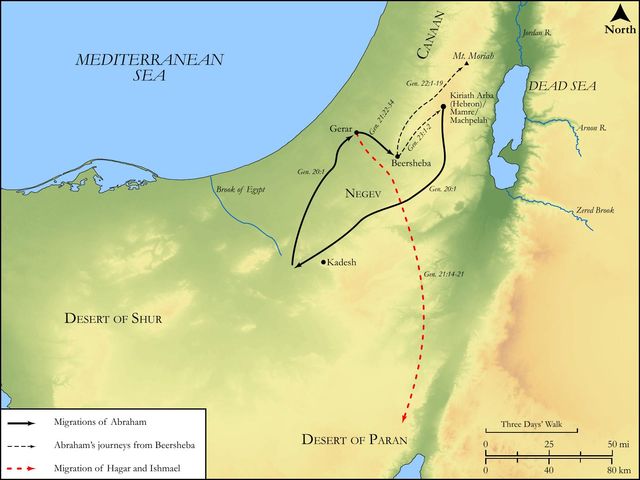
The "wilderness of Paran" was a vast, arid region stretching south of Canaan and north of the Sinai Peninsula, characterized by nomadic life. For Ishmael to "dwell" there implies an adaptation to this challenging environment, consistent with the lifestyle of a "wild donkey of a man" prophesied in Genesis 16:12. In the households of the patriarchs, the arrangement of marriages by parents was a common and crucial practice, signifying the formal establishment of a new family unit and ensuring the continuation of lineage. Hagar, being an Egyptian, would naturally seek a wife for her son from her homeland, reinforcing cultural ties and securing a suitable match within a familiar social framework. This act was vital for the foundation of Ishmael's independent household and future descendants.
Key Themes
ShowHideGenesis 21:21 contributes significantly to several overarching themes in the book of Genesis. It powerfully illustrates the theme of Divine Providence, demonstrating God's care and faithfulness extending even to those outside the direct covenant line established through Isaac. It also highlights the Fulfillment of Prophecy, as God's earlier promises to Hagar (Genesis 16:10) and Abraham (Genesis 21:13) regarding Ishmael's future are shown to be actively unfolding. Furthermore, the verse underscores the Formation of Nations, marking a foundational step in the distinct development of the Ishmaelite people, separate from the burgeoning Israelite nation. This separation, while divinely ordained, still operates within God's sovereign plan for all humanity.
Exposition and Analysis
ShowHideGenesis 21:21 succinctly details two pivotal developments in Ishmael's life after his departure from Abraham's camp: his dwelling place and his marriage, both demonstrating God's continued oversight.
Key Word Analysis
ShowHideThis primitive root signifies more than mere temporary residence; it implies settling down, remaining, establishing a home, and even, causatively, to marry. Here, it denotes Ishmael's transition from a transient, dependent child to an independent individual establishing a permanent, albeit nomadic, base in the wilderness. It speaks to a divinely ordained stability in an otherwise unstable environment.
Derived from a root meaning "to drive," this word refers to a pasture or open field where cattle are driven, by implication, a desert. It describes a desolate yet expansive region, suitable for a nomadic lifestyle. The specific mention of "Paran" grounds Ishmael's new life in a known geographical area, emphasizing his separation from the settled life of Abraham's camp and his adaptation to a rugged, untamed existence.
This primitive root is broad, meaning "to take" in various applications, including to fetch, get, or receive. In this context, it specifically refers to Hagar's active role in securing a wife for Ishmael. This highlights her continued maternal care and agency in shaping her son's future, a crucial act in the households of the patriarchs for establishing a new family unit and ensuring the continuation of lineage.
Verse Breakdown
ShowHide"And he dwelt in the wilderness of Paran"
This phrase marks Ishmael's establishment of an independent existence. After the dramatic events of his expulsion and God's miraculous provision, Ishmael finds a settled, though nomadic, home in the vast and arid region of Paran. This dwelling signifies a new chapter for Ishmael, where he begins to fulfill the prophetic word given to Hagar that he would be a "wild donkey of a man" (Genesis 16:12), thriving in untamed environments. It underscores God's faithfulness in providing a place for Ishmael to grow and multiply, even outside the direct covenant line through Isaac.
"and his mother took him a wife out of the land of Egypt"
This clause highlights Hagar's ongoing maternal care and her pivotal role in securing Ishmael's future. As an Egyptian herself, Hagar's choice of a wife from her homeland ensured a strong cultural and ethnic connection for Ishmael's burgeoning lineage. In the households of the patriarchs, parental arrangement of marriages was customary and essential for the formal establishment of a new family unit. This marriage is crucial for the fulfillment of God's promise to Abraham that Ishmael would be made "fruitful and multiply him exceedingly" (Genesis 17:20), laying the groundwork for the twelve princes and the nation that would descend from him, as later detailed in Genesis 25:12-18.
Literary Devices
ShowHideThe verse employs Conciseness to convey significant developments in Ishmael's life with remarkable brevity. It acts as a Summary Statement, providing closure to Ishmael's immediate narrative arc following his expulsion. The mention of the "wilderness of Paran" functions as Setting and Symbolism, representing both a literal geographical location and a metaphorical space of testing, independence, and divine provision outside the familiar. The act of Hagar taking a wife from Egypt is a form of Foreshadowing, hinting at the distinct cultural and national identity that the Ishmaelites would develop, separate from the Israelites, yet still under God's overarching sovereignty.
Theological and Thematic Connections
ShowHideGenesis 21:21 offers a profound glimpse into the expansive nature of God's providence and faithfulness. While the primary covenant line passes through Isaac, this verse powerfully illustrates that God's care extends beyond the chosen lineage, demonstrating His commitment to all His promises, even those made to Abraham concerning Ishmael. It underscores that God's sovereign plan encompasses diverse peoples and their origins, affirming His universal dominion and compassion. Ishmael's establishment in the wilderness, a place often associated with hardship and divine encounter in biblical narratives, further highlights God's ability to sustain and provide even in the most challenging circumstances.
Reflection and Application
ShowHideGenesis 21:21 offers profound encouragement that God's care extends beyond our immediate expectations, comfort zones, or even perceived "right" paths. Ishmael, cast out from Abraham's home, found stability and purpose in the wilderness, a place of desolation transformed into a dwelling by God's provision. This reminds us that even when we feel displaced, overlooked, or navigate a "wilderness" season of life, God remains faithful to His word, providing for and guiding individuals according to His sovereign plan. Our worth and future are not solely determined by human favor or conventional paths, but by God's unwavering commitment to His promises. We are called to trust in His provision, knowing He can lead us to stability, purpose, and the fulfillment of His will, even in the most unexpected places, demonstrating His grace in every circumstance.
Questions for Reflection
ShowHideFAQ
ShowHideWhy did God continue to bless Ishmael if he was not the covenant heir?
ShowHideGod's covenant with Abraham, establishing the lineage for the promised Messiah, was indeed specifically through Isaac. However, God's character is also one of universal care and faithfulness to all His promises. He had promised Abraham that Ishmael would also be blessed and become a great nation because he was Abraham's son (Genesis 17:20). Genesis 21:21 demonstrates God's commitment to this specific promise, showcasing His compassion and ability to work out His plans for multiple lineages, even while maintaining the distinct covenant line through Isaac. This highlights the multifaceted nature of God's sovereignty, where His specific redemptive plan coexists with His general providence over all humanity.
What is the significance of Ishmael's mother taking him a wife from Egypt?
ShowHideHagar, Ishmael's mother, was an Egyptian slave, and her decision to take a wife for Ishmael from her homeland reinforced his cultural and ethnic identity. This choice ensured that Ishmael's descendants would be connected to Egypt, a powerful and influential nation in that age. It also highlights the common practice of arranged marriages in the households of the patriarchs, where parents played a crucial role in securing their children's future, lineage, and social standing. This act was instrumental in establishing Ishmael's independent family and laying the groundwork for the fulfillment of God's promise to make him a great nation, as detailed in Genesis 25:12-18.
Christ-Centered Fulfillment
ShowHideWhile Genesis 21:21 focuses on Ishmael, a figure outside the direct Messianic lineage, it subtly points to the expansive nature of God's grace and provision, which finds its ultimate and universal fulfillment in Christ. The fact that God cared for Ishmael, established his dwelling, and ensured his lineage, even after his separation from Abraham's household, foreshadows the New Covenant reality where God's saving grace extends beyond the physical descendants of Abraham to all nations through faith in Jesus Christ (Galatians 3:28-29). Christ's redemptive work bridges divides, offering a new "dwelling" and "lineage" in Him, where all who believe, regardless of their earthly origin or past circumstances, are brought into God's family and partake in the ultimate fulfillment of His promises (Ephesians 2:19-20). In Christ, the "wilderness" becomes a place of spiritual flourishing, and the "taking of a wife" finds its spiritual parallel in the church, the bride of Christ, drawn from every tribe and nation (Revelation 5:9-10).