


Genesis 21:22
- וַיְהִיvay·Hiand it wasH1961Conj-w ¦ V-Qal-ConsecImperf-3msVerb Qal Consecutive Imperfect 3rd Singular Masculineוַandיְהִיit was
- בָּעֵתba·'Etat the timeH6256Prep-b ¦ N-csNoun Singular common gender Absoluteבָּat theעֵתtime
- הַהִואha·Hiv'<the> thatH1931Art ¦ Pro-3fsPronoun Personal 3rd Singular Feminineהַ<the>הִואthat
- וַיֹּאמֶרvai·Yo·merand he saidH559Conj-w ¦ V-Qal-ConsecImperf-3msVerb Qal Consecutive Imperfect 3rd Singular Masculineוַandיֹּאמֶרhe said
- אֲבִימֶלֶךְ'a·vi·Me·lekhAbimelechH40N-proper-mNoun Proper Masculine
- וּפִיכֹלu·fi·Kholand PhicolH6369Conj-w ¦ N-proper-mNoun Proper MasculineוּandפִיכֹלPhicol
- שַׂרsar[the] commander ofH8269N-mscNoun Singular Masculine Construct
- צְבָאוֹtze·va·'Ohis armyH6635N-msc ¦ 3msNoun Singular Masculine Constructצְבָאarmyוֹhis
- אֶל'eltoH413PrepPreposition
- אַבְרָהָם'av·ra·HamAbrahamH85N-proper-mNoun Proper Masculine
- לֵאמֹרle·Mor<to> sayingH559Prep-l ¦ V-Qal-InfVerb Qal Infinitive Constructלֵ<to>אמֹרsaying
- אֱלֹהִים'E·lo·HimGodH430N-mpNoun Plural Masculine Absolute
- עִמְּךָ'i·me·Kha[is] with youH5973Prep ¦ 2msPreposition Definiteעִמְּ[is] withךָyou
- בְּכֹלbe·Kholin allH3605Prep-b ¦ N-msNoun Singular Masculine Absoluteבְּinכֹלall
- אֲשֶׁר'a·SherthatH834RelParticle Relative
- אַתָּה'a·TahyouH859Pro-2msPronoun Personal 2nd Singular Masculine
- עֹשֶׂה'o·Seh[are] doingH6213V-Qal-Prtcpl-msVerb Qal Participle Singular Masculine Absolute
English is a literal word-by-word gloss of the Hebrew, not the KJV's wording. Why?
This is the original text the KJV's translators worked from — each Hebrew word with its own literal English meaning in this verse, prepared by scholars at Tyndale House, Cambridge. The KJV translates whole sentences, not word by word, so its wording differs: one Hebrew word can become several English words, and the KJV may choose “the LORD” where the gloss reads “Yahweh”. Both are faithful — they answer different questions. For the KJV's own rendering, switch to the KJV text.
Details
See on the biblical-era maps


Study this verse
Public-domain commentary
Matthew Henry
From his Commentary on the Whole Bible. Henry comments on passages, not single verses — this entry covers Genesis 21:22–32. His three-level outline is real structure in the source text, so it is rendered as structure.
We have here an account of the treaty between Abimelech and Abraham, in which appears the accomplishment of that promise (Gen 12:2) that God would make his name great. His friendship is valued, is courted, though a stranger, though a tenant at will to the Canaanites and Perizzites.
I.The league is proposed by Abimelech, and Phichol his prime-minister of state and general of his army.
1.The inducement to it was God's favour to Abraham (Gen 21:22): "God is with thee in all that thou doest, and we cannot but take notice of it." Note,
(1.)God in his providence sometimes shows his people such tokens for good that their neighbours cannot but take notice of it, Psa 86:17. Their affairs do so visibly prosper, and they have such remarkable success in their undertakings, that a confession is extorted from all about them of God's presence with them.
(2.)It is good being in favour with those that are in favour with God, and having an interest in those that have an interest in heaven, Zac 8:23. We will go with you, for we have heard that God is with you. We do well for ourselves if we have fellowship with those that have fellowship with God, Jo1 1:3.
2.The tenour of it was, in general, that there should be a firm and constant friendship between the two families, which should not upon any account be violated. This bond of friendship must be strengthened by the bond of an oath, in which the true God was appealed to, both as a witness of their sincerity and an avenger in case either side were treacherous, Gen 21:23. Observe,
(1.)He desires the entail of this league upon his posterity and the extension of it to his people. He would have his son, and his son's son, and his land likewise, to have the benefit of it. Good men should secure an alliance and communion with the favourites of Heaven, not for themselves only, but for theirs also.
(2.)He reminds Abraham of the fair treatment he had found among them: According to the kindness I have done unto thee. As those that have received kindness must return it, so those that have shown kindness may expect it.
II.It is consented to by Abraham, with a particular clause inserted about a well. In Abraham's part of this transaction observe,
1.He was ready to enter into this league with Abimelech, finding him to be a man of honour and conscience, and that had the fear of God before his eyes: I will swear, Gen 21:24. Note,
(1.)Religion does not make men morose and unconversable; I am sure it ought not. We must not, under colour of shunning bad company, be sour to all company, and jealous of every body.
(2.)An honest mind does not startle at giving assurances: if Abraham say that he will be true to Abimelech, he is not afraid to swear it; an oath is for confirmation.
2.He prudently settled the matter concerning a well, about which Abimelech's servants had quarrelled with him. Wells of water, it seems, were choice goods in that country: thanks be to God, that they are not so scarce in ours.
(1.)Abraham mildly told Abimelech of it, Gen 21:25. Note, If our brother trespass against us, we must, with the meekness of wisdom, tell him his fault, that the matter may be fairly accommodated and an end made of it, Mat 18:15.
(2.)He acquiesced in Abimelech's justification of himself in this matter: I wot not who has done this thing, Gen 21:26. Many are suspected of injustice and unkindness that are perfectly innocent, and we ought to be glad when they clear themselves. The faults of servants must not be imputed to their masters, unless they know of them and justify them; and no more can be expected from an honest man than that he be ready to do right as soon as he knows that he has done wrong.
(3.)He took care to have his title to the well cleared and confirmed, to prevent any disputes or quarrels for the future, Gen 21:30. It is justice, as well as wisdom, to do thus, in perptuam rei memoriam - that the circumstance may be perpetually remembered.
3.He made a very handsome present to Abimelech, Gen 21:27. It was not any thing curious or fine that he presented to him, but that which was valuable and useful - sheep and oxen, in gratitude for Abimelech's kindness to him, and in token of hearty friendship between them. The interchanging of kind offices is the improving of love: that which is mine is my friend's.
4.He ratified the covenant by an oath, and registered it by giving a new name to the place (Gen 21:31), Beer-sheba, the well of the oath, in remembrance of the covenant they swore to, that they might be ever mindful of it; or the well of seven, in remembrance of the seven lambs given to Abimelech, as a consideration for his confirming Abraham's title to that well. Note, Bargains made must be remembered, that we may make them good, and may not break our word through oversight.
Historical interpretation
Historical reception
1 surviving comment on this verse from the historical church.
(Verse 22.) And Abimelech and Phicol, the commanders of his army, said to his servants, 'Except Abimelech and Phicol, the third name mentioned here is not found in the Hebrew text.'
Continue studying Genesis 21:22 across the web’s major study libraries — every link below opens this exact verse, chapter, or book on the destination site.
Read & Compare
 BibleGatewayThis verse in more than 200 translations and 70 languages.
 Bible.comThe YouVersion reader — hundreds of translations, reading plans, and highlights.
 ESV.orgCrossway's official English Standard Version reader.
 NET BibleThe NET translation with 60,000+ translators' notes on every rendering decision.
 STEP BibleTyndale House's free study tool — original text, vocabulary, and scholarly resources.
 BibliaLogos Bible Software's free web reader.
 USCCBThe New American Bible (Revised Edition) with the U.S. bishops' study notes.
Commentaries
 BibleHub CommentariesDozens of classic commentaries on this verse, gathered on one page.
 StudyLightMore than 100 commentary sets — the largest collection on the web.
 BibleRefPlain-English commentary on what this verse means, verse by verse.
 Enduring WordDavid Guzik's free commentary on this chapter, widely used by Bible teachers.
 Bible Study ToolsVerse commentary alongside Greek and Hebrew study aids.
Original Language & Research
- BibleHub InterlinearThe verse word by word — original language, transliteration, and English.
- BibleHub LexiconEvery word's original-language definition and Strong's entry.
 Blue Letter BibleDeep-study tools — Strong's numbers, concordance, and word studies.
 SefariaThe Hebrew text with Rashi and centuries of Jewish commentary.
Sermons, Hymns & Audio


TrulyRandomVerse is not affiliated with these sites and doesn’t control their content. They’re linked because they’re genuinely useful.
Summary
Genesis 21:22 marks a significant turning point where Abimelech, the Philistine king of Gerar, accompanied by Phichol, his chief military commander, approaches Abraham with an unsolicited declaration. This powerful statement acknowledges the undeniable and visible presence of God's favor and blessing upon Abraham's life, recognizing his prosperity, security, and success in all his endeavors. This encounter highlights the compelling nature of divine favor, which was so evident that even those outside the covenant community could perceive and respond to it, leading to a desire for a peaceful and lasting alliance.
Context
ShowHideLiterary Context
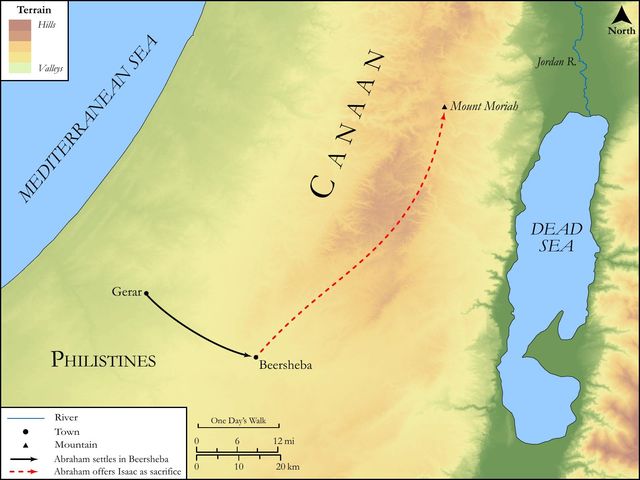
This verse immediately follows the emotionally charged events of Isaac's birth and the subsequent expulsion of Hagar and Ishmael from Abraham's household in Genesis 21:1-21. Abraham has recently settled in Beersheba, a new location that signifies a period of relative stability and growth for his household. The narrative transitions from internal family dynamics to external recognition of Abraham's growing influence. Abimelech's approach signals a shift in the power dynamic, where Abraham is no longer merely a sojourner but a figure whose divine backing is undeniable, prompting the king of the land to seek a formal covenant of peace. This encounter sets the stage for the subsequent well-digging dispute and covenant at Beersheba.
Historical & Cultural Context
In the ancient Near East, a king's approach to a powerful individual, especially one accompanied by his chief military captain, was a formal and significant diplomatic gesture. It indicated a recognition of the individual's strength, influence, and potential threat or alliance value. Abimelech's previous encounter with Abraham in Genesis 20 had already demonstrated God's protective hand over Abraham and Sarah, even leading to divine intervention that afflicted Abimelech's household. This prior experience would have deeply impressed upon Abimelech the reality of Abraham's God. For a Philistine king to acknowledge the God of Abraham, it underscores the visible manifestation of God's blessing in Abraham's life—his prosperity, the size of his retinue, and his apparent security in a foreign land—which would have been interpreted as clear signs of divine favor in that cultural milieu.
Key Themes
ShowHideGenesis 21:22 powerfully contributes to several overarching themes in the book of Genesis and the broader biblical narrative. Firstly, it underscores the theme of Divine Faithfulness to Covenant Promises, as God continues to bless Abraham and make his name great, just as He promised in Genesis 12:2. Secondly, it highlights the Visible Testimony of God's Presence, demonstrating that God's favor can be so evident in the lives of His people that even outsiders, like Abimelech, are compelled to acknowledge it. This anticipates the idea that God's people are meant to be a blessing and a witness to the nations, a theme that resonates throughout the Old Testament and finds its ultimate fulfillment in the church's mission. Lastly, it reinforces God's Sovereignty Over All Nations, showing that even pagan rulers operate under the ultimate authority of the one true God, who can move them to recognize His work.
Exposition and Analysis
ShowHideKey Word Analysis
ShowHideFrom the Hebrew words for "father" and "king," meaning "father of (the) king." This name is significant as it designates the Philistine ruler of Gerar who, despite his royal status and pagan background, is compelled to acknowledge the superior divine power at work in Abraham's life. His very name, implying a foundational authority, contrasts with his recognition of a higher, divine authority over Abraham.
This is the plural form of "Eloah," often used to refer to the supreme God, especially when accompanied by the article (though not present here, the context clearly points to the God of Abraham). The use of Elohim by Abimelech, a non-Israelite, is striking. It indicates that he recognized not just a god, but the powerful, supreme deity who was uniquely associated with Abraham and whose influence was undeniable in "all that thou doest."
A primitive root meaning "to do or make, in the broadest sense and widest application." This word encompasses all of Abraham's actions, endeavors, and outcomes. Abimelech's observation that God is with Abraham "in all that thou doest" signifies a comprehensive and pervasive divine backing, extending to every aspect of Abraham's life—his prosperity, his military strength (implied by Phichol's presence), his security, and his overall success.
Verse Breakdown
ShowHide"¶ And it came to pass at that time,"
This opening phrase serves as a temporal marker, indicating that the events described occurred at a specific, opportune moment following the preceding narrative. It signals a new development in Abraham's life, shifting from family matters to external recognition and diplomatic engagement.
"that Abimelech and Phichol the chief captain of his host spake unto Abraham, saying,"
This clause identifies the unexpected visitors and their high status. Abimelech, the king, bringing his chief military commander, Phichol, underscores the gravity and official nature of their approach. It's not a casual visit but a formal overture, signifying that Abraham's presence and power had become a matter of state concern for Gerar.
"God [is] with thee in all that thou doest:"
This is the pivotal declaration. It is an unsolicited, profound acknowledgment from a pagan ruler that Abraham's success, security, and prosperity are not merely due to his own skill or fortune, but are directly attributable to the active, comprehensive presence and favor of his God. The phrase "in all that thou doest" emphasizes the pervasive nature of this divine backing, impacting every facet of Abraham's life.
Literary Devices
ShowHideThe verse employs several literary devices to convey its profound message. Irony is prominent, as a pagan king, Abimelech, articulates a truth about God's presence with Abraham that perhaps even Abraham himself might have occasionally doubted or taken for granted. This external testimony serves to validate God's faithfulness and Abraham's unique relationship with Him. The phrase "God is with thee" also functions as foreshadowing, hinting at the recurring biblical motif of divine companionship and active presence, which reaches its zenith in the person of Jesus Christ, Immanuel, "God with us." Furthermore, the encounter presents a contrast between the worldly power of a king and the spiritual power manifested through God's favor on a nomadic patriarch, highlighting the supremacy of God's blessing over human might.
Theological and Thematic Connections
ShowHideThis verse profoundly underscores God's unwavering faithfulness to His covenant promises, demonstrating that His blessings are not merely spiritual abstractions but tangible realities that shape the lives of His people. Abimelech's unsolicited declaration serves as a powerful testament to the visible nature of God's presence and favor, which can be so compelling that even those outside the covenant community are forced to acknowledge it. This highlights that God's work in His people is not just for their benefit but also to be a witness to the world, revealing His power and sovereignty over all nations and rulers.
Reflection and Application
ShowHideGenesis 21:22 offers timeless insights for believers today, reminding us that genuine success, security, and influence are ultimately rooted not in our own efforts or strategies, but in the active presence and favor of God in our lives. When God is truly with us, His blessing can be so evident and compelling that even those who do not share our faith may recognize His hand upon us. This makes our lives a powerful, living testimony to His power, faithfulness, and the reality of His kingdom. Abraham's consistent walk, despite his imperfections, allowed God's blessing to be seen, encouraging us to live lives of integrity, trust, and obedience. Such lives, marked by God's favor, can open doors, provide protection, and extend influence even in challenging or hostile environments, ultimately drawing others to inquire about the God who is with us.
Questions for Reflection
ShowHideFAQ
ShowHideWhy would a pagan king acknowledge God's presence with Abraham?
ShowHideAbimelech, though not a worshiper of Yahweh, was a shrewd and pragmatic ruler who observed the undeniable evidence of God's favor on Abraham's life. This included Abraham's prosperity, his large and seemingly secure household, and the clear divine intervention that had previously occurred on Abraham's behalf (as detailed in Genesis 20, where God directly afflicted Abimelech's household until Sarah was returned). For Abimelech, this was not a theological conversion but a pragmatic recognition of a powerful spiritual reality. He sought to secure a peaceful alliance with someone clearly backed by a formidable deity, understanding that opposing Abraham would mean opposing his God. His acknowledgment was a strategic move to ensure the well-being of his own kingdom.
Christ-Centered Fulfillment
ShowHideAbraham's experience of God's visible presence and blessing, recognized even by a pagan king, powerfully foreshadows the ultimate "God with us" in the person of Jesus Christ. Jesus is Immanuel (Matthew 1:23), the perfect embodiment of God's active presence among humanity. His life, miracles, teachings, and ultimately His resurrection were the supreme manifestation of divine power and favor, recognized not only by His disciples but also by outsiders, including Roman centurions who confessed His divine identity (Matthew 27:54). Through Christ, believers are indwelt by the Holy Spirit (John 14:16-17), making them temples where God's presence resides (1 Corinthians 6:19). This indwelling enables believers to live lives that, like Abraham's, can visibly testify to God's active work and blessing in the world, drawing others to the one true God and His Son, Jesus Christ, who is the Way, the Truth, and the Life (John 14:6).