


Joshua 3:7
- וַיֹּאמֶרvai·Yo·merand he saidH559Conj-w ¦ V-Qal-ConsecImperf-3msVerb Qal Consecutive Imperfect 3rd Singular Masculineוַandיֹּאמֶרhe said
- יְהוָהYah·wehYahwehH3068N-properNoun Proper Title
- אֶל'eltoH413PrepPreposition
- יְהוֹשֻׁעַye·ho·Shu·a'JoshuaH3091N-proper-mNoun Proper Masculine
- הַיּוֹםhai·Yomthe dayH3117Art ¦ N-msNoun Singular Masculine Absoluteהַtheיּוֹםday
- הַזֶּהha·Zeh<the> thisH2088Art ¦ PrtParticle Demonstrativeהַ<the>זֶּהthis
- אָחֵל'a·ChelI will beginH2490V-Hiphil-Imperf-1csVerb Hiphil Imperfect 1st Singular common gender
- גַּדֶּלְךָga·del·Khato make great youH1431V-Piel-Inf ¦ 2msVerb Piel Infinitive Constructגַּדֶּלְto make greatךָyou
- בְּעֵינֵיbe·'ei·Neiin [the] eyes ofH5869Prep-b ¦ N-fdcNoun Dual Feminine Constructבְּinעֵינֵי[the] eyes of
- כָּלkolallH3605N-mscNoun Singular Masculine Construct
- יִשְׂרָאֵלYis·ra·'ElIsraelH3478N-properNoun Proper Location
- אֲשֶׁר'a·SherthatH834RelParticle Relative
- יֵדְעוּןye·de·'Unthey will know !H3045V-Qal-Imperf-3mp ¦ SfxVerb Qal Imperfect 3rd Plural Masculineיֵדְעוּthey will knowן!
- כִּיKithatH3588PrtParticle Conditional
- כַּאֲשֶׁרka·'a·Sherjust asH834Prep-k ¦ RelParticle Relativeכַּjustאֲשֶׁרas
- הָיִיתִיha·Yi·tiI wasH1961V-Qal-Perf-1csVerb Qal Perfect 1st Singular common gender
- עִם'imwithH5973PrepPreposition
- מֹשֶׁהmo·ShehMosesH4872N-proper-mNoun Proper Masculine
- אֶהְיֶה'eh·YehI will beH1961V-Qal-Imperf-1csVerb Qal Imperfect 1st Singular common gender
- עִמָּךְ'i·Makhwith youH5973Prep ¦ 2msPreposition Definiteעִמָּwithךְyou
English is a literal word-by-word gloss of the Hebrew, not the KJV's wording. Why?
This is the original text the KJV's translators worked from — each Hebrew word with its own literal English meaning in this verse, prepared by scholars at Tyndale House, Cambridge. The KJV translates whole sentences, not word by word, so its wording differs: one Hebrew word can become several English words, and the KJV may choose “the LORD” where the gloss reads “Yahweh”. Both are faithful — they answer different questions. For the KJV's own rendering, switch to the KJV text.
Details
See on the biblical-era map
Study this verse
Public-domain commentary
Matthew Henry
From his Commentary on the Whole Bible. Henry comments on passages, not single verses — this entry covers Joshua 3:7–13. His three-level outline is real structure in the source text, so it is rendered as structure.
We may observe here how God honours Joshua, and by this wondrous work he is about to do designs to make Israel know that he is their governor, and then how Joshua honours God and endeavours by it to make Israel know that he is their God. Thus those that honour God he will honour, and those whom he has advanced should do what they can in their places to exalt him.
I.God speaks to Joshua to put honour upon him, v.
7, 8. 1. It was a great honour God id him that he spoke to him as he had done to Moses from off the mercy-seat, before the priests removed it with the ark. This would make Joshua easy in himself and great among the people, that God was pleased to speak so familiarly to him. 2. that he designed to magnify him in the sight of all Israel. He had told him before that he would be with him (Jos 1:5), and that comforted him, but now all Israel shall see it, and this would magnify him. Those are truly great with whom God is and whom he employs and owns in his service. God magnified him because he would have the people magnify him. Pious magistrates are to be highly honoured and esteemed as public blessings, and the more we see of God with them the more we should honour them. by the dividing of the red Sea Israel was convinced that God was with Moses in bringing them out of Egypt; therefore they are said to be baptized unto Moses in the sea, Co1 10:2. and upon that occasion they believed him, Exo 14:31. And now, by the dividing of Jordan, they shall be convinced that God is in like manner with Joshua in bringing them into Canaan. God had magnified Joshua before on several occasions, but now he began to magnify him as the successor of Moses in the government. Some have observed that it was at the banks of Jordan that God began to magnify Joshua, and at the same place he began to magnify our Lord Jesus as Mediator; for John was baptizing at Bethabara, the house of passage, and there it was that when our Saviour was baptized it was proclaimed concerning him, This is my beloved Son. 3. That by him he gave orders to the priests themselves, though they were his immediate attendants (Jos 3:8): Thou shalt command the priests, that is, "Thou shalt make known to them the divine command in this matter, and take care that they observe it, to stand still at the brink of Jordan while the waters part, that it may appear to be at the presence of the Lord, of the mighty God of Jacob, that Jordan is driven back," Psa 114:5, Psa 114:7. God could have divided the river without the priests, but they could not without him. The priests must herein set a good example to the people, and teach them to do their utmost in the service of God, and trust him for help in time of need.
II.Joshua speaks to the people, and therein honours God.
1.He demands attention (Jos 3:9): "Come hither to me, as many as can come within hearing, and, before you see the works, hear the words of the Lord your God, that you may compare them together and they may illustrate each other." He had commanded them to sanctify themselves, and therefore calls them to hear the word of God, for that is the ordinary means of sanctification, Joh 17:17.
2.He now tells them, at length, by what way they should pass over Jordan, by the stopping of its streams (Jos 3:13): The waters of Jordan shall be cut off. God could by a sudden and miraculous frost have congealed the surface, so that they might all have gone over upon the ice; but that being a thing sometimes done even in that country by the ordinary power of nature (Job 38:30), it would not have been such an honour to Israel's God, nor such a terror to Israel's enemies; it must therefore be done in such a way as had no precedent but the dividing of the Red Sea: and that miracle is here repeated, to show that God has the same power to finish the salvation of his people that he had to begin it, for he is the Alpha and the Omega; and that the word of the Lord (as the Chaldee reads it, Jos 3:7), the essential, eternal Word, was as truly with Joshua as he was with Moses. And by the dividing of the waters from the waters, and the making of the dry land to appear which had been covered, God would remind them of that in which Moses by revelation had instructed them concerning the work of creation (Gen 1:6, Gen 1:9), that by what they now saw their belief of that which they there read might be assisted, and they might know that the God whom they worshipped was the same God that made the world and that it was the same power that was engaged and employed for them.
3.The people having been directed before to follow the ark are here told that it should pass before them into Jordan, v. 11. Observe,
(1.)The ark of the covenant must be their guide. during the reign of Moses, the cloud was their guide, but now, in Joshua's reign, the ark; both were visible signs of God's presence and presidency, but divine grace under the Mosaic dispensation was wrapt up as in a cloud and covered with a veil, while by Christ, our Joshua, it is revealed in the ark of the covenant unveiled.
(2.)It is called the ark of the covenant of the Lord of all the earth. "He that is your God (v. 9), in covenant with you, is the Lord of all the earth, has both right and power to command, control, use, and dispose of all nations and of all creatures. He is the Lord of all the earth, therefore he needs not you, nor can he be benefited by you; therefore it is your honour and happiness to have him in covenant with you: if he be yours, all the creatures are at your service, and when he pleases shall be employed for you." When we are praising and worshipping God as Israel's God, and ours through Christ, we must remember that he is the Lord of the whole earth, and reverence him and trust in him accordingly. Some observe an accent in the original, which they think directs us to translate it somewhat more emphatically, Behold the ark of the covenant, even the ark of the Lord, or even of the covenant of the Lord of all the earth.
(3.)They are told that the ark should pass before them into Jordan. God would not appoint them to go any where but where he himself would go before them and go with them; and they might safely venture, even into Jordan itself, if the ark of the covenant led them. While we make God's precepts our rule, his promises our stay, and his providence our guide, we need not dread the greatest difficulties we may meet with in the way of duty. That promise is sure to all the seed (Isa 43:2), When thou passes through the waters I will be with thee, and through the rivers they shall not overflow thee.
4.From what God was now about to do for them he infers an assurance of what he would yet further do. This he mentions first, so much was his heart upon it, and so great a satisfaction did it give him (v. 10): "Hereby you shall know that the living God (the true God, and God of power, not one of the dead gods of the heathen) is among you, though you see him not, nor are to have any image of him, is among you to give you law, secure your welfare, and receive your homage, - is among you in this great undertaking now before you; and therefore you shall, nay, he himself will, without fail, drive out from before you the Canaanites." So that the dividing of Jordan was intended to be to them,
(1.)A sure token of God's presence with them. By this they could not but know that God was among them, unless their unbelief was as obstinate against the most convincing evidence as that of their fathers was, who presently after God had divided the Red Sea before them, impudently asked, Is the Lord among us, or is he not? Exo 17:7.
(2.)A sure pledge of the conquest of Canaan. "If the living God is among you, expelling he will expel (so the Hebrew phrase is) from before you the Canaanites." He will do it certainly, and do it effectually. What should hinder him? What can stand in his way before whom rivers are divided and dried up? The forcing of the lines was certain presage of the ruin of all their hosts: how could they stand their ground when Jordan itself was driven back? When they had not courage to dispute this pass, but trembled at the approach of the mighty God of Jacob (Psa 114:7), what opposition could they ever make after this? This assurance which Joshua here gives them was so well grounded that it would enable one Israelite to chase a thousand Canaanites, and two to put then thousand to flight; and it would be abundantly strengthened by remembering the song of Moses, dictated forty years before, which plainly foretold the dividing of Jordan and the influence it would have upon the driving out of the Canaanites. Exo 15:15-17, "The inhabitants of Canaan shall melt away, and so be effectually driven out; they shall be as still as a stone till thy people pass over, and then thou shalt bring them in and plant them." Note, God's glorious appearances for his church and people ought to be improved by us for the encouragement of our faith and hope for the future. As for God, his work is perfect. If Jordan's flood cannot keep them our, Canaan's force cannot turn them out again.
5.He directs them to get twelve men ready, one of each tribe, who must be within call to receive such orders as Joshua should afterwards give them, Jos 3:12. It does not appear that they were to attend the priests, and walk with them when they carried the ark, that they might more immediately be witnesses of the wonders done by it, as some think; but they were to be at hand for the service they were called to, Jos 4:4, etc.
Historical interpretation
Historical reception
2 surviving comments on this verse. Each one is dated, so this reads as a timeline rather than a list.
And he commands the priests to go before the people with the ark of the covenant. It is then, too, that the mystery of the dispensation of the Father with the Son is manifested, since the Son is highly exalted by him who grants "that in the name of Jesus every knee should bow, of those that are in heaven, on earth, and under the earth; and that every tongue should confess that Jesus Christ is Lord, to the glory of God the Father."These matters are revealed through the following words which have been recorded in the book of Joshua: "And the Lord said to Jesus [Joshua], 'In this day I will begin to exalt you before the sons of Israel.' " We must also hear our Lord Jesus saying to the sons of Israel, "Come here and hear the Word of the Lord our God. In this you shall know that the living God is among you." For by being baptized into Jesus we will know that the living God is among us.
What great things were manifested before! The Red Sea was crossed on foot, manna was given from heaven, springs were burst open in the wilderness, the law was given through Moses. Many signs and marvels were performed in the wilderness, but nowhere is it said that Jesus [Joshua] was "exalted." But where the Jordan is crossed, there it is said to Jesus [Joshua], "In this day I am beginning to exalt you in the sight of the people." Indeed, Jesus is not exalted before the mystery of baptism. But his exaltation, even his exaltation in the sight of the people, assumes a beginning from then on. If "all who are baptized [into Christ Jesus] are baptized into his death," and the death of Jesus is made complete by the exaltation of the cross, deservedly then, Jesus is first exalted for each of the faithful when that person arrives at the mystery of baptism. Because thus it is written that "God exalted him and gave him a name that is above every name, that at the name of Jesus every knee should bend, in heaven and on earth, and below the earth."
Continue studying Joshua 3:7 across the web’s major study libraries — every link below opens this exact verse, chapter, or book on the destination site.
Read & Compare
 BibleGatewayThis verse in more than 200 translations and 70 languages.
 Bible.comThe YouVersion reader — hundreds of translations, reading plans, and highlights.
 ESV.orgCrossway's official English Standard Version reader.
 NET BibleThe NET translation with 60,000+ translators' notes on every rendering decision.
 STEP BibleTyndale House's free study tool — original text, vocabulary, and scholarly resources.
 BibliaLogos Bible Software's free web reader.
 USCCBThe New American Bible (Revised Edition) with the U.S. bishops' study notes.
Commentaries
 BibleHub CommentariesDozens of classic commentaries on this verse, gathered on one page.
 StudyLightMore than 100 commentary sets — the largest collection on the web.
 BibleRefPlain-English commentary on what this verse means, verse by verse.
 Enduring WordDavid Guzik's free commentary on this chapter, widely used by Bible teachers.
 Bible Study ToolsVerse commentary alongside Greek and Hebrew study aids.
Original Language & Research
- BibleHub InterlinearThe verse word by word — original language, transliteration, and English.
- BibleHub LexiconEvery word's original-language definition and Strong's entry.
 Blue Letter BibleDeep-study tools — Strong's numbers, concordance, and word studies.
 SefariaThe Hebrew text with Rashi and centuries of Jewish commentary.
Sermons, Hymns & Audio


TrulyRandomVerse is not affiliated with these sites and doesn’t control their content. They’re linked because they’re genuinely useful.
Summary
Joshua 3:7 marks a pivotal divine declaration at a critical juncture in Israel's history, as the LORD directly addresses Joshua, affirming his leadership and promising His unwavering presence. This verse serves as a powerful, public divine endorsement, designed to establish Joshua's authority and credibility in the eyes of all Israel, ensuring their trust and obedience as they stand poised to enter the Promised Land under his command.
Context
ShowHideLiterary Context
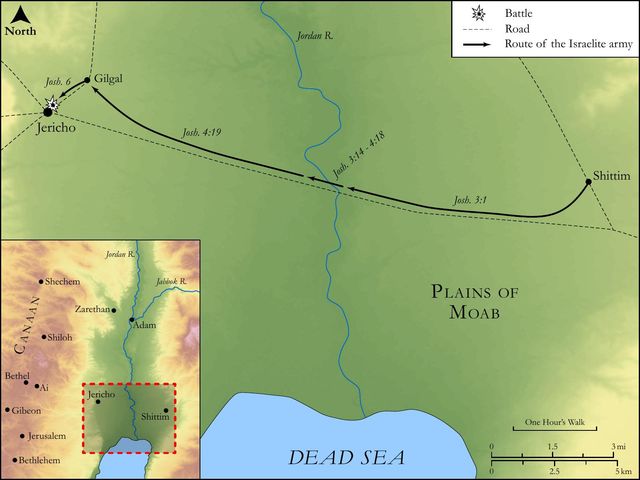
This divine declaration immediately follows the successful mission of the two spies to Jericho in Joshua 2 and directly precedes the miraculous crossing of the Jordan River, detailed in Joshua 3:9-17. The Israelites have been encamped at Shittim, on the eastern side of the Jordan, for three days, preparing for the daunting task ahead. The narrative flow emphasizes a crucial transition from preparation to decisive action, with God's direct address to Joshua serving as the indispensable divine impetus. This moment builds powerfully upon God's initial commissioning of Joshua in Joshua 1:1-9, where He first promised His presence and success. Now, in Joshua 3:7, God reiterates and publicly validates that promise before the entire nation, cementing Joshua's role as Moses' divinely appointed successor.
Historical & Cultural Context
The death of Moses, Israel's venerable and unparalleled leader for forty years, left a significant void. While Joshua had served as Moses' aide and chosen successor, his authority needed to be unequivocally established and publicly affirmed in the eyes of a people accustomed to Moses' direct communication with God and his miraculous leadership. They were on the brink of invading Canaan, a land inhabited by formidable, well-established nations. In the ancient Near East, a leader's legitimacy was often inextricably tied to divine favor and a public demonstration of that favor. God's public "magnification" of Joshua was therefore essential not only to prevent internal dissent and foster national unity but also to instill unwavering confidence in the face of the immense challenges of conquest that lay before them. This divine act served as a visible sign to both Israel and the surrounding nations of God's continued backing of His chosen people and their new leader.
Key Themes
ShowHideThis verse powerfully underscores several key theological and narrative themes central to the book of Joshua and beyond. Firstly, it highlights the Divine Affirmation of Leadership, demonstrating that true spiritual authority is not self-proclaimed or merely humanly appointed, but divinely initiated, validated, and publicly acknowledged by God Himself. Secondly, the profound declaration, "as I was with Moses, so I will be with thee," emphasizes the Continuity of God's Presence and Faithfulness. It serves as a powerful assurance to Israel that God's covenant promises and His active, powerful presence would not cease with Moses' death but would continue seamlessly with Joshua, providing immense comfort and confidence. This echoes and reinforces the promise given to Joshua earlier in Joshua 1:5, which explicitly states, "I will not fail thee, nor forsake thee." Thirdly, the verse signals Preparation for Great Works, indicating that Joshua's magnification was not for personal glory but was a necessary divine act to enable him to lead Israel effectively through the miraculous Jordan River crossing and the subsequent conquest of Canaan, ultimately culminating in the fulfillment of God's ancient promises to Abraham, Isaac, and Jacob (compare Genesis 12:7).
Exposition and Analysis
ShowHideKey Word Analysis
ShowHideThe Hebrew verb גָּדַל (gadal, H1431) means "to make great," "to cause to be great," "to exalt," or "to promote." It signifies an increase in status, importance, or authority, rather than physical size. In this context, God's action of "magnifying" Joshua implies a public elevation of his standing and credibility in the eyes of the entire Israelite community. It is an act of divine legitimation, ensuring that the people would perceive Joshua as God's chosen and empowered leader, worthy of the same respect and obedience they afforded Moses. This divine act would be visibly demonstrated through the miraculous events that followed, particularly the Jordan crossing.
The Hebrew verb יָדַע (yadaʻ, H3045) means "to know," but often implies more than mere intellectual apprehension. It can denote experiential knowledge, recognition, or acknowledgment through encounter. Here, God's purpose is "that they may know" – meaning, that Israel would experientially recognize and acknowledge the reality of God's active presence with Joshua, just as they had with Moses. This profound, experiential knowledge would be proven through the subsequent miraculous events, particularly the Jordan crossing, solidifying Joshua's leadership in their hearts and minds, fostering trust and obedience.
Verse Breakdown
ShowHide"And the LORD said unto Joshua, This day will I begin to magnify thee in the sight of all Israel"
This opening clause unequivocally establishes the divine origin of the declaration, emphasizing that Joshua's authority is not self-appointed or humanly conferred but divinely ordained. The phrase "This day" highlights the immediacy and profound significance of the moment, marking the commencement of a new, divinely sanctioned phase of leadership for Israel. God's commitment to "magnify" Joshua "in the sight of all Israel" underscores the public, undeniable, and visible nature of this divine endorsement. It is a public spectacle designed to instill confidence, foster unity, and ensure obedience within the nation as they embark on the conquest.
"that they may know that"
This phrase articulates the explicit purpose and intended outcome of God's action. The magnification of Joshua is not an end in itself, nor is it for Joshua's personal aggrandizement, but rather a crucial means to a greater end: for the people of Israel to gain experiential knowledge, firm conviction, and unwavering trust regarding God's continued presence and active involvement in their leadership. This knowledge is absolutely crucial for their collective obedience, unity, and ultimately, their successful entry into the Promised Land.
"as I was with Moses, [so] I will be with thee."
This is the theological core of the divine promise and the foundational basis of Joshua's legitimacy. It establishes an undeniable continuity of divine presence, favor, and empowering support. The past faithfulness of God with Moses, evidenced by numerous miracles, deliverances (e.g., the Red Sea crossing, the provision of manna), and direct communication, serves as the unshakeable guarantee for God's future faithfulness and active presence with Joshua. This profound assurance would alleviate any lingering doubts or anxieties among the people regarding Joshua's capacity to lead them, as it rooted his authority directly in God's unchanging character and His unwavering covenant commitment to His people.
Literary Devices
ShowHideJoshua 3:7 employs several significant literary devices that amplify its meaning and impact. Foremost is Divine Speech, where God directly addresses Joshua, underscoring the absolute authority and certainty of the promise. This direct address elevates the significance of the moment, making it unequivocally clear that Joshua's leadership is divinely sanctioned and empowered. There is also clear Parallelism in the phrase "as I was with Moses, so I will be with thee," creating a direct comparison and continuity between the two leaders and, more importantly, between God's consistent, unwavering presence with both. This parallelism serves to reassure the people that the divine power, guidance, and miraculous intervention they experienced under Moses would continue unabated under Joshua. Furthermore, the verse contains a strong element of Foreshadowing, as God's promise to "magnify" Joshua anticipates the miraculous crossing of the Jordan River (as detailed in Joshua 3:14-17) and the subsequent victories in Canaan, which would serve as tangible, undeniable proof of God's presence with Joshua and indeed magnify him in the eyes of all Israel, as later confirmed in Joshua 4:14.
Theological and Thematic Connections
ShowHideJoshua 3:7 is a profound statement about God's sovereignty over leadership and His unwavering covenant faithfulness. It teaches that God Himself initiates, calls, and validates those He appoints to lead His people, ensuring their authority is rooted in His divine backing rather than human charisma, popular vote, or self-proclamation. This divine endorsement is not for the leader's personal aggrandizement but is always for the ultimate benefit of the community, enabling them to trust and follow God's appointed shepherd into His divine purposes. The explicit continuity of God's presence, stated in the direct comparison to Moses, highlights God's unchanging character and His steadfast commitment to His promises, regardless of changing circumstances or the transition of human leadership. This provides immense comfort and confidence to God's people, reminding us that God's work is ultimately His own, and He will faithfully equip, sustain, and empower those through whom He chooses to accomplish His will.
This theme of divine presence and affirmation of leaders resonates throughout Scripture:
Reflection and Application
ShowHideJoshua 3:7 offers profound encouragement and practical lessons for believers today, demonstrating God's active involvement in His people's lives and His commitment to His purposes. It reminds us that God is actively involved in raising up and affirming leaders, not just in ancient Israel, but in the church, in our communities, and even in our personal spheres of influence. When God calls someone to a task, He also equips and empowers them, often publicly, to ensure their credibility and effectiveness. This verse encourages us to trust in God's unfailing presence, especially during times of significant transition, when facing daunting challenges, or when stepping into new responsibilities. Just as He was faithfully with Moses and then with Joshua, He promises to be with us, providing the strength, wisdom, and validation needed to fulfill His will. It teaches us to look for God's hand in affirming those He has called and to find our ultimate confidence not in human ability or resources, but in God's unchanging faithfulness and His unwavering commitment to His people and His redemptive plan.
Questions for Reflection
ShowHideFAQ
ShowHideWhy was it necessary for God to "magnify" Joshua?
ShowHideIt was necessary for several crucial reasons, primarily to ensure the successful continuation of God's redemptive plan for Israel. Firstly, Moses had been Israel's leader for forty years, a figure of immense authority, unique divine communication, and proven miraculous power. His death left a significant spiritual and leadership void, and while Joshua was Moses' chosen successor and had served faithfully, his authority needed to be unequivocally established in the eyes of a people accustomed to Moses' unparalleled leadership. Secondly, Israel was on the cusp of entering the Promised Land, a monumental task that required immense unity, unwavering faith, and absolute obedience to their new leader. Any lingering doubts about Joshua's legitimacy or ability could have led to rebellion, disunity, or failure in the face of formidable enemies. God's public "magnification" of Joshua, therefore, served to divinely validate his leadership, instill profound confidence in the people, and ensure their full cooperation as they embarked on the daunting conquest of Canaan. This divine endorsement was then tangibly and powerfully demonstrated through the miraculous crossing of the Jordan River under Joshua's command, as recounted in Joshua 3:14-17.
Christ-Centered Fulfillment
ShowHideJoshua 3:7, with its profound emphasis on a divinely appointed leader and the continuity of God's empowering presence, powerfully foreshadows the ultimate leadership and presence found in Jesus Christ. Just as God magnified Joshua in the sight of Israel to lead them into the earthly Promised Land, so God the Father has supremely magnified His Son, Jesus, in the sight of all humanity to lead His people into the true, eternal rest. Jesus is the greater Joshua (a Hellenized form of the Hebrew name "Yeshua" or "Yehoshua"), the one who truly fulfills God's promise to be "with us." He is Emmanuel, "God with us" (Matthew 1:23), the very embodiment of God's presence, uniquely and fully incarnate. While God's presence was with Moses and Joshua externally and in a limited sense, in Christ, God's presence is uniquely and fully incarnate, dwelling among us (see John 1:14). He leads His new covenant people not merely across a physical river but through the spiritual wilderness of sin and death, into the heavenly "rest" that remains for the people of God (Hebrews 4:9-10). Furthermore, Jesus' ascension did not leave His followers alone; He promised the Holy Spirit, the Comforter, to be "with you forever" (John 14:16), ensuring the continuity of God's empowering presence in every believer, just as God was with Joshua. Thus, Joshua 3:7 ultimately points to Christ as the divinely appointed and eternally present Leader who brings His people into their ultimate, spiritual inheritance.