


Joshua 3:8
Bible text: King James Version (1769 Blayney text) · Public domain
Bible text: King James Version with Strong's numbers · Public domain
Bible text: Berean Standard Bible · Public domain
Bible text: American Standard Version (1901) · Public domain
Bible text: World English Bible, Messianic edition · Public domain
Bible text: Geneva Bible (1599) · Public domain
Bible text: Young's Literal Translation · Public domain
- וְאַתָּהve·'a·Tahand youH859Conj-w ¦ Pro-2msPronoun Personal 2nd Singular Masculineוְandאַתָּהyou
- תְּצַוֶּהte·tza·Vehyou will commandH6680V-Piel-Imperf-2msVerb Piel Imperfect 2nd Singular Masculine
- אֶת'et<obj.>H853DirObjMParticle Object Indicator
- הַכֹּהֲנִיםha·Ko·ha·Nimthe priestsH3548Art ¦ N-mpNoun Plural Masculine Absoluteהַtheכֹּהֲנִיםpriests
- נֹשְׂאֵיno·se·'Ei[the] bearers ofH5375V-Qal-Prtcpl-mpVerb Qal Participle Plural Masculine Construct
- אֲרוֹן'a·ron[the] ark ofH727N-mscNoun Singular Masculine Construct
- הַבְּרִיתha·be·Ritthe covenantH1285Art ¦ N-fsNoun Singular Feminine Absoluteהַtheבְּרִיתcovenant
- לֵאמֹרle·Mor<to> sayingH559Prep-l ¦ V-Qal-InfVerb Qal Infinitive Constructלֵ<to>אמֹרsaying
- כְּבֹאֲכֶםke·vo·'a·Khemwhen come youH935Prep-k ¦ V-Qal-Inf ¦ 2mpVerb Qal Infinitive Constructכְּwhenבֹאֲcomeכֶםyou
- עַד'adtoH5704PrepPreposition
- קְצֵהke·Tzeh[the] edge ofH7097N-mscNoun Singular Masculine Construct
- מֵיmei[the] waters ofH4325N-mpcNoun Plural Masculine Construct
- הַיַּרְדֵּןhai·yar·Denthe JordanH3383Art ¦ N-properNoun Proper LocationהַtheיַּרְדֵּןJordan
- בַּיַּרְדֵּןbai·yar·Denin the JordanH3383Prep-b ¦ N-properNoun Proper Locationבַּin theיַּרְדֵּןJordan
- תַּעֲמֹדוּta·'a·Mo·duyou will stand stillH5975V-Qal-Imperf-2mpVerb Qal Imperfect 2nd Plural Masculine
English is a literal word-by-word gloss of the Hebrew, not the KJV's wording. Why?
This is the original text the KJV's translators worked from — each Hebrew word with its own literal English meaning in this verse, prepared by scholars at Tyndale House, Cambridge. The KJV translates whole sentences, not word by word, so its wording differs: one Hebrew word can become several English words, and the KJV may choose “the LORD” where the gloss reads “Yahweh”. Both are faithful — they answer different questions. For the KJV's own rendering, switch to the KJV text.
Details
See on the biblical-era map
Study this verse
Public-domain commentary
Matthew Henry
From his Commentary on the Whole Bible. Henry comments on passages, not single verses — this entry covers Joshua 3:7–13. His three-level outline is real structure in the source text, so it is rendered as structure.
We may observe here how God honours Joshua, and by this wondrous work he is about to do designs to make Israel know that he is their governor, and then how Joshua honours God and endeavours by it to make Israel know that he is their God. Thus those that honour God he will honour, and those whom he has advanced should do what they can in their places to exalt him.
I.God speaks to Joshua to put honour upon him, v.
7, 8. 1. It was a great honour God id him that he spoke to him as he had done to Moses from off the mercy-seat, before the priests removed it with the ark. This would make Joshua easy in himself and great among the people, that God was pleased to speak so familiarly to him. 2. that he designed to magnify him in the sight of all Israel. He had told him before that he would be with him (Jos 1:5), and that comforted him, but now all Israel shall see it, and this would magnify him. Those are truly great with whom God is and whom he employs and owns in his service. God magnified him because he would have the people magnify him. Pious magistrates are to be highly honoured and esteemed as public blessings, and the more we see of God with them the more we should honour them. by the dividing of the red Sea Israel was convinced that God was with Moses in bringing them out of Egypt; therefore they are said to be baptized unto Moses in the sea, Co1 10:2. and upon that occasion they believed him, Exo 14:31. And now, by the dividing of Jordan, they shall be convinced that God is in like manner with Joshua in bringing them into Canaan. God had magnified Joshua before on several occasions, but now he began to magnify him as the successor of Moses in the government. Some have observed that it was at the banks of Jordan that God began to magnify Joshua, and at the same place he began to magnify our Lord Jesus as Mediator; for John was baptizing at Bethabara, the house of passage, and there it was that when our Saviour was baptized it was proclaimed concerning him, This is my beloved Son. 3. That by him he gave orders to the priests themselves, though they were his immediate attendants (Jos 3:8): Thou shalt command the priests, that is, "Thou shalt make known to them the divine command in this matter, and take care that they observe it, to stand still at the brink of Jordan while the waters part, that it may appear to be at the presence of the Lord, of the mighty God of Jacob, that Jordan is driven back," Psa 114:5, Psa 114:7. God could have divided the river without the priests, but they could not without him. The priests must herein set a good example to the people, and teach them to do their utmost in the service of God, and trust him for help in time of need.
II.Joshua speaks to the people, and therein honours God.
1.He demands attention (Jos 3:9): "Come hither to me, as many as can come within hearing, and, before you see the works, hear the words of the Lord your God, that you may compare them together and they may illustrate each other." He had commanded them to sanctify themselves, and therefore calls them to hear the word of God, for that is the ordinary means of sanctification, Joh 17:17.
2.He now tells them, at length, by what way they should pass over Jordan, by the stopping of its streams (Jos 3:13): The waters of Jordan shall be cut off. God could by a sudden and miraculous frost have congealed the surface, so that they might all have gone over upon the ice; but that being a thing sometimes done even in that country by the ordinary power of nature (Job 38:30), it would not have been such an honour to Israel's God, nor such a terror to Israel's enemies; it must therefore be done in such a way as had no precedent but the dividing of the Red Sea: and that miracle is here repeated, to show that God has the same power to finish the salvation of his people that he had to begin it, for he is the Alpha and the Omega; and that the word of the Lord (as the Chaldee reads it, Jos 3:7), the essential, eternal Word, was as truly with Joshua as he was with Moses. And by the dividing of the waters from the waters, and the making of the dry land to appear which had been covered, God would remind them of that in which Moses by revelation had instructed them concerning the work of creation (Gen 1:6, Gen 1:9), that by what they now saw their belief of that which they there read might be assisted, and they might know that the God whom they worshipped was the same God that made the world and that it was the same power that was engaged and employed for them.
3.The people having been directed before to follow the ark are here told that it should pass before them into Jordan, v. 11. Observe,
(1.)The ark of the covenant must be their guide. during the reign of Moses, the cloud was their guide, but now, in Joshua's reign, the ark; both were visible signs of God's presence and presidency, but divine grace under the Mosaic dispensation was wrapt up as in a cloud and covered with a veil, while by Christ, our Joshua, it is revealed in the ark of the covenant unveiled.
(2.)It is called the ark of the covenant of the Lord of all the earth. "He that is your God (v. 9), in covenant with you, is the Lord of all the earth, has both right and power to command, control, use, and dispose of all nations and of all creatures. He is the Lord of all the earth, therefore he needs not you, nor can he be benefited by you; therefore it is your honour and happiness to have him in covenant with you: if he be yours, all the creatures are at your service, and when he pleases shall be employed for you." When we are praising and worshipping God as Israel's God, and ours through Christ, we must remember that he is the Lord of the whole earth, and reverence him and trust in him accordingly. Some observe an accent in the original, which they think directs us to translate it somewhat more emphatically, Behold the ark of the covenant, even the ark of the Lord, or even of the covenant of the Lord of all the earth.
(3.)They are told that the ark should pass before them into Jordan. God would not appoint them to go any where but where he himself would go before them and go with them; and they might safely venture, even into Jordan itself, if the ark of the covenant led them. While we make God's precepts our rule, his promises our stay, and his providence our guide, we need not dread the greatest difficulties we may meet with in the way of duty. That promise is sure to all the seed (Isa 43:2), When thou passes through the waters I will be with thee, and through the rivers they shall not overflow thee.
4.From what God was now about to do for them he infers an assurance of what he would yet further do. This he mentions first, so much was his heart upon it, and so great a satisfaction did it give him (v. 10): "Hereby you shall know that the living God (the true God, and God of power, not one of the dead gods of the heathen) is among you, though you see him not, nor are to have any image of him, is among you to give you law, secure your welfare, and receive your homage, - is among you in this great undertaking now before you; and therefore you shall, nay, he himself will, without fail, drive out from before you the Canaanites." So that the dividing of Jordan was intended to be to them,
(1.)A sure token of God's presence with them. By this they could not but know that God was among them, unless their unbelief was as obstinate against the most convincing evidence as that of their fathers was, who presently after God had divided the Red Sea before them, impudently asked, Is the Lord among us, or is he not? Exo 17:7.
(2.)A sure pledge of the conquest of Canaan. "If the living God is among you, expelling he will expel (so the Hebrew phrase is) from before you the Canaanites." He will do it certainly, and do it effectually. What should hinder him? What can stand in his way before whom rivers are divided and dried up? The forcing of the lines was certain presage of the ruin of all their hosts: how could they stand their ground when Jordan itself was driven back? When they had not courage to dispute this pass, but trembled at the approach of the mighty God of Jacob (Psa 114:7), what opposition could they ever make after this? This assurance which Joshua here gives them was so well grounded that it would enable one Israelite to chase a thousand Canaanites, and two to put then thousand to flight; and it would be abundantly strengthened by remembering the song of Moses, dictated forty years before, which plainly foretold the dividing of Jordan and the influence it would have upon the driving out of the Canaanites. Exo 15:15-17, "The inhabitants of Canaan shall melt away, and so be effectually driven out; they shall be as still as a stone till thy people pass over, and then thou shalt bring them in and plant them." Note, God's glorious appearances for his church and people ought to be improved by us for the encouragement of our faith and hope for the future. As for God, his work is perfect. If Jordan's flood cannot keep them our, Canaan's force cannot turn them out again.
5.He directs them to get twelve men ready, one of each tribe, who must be within call to receive such orders as Joshua should afterwards give them, Jos 3:12. It does not appear that they were to attend the priests, and walk with them when they carried the ark, that they might more immediately be witnesses of the wonders done by it, as some think; but they were to be at hand for the service they were called to, Jos 4:4, etc.
Historical interpretation
Historical reception
1 surviving comment on this verse from the historical church.
And he commands the priests to go before the people with the ark of the covenant. It is then, too, that the mystery of the dispensation of the Father with the Son is manifested, since the Son is highly exalted by him who grants "that in the name of Jesus every knee should bow, of those that are in heaven, on earth, and under the earth; and that every tongue should confess that Jesus Christ is Lord, to the glory of God the Father."These matters are revealed through the following words which have been recorded in the book of Joshua: "And the Lord said to Jesus [Joshua], 'In this day I will begin to exalt you before the sons of Israel.' " We must also hear our Lord Jesus saying to the sons of Israel, "Come here and hear the Word of the Lord our God. In this you shall know that the living God is among you." For by being baptized into Jesus we will know that the living God is among us.
Continue studying Joshua 3:8 across the web’s major study libraries — every link below opens this exact verse, chapter, or book on the destination site.
Read & Compare
 BibleGatewayThis verse in more than 200 translations and 70 languages.
 Bible.comThe YouVersion reader — hundreds of translations, reading plans, and highlights.
 ESV.orgCrossway's official English Standard Version reader.
 NET BibleThe NET translation with 60,000+ translators' notes on every rendering decision.
 STEP BibleTyndale House's free study tool — original text, vocabulary, and scholarly resources.
 BibliaLogos Bible Software's free web reader.
 USCCBThe New American Bible (Revised Edition) with the U.S. bishops' study notes.
Commentaries
 BibleHub CommentariesDozens of classic commentaries on this verse, gathered on one page.
 StudyLightMore than 100 commentary sets — the largest collection on the web.
 BibleRefPlain-English commentary on what this verse means, verse by verse.
 Enduring WordDavid Guzik's free commentary on this chapter, widely used by Bible teachers.
 Bible Study ToolsVerse commentary alongside Greek and Hebrew study aids.
Original Language & Research
- BibleHub InterlinearThe verse word by word — original language, transliteration, and English.
- BibleHub LexiconEvery word's original-language definition and Strong's entry.
 Blue Letter BibleDeep-study tools — Strong's numbers, concordance, and word studies.
 SefariaThe Hebrew text with Rashi and centuries of Jewish commentary.
Sermons, Hymns & Audio


TrulyRandomVerse is not affiliated with these sites and doesn’t control their content. They’re linked because they’re genuinely useful.
Summary
Joshua 3:8 delivers a precise divine imperative through Joshua to the Israelite priests, commanding them to carry the sacred Ark of the Covenant to the very edge of the Jordan River, which was then at flood stage, and to stand firm within its turbulent waters. This instruction is far more than a logistical detail; it is a profound test of faith and obedience, serving as the catalyst for a miraculous divine intervention that would part the waters, clear the path into the Promised Land, unequivocally affirm Joshua's leadership, and underscore the active, covenantal presence of God among His people as they stepped into their long-awaited inheritance.
Context
ShowHideLiterary Context
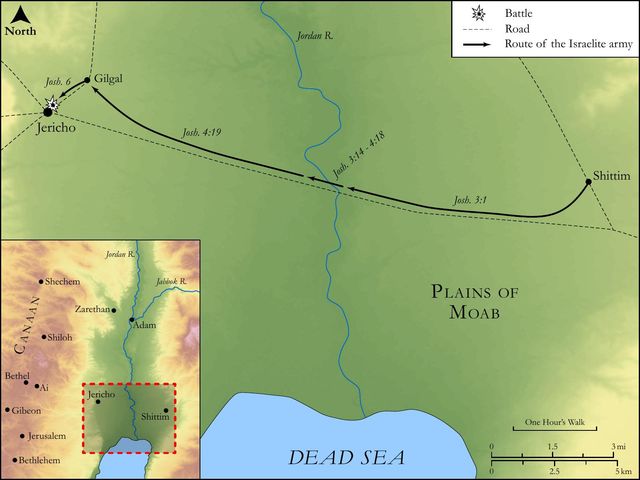
Joshua 3 strategically positions itself as the immediate precursor to Israel's entry into the Promised Land, following the reconnaissance mission of the spies to Jericho in Joshua 2 and the people's encampment at Shittim. The narrative meticulously builds anticipation, detailing the people's consecration and preparation for a momentous divine act. Verse 8 is a direct, specific command from God to Joshua, which Joshua then faithfully relays to the priests, outlining the precise action required for the miraculous crossing. This divine instruction precedes the actual parting of the waters (Joshua 3:15-17), serving as the critical catalyst. It emphasizes the Ark's pivotal role as the tangible symbol of God's presence and the priests' necessary act of courageous obedience, highlighting God's meticulous planning and Israel's required participation in His redemptive purposes.
Historical & Cultural Context
The historical setting places the Israelites at the Jordan River during the harvest season, typically in March or April. At this time, the river was notoriously at its highest, swollen by melting snows from Mount Hermon, rendering it a formidable, impassable barrier. This specific timing dramatically underscores the impossibility of a natural crossing, thereby magnifying the impending miracle as an undeniable divine act. Geographically, the Jordan River served as the eastern boundary of the Promised Land, making its crossing a deeply symbolic and literal entry into their long-awaited inheritance, a fulfillment of centuries of divine promise. The priests, specifically those from the tribe of Levi, were divinely appointed as the designated bearers of the Ark of the Covenant, a sacred duty that reflected their unique role in mediating God's presence and commands to the people. The Ark itself was not merely a religious artifact but the most sacred object in Israel, representing God's covenant presence, His heavenly throne, and His supreme authority among His chosen nation.
Key Themes
ShowHideThis verse is intricately woven into several overarching theological and narrative themes found throughout the book of Joshua and the broader Pentateuch. It powerfully illustrates Divine Faithfulness and Promise Fulfillment, as God, who had sworn to Abraham that his descendants would inherit the land (Genesis 15:18), now actively clears the way for their entry, echoing His past deliverance at the Red Sea. The theme of Obedience as a Prerequisite for Blessing is paramount; the miracle of the parted waters is explicitly contingent upon the priests' seemingly counter-intuitive act of stepping into the raging waters. Furthermore, this event solidifies Joshua's Leadership, demonstrating God's unequivocal endorsement of him as Moses' divinely appointed successor, much as God had authenticated Moses through powerful signs and wonders (e.g., Exodus 4:1-9). Finally, the Centrality of the Ark of the Covenant underscores God's active presence and guidance, reminding Israel that their victories and progress are not achieved by their own might or strategy but solely by His sovereign power, as seen in its crucial role in battles and journeys (e.g., Numbers 10:33-36).
Exposition and Analysis
ShowHideKey Word Analysis
ShowHideThis verb (H6680) signifies a strong, authoritative directive, typically from a superior to a subordinate, carrying the full weight of obligation and the expectation of immediate, unquestioning compliance. In this context, it indicates that Joshua is not merely suggesting but issuing a divine mandate, emphasizing the seriousness and non-negotiable nature of the instruction given to the priests, thereby highlighting the divine origin and absolute authority of the plan.
More than simply a container, the ʼârôwn (H727) was the most sacred object in Israel, representing God's very throne and His covenant presence among His people. Its presence at the forefront of the crossing signifies that God Himself, not merely human strength or strategy, was leading the way into the Promised Land, actively fulfilling His promises and demonstrating His personal, intimate involvement in the destiny of Israel.
This verb (H5975) implies not just stopping movement but adopting a firm, fixed, and resolute posture. In the context of the overflowing Jordan, it conveys an act of unwavering faith and profound courage. The priests were to hold their ground in the face of the rushing waters, trusting implicitly that God would act precisely at that point of obedience, rather than waiting for the waters to recede before entering. It demands a courageous, active step into the unknown.
Verse Breakdown
ShowHide"And thou shalt command the priests that bear the ark of the covenant, saying"
This opening clause establishes the divine chain of command, flowing directly from God to Joshua, and then from Joshua, as God's divinely appointed leader, to the priests. It underscores Joshua's authoritative role as Moses' successor and highlights the sacred duty of the priests, who were uniquely tasked with carrying the Ark, the tangible symbol of God's presence and covenant. The specificity of the command, directed to those holding the most sacred object, emphasizes the spiritual significance and solemnity of the impending act.
"When ye are come to the brink of the water of Jordan"
This clause precisely specifies the location for the initial action. "Brink" (Hebrew: qâtseh) denotes the very edge, the point of immediate physical contact with the overflowing river. It implies a critical moment of decision and commitment, where the priests must physically engage with the formidable obstacle, not merely observe it from a safe distance. This sets up the dramatic tension and highlights the seemingly impossible nature of the task from a human perspective, preparing the audience for the miraculous divine intervention.
"ye shall stand still in Jordan"
This is the climactic instruction, demanding an extraordinary act of faith and courage. The priests are not to cross over immediately but to enter the turbulent waters and hold their position. This act of "standing still" (Hebrew: ʻâmad) in the midst of the danger signifies unwavering trust in God's power to intervene. It is a prerequisite for the miracle, demonstrating that divine intervention often awaits human obedience and courageous faith, rather than preceding it.
Literary Devices
ShowHideJoshua 3:8 masterfully employs several literary devices to heighten its impact and convey its profound theological message. Anticipation is skillfully built through the precise, almost ritualistic, nature of the divine command, meticulously setting the stage for the miraculous event of the Jordan's parting. The Symbolism of the Ark of the Covenant is paramount; it is not merely a wooden chest but the embodiment of God's active, covenantal presence, leading His people into their promised inheritance. The command itself presents a powerful instance of Dramatic Irony from a human perspective, as stepping into an overflowing river seems utterly suicidal or foolish, yet it is precisely the divine instruction for their deliverance. The scene also utilizes Foreshadowing, as the miraculous crossing of the Jordan, led by the Ark, powerfully echoes the prior miraculous crossing of the Red Sea (Exodus 14), reinforcing God's consistent character as a mighty deliverer. Finally, the Repetition of the Ark's central role throughout chapter 3 emphasizes its centrality and God's direct, personal involvement in the unfolding events.
Theological and Thematic Connections
ShowHideJoshua 3:8 profoundly illustrates the principle that God often calls for an initial, courageous act of faith and obedience before revealing His full power and provision. The command to "stand still in Jordan" when the river was at flood stage was a test of absolute trust, demonstrating that God's ways are often counter-intuitive to human logic and defy natural limitations. This event serves as a powerful theological statement about divine sovereignty—God is not limited by any natural barriers, however formidable—and human responsibility—our active participation through faith is often required for God's miracles to unfold. It underscores the dynamic of the covenant relationship where God's unwavering promises are met with human obedience, leading to the glorious fulfillment of His redemptive plan for His people.
Reflection and Application
ShowHideJoshua 3:8 offers profound and enduring lessons for contemporary believers navigating their own "Jordan Rivers"—those seemingly insurmountable obstacles, uncertain transitions, or daunting calls to obedience in life. The command to the priests to step into the overflowing river before it parted is a timeless call to courageous, active faith. It challenges us to move beyond passive waiting and to take a tangible step of obedience, even when the path ahead is unclear, appears dangerous, or defies logical explanation. This verse powerfully reminds us that God often waits for our initial act of faith—our "foot in the water"—before He fully reveals His solution or breakthrough. It encourages us to trust implicitly in God's active presence, symbolized by the Ark, knowing that He goes before us and is faithfully with us in every challenge. Our obedience, even when it feels like stepping into the unknown, is not a means to earn God's favor but a vital demonstration of our trust in His unchanging character and unfailing promises, thereby opening the door for His miraculous intervention in our lives and circumstances.
Questions for Reflection
ShowHideFAQ
ShowHideWhy was the Ark of the Covenant so important in this crossing?
ShowHideThe Ark of the Covenant was the most sacred object to Israel, symbolizing God's tangible presence, His heavenly throne, and the very essence of His covenant relationship with His people. Its leading role in the Jordan crossing was crucial for several profound reasons. First, it unequivocally signified that God Himself was leading the way into the Promised Land, not merely Joshua or the Israelite army. This reinforced the theological truth that the land was a divine gift, and their entry was by God's power, not their own might or strategy. Second, it served as a visible and powerful reminder of God's faithfulness to His promises, echoing His past deliverance at the Red Sea where He also miraculously made a way through water. Third, its presence explicitly affirmed Joshua's divine leadership, demonstrating that God was with him just as He had been with Moses (Joshua 3:7). The Ark's centrality underscored that the entire event was a divine act, confirming God's active, sovereign involvement in their history and destiny.
Did the priests have to wait for the water to part before stepping in?
ShowHideNo, the command in Joshua 3:8 explicitly states, "When ye are come to the brink of the water of Jordan, ye shall stand still in Jordan." This means the priests were commanded to step into the overflowing river and hold their position, not to wait for the waters to recede or part beforehand. Joshua 3:15 further confirms this: "And as they that bare the ark were come unto Jordan, and the feet of the priests that bare the ark were dipped in the brim of the water, (for Jordan overfloweth all his banks all the time of harvest,) that the waters which came down from above stood and rose up upon an heap..." The miracle of the waters parting happened as their feet touched the water, not prior to it. This detail is crucial, as it highlights the necessity of an active, courageous step of faith and obedience as a prerequisite for God's miraculous intervention.
Christ-Centered Fulfillment
ShowHideThe miraculous crossing of the Jordan in Joshua 3, initiated by the command in verse 8, powerfully foreshadows the ultimate fulfillment found in Jesus Christ. Just as the Ark of the Covenant, representing God's very presence, led Israel through an impossible barrier into their promised earthly inheritance, so Jesus Christ, the very embodiment of God with us (Immanuel), leads His people through the insurmountable barrier of sin and death into the promised eternal inheritance. The priests' act of stepping into the overflowing Jordan, an act of faith preceding the miracle, mirrors the call to faith in Christ, where our trust in His finished work on the cross (Colossians 2:13-14) is the prerequisite for spiritual breakthrough, new life, and reconciliation with God. Jesus is our true Joshua, leading us not into an earthly land but into the heavenly kingdom and the true rest found in Him (Hebrews 4:8-10). He is the one who has already "stood still" in the "waters" of death and divine judgment, conquering them through His glorious resurrection (Romans 6:4), thereby making a living way for all who believe to enter into God's presence and experience the fullness of His promises, a far greater reality than the physical land of Canaan.