


Joshua 3:3
Bible text: King James Version (1769 Blayney text) · Public domain
Bible text: King James Version with Strong's numbers · Public domain
Bible text: Berean Standard Bible · Public domain
Bible text: American Standard Version (1901) · Public domain
Bible text: World English Bible, Messianic edition · Public domain
Bible text: Geneva Bible (1599) · Public domain
Bible text: Young's Literal Translation · Public domain
- וַיְצַוּוּvay·tza·Vuand they commandedH6680Conj-w ¦ V-Piel-ConsecImperf-3mpVerb Piel Consecutive Imperfect 3rd Plural Masculineוַandיְצַוּוּthey commanded
- אֶת'et<obj.>H853DirObjMParticle Object Indicator
- הָעָםha·'Amthe peopleH5971Art ¦ N-msNoun Singular Masculine Absoluteהָtheעָםpeople
- לֵאמֹרle·Mor<to> sayingH559Prep-l ¦ V-Qal-InfVerb Qal Infinitive Constructלֵ<to>אמֹרsaying
- כִּרְאוֹתְכֶםkir·'ot·Khemwhen see youH7200Prep-k ¦ V-Qal-Inf ¦ 2mpVerb Qal Infinitive Constructכִּwhenרְאוֹתְseeכֶםyou
- אֵת'et<obj.>H853DirObjMParticle Object Indicator
- אֲרוֹן'a·Ron[the] ark ofH727N-mscNoun Singular Masculine Construct
- בְּרִיתbe·rit[the] covenant ofH1285N-fscNoun Singular Feminine Construct
- יְהוָהYah·wehYahwehH3068N-properNoun Proper Title
- אֱלֹהֵיכֶם'e·Lo·hei·Khemyour GodH430N-mpc ¦ 2mpNoun Plural Masculine ConstructאֱלֹהֵיGodכֶםyour
- וְהַכֹּהֲנִיםve·ha·ko·ha·Nimand the priestsH3548Conj-w ¦ Art ¦ N-mpNoun Plural Masculine Absoluteוְandהַtheכֹּהֲנִיםpriests
- הַלְוִיִּםhal·vi·Yimthe LevitesH3881Art ¦ N-mpNoun Gentilic Plural Masculine AbsoluteהַtheלְוִיִּםLevites
- נֹשְׂאִיםno·se·'ImcarryingH5375V-Qal-Prtcpl-mpVerb Qal Participle Plural Masculine Absolute
- אֹתוֹ'o·To<obj.> itH853DirObjM ¦ 3msParticle Object Indicatorאֹת<obj.>וֹit
- וְאַתֶּםve·'a·Temand youH859Conj-w ¦ Pro-2mpPronoun Personal 2nd Plural Masculineוְandאַתֶּםyou
- תִּסְעוּtis·'Uyou will set outH5265V-Qal-Imperf-2mpVerb Qal Imperfect 2nd Plural Masculine
- מִמְּקוֹמְכֶםmi·me·Kom·Khemfrom your placeH4725Prep-m ¦ N-msc ¦ 2mpNoun Singular Masculine Constructמִfromמְּקוֹמְplaceכֶםyour
- וַהֲלַכְתֶּםva·ha·lakh·Temand you will goH1980Conj-w ¦ V-Qal-ConsecPerf-2mpVerb Qal Consecutive Perfect 2nd Plural Masculineוַandהֲלַכְתֶּםyou will go
- אַחֲרָיו'a·cha·Ravbehind itH310Adj-mpc ¦ 3msAdjective Numerical Plural Masculine Constructאַחֲרָיbehindוit
English is a literal word-by-word gloss of the Hebrew, not the KJV's wording. Why?
This is the original text the KJV's translators worked from — each Hebrew word with its own literal English meaning in this verse, prepared by scholars at Tyndale House, Cambridge. The KJV translates whole sentences, not word by word, so its wording differs: one Hebrew word can become several English words, and the KJV may choose “the LORD” where the gloss reads “Yahweh”. Both are faithful — they answer different questions. For the KJV's own rendering, switch to the KJV text.
Details
See on the biblical-era map
Study this verse
Public-domain commentary
Matthew Henry
From his Commentary on the Whole Bible. Henry comments on passages, not single verses — this entry covers Joshua 3:1–6. His three-level outline is real structure in the source text, so it is rendered as structure.
Rahab, in mentioning to the spies the drying up of the Red Sea (Jos 2:10), the report of which terrified the Canaanites more than anything else, intimates that those on that side the water expected that Jordan, that great defence of their country, would in like manner give way to them. Whether the Israelites had any expectation of it does not appear. God often did things for them which they looked not for, Isa 64:3. Now here we are told,
I.That they came to Jordan and lodged there, Jos 3:1.
Though they were not yet told how they should pass the river, and were unprovided for the passing of it in any ordinary way, yet they went forward in faith, having been told (Jos 1:11) that they should pass it. We must go on in the way of our duty though we foresee difficulties, trusting God to help us through them when we come to them. Let us proceed as far as we can, and depend on divine sufficiency for that which we find ourselves not sufficient for. In this march Joshua led them, and particular notice is taken of his early rising as there is afterwards upon other occasions (Jos 6:12; Jos 7:16; Jos 8:10), which intimates how little he loved his ease, how much he loved his business, and what care and pains he was willing to take in it. Those that would bring great tings to pass must rise early. Love not sleep, lest thou come to poverty. Joshua herein set a good example to the officers under him, and taught them to rise early, and to all that are in public stations especially to attend continually to the duty of their place.
II.That the people were directed to follow the ark.
Officers were appointed to go through the host to give these directions (v. 2), that every Israelite might know both what to do and what to depend upon.
1.They might depend upon the ark to lead them; that is, upon God himself, of whose presence the ark was an instituted sign and token. It seems, the pillar of cloud and fire was removed, else that would have led them, unless we suppose that it now hovered over the ark and so they had a double guide: honour was put upon the ark, and a defence upon that glory. It is called here the ark of the covenant of the Lord their God. What greater encouragement could they have than this, that the Lord was their God, a God in covenant with them? Here was the ark of the covenant; if God be ours, we need not fear any evil. He was nigh to them, present with them, went before them: what could come amiss to those that were thus guided, thus guarded? Formerly the ark was carried in the midst of the camp, but now it went before them to search out a resting-place for them (Num 10:33), and, as it were, to give them livery and seisin of the promised land, and put them in possession of it In the ark the tables of the law were, and over it the mercy-seat; for the divine law and grace reigning in the heart are the surest pledges of God's presence and favour, and those that would be led to the heavenly Canaan must take the law of God for their guide (if thou wilt enter into life keep the commandments) and have the great propitiation in their eye, looking for the mercy of our Lord Jesus Christ unto eternal life.
2.They might depend upon the priests and Levites, who were appointed for that purpose to carry the ark before them. The work of ministers is to hold forth the word of life, and to take care of the administration of those ordinances which are the tokens of God's presence and the instruments of his power and grace; and herein they must go before the people of God in their way to heaven.
3.The people must follow the ark: Remove from your place and go after it,
(1.)As those that are resolved never to forsake it. Wherever God's ordinances are, there we must be; if they flit, we must remove and go after them.
(2.)As those that are entirely satisfied in its guidance, that it will lead in the best way to the best end; and therefore, Lord, I will follow thee whithersoever thou goest. This must be all their car, to attend the motions of the ark, and follow it with an implicit faith. Thus must we walk after the rule of the word and the direction of the Spirit in every thing, so shall peace be upon us, as it now was upon the Israel of God. They must follow the priests as far as they carried the ark, but no further; so we must follow our ministers only as they follow Christ.
4.In following the ark, they must keep their distance, v. 4. They must none of them come within a thousand yards of the ark.
(1.)They must thus express their awful and reverent regard to that token of God's presence, lest its familiarity with them should breed contempt. This charge to them not to come near was agreeable to that dispensation of darkness, bondage, and terror: but we now through Christ have access with boldness.
(2.)Thus it was made to appear that the ark was able to protect itself, and needed not to be guarded by the men of war, but was itself a guard to them. With what a noble defiance of the enemy did it leave all it its friends half a mile behind except the unarmed priests that carried it as perfectly sufficient for its own safety and theirs that fallowed it!
(3.)Thus it was the better seen by those that were to be led by it: That you may know the way by which you must go, seeing it, as it were, chalked out or tracked by the ark. Had they been allowed to come near it, they would have surrounded it, and none would have had the sight of it but those that were close to it; but, as it was put at such a distance before them, they would all have the satisfaction of seeing it, and would be animated by the sight. And it was with good reason that this provision was made for their encouragement: For you have not passed this way heretofore. This had been the character of all their way through the wilderness, it was an untrodden path, but this especially through Jordan. While we are here we must expect and prepare for unusual events, to pass ways that we have not passed before, and much more when we go hence; our way through the valley of the shadow of death is a way we have not gone before, which makes it the more formidable. But, if we have the assurance of God's presence, we need not fear; that will furnish us with such strength as we never had when we come to do a work we never did.
III.They were commanded to sanctify themselves, that they might be prepared to attend the ark; and with good reason:
For tomorrow the Lord will do wonders among you, v. 5. See how magnificently he speaks of God's works: he doeth wonders, and is therefore to be adored, admired, and trusted in. See how intimately acquainted Joshua was with the divine counsels: he could tell before-hand what god would do, and when. See what preparation we must make to receive the discoveries of God's glory and the communications of his grace: we must sanctify ourselves. This we must do when we are to attend the ark, and God by it is about to do wonders among us; we must separate ourselves from all other cares, devote ourselves to God's honour, and cleanse ourselves from all filthiness of flesh and spirit. The people of Israel were now entering into the holy land, and therefore must sanctify themselves. God was about to give them uncommon instances of his favour, which by meditation and prayer they must compose their minds to a very careful observation of, that they might give God the glory, and take to themselves the comfort, of these appearances.
IV.The priests were ordered to take up the ark and carry it before the people, v.
6. It was the Levites' work ordinarily to carry the ark, Num 4:15. But on this great occasion the priests were ordered to do it. And they did as they were commanded, took up the ark, and did not think themselves disparaged, went before the people, and did not thing themselves exposed; the ark they carried was both their honour and their defence. And now we may suppose that prayer of Moses used, when the ark set forward (Num 10:35), Rise up, Lord and let they enemies be scattered. Magistrates are here instructed to stir up ministers to their work, and to make use of their authority for the furtherance of religion. Ministers must likewise learn to go before in the way of God, and not to shrink nor draw back when dangers are before them. They mus expect to be most struck at, but they know whom they have trusted.
Historical interpretation
Historical reception
1 surviving comment on this verse from the historical church.
Finally, see what is said: "Let the people be at a distance from the ark of the covenant," it says, "by two thousand cubits." The priests and the Levites, however, are very near, and near enough so that the ark of the Lord and the divine law are carried on their own shoulders. Blessed are those who deserve to be very close to God. But remember that it is written, "Those who draw near to me, draw near to fire." If you are gold and silver and have drawn near to the fire, you will shine forth more splendid and glowing because of the fire. But if you are conscious of building "wood, hay and stubble" upon the foundation of your faith, and you approach the fire with such building, you will be consumed. Blessed, therefore, are those who are very near, who are so very near that the fire illumines and does not burn them. Nevertheless, even Israel will be saved; but it will be saved from far away, and it makes its journey not by its own power but by the support and foresight of the priests.
Continue studying Joshua 3:3 across the web’s major study libraries — every link below opens this exact verse, chapter, or book on the destination site.
Read & Compare
 BibleGatewayThis verse in more than 200 translations and 70 languages.
 Bible.comThe YouVersion reader — hundreds of translations, reading plans, and highlights.
 ESV.orgCrossway's official English Standard Version reader.
 NET BibleThe NET translation with 60,000+ translators' notes on every rendering decision.
 STEP BibleTyndale House's free study tool — original text, vocabulary, and scholarly resources.
 BibliaLogos Bible Software's free web reader.
 USCCBThe New American Bible (Revised Edition) with the U.S. bishops' study notes.
Commentaries
 BibleHub CommentariesDozens of classic commentaries on this verse, gathered on one page.
 StudyLightMore than 100 commentary sets — the largest collection on the web.
 BibleRefPlain-English commentary on what this verse means, verse by verse.
 Enduring WordDavid Guzik's free commentary on this chapter, widely used by Bible teachers.
 Bible Study ToolsVerse commentary alongside Greek and Hebrew study aids.
Original Language & Research
- BibleHub InterlinearThe verse word by word — original language, transliteration, and English.
- BibleHub LexiconEvery word's original-language definition and Strong's entry.
 Blue Letter BibleDeep-study tools — Strong's numbers, concordance, and word studies.
 SefariaThe Hebrew text with Rashi and centuries of Jewish commentary.
Sermons, Hymns & Audio


TrulyRandomVerse is not affiliated with these sites and doesn’t control their content. They’re linked because they’re genuinely useful.
Summary
Joshua 3:3 presents a pivotal divine directive to the Israelites on the precipice of the Promised Land, instructing them to fix their gaze upon the Ark of the Covenant, borne by the Levitical priests, and to follow it as their sole guide across the formidable Jordan River. This command not only established the Ark as the tangible sign of God's active presence and sovereign leadership but also served as an imperative call to radical faith and immediate obedience, preparing the nation for an unprecedented miraculous passage and the commencement of their inheritance in Canaan.
Context
ShowHideLiterary Context
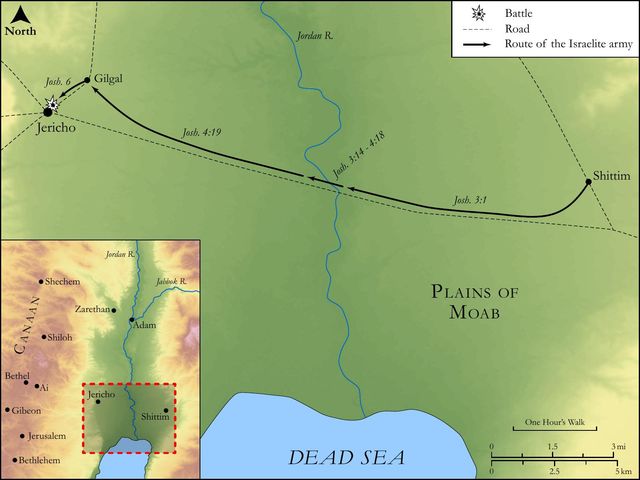
This verse is strategically placed at a critical juncture in the book of Joshua, immediately following the successful reconnaissance mission of the two spies to Jericho and their safe return (Joshua 2). The preceding verses, Joshua 3:1-2, describe the Israelites' encampment at Shittim, their journey to the Jordan, and a three-day waiting period. Joshua 3:3 thus marks the direct, authoritative command for the impending crossing, setting the stage for the miraculous parting of the Jordan River described in vivid detail in Joshua 3:14-17. It functions as a divine instruction, relayed through Joshua's officers, to prepare the people for an unprecedented act of God, emphasizing the Ark's central role as the vanguard of the divine presence, a theme consistent with God's initial commission to Joshua in Joshua 1:1-9.
Historical & Cultural Context
The Israelites had endured forty years of wilderness wandering, and this moment signified the definitive end of that era and the commencement of their conquest of Canaan. Historically, the Jordan River, particularly during the harvest season (as explicitly noted in Joshua 3:15), was at its annual flood stage, rendering a crossing humanly impossible. Culturally, the Ark of the Covenant was the most sacred object to Israel, representing God's very throne, His immanent presence among His people, and the physical embodiment of His covenant with them. The priests, specifically those from the tribe of Levi, were the only ones consecrated and ritually pure enough to handle the Ark, underscoring its profound sanctity and the divine authority behind the command. This act was not merely a logistical maneuver but a profound theological statement, demonstrating God's sovereign power over nature and His unwavering faithfulness to His covenant promises.
Key Themes
ShowHideJoshua 3:3 powerfully highlights several key themes central to the book of Joshua and the broader Old Testament narrative. First, Divine Guidance and Presence is paramount, with the Ark of the Covenant serving as the visible manifestation of God actively leading His people into their inheritance, echoing earlier instances of divine leading like the pillar of cloud and fire in Exodus 13:21-22. Second, Faith and Obedience are unequivocally demanded, as the command to "remove from your place, and go after it" required the people to step out in trust before the path was made clear, a foundational principle for receiving God's promises (Hebrews 11:6). Third, the verse underscores the Sanctity of God's Instruments and Servants, with the specific mention of "the priests the Levites bearing it," reinforcing the sacred nature of God's covenant symbols and the consecrated role of those called to minister before Him, a principle established in the Mosaic Law (e.g., Numbers 4:15).
Exposition and Analysis
ShowHideKey Word Analysis
ShowHideThis term refers to the most sacred object in ancient Israel (H727, H1285), a gold-covered wooden chest containing the tablets of the Law, Aaron's rod, and a pot of manna. More than a mere container, it symbolized God's tangible presence among His people, His throne, and the focal point of the covenant relationship (H1285, "a compact") He established with Israel at Sinai. Its presence at the forefront of the crossing signified that God Himself (H3068, "the self-Existent or Eternal") was leading the way, guaranteeing His protective power and faithfulness to His promises.
This specific designation emphasizes the unique and consecrated role of the Levitical priests (H3548, "one officiating, a priest"; H3881, "a Levite or descendant of Levi"). Only they were permitted to handle the Ark (H5375, "to lift, bear"), a task that required ritual purity and a deep understanding of its sanctity. Their bearing of the Ark underscored the sacredness of the divine presence and the mediating role of the priesthood in Israelite worship and national life. It also highlighted the divine order and protocol for approaching God's holiness.
This imperative phrase conveys a command for active, deliberate, and immediate following (H1980, "to walk... to follow"; H310, "after, behind"). It implies not merely a physical movement but a spiritual alignment and submission to God's direction. The people were not to lead, nor were they to wait for the path to be fully revealed; rather, they were to trust and follow the visible sign of God's presence, indicating a posture of faith and obedience essential for entering and possessing the Promised Land (H4725, "a standing... a locality").
Verse Breakdown
ShowHide"And they commanded the people, saying"
This opening clause establishes the authoritative source of the instruction. While not explicitly stated who "they" are in this immediate verse, the preceding verses (Joshua 3:2) indicate that Joshua's officers had gone through the camp. Thus, "they" refers to Joshua and his officers, conveying the divine command (H6680, "to constitute, enjoin"; H559, "to say") to the entire nation (H5971, "a people"), emphasizing the authoritative and unified nature of the directive.
"When ye see the ark of the covenant of the LORD your God"
This sets the precise condition for action. The Ark (H727) serves as the visual cue (H7200, "to see") and the central object of focus. The phrase "the LORD (H3068) your God (H430)" reinforces the covenantal relationship (H1285), reminding the people that the God who made promises to Abraham, Isaac, and Jacob was actively leading them. Their subsequent action was contingent upon the manifestation of His presence.
"and the priests the Levites bearing it"
This specifies the agents responsible for carrying (H5375, "to lift, bear") the Ark. The mention of "priests (H3548) the Levites (H3881)" underscores the sacredness of the Ark and the divinely appointed role of the priesthood in mediating God's presence and commands. It also highlights the orderly and reverent manner in which God's presence was to be approached.
"then ye shall remove from your place"
This is the first part of the command, requiring a physical and spiritual departure (H5265, "to pull up, especially the tent-pins, i.e. start on a journey") from their current position (H4725, "a spot, locality"). It signifies leaving behind the wilderness journey and embracing the new phase of their national existence. It implies an act of faith, stepping out from the known into the unknown, trusting God's leading.
"and go after it"
This is the decisive action required: active pursuit and following (H1980, "to walk... to follow"; H310, "after, behind"). It means placing their trust entirely in God's leading, as symbolized by the Ark. This command emphasizes that their success in conquering the land would not be by human strategy or strength, but by obediently following God's divine direction.
Literary Devices
ShowHideThe verse employs several significant literary devices that enrich its meaning. Symbolism is paramount, with the Ark of the Covenant serving as the central symbol of God's presence, power, and covenant faithfulness. Its physical presence at the head of the procession symbolizes God Himself leading His people into the Promised Land. The act of "bearing it" by the priests further emphasizes the Ark's sacredness and the divine order. Metonymy is also prominently present, where the Ark (the physical object) stands in for God's actual presence and guidance. The command to "go after it" is thus a command to follow God directly. Furthermore, the pervasive use of the imperative mood ("remove," "go after") conveys the authoritative and non-negotiable nature of the divine command, demanding immediate and unquestioning obedience from the people.
Theological and Thematic Connections
ShowHideJoshua 3:3 serves as a profound theological statement on divine leadership and human obedience, echoing the foundational principle that God's people are to follow His revealed will. The Ark, representing God's active presence, functions as the ultimate guide, demonstrating that the success of Israel's mission in Canaan was entirely dependent on God's active involvement and not on human strength or strategic prowess. This reliance on God's visible (and later, spiritual) leading is a recurring theme throughout biblical history, reminding believers that true progress and flourishing come from aligning with divine direction. The command to "remove from your place" and "go after it" encapsulates the essence of faith: stepping into the unknown, trusting that God will make a way where there appears to be none.
Reflection and Application
ShowHideJoshua 3:3 offers timeless principles for contemporary believers navigating their own spiritual journeys. Just as the Israelites were called to fix their gaze on the Ark, the visible sign of God's presence, we are called to fix our eyes on Christ, who is the ultimate revelation of God, and to follow His leading. This often necessitates a "removing from our place"—a willingness to step out of our comfort zones, familiar routines, or perceived security, and to trust God's direction, even when the path ahead seems daunting or impossible, much like the Jordan River at flood stage. Our spiritual progress and the fulfillment of God's purposes in our lives are not achieved through self-reliance or human wisdom, but through humble, active obedience to His Word and the guidance of the Holy Spirit. This verse reminds us that God's presence is our ultimate security, and His commands are always for our good, even when they demand radical faith and a willingness to venture into the unknown.
Questions for Reflection
ShowHideFAQ
ShowHideWhy was the Ark of the Covenant so important for this crossing?
ShowHideThe Ark of the Covenant was supremely important because it represented the tangible presence and throne of God among His people. It contained the tablets of the Law, symbolizing God's covenant faithfulness and His righteous standards. For the Jordan crossing, the Ark going before them signified that God Himself was leading the way, not merely offering advice, but actively intervening to make the impossible possible. It was a visible assurance of His power, protection, and commitment to fulfill His promises to Israel, demonstrating that the victory and inheritance were His doing, not theirs. It was the focal point of their faith and the guarantee of divine success.
Why were "the priests the Levites" specifically chosen to carry the Ark?
ShowHideThe priests, who were from the tribe of Levi, were the only ones consecrated and ritually pure enough to handle the sacred Ark according to the Mosaic Law (Numbers 4:15). Their specific role underscored the Ark's extreme holiness and the reverence due to God's presence. It also highlighted the mediating role of the priesthood in Israel, serving as the bridge between God and His people. Their carrying the Ark emphasized divine order, the sanctity of God's instruments, and the seriousness of approaching His holiness. It was a demonstration that God's work is done according to His prescribed order and through His appointed servants.
What does it mean to "remove from your place, and go after it" in a modern context?
ShowHideIn a modern context, "remove from your place" signifies a willingness to leave behind what is familiar, comfortable, or seemingly secure, whether it's a way of thinking, a lifestyle, a relationship, or a career path, when God calls for a change. It implies a departure from self-reliance and a readiness to embrace the unknown. "Go after it" means actively and obediently following God's leading, primarily through His Word (the Bible) and the guidance of the Holy Spirit. It requires faith to step out even when the full path isn't clear, trusting that God will make a way and provide for every need, much like the Israelites trusting God to part the Jordan River. It's a call to dynamic, Spirit-led living rather than static adherence to tradition or personal preference, prioritizing God's will above all else.
Christ-Centered Fulfillment
ShowHideJoshua 3:3, with its profound emphasis on the Ark of the Covenant as the visible sign of God's presence leading His people into their inheritance, finds its ultimate and glorious fulfillment in Jesus Christ. The Ark, a powerful symbol of God dwelling among humanity, perfectly foreshadows the incarnation of God in Christ, who is truly "God with us" (Matthew 1:23). Just as the Israelites were commanded to fix their gaze upon and follow the Ark, we are called to follow Jesus, who unequivocally declared, "I am the way, the truth, and the life; no one comes to the Father except through Me" (John 14:6). He is not merely a guide but the very embodiment of the divine presence and the sole means by which we enter into our true spiritual inheritance—eternal life and unhindered communion with God. The Ark's sacred contents (the Law, manna, Aaron's rod) pointed to God's perfect provision and sovereign authority, all perfectly fulfilled in Christ, who is the living Word made flesh (John 1:1) and the true bread from heaven that gives life to the world (John 6:35). Moreover, the Ark's presence made the humanly impossible Jordan crossing possible, just as Christ, through His sacrificial death and triumphant resurrection, has overcome the impossible barrier of sin and death, opening the way for us to enter God's holy presence and inherit His eternal promises (Hebrews 9:11-12). To "go after" Christ is to embrace His Lordship, trust implicitly in His atoning work, and live in radical, obedient faith, confident that He leads us into the fullness of God's promised eternal kingdom.