


Joshua 3:15
Bible text: King James Version (1769 Blayney text) · Public domain
Bible text: King James Version with Strong's numbers · Public domain
Bible text: Berean Standard Bible · Public domain
Bible text: American Standard Version (1901) · Public domain
Bible text: World English Bible, Messianic edition · Public domain
Bible text: Geneva Bible (1599) · Public domain
Bible text: Young's Literal Translation · Public domain
- וּכְבוֹאu·khe·Vo'and just as cameH935Conj-w ¦ Prep-k ¦ V-Qal-InfVerb Qal Infinitive Constructוּandכְjust asבוֹאcame
- נֹשְׂאֵיno·se·'Ei[the] bearers ofH5375V-Qal-Prtcpl-mpVerb Qal Participle Plural Masculine Construct
- הָאָרוֹןha·'a·rOnthe arkH727Art ¦ N-msNoun Singular Masculine Absoluteהָtheאָרוֹןark
- עַד'adtoH5704PrepPreposition
- הַיַּרְדֵּןhai·yar·Denthe JordanH3383Art ¦ N-properNoun Proper LocationהַtheיַּרְדֵּןJordan
- וְרַגְלֵיve·rag·Leiand [the] feet ofH7272Conj-w ¦ N-fdcNoun Dual Feminine Constructוְandרַגְלֵי[the] feet of
- הַכֹּהֲנִיםha·ko·ha·Nimthe priestsH3548Art ¦ N-mpNoun Plural Masculine Absoluteהַtheכֹּהֲנִיםpriests
- נֹשְׂאֵיno·se·'Ei[the] bearers ofH5375V-Qal-Prtcpl-mpVerb Qal Participle Plural Masculine Construct
- הָאָרוֹןha·'a·Ronthe arkH727Art ¦ N-msNoun Singular Masculine Absoluteהָtheאָרוֹןark
- נִטְבְּלוּnit·be·Luthey were dippedH2881V-Niphal-Perf-3cpVerb Niphal Perfect 3rd Plural common gender
- בִּקְצֵהbik·Tzehin [the] edge ofH7097Prep-b ¦ N-mscNoun Singular Masculine Constructבִּinקְצֵה[the] edge of
- הַמָּיִםha·Ma·yimthe watersH4325Art ¦ N-mpNoun Plural Masculine Absoluteהַtheמָּיִםwaters
- וְהַיַּרְדֵּןve·hai·yar·Denand the JordanH3383Conj-w ¦ Art ¦ N-properNoun Proper LocationוְandהַtheיַּרְדֵּןJordan
- מָלֵאma·Le'it is fullH4390V-Qal-Perf-3msVerb Qal Perfect 3rd Singular Masculine
- עַל'aloverH5921PrepPreposition
- כָּלkolallH3605N-mscNoun Singular Masculine Construct
- גְּדוֹתָיוge·do·Tavits banksH1415N-fpc ¦ 3msNoun Plural Feminine Constructגְּדוֹתָיbanksוits
- כֹּלkolallH3605N-mscNoun Singular Masculine Construct
- יְמֵיye·Mei[the] days ofH3117N-mpcNoun Plural Masculine Construct
- קָצִירka·TzirharvestH7105N-msNoun Singular Masculine Absolute
English is a literal word-by-word gloss of the Hebrew, not the KJV's wording. Why?
This is the original text the KJV's translators worked from — each Hebrew word with its own literal English meaning in this verse, prepared by scholars at Tyndale House, Cambridge. The KJV translates whole sentences, not word by word, so its wording differs: one Hebrew word can become several English words, and the KJV may choose “the LORD” where the gloss reads “Yahweh”. Both are faithful — they answer different questions. For the KJV's own rendering, switch to the KJV text.
Details
See on the biblical-era map
Study this verse
Public-domain commentary
Matthew Henry
From his Commentary on the Whole Bible. Henry comments on passages, not single verses — this entry covers Joshua 3:14–17. His two-level outline is real structure in the source text, so it is rendered as structure.
Here we have a short and plain account of the dividing of the river Jordan, and the passage of the children of Israel through it. The story is not garnished with the flowers of rhetoric (gold needs not to be painted), but it tell us, in short, matter of fact.
I.That this river was now broader and deeper than usually it was at other times of the year, Jos 3:15.
The melting of the snow on the mountains of Lebanon, near which this river had its rise, was the occasion that at the time of harvest, barley-harvest, which was the spring of the year, Jordan overflowed all his banks. This great flood, just at that time (which Providence might have restrained for once, of which he might have ordered them to cross at another time of the year) very much magnified the power of God and his kindness to Israel. Note, Though the opposition given to the salvation of God's people have all imaginable advantages, yet god can and will conquer it. Let the banks of Jordan be filled to the brink, filled till they run over, it is as easy to Omnipotence to divide them, and dry them up, as if they were ever so narrow, ever so shallow; it is all one with the Lord.
II.That as soon as ever the feet of the priests dipped in the brim of the water the stream stopped immediately, as if a sluice had been led down to dam it up, Jos 3:15, Jos 3:16. So that the waters above swelled, stood on a heap, and ran back, and yet, as it should seem did not spread, but congealed, which unaccountable rising of the river was observed with amazement by those that live upward upon it many miles off, and the remembrance of it remained among them long after: the waters on the other side this invisible dam ran down of course, and left the bottom of the river dry as far downward, it is likely, as they swelled upward. When they passed through the red Sea, the waters were a wall on either hand, here only on the right-hand. Note, The God of nature can, when he pleases, change the course of nature, and alter its properties, can turn fluids into solids, waters into standing rocks, as, on the contrary, rocks into standing waters, to serve his own purposes. See Psa 114:5, Psa 114:8. What cannot God do? What will he not do for the perfecting of his peoples, salvation? Sometimes he cleaves the earth with rivers (Hab 3:9), and sometimes, as here, cleaves the rivers without earth. It is easy to imagine how, when the course of this strong rapid stream was arrested on a sudden, the waters roared and were troubled, so that the mountains seemed to shake with the swelling thereof (Psa 46:3), how the floods lifted up their voice, the floods lifted up their waves, while the Lord on high showed himself mightier than the noise of these many waters, Psa 93:3, Psa 93:4. With reference to this the prophet asks, Was the Lord displeased against the rivers? was thine anger against the rivers? Hab 3:8. No, Thou wentest forth for the salvation of thy people, Jos 3:13. In allusion to this, it is foretold, among the great things God will do for the gospel church in the latter days, that the great river Euphrates shall be dried up, that the way of the kings of the east may be prepared, Rev 16:12. When the time has come for Israel's entrance into the land of promise all difficulties shall be conquered, mountains shall become plains (Zac 4:7) and rivers become dry, for the ransomed of the Lord to pass over. When we have finished our pilgrimage through this wilderness, death will be like this Jordan between us and the heavenly Canaan, but the ark of the covenant has prepare us a way through it; it is the last enemy that shall be destroyed.
III.That the people passed over right against Jericho, which was,
1.An instance of their boldness, and a noble defiance of their enemies. Jericho was one of the strongest cities, and yet they dared to face it at their first entrance.
2.It was an encouragement to them to venture through Jordan, for Jericho was a goodly city and the country about it extremely pleasant; and, having that in view as their own, what difficulties could discourage them from taking possession?
3.It would increase the confusion and terror of their enemies, who no doubt strictly observed their motions, and were the amazed spectators of this work of wonders.
IV.That the priests stood still in the midst of Jordan while all the people passed over, Jos 3:17.
There the ark was appointed to be, to show that the same power that parted the waters kept them parted as long as there was occasion; and had not the divine presence, of which the ark was a token, been their security, the waters would have returned upon them and buried them. there the priests were appointed to stand still,
1.To try their faith, whether they could venture to take their post, when god assigned it to them, with mountains of water over their heads. As they made a bold step when they set the first foot into Jordan, so now they made a bold stand when they tarried longest in Jordan; but they knew they carried their own protection with them. Note, Ministers in times of peril should be examples of courage and confidence in the divine goodness.
2.It was to encourage the faith of the people, that they might go triumphantly into Canaan, and fear no evil, no, not in this valley of the shadow of death (for so the divided river was), being assured of God's presence, which interposed between them and the greatest danger, between them and the proud waters, which otherwise had gone over their souls. Thus in the greatest dangers the saints are comforted with his rod and his staff, Psa 23:4.
Historical interpretation
Two Centuries of Reception
3 surviving comments on this verse. Each one is dated, so this reads as a timeline rather than a list.
Select a marker to jump to its quote. Markers stagger vertically where authors wrote within a few decades of each other.
And do not imagine that these deeds are only in former times and nothing so great as this is brought forth in you who are now the hearer of them. For all things are fulfilled in you according to a mystical reckoning. Indeed you who long to draw near to the hearing of the divine law have recently forsaken the darkness of idolatry and are now for the first time forsaking Egypt. When you are reckoned among the number of catechumens and have undertaken to submit to the precepts of the church, you have parted the Red Sea and, placed in the stations of the desert, you daily devote yourself to hearing the law of God and to looking upon the face of Moses, through which the glory of the Lord is revealed. But if, you also have entered the mystic font of baptism and in the presence of the priestly and levitical order have been instructed by those venerable and magnificent sacraments, which are known to those who are permitted to know those things, then, with the Jordan parted, you will enter the land of promise by the services of the priests. In this land, Jesus receives you after Moses and becomes for you the leader of a new way.
Joshua son of Nun made the Jordan River stop, but only as long as the ark was in the water. As soon as the people had crossed to the other side and the ark had come through, he gave the river back its usual flow again. The bottom of the deep in the Red Sea was denuded of water when the sea was driven back to either side by the Spirit, but the duration of the marvel was the passage of the army through the deep on the dry strip. But after that the surface of the sea became one again, and the temporary gap was flooded over. So this remains a unique event which occurred in such a way that the marvel did not lose credibility because of the passage of time, since it continues to be testified to by visible traces.
Then there are the deeds of Joshua, who was marked out with Christ’s name; under his guidance the Jordan kept its stream stationary and its waters still as it recoiled from the countenance of the divine ark. A strange power divided the river. One section came to a halt, its stream flowing back, while another section hastened in its gliding course to the sea, leaving the river bed exposed. Where the current surged strongly from its source, it held back and piled high its waves, so that a threatening mountain of water hung poised in quivering formation and looked down to see human feet passing across the dry, deep bed, and grimy soles hastening over the congealed mud, dry-footed in mid-river.
Continue studying Joshua 3:15 across the web’s major study libraries — every link below opens this exact verse, chapter, or book on the destination site.
Read & Compare
 BibleGatewayThis verse in more than 200 translations and 70 languages.
 Bible.comThe YouVersion reader — hundreds of translations, reading plans, and highlights.
 ESV.orgCrossway's official English Standard Version reader.
 NET BibleThe NET translation with 60,000+ translators' notes on every rendering decision.
 STEP BibleTyndale House's free study tool — original text, vocabulary, and scholarly resources.
 BibliaLogos Bible Software's free web reader.
 USCCBThe New American Bible (Revised Edition) with the U.S. bishops' study notes.
Commentaries
 BibleHub CommentariesDozens of classic commentaries on this verse, gathered on one page.
 StudyLightMore than 100 commentary sets — the largest collection on the web.
 BibleRefPlain-English commentary on what this verse means, verse by verse.
 Enduring WordDavid Guzik's free commentary on this chapter, widely used by Bible teachers.
 Bible Study ToolsVerse commentary alongside Greek and Hebrew study aids.
Original Language & Research
- BibleHub InterlinearThe verse word by word — original language, transliteration, and English.
- BibleHub LexiconEvery word's original-language definition and Strong's entry.
 Blue Letter BibleDeep-study tools — Strong's numbers, concordance, and word studies.
 SefariaThe Hebrew text with Rashi and centuries of Jewish commentary.
Sermons, Hymns & Audio


TrulyRandomVerse is not affiliated with these sites and doesn’t control their content. They’re linked because they’re genuinely useful.
Summary
Joshua 3:15 captures the pivotal moment before Israel's miraculous crossing of the Jordan River into the Promised Land. It meticulously describes the priests, bearing the sacred Ark of the Covenant, arriving at the riverbank and stepping into its waters. The verse crucially highlights that the Jordan was at its peak flood stage, overflowing its banks due to the harvest season, thereby powerfully underscoring the extraordinary, supernatural nature of the divine intervention that was about to unfold, making the subsequent miracle undeniably God's work.
Context
ShowHideLiterary Context
Joshua 3 serves as the dramatic prelude to Israel's entry into Canaan, marking a monumental transition from wilderness wandering to the fulfillment of God's covenant promises. The chapter opens with Joshua's directives for the people to consecrate themselves, preparing them for the Lord's mighty acts. The Ark of the Covenant, symbolizing God's active presence and leadership, is commanded to precede the people. Verse 15 is strategically placed within the narrative, detailing the priests' obedient action of entering the swollen river, immediately preceding the miraculous parting of the waters described in Joshua 3:16. Unlike the Red Sea crossing, where the waters parted before the people entered, here God demands an initial act of faith: the priests must step into the turbulent waters first. This sequence emphasizes that human obedience and trust are paramount, serving as the catalyst for the unfolding divine miracle and highlighting the active role of faith in response to God's command.
Historical & Cultural Context
The Jordan River's behavior is key to understanding this passage. During the spring, specifically the time of the barley harvest (typically April-May), the river is notoriously swollen. This is due to the melting snows from Mount Hermon and increased seasonal rainfall, transforming the Jordan from a relatively manageable stream into a formidable, fast-flowing torrent. This natural condition would make an unassisted crossing by a large multitude utterly impossible. The explicit mention of "harvest" (Hebrew: qatsir) precisely situates the event during this period of high water. Culturally, the Ark of the Covenant was the most sacred object to Israel, representing God's throne, His covenant with His people, and His active, dwelling presence among them. Its leading role in the crossing was not merely symbolic; it underscored that this was not a human military maneuver but a divinely orchestrated act of conquest and fulfillment of ancient covenant promises, demonstrating God's absolute power over creation and His unwavering faithfulness to His chosen people.
Key Themes
ShowHideThis verse powerfully contributes to several overarching themes within the book of Joshua and the broader biblical narrative. It profoundly emphasizes God's Sovereignty and Power over nature, demonstrating His absolute ability to overcome any physical obstacle for the sake of His people, even a raging river at its peak. The seemingly audacious act of the priests stepping into the water highlights the crucial theme of Faith and Obedience, illustrating that divine intervention often requires human initiative born of unwavering trust in God's promises, as seen in God's direct command to Joshua in Joshua 3:7-8. The Leadership of God through the Ark is central, affirming that God Himself, through His visible presence, is leading His people into the Promised Land, thereby fulfilling the ancient promises made to Abraham, Isaac, and Jacob (e.g., Genesis 12:7). Finally, the overflowing Jordan serves as a potent Symbol of Overcoming Insurmountable Obstacles, powerfully illustrating that seemingly impossible barriers can be overcome when God is actively at work, echoing the earlier miraculous deliverance at the Red Sea.
Exposition and Analysis
ShowHideKey Word Analysis
ShowHideThis refers to the principal river of Palestine, flowing from Mount Hermon south through the Jordan Rift Valley to the Dead Sea. Its name, derived from a root meaning "to descend," aptly describes its course. In this context, the Jordan is more than a geographical feature; it is presented as a formidable natural barrier, representing the final physical obstacle to Israel's entry into the Promised Land. Its miraculous crossing marks a new, decisive phase in Israel's history, transitioning from nomadic wilderness wandering to settlement and inheritance.
Derived from a primitive root meaning "to fill or be full of," this term precisely describes the Jordan River at its maximum capacity. It signifies that the river was not merely full, but swollen and spilling beyond its normal confines, covering its banks. This emphasis on the river's engorged state powerfully highlights the sheer volume and turbulent power of the water, making the subsequent cessation of its flow an even more astounding and undeniably supernatural miracle. It underscores the immense magnitude of the challenge the Israelites faced and the divine scale of God's intervention.
This term specifically refers to the time of the barley harvest, which typically occurs in the spring, around April. This season coincides with the melting of snow from Mount Hermon and increased rainfall, causing the Jordan to be at its highest and most dangerous. The inclusion of this precise detail is not incidental; it serves to meticulously set the scene, maximizing the dramatic impact of the miracle. It unequivocally demonstrates God's power over the most challenging natural conditions, leaving no room for naturalistic explanations for the crossing.
Verse Breakdown
ShowHide"And as they that bare the ark were come unto Jordan"
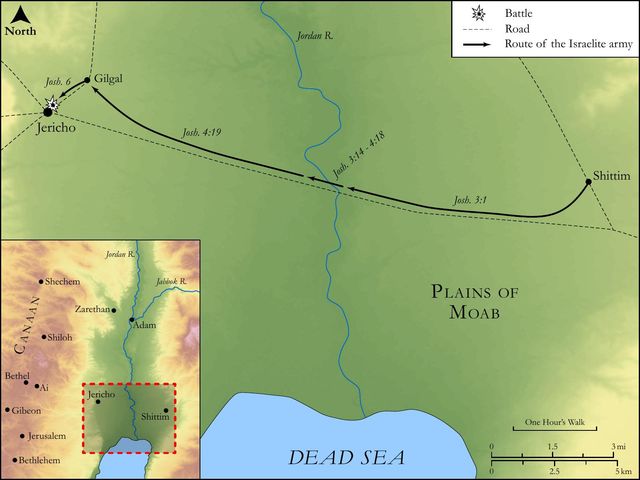
This clause establishes the central role of the Ark of the Covenant, the tangible symbol of God's presence, authority, and covenant faithfulness. The "they" refers specifically to the priests, consecrated Levites, who were divinely appointed to carry this most sacred object. Their arrival at the riverbank signifies the culmination of their journey from Shittim and their immediate proximity to the final, formidable barrier before entering the promised land of Canaan. It underscores that God, through His chosen vessel and His designated servants, is actively leading the way for His people.
"and the feet of the priests that bare the ark were dipped in the brim of the water"
This is the pivotal moment of faith and obedience. The priests, bearing the Ark, are commanded to make physical contact with the turbulent, overflowing waters. This act of stepping in before the miracle occurs is profoundly significant. It demonstrates their complete and unwavering trust in God's word, even when the circumstances appear perilous and contrary to all natural logic. Their initial, courageous step of faith serves as the catalyst for the divine action, making their obedience an active prerequisite for the miraculous parting of the waters.
"(for Jordan overfloweth all his banks all the time of harvest,)"
This parenthetical clause functions as a crucial explanatory note, providing the essential context necessary to fully appreciate the extraordinary magnitude of the impending miracle. It clarifies that the river was not merely passable or at a low ebb, but was at its most formidable, dangerous, and impassable state. This precise detail eliminates any natural explanation for the subsequent crossing, unequivocally attributing the parting of the waters to the supernatural power of God alone. It amplifies the wonder, the divine authority, and the undeniable glory demonstrated by God in this momentous event.
Literary Devices
ShowHideJoshua 3:15 employs several powerful literary devices to enhance its narrative impact and theological significance. The Parenthetical Explanation in the clause "(for Jordan overfloweth all his banks all the time of harvest,)" is a key feature, providing vital background information that profoundly magnifies the miracle. This detail functions as a form of Amplification, intensifying the reader's understanding of the immense, humanly insurmountable challenge faced by the Israelites, thereby highlighting the extraordinary nature of God's intervention. The overflowing Jordan itself serves as potent Symbolism, representing the formidable, seemingly impassable obstacles that often stand between God's people and His promised blessings. The act of the priests stepping into the raging water, prior to its parting, creates a sense of Dramatic Irony for the reader, who is aware of the miraculous outcome, but for the characters involved, it is an act of profound Faith that underscores the tension and the absolute necessity of trust in God's word. The entire scene also carries a strong sense of Foreshadowing, subtly hinting at the even greater and more dramatic display of divine power that is about to unfold in the subsequent verses of the chapter.
Theological and Thematic Connections
ShowHideJoshua 3:15 stands as a profound theological declaration concerning God's omnipotence, His unwavering faithfulness to His covenant promises, and the essential nature of human faith. It powerfully illustrates that God frequently calls His people to step out in audacious obedience into challenging, even seemingly impossible, circumstances before He fully reveals His divine solution. The overflowing Jordan, an insurmountable barrier by any human standard, serves as a powerful testament to God's absolute sovereignty over all creation and His unparalleled ability to make a way where there is no way. This momentous event solidifies Joshua's divinely appointed leadership, confirming him as God's chosen successor to Moses, and profoundly reminds all Israel that their entry into the Promised Land is not by their own might, strategy, or power, but solely by divine intervention. It underscores the timeless biblical principle that God's active presence, visibly symbolized by the Ark, is the key to overcoming life's greatest obstacles, and that His timing is perfect, often choosing moments of greatest difficulty to display His glory and power most clearly.
Reflection and Application
ShowHideJoshua 3:15 offers a timeless and deeply profound lesson for believers navigating their own "Jordan moments"—those seemingly insurmountable obstacles or periods of daunting transition in life. It challenges us to honestly consider where God might be calling us to step out in faith, even when the path ahead appears overwhelming, dangerous, or utterly impossible by human reckoning. Just as the priests were required to dip their feet into the raging river before it miraculously parted, we are often called to take the very first step of obedience and trust, even when we cannot fully discern the complete solution or the entire path forward. This verse profoundly encourages us to trust implicitly in God's perfect timing, knowing that He frequently allows circumstances to reach their most challenging and desperate point precisely to magnify His power and ensure that His intervention is undeniably supernatural. It serves as a powerful reminder that God's presence, symbolized by the Ark, goes before us, faithfully leading the way through the seemingly impassable obstacles of life—whether they manifest as financial crises, health battles, relational breakdowns, or periods of spiritual wilderness. Our act of faith, however small or seemingly insignificant, can be the divine catalyst for God to open a way where there was none, demonstrating His unwavering faithfulness to His promises and His profound desire to lead us into His promised blessings and spiritual inheritance.
Questions for Reflection
ShowHideFAQ
ShowHideWhy was it important that the Jordan was overflowing at the time of the crossing?
ShowHideThe fact that the Jordan River was overflowing its banks during the harvest season (its peak flood stage) is critically important for several profound reasons. First, it completely eliminates any possibility of a naturalistic explanation for the crossing, thereby making the subsequent parting of the waters an undeniable, irrefutable miracle of God. Had the river been at a low ebb, skeptics might attribute the crossing to a natural phenomenon or a fortunate coincidence. Second, it powerfully highlights the immense power and absolute sovereignty of God over all creation. He deliberately chose the most challenging and humanly impossible moment to demonstrate His unparalleled ability to overcome any obstacle for the sake of His people. Third, it profoundly magnifies the faith and courageous obedience of the priests and the entire Israelite community; they were commanded to step into a dangerous, raging torrent, not a gentle stream, which unequivocally underscores their deep trust in God's word and command (see Joshua 3:7-8). This crucial detail ensures that the glory for the miraculous crossing belongs entirely and exclusively to God, powerfully confirming His active presence and supreme power among His people as they finally entered the long-promised land.
What is the significance of the priests carrying the Ark of the Covenant into the water?
ShowHideThe priests carrying the Ark of the Covenant into the water holds profound theological and symbolic significance. The Ark represented the very presence of God dwelling among His people, serving as His throne and the tangible embodiment of His covenant with Israel. By having the priests, who were consecrated for sacred service to God, carry the Ark and lead the way, it emphatically emphasized that God Himself was actively leading His people into the Promised Land. This was not a human military strategy or a mere logistical maneuver, but a divine initiative from start to finish. The Ark's presence sanctified the path and powerfully symbolized God's direct and active role in conquering the land and fulfilling His ancient promises. Furthermore, the fact that the priests' feet had to physically touch the water before it miraculously parted underscored a vital biblical principle of faith and obedience: God's power was unleashed in direct response to their courageous step of trust, demonstrating that divine action often awaits human response to divine command. This act also served to publicly confirm and magnify Joshua's leadership, as God had explicitly promised to exalt him in the sight of all Israel (see Joshua 3:7).
Christ-Centered Fulfillment
ShowHideThe miraculous crossing of the Jordan River, initiated by the priests stepping into the overflowing waters with the Ark of the Covenant, finds its ultimate and most profound Christ-centered fulfillment in the person and redemptive work of Jesus Christ. The Jordan, presented as a formidable, humanly insurmountable barrier to the earthly Promised Land, can be seen as a powerful type of the ultimate, insurmountable barrier of sin and death that separates fallen humanity from God's true spiritual "promised land" of eternal life, perfect fellowship, and divine rest. Just as the Ark, symbolizing God's active presence, led the way through the waters, so Jesus Christ, the ultimate and perfect embodiment of God's presence among humanity (John 1:14), has opened the only way for us to overcome this spiritual chasm. His own baptism in the Jordan River (Matthew 3:13-17), though not involving a parting of waters, marked the commencement of His public ministry, through which He would ultimately conquer the power of sin and death on the cross. Christ Himself is the "new and living way" (Hebrews 10:19-20) who has not only dipped His feet but has fully entered into the ultimate "overflowing Jordan" of God's righteous judgment on sin, enduring death itself, and emerging victoriously from the grave. Through His resurrection, He has made it eternally possible for all who believe in Him to enter into the true spiritual rest and glorious inheritance found in God's eternal kingdom. He is our Great High Priest, who has not merely touched the waters but has fully entered into the depths of death and emerged triumphant, leading us, His people, into the spiritual Canaan of God's abiding presence and everlasting promises (Romans 6:4).