


Joshua 3:14
Bible text: King James Version (1769 Blayney text) · Public domain
Bible text: King James Version with Strong's numbers · Public domain
Bible text: Berean Standard Bible · Public domain
Bible text: American Standard Version (1901) · Public domain
Bible text: World English Bible, Messianic edition · Public domain
Bible text: Geneva Bible (1599) · Public domain
Bible text: Young's Literal Translation · Public domain
- וַיְהִיvay·Hiand it wasH1961Conj-w ¦ V-Qal-ConsecImperf-3msVerb Qal Consecutive Imperfect 3rd Singular Masculineוַandיְהִיit was
- בִּנְסֹעַbin·So·a'when set outH5265Prep-b ¦ V-Qal-InfVerb Qal Infinitive Constructבִּwhenנְסֹעַset out
- הָעָםha·'Amthe peopleH5971Art ¦ N-msNoun Singular Masculine Absoluteהָtheעָםpeople
- מֵאָהֳלֵיהֶםme·'O·ho·lei·Hemfrom their tentsH168Prep-m ¦ N-mpc ¦ 3mpNoun Plural Masculine Constructמֵfromאָהֳלֵיtentsהֶםtheir
- לַעֲבֹרla·'a·Vorto pass overH5674Prep-l ¦ V-Qal-InfVerb Qal Infinitive Constructלַtoעֲבֹרpass over
- אֶת'et<obj.>H853DirObjMParticle Object Indicator
- הַיַּרְדֵּןhai·yar·Denthe JordanH3383Art ¦ N-properNoun Proper LocationהַtheיַּרְדֵּןJordan
- וְהַכֹּהֲנִיםve·ha·ko·ha·Nimand the priestsH3548Conj-w ¦ Art ¦ N-mpNoun Plural Masculine Absoluteוְandהַtheכֹּהֲנִיםpriests
- נֹשְׂאֵיno·se·'Ei[the] bearers ofH5375V-Qal-Prtcpl-mpVerb Qal Participle Plural Masculine Construct
- הָאָרוֹןha·'a·Ronthe arkH727Art ¦ N-msNoun Singular Masculine Absoluteהָtheאָרוֹןark
- הַבְּרִיתha·be·Ritthe covenantH1285Art ¦ N-fsNoun Singular Feminine Absoluteהַtheבְּרִיתcovenant
- לִפְנֵיlif·Nei<to> beforeH6440Prep-l ¦ N-mpcNoun Plural Masculine Constructלִ<to>פְנֵיbefore
- הָעָםha·'Amthe peopleH5971Art ¦ N-msNoun Singular Masculine Absoluteהָtheעָםpeople
English is a literal word-by-word gloss of the Hebrew, not the KJV's wording. Why?
This is the original text the KJV's translators worked from — each Hebrew word with its own literal English meaning in this verse, prepared by scholars at Tyndale House, Cambridge. The KJV translates whole sentences, not word by word, so its wording differs: one Hebrew word can become several English words, and the KJV may choose “the LORD” where the gloss reads “Yahweh”. Both are faithful — they answer different questions. For the KJV's own rendering, switch to the KJV text.
Details
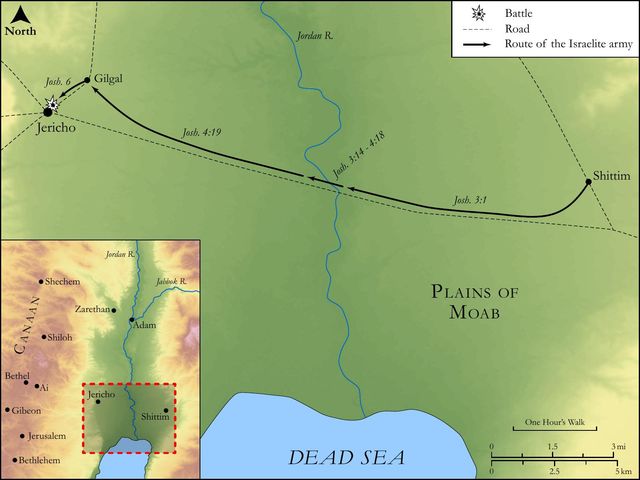
See on the biblical-era map
Study this verse
Public-domain commentary
Matthew Henry
From his Commentary on the Whole Bible. Henry comments on passages, not single verses — this entry covers Joshua 3:14–17. His two-level outline is real structure in the source text, so it is rendered as structure.
Here we have a short and plain account of the dividing of the river Jordan, and the passage of the children of Israel through it. The story is not garnished with the flowers of rhetoric (gold needs not to be painted), but it tell us, in short, matter of fact.
I.That this river was now broader and deeper than usually it was at other times of the year, Jos 3:15.
The melting of the snow on the mountains of Lebanon, near which this river had its rise, was the occasion that at the time of harvest, barley-harvest, which was the spring of the year, Jordan overflowed all his banks. This great flood, just at that time (which Providence might have restrained for once, of which he might have ordered them to cross at another time of the year) very much magnified the power of God and his kindness to Israel. Note, Though the opposition given to the salvation of God's people have all imaginable advantages, yet god can and will conquer it. Let the banks of Jordan be filled to the brink, filled till they run over, it is as easy to Omnipotence to divide them, and dry them up, as if they were ever so narrow, ever so shallow; it is all one with the Lord.
II.That as soon as ever the feet of the priests dipped in the brim of the water the stream stopped immediately, as if a sluice had been led down to dam it up, Jos 3:15, Jos 3:16. So that the waters above swelled, stood on a heap, and ran back, and yet, as it should seem did not spread, but congealed, which unaccountable rising of the river was observed with amazement by those that live upward upon it many miles off, and the remembrance of it remained among them long after: the waters on the other side this invisible dam ran down of course, and left the bottom of the river dry as far downward, it is likely, as they swelled upward. When they passed through the red Sea, the waters were a wall on either hand, here only on the right-hand. Note, The God of nature can, when he pleases, change the course of nature, and alter its properties, can turn fluids into solids, waters into standing rocks, as, on the contrary, rocks into standing waters, to serve his own purposes. See Psa 114:5, Psa 114:8. What cannot God do? What will he not do for the perfecting of his peoples, salvation? Sometimes he cleaves the earth with rivers (Hab 3:9), and sometimes, as here, cleaves the rivers without earth. It is easy to imagine how, when the course of this strong rapid stream was arrested on a sudden, the waters roared and were troubled, so that the mountains seemed to shake with the swelling thereof (Psa 46:3), how the floods lifted up their voice, the floods lifted up their waves, while the Lord on high showed himself mightier than the noise of these many waters, Psa 93:3, Psa 93:4. With reference to this the prophet asks, Was the Lord displeased against the rivers? was thine anger against the rivers? Hab 3:8. No, Thou wentest forth for the salvation of thy people, Jos 3:13. In allusion to this, it is foretold, among the great things God will do for the gospel church in the latter days, that the great river Euphrates shall be dried up, that the way of the kings of the east may be prepared, Rev 16:12. When the time has come for Israel's entrance into the land of promise all difficulties shall be conquered, mountains shall become plains (Zac 4:7) and rivers become dry, for the ransomed of the Lord to pass over. When we have finished our pilgrimage through this wilderness, death will be like this Jordan between us and the heavenly Canaan, but the ark of the covenant has prepare us a way through it; it is the last enemy that shall be destroyed.
III.That the people passed over right against Jericho, which was,
1.An instance of their boldness, and a noble defiance of their enemies. Jericho was one of the strongest cities, and yet they dared to face it at their first entrance.
2.It was an encouragement to them to venture through Jordan, for Jericho was a goodly city and the country about it extremely pleasant; and, having that in view as their own, what difficulties could discourage them from taking possession?
3.It would increase the confusion and terror of their enemies, who no doubt strictly observed their motions, and were the amazed spectators of this work of wonders.
IV.That the priests stood still in the midst of Jordan while all the people passed over, Jos 3:17.
There the ark was appointed to be, to show that the same power that parted the waters kept them parted as long as there was occasion; and had not the divine presence, of which the ark was a token, been their security, the waters would have returned upon them and buried them. there the priests were appointed to stand still,
1.To try their faith, whether they could venture to take their post, when god assigned it to them, with mountains of water over their heads. As they made a bold step when they set the first foot into Jordan, so now they made a bold stand when they tarried longest in Jordan; but they knew they carried their own protection with them. Note, Ministers in times of peril should be examples of courage and confidence in the divine goodness.
2.It was to encourage the faith of the people, that they might go triumphantly into Canaan, and fear no evil, no, not in this valley of the shadow of death (for so the divided river was), being assured of God's presence, which interposed between them and the greatest danger, between them and the proud waters, which otherwise had gone over their souls. Thus in the greatest dangers the saints are comforted with his rod and his staff, Psa 23:4.
Historical interpretation
Two Centuries of Reception
3 surviving comments on this verse. Each one is dated, so this reads as a timeline rather than a list.
Select a marker to jump to its quote. Markers stagger vertically where authors wrote within a few decades of each other.
And do not imagine that these deeds are only in former times and nothing so great as this is brought forth in you who are now the hearer of them. For all things are fulfilled in you according to a mystical reckoning. Indeed you who long to draw near to the hearing of the divine law have recently forsaken the darkness of idolatry and are now for the first time forsaking Egypt. When you are reckoned among the number of catechumens and have undertaken to submit to the precepts of the church, you have parted the Red Sea and, placed in the stations of the desert, you daily devote yourself to hearing the law of God and to looking upon the face of Moses, through which the glory of the Lord is revealed. But if, you also have entered the mystic font of baptism and in the presence of the priestly and levitical order have been instructed by those venerable and magnificent sacraments, which are known to those who are permitted to know those things, then, with the Jordan parted, you will enter the land of promise by the services of the priests. In this land, Jesus receives you after Moses and becomes for you the leader of a new way.
Joshua son of Nun made the Jordan River stop, but only as long as the ark was in the water. As soon as the people had crossed to the other side and the ark had come through, he gave the river back its usual flow again. The bottom of the deep in the Red Sea was denuded of water when the sea was driven back to either side by the Spirit, but the duration of the marvel was the passage of the army through the deep on the dry strip. But after that the surface of the sea became one again, and the temporary gap was flooded over. So this remains a unique event which occurred in such a way that the marvel did not lose credibility because of the passage of time, since it continues to be testified to by visible traces.
Then there are the deeds of Joshua, who was marked out with Christ’s name; under his guidance the Jordan kept its stream stationary and its waters still as it recoiled from the countenance of the divine ark. A strange power divided the river. One section came to a halt, its stream flowing back, while another section hastened in its gliding course to the sea, leaving the river bed exposed. Where the current surged strongly from its source, it held back and piled high its waves, so that a threatening mountain of water hung poised in quivering formation and looked down to see human feet passing across the dry, deep bed, and grimy soles hastening over the congealed mud, dry-footed in mid-river.
Continue studying Joshua 3:14 across the web’s major study libraries — every link below opens this exact verse, chapter, or book on the destination site.
Read & Compare
 BibleGatewayThis verse in more than 200 translations and 70 languages.
 Bible.comThe YouVersion reader — hundreds of translations, reading plans, and highlights.
 ESV.orgCrossway's official English Standard Version reader.
 NET BibleThe NET translation with 60,000+ translators' notes on every rendering decision.
 STEP BibleTyndale House's free study tool — original text, vocabulary, and scholarly resources.
 BibliaLogos Bible Software's free web reader.
 USCCBThe New American Bible (Revised Edition) with the U.S. bishops' study notes.
Commentaries
 BibleHub CommentariesDozens of classic commentaries on this verse, gathered on one page.
 StudyLightMore than 100 commentary sets — the largest collection on the web.
 BibleRefPlain-English commentary on what this verse means, verse by verse.
 Enduring WordDavid Guzik's free commentary on this chapter, widely used by Bible teachers.
 Bible Study ToolsVerse commentary alongside Greek and Hebrew study aids.
Original Language & Research
- BibleHub InterlinearThe verse word by word — original language, transliteration, and English.
- BibleHub LexiconEvery word's original-language definition and Strong's entry.
 Blue Letter BibleDeep-study tools — Strong's numbers, concordance, and word studies.
 SefariaThe Hebrew text with Rashi and centuries of Jewish commentary.
Sermons, Hymns & Audio


TrulyRandomVerse is not affiliated with these sites and doesn’t control their content. They’re linked because they’re genuinely useful.
Summary
Joshua 3:14 marks the pivotal moment when the Israelites, under divine command, broke camp and began their advance towards the Jordan River. This crucial movement, led by the priests bearing the sacred Ark of the Covenant, sets the immediate stage for the miraculous parting of the Jordan, underscoring God's active presence and leadership in bringing His people into the promised inheritance after forty years of wilderness wandering.
Context
ShowHideLiterary Context
This verse is strategically placed at a pivotal juncture in the book of Joshua, serving as the narrative trigger for the long-awaited entry into the Promised Land. It immediately follows God's clear and detailed instructions to Joshua concerning the crossing of the Jordan, including the command for the priests to bear the Ark of the Covenant (see Joshua 3:7-8). Furthermore, it is directly succeeded by the detailed account of the miraculous parting of the waters (see Joshua 3:15-17). The preceding verses also describe the people's consecration (see Joshua 3:5) and Joshua's charge to the priests regarding their role. Thus, Joshua 3:14 transitions the narrative from divine instruction and human preparation to concrete, faith-filled action, initiating the physical movement that will culminate in the fulfillment of God's ancient promises.
Historical & Cultural Context
The Israelites stood at the threshold of the Promised Land, having completed forty years of wilderness wandering—a period marked by divine provision, discipline, and the formation of a national identity under the Mosaic Covenant. The Jordan River, particularly during the spring harvest season (as explicitly noted in Joshua 3:15), was at its annual flood stage, rendering a natural crossing utterly impossible for such a vast multitude. This natural barrier heightened the necessity and dramatic impact of divine intervention. Central to this scene was the Ark of the Covenant, the most sacred object in Israel, representing God's throne, His manifest presence among His people, and the tangible embodiment of His covenant relationship with them. Its placement at the head of the procession, carried by the consecrated priests, was a profound visual and theological statement: God Himself was leading the way into the challenges and promises of Canaan, demonstrating His faithfulness and power. The priests' unique role as bearers of the Ark underscored their mediatorial function and the holiness required for engaging with God's presence.
Key Themes
ShowHideJoshua 3:14 powerfully contributes to several overarching themes within the book of Joshua and the broader Pentateuchal narrative. Firstly, it emphatically highlights Divine Sovereignty and Guidance, demonstrating that God is not a distant observer but an active, personal leader of His people. The entire movement is orchestrated by Him, with the Ark symbolizing His personal presence going before them, much as it did during their wilderness wanderings (see Numbers 10:33). Secondly, it underscores the theme of Obedience and Faith, as the people are called to step out in trust towards an impassable river based solely on God's command and promise. Their "removal from their tents" is a tangible act of faith, a willingness to follow God into the unknown. Thirdly, the Significance of the Ark of the Covenant is paramount; its leading position signifies that God's covenant faithfulness is the foundational assurance for their entry into the land, and His power will overcome all obstacles. Lastly, this verse marks the literal and symbolic Transition from the nomadic wilderness existence to the settled life in the Promised Land, signifying the climactic fulfillment of centuries-old promises made to Abraham (see Genesis 12:7).
Exposition and Analysis
ShowHideKey Word Analysis
ShowHideFrom the primitive root H5265, this verb properly signifies "to pull up" (especially tent-pins), implying "to start on a journey" or "to set out." In this context, it conveys a decisive and purposeful breaking of camp, indicating not a casual stroll but a deliberate, commanded movement towards a specific, divinely appointed destination. It encapsulates an act of obedience and profound faith, as the people are moving towards an insurmountable natural obstacle (the flooded Jordan) with no visible human means of crossing, trusting that God will miraculously make a way.
Derived from H168, "tents" refer to the temporary dwellings of the Israelites during their forty years of wilderness wandering. Their "removal from their tents" symbolizes the definitive end of an era—the nomadic, transient phase of their history—and the beginning of their permanent settlement in the Promised Land. This act signifies a profound transition from a wandering existence to an inherited home, marking a fundamental shift in their national identity and destiny as God's covenant people.
This term denotes a "compact," "confederacy," or "league," often referring to an agreement made by "cutting" (as in passing between pieces of flesh in a covenant ritual). In this verse, as part of "the ark of the covenant," it highlights the foundational relationship between God and Israel. The Ark, containing the tablets of the Law, was the tangible symbol of God's solemn promises and requirements. Its leading position emphasizes that the entire undertaking of entering Canaan is rooted in God's faithfulness to His covenant, and it is His covenant power that enables the impossible crossing.
Verse Breakdown
ShowHide"And it came to pass, when the people removed from their tents,"
This opening clause establishes the initiation of the decisive action, signaling a significant event in the unfolding narrative. The phrase "the people removed from their tents" highlights their collective obedience and the physical commencement of the journey, signifying their readiness to leave their nomadic past behind and step into their promised future. This movement is a direct response to divine command, demonstrating their active participation in God's plan.
"to pass over Jordan,"
This phrase clearly states both the immediate objective and the formidable obstacle confronting the Israelites. The Jordan River, particularly at its flood stage, represented an impassable barrier, a natural boundary to the Promised Land. This objective sets the stage for the miraculous intervention that is about to occur, emphasizing that human effort, ingenuity, or strength alone would be utterly insufficient to achieve this divinely appointed goal.
"and the priests bearing the ark of the covenant before the people;"
This final, crucial clause reveals the divine strategy and the ultimate source of Israel's power and success. The priests, consecrated for sacred service, carrying the Ark—the most sacred object, the tangible symbol of God's manifest presence, His throne, and His covenant authority—at the very front of the procession, demonstrates unequivocally that God Himself is leading the charge. This specific arrangement ensures that the people understand that their success is not attributable to their own military might or strategic planning, but solely to God's sovereign power and unwavering covenant faithfulness.
Literary Devices
ShowHideThe verse employs several powerful literary devices that amplify its theological significance. Foreshadowing is prominently featured, as the seemingly ordinary act of breaking camp, combined with the extraordinary detail of the Ark leading the way, strongly hints at the miraculous event about to unfold at the Jordan River. The Symbolism of the Ark of the Covenant is central; it is not merely a physical container but a profound representation of God's active, leading presence, His unwavering covenant fidelity, and His sovereign power over creation. The Narrative Progression is clear and deliberate, moving from a state of preparation to the commencement of the decisive action, effectively building suspense and anticipation towards the climax of the river crossing. Furthermore, there is a strong Emphasis on divine leadership through the specific mention of the priests bearing the Ark "before the people," highlighting that God, not human strategy or might, is the true and ultimate leader of Israel into their inheritance.
Theological and Thematic Connections
ShowHideJoshua 3:14 is a profound theological statement about God's unwavering faithfulness and His distinctive method of leading His people into their inheritance. It teaches that entering into God's promises often necessitates an initial, courageous step of faith—a deliberate movement towards the seemingly impossible—with the absolute assurance that God Himself goes before us. The Ark's leading role profoundly underscores that divine presence and covenant faithfulness are the true keys to overcoming formidable obstacles and possessing what God has promised. This event powerfully echoes the earlier miraculous deliverance at the Red Sea, establishing a consistent pattern of God making a way through impassable waters to bring His people to freedom and the fulfillment of His promises. It serves as an enduring reminder that God's power is not constrained by natural barriers, and His active presence guarantees success for those who obediently follow His leading.
Reflection and Application
ShowHideJoshua 3:14 serves as a powerful and enduring reminder that our spiritual journey of faith frequently involves stepping out into the unknown, trusting implicitly in God's manifest presence and sovereign power to make a way where there appears to be none. Just as the Israelites were compelled to physically "remove from their tents" and advance towards the daunting, flooded Jordan, we too are called to leave behind our comfort zones, familiar patterns of thought, and self-reliance, advancing towards the "Jordans" in our own lives—whether they represent challenging circumstances, new divine callings, or seemingly insurmountable obstacles that block our path to God's promises. This verse profoundly encourages us to fix our gaze not on the imposing size or nature of the obstacle, but steadfastly on the God who goes before us. It challenges us to cultivate a deep, abiding trust in His leading, recognizing that His presence is our ultimate assurance of success and breakthrough. Our obedience, even in the face of profound uncertainty, is the key that unlocks His miraculous intervention, allowing us to experience His faithfulness in new and profound ways as we step into the inheritance He has prepared for us.
Questions for Reflection
ShowHideFAQ
ShowHideWhy was the Ark of the Covenant so important in this event?
ShowHideThe Ark of the Covenant was supremely important because it symbolized the very presence of the living God among His people. It was not merely a religious artifact but the tangible representation of God's throne, His ultimate authority, and the enduring terms of His covenant faithfulness to Israel. By having the priests, who were consecrated for sacred service, carry the Ark at the forefront of the procession, God was unequivocally demonstrating that He Himself was leading the way into the Promised Land and would personally overcome the formidable obstacle of the Jordan River. This emphasized that the impending miracle was entirely of divine origin, not attributable to human strength, strategy, or ingenuity, thereby instilling profound faith and awe in the people. Its presence also underscored the holiness required for approaching God and receiving His blessings and provisions.
What does the detail "Jordan at flood stage" add to the narrative?
ShowHideThe crucial detail that the Jordan River was "at flood stage" (explicitly mentioned in Joshua 3:15) is vital because it dramatically heightens the miraculous nature of the crossing. If the river had been low, easily fordable, or at its typical dry-season level, the event would have been far less impressive and its divine origin less apparent. By describing it as being at its fullest, swelled by the spring harvest rains, the text emphasizes that a natural crossing for such a vast multitude was absolutely impossible. This detail powerfully underscores God's absolute sovereignty and power over nature and His ability to make a way where there is no humanly conceivable path. It magnifies the divine intervention, demonstrating that God can remove any barrier, no matter how formidable, to fulfill His promises to His people and bring them into their inheritance.
Christ-Centered Fulfillment
ShowHideJoshua 3:14, with its vivid depiction of the Ark of the Covenant leading Israel through the impassable Jordan River into the long-awaited Promised Land, profoundly foreshadows the person and redemptive work of Jesus Christ. Christ is the ultimate "Ark of the Covenant," the very embodiment of God's manifest presence among humanity, for in Him "all the fullness of the Deity lives in bodily form" (Colossians 2:9). Just as the Ark went before Israel, making an impossible way through the waters, so Jesus, our Great High Priest (as powerfully affirmed in Hebrews 4:14), has gone before us. He has passed through the "waters" of sin, death, and God's righteous judgment, opening the only way into the true spiritual promised land—eternal life, reconciliation, and intimate fellowship with God. He is unequivocally "the way, and the truth, and the life" (John 14:6), leading His redeemed people through the seemingly impossible obstacles of a fallen world into the glorious inheritance secured by His perfect sacrifice. Our "removal from our tents" of sin, self-reliance, and worldly security is a decisive step of faith, a call to follow Him who has already conquered, trusting that His abiding presence guarantees our passage into the abundant and eternal life He so freely offers (John 10:10).