


1 Chronicles 12:15
Bible text: King James Version (1769 Blayney text) · Public domain
Bible text: King James Version with Strong's numbers · Public domain
Bible text: Berean Standard Bible · Public domain
Bible text: American Standard Version (1901) · Public domain
Bible text: World English Bible, Messianic edition · Public domain
Bible text: Geneva Bible (1599) · Public domain
Bible text: Young's Literal Translation · Public domain
- אֵלֶּה'E·lehtheseH428PrtParticle Demonstrative
- הֵםHem[were] theyH1992Pro-3mpPronoun Personal 3rd Plural Masculine
- אֲשֶׁר'a·SherwhoH834RelParticle Relative
- עָבְרוּ'a·ve·Ruthey passed overH5674V-Qal-Perf-3cpVerb Qal Perfect 3rd Plural common gender
- אֶת'et<obj.>H853DirObjMParticle Object Indicator
- הַיַּרְדֵּןhai·yar·Denthe JordanH3383Art ¦ N-properNoun Proper LocationהַtheיַּרְדֵּןJordan
- בַּחֹדֶשׁba·Cho·deshin the monthH2320Prep-b ¦ N-msNoun Singular Masculine Absoluteבַּin theחֹדֶשׁmonth
- הָרִאשׁוֹןha·ri·Shon<the> firstH7223Art ¦ Adj-msAdjective Numerical Position Singular Masculine Absoluteהָ<the>רִאשׁוֹןfirst
- וְהוּאve·Hu'and itH1931Conj-w ¦ Pro-3msPronoun Personal 3rd Singular Masculineוְandהוּאit
- מְמַלֵּאme·ma·Le'[was] overflowingH4390V-Piel-Prtcpl-msVerb Piel Participle Singular Masculine Absolute
- עַל'aloverH5921PrepPreposition
- כָּלkolallH3605N-mscNoun Singular Masculine Construct
- גְּדוֹתָיוgi·d·yo·tavits banksH1415N-fpc ¦ 3msNoun Plural Feminine Constructגְּדוֹתָיbanksוits
- וַיַּבְרִיחוּvai·yav·Ri·chuand they put to flightH1272Conj-w ¦ V-Hiphil-ConsecImperf-3mpVerb Hiphil Consecutive Imperfect 3rd Plural Masculineוַandיַּבְרִיחוּthey put to flight
- אֶת'et<obj.>H853DirObjMParticle Object Indicator
- כָּלkolallH3605N-mscNoun Singular Masculine Construct
- הָעֲמָקִיםha·'a·ma·Kimthe valleysH6010Art ¦ N-mpNoun Plural Masculine Absoluteהָtheעֲמָקִיםvalleys
- לַמִּזְרָחla·miz·Rachto the eastH4217Prep-l ¦ N-msNoun Singular Masculine Absoluteלַto theמִּזְרָחeast
- וְלַמַּעֲרָבve·La·ma·'a·Ravand to the westH4628Conj-w ¦ Prep-l ¦ N-msNoun Singular Masculine Absoluteוְandלַto theמַּעֲרָבwest
English is a literal word-by-word gloss of the Hebrew, not the KJV's wording. Why?
This is the original text the KJV's translators worked from — each Hebrew word with its own literal English meaning in this verse, prepared by scholars at Tyndale House, Cambridge. The KJV translates whole sentences, not word by word, so its wording differs: one Hebrew word can become several English words, and the KJV may choose “the LORD” where the gloss reads “Yahweh”. Both are faithful — they answer different questions. For the KJV's own rendering, switch to the KJV text.
Details
See on the biblical-era maps
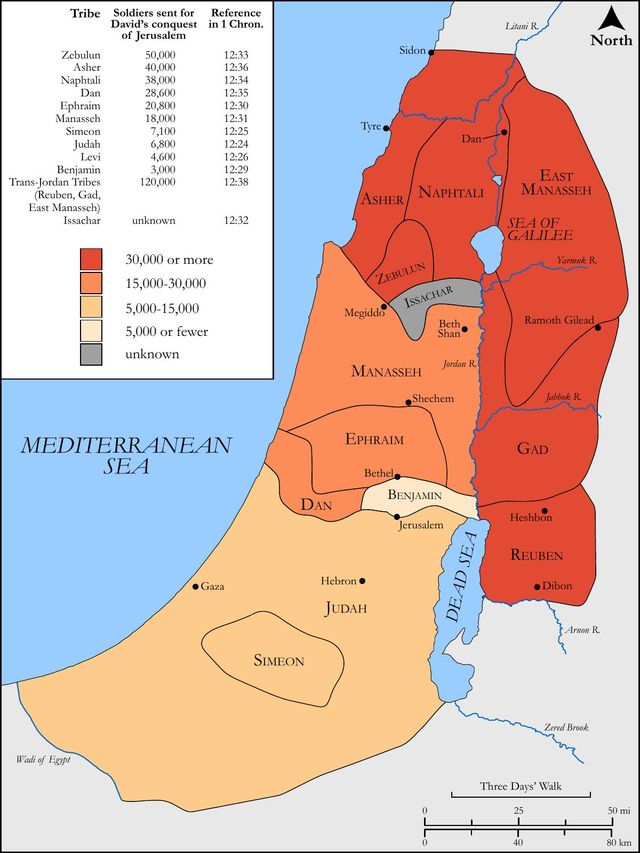
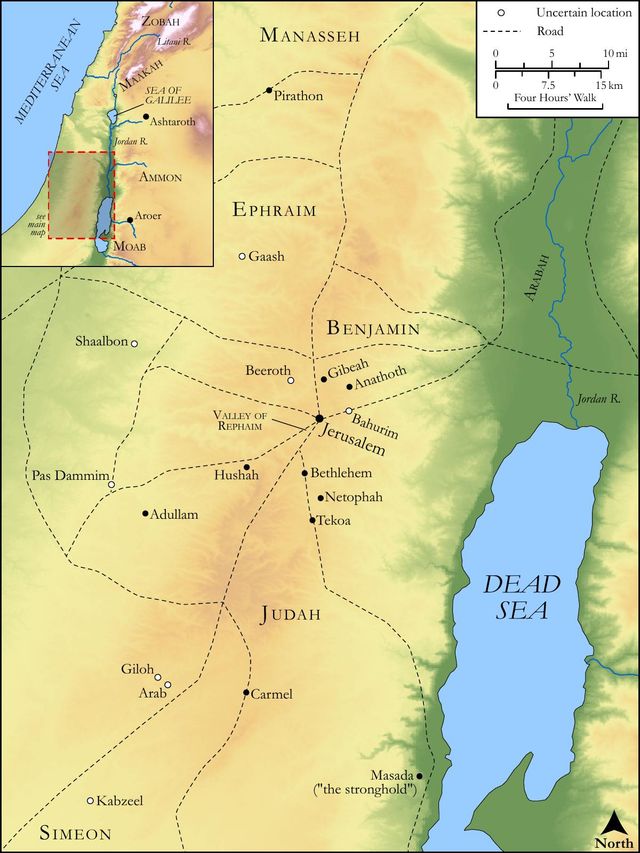
Study this verse
Public-domain commentary
Matthew Henry
From his Commentary on the Whole Bible. Henry comments on passages, not single verses — this entry covers 1 Chronicles 12:1–22. His four-level outline is real structure in the source text, so it is rendered as structure.
We have here an account of those that appeared and acted as David's friends, upon the death of Saul, to bring about the revolution. All the forces he had, while he was persecuted, was but 600 men, who served for his guards; but, when the time had come that he must begin to act offensively, Providence brought in more to his assistance. Even while he kept himself close, because of Saul (Ch1 12:1), while he did not appear, to invite or encourage his friends and well-wishers to come in to him (not foreseeing that the death of Saul was so near), God was inclining and preparing them to come over to him with seasonable succours. Those that trust God to do his work for them in his own way and time shall find his providence outdoing all their forecast and contrivance. The war was God's, and he found out helpers of the war, whose forwardness to act for the man God designed for the government is here recorded to their honour.
I.Some, even of Saul's brethren, of the tribe of Benjamin, and a-kin to him, came over to David, Ch1 12:2.
What moved them to it we are not told. Probably a generous indignation at the base treatment which Saul, one of their tribe, gave him, animated them to appear the more vigorously for him, that the guilt and reproach of it might not lie upon them. These Benjamites are described to be men of great dexterity, that were trained up in shooting and slinging, and used both hands alike - ingenious active men; a few of these might do David a great deal of service. Several of the leading men of them are here named. See Jdg 20:16.
II.Some of the tribe of Gad, though seated on the other side Jordan, had such a conviction of David's title to the government, and fitness for it, that they separated themselves from their brethren (a laudable separation it was) to go to David, though he was in the hold in the wilderness (Ch1 12:8), probably some of his strong holds in the wilderness of Engedi. They were but few, eleven in all, here named, but they added much to David's strength. Those that had hitherto come in to his assistance were most of them men of broken fortunes, distressed, discontented, and soldiers of fortune, that came to him rather for protection than to do him any service, Sa1 22:2. But these Gadites were brave men, men of war, and fit for the battle, Ch1 12:8. For,
1.They were able-bodied men, men of incredible swiftness, not to fly from, but to fly upon, the enemy, and to pursue the scattered forces. In this they were as swift as the roes upon the mountains, so that no man could escape from them; and yet they had faces like the faces of lions, so that no man could out-fight them.
2.They were disciplined men, trained up to military exercises; they could handle shield and buckler, use both offensive and defensive weapons.
3.They were officers of the militia in their own tribe (Ch1 12:14), so that though they did not bring soldiers with them they had them at command, hundreds, thousands.
4.They were daring men, that could break through the greatest difficulties. Upon some expedition or other, perhaps this to David, they swam over the Jordan, when it overflowed all its banks, Ch1 12:15. Those are fit to be employed in the cause of God that can venture thus in a dependence upon the divine protection.
5.They were men that would go through with the business they engaged in. What enemies those were that they met with in the valleys, when they had passed Jordan, does not appear; but they put them to flight with their lion-like faces, and pursued them with matchless fury, both towards the east and towards the west; which way soever they turned, they followed their blow, and did not do their work by halves.
III.Some of Judah and Benjamin came to him, Ch1 12:16.
Their leader was Amasai, whether the same with that Amasa that afterwards sided with Absalom (Sa2 17:25) or no does not appear. Now here we have,
1.David's prudent treaty with them, Ch1 12:17. He was surprised to see them, and could not but conceive some jealousy of the intentions of their coming, having been so often in danger by the treachery of the men of Ziph and the men of Keilah, who yet were all men of Judah. He might well be timorous whose life was so much struck at; he might well be suspicious who had been deceived in so many that he said, in his haste, All men are liars. No marvel that he meets these men of Judah with caution. Observe,
(1.)How he puts the matter to themselves, how fairly he deals with them. As they are, they shall find him; so shall all that deal with the Son of David.
[1.]If they be faithful and honourable, he will be their rewarder: "If you have come peaceably unto me, to help me, though you have come late and have left me exposed a great while, though you bring no great strength with you to turn the scale for me, yet I will thankfully accept your good-will, and my heart shall be knit unto you; I will love you and honour you, and do you all the kindness I can." Affection, respect, and service, that are cordial and sincere, will find favour with a good man, as they do with a good God, though clogged with infirmities, and turning to no great account. But,
[2.]If they be false, and come to betray him into the hands of Saul, under colour of friendship, he leaves them to God to be their avenger, as he is, and will be, of every thing that is treacherous and perfidious. Never was man more violently run upon, and run down, than David was (except the Son of David himself), and yet he had the testimony of his conscience that there was no wrong in his hands. He meant no harm to any man, which was his rejoicing in the day of evil, and enabled him, when he feared treachery, to commit his cause to him that judges righteously. He will not be judge in his own cause, though a wise man, nor avenge himself, though a man of valour; but let the righteous God, who hath said, Vengeance is mine, do both. The God of our fathers look thereon and rebuke it.
(2.)In this appeal observe,
[1.]He calls God the God of our fathers, both his fathers and theirs. Thus he reminded them not to deal ill with him; for they were both descendants from the same patriarchs, and both dependents on the same God. Thus he encouraged himself to believe that God would right him if he should be abused; for he was the God of his fathers and therefore a blessing was entailed on him, and a God to all Israel and therefore not only a Judge to all the earth, but particularly concerned in determining controversies between contesting Israelites.
[2.]He does not imprecate any fearful judgement upon them, though they should deal treacherously, but very modestly refers his cause to the divine wisdom and justice: The Lord look thereon, and judge as he sees (for he sees men's hearts), and rebuke it. It becomes those that appeal to God to express themselves with great temper and moderation; for the wrath of man works not the righteousness of God.
2.Their hearty closure with him, Ch1 12:18. Amasai was their spokesman, on whom the Spirit of the Lord came, not a spirit of prophecy, but a spirit of wisdom and resolution, according to the occasion, putting words into his mouth, unpremeditated, which were proper both to give David satisfaction and to animate those that accompanied him. Nothing could be said finer, more lively, or more pertinent to the occasion. For himself and all his associates,
(1.)He professed a very cordial adherence to David, and his interest, against all that opposed him, and a resolution to stand by him with the hazard of all that was dear to him: Thine are we, David, and on thy side, thou son of Jesse. In calling him son of Jesse they reminded themselves that he was lineally descended from Nahshon and Salmon, who in their days were princes of the tribe of Judah. Saul called him so in disdain (Sa1 20:27; Sa1 22:7), but they looked upon it as his honour. They were convinced that God was on his side; and therefore, Thine are we, David, and on thy side. It is good, if we must side, to side with those that side with God and have God with them.
(2.)He wished prosperity to David and his cause, not drinking a health, but praying for peace to him and all his friends and well-wishers: "Peace, peace, be unto thee, all the good thy heart desires, and peace be to thy helpers, among whom we desire to be reckoned, that peace may be on us." (3.) He assured him of help from heaven: "For thy God helpeth thee; therefore we wish peace may be, and therefore we doubt not but peace shall be, to thee and thy helpers. God is thy God, and those that have him for their God no doubt have him for their helper in every time of need and danger." From these expressions of Amasai we may take instruction how to testify our affection and allegiance to the Lord Jesus. His we must be without reservation or power of revocation. On his side we must be forward to appear and act. To his interest we must be hearty well-wishers: "Hosanna! prosperity to his gospel and kingdom;" for his God helpeth him, and will till he shall have put down all opposing rule, principality, and power.
3.David's cheerful acceptance of them into his interest and friendship. Charity and honour teach us to let fall our jealousies as soon as satisfaction is given us: David received them, and preferred them to be captains of the band.
IV.Some of Manasseh likewise joined with him, v.
19. Providence gave them a fair opportunity to do so when he and his men marched through their country upon this occasion. Achish took David with him when he went out to fight with Saul; but the lords of the Philistines obliged him to withdraw. We have the story, Sa1 29:4, etc. In his return some great men of Manasseh, who had no heart to join with Saul against the Philistines struck in with David, and very seasonably, to help him against the band of Amelekites who plundered Ziklag; they were not many, but they were all mighty men and did David good service upon that occasion, 1 Sa. 30. See how Providence provides. David's interest grew strangely just when he had occasion to make use of it, Ch1 12:22. Auxiliary forces flocked in daily, till he had a great host. When the promise comes to the birth, leave it to God to find strength to bring forth.
Continue studying 1 Chronicles 12:15 across the web’s major study libraries — every link below opens this exact verse, chapter, or book on the destination site.
Read & Compare
 BibleGatewayThis verse in more than 200 translations and 70 languages.
 Bible.comThe YouVersion reader — hundreds of translations, reading plans, and highlights.
 ESV.orgCrossway's official English Standard Version reader.
 NET BibleThe NET translation with 60,000+ translators' notes on every rendering decision.
 STEP BibleTyndale House's free study tool — original text, vocabulary, and scholarly resources.
 BibliaLogos Bible Software's free web reader.
 USCCBThe New American Bible (Revised Edition) with the U.S. bishops' study notes.
Commentaries
 BibleHub CommentariesDozens of classic commentaries on this verse, gathered on one page.
 StudyLightMore than 100 commentary sets — the largest collection on the web.
 BibleRefPlain-English commentary on what this verse means, verse by verse.
 Enduring WordDavid Guzik's free commentary on this chapter, widely used by Bible teachers.
 Bible Study ToolsVerse commentary alongside Greek and Hebrew study aids.
Original Language & Research
- BibleHub InterlinearThe verse word by word — original language, transliteration, and English.
- BibleHub LexiconEvery word's original-language definition and Strong's entry.
 Blue Letter BibleDeep-study tools — Strong's numbers, concordance, and word studies.
 SefariaThe Hebrew text with Rashi and centuries of Jewish commentary.
Sermons, Hymns & Audio


TrulyRandomVerse is not affiliated with these sites and doesn’t control their content. They’re linked because they’re genuinely useful.
Summary
1 Chronicles 12:15 powerfully narrates the extraordinary valor of the Gadite warriors who committed themselves to David. This verse highlights their remarkable feat of crossing the Jordan River during the first month, a period when its waters were at their most perilous, having overflown all its banks due to spring floods. Their determination was not merely to cross, but to engage the enemy, as they decisively routed the inhabitants of the valleys, securing territory both to the east and west. This act not only demonstrated their formidable military prowess but also underscored their unwavering loyalty and significant contribution to the consolidation of David's nascent kingdom.
Context
ShowHideLiterary Context
This verse is situated within a detailed roster of mighty men who joined David's cause, specifically during his time of exile and subsequent ascent to kingship over all Israel (1 Chronicles 12:1-22). The preceding verses (1 Chronicles 12:8-14) lavishly describe the Gadites as exceptionally brave and skilled warriors, characterized by their lion-like faces, gazelle-like swiftness, and mastery of weaponry. Verse 15 serves as a compelling narrative illustration of these attributes, providing a concrete example of their extraordinary courage and effectiveness. It functions as a testament to the caliber of individuals God was assembling to support His chosen king, showcasing their readiness to overcome formidable natural and military obstacles to fulfill their commitment to David.
Historical & Cultural Context
The "first month" refers to Nisan (or Abib), which typically corresponds to March-April on the modern calendar. This specific time of year is crucial because it marks the annual spring thaw, when melting snows from Mount Hermon and the Lebanese mountains cause the Jordan River to swell dramatically and overflow its banks, rendering it exceptionally dangerous and often impassable. The historical backdrop is David's period of consolidation, where he was gathering support and establishing his authority. The Gadites' act of crossing the flooded Jordan carries significant cultural and theological weight, echoing the miraculous crossing of the Jordan by Joshua and the Israelites under divine guidance. This parallel suggests not only the Gadites' incredible human courage but also implies a sense of divine enablement or extraordinary faith that allowed them to surmount such a formidable natural barrier, demonstrating their profound commitment to David's divinely appointed leadership. Their subsequent military success in clearing the valleys was strategically vital for securing borders and establishing control for David's emerging kingdom.
Key Themes
ShowHideThe account of the Gadites' perilous crossing of the Jordan at flood stage encapsulates several profound themes that resonate throughout the biblical narrative. Their audacious act embodies immense Courage and Faith, illustrating a willingness to undertake seemingly impossible tasks despite overwhelming odds, implicitly trusting in divine assistance. This echoes the faith required to follow God's calling even when the path is uncertain, as seen in Abraham's obedient journey (Hebrews 11:8). The overflowing Jordan River serves as a powerful symbol of Overcoming Obstacles, emphasizing that through determination, strength, and unwavering resolve, formidable barriers can be surmounted. Furthermore, their willingness to face extreme danger to align with David underscores their deep Commitment to Leadership and their belief in his divinely appointed role as king over Israel, a loyalty that foreshadows the unwavering allegiance required for God's eternal kingdom. Finally, their subsequent success in clearing out enemies from the valleys highlights their Military Effectiveness and their invaluable contribution to securing and expanding territory for Israel, directly contributing to the establishment of David's unified reign (2 Samuel 5:1-5).
Exposition and Analysis
ShowHideKey Word Analysis
ShowHideThis verb (H4390) signifies "to fill or be full of, to overflow." In this context, it vividly describes the Jordan River at its maximum capacity, having spilled beyond its normal confines. It is not merely a slight rise in water level but a state of complete inundation, transforming the river into a formidable and life-threatening obstacle. This detail profoundly emphasizes the extreme and hazardous conditions under which the Gadites operated, highlighting the immense challenge they willingly faced.
This noun (H1415) refers specifically to the riverbanks or shores. The phrase "overflown all his banks" underscores the severity of the flood, indicating that the river had completely submerged its usual boundaries, making the distinction between land and water indistinguishable. This detail highlights the exceptional nature of the Gadites' achievement, as they navigated a landscape where the river's edge was obliterated, requiring extraordinary skill, courage, and perhaps even a sense of divine guidance.
This noun (H2320) refers to the new moon, and by implication, a month. The specific mention of the "first month" (Nisan/Abib) is a precise temporal marker that intensifies the danger and difficulty of the crossing. This was the season of peak spring floods, caused by the melting snows from Mount Hermon. Specifying this month emphasizes that the Gadites faced the Jordan at its most treacherous, not at a convenient time, further magnifying their bravery and resolve.
Verse Breakdown
ShowHide"These [are] they that went over Jordan in the first month"
This initial clause identifies the subjects of the narrative: the Gadite warriors. Their decision to cross the Jordan River, a significant geographical and symbolic barrier, specifically "in the first month" (Nisan/Abib) immediately signals the extraordinary nature of their undertaking. This was the season of its most dangerous flooding, indicating their unwavering loyalty and proactive commitment to join David, regardless of the daunting circumstances.
"when it had overflown all his banks"
This parenthetical yet crucial detail provides the perilous context for their heroic deed. The Jordan River, swollen by the annual spring thaw, had burst its normal confines, presenting a seemingly insurmountable obstacle. This emphasizes the immense physical challenge and the profound courage required to even attempt such a crossing, highlighting their determination to reach David despite overwhelming natural forces that would deter ordinary individuals.
"and they put to flight all [them] of the valleys, [both] toward the east, and toward the west"
This final clause describes the successful and comprehensive outcome of their perilous journey. Having overcome the natural barrier, the Gadites then demonstrated their formidable military prowess by decisively defeating the inhabitants of the surrounding valleys. The mention of "east and west" signifies a comprehensive and decisive victory, indicating that they secured territory on both sides of the Jordan, thereby establishing a strategic foothold and contributing significantly to the expansion and security of David's emerging kingdom.
Literary Devices
ShowHideThe verse employs several powerful literary devices to convey the magnitude of the Gadites' achievement and to elevate their actions beyond mere military prowess. Hyperbole is subtly present in the description of the river having "overflown all his banks," emphasizing the extreme and seemingly impassable conditions, thereby magnifying the warriors' courage and the scale of their triumph. Symbolism is central, with the overflowing Jordan River serving as a potent symbol of overwhelming obstacles, insurmountable challenges, and the chaotic forces that stand against God's purposes. The Gadites' successful crossing of this symbolic barrier represents the triumph of faith, determination, and divine enablement over adversity. Furthermore, there is a strong Allusion to the miraculous crossing of the Jordan by Joshua and the Israelites in Joshua 3, which elevates the Gadites' feat beyond mere human strength. This allusion imbues their action with a theological weight, connecting their human courage to a pattern of divine assistance in overcoming the impossible, suggesting that their valor was either divinely enabled or deeply reflective of the faith of their ancestors.
Theological and Thematic Connections
ShowHide1 Chronicles 12:15 offers a profound theological statement about the nature of divine calling and human response. The Gadites' willingness to face an "overflowing Jordan" to align with David, God's anointed king, speaks powerfully to the principle that God often calls His people to step into seemingly impossible situations to fulfill His sovereign purposes. Their courage and subsequent military success illustrate that genuine commitment to God's kingdom, often accompanied by extraordinary faith, can overcome formidable natural and spiritual barriers. This passage underscores God's providence in raising up and equipping individuals with unique gifts and unwavering resolve to advance His kingdom, even when the path is fraught with peril. It teaches that divine enablement often accompanies human determination, transforming what appear to be insurmountable obstacles into opportunities for God's power and faithfulness to be magnificently displayed through obedient human action.
Reflection and Application
ShowHideThe narrative of the Gadites in 1 Chronicles 12:15 provides a compelling model for believers navigating the complexities of life and faith in the modern world. We, too, invariably encounter "overflowing Jordans"—situations that appear insurmountable, whether they are personal crises, spiritual battles, professional challenges, relational difficulties, or societal injustices. This verse calls us to cultivate a similar spirit of courage, determination, and unwavering commitment to God's purposes, even when the path ahead seems perilous and the odds are stacked against us. It reminds us that significant progress in our spiritual walk or in fulfilling our God-given callings often requires bold steps taken in the face of daunting circumstances, trusting that our resolve, coupled with God's enabling grace, can lead to victory. Just as the Gadites secured territory for David's earthly kingdom, we are called to advance God's kingdom in our spheres of influence, overcoming obstacles through faith and action, knowing that God empowers those who step out in obedience and commitment to His sovereign will.
Questions for Reflection
ShowHideFAQ
ShowHideWhy is the "first month" significant in this verse?
ShowHideThe "first month" refers to Nisan (or Abib), which typically falls in March-April on the modern calendar. This time of year is crucial because it coincides with the annual spring thaw, when melting snows from Mount Hermon and the Lebanese mountains cause the Jordan River to swell dramatically and overflow its banks. This detail emphasizes the extreme danger and difficulty of the crossing, highlighting that the Gadites undertook this feat at the most treacherous time, not at a convenient low-water period. It underscores their extraordinary courage, determination, and the formidable nature of the obstacle they overcame.
How did the Gadites manage to cross the Jordan when it was overflowing? Was it a miracle?
ShowHideThe biblical text itself does not explicitly state how the Gadites managed to cross the overflowing river. It simply records that they "went over Jordan." While the parallel to Joshua's miraculous crossing is strong and suggests divine enablement, the Chronicler's primary focus here is on the Gadites' exceptional courage, skill, and unwavering determination. It could have been through extraordinary military engineering, unparalleled swimming abilities, or indeed, a divine intervention that is implied but not detailed. The emphasis is on their resolve to overcome the impossible barrier to join David, demonstrating their valor and commitment to his cause.
What is the significance of them putting to flight enemies "both toward the east, and toward the west" in the valleys?
ShowHideThis phrase indicates the comprehensive nature of their military success and strategic impact. By clearing out enemies "toward the east, and toward the west," the Gadites secured territory on both sides of the Jordan River. This not only demonstrated their formidable prowess as warriors but also contributed significantly to the consolidation and expansion of David's kingdom. It shows their effectiveness in establishing control and security in the region, which was vital for David's ultimate reign over a unified Israel and for protecting the newly acquired territories.
Christ-Centered Fulfillment
ShowHideThe extraordinary courage and unwavering commitment of the Gadites, who braved the overflowing Jordan to align with David, find their ultimate and profound fulfillment in Christ. Just as these warriors overcame a formidable natural barrier to join God's anointed king and secure his earthly kingdom, believers are called to overcome far greater spiritual "Jordans" to align with Jesus, the true and eternal King. Our "overflowing Jordan" is the insurmountable barrier of sin and death, a chasm no human effort or strength can possibly cross. However, Christ, through His sacrificial death on the cross and His glorious resurrection, has provided the only way. He is the Lamb of God who takes away the sin of the world, and through faith in Him, we are enabled to pass from death to life (John 5:24). The "first month" of new beginnings in the Gadites' journey can be seen as a shadow of the new covenant established in Christ, inviting us into a new life of grace and purpose. We are called to be "mighty men and women" for Christ's kingdom, demonstrating unwavering faith and courage as we face the spiritual battles of this age, equipped with the full armor of God (Ephesians 6:10-17). The Gadites' securing of territory for David's earthly reign foreshadows Christ's ultimate triumph over all hostile powers and His establishment of an eternal, unshakable kingdom (Colossians 1:13; Revelation 11:15). In Christ, we are empowered to overcome every obstacle and participate in the ongoing expansion of His glorious reign, confident in His victory.